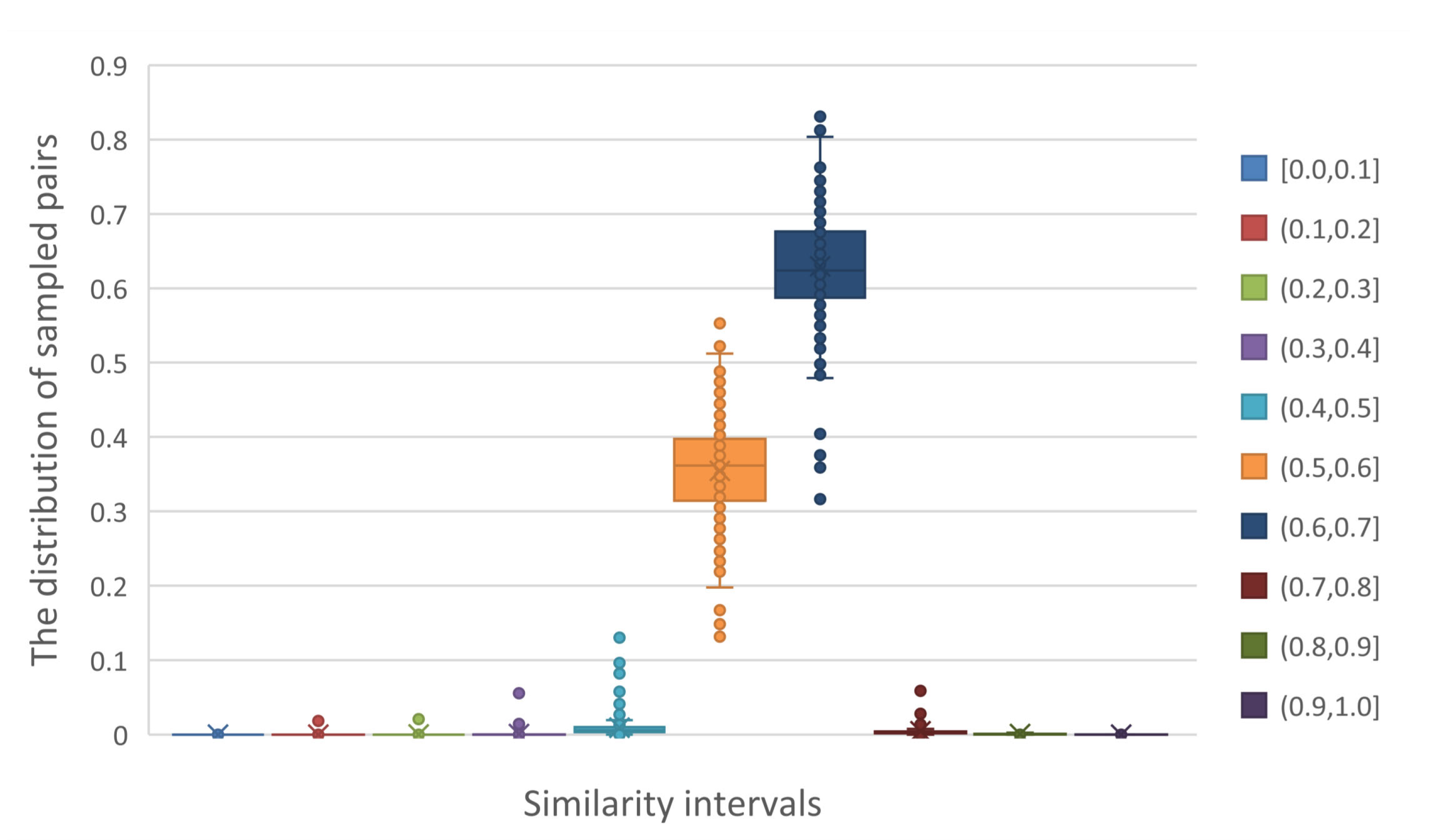
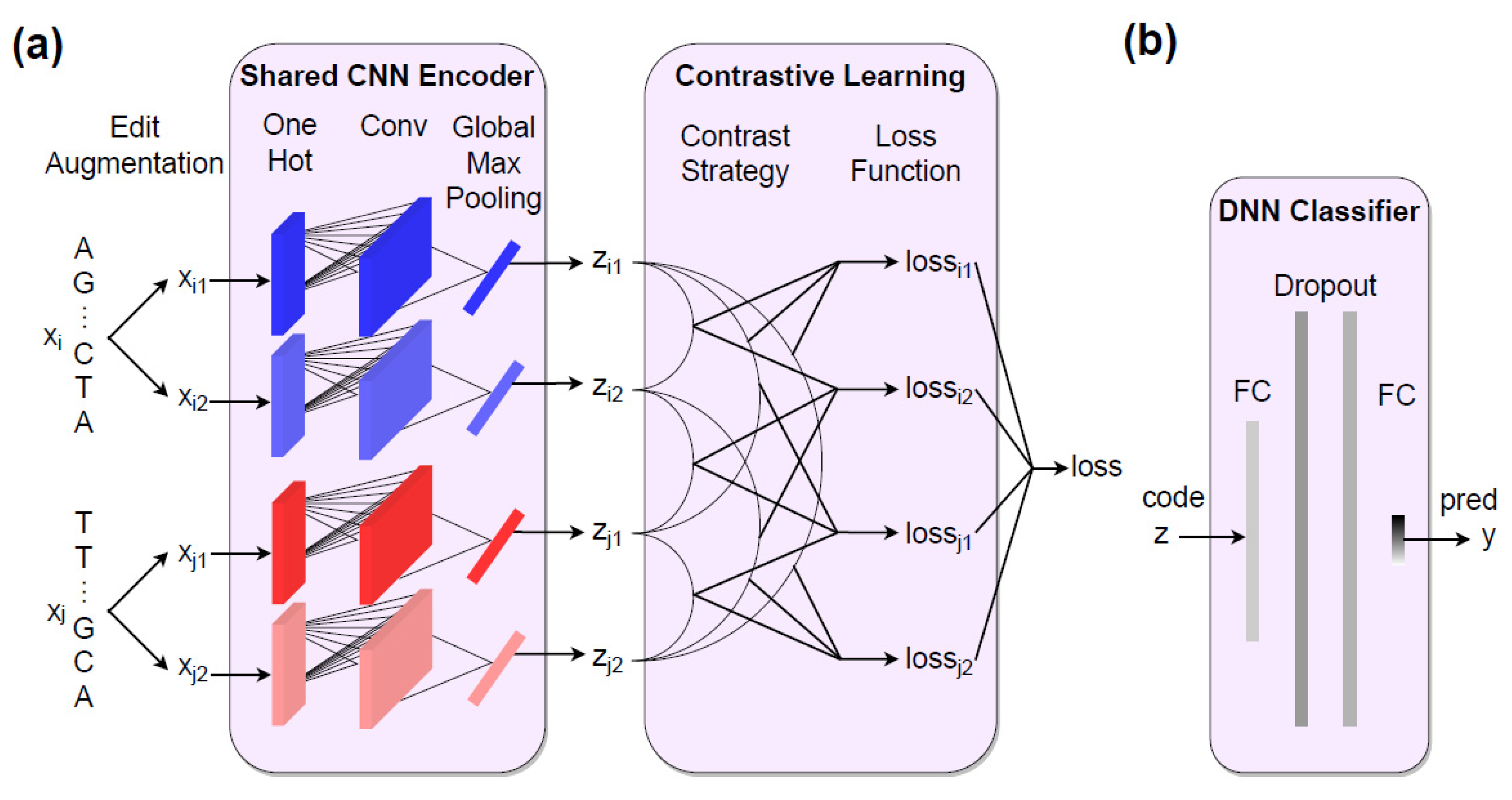
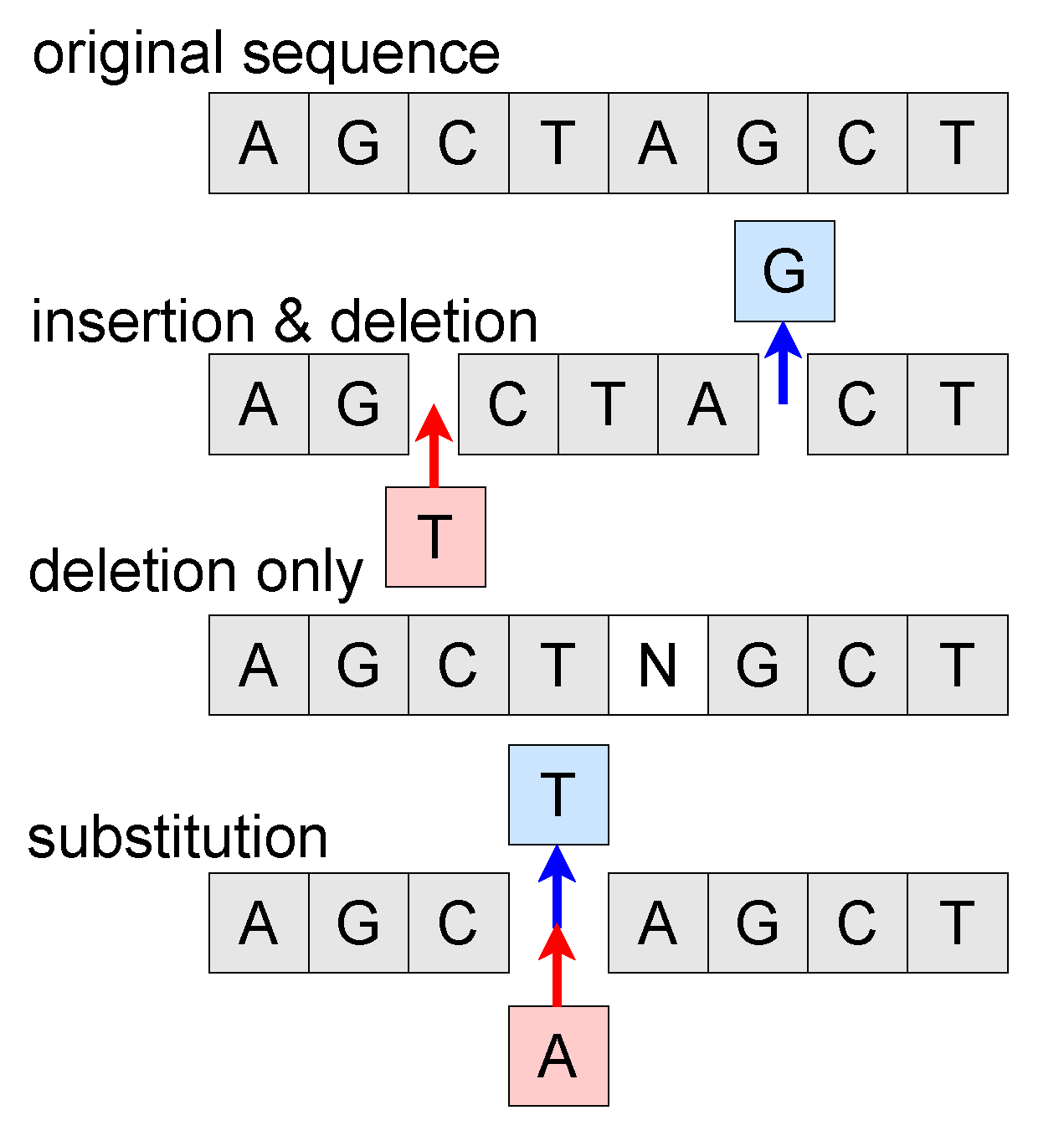
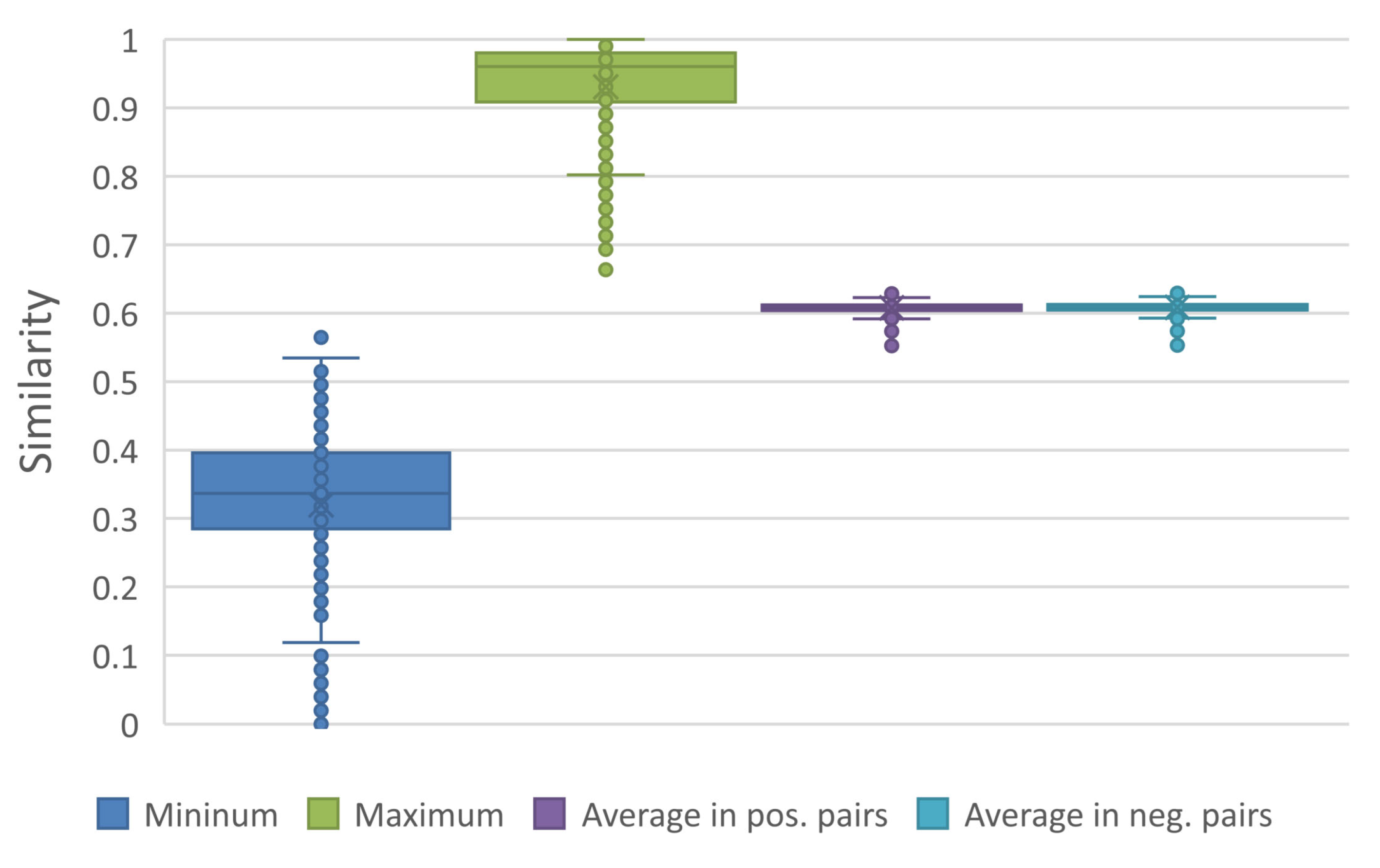
A Contrastive Learning Pre-Training Method for Motif Occupancy Identification

Abstract
1. Introduction
2. Materials and Methods
2.1. Dataset and DNA Sequences
2.2. Model Overview
2.3. The Needleman–Wunsch Algorithm and Sequence Similarity
2.4. Sequence Edit Augmentation
2.5. Self-Supervised Contrastive Learning Based on a Sequence Similarity Criterion
2.6. Supervised Contrastive Learning
2.7. Model Training and Hyper-Parameter Settings
3. Results
3.1. Comparison Experiments and Performance Measure
3.2. Comparison Results
3.3. Analysis of Small Sample Learning
3.4. Self-Supervised Model for Transfer Learning
4. Discussion
5. Conclusions
Author Contributions
Funding
Institutional Review Board Statement
Informed Consent Statement
Data Availability Statement
Conflicts of Interest
References
- Karin, M. Too many transcription factors: Positive and negative interactions. New Biol. 1990, 2, 126–131. [Google Scholar]
- Latchman, D.S. Transcription factors: An overview. Int. J. Biochem. Cell Biol. 1997, 29, 1305–1312. [Google Scholar] [CrossRef] [Scilit]
- Zeng, H.; Edwards, M.D.; Liu, G.; Gifford, D.K. Convolutional neural network architectures for predicting DNA–protein binding. Bioinformatics 2016, 32, i121–i127. [Google Scholar] [CrossRef] [Scilit]
- Ghandi, M.; Lee, D.; Mohammad-Noori, M.; Beer, M.A. Enhanced regulatory sequence prediction using gapped k-mer features. PLoS Comput. Biol. 2014, 10, e1003711. [Google Scholar] [CrossRef] [Scilit] [PubMed]
- Li, W.; Zhao, Q.; Zhang, H.; Quan, X.; Xu, J.; Yin, Y. Bayesian Multi-scale Convolutional Neural Network for Motif Occupancy Identification. In Proceedings of the 2020 IEEE International Conference on Bioinformatics and Biomedicine (BIBM), Seoul, Korea, 16–19 December 2020; pp. 293–298. [Google Scholar]
- Caron, M.; Misra, I.; Mairal, J.; Goyal, P.; Bojanowski, P.; Joulin, A. Unsupervised learning of visual features by contrasting cluster assignments. Adv. Neural Inf. Process. Syst. 2020, 33, 9912–9924. [Google Scholar]
- He, K.; Fan, H.; Wu, Y.; Xie, S.; Girshick, R. Momentum contrast for unsupervised visual representation learning. In Proceedings of the IEEE/CVF Conference on Computer Vision and Pattern Recognition, Seattle, WA, USA, 13–19 June 2020; pp. 9729–9738. [Google Scholar]
- Chen, T.; Kornblith, S.; Norouzi, M.; Hinton, G. A simple framework for contrastive learning of visual representations. In Proceedings of the International Conference on Machine Learning, Virtual, 13–18 July 2020; pp. 1597–1607. [Google Scholar]
- Jaiswal, A.; Babu, A.R.; Zadeh, M.Z.; Banerjee, D.; Makedon, F. A survey on contrastive self-supervised learning. Technologies 2021, 9, 2. [Google Scholar] [CrossRef] [Scilit]
- Chen, X.; Fan, H.; Girshick, R.; He, K. Improved baselines with momentum contrastive learning. arXiv 2020, arXiv:2003.04297. [Google Scholar]
- Khosla, P.; Teterwak, P.; Wang, C.; Sarna, A.; Tian, Y.; Isola, P.; Maschinot, A.; Liu, C.; Krishnan, D. Supervised contrastive learning. Adv. Neural Inf. Process. Syst. 2020, 33, 18661–18673. [Google Scholar]
- Zheng, M.; Wang, F.; You, S.; Qian, C.; Zhang, C.; Wang, X.; Xu, C. Weakly supervised contrastive learning. In Proceedings of the IEEE/CVF International Conference on Computer Vision, Virtual, 11–17 October 2021; pp. 10042–10051. [Google Scholar]
- Zou, J.Y.; Hsu, D.J.; Parkes, D.C.; Adams, R.P. Contrastive learning using spectral methods. Adv. Neural Inf. Process. Syst. 2013, 26, 2238–2246. [Google Scholar]
- Wang, X.; Wang, J.; Zhang, H.; Huang, S.; Yin, Y. HDMC: A novel deep learning-based framework for removing batch effects in single-cell RNA-seq data. Bioinformatics 2022, 38, 1295–1303. [Google Scholar] [CrossRef] [Scilit] [PubMed]
- Ciortan, M.; Defrance, M. Contrastive self-supervised clustering of scRNA-seq data. BMC Bioinform. 2021, 22, 1–27. [Google Scholar] [CrossRef] [Scilit] [PubMed]
- Wan, H.; Chen, L.; Deng, M. scNAME: Neighborhood contrastive clustering with ancillary mask estimation for scRNA-seq data. Bioinformatics 2022, 38, 1575–1583. [Google Scholar] [CrossRef] [Scilit] [PubMed]
- Navarro, G. A guided tour to approximate string matching. ACM Comput. Surv. 2001, 33, 31–88. [Google Scholar] [CrossRef] [Scilit]
- Needleman, S.B.; Wunsch, C.D. A general method applicable to the search for similarities in the amino acid sequence of two proteins. J. Mol. Biol. 1970, 48, 443–453. [Google Scholar] [CrossRef] [Scilit]
- Smith, T.F.; Waterman, M.S. Identification of common molecular subsequences. J. Mol. Biol. 1981, 147, 195–197. [Google Scholar] [CrossRef] [Scilit]
- Casey, R. BLAST Sequences Aid in Genomics and Proteomics. 2005. Available online: http://www.b-eye-network.com/view/1730 (accessed on 2 April 2022).
- Rice, P.; Longden, I.; Bleasby, A. EMBOSS: The European molecular biology open software suite. Trends Genet. 2000, 16, 276–277. [Google Scholar] [CrossRef] [Scilit]
- The ENCODE Project Consortium. An integrated encyclopedia of DNA elements in the human genome. Nature 2012, 489, 57. [Google Scholar] [CrossRef] [Scilit]
- So, K.K.; Peng, X.L.; Sun, H.; Wang, H. Whole genome chromatin IP-sequencing (ChIP-Seq) in skeletal muscle cells. In Skeletal Muscle Development; Springer: Berlin/Heidelberg, Germany, 2017; pp. 15–25. [Google Scholar]
- Harris, D.; Harris, S.L. Digital Design and Computer Architecture; Morgan Kaufmann: San Francisco, CA, USA, 2010. [Google Scholar]
- Zhou, J.; Troyanskaya, O.G. Predicting effects of noncoding variants with deep learning–based sequence model. Nat. Methods 2015, 12, 931–934. [Google Scholar] [CrossRef] [Scilit] [PubMed]
- Alipanahi, B.; Delong, A.; Weirauch, M.T.; Frey, B.J. Predicting the sequence specificities of DNA-and RNA-binding proteins by deep learning. Nat. Biotechnol. 2015, 33, 831–838. [Google Scholar] [CrossRef] [Scilit] [PubMed]
- Srivastava, N.; Hinton, G.; Krizhevsky, A.; Sutskever, I.; Salakhutdinov, R. Dropout: A simple way to prevent neural networks from overfitting. J. Mach. Learn. Res. 2014, 15, 1929–1958. [Google Scholar]
- Shorten, C.; Khoshgoftaar, T.M. A survey on image data augmentation for deep learning. J. Big Data 2019, 6, 60. [Google Scholar] [CrossRef] [Scilit]
- Iwana, B.K.; Uchida, S. An empirical survey of data augmentation for time series classification with neural networks. PLoS ONE 2021, 16, e0254841. [Google Scholar] [CrossRef] [Scilit] [PubMed]
- Kingma, D.P.; Ba, J. Adam: A method for stochastic optimization. arXiv 2014, arXiv:1412.6980. [Google Scholar]
- Shannon, C.E. A mathematical theory of communication. ACM Sigmobile Mob. Comput. Commun. Rev. 2001, 5, 3–55. [Google Scholar] [CrossRef] [Scilit]
- Sasaki, Y. The Truth of the F-Measure. 2007. Available online: http://www.cs.odu.edu/~mukka/cs795sum09dm/Lecturenotes/Day3/F-measure-YS-26Oct07.pdf (accessed on 2 April 2022).
- Fawcett, T. An introduction to ROC analysis. Pattern Recognit. Lett. 2006, 27, 861–874. [Google Scholar] [CrossRef] [Scilit]
- Wang, F.; Zhu, L.; Li, J.; Chen, H.; Zhang, H. Unsupervised soft-label feature selection. Knowl.-Based Syst. 2021, 219, 106847. [Google Scholar] [CrossRef] [Scilit]
- Algan, G.; Ulusoy, I. Meta soft label generation for noisy labels. In Proceedings of the 2020 25th International Conference on Pattern Recognition (ICPR), Milan, Italy, 10–15 January 2021; pp. 7142–7148. [Google Scholar] [CrossRef] [Scilit]
- Bragança, L.S.M.; Souza, A.D.; Braga, R.A.S.; Suriani, M.A.M.; Dias, R.M.C. Sequence Alignment Algorithms in Hardware Implementation: A Systematic Mapping of the Literature. In ITNG 2021 18th International Conference on Information Technology-New Generations; Latifi, S., Ed.; Springer International Publishing: Cham, Switzerland, 2021; pp. 307–312. [Google Scholar]
- Rashed, A.E.E.D.; Obaya, M.; Moustafa, H.E.D. Accelerating DNA pairwise sequence alignment using FPGA and a customized convolutional neural network. Comput. Electr. Eng. 2021, 92, 107112. [Google Scholar] [CrossRef] [Scilit]
- Mondal, P.; Basuli, K. OAIPM: Optimal Algorithm to Identify Point Mutation Between DNA Sequences. In Proceedings of the International Conference on Advanced Computing Applications, Lisbon, Portugal, 20–21 September 2022; Springer: Singapore, 2022; pp. 393–401. [Google Scholar]


| Type | Symbol | Meaning |
|---|---|---|
| Variables | input sequences | |
| classification labels of input sequences | ||
| p-th character of | ||
| augmented sequences of | ||
| encodes features of augmented sequences | ||
| constant temperature hyper-parameter | ||
| zoom ratio hyper-parameter of learning rate | ||
| total self-supervised contrastive loss | ||
| total supervised contrastive loss | ||
| sample self-supervised loss of | ||
| sample supervised loss of | ||
| Sets | I | full augmented sample set |
| augmented sample set excluding | ||
| positive sample set of | ||
| negative sample set of | ||
| Functions | Needleman–Wunsch score between first p characters of | |
| and first q characters of | ||
| character matching score between characters and | ||
| similarity score between sequences and | ||
| cosine similarity score between features and | ||
| self-supervised similarity label between sequences and | ||
| supervised similarity label between sequences and |
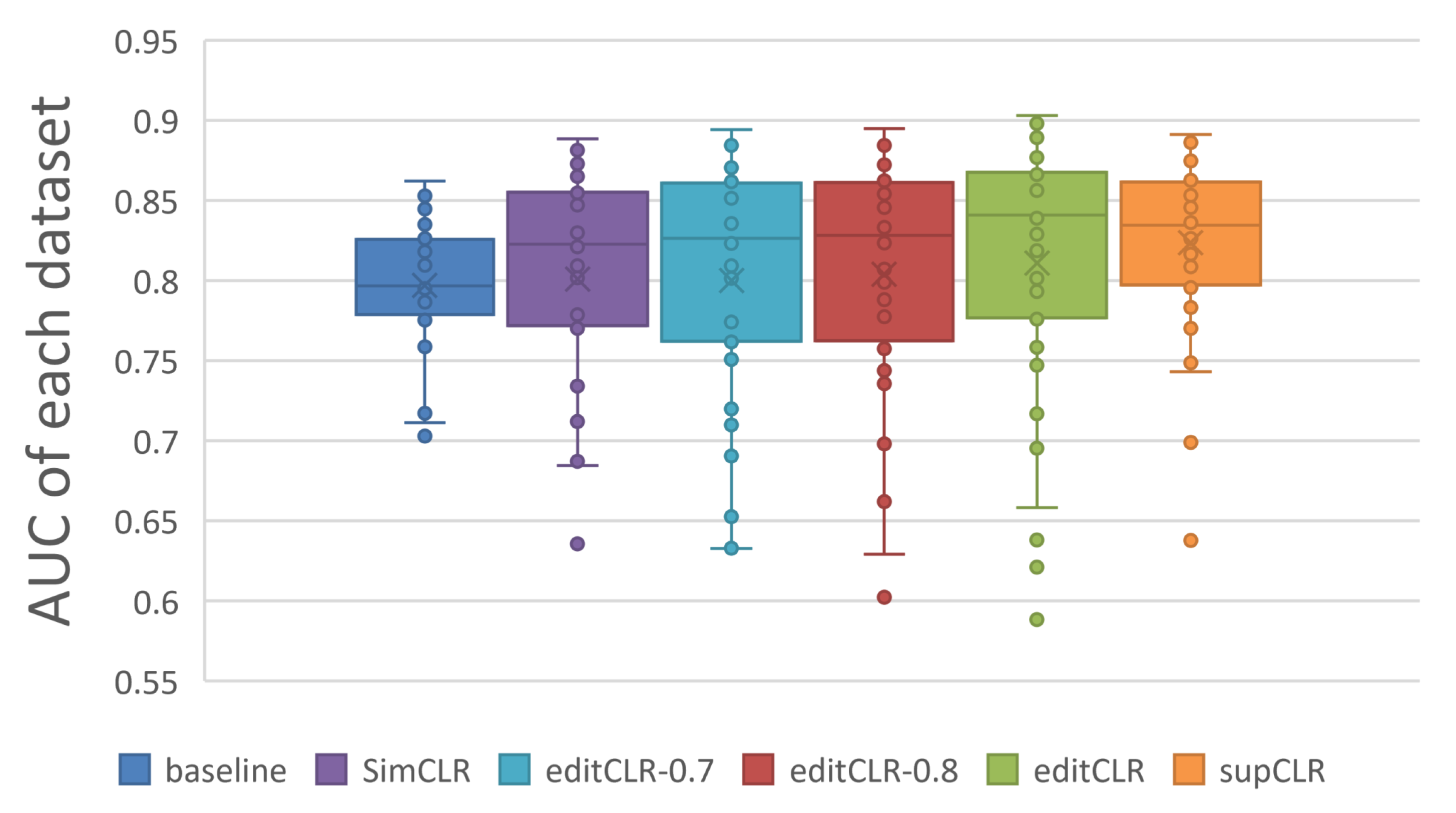
| Method | Accuracy | Score | Precision | Recall | AUC |
|---|---|---|---|---|---|
| baseline | 0.716 | 0.702 | 0.738 | 0.675 | 0.797 |
| simCLR | 0.719 | 0.721 | 0.761 | 0.689 | 0.801 |
| editCLR-0.7 | 0.720 | 0.721 | 0.760 | 0.692 | 0.800 |
| editCLR-0.8 | 0.720 | 0.722 | 0.760 | 0.690 | 0.804 |
| editCLR | 0.723 | 0.725 | 0.762 | 0.694 | 0.811 |
| supCLR | 0.734 | 0.734 | 0.784 | 0.691 | 0.823 |
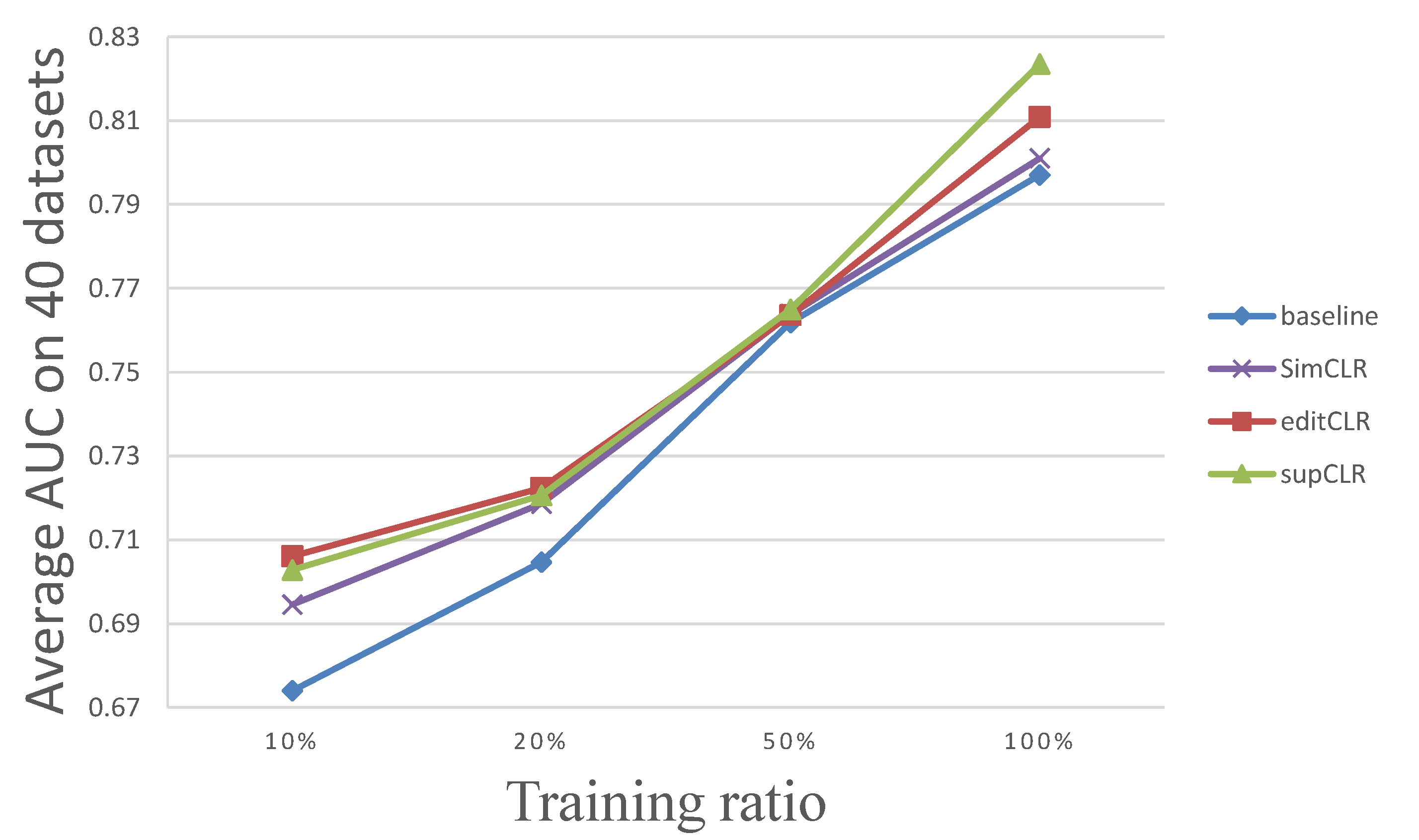
| Method | Training Ratio | Accuracy | Score | AUC |
|---|---|---|---|---|
| baseline | 50% | 0.688 | 0.683 | 0.762 |
| SimCLR | 0.690 | 0.697 | 0.764 | |
| editCLR | 0.693 | 0.700 | 0.764 | |
| supCLR | 0.700 | 0.698 | 0.765 | |
| baseline | 20% | 0.636 | 0.632 | 0.705 |
| SimCLR | 0.653 | 0.659 | 0.719 | |
| editCLR | 0.657 | 0.664 | 0.722 | |
| supCLR | 0.658 | 0.656 | 0.721 | |
| baseline | 10% | 0.629 | 0.607 | 0.674 |
| SimCLR | 0.636 | 0.646 | 0.695 | |
| editCLR | 0.640 | 0.650 | 0.706 | |
| supCLR | 0.639 | 0.645 | 0.703 |
| Architecture | Model | Accuracy | Score | AUC |
|---|---|---|---|---|
| 1layer64motif | baseline | 0.717 | 0.707 | 0.794 |
| editCLR#1 | 0.693 | 0.718 | 0.768 | |
| editCLR#2 | 0.720 | 0.715 | 0.807 | |
| editCLR#3 | 0.715 | 0.729 | 0.792 | |
| editCLR#4 | 0.715 | 0.711 | 0.806 | |
| 1layer128motif | baseline | 0.723 | 0.712 | 0.805 |
| editCLR#5 | 0.725 | 0.727 | 0.811 | |
| editCLR#6 | 0.726 | 0.715 | 0.804 | |
| editCLR#7 | 0.718 | 0.709 | 0.800 | |
| editCLR#8 | 0.721 | 0.716 | 0.808 |
Publisher’s Note: MDPI stays neutral with regard to jurisdictional claims in published maps and institutional affiliations. |
© 2022 by the authors. Licensee MDPI, Basel, Switzerland. This article is an open access article distributed under the terms and conditions of the Creative Commons Attribution (CC BY) license (https://creativecommons.org/licenses/by/4.0/).
Share and Cite
Lin, K.; Quan, X.; Yin, W.; Zhang, H. A Contrastive Learning Pre-Training Method for Motif Occupancy Identification. Int. J. Mol. Sci. 2022, 23, 4699. https://doi.org/10.3390/ijms23094699
Lin K, Quan X, Yin W, Zhang H. A Contrastive Learning Pre-Training Method for Motif Occupancy Identification. International Journal of Molecular Sciences. 2022; 23(9):4699. https://doi.org/10.3390/ijms23094699
Chicago/Turabian StyleLin, Ken, Xiongwen Quan, Wenya Yin, and Han Zhang. 2022. "A Contrastive Learning Pre-Training Method for Motif Occupancy Identification" International Journal of Molecular Sciences 23, no. 9: 4699. https://doi.org/10.3390/ijms23094699
APA StyleLin, K., Quan, X., Yin, W., & Zhang, H. (2022). A Contrastive Learning Pre-Training Method for Motif Occupancy Identification. International Journal of Molecular Sciences, 23(9), 4699. https://doi.org/10.3390/ijms23094699