Article

Pan-Cancer Prediction of Cell-Line Drug Sensitivity Using Network-Based Methods
by
Maryam Pouryahya
1,†,
Jung Hun Oh
1,*,†,
James C. Mathews
1,
Zehor Belkhatir
2,
Caroline Moosmüller
3,
Joseph O. Deasy
1,‡ and
Allen R. Tannenbaum
4,‡
1
Department of Medical Physics, Memorial Sloan Kettering Cancer Center, New York, NY 10065, USA
2
School of Engineering and Sustainable Development, De Montfort University, Leicester LE1 9BH, UK
3
Department of Mathematics, University of California at San Diego, La Jolla, CA 92093, USA
4
Departments of Computer Science and Applied Mathematics & Statistics, Stony Brook University, Stony Brook, NY 11794, USA
*
Author to whom correspondence should be addressed.
These authors contributed equally to this work.
These authors share the senior authorship.
Int. J. Mol. Sci. 2022, 23(3), 1074; https://doi.org/10.3390/ijms23031074
Submission received: 10 December 2021 / Revised: 15 January 2022 / Accepted: 17 January 2022 / Published: 19 January 2022
(This article belongs to the Special Issue Deep Learning and Machine Learning in Bioinformatics)

Abstract

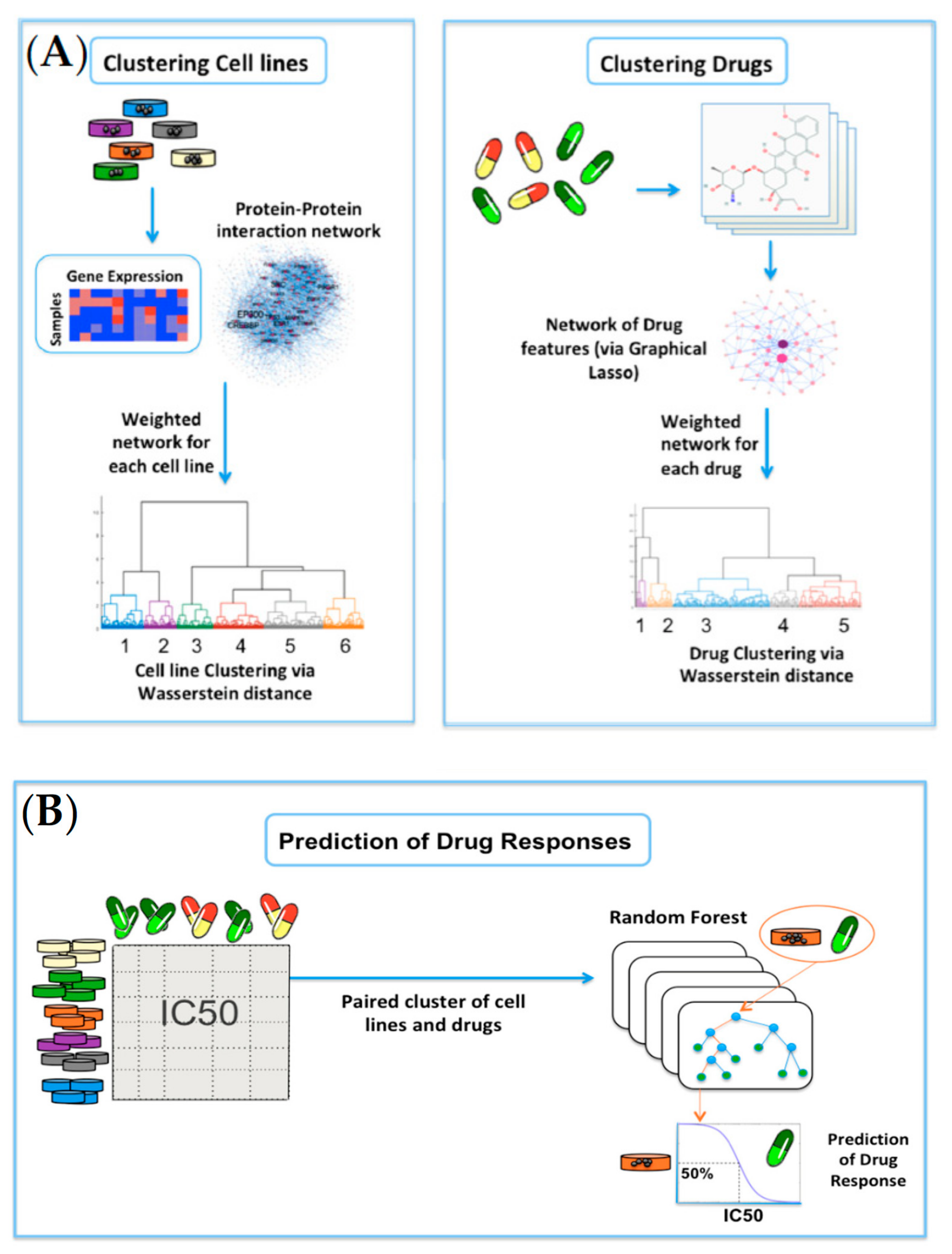
The development of reliable predictive models for individual cancer cell lines to identify an optimal cancer drug is a crucial step to accelerate personalized medicine, but vast differences in cancer cell lines and drug characteristics make it quite challenging to develop predictive models that result in high predictive power and explain the similarity of cell lines or drugs. Our study proposes a novel network-based methodology that breaks the problem into smaller, more interpretable problems to improve the predictive power of anti-cancer drug responses in cell lines. For the drug-sensitivity study, we used the GDSC database for 915 cell lines and 200 drugs. The theory of optimal mass transport was first used to separately cluster cell lines and drugs, using gene-expression profiles and extensive cheminformatic drug features, represented in a form of data networks. To predict cell-line specific drug responses, random forest regression modeling was separately performed for each cell-line drug cluster pair. Post-modeling biological analysis was further performed to identify potential biological correlates associated with drug responses. The network-based clustering method resulted in 30 distinct cell-line drug cluster pairs. Predictive modeling on each cell-line-drug cluster outperformed alternative computational methods in predicting drug responses. We found that among the four drugs top-ranked with respect to prediction performance, three targeted the PI3K/mTOR signaling pathway. Predictive modeling on clustered subsets of cell lines and drugs improved the prediction accuracy of cell-line specific drug responses. Post-modeling analysis identified plausible biological processes associated with drug responses.
Keywords: drug sensitivity; optimal mass transport; network-based clustering; cell lines drug sensitivity; optimal mass transport; network-based clustering; cell lines