Review

Plasticity towards Rigidity: A Macrophage Conundrum in Pulmonary Fibrosis

1
Department of Medicine, Division of Pulmonary, Allergy & Critical Care Medicine, University of Alabama at Birmingham, Birmingham, AL 35294, USA
2
Department of Pathology, Division of Cellular and Molecular Pathology, University of Alabama at Birmingham, Birmingham, AL 35294, USA
*
Author to whom correspondence should be addressed.
Int. J. Mol. Sci. 2022, 23(19), 11443; https://doi.org/10.3390/ijms231911443
Submission received: 1 September 2022 / Revised: 21 September 2022 / Accepted: 23 September 2022 / Published: 28 September 2022
(This article belongs to the Special Issue Macrophages in Respiratory Diseases)

Abstract

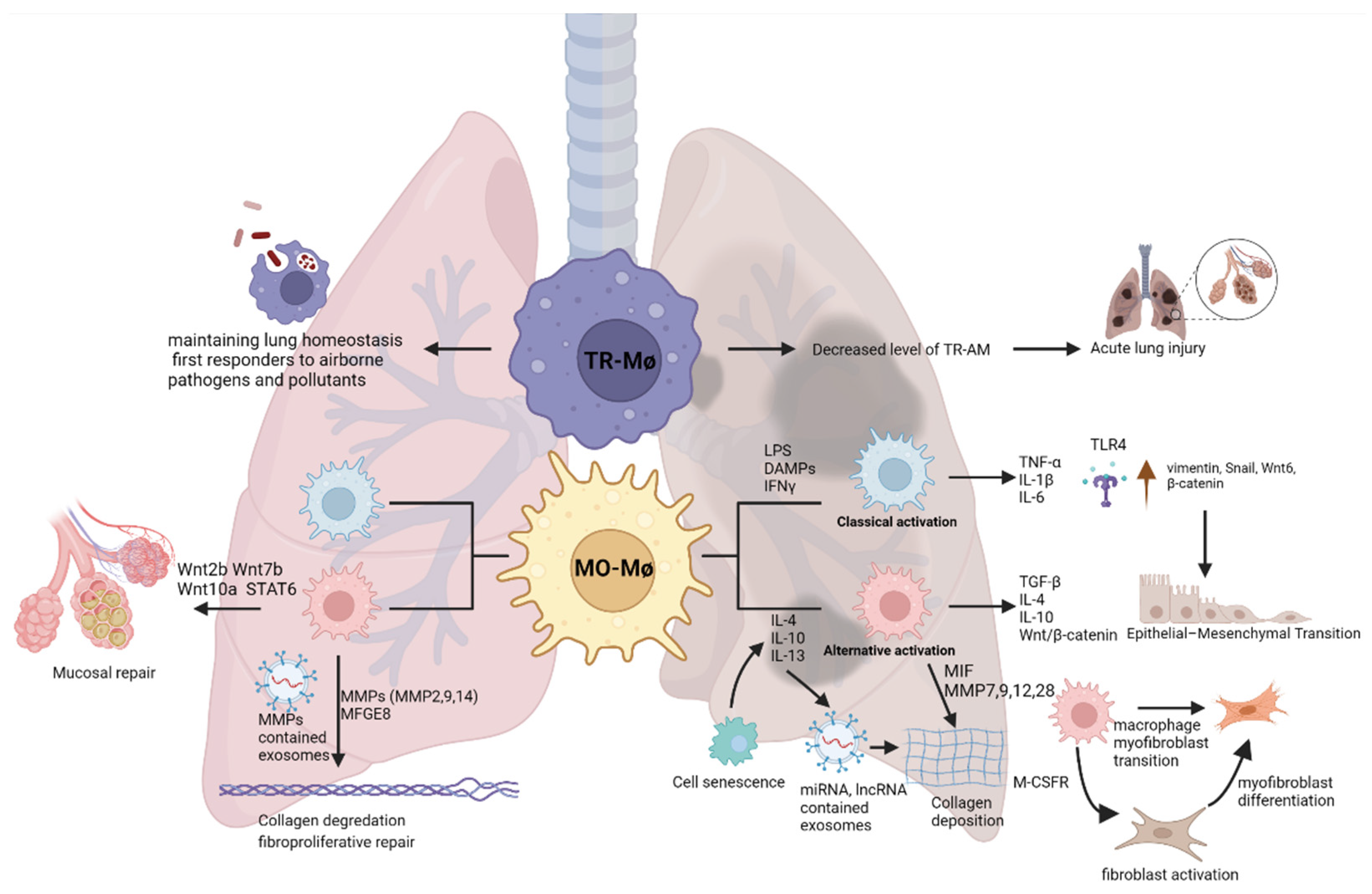
Idiopathic pulmonary fibrosis (IPF) is a progressive, chronic, and ultimately fatal diffuse parenchymal lung disease. The molecular mechanisms of fibrosis in IPF patients are not fully understood and there is a lack of effective treatments. For decades, different types of drugs such as immunosuppressants and antioxidants have been tested, usually with unsuccessful results. Although two antifibrotic drugs (Nintedanib and Pirfenidone) are approved and used for the treatment of IPF, side effects are common, and they only slow down disease progression without improving patients’ survival. Macrophages are central to lung homeostasis, wound healing, and injury. Depending on the stimulus in the microenvironment, macrophages may contribute to fibrosis, but also, they may play a role in the amelioration of fibrosis. In this review, we explore the role of macrophages in IPF in relation to the fibrotic processes, epithelial–mesenchymal transition (EMT), and their crosstalk with resident and recruited cells and we emphasized the importance of macrophages in finding new treatments.
Keywords: idiopathic pulmonary fibrosis; activated macrophages; fibrotic macrophages; EMT idiopathic pulmonary fibrosis; activated macrophages; fibrotic macrophages; EMT