In Silico Study of Cell Surface Structures of Parabacteroides distasonis Involved in Its Maintenance within the Gut Microbiota

Abstract
1. Introduction
2. Results
2.1. P. distasonis Genomes Characterization
2.2. Identification of P. distasonis Genes Potentially Involved in Capsule, Fimbriae-like and Pilus-like Synthesis
2.2.1. P. distasonis Gene Cluster Potentially Involved in Capsule Synthesis
2.2.2. P. distasonis Gene Cluster Potentially Involved in Fimbriae-like Synthesis
2.2.3. P. distasonis Gene Cluster Potentially Involved in Pili-like Synthesis
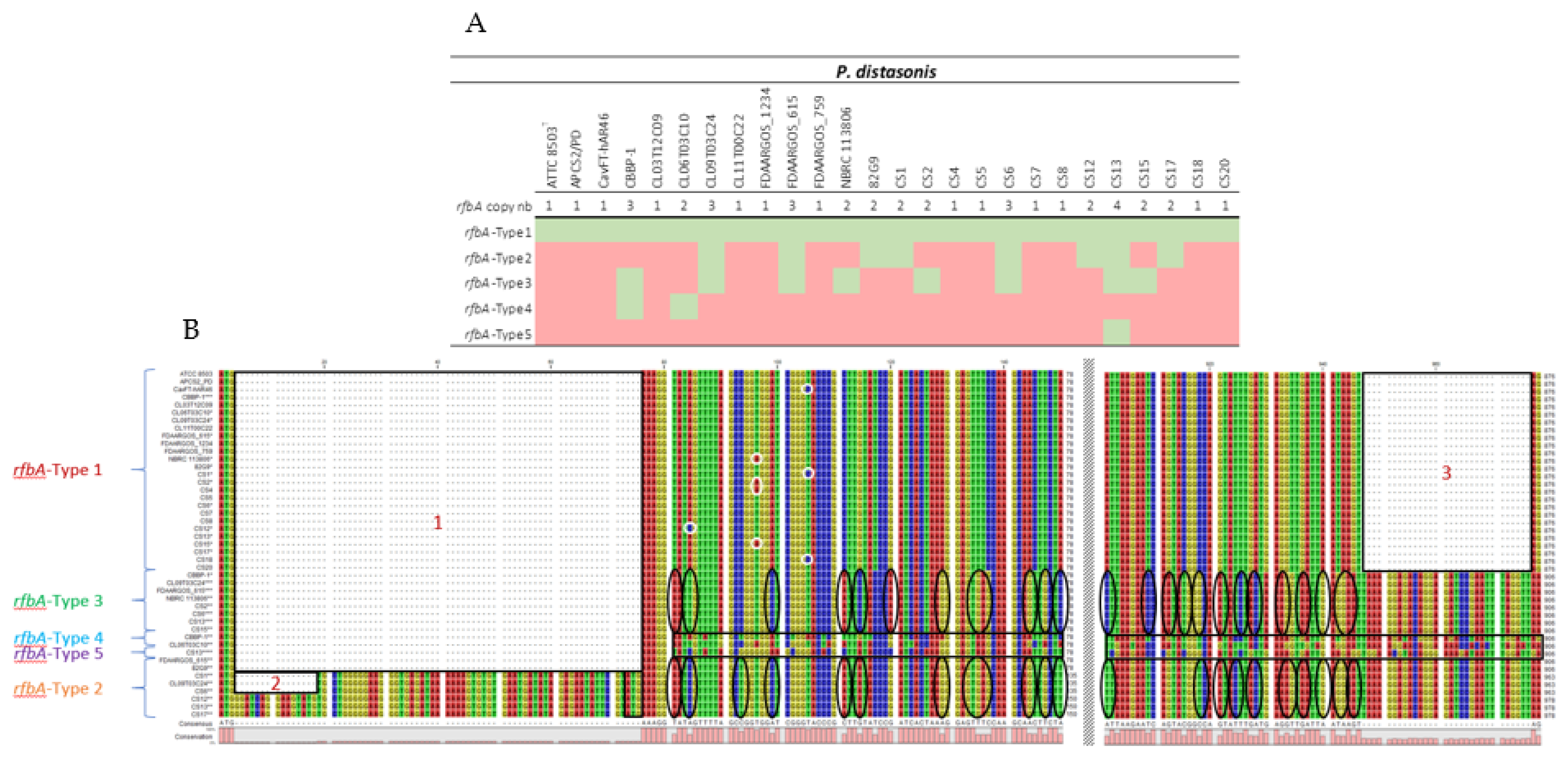
2.3. rfbA Classification and Investigation
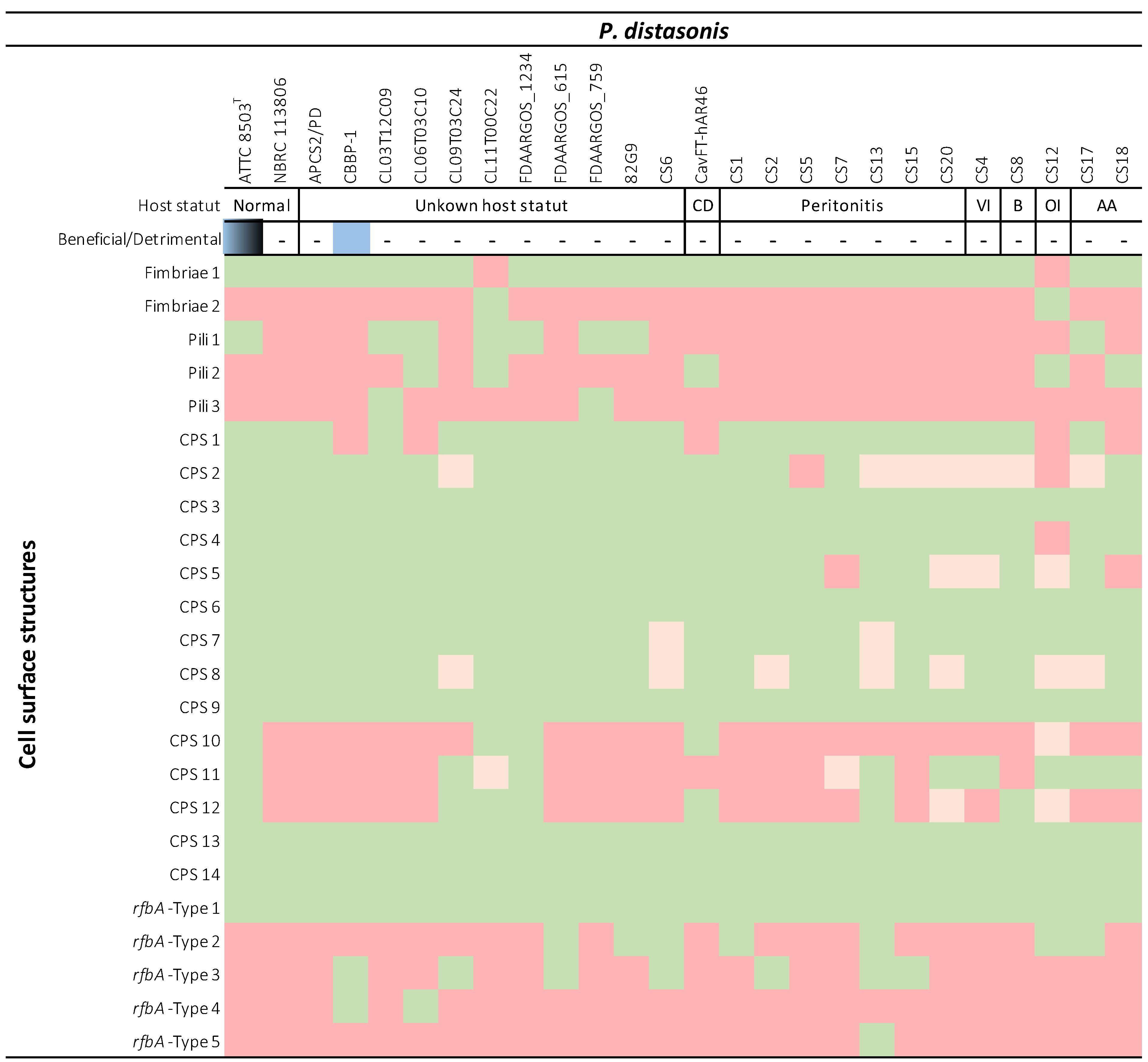
2.4. Implication of P. distasonis Cell Surface Structures in Its Potential Pathogenicity
3. Discussion
4. Materials and Methods
4.1. Whole-Genome Sequencing
4.2. Genome Data Used
4.3. Pan and Core-Genome Analysis
4.4. Phylogenetic Analysis
4.5. Comparative Genome Analysis
4.6. rfbA-Type Determination and Analysis
Supplementary Materials
Author Contributions
Funding
Institutional Review Board Statement
Informed Consent Statement
Data Availability Statement
Conflicts of Interest
References
- O’Hara, A.M.; Shanahan, F. The Gut Flora as a Forgotten Organ. EMBO Rep. 2006, 7, 688–693. [Google Scholar] [CrossRef] [Scilit] [PubMed]
- Anwar, H.; Irfan, S.; Hussain, G.; Naeem Faisal, M.; Muzaffar, H.; Mustafa, I.; Mukhtar, I.; Malik, S.; Irfan Ullah, M. Gut Microbiome: A New Organ System in Body. In Parasitology and Microbiology Research; Antonio Bastidas Pacheco, G., Ali Kamboh, A., Eds.; IntechOpen: Rijeka, Croatia, 2020; ISBN 978-1-78985-901-0. [Google Scholar]
- Wang, H.-X.; Wang, Y.-P. Gut Microbiota-Brain Axis. Chin. Med. J. 2016, 129, 2373–2380. [Google Scholar] [CrossRef] [Scilit] [PubMed]
- Talham, G.L.; Jiang, H.-Q.; Bos, N.A.; Cebra, J.J. Segmented Filamentous Bacteria Are Potent Stimuli of a Physiologically Normal State of the Murine Gut Mucosal Immune System. Infect. Immun. 1999, 67, 1992–2000. [Google Scholar] [CrossRef] [PubMed]
- Jandhyala, S.M. Role of the Normal Gut Microbiota. WJG 2015, 21, 8787. [Google Scholar] [CrossRef] [Scilit] [PubMed]
- Lynch, J.B.; Hsiao, E.Y. Microbiomes as Sources of Emergent Host Phenotypes. Science 2019, 365, 1405–1409. [Google Scholar] [CrossRef] [Scilit] [PubMed]
- Morais, L.H.; Schreiber, H.L.; Mazmanian, S.K. The Gut Microbiota–Brain Axis in Behaviour and Brain Disorders. Nat. Rev. Microbiol. 2021, 19, 241–255. [Google Scholar] [CrossRef] [Scilit]
- Nie, L.; Cai, S.-Y.; Shao, J.-Z.; Chen, J. Toll-Like Receptors, Associated Biological Roles, and Signaling Networks in Non-Mammals. Front. Immunol. 2018, 9, 1523. [Google Scholar] [CrossRef] [Scilit]
- Tytgat, H.L.P.; Van Teijlingen, N.H.; Sullan, R.M.A.; Douillard, F.P.; Rasinkangas, P.; Messing, M.; Reunanen, J.; Satokari, R.; Vanderleyden, J.; Dufrêne, Y.F.; et al. Probiotic Gut Microbiota Isolate Interacts with Dendritic Cells via Glycosylated Heterotrimeric Pili. PLoS ONE 2016, 11, e0151824. [Google Scholar] [CrossRef] [Scilit]
- Ligthart, K.; Belzer, C.; De Vos, W.M.; Tytgat, H.L.P. Bridging Bacteria and the Gut: Functional Aspects of Type IV Pili. Trends Microbiol. 2020, 28, 340–348. [Google Scholar] [CrossRef] [Scilit]
- Patrick, S.; Blakely, G.W.; Houston, S.; Moore, J.; Abratt, V.R.; Bertalan, M.; Cerdeño-Tárraga, A.M.; Quail, M.A.; Corton, N.; Corton, C.; et al. Twenty-Eight Divergent Polysaccharide Loci Specifying within- and amongst-Strain Capsule Diversity in Three Strains of Bacteroides Fragilis. Microbiology 2010, 156, 3255–3269. [Google Scholar] [CrossRef] [Scilit]
- Nagano, K.; Hasegawa, Y.; Abiko, Y.; Yoshida, Y.; Murakami, Y.; Yoshimura, F. Porphyromonas Gingivalis FimA Fimbriae: Fimbrial Assembly by FimA Alone in the Fim Gene Cluster and Differential Antigenicity among FimA Genotypes. PLoS ONE 2012, 7, e43722. [Google Scholar] [CrossRef] [Scilit]
- Mihajlovic, J.; Bechon, N.; Ivanova, C.; Chain, F.; Almeida, A.; Langella, P.; Beloin, C.; Ghigo, J.-M. A Putative Type V Pilus Contributes to Bacteroides Thetaiotaomicron Biofilm Formation Capacity. J. Bacteriol. 2019, 201, e00650-18. [Google Scholar] [CrossRef] [Scilit]
- Hasegawa, Y.; Iwami, J.; Sato, K.; Park, Y.; Nishikawa, K.; Atsumi, T.; Moriguchi, K.; Murakami, Y.; Lamont, R.J.; Nakamura, H.; et al. Anchoring and Length Regulation of Porphyromonas Gingivalis Mfa1 Fimbriae by the Downstream Gene Product Mfa2. Microbiology 2009, 155, 3333–3347. [Google Scholar] [CrossRef] [Scilit]
- Hasegawa, Y.; Nagano, K. Porphyromonas Gingivalis FimA and Mfa1 Fimbriae: Current Insights on Localization, Function, Biogenesis, and Genotype. Jpn. Dent. Sci. Rev. 2021, 57, 190–200. [Google Scholar] [CrossRef] [Scilit]
- Koh, G.Y.; Kane, A.V.; Wu, X.; Crott, J.W. Parabacteroides Distasonis Attenuates Tumorigenesis, Modulates Inflammatory Markers and Promotes Intestinal Barrier Integrity in Azoxymethane-Treated A/J Mice. Carcinogenesis 2020, 41, 909–917. [Google Scholar] [CrossRef] [Scilit]
- Wang, K.; Liao, M.; Zhou, N.; Bao, L.; Ma, K.; Zheng, Z.; Wang, Y.; Liu, C.; Wang, W.; Wang, J.; et al. Parabacteroides Distasonis Alleviates Obesity and Metabolic Dysfunctions via Production of Succinate and Secondary Bile Acids. Cell Rep. 2019, 26, 222–235.e5. [Google Scholar] [CrossRef] [Scilit]
- Li, M.; Wang, S.; Li, Y.; Zhao, M.; Kuang, J.; Liang, D.; Wang, J.; Wei, M.; Rajani, C.; Ma, X.; et al. Gut Microbiota-Bile Acid Crosstalk Contributes to the Rebound Weight Gain after Calorie Restriction in Mice. Nat. Commun. 2022, 13, 2060. [Google Scholar] [CrossRef] [Scilit] [PubMed]
- Pfalzer, A.C.; Nesbeth, P.-D.C.; Parnell, L.D.; Iyer, L.K.; Liu, Z.; Kane, A.V.; Chen, C.-Y.O.; Tai, A.K.; Bowman, T.A.; Obin, M.S.; et al. Diet- and Genetically-Induced Obesity Differentially Affect the Fecal Microbiome and Metabolome in Apc1638N Mice. PLoS ONE 2015, 10, e0135758. [Google Scholar] [CrossRef] [Scilit] [PubMed]
- Koh, G.Y.; Kane, A.; Lee, K.; Xu, Q.; Wu, X.; Roper, J.; Mason, J.B.; Crott, J.W. Parabacteroides Distasonis Attenuates Toll-like Receptor 4 Signaling and Akt Activation and Blocks Colon Tumor Formation in High-fat Diet-fed Azoxymethane-treated Mice. Int. J. Cancer 2018, 143, 1797–1805. [Google Scholar] [CrossRef] [Scilit] [PubMed]
- Kverka, M.; Zakostelska, Z.; Klimesova, K.; Sokol, D.; Hudcovic, T.; Hrncir, T.; Rossmann, P.; Mrazek, J.; Kopecny, J.; Verdu, E.F.; et al. Oral Administration of Parabacteroides Distasonis Antigens Attenuates Experimental Murine Colitis through Modulation of Immunity and Microbiota Composition. Clin. Exp. Immunol. 2011, 163, 250–259. [Google Scholar] [CrossRef] [Scilit] [PubMed]
- Cuffaro, B.; Assohoun, A.L.W.; Boutillier, D.; Súkeníková, L.; Desramaut, J.; Boudebbouze, S.; Salomé-Desnoulez, S.; Hrdý, J.; Waligora-Dupriet, A.-J.; Maguin, E.; et al. In Vitro Characterization of Gut Microbiota-Derived Commensal Strains: Selection of Parabacteroides Distasonis Strains Alleviating TNBS-Induced Colitis in Mice. Cells 2020, 9, 2104. [Google Scholar] [CrossRef] [Scilit]
- Cuffaro, B.; Assohoun, A.L.W.; Boutillier, D.; Peucelle, V.; Desramaut, J.; Boudebbouze, S.; Croyal, M.; Waligora-Dupriet, A.-J.; Rhimi, M.; Grangette, C.; et al. Identification of New Potential Biotherapeutics from Human Gut Microbiota-Derived Bacteria. Microorganisms 2021, 9, 565. [Google Scholar] [CrossRef] [Scilit]
- Hiippala, K.; Kainulainen, V.; Suutarinen, M.; Heini, T.; Bowers, J.R.; Jasso-Selles, D.; Lemmer, D.; Valentine, M.; Barnes, R.; Engelthaler, D.M.; et al. Isolation of Anti-Inflammatory and Epithelium Reinforcing Bacteroides and Parabacteroides Spp. from A Healthy Fecal Donor. Nutrients 2020, 12, 935. [Google Scholar] [CrossRef] [Scilit]
- Chamarande, J.; Cunat, L.; Caillet, C.; Mathieu, L.; Duval, J.F.L.; Lozniewski, A.; Frippiat, J.-P.; Alauzet, C.; Cailliez-Grimal, C. Surface Properties of Parabacteroides Distasonis and Impacts of Stress-Induced Molecules on Its Surface Adhesion and Biofilm Formation Capacities. Microorganisms 2021, 9, 1602. [Google Scholar] [CrossRef] [Scilit]
- Dziarski, R.; Park, S.Y.; Kashyap, D.R.; Dowd, S.E.; Gupta, D. Pglyrp-Regulated Gut Microflora Prevotella Falsenii, Parabacteroides Distasonis and Bacteroides Eggerthii Enhance and Alistipes Finegoldii Attenuates Colitis in Mice. PLoS ONE 2016, 11, e0146162. [Google Scholar] [CrossRef] [Scilit]
- Blacher, E.; Bashiardes, S.; Shapiro, H.; Rothschild, D.; Mor, U.; Dori-Bachash, M.; Kleimeyer, C.; Moresi, C.; Harnik, Y.; Zur, M.; et al. Potential Roles of Gut Microbiome and Metabolites in Modulating ALS in Mice. Nature 2019, 572, 474–480. [Google Scholar] [CrossRef] [Scilit]
- Moreno-Arrones, O.M.; Serrano-Villar, S.; Perez-Brocal, V.; Saceda-Corralo, D.; Morales-Raya, C.; Rodrigues-Barata, R.; Moya, A.; Jaen-Olasolo, P.; Vano-Galvan, S. Analysis of the Gut Microbiota in Alopecia Areata: Identification of Bacterial Biomarkers. J. Eur. Acad. Derm. Venereol. 2020, 34, 400–405. [Google Scholar] [CrossRef] [Scilit]
- Zhou, C.; Zhao, H.; Xiao, X.; Chen, B.; Guo, R.; Wang, Q.; Chen, H.; Zhao, L.; Zhang, C.; Jiao, Y.; et al. Metagenomic Profiling of the Pro-Inflammatory Gut Microbiota in Ankylosing Spondylitis. J. Autoimmun. 2020, 107, 102360. [Google Scholar] [CrossRef] [Scilit]
- Bank, N.C.; Singh, V.; Rodriguez-Palacios, A. Classification of Parabacteroides Distasonis and Other Bacteroidetes Using O- Antigen Virulence Gene: RfbA -Typing and Hypothesis for Pathogenic vs. Probiotic Strain Differentiation. Gut Microbes 2022, 14, 1997293. [Google Scholar] [CrossRef] [Scilit]
- Hamada, N.; Sojar, H.T.; Cho, M.I.; Genco, R.J. Isolation and Characterization of a Minor Fimbria from Porphyromonas Gingivalis. Infect. Immun. 1996, 64, 4788–4794. [Google Scholar] [CrossRef] [Scilit]
- Lamont, R.J.; El-Sabaeny, A.; Park, Y.; Cook, G.S.; Costerton, J.W.; Demuth, D.R. Role of the Streptococcus Gordonii SspB Protein in the Development of Porphyromonas Gingivalis Biofilms on Streptococcal Substrates. Microbiology 2002, 148, 1627–1636. [Google Scholar] [CrossRef] [Scilit]
- Nagano, K.; Hasegawa, Y.; Yoshida, Y.; Yoshimura, F. A Major Fimbrilin Variant of Mfa1 Fimbriae in Porphyromonas Gingivalis. J. Dent. Res. 2015, 94, 1143–1148. [Google Scholar] [CrossRef] [Scilit]
- Eggerth, A.H.; Gagnon, B.H. The Bacteroides of Human Feces. J. Bacteriol. 1933, 25, 389–413. [Google Scholar] [CrossRef] [Scilit]
- Yang, F.; Kumar, A.; Davenport, K.W.; Kelliher, J.M.; Ezeji, J.C.; Good, C.E.; Jacobs, M.R.; Conger, M.; West, G.; Fiocchi, C.; et al. Complete Genome Sequence of a Parabacteroides Distasonis Strain (CavFT HAR46) Isolated from a Gut Wall-Cavitating Microlesion in a Patient with Severe Crohn’s Disease. Microbiol. Resour. Announc. 2019, 8, e00585-19. [Google Scholar] [CrossRef] [Scilit]
- Caballero, S.; Kim, S.; Carter, R.A.; Leiner, I.M.; Sušac, B.; Miller, L.; Kim, G.J.; Ling, L.; Pamer, E.G. Cooperating Commensals Restore Colonization Resistance to Vancomycin-Resistant Enterococcus Faecium. Cell Host Microbe 2017, 21, 592–602.e4. [Google Scholar] [CrossRef] [Scilit]
- García-Bayona, L.; Coyne, M.J.; Comstock, L.E. Mobile Type VI Secretion System Loci of the Gut Bacteroidales Display Extensive Intra-Ecosystem Transfer, Multi-Species Spread and Geographical Clustering. PLoS Genet. 2021, 17, e1009541. [Google Scholar] [CrossRef] [Scilit]
- Sichtig, H.; Minogue, T.; Yan, Y.; Stefan, C.; Hall, A.; Tallon, L.; Sadzewicz, L.; Nadendla, S.; Klimke, W.; Hatcher, E.; et al. FDA-ARGOS Is a Database with Public Quality-Controlled Reference Genomes for Diagnostic Use and Regulatory Science. Nat. Commun. 2019, 10, 3313. [Google Scholar] [CrossRef] [Scilit]
- Thornton, R.F.; Murphy, E.C.; Kagawa, T.F.; O’Toole, P.W.; Cooney, J.C. The Effect of Environmental Conditions on Expression of Bacteroides Fragilis and Bacteroides Thetaiotaomicron C10 Protease Genes. BMC Microbiol. 2012, 12, 190. [Google Scholar] [CrossRef] [Scilit]
- Bostanci, N.; Belibasakis, G.N. Porphyromonas Gingivalis: An Invasive and Evasive Opportunistic Oral Pathogen. FEMS Microbiol. Lett. 2012, 333, 1–9. [Google Scholar] [CrossRef] [Scilit]
- Wexler, H.M. Bacteroides: The Good, the Bad, and the Nitty-Gritty. Clin. Microbiol. Rev. 2007, 20, 593–621. [Google Scholar] [CrossRef] [Scilit]
- Xu, J.; Mahowald, M.A.; Ley, R.E.; Lozupone, C.A.; Hamady, M.; Martens, E.C.; Henrissat, B.; Coutinho, P.M.; Minx, P.; Latreille, P.; et al. Evolution of Symbiotic Bacteria in the Distal Human Intestine. PLoS Biol. 2007, 5, e156. [Google Scholar] [CrossRef] [Scilit] [PubMed]
- Palmela, C.; Chevarin, C.; Xu, Z.; Torres, J.; Sevrin, G.; Hirten, R.; Barnich, N.; Ng, S.C.; Colombel, J.-F. Adherent-Invasive Escherichia Coli in Inflammatory Bowel Disease. Gut 2018, 67, 574–587. [Google Scholar] [CrossRef] [Scilit] [PubMed]
- Garber, J.M.; Hennet, T.; Szymanski, C.M. Significance of Fucose in Intestinal Health and Disease. Mol. Microbiol. 2021, 115, 1086–1093. [Google Scholar] [CrossRef] [Scilit] [PubMed]
- Chatzidaki-Livanis, M.; Weinacht, K.G.; Comstock, L.E. Trans Locus Inhibitors Limit Concomitant Polysaccharide Synthesis in the Human Gut Symbiont Bacteroides Fragilis. Proc. Natl. Acad. Sci. USA 2010, 107, 11976–11980. [Google Scholar] [CrossRef] [Scilit]
- Bechon, N.; Mihajlovic, J.; Vendrell-Fernández, S.; Chain, F.; Langella, P.; Beloin, C.; Ghigo, J.-M. Capsular Polysaccharides Cross-Regulation Modulates Bacteroides Thetaiotaomicron biofilm formation. Microbiology 2020, 11, e00729-20. [Google Scholar] [CrossRef] [Scilit]
- Patrick, S.; Parkhill, J.; McCoy, L.J.; Lennard, N.; Larkin, M.J.; Collins, M.; Sczaniecka, M.; Blakely, G. Multiple Inverted DNA Repeats of Bacteroides Fragilis That Control Polysaccharide Antigenic Variation Are Similar to the Hin Region Inverted Repeats of Salmonella Typhimurium. Microbiology 2003, 149, 915–924. [Google Scholar] [CrossRef] [Scilit]
- Xu, Q.; Shoji, M.; Shibata, S.; Naito, M.; Sato, K.; Elsliger, M.-A.; Grant, J.C.; Axelrod, H.L.; Chiu, H.-J.; Farr, C.L.; et al. A Distinct Type of Pilus from the Human Microbiome. Cell 2016, 165, 690–703. [Google Scholar] [CrossRef] [Scilit]
- Qin, D.; Bai, Y.; Li, Y.; Huang, Y.; Li, L.; Wang, G.; Qu, Y.; Wang, J.; Yu, L.-Y.; Hou, X. Changes in Gut Microbiota by the Lactobacillus Casei Anchoring the K88 Fimbrial Protein Prevented Newborn Piglets From Clinical Diarrhea. Front. Cell. Infect. Microbiol. 2022, 12, 842007. [Google Scholar] [CrossRef] [Scilit]
- Vargas García, C.E.; Petrova, M.; Claes, I.J.J.; De Boeck, I.; Verhoeven, T.L.A.; Dilissen, E.; Von Ossowski, I.; Palva, A.; Bullens, D.M.; Vanderleyden, J.; et al. Piliation of Lactobacillus Rhamnosus GG Promotes Adhesion, Phagocytosis, and Cytokine Modulation in Macrophages. Appl. Environ. Microbiol. 2015, 81, 2050–2062. [Google Scholar] [CrossRef] [Scilit]
- Pruzzo, C.; Dainelli, B.; Ricchetti, M. Piliated Bacteroides Fragilis Strains Adhere to Epithelial Cells and Are More Sensitive to Phagocytosis by Human Neutrophils Than Nonpilated Strains. Infect. Immun. 1984, 43, 6. [Google Scholar] [CrossRef] [Scilit]
- Fletcher, C.M.; Coyne, M.J.; Bentley, D.L.; Villa, O.F.; Comstock, L.E. Phase-Variable Expression of a Family of Glycoproteins Imparts a Dynamic Surface to a Symbiont in Its Human Intestinal Ecosystem. Proc. Natl. Acad. Sci. USA 2007, 104, 2413–2418. [Google Scholar] [CrossRef] [Scilit]
- Vallenet, D.; Belda, E.; Calteau, A.; Cruveiller, S.; Engelen, S.; Lajus, A.; Le Fèvre, F.; Longin, C.; Mornico, D.; Roche, D.; et al. MicroScope—An Integrated Microbial Resource for the Curation and Comparative Analysis of Genomic and Metabolic Data. Nucleic Acids Res. 2013, 41, D636–D647. [Google Scholar] [CrossRef] [Scilit]
- Letunic, I.; Bork, P. Interactive Tree Of Life (ITOL) v5: An Online Tool for Phylogenetic Tree Display and Annotation. Nucleic Acids Res. 2021, 49, W293–W296. [Google Scholar] [CrossRef] [Scilit]
- Coyne, M.J.; Kalka-Moll, W.; Tzianabos, A.O.; Kasper, D.L.; Comstock, L.E. Bacteroides Fragilis NCTC9343 Produces at Least Three Distinct Capsular Polysaccharides: Cloning, Characterization, and Reassignment of Polysaccharide B and C Biosynthesis Loci. Infect. Immun. 2000, 68, 6. [Google Scholar] [CrossRef]




| Strain | Type of Sample | Host Status | Isolation Date | Isolation Country | References | |
|---|---|---|---|---|---|---|
| Parabacteroides distasonis | ATCC 8503T | Human feces | Apparently normal | 1933 | USA | [34] |
| APCS2/PD | Human feces | Unknown | 2017 | Ireland | NCBI | |
| CavFT-hAR46 | Human intramural gut wall | Severe Crohn’s disease | 2019 | USA | [35] | |
| CBBP-1 | Feces | Unknown | Unknown | Unknown | [36] | |
| CL03T12C09 | Unknown | Unknown | Unknown | Unknown | NCBI | |
| CL06T03C10 | Human feces | Unknown | 2009 | USA | [37] | |
| CL09T03C24 | Unknown | Unknown | Unknown | Unknown | NCBI | |
| CL11T00C22 | Human feces | Unknown | 2009 | USA | [37] | |
| FDAAROS_1234 | Unknown | Unknown | Unknown | Unknown | NCBI | |
| FDAARGOS_615 | Human feces | Unknown | Unknown | Unknown | Not Published | |
| FDAARGOS_759 | Human feces | Unknown | Unknown | USA | [38] | |
| NRBC 113806 | Human feces | Normal | Unknown | Unknown | NCBI | |
| 82G9 | Human feces | Unknown | Unknown | Japan | NCBI | |
| CS1 | Peritoneal fluid | Peritonitis | 2016 | France | [25] | |
| CS2 | Peritoneal fluid | Peritonitis | 2016 | France | [25] | |
| CS4 | Vulvectomy | Vulvar infection | 2016 | France | [25] | |
| CS5 | Peritoneal fluid | Peritonitis | 2016 | France | [25] | |
| CS6 | Sterility control of mesenchymal stem cells | Unknown | 2016 | France | [25] | |
| CS7 | Peritoneal fluid | Peritonitis | 2016 | France | [25] | |
| CS8 | Blood culture | Bacteremia | 2016 | France | [25] | |
| CS12 | Bone, sacrum | Osteo-articular infection | 2016 | France | [25] | |
| CS13 | Peritoneal fluid | Peritonitis | 2016 | France | [25] | |
| CS15 | Peritoneal fluid | Peritonitis | 2016 | France | [25] | |
| CS17 | Small intestine collection | Abdominal abscess | 2017 | France | [25] | |
| CS18 | Abdominal collection | Abdominal abscess | 2017 | France | [25] | |
| CS20 | Peritoneal fluid | Peritonitis | 2017 | France | [25] |
| Structure | Reference Gene | Pdist Strain | Label | Length (aa) | Automatic Assignation of Biological Function | % Homology |
|---|---|---|---|---|---|---|
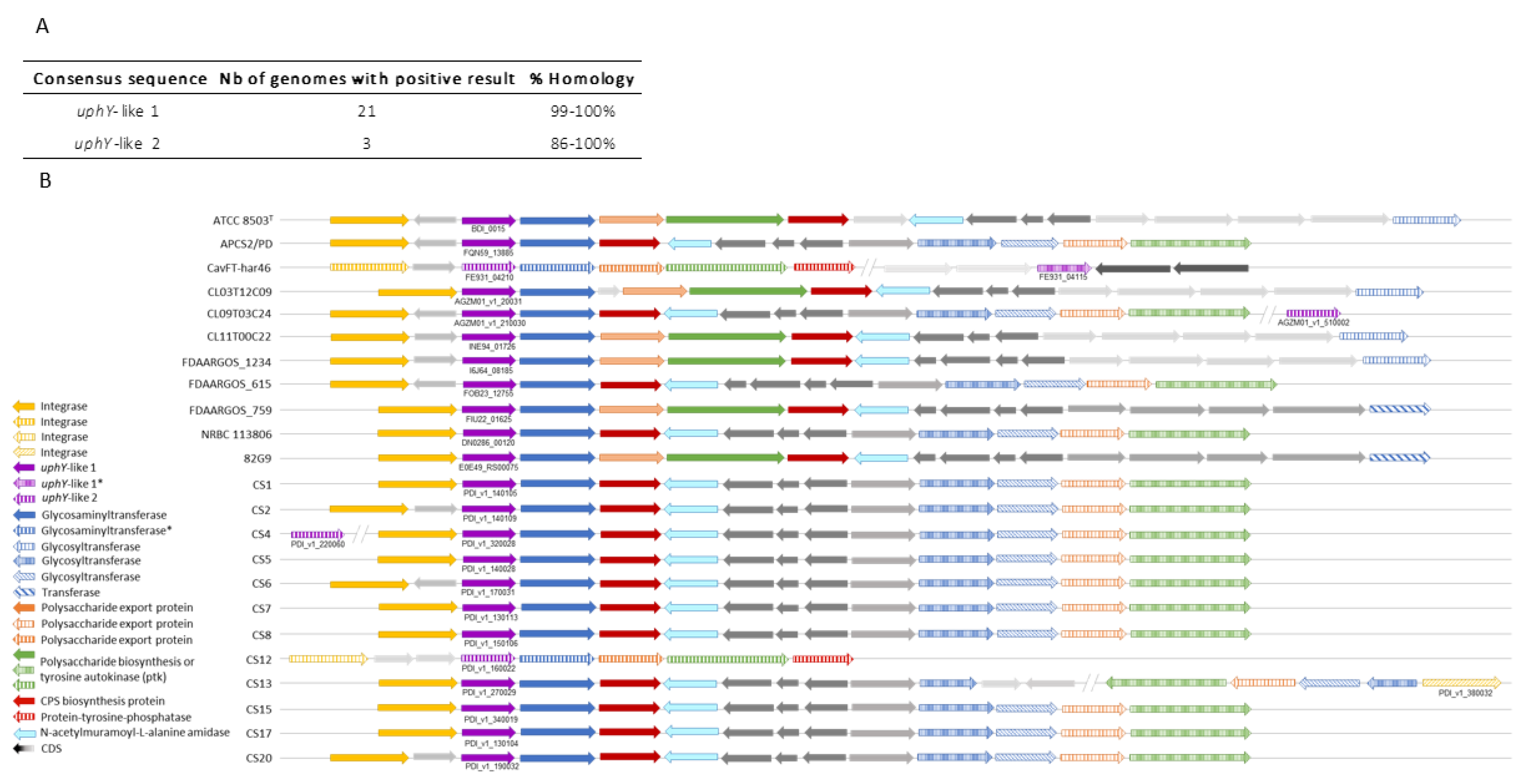
| Capsule | up(a-g)Y | No match | ||||
| up(a-g)Z | No match | |||||
| uphY | CS12 | PDI_v1_160022 | 185 | Transcription antitermination protein UpdY | 36.90 | |
| CL09T03C24 | AGZN01_v1_510002 | 192 | Transcription antitermination protein UpdY | 36.00 | ||
| CS4 | PDI_v1_220060 | 192 | Transcription antitermination protein UpdY | 36.00 | ||
| FDAARGOS_615 | FOB23_12755 | 179 | UpxY family transcription antiterminator | 33.72 | ||
| APCS2/PD | FQN59_13885 | 179 | UpxY family transcription antiterminator | 33.70 | ||
| CS2 | PDI_v1_140109 | 179 | Transcription antitermination protein UpdY | 33.70 | ||
| CS5 | PDI_v1_140028 | 179 | Transcription antitermination protein UpdY | 33.70 | ||
| CS6 | PDI_v1_170031 | 179 | Transcription antitermination protein UpdY | 33.70 | ||
| CS8 | PDI_v1_150106 | 179 | Transcription antitermination protein UpdY | 33.70 | ||
| CS15 | PDI_v1_340019 | 179 | Transcription antitermination protein UpdY | 33.70 | ||
| CL03T12C09 | AGZM01_v1_20031 | 179 | Transcription antitermination protein UpdY | 33.14 | ||
| FDAARGOS_759 | FIU22_01625 | 179 | UpxY family transcription antiterminator | 33.14 | ||
| 82G9 | E0E49_RS00075 | 179 | UpxY family transcription antiterminator | 33.14 | ||
| CS1 | PDI_v1_140105 | 179 | Transcription antitermination protein UpdY | 33.10 | ||
| CS7 | PDI_v1_130113 | 179 | Transcription antitermination protein UpdY | 33.10 | ||
| upgZ | No match | |||||
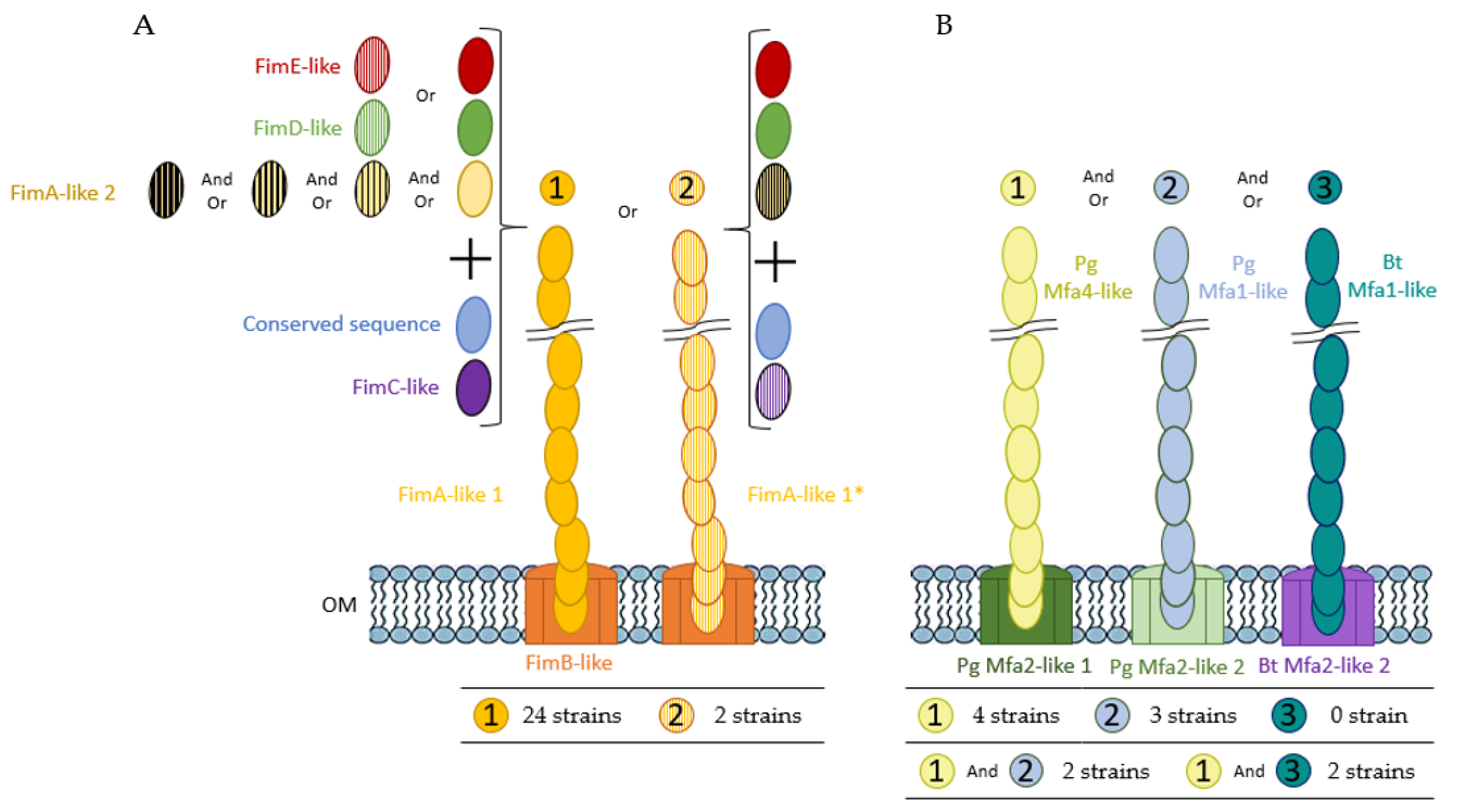
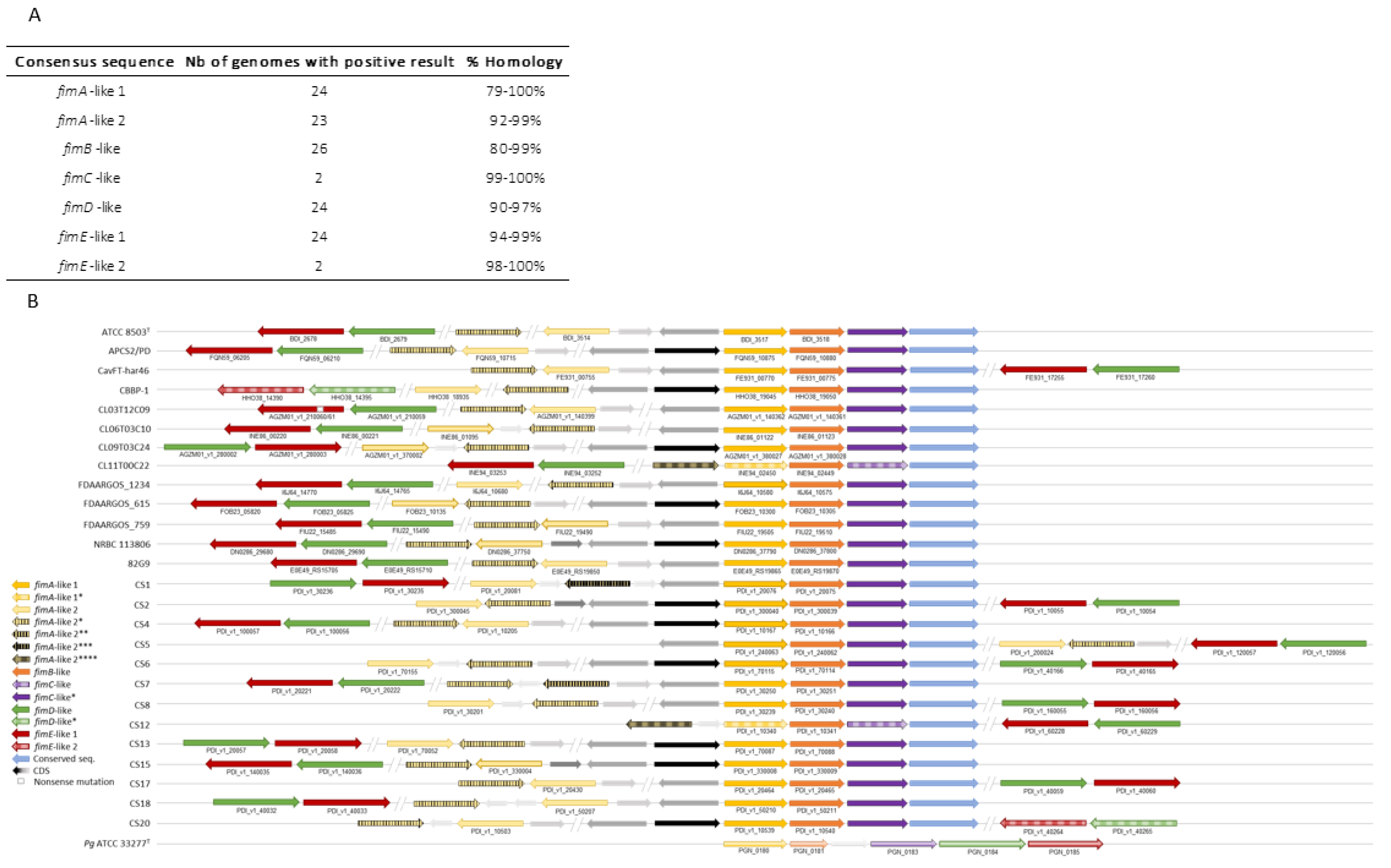
| Fimbriae | fimA | 82G9 | E0E49_RS19850 | 444 | fimbrial protein | 26.21 |
| ATCC 8503T | BDI_3514 | 444 | putative fimbrial protein precursor | 25.99 | ||
| CavFT-hAR46 | FE931_00755 | 444 | fimbrial protein | 25.99 | ||
| FDAARGOS_759 | FIU22_19490 | 444 | fimbrial protein | 25.99 | ||
| CS6 | PDI_v1_70115 | 432 | Fimbrial protein | 25.60 | ||
| CS13 | PDI_v1_70087 | 432 | Fimbrial protein | 25.60 | ||
| CL11T00C22 | INE94_02450 | 431 | Major fimbrium subunit FimA type-2 | 25.30 | ||
| CS12 | PDI_v1_10340 | 431 | Major fimbrial subunit protein (FimA) | 25.10 | ||
| CS1 | PDI_v1_20076 | 434 | Major fimbrial subunit protein type II | 24.90 | ||
| CS2 | PDI_v1_300040 | 419 | Fimbrial protein | 24.20 | ||
| CS15 | PDI_v1_330008 | 419 | Fimbrial protein | 24.20 | ||
| CS20 | PDI_v1_10539 | 419 | Fimbrial protein | 24.20 | ||
| APCS2/PD | FQN59_10875 | 419 | fimbrial protein | 24.10 | ||
| CS4 | PDI_v1_10167 | 419 | Fimbrial protein | 24.10 | ||
| CL06T03C10 | INE86_01122 | 420 | Major fimbrium subunit FimA type-2 | 24.00 | ||
| CS18 | PDI_v1_50210 | 420 | Fimbrial protein | 24.00 | ||
| CS8 | PDI_v1_30239 | 421 | P_gingi_FimA domain-containing protein | 23.70 | ||
| CS5 | PDI_v1_240063 | 421 | P_gingi_FimA domain-containing protein | 23.70 | ||
| CS17 | PDI_v1_20464 | 421 | P_gingi_FimA domain-containing protein | 23.70 | ||
| FDAARGOS_1234 | I6J64_10580 | 421 | fimbrial protein | 23.50 | ||
| CS7 | PDI_v1_30250 | 437 | Fimbrial protein | 23.20 | ||
| fimB | 82G9 | E0E49_RS19870 | 303 | FimB/Mfa2 family fimbrial subunit | 29.90 | |
| CBBP-1 | HHO38_19050 | 303 | FimB/Mfa2 family fimbrial subunit | 29.90 | ||
| CL06T03C10 | INE86_01123 | 303 | Fimbrillin-A associated anchor proteins Mfa1 and Mfa2 | 29.90 | ||
| FDAARGOS_1234 | I6J64_10575 | 303 | FimB/Mfa2 family fimbrial subunit | 29.90 | ||
| FDAARGOS_759 | FIU22_19510 | 303 | FimB/Mfa2 family fimbrial subunit | 29.90 | ||
| CS1 | PDI_v1_20075 | 303 | Fimbrillin-A associated anchor proteins Mfa1 and Mfa2 | 29.90 | ||
| CS6 | PDI_v1_70114 | 303 | FimB/Mfa2 family fimbrial subunit | 29.90 | ||
| CS12 | PDI_v1_10341 | 305 | Fimbrillin-A associated anchor proteins Mfa1 and Mfa2 | 29.90 | ||
| CS13 | PDI_v1_70088 | 303 | FimB/Mfa2 family fimbrial subunit | 29.90 | ||
| CL11T00C22 | INE94_02449 | 305 | Fimbrillin-A associated anchor proteins Mfa1 and Mfa2 | 29.00 | ||
| fimC | CL11T00C22 | INE94_02448 | 375 | Putative fimbrium tip subunit Fim1C | 22.50 | |
| fimD | CS2 | PDI_v1_10054 | 684 | P_gingi_FimA domain-containing protein | 26.40 | |
| CS15 | PDI_v1_140036 | 684 | P_gingi_FimA domain-containing protein | 26.40 | ||
| CS12 | PDI_v1_60229 | 685 | P_gingi_FimA domain-containing protein | 26.10 | ||
| CS17 | PDI_v1_40059 | 685 | P_gingi_FimA domain-containing protein | 26.10 | ||
| CS18 | PDI_v1_40032 | 685 | P_gingi_FimA domain-containing protein | 26.10 | ||
| CL03T12C09 | AGZM01_v1_210059 | 684 | P_gingi_FimA domain-containing protein | 26.02 | ||
| CS5 | PDI_v1_120056 | 675 | P_gingi_FimA domain-containing protein | 25.70 | ||
| CS8 | PDI_v1_160055 | 675 | P_gingi_FimA domain-containing protein | 25.70 | ||
| CS4 | PDI_v1_100056 | 677 | P_gingi_FimA domain-containing protein | 25.10 | ||
| CL09T03C24 | AGZN01_v1_280002 | 678 | P_gingi_FimA domain-containing protein | 24.76 | ||
| fimE | CL11T00C22 | INE94_03253 | 632 | Major fimbrium tip subunit FimE | 27.10 | |
| CL06T03C10 | INE86_00220 | 632 | Major fimbrium tip subunit FimE | 25.30 | ||
| CBBP-1 | HHO38_14390 | 688 | FimB/Mfa2 family fimbrial subunit | 23.01 | ||
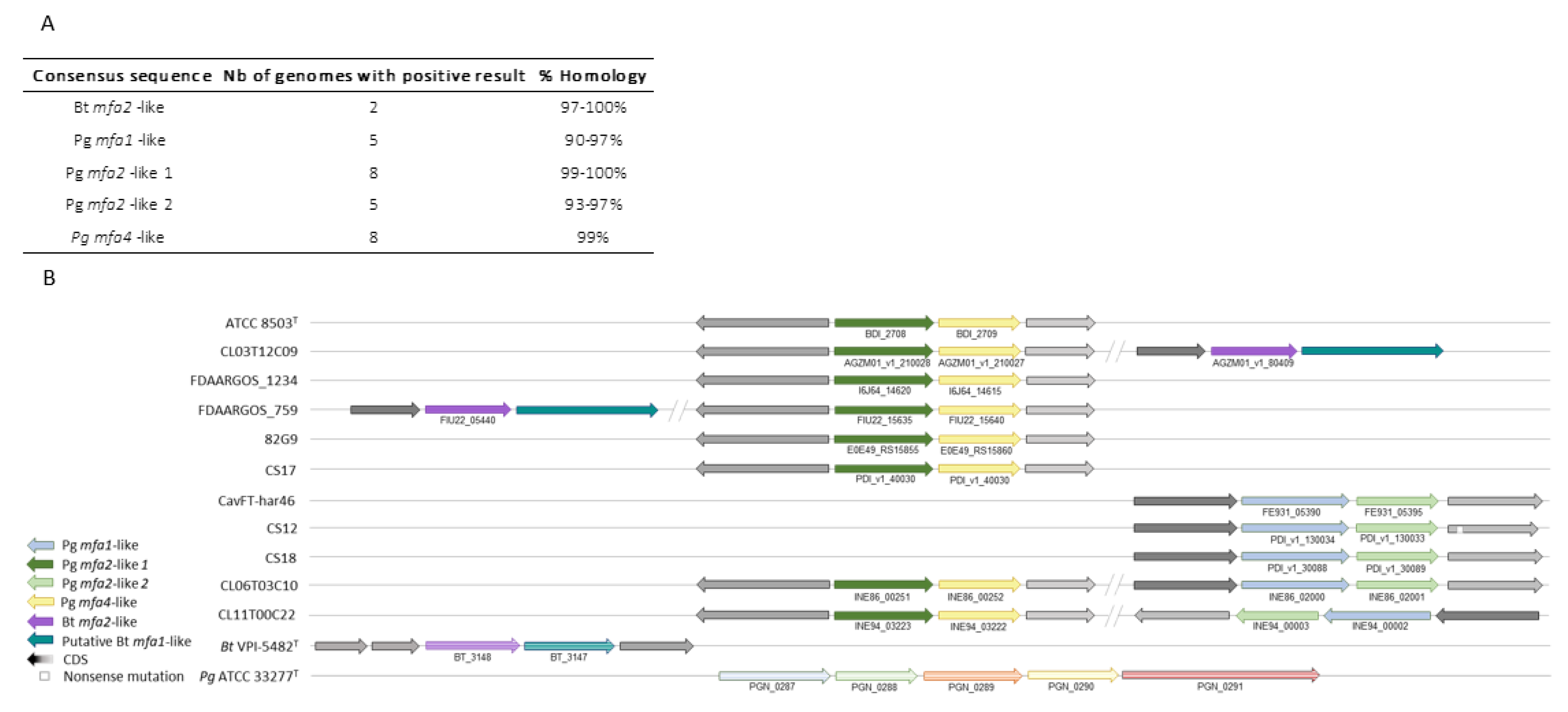
| Pilus | Bt mfa1 | No match | ||||
| Bt mfa2 | FDAARGOS_759 | FIU22_05440 | 350 | FimB/Mfa2 family fimbrial subunit | 28.98 | |
| Pg mfa1 | CS12 | PDI_v1_130034 | 509 | Fimbrillin_C domain-containing protein | 26.50 | |
| CS18 | PDI_v1_30088 | 509 | Fimbrillin_C domain-containing protein | 26.50 | ||
| CL06T03C10 | INE86_02000 | 392 | Minor fimbrium subunit Mfa1 | 25.40 | ||
| CL11T00C22 | INE94_00002 | 509 | Major fimbrial subunit protein type IV | 25.40 | ||
| Pg mfa2 | CL06T03C10 | INE86_02001 | 329 | Minor fimbrium anchoring subunit Mfa2 | 31.20 | |
| CL11T00C22 | INE94_00003 | 329 | Minor fimbrium anchoring subunit Mfa2 | 31.20 | ||
| CS12 | PDI_v1_130033 | 329 | FimB/Mfa2 family fimbrial subunit | 30.90 | ||
| CS18 | PDI_v1_30089 | 329 | putative Minor fimbrium anchoring subunit Mfa2 | 30.40 | ||
| FDAARGOS_759 | FIU22_15640 | 300 | FimB/Mfa2 family fimbrial subunit | 24.32 | ||
| 82G9 | E0E49_RS15860 | 300 | FimB/Mfa2 family fimbrial subunit | 24.32 | ||
| Pg mfa3 | No match | |||||
| Pg mfa4 | FDAARGOS_759 | FIU22_15635 | 463 | Mfa1 fimbrilin C-terminal domain-containing protein | 20.83 | |
| ATCC 8503T | BDI_2708 | 463 | putative outer membrane protein | 20.51 | ||
| CL03T12C09 | AGZM01_v1_210028 | 463 | Fimbrillin_C domain-containing protein | 20.51 | ||
| 82G9 | E0E49_RS15855 | 463 | Mfa1 fimbrilin C-terminal domain-containing protein | 20.20 | ||
| Pg mfa5 | No match | |||||
| P. distasonis | |||||||||||||||||||||||||||
|---|---|---|---|---|---|---|---|---|---|---|---|---|---|---|---|---|---|---|---|---|---|---|---|---|---|---|---|
| ATTC 8503T | APCS2/PD | CavFT-hAR46 | CBBP-1 | CL03T12C09 | CL06T03C10 | CL09T03C24 | CL11T00C22 | FDAARGOS_1234 | FDAARGOS_615 | FDAARGOS_759 | NBRC 113806 | 82G9 | CS1 | CS2 | CS4 | CS5 | CS6 | CS7 | CS8 | CS12 | CS13 | CS15 | CS17 | CS18 | CS20 | ||
| Capsular polysaccharide loci | 1 | ● | ● | ● | ● | ● | ● | ● | ● | ● | ● | ● | ● | ● | ● | ● | ● | ● | ● | ● | ● | ● | |||||
| 2 | ● | ● | ● | ||||||||||||||||||||||||
| 3 | ● | ||||||||||||||||||||||||||
| 4 | |||||||||||||||||||||||||||
| 5 | ● | ● | ● | ● | ● | ● | ● | ● | ● | ● | ● | ● | |||||||||||||||
| 6 | |||||||||||||||||||||||||||
| 7 | |||||||||||||||||||||||||||
| 8 | ● | ● | ● | ● | ● | ● | ● | ● | ● | ● | ● | ● | |||||||||||||||
| 9 | ● | ● | ● | ● | |||||||||||||||||||||||
| 10 | |||||||||||||||||||||||||||
| 11 | ● | ||||||||||||||||||||||||||
| 12 | |||||||||||||||||||||||||||
| 13 | ● | ● | ● | ● | ● | ● | ● | ● | ● | ● | ● | ● | ● | ● | ● | ● | ● | ● | ● | ● | ● | ● | ● | ● | ● | ● | |
| 14 | |||||||||||||||||||||||||||

| Structure | Reference Genome | Gene | Label | Length (Aa) | Reference |
|---|---|---|---|---|---|
| Capsule | Bacteroides fragilis ATCC 25285T | upaY | BF1367 | 172 | [11,42,55] |
| upaZ | BF1368 | 157 | |||
| upbY | BF1893 | 174 | |||
| upbZ | BF1894 | 161 | |||
| upcY | BF1009 | 172 | |||
| upcZ | BF1010 | 130 | |||
| updY | BF3699 | 179 | |||
| updZ | BF3698 | 161 | |||
| upeY | BF2606 | 172 | |||
| upeZ | BF2605 | 160 | |||
| upfY | BF1549 | 199 | |||
| upfZ | BF1550 | 160 | |||
| upgY | BF0731 | 178 | |||
| upgZ | BF0732 | 162 | |||
| uphY | BF3466 | 179 | |||
| uphZ | BF3465 | 161 | |||
| Fimbriae | Porphyromonas gingivalis ATCC 33277T | fimA | PGN_0180 | 383 | [12,15] |
| fimB | PGN_0181 | 118 | |||
| fimC | PGN_0183 | 462 | |||
| fimD | PGN_0184 | 670 | |||
| fimE | PGN_0185 | 550 | |||
| Pilus | Bacteroides thetaiotaomicron VPI-5482T | mfa1 | BT_3147 | 388 | [13] |
| mfa2 | BT_3148 | 430 | |||
| Porphyromonas gingivalis ATCC 33277T | mfa1 | PGN_0287 | 563 | [14,33,48] | |
| mfa2 | PGN_0288 | 324 | |||
| mfa3 | PGN_0289 | 446 | |||
| mfa4 | PGN_0290 | 333 | |||
| mfa5 | PGN_0291 | 1228 |
Publisher’s Note: MDPI stays neutral with regard to jurisdictional claims in published maps and institutional affiliations. |
© 2022 by the authors. Licensee MDPI, Basel, Switzerland. This article is an open access article distributed under the terms and conditions of the Creative Commons Attribution (CC BY) license (https://creativecommons.org/licenses/by/4.0/).
Share and Cite
Chamarande, J.; Cunat, L.; Alauzet, C.; Cailliez-Grimal, C. In Silico Study of Cell Surface Structures of Parabacteroides distasonis Involved in Its Maintenance within the Gut Microbiota. Int. J. Mol. Sci. 2022, 23, 9411. https://doi.org/10.3390/ijms23169411
Chamarande J, Cunat L, Alauzet C, Cailliez-Grimal C. In Silico Study of Cell Surface Structures of Parabacteroides distasonis Involved in Its Maintenance within the Gut Microbiota. International Journal of Molecular Sciences. 2022; 23(16):9411. https://doi.org/10.3390/ijms23169411
Chicago/Turabian StyleChamarande, Jordan, Lisiane Cunat, Corentine Alauzet, and Catherine Cailliez-Grimal. 2022. "In Silico Study of Cell Surface Structures of Parabacteroides distasonis Involved in Its Maintenance within the Gut Microbiota" International Journal of Molecular Sciences 23, no. 16: 9411. https://doi.org/10.3390/ijms23169411
APA StyleChamarande, J., Cunat, L., Alauzet, C., & Cailliez-Grimal, C. (2022). In Silico Study of Cell Surface Structures of Parabacteroides distasonis Involved in Its Maintenance within the Gut Microbiota. International Journal of Molecular Sciences, 23(16), 9411. https://doi.org/10.3390/ijms23169411