Article

Upstream Open Reading Frame Mediated Translation of WNK8 Is Required for ABA Response in Arabidopsis

1
Department of Biology, Southern University of Science and Technology, Shenzhen 518055, China
2
Key Laboratory of Molecular Design for Plant Cell Factory of Guangdong Higher Education Institutes, Department of Biology, Southern University of Science and Technology, Shenzhen 518055, China
3
Academy for Advanced Interdisciplinary Studies, Southern University of Science and Technology, Shenzhen 518055, China
*
Authors to whom correspondence should be addressed.
Int. J. Mol. Sci. 2021, 22(19), 10683; https://doi.org/10.3390/ijms221910683
Submission received: 16 August 2021 / Revised: 25 September 2021 / Accepted: 27 September 2021 / Published: 1 October 2021

Abstract

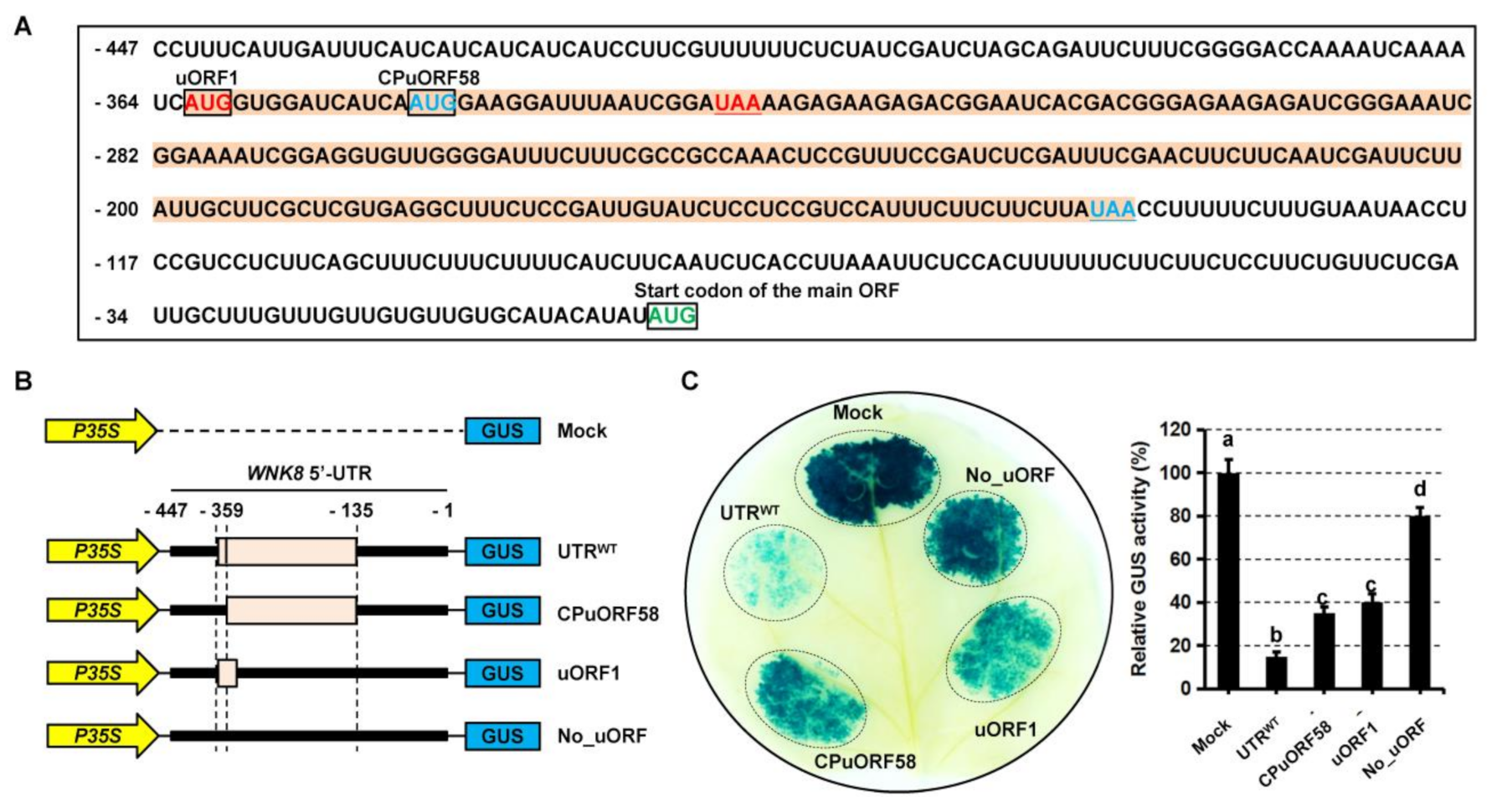
With no lysine (K) (WNK) kinases comprise a family of serine/threonine kinases belonging to an evolutionary branch of the eukaryotic kinome. These special kinases contain a unique active site and are found in a wide range of eukaryotes. The model plant Arabidopsis has been reported to have 11 WNK members, of which WNK8 functions as a negative regulator of abscisic acid (ABA) signaling. Here, we found that the expression of WNK8 is post-transcriptionally regulated through an upstream open reading frame (uORF) found in its 5′ untranslated region (5′-UTR). This uORF has been predicted to encode a conserved peptide named CPuORF58 in both monocotyledons and dicotyledons. The analysis of the published ribosome footprinting studies and the study of the frameshift CPuORF58 peptide with altered repression capability suggested that this uORF causes ribosome stalling. Plants transformed with the native WNK8 promoter driving WNK8 expression were comparable with wild-type plants, whereas the plants transformed with a similar construct with mutated CPuORF58 start codon were less sensitive to ABA. In addition, WNK8 and its downstream target RACK1 were found to synergistically coordinate ABA signaling rather than antagonistically modulating glucose response and flowering in plants. Collectively, these results suggest that the WNK8 expression must be tightly regulated to fulfill the demands of ABA response in plants.
Keywords: upstream open reading frame; translation; abscisic acid; protein kinase WNK8 upstream open reading frame; translation; abscisic acid; protein kinase WNK8