Review

Alpha-Synuclein as a Prominent Actor in the Inflammatory Synaptopathy of Parkinson’s Disease
by
Antonella Cardinale
1,2,†,
Valeria Calabrese
1,3,†,
Antonio de Iure
1 and
Barbara Picconi
1,4,*
1
Laboratory Experimental Neurophysiology, IRCCS San Raffaele Pisana, 00166 Rome, Italy
2
Department of Neuroscience, Università Cattolica del Sacro Cuore, 00168 Rome, Italy
3
Department of Medicine, Università degli Studi di Perugia, 06123 Perugia, Italy
4
Department of di Scienze Umane e Promozione della Qualità della Vita, Università Telematica San Raffaele, 00166 Rome, Italy
*
Author to whom correspondence should be addressed.
A.C. and V.C. contributed equally to this work.
Int. J. Mol. Sci. 2021, 22(12), 6517; https://doi.org/10.3390/ijms22126517
Submission received: 14 May 2021 / Revised: 4 June 2021 / Accepted: 15 June 2021 / Published: 17 June 2021
(This article belongs to the Special Issue Molecular and Cellular Mechanisms in Inflammatory Synaptopathy)

Abstract

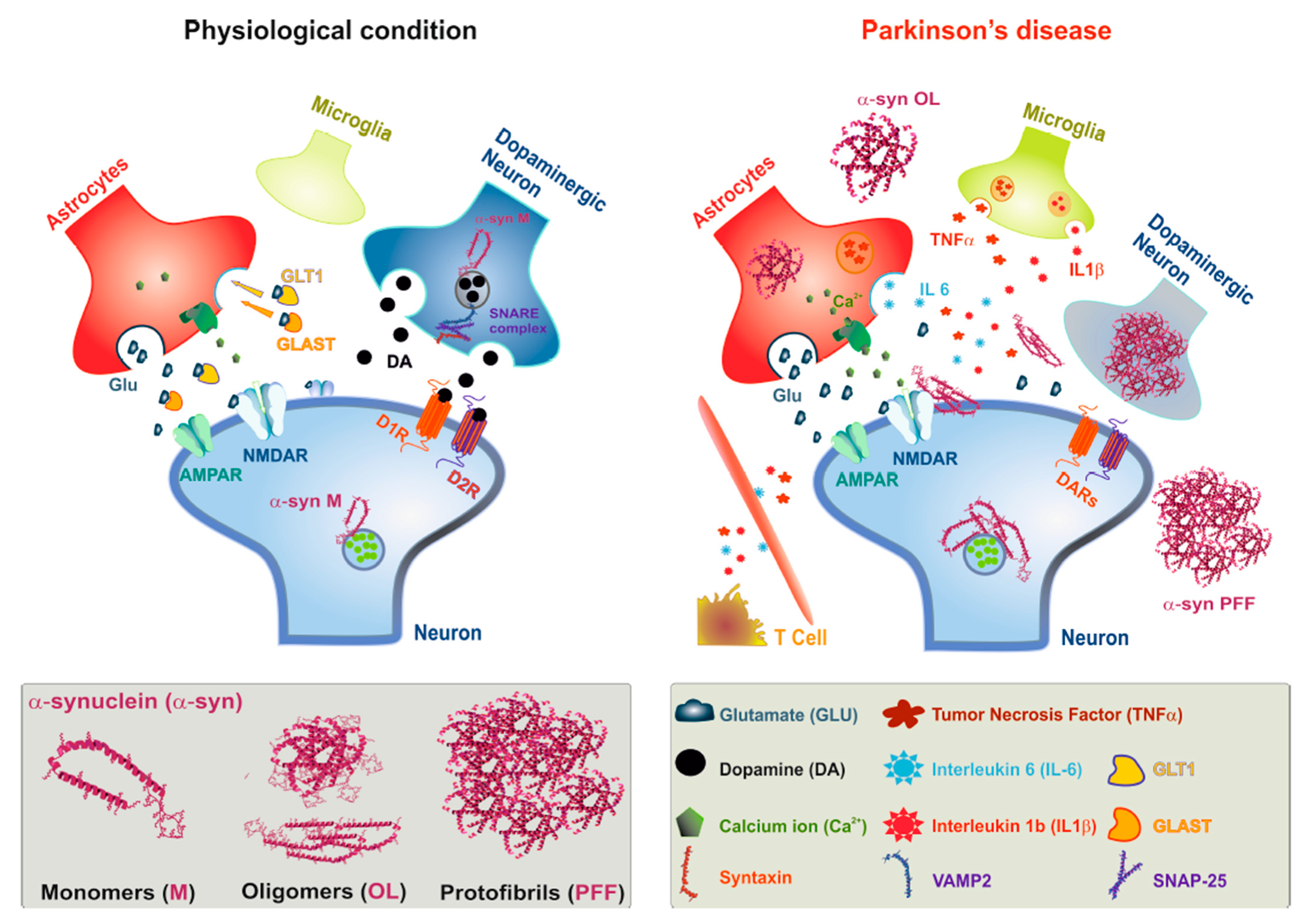
Parkinson’s disease (PD) is considered the most common disorder of synucleinopathy, which is characterised by intracellular inclusions of aggregated and misfolded α-synuclein (α-syn) protein in various brain regions, and the loss of dopaminergic neurons. During the early prodromal phase of PD, synaptic alterations happen before cell death, which is linked to the synaptic accumulation of toxic α-syn specifically in the presynaptic terminals, affecting neurotransmitter release. The oligomers and protofibrils of α-syn are the most toxic species, and their overexpression impairs the distribution and activation of synaptic proteins, such as the SNARE complex, preventing neurotransmitter exocytosis and neuronal synaptic communication. In the last few years, the role of the immune system in PD has been increasingly considered. Microglial and astrocyte activation, the gene expression of proinflammatory factors, and the infiltration of immune cells from the periphery to the central nervous system (CNS) represent the main features of the inflammatory response. One of the actors of these processes is α-syn accumulation. In light of this, here, we provide a systematic review of PD-related α-syn and inflammation inter-players.
Keywords: synaptopathy; α-synuclein; dopamine; neuroinflammation; immune system synaptopathy; α-synuclein; dopamine; neuroinflammation; immune system