


The authors would like to make the following corrections to their paper published in the International Journal of Molecular Science [1]. The ionic conductivities shown in Table 1 were wrong because of the inconsistent unit of the thickness of membranes used in the calculation. In the corrected version, we updated the ionic conductivity and added the thickness, area, and bulk resistance of each membrane. The following changes are noted. The changes do not affect the conclusions of the article.
Table 1.
Basic properties of PPO-TMA, PPO-MPy, and PPO-MIM separator membranes.
2. Change of Figure 5
Figure 5.
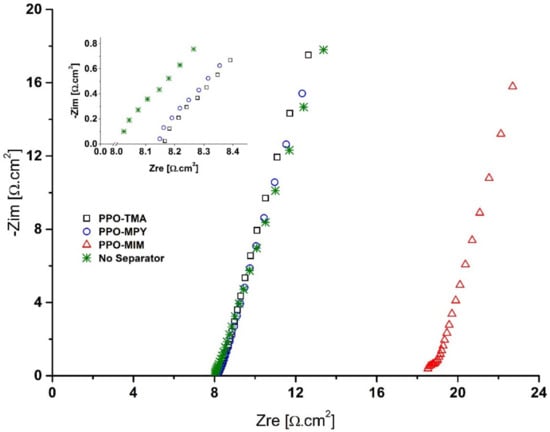
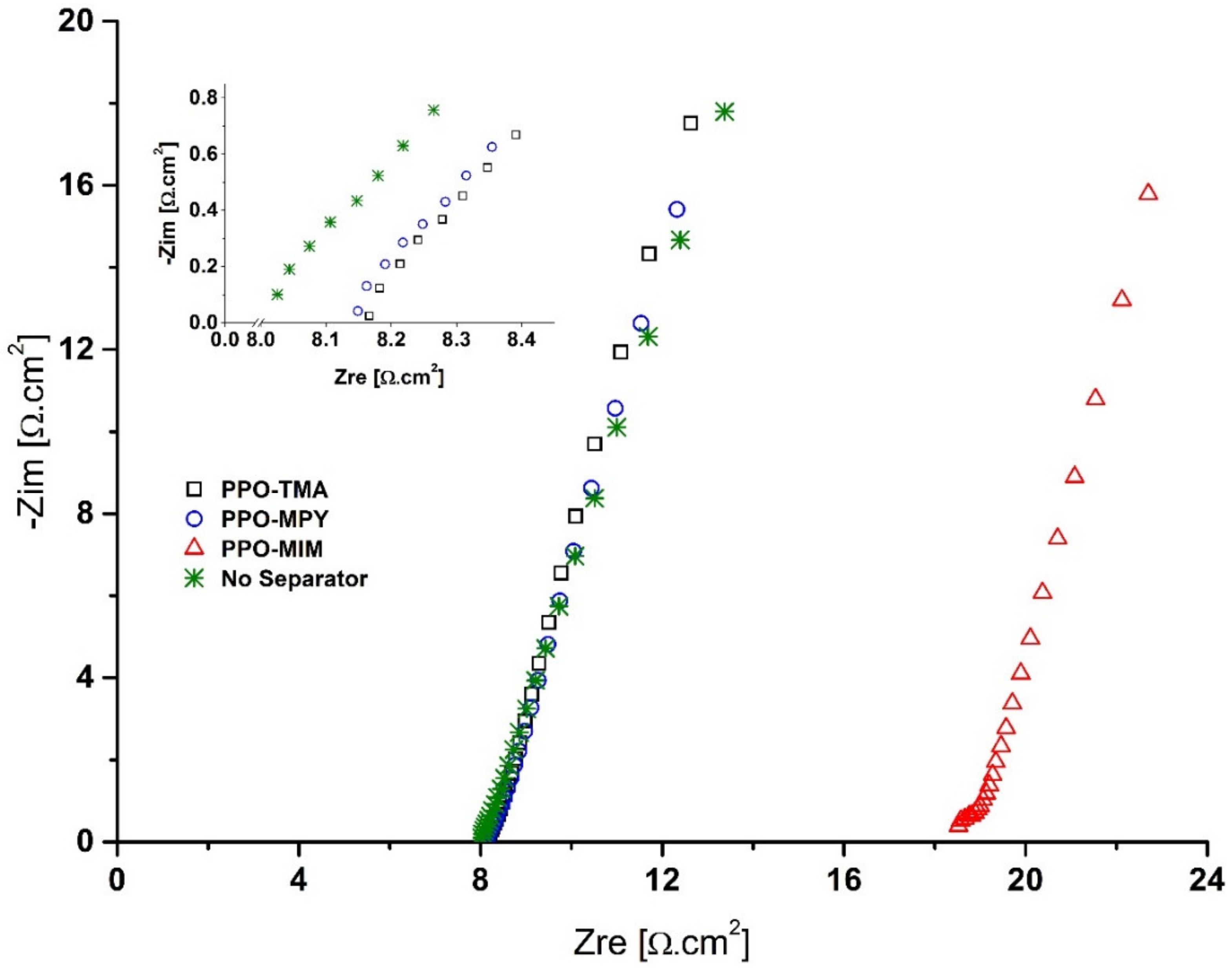
Nyquist plot of EIS for determining ionic conductivity of PPO-based separator membranes. The values of Zre and Zim were obtained by multiplying Rb values by the samples’ area (1.766 cm2).
Figure 5 should be replaced with the following (the units of resistance in the insert image was changed to [Ω.cm2]):
3. Changes in Text
Lines 11–13 of the Abstract should be replaced with the following text:
Ionic conductivity of PPO–TMA, PPO–MPY, and PPO–MIM was determined using electrochemical impedance spectroscopy to be 17.37, 16.25, and 0.29 mS/cm, respectively.
Lines 1–11 on page 7 should be replaced with the following text:
Also, very low electrolyte uptake of PPO–MIM was reflected in the ionic conductivity measurements, showing very low conductivity of 0.29 mS/cm determined using a Nyquist plot of electrochemical impedance spectroscopy (EIS) (Figure 5). For PPO–TMA and PPO–MPy, the ionic conductivity was calculated to be 17.37 and 16.25 mS/cm. Due to deficient electrolyte uptake and low ionic conductivity of PPO–MIM, it was not included in the rest of the study.
Slightly higher ionic conductivities have been reported for the same separator membranes, which could be attributed to the higher measurement temperature and lower KOH solution concentration. In this study, the measurements were carried out in KOH, 7 M solution to mimic the real cell operation condition. As can be seen in Table 1, the separator membranes absorb much less electrolyte than they do in water, resulting in lower measured ionic conductivity.
Lines 3–5 in the Conclusion should be replaced with the following text:
They offered a good ionic conductivity of ~17 mS/cm along with very low zincate diffusion coefficient of 1.13 × 10⁻⁸ and 0.28 × 10⁻⁸ cm2/min for PPO–TMA and PPO–MPY, respectively.
We apologize for any inconvenience caused to the readers by this error.
Reference
- Abbasi, A.; Hosseini, S.; Somwangthanaroj, A.; Mohamad, A.A.; Kheawhom, S. Poly(2,6-Dimethyl-1,4-Phenylene Oxide)-Based Hydroxide Exchange Separator Membranes for Zinc–Air Battery. Int. J. Mol. Sci. 2019, 20, 3678. [Google Scholar] [CrossRef] [Scilit] [PubMed]

© 2020 by the authors. Licensee MDPI, Basel, Switzerland. This article is an open access article distributed under the terms and conditions of the Creative Commons Attribution (CC BY) license (http://creativecommons.org/licenses/by/4.0/).