Review

Deleterious Alteration of Glia in the Brain of Alzheimer’s Disease

College of Pharmacy, Hanyang University ERICA, Gyeonggi-do 15588, Korea
*
Author to whom correspondence should be addressed.
Int. J. Mol. Sci. 2020, 21(18), 6676; https://doi.org/10.3390/ijms21186676
Submission received: 12 August 2020 / Revised: 9 September 2020 / Accepted: 10 September 2020 / Published: 12 September 2020

Abstract

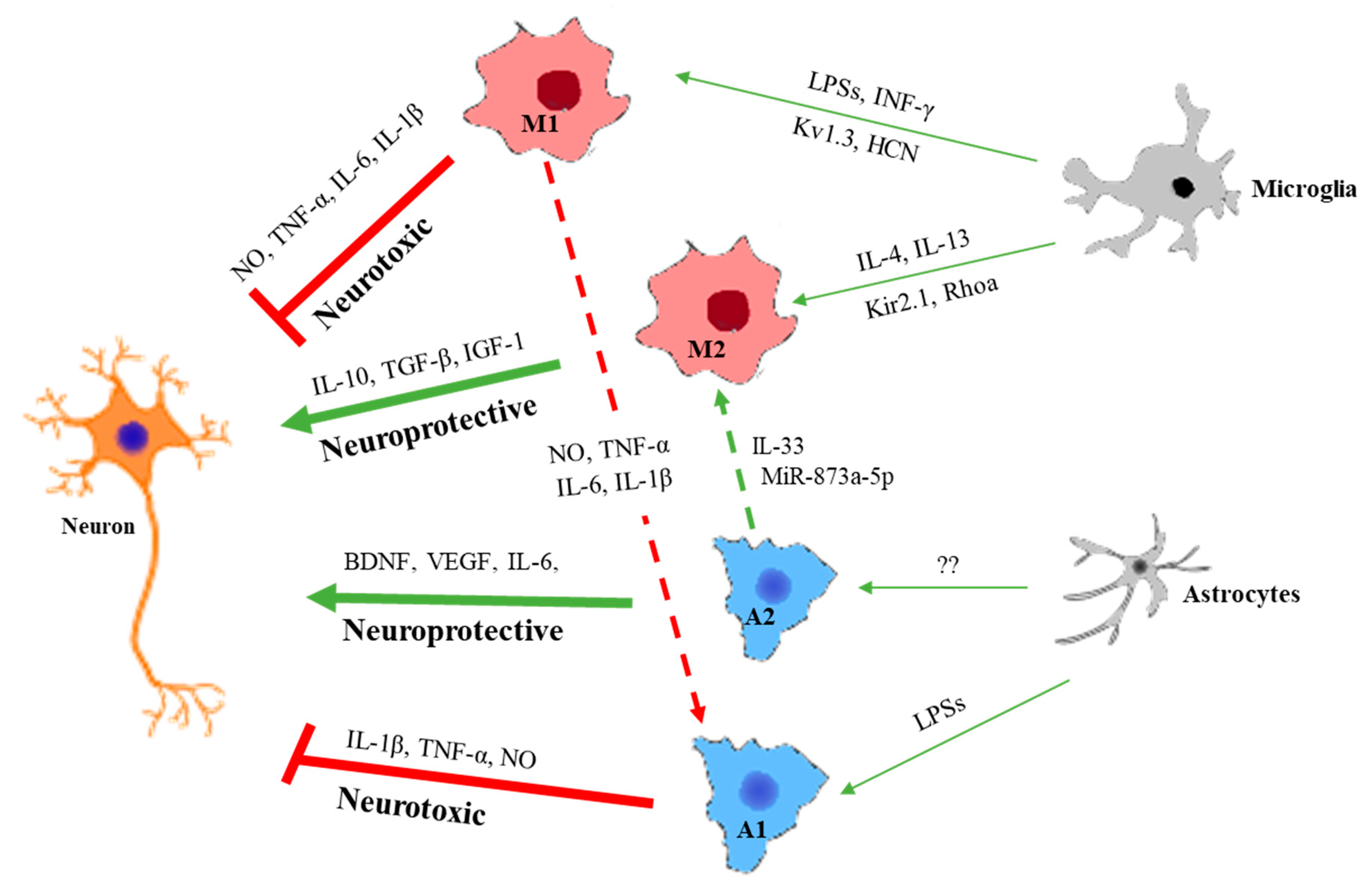
The deterioration of neurons in Alzheimer’s disease (AD) arises from genetic, immunologic, and cellular factors inside the cortex. The traditional consensus of the amyloid-beta (Aβ) paradigm as a singular cause of AD has been under revision, with the accumulation of exploding neurobiological evidence. Among the multifaceted casualties of AD, the involvement of glia gains significance for its dynamic contribution to neurons, either in a neuroprotective or neurotoxic fashion. Basically, microglia and astrocytes contribute to neuronal sustainability by releasing neuroprotective cytokines, maintaining an adequate amount of glutamate in the synapse, and pruning excessive synaptic terminals. Such beneficial effects divert to the other detrimental cascade in chronic neuroinflammatory conditions. In this change, there are new discoveries of specific cytokines, microRNAs, and complementary factors. Previously unknown mechanisms of ion channels such as Kv1.3, Kir2.1, and HCN are also elucidated in the activation of microglia. The activation of glia is responsible for the excitotoxicity through the overflow of glutamate transmitter via mGluRs expressed on the membrane, which can lead to synaptic malfunction and engulfment. The communication between microglia and astrocytes is mediated through exosomes as well as cytokines, where numerous pieces of genetic information are transferred in the form of microRNAs. The new findings tell us that the neuronal environment in the AD condition is a far more complicated and dynamically interacting space. The identification of each molecule in the milieu and cellular communication would contribute to a better understanding of AD in the neurobiological perspective, consequently suggesting a possible therapeutic clue.
Keywords: Alzheimer’s disease (AD), glia; microglia; astrocyte; neuroinflammation; cytokine; microRNA; mGluR; complementary system; exosome; glutamate; excitotoxicity; ion channel; synapse Alzheimer’s disease (AD), glia; microglia; astrocyte; neuroinflammation; cytokine; microRNA; mGluR; complementary system; exosome; glutamate; excitotoxicity; ion channel; synapse