Review

Glucagon, GLP-1 and Thermogenesis


by
Ismael González-García
1,*,
Edward Milbank
2,3,
Carlos Diéguez
2,3,
Miguel López
2,3 and
Cristina Contreras
4,*
1
Institute for Diabetes and Obesity, Helmholtz Diabetes Center, Helmholtz Zentrum München, German Research Center for Environmental Health (GmbH), 85764 Neuherberg, Germany
2
Center for Research in Molecular Medicine and Chronic Diseases (CIMUS), University of Santiago de Compostela-Instituto de Investigación Sanitaria, 15782 Santiago de Compostela, Spain
3
Centro de Investigación Biomédica en Red, Fisiopatología de la Obesidad y Nutrición (CIBERobn), 15706 Santiago de Compostela, Spain
4
Department of Physiology, Pharmacy School, Complutense University of Madrid, 28040 Madrid, Spain
*
Authors to whom correspondence should be addressed.
Int. J. Mol. Sci. 2019, 20(14), 3445; https://doi.org/10.3390/ijms20143445
Submission received: 20 June 2019 / Revised: 9 July 2019 / Accepted: 10 July 2019 / Published: 13 July 2019
(This article belongs to the Special Issue The Biology and Pharmacology of Glucagon)

Abstract

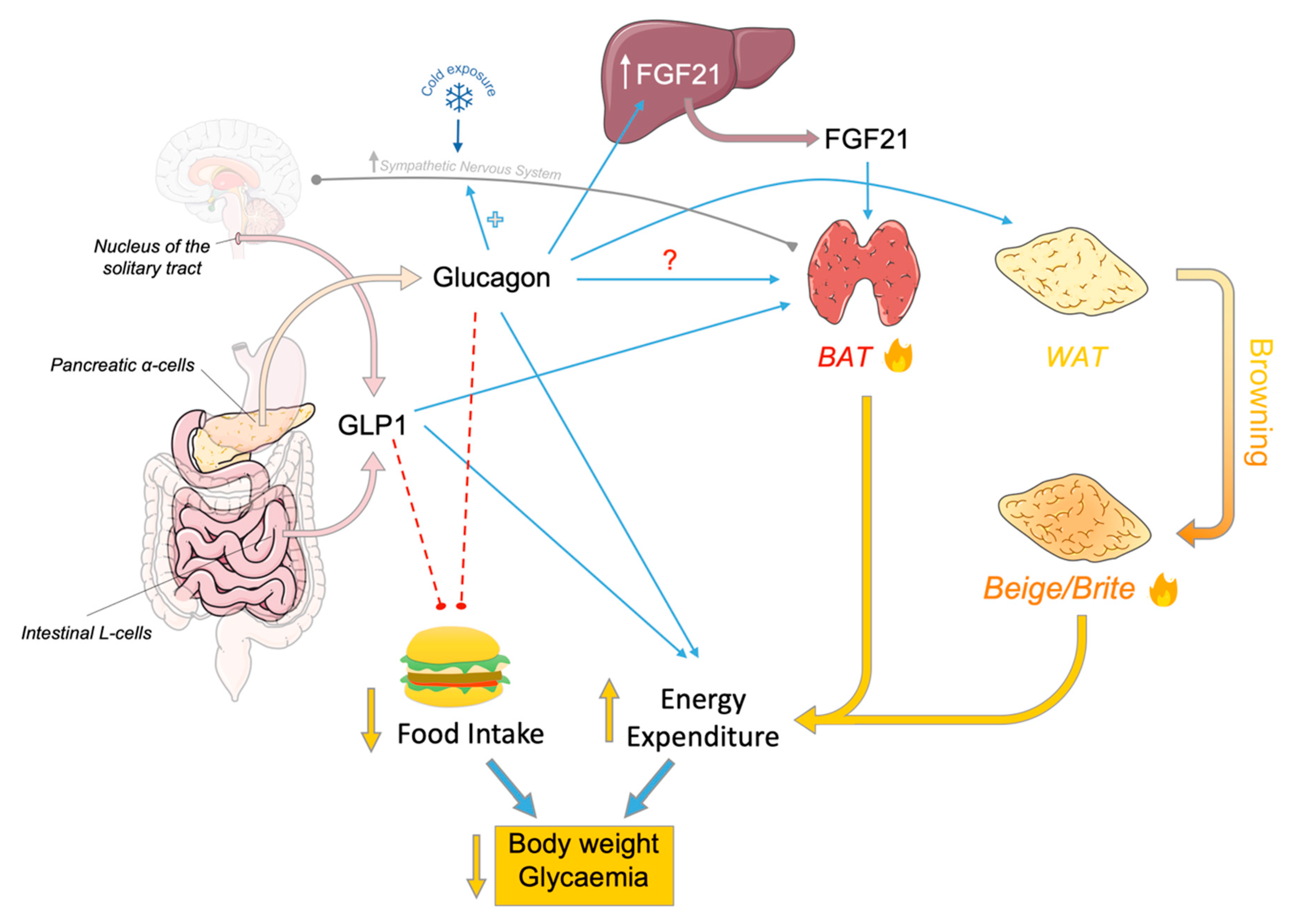
Brown adipose tissue (BAT) thermogenesis is a conserved mechanism to maintain body temperature in mammals. However, since BAT contribution to energy expenditure can represent a relevant modulator of metabolic homeostasis, many studies have focused on the nervous system and endocrine factors that control the activity of this tissue. There is long-established evidence that the counter-regulatory hormone glucagon negatively influences energy balance, enhances satiety, and increases energy expenditure. Despite compelling evidence showing that glucagon has direct action on BAT thermogenesis, recent findings are questioning this conventional attribute of glucagon action. Glucagon like peptide-1 (GLP-1) is an incretin secreted by the intestinal tract which strongly decreases feeding, and, furthermore, improves metabolic parameters associated with obesity and diabetes. Therefore, GLP-1 receptors (GLP-1-R) have emerged as a promising target in the treatment of metabolic disorders. In this short review, we will summarize the latest evidence in this regard, as well as the current therapeutic glucagon- and GLP-1-based approaches to treating obesity.
Keywords: glucagon; GLP1; thermogenesis; brown adipose tissue; browning; hypothalamic control of energy balance glucagon; GLP1; thermogenesis; brown adipose tissue; browning; hypothalamic control of energy balance