Review

Drosophila Jak/STAT Signaling: Regulation and Relevance in Human Cancer and Metastasis

by
Sunny Trivedi
and
Michelle Starz-Gaiano
*
Department of Biological Sciences, University of Maryland Baltimore County, 1000 Hilltop Circle, Baltimore, MD 21250, USA
*
Author to whom correspondence should be addressed.
Int. J. Mol. Sci. 2018, 19(12), 4056; https://doi.org/10.3390/ijms19124056
Submission received: 8 November 2018 / Revised: 8 December 2018 / Accepted: 11 December 2018 / Published: 14 December 2018
(This article belongs to the Special Issue Drosophila Model and Human Disease)

Abstract

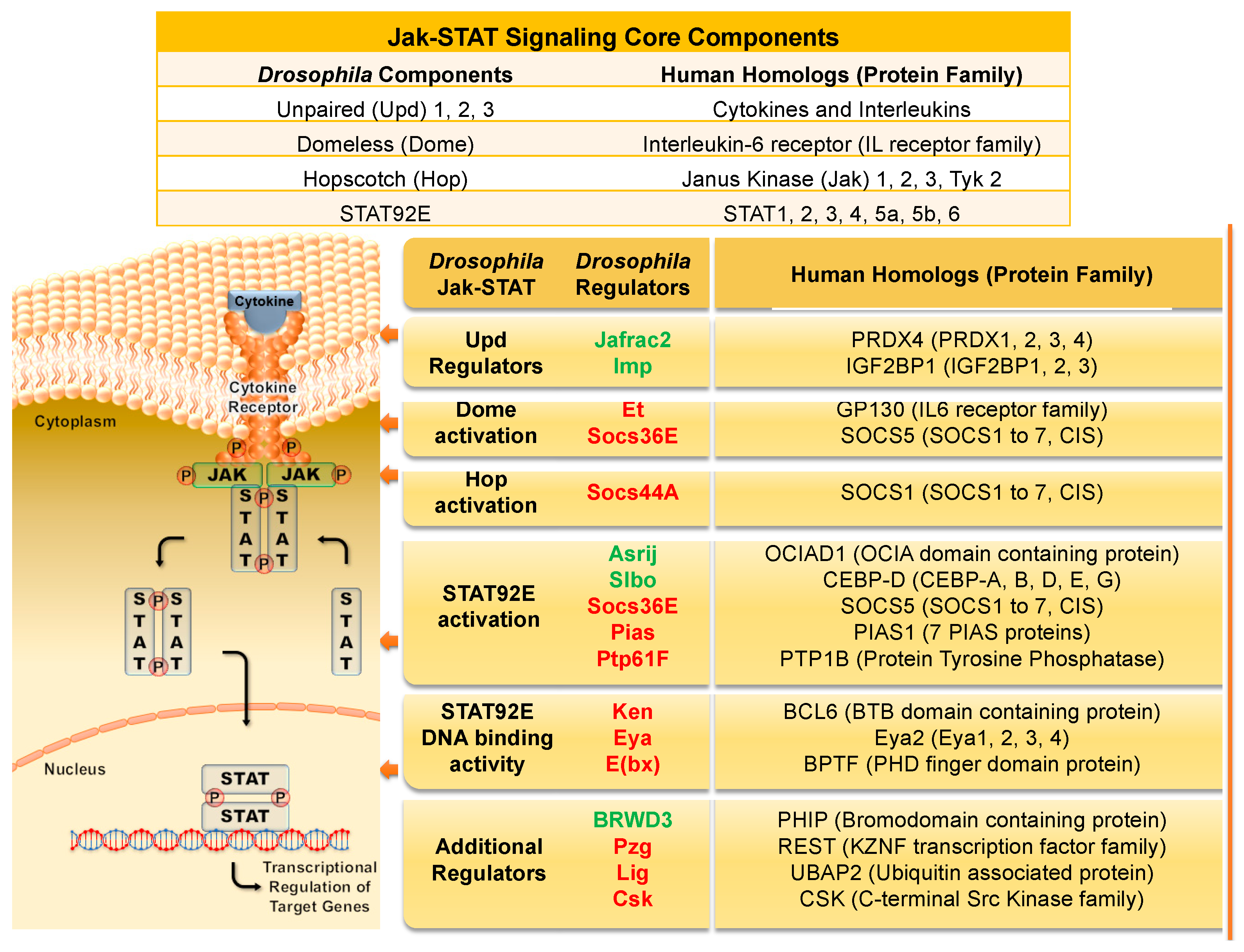
Over the past three-decades, Janus kinase (Jak) and signal transducer and activator of transcription (STAT) signaling has emerged as a paradigm to understand the involvement of signal transduction in development and disease pathology. At the molecular level, cytokines and interleukins steer Jak/STAT signaling to transcriptional regulation of target genes, which are involved in cell differentiation, migration, and proliferation. Jak/STAT signaling is involved in various types of blood cell disorders and cancers in humans, and its activation is associated with carcinomas that are more invasive or likely to become metastatic. Despite immense information regarding Jak/STAT regulation, the signaling network has numerous missing links, which is slowing the progress towards developing drug therapies. In mammals, many components act in this cascade, with substantial cross-talk with other signaling pathways. In Drosophila, there are fewer pathway components, which has enabled significant discoveries regarding well-conserved regulatory mechanisms. Work across species illustrates the relevance of these regulators in humans. In this review, we showcase fundamental Jak/STAT regulation mechanisms in blood cells, stem cells, and cell motility. We examine the functional relevance of key conserved regulators from Drosophila to human cancer stem cells and metastasis. Finally, we spotlight less characterized regulators of Drosophila Jak/STAT signaling, which stand as promising candidates to be investigated in cancer biology. These comparisons illustrate the value of using Drosophila as a model for uncovering the roles of Jak/STAT signaling and the molecular means by which the pathway is controlled.
Keywords: Janus kinase (Jak) 1; signal transducer and activator of transcription (STAT) 2; Drosophila 3; cancer metastasis 4. Janus kinase (Jak) 1; signal transducer and activator of transcription (STAT) 2; Drosophila 3; cancer metastasis 4.