Inhibition of Tetraspanin Functions Impairs Human Papillomavirus and Cytomegalovirus Infections

 , ,
, ,  ,
, Abstract
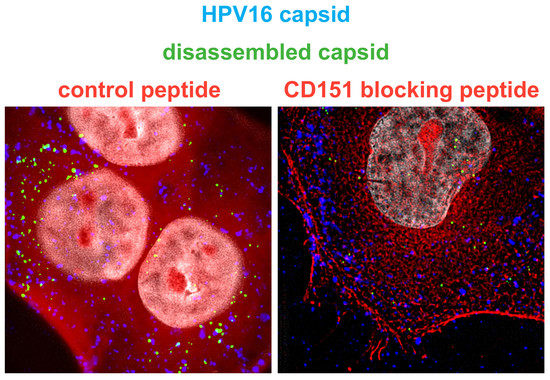
Share and Cite
Fast, L.A.; Mikuličić, S.; Fritzen, A.; Schwickert, J.; Boukhallouk, F.; Hochdorfer, D.; Sinzger, C.; Suarez, H.; Monk, P.N.; Yáñez-Mó, M.; et al. Inhibition of Tetraspanin Functions Impairs Human Papillomavirus and Cytomegalovirus Infections. Int. J. Mol. Sci. 2018, 19, 3007. https://doi.org/10.3390/ijms19103007
Fast LA, Mikuličić S, Fritzen A, Schwickert J, Boukhallouk F, Hochdorfer D, Sinzger C, Suarez H, Monk PN, Yáñez-Mó M, et al. Inhibition of Tetraspanin Functions Impairs Human Papillomavirus and Cytomegalovirus Infections. International Journal of Molecular Sciences. 2018; 19(10):3007. https://doi.org/10.3390/ijms19103007
Chicago/Turabian StyleFast, Laura A., Snježana Mikuličić, Anna Fritzen, Jonas Schwickert, Fatima Boukhallouk, Daniel Hochdorfer, Christian Sinzger, Henar Suarez, Peter N. Monk, María Yáñez-Mó, and et al. 2018. "Inhibition of Tetraspanin Functions Impairs Human Papillomavirus and Cytomegalovirus Infections" International Journal of Molecular Sciences 19, no. 10: 3007. https://doi.org/10.3390/ijms19103007
APA StyleFast, L. A., Mikuličić, S., Fritzen, A., Schwickert, J., Boukhallouk, F., Hochdorfer, D., Sinzger, C., Suarez, H., Monk, P. N., Yáñez-Mó, M., Lieber, D., & Florin, L. (2018). Inhibition of Tetraspanin Functions Impairs Human Papillomavirus and Cytomegalovirus Infections. International Journal of Molecular Sciences, 19(10), 3007. https://doi.org/10.3390/ijms19103007