


One-Pot Three-Component Synthesis of Novel Diethyl((2-oxo-1,2-dihydroquinolin-3-yl)(arylamino)methyl)phosphonate as Potential Anticancer Agents
Abstract
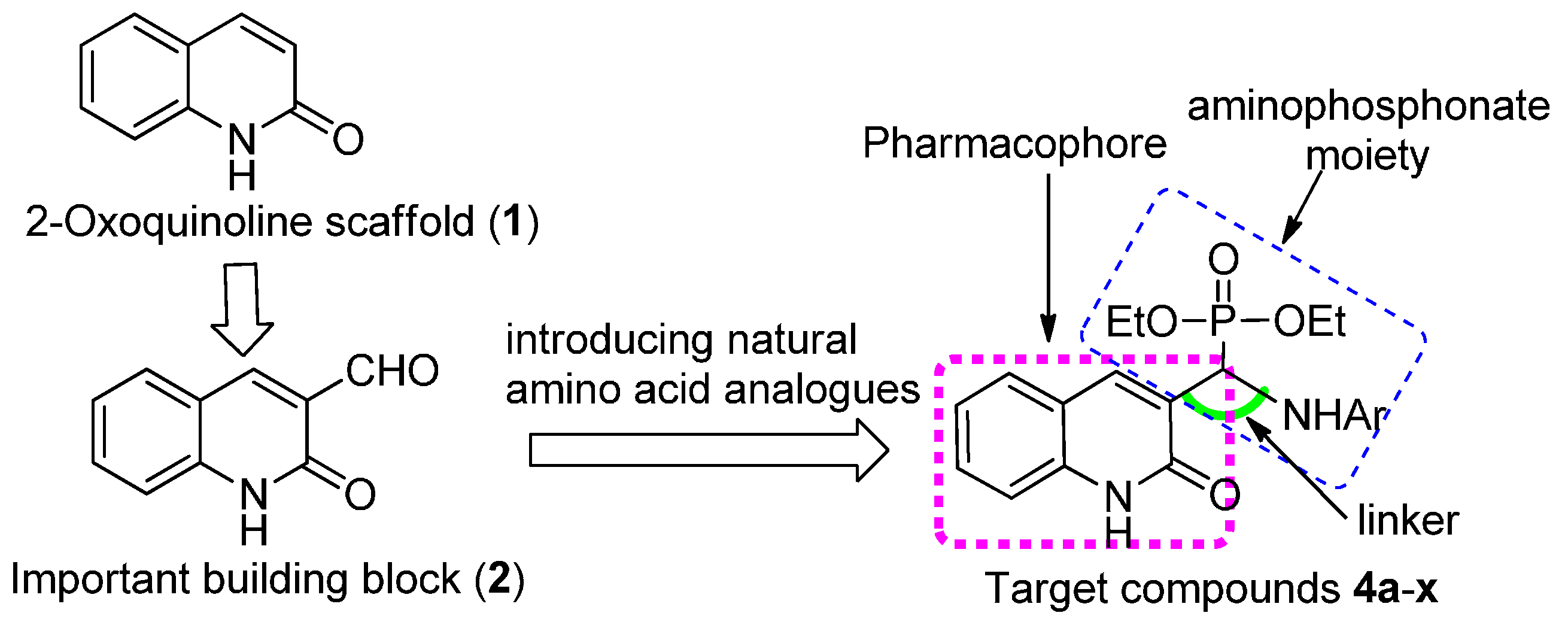
:1. Introduction
2. Results and Discussion
2.1. Biological Activity
2.1.1. In Vitro Cytotoxic Activity
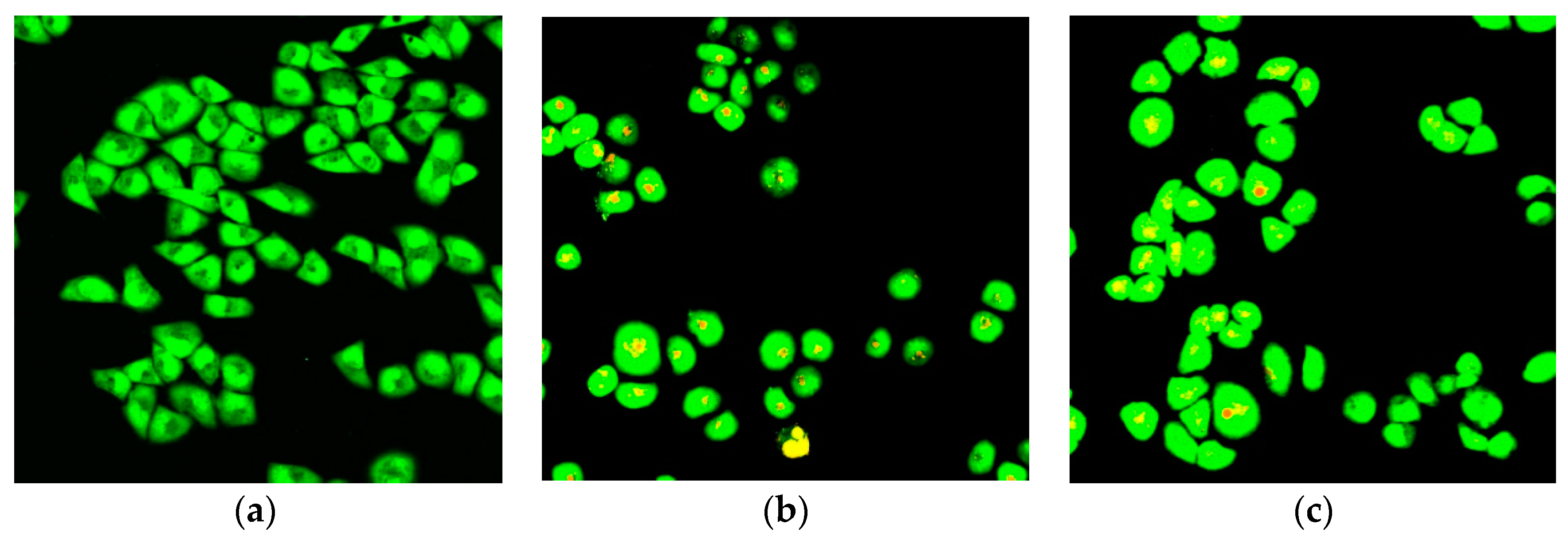
2.1.2. Apoptosis Assessment by Acridine Orange(AO)/Ethidium Bromide(EB) Staining
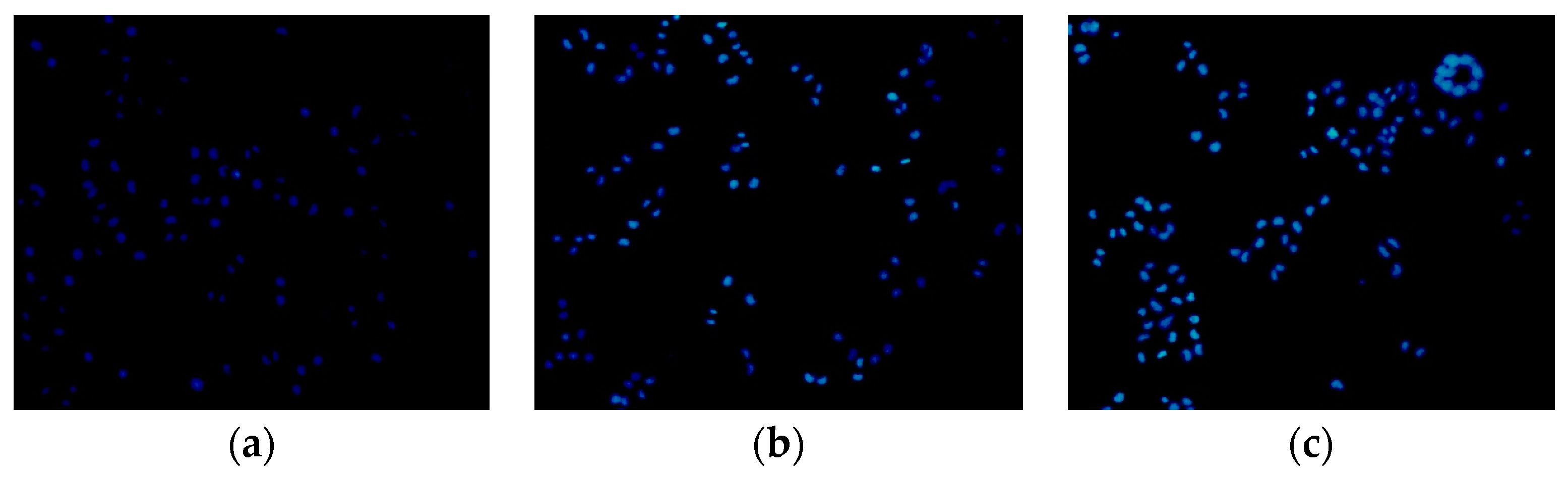
2.1.3. Apoptosis Assessment by Hoechst 33342 Staining
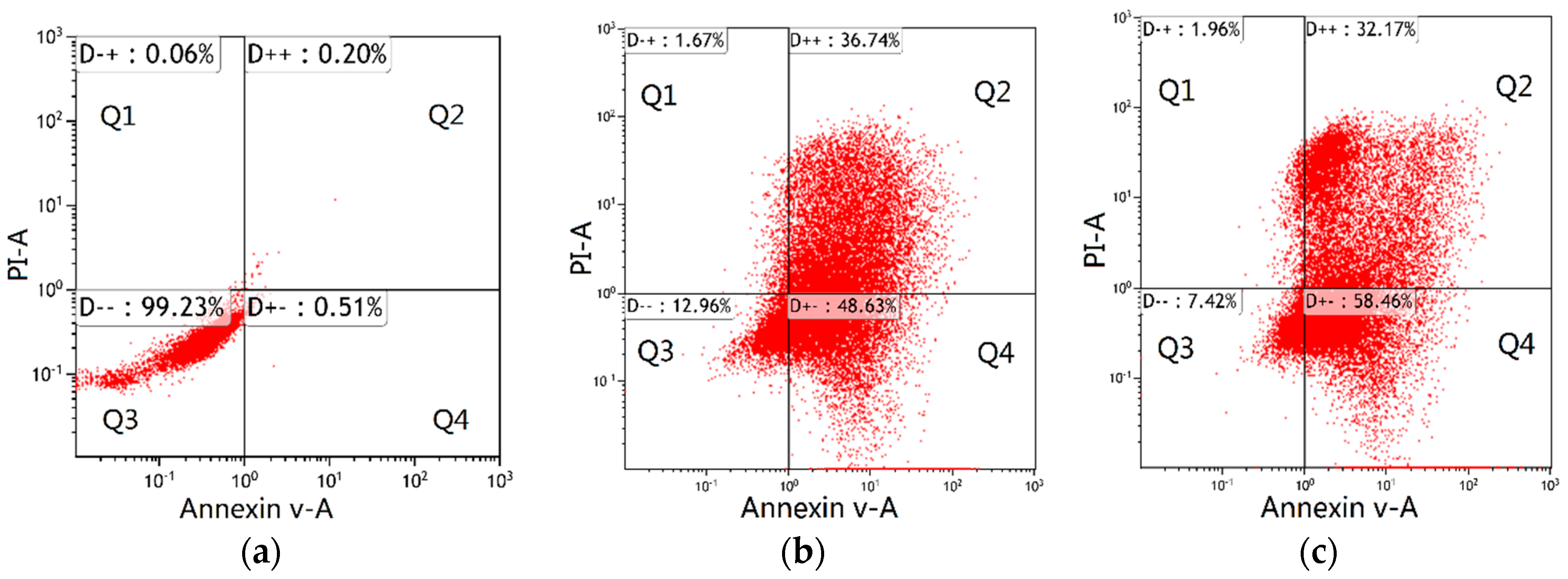
2.1.4. Apoptosis Study by Flow Cytometry Assay
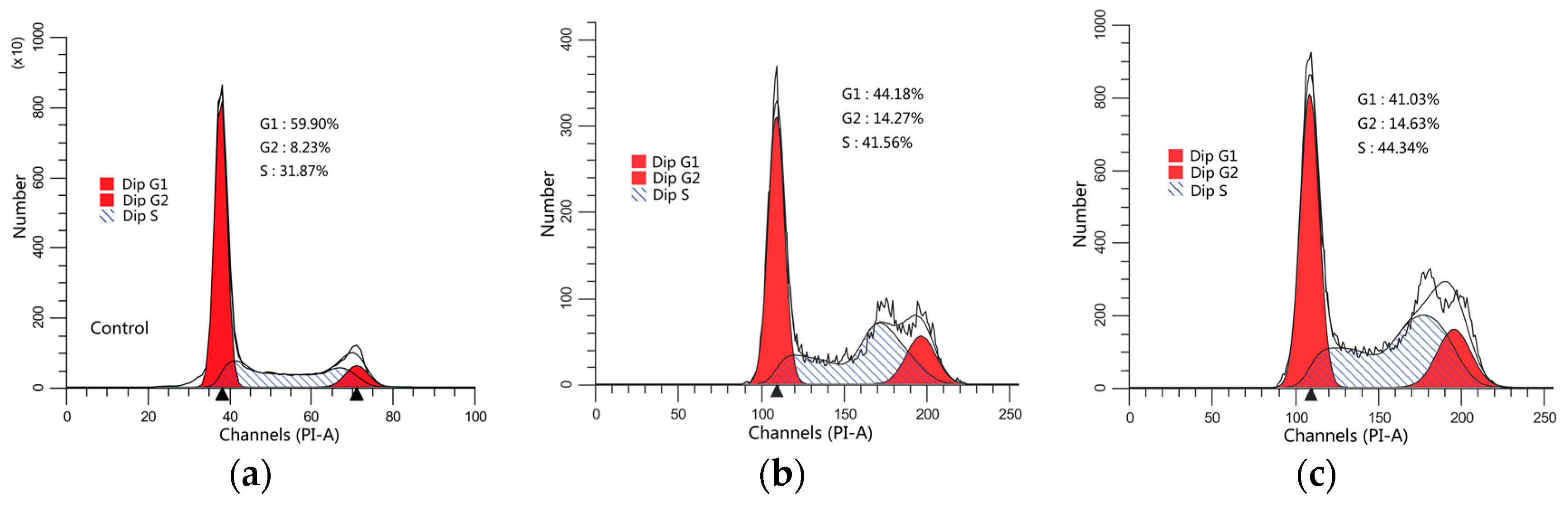
2.1.5. Investigation of Cell Cycle Distribution
3. Experimental Section
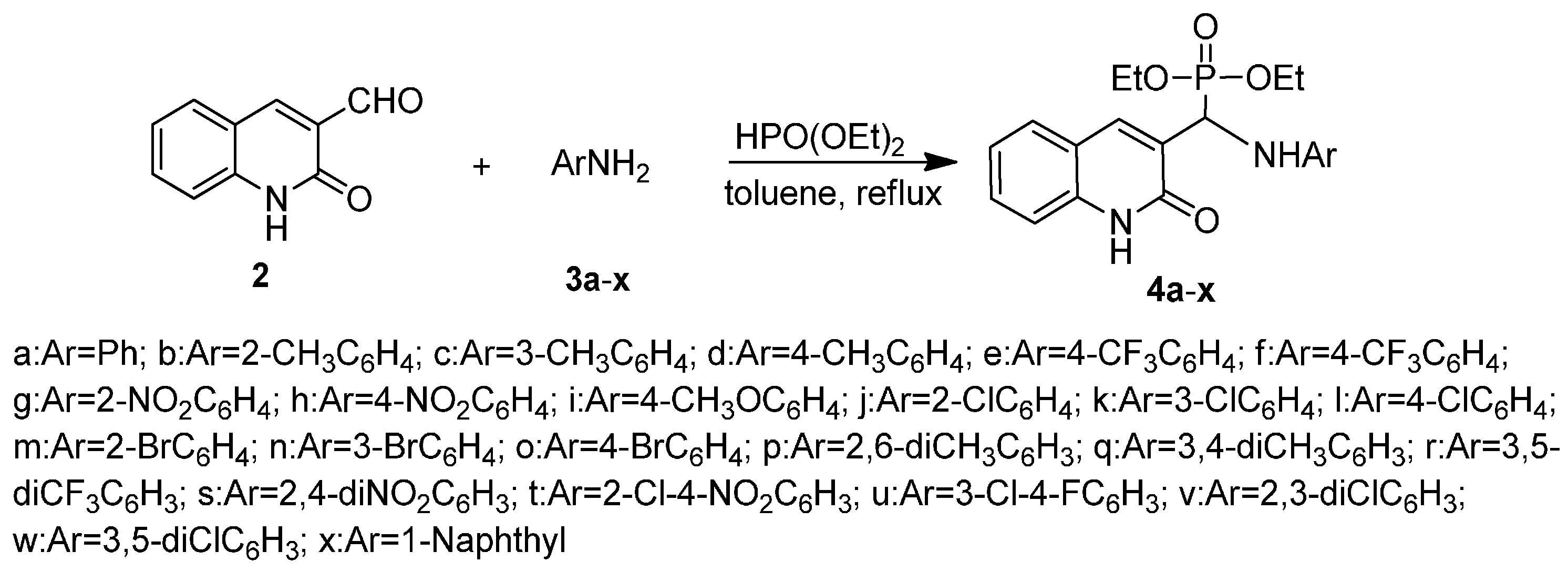
3.1. Chemistry
3.2. Biological Assays
3.2.1. Cell Antiproliferative Activity Assay
3.2.2. AO/EB Staining
3.2.3. Hoechst 33342 Staining
3.2.4. Apoptosis Detection via Flow Cytometry
3.2.5. Cell Cycle Distribution Analysis
4. Conclusions
Supplementary Materials
Acknowledgments
Author Contributions
Conflicts of Interest
References
- Hung, H.Y.; Ohkoshi, E.; Goto, M.; Bastow, K.F.; Nakagawa-Goto, K.; Lee, K.H. Antitumor agents. 293. nontoxicdimethyl-4,4′-dimethoxy-5,6,5′,6′-dimethy-lenedi oxybiphenyl-2,2′-dicarboxylate (DDB) analogues chemosensitize multidrug-resistant cancer cells to clinical anticancer drugs. J. Med. Chem. 2012, 55, 5413–5424. [Google Scholar] [CrossRef] [PubMed]
- Instituto Nacional de Cancer. Instituto Nacional do Cancer. Available online: http://www1.inca.gov.br/vigilancia/ (accessed on 6 August 2014).
- World Health Organization. World Health Organization. Available online: http://www.who.int/mediacentre/factsheets/fs297/en/index.html (accessed on 6 August 2014).
- Caleta, I.; Kralj, M.; Marjanovic, M.; Bertoša, B.; Tomić, S.; Pavlović, G.; Pavelić, K.; Karminski-Zamola, G. Novel cyano- and amidinobenzothiazole derivatives: Synthesis, antitumor evaluation, and X-ray and quantitative structure-activity relationship (QSAR) analysis. J. Med. Chem. 2009, 52, 1744–1756. [Google Scholar] [CrossRef] [PubMed]
- Ciardiello, F.; Tortora, G. A novel approach in the treatment of cancer: Targeting the epidermal growth factor receptor. Clin. Cancer Res. 2001, 7, 2958–2970. [Google Scholar] [PubMed]
- Brannon-Peppas, L.; Blanchette, J.O. Nanoparticle and targeted systems for cancer therapy. Adv. Drug. Deliv. Rev. 2004, 56, 1649–1659. [Google Scholar] [CrossRef] [PubMed]
- Aird, R.E.; Cummings, J.; Ritchie, A.A.; Muir1, M.; Morris, R.E.; Chen, H.; Sadler, P.J.; Jodrell, D.I. In vitro and in vivo activity and cross resistance profiles of novel ruthenium (II) organometallic arene complexes in human ovarian cancer. Br. J. Cancer 2002, 86, 1652–1657. [Google Scholar] [CrossRef] [PubMed]
- Abhishek, K.; Jennifer, F.; Pankaj, K. Design, synthesis and docking studies of new quinoline-3-carbohydrazide derivatives as antitubercular agents. Eur. J. Med. Chem. 2011, 46, 5283–5292. [Google Scholar]
- Shi, J.; Xiao, Z.; Ihnat, M.A.; Kamatb, C.; Pandita, B.; Hua, Z.G.; Li, P.K. Structure-activity relationships studies of the anti-angiogenic activities of linomide. Bioorg. Med. Chem. Lett. 2003, 13, 1187–1189. [Google Scholar] [CrossRef]
- Joseph, B.; Darro, F.; Béhard, A.; Lesur, B.; Collignon, F.; Decaestecker, C.; Frydman, A.; Guillaumet, G.; Kiss, R. 3-Aryl-2-quinolone derivatives: Synthesis and characterization of in vitro and in vivo antitumor effects with emphasis on a new therapeutical target connected with cell migration. J. Med. Chem. 2002, 45, 2543–2555. [Google Scholar] [CrossRef] [PubMed]
- Zhang, Y.; Fang, Y.L.; Liang, H.; Wang, H.S.; Hu, K.; Liu, X.X.; Yi, X.H.; Peng, Y. Synthesis and antioxidant activities of 2-oxo-quinoline-3-carbaldehyde Schiff-base derivatives. Bioorg. Med. Chem. Lett. 2013, 23, 107–111. [Google Scholar] [CrossRef] [PubMed]
- Sarveswari, S.; Vijayakumar, V.; Siva, R.; Priya, R. Synthesis of 4-hydroxy-2(1H)-quinolone derived chalcones, pyrazolines and their antimicrobial, in silico antimalarial evaluations. Appl. Biochem. Biotechnol. 2015, 175, 43–64. [Google Scholar] [CrossRef] [PubMed]
- Guo, M.; Zheng, C.J.; Song, M.X.; Wu, Y.; Sun, L.P.; Li, Y.J.; Liu, Y.; Piao, H.R. Synthesis and biological evaluation of rhodanine derivatives bearing a quinoline moiety as potent antimicrobial agents. Bioorg. Med. Chem. Lett. 2013, 23, 4358–4361. [Google Scholar] [CrossRef] [PubMed]
- Suthar, S.K.; Jaiswal, V.; Lohan, S.; Bansal, S.; Chaudhary, A.; Tiwari, A.; Alex, A.T.; Joesph, A. Novel quinolone substituted thiazolidin-4-ones as anti-inflammatory, anticancer agents: Design, synthesis and biological screening. Eur. J. Med. Chem. 2013, 63, 589–602. [Google Scholar] [CrossRef] [PubMed]
- Meth-Cohn, O. The synthesis of pyridines, quinolines and other related systems by the Vilsmeier and the reverse Vilsmeier method. Heterocycles 1993, 35, 539–557. [Google Scholar] [CrossRef]
- Rajendran, S.P.; Manonmoni, M.; Vijaya-Lakshmi, S. Synthesis of pyrazolo[3,4-b]quinolines and their 1-phenyl derivatives. Org. Prep. Proced. Int. 1994, 26, 383–385. [Google Scholar] [CrossRef]
- Chen, Y.F.; Lin, Y.C.; Huang, P.K.; Chan, H.C.; Kuo, S.C.; Lee, K.H.; Huang, L.J. Design and synthesis of 6,7-methylenedioxy-4-substituted phenylquinolin-2(1H)-one derivatives as novel anticancer agents that induce apoptosis with cell cycle arrest at G2/M phase. Bioorg. Med. Chem. 2013, 21, 5064–5075. [Google Scholar] [CrossRef] [PubMed]
- Raghavana, S.; Manogaranb, P.; Gadepalli Narasimha, K.K.; Kuppusamia, B.K.; Mariyappana, P.; Gopalakrishnanb, A.; Venkatraman, G. Synthesis and anticancer activity of novel curcumin-quinolone hybrids. Bioorg. Med. Chem. Lett. 2015, 25, 3601–3605. [Google Scholar] [CrossRef] [PubMed]
- Gnant, M.; Clézardin, P. Direct and indirect anticancer activity of bisphosphonates: A brief review of published literature. Cancer Treat. Rev. 2012, 38, 407–415. [Google Scholar] [CrossRef] [PubMed]
- He, S.; Ouyang, X.L.; Huang, X.C.; Hu, W.S.; Dai, W.L.; Tian, X.Y.; Pan, Y.M.; Huang, S.W.; Wang, H.S. Synthesis of derivatives of artesunate α-aminophosphonate and their antimicrobial activities. Lett. Drug Des. Discov. 2015, 12, 408–416. [Google Scholar] [CrossRef]
- Devarayan, K.; Sathishkumar, Y.; Lee, Y.S.; Kim, B.S. Effect of microgravity on fungistatic activity of an α-aminophosphonate chitosan derivative against aspergillus niger. PLoS ONE 2015, 10, e0139303/13. [Google Scholar] [CrossRef] [PubMed]
- Abdou, W.M.; Barghash, R.F.; Bekheit, M.S. Carbodiimides in the synthesis of enamino and α-aminophosphonates as peptidomimetics of analgesic/antiinflammatory and anticancer agents. J. Arch. Pharm. Chem. Life Sci. 2012, 345, 884–895. [Google Scholar] [CrossRef] [PubMed]
- Huang, X.C.; Wang, M.; Pan, Y.M.; Tiana, X.Y.; Wang, H.S.; Zhang, Y. Synthesis and antitumor activities of novel α-aminophosphonates dehydroabietic acid derivatives. Bioorg. Med. Chem. Lett. 2013, 23, 5283–5289. [Google Scholar] [CrossRef] [PubMed]
- Ye, M.Y.; Yao, G.Y.; Pan, Y.M.; Liao, Z.X.; Zhang, Y.; Wang, H.S. Synthesis and antitumor activities of novel α-aminophosphonate derivatives containing an alizarin moiety. Eur. J. Med. Chem. 2014, 83, 116–128. [Google Scholar] [CrossRef] [PubMed]
- Li, Y.J.; Wang, C.Y.; Ye, M.Y.; Yao, G.Y.; Wang, H.S. Novel coumarin-containing aminophosphonates as antitumor agent: Synthesis, cytotoxicity, DNA-binding and apoptosis evaluation. Molecules 2015, 20, 14791–14809. [Google Scholar] [CrossRef] [PubMed]
- Foroogh, B.; Farhad, P.; Fatemeh, D.; Yousefi, R.; Mohammad, B.S.; Bagher, M.; Ali, K.N. Synthesis of new α-aminophosphonate derivatives incorporating benzimidazole, theophylline and adenine nucleobases using l-cysteine functionalized magnetic nanoparticles (LCMNP) as magnetic reusable catalyst: Evaluation of their anticancer properties. RSC Adv. 2016, 6, 5915–5924. [Google Scholar]
- Li, W.; Yang, Z.H.; Hu, A.X.; Yan, X.W.; Ding, N.; Ye, J. Design, synthesis, and antitumor activity of (E,Z)-1-(dihydrobenzofuran-5-yl)-3-phenyl-2-(1,2,4-triazol-1-yl)-2-propen-1-ones. Chem. Biol. Drug Des. 2015, 86, 1339–1350. [Google Scholar] [CrossRef] [PubMed]

| Compound | IC50 ± SD (µM) a | ||||
|---|---|---|---|---|---|
| Ar | A549 | HeLa | MCF-7 | U2OS | |
| 4a | Ph | 103.6 ± 1.0 | 125.6 ± 4.4 | 90.2 ± 0.3 | >200 |
| 4b | 2-CH3C6H4 | 96.7 ± 5.7 | 25.5 ± 0.9 | 57.9 ± 0.3 | 143.1 ± 6.2 |
| 4c | 3-CH3C6H4 | 86.7 ± 3.8 | 36.1 ± 2.6 | 112.2 ± 0.3 | 131.6 ± 5.3 |
| 4d | 4-CH3C6H4 | 59.6 ± 4.3 | 49.4 ± 0.4 | 28.4 ± 0.4 | >200 |
| 4e | 3-CF3C6H4 | 91.7 ± 2.5 | 31.8 ± 0.6 | 29.1 ± 0.6 | 157.6 ± 4.1 |
| 4f | 4-CF3C6H4 | 41.6 ± 2.1 | 39.7 ± 6.4 | 57.5 ± 1.4 | 58.5 ± 0.7 |
| 4g | 2-NO2C6H4 | 53.5 ± 1.9 | 61.7 ± 0.9 | 174.3 ± 8.6 | 63.7 ± 1.2 |
| 4h | 4-NO2C6H4 | 128.0 ± 1.2 | 67.9 ± 1.7 | 35.7 ± 0.8 | 73.0 ± 0.1 |
| 4i | 4-OCH3C6H4 | 108.2 ± 1.1 | 73.4 ± 1.1 | 28.5 ± 1.9 | 109.9 ± 7.9 |
| 4j | 2-ClC6H4 | 22.7 ± 3.0 | 50.0 ± 0.8 | 25.5 ± 0.4 | 73.9 ± 0.9 |
| 4k | 3-ClC6H4 | 35.4 ± 0.6 | 137.0 ± 8.9 | 31.2 ± 2.0 | 60.8 ± 4.0 |
| 4l | 4-ClC6H4 | 163.3 ± 3.3 | 49.9 ± 3.9 | 54.6 ± 1.4 | 110.5 ± 0.2 |
| 4m | 2-BrC6H4 | 85.6 ± 2.2 | 95.2 ± 5.9 | 26.0 ± 0.5 | 86.5 ± 1.6 |
| 4n | 3-BrC6H4 | 49.4 ± 2.5 | 19.2 ± 0.4 | 55.2 ± 2.1 | 46.3 ± 1.4 |
| 4o | 4-BrC6H4 | >200 | >200 | >200 | 94.9 ± 2.1 |
| 4p | 2,6-diCH3C6H3 | 40.8 ± 0.4 | 64.9 ± 6.1 | 87.4 ± 3.3 | 26.3 ± 1.3 |
| 4q | 3,4-diCH3C6H3 | 26.4 ± 1.4 | 76.8 ± 8.6 | 79.0 ± 1.9 | 89.8 ± 1.1 |
| 4r | 3,5-diCF3C6H3 | 31.1 ± 0.1 | 45.9 ± 1.5 | 42.8 ± 5.9 | 132.1 ± 8.2 |
| 4s | 2,4-diNO2C6H3 | 21.6 ± 1.2 | 37.2 ± 5.4 | 65.5 ± 2.7 | 87.1 ± 7.8 |
| 4t | 2-Cl-4-NO2C6H3 | 62.7 ± 7.2 | 15.1 ± 1.4 | 63.8 ± 3.1 | 38.1 ± 1.5 |
| 4u | 3-Cl-4-FC6H3 | 16.6 ± 0.9 | 2.5 ± 0.6 | 1.0 ± 0.4 | 26.3 ± 2.0 |
| 4v | 2,3-diClC6H3 | 49.8 ± 7.8 | 39.3 ± 5.2 | 32.0 ± 1.4 | 44.7 ± 0.8 |
| 4w | 3,5-diClC6H3 | 46.9 ± 0.8 | 62.2 ± 4.5 | 27.0 ± 3.4 | 43.4 ± 1.2 |
| 4x | 1-Naphthyl | 29.4 ± 0.5 | 27.4 ± 6.0 | 0.3 ± 0.1 | 2.5 ± 0.2 |
| 2-oxo-quinoline | >200 | >200 | >200 | >200 | |
| 5-FU | 34.32 ± 2.1 | 56.5 ± 3.4 | 79.3 ± 5.1 | NT b | |
| Group | Concentration (µM) | Necrotic Cells (Q1, %) | Late Apoptotic Cells (Q2, %) | Viable Cells (Q3, %) | Early Apoptotic Cells (Q4, %) | Apoptotic Cells (Q2 + Q4, %) |
|---|---|---|---|---|---|---|
| Control | 0 | 0.06 | 0.2 | 99.23 | 0.51 | 0.71 |
| Compd. 4u | 10 | 1.67 | 36.74 | 12.96 | 48.63 | 85.37 |
| Compd. 4u | 15 | 1.96 | 32.17 | 7.42 | 58.46 | 90.63 |
| Group | Concentration (µM) | G0/G1 (Phase%) | S (Phase%) | G2/M (Phase%) |
|---|---|---|---|---|
| Control | 0 | 59.90 | 31.87 | 8.23 |
| Compd. 4u | 5 | 44.18 | 41.56 | 14.27 |
| Compd. 4u | 10 | 41.03 | 44.34 | 14.63 |
© 2016 by the authors; licensee MDPI, Basel, Switzerland. This article is an open access article distributed under the terms and conditions of the Creative Commons Attribution (CC-BY) license (http://creativecommons.org/licenses/by/4.0/).
Share and Cite
Fang, Y.-L.; Wu, Z.-L.; Xiao, M.-W.; Tang, Y.-T.; Li, K.-M.; Ye, J.; Xiang, J.-N.; Hu, A.-X. One-Pot Three-Component Synthesis of Novel Diethyl((2-oxo-1,2-dihydroquinolin-3-yl)(arylamino)methyl)phosphonate as Potential Anticancer Agents. Int. J. Mol. Sci. 2016, 17, 653. https://doi.org/10.3390/ijms17050653
Fang Y-L, Wu Z-L, Xiao M-W, Tang Y-T, Li K-M, Ye J, Xiang J-N, Hu A-X. One-Pot Three-Component Synthesis of Novel Diethyl((2-oxo-1,2-dihydroquinolin-3-yl)(arylamino)methyl)phosphonate as Potential Anticancer Agents. International Journal of Molecular Sciences. 2016; 17(5):653. https://doi.org/10.3390/ijms17050653
Chicago/Turabian StyleFang, Yi-Lin, Zhi-Lin Wu, Meng-Wu Xiao, Yu-Ting Tang, Kang-Ming Li, Jiao Ye, Jian-Nan Xiang, and Ai-Xi Hu. 2016. "One-Pot Three-Component Synthesis of Novel Diethyl((2-oxo-1,2-dihydroquinolin-3-yl)(arylamino)methyl)phosphonate as Potential Anticancer Agents" International Journal of Molecular Sciences 17, no. 5: 653. https://doi.org/10.3390/ijms17050653
APA StyleFang, Y.-L., Wu, Z.-L., Xiao, M.-W., Tang, Y.-T., Li, K.-M., Ye, J., Xiang, J.-N., & Hu, A.-X. (2016). One-Pot Three-Component Synthesis of Novel Diethyl((2-oxo-1,2-dihydroquinolin-3-yl)(arylamino)methyl)phosphonate as Potential Anticancer Agents. International Journal of Molecular Sciences, 17(5), 653. https://doi.org/10.3390/ijms17050653

