Valorization of Food By-Products into a Zero-Waste Broth: Effects of Yeast Extract on Composition and Sensory Properties

 ,
,  , ,
, ,  ,
,  , , , and
Abstract
1. Introduction
2. Results and Discussion
2.1. Characterization of Zero-Waste Broth
2.2. Yeast Extracts as a Source of Nucleosides and Vitamins
2.3. Zero-Waste Broth Enriched with Yeast Extract: Bioactive-Related Properties
3. Materials and Methods
3.1. Chemicals and Reagents
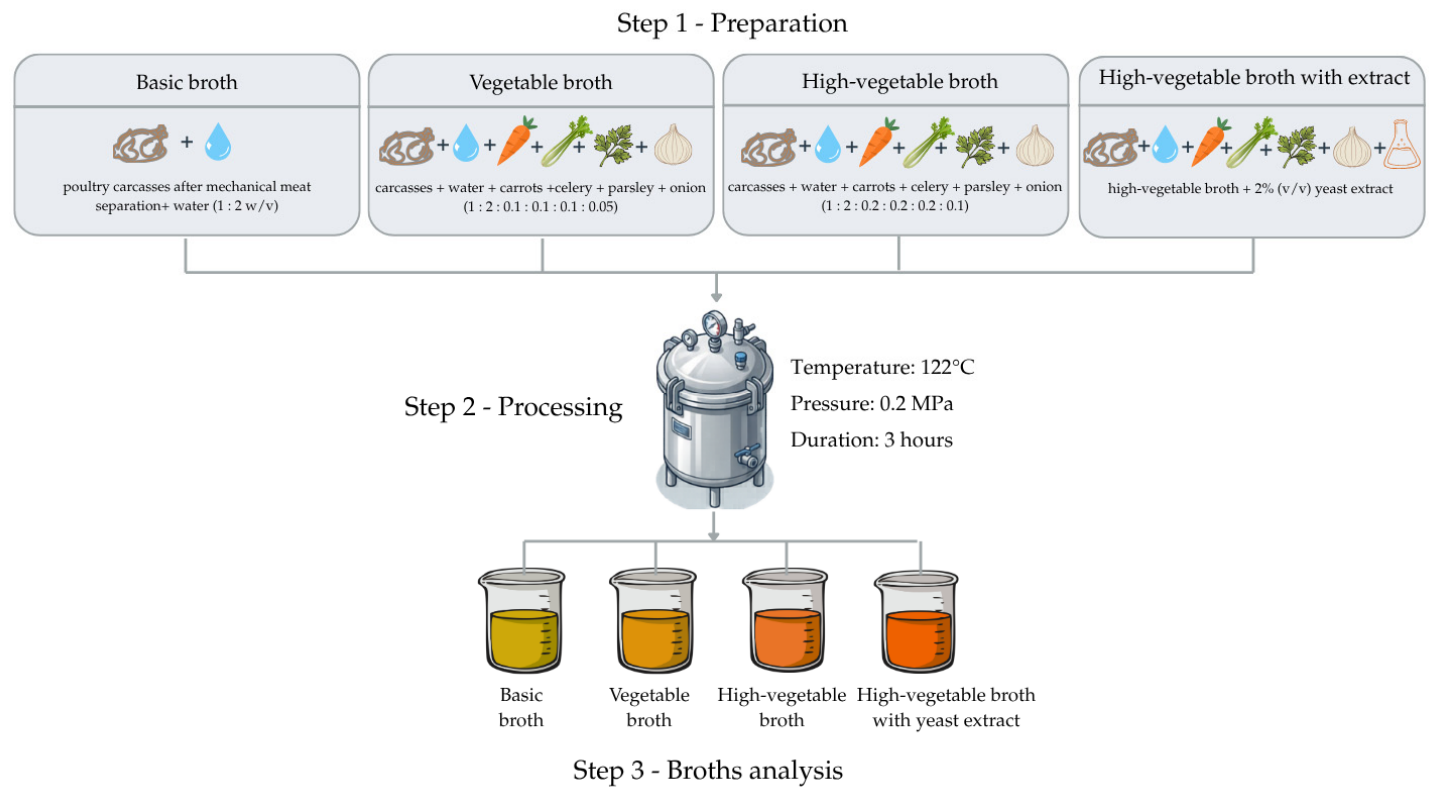
3.2. Broths Preparation
3.3. Amino Acids Composition of Broths
3.4. Determination of Protein Content in Broths
3.5. Turbidity of Broths
3.6. Content of Vitamin A and K in Broths
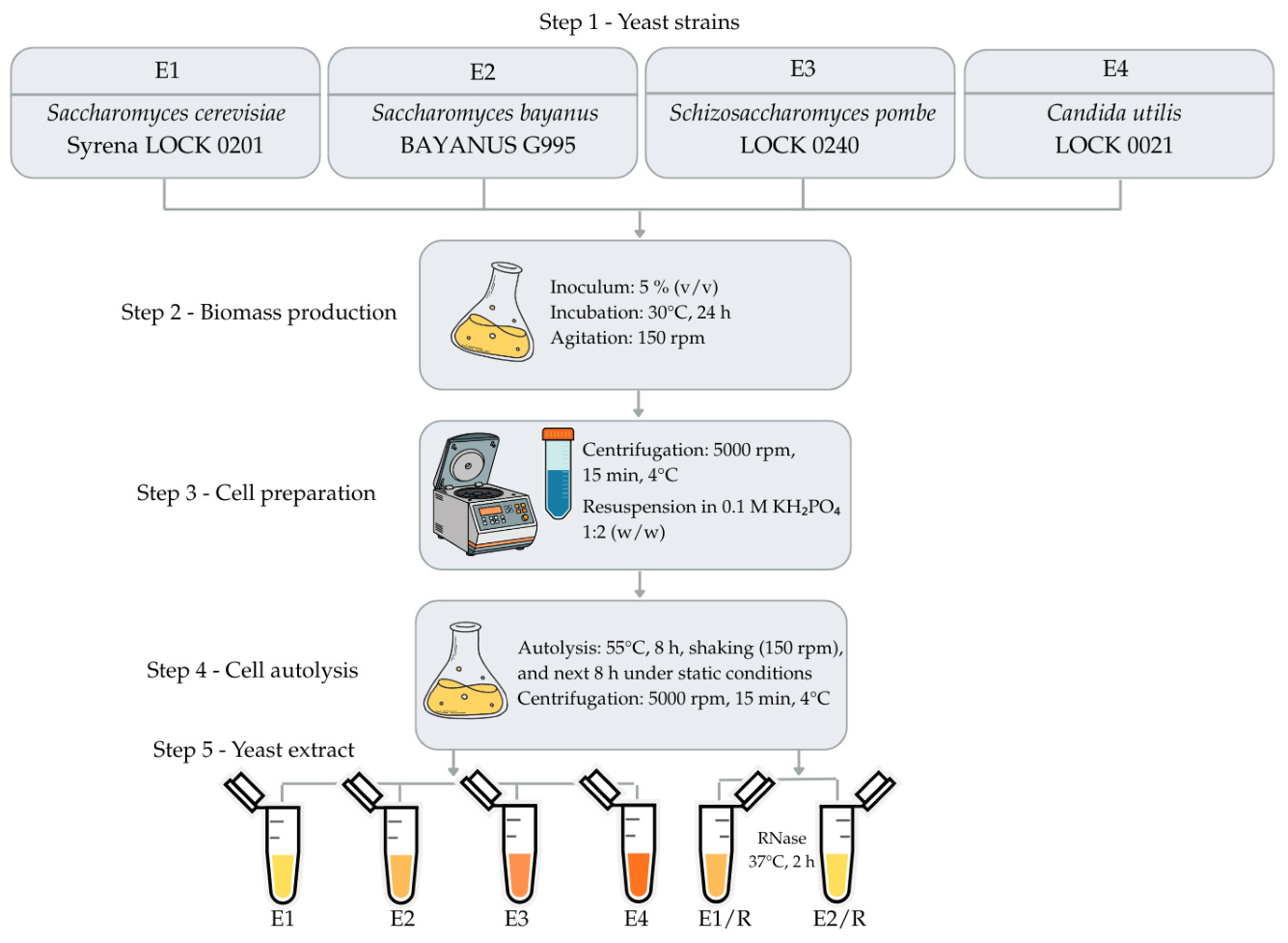
3.7. Preparation of Yeast Extracts
3.8. Determination of Nucleoside 5′-Phosphate Content in Yeast Extracts and Broths
3.9. Antioxidant Properties of Broths and Yeast Extracts
3.10. Determination of B-Group Vitamin Content in Yeast Extracts and Broths
3.11. Sensory Evaluation of Broths
3.12. Statistical Analysis
4. Conclusions
Author Contributions
Funding
Institutional Review Board Statement
Informed Consent Statement
Data Availability Statement
Conflicts of Interest
References
- Yamamoto, T.; Inui-Yamamoto, C. The flavor-enhancing action of glutamate and its mechanism involving the notion of kokumi. npj Sci. Food 2023, 7, 3. [Google Scholar] [CrossRef]
- Yang, J.; Liao, J.; Dong, H.; Huang, G.; Bai, W.; Tu, J.; Zeng, X. Synergistic effect of kokumi-active γ-glutamyl peptides and l-glutamate on enhancing umami sensation and stimulating cholecystokinin secretion via T1R1/T1R3 activation in STC-1 cells. J. Agric. Food Chem. 2022, 70, 14395–14402. [Google Scholar] [CrossRef]
- IMARC Group. Europe Soup Market Size, Share, Trends and Forecast by Type, Category, Packaging, Distribution Channel, and Country 2025–2033. 2025. Available online: https://www.imarcgroup.com/europe-soup-market (accessed on 4 November 2025).
- Statista. Soups—Poland. 2025. Available online: https://www.statista.com/outlook/emo/food/convenience-food/soups/poland (accessed on 4 November 2025).
- Coderoni, S.; Perito, M.A. Sustainable consumption in the circular economy: An analysis of consumers’ purchase intentions for waste-to-value food. J. Clean. Prod. 2020, 252, 119870. [Google Scholar] [CrossRef]
- Grasso, S.; Asioli, D. Consumer preferences for upcycled ingredients: A case study with biscuits. Food Qual. Prefer. 2020, 84, 103951. [Google Scholar] [CrossRef]
- Wang, S.; Zhang, S.; Adhikari, K. Influence of monosodium glutamate and its substitutes on sensory characteristics and consumer perceptions of chicken soup. Foods 2019, 8, 71. [Google Scholar] [CrossRef]
- Kos, I.; Bendelja Ljoljić, D.; Vrdoljak, I.; Glavaš, V.; Kovačević, N.; Pleadin, J.; Vnučec, I. Glutamate in meat processing—Origin, function and novel application. J. Cent. Eur. Agric. 2023, 24, 624–633. [Google Scholar] [CrossRef]
- Prescott, J. The science of savory: Umami taste and food preferences. In Umami: The Fifth Taste; Wilcox, D., Yokota, N., Kawakami, J., Eds.; Kodansha: New York, NY, USA, 2014; pp. 11–17. [Google Scholar]
- Kurihara, K. Umami the fifth basic taste: History of studies on receptor mechanisms and role as a food flavor. BioMed Res. Int. 2015, 2015, 189402. [Google Scholar] [CrossRef]
- Otero, M.; Guerrero, I.; Wagner, J.; Cabello, A.; Sceni, P.; García, R.; Soriano, J.; Tomasini, A.; Saura, G.; Almazán, O. Yeast and its derivatives as ingredients in the food industry. Biotecnol. Apl. 2011, 28, 272–275. [Google Scholar]
- EFSA. Update of the list of qualified presumption of safety (QPS) recommended microbiological agents intentionally added to food or feed: Suitability of taxonomic units notified to EFSA until September 2024. EFSA J. 2025, 23, 9169. [Google Scholar]
- U.S. Food and Drug Administration (FDA). GRAS Notice Inventory. Available online: https://www.fda.gov/food/generally-recognized-safe-gras/gras-notice-inventory (accessed on 4 November 2025).
- Tomé, D. Yeast extracts: Nutritional and flavoring food ingredients. ACS Food Sci. Technol. 2021, 1, 487–494. [Google Scholar] [CrossRef]
- Tao, Z.; Yuan, H.; Liu, M.; Liu, Q.; Zhang, S.; Liu, H.; Jiang, Y.; Huang, D.; Wang, T. Yeast extract: Characteristics, production, applications and future perspectives. J. Microbiol. Biotechnol. 2023, 33, 151–166. [Google Scholar] [CrossRef]
- Şen Yılmaz, E.B. Utilization of yeast extract as a flavor enhancer and masking agent in sodium-reduced marinated shrimp. Molecules 2024, 29, 182. [Google Scholar] [CrossRef]
- Hossain, M.J.; Alam, A.N.; Lee, E.-Y.; Hwang, Y.-H.; Joo, S.-T. Umami characteristics and taste improvement mechanism of meat. Food Sci. Anim. Resour. 2024, 44, 515–532. [Google Scholar] [CrossRef]
- You, Z.; Bai, Y.; Bo, D.; Feng, Y.; Shen, J.; Wang, Y.; Bai, Y. A review of taste-active compounds in meat: Identification, influencing factors, and taste transduction mechanism. J. Food Sci. 2024, 89, 8128–8155. [Google Scholar] [CrossRef]
- Vieira, E.; Carvalho, J.; Pinto, E.; Cunha, S.; Almeida, A.; Ferreira, I. Nutritive value, antioxidant activity and phenolic compounds profile of brewer’s spent yeast extract. J. Food Compos. Anal. 2016, 52, 44–51. [Google Scholar] [CrossRef]
- Złotek, U.; Świeca, M. Elicitation effect of Saccharomyces cerevisiae yeast extract on main health-promoting compounds and antioxidant and anti-inflammatory potential of butter lettuce (Lactuca sativa L.). J. Sci. Food Agric. 2015, 96, 2565–2572. [Google Scholar] [CrossRef]
- Podpora, B.; Swiderski, F.; Sadowska, A.; Piotrowska, A.; Rakowska, R. Spent brewer’s yeast autolysates as a new and valuable component of functional food and dietary supplements. J. Food Process. Technol. 2015, 6, 1000526. [Google Scholar]
- Komorowska, A.; Sieliwanowicz, B.; Stecka, K. Flavour enhancers—Characteristics, obtainment and application. Food Sci. Technol. Qual. 2002, 4, 30–39. (In Polish) [Google Scholar]
- Tanaka, K.; Itoh, T.; Kondoh, T. Effects of purine and pyrimidine 5’-ribonucleotides on glutamate detection threshold and umami intensity in Japanese young female trained participants. Chem. Senses 2025, 50, bjaf043. [Google Scholar] [CrossRef] [PubMed]
- Wang, W.; Zhou, X.; Liu, Y. Characterization and evaluation of umami taste: A review. TrAC Trends Anal. Chem. 2020, 127, 2–7. [Google Scholar] [CrossRef]
- Crowe, M.S.; Wang, H.; Blakeney, B.A.; Mahavadi, S.; Singh, K.; Murthy, K.S.; Grider, J.R. Expression and function of umami receptors T1R1/T1R3 in gastric smooth muscle. Neurogastroenterol. Motil. 2020, 32, e13737. [Google Scholar] [CrossRef]
- Komorowska, A.; Sieliwanowicz, B.; Mrówka, E.; Stecka, K.; Hałasińska, A. Studies on yeast extracts enriched in 5’nucleotides flavour enhancers obtained from spent brewery yeast. Electron. J. Pol. Agric. Univ. 2003, 6, 2–6. [Google Scholar]
- European Union. Regulation (EU) No 1169/2011 of the European Parliament and of the Council on the provision of food information to consumers. Off. J. Eur. Union 2011, L 304, 61. [Google Scholar]
- European Union. Regulation (EC) No 1924/2006 of the European Parliament and of the Council on nutrition and health claims made on foods. Off. J. Eur. Union 2006, L 404, 8–9. [Google Scholar]
- European Union. Commission Regulation (EU) No 432/2012 establishing a list of permitted health claims made on foods, other than those referring to the reduction of disease risk and to children’s development and health. Off. J. Eur. Union 2012, L 136, 1–40. [Google Scholar]
- Dawidowicz, A.L.; Wianowska, D.; Olszowy, M. On practical problems in estimation of antioxidant activity of compounds by DPPH method (Problems in estimation of antioxidant activity). Food Chem. 2012, 131, 1037–1043. [Google Scholar] [CrossRef]
- Kiss, A.; Papp, V.A.; Pál, A.; Prokisch, J.; Mirani, S.; Toth, B.E.; Alshaal, T. Comparative study on antioxidant capacity of diverse food matrices: Applicability, suitability and inter-correlation of multiple assays to assess polyphenol and antioxidant status. Antioxidants 2025, 14, 317. [Google Scholar] [CrossRef] [PubMed]
- Szajdek, A.; Borowska, J. Antioxidant properties of plant-based food products. Food Sci. Technol. Qual. 2004, 4, 5–28. (In Polish) [Google Scholar]
- Zhu, Y.; Lao, F.; Pan, X.; Wu, J. Food protein-derived antioxidant peptides: Molecular mechanism, stability and bioavailability. Biomolecules 2022, 12, 1622. [Google Scholar] [CrossRef]
- Guo, X.; Wu, J.; Meng, X.; Zhang, Y.; Peng, Z. Oxidative characteristics and gel properties of porcine myofibrillar proteins affected by L-lysine and L-histidine in a dose-dependent manner at a low and high salt concentration. Int. J. Food Sci. Technol. 2022, 57, 2556–2567. [Google Scholar] [CrossRef]
- Mirzaei, M.; Mirdamadi, S.; Ehsani, M.R. Purification and identification of antioxidant and ACE-inhibitory peptide from Saccharomyces cerevisiae protein hydrolysate. J. Funct. Foods 2015, 19, 259–268. [Google Scholar] [CrossRef]
- European Union. Commission Regulation (EC) No 1441/2007 of 5 December 2007 amending Regulation (EC) No 2073/2005 on microbiological criteria for foodstuffs. Off. J. Eur. Union 2007, L 322, 12–29. [Google Scholar]
- European Union. Commission Directive 98/64/EC of 3 September 1998 establishing Community methods of analysis for the determination of aminoacids, crude oils and fats, and olaquindox in feedingstuffs. Off. J. Eur. Communities 1998, L 257, 14–16. [Google Scholar]
- Liu, Z.; Pan, J. A practical method for extending the biuret assay to protein determination of corn-based products. Food Chem. 2017, 224, 289–293. [Google Scholar] [CrossRef]
- Re, R.; Pellegrini, N.; Proteggente, A.; Pannala, A.; Yang, M.; Rice-Evans, C. Antioxidant activity applying an improved ABTS radical cation decolorization assay. Free Radic. Biol. Med. 1999, 26, 1231–1237. [Google Scholar] [CrossRef]
- Brand-Williams, W.; Cuvelier, M.E.; Berset, C. Use of a free radical method to evaluate antioxidant activity. LWT Food Sci. Technol. 1995, 28, 25–30. [Google Scholar] [CrossRef]
- Xiao, F.; Xu, T.; Lu, B.; Liu, R. Guidelines for antioxidant assays for food components. Food Front. 2020, 1, 60–69. [Google Scholar] [CrossRef]



| Parameter | Content in Broth |
|---|---|
| Protein content [g/100 g] | 3.13 ± 0.28 |
| Content of soluble proteins [g/100 g] | 3.14 ± 0.22 |
| Proportion of white muscle tissue [g/100 g] | 58.31 ± 4.35 |
| Proportion of connective tissue proteins [g/100 g] | 41.69 ± 4.01 |
| Amino acid composition [g/100 g of proteins] | |
| Cysteine | 0.83 ± 0.06 |
| Aspartic acid | 7.94 ± 0.62 |
| Tyrosine | 5.22 ± 0.48 |
| Serine | 5.57 ± 0.39 |
| Glutamic acid | 10.27 ± 0.86 |
| Proline | 8.25 ± 0.63 |
| Glycine | 18.63 ± 1.02 |
| Alanine | 9.81 ± 0.84 |
| Hydroxyproline | 3.96 ± 0.27 |
| Hydroxylysine | 0.25 ± 0.04 |
| Exogenous amino acids | |
| Valine | 3.91 ± 0.21 |
| Methionine | 2.52 ± 0.17 |
| Isoleucine | 5.13 ± 0.38 |
| Threonine | 2.64 ± 0.19 |
| Phenylalanine | 2.58 ± 0.33 |
| Lysine | 4.56 ± 0.26 |
| Histidine | 1.41 ± 0.09 |
| Arginine | 5.16 ± 0.40 |
| Tryptophan | 0.55 ± 0.03 |
| Leucine | 1.00 ± 0.08 |
| Content of exogenous amino acids [g/100 g of broth] | 0.92 ± 0.07 |
| Parameter | Broth with Vegetables | Broth with Higher Content of Vegetables |
|---|---|---|
| Vitamin K1 content [µg/100 g] | 2.020 ± 0.170 b | 4.615 ± 0.203 a |
| Vitamin K2 content [µg/100 g] | 4.710 ± 0.396 b | 8.505 ± 0.516 a |
| β-carotene concentration [µg/100 g] | 720 ± 34 b | 1060 ± 85 a |
| Calculated vitamin A content [µg/100 g] | 120 | 177 |
| Antioxidant activity | ||
| ABTS [mg TX/L]/% inhibition | 426.6 ± 20.6 b/59.7 | 511.2 ± 22.6 a/70.4 |
| FRAP [mg FeSO4/L] | 365.7 ± 19.1 b | 614.5 ± 24.8 a |
| Type of Autolysate | 5′CMP | 5′UMP | 5′GMP and 5′IMP | 5′TMP | 5′AMP | Other Nucleotides and Nucleosides |
|---|---|---|---|---|---|---|
| Concentration [µg/mL] | ||||||
| E1 | 14.89 ± 1.15 a | not detected | 10.47 ± 0.59 a | 12.92 ± 0.92 a | 22.57 ± 1.11 a | 1447.39 ± 9.15 b |
| E2 | 14.48 ± 0.52 a | not detected | trace d | 9.74 ± 0.73 c | 8.21 ± 0.14 b | 721.15 ± 5.19 d |
| E1/R | 14.76 ± 1.52 a | not detected | 9.91 ± 0.32 b | 11.81 ± 0.53 b | 3.24 ± 0.08 d | 1573.66 ± 17.32 a |
| E2/R | 14.44 ± 1.07 a | not detected | trace d | 8.88 ± 0.89 c | 7.15 ± 0.32 c | 765.14 ± 5.21 c |
| EC | 14.48 ± 0.43 a | 0.34 ± 0.01 | 1.16 ± 0.09 c | 8.77 ± 0.36 c | 3.13 ± 0.54 d | 78.54 ± 1.11 e |
| Type of Autolysate | ABTS | DPPH | FRAP | ||
|---|---|---|---|---|---|
| mg TX/L | % Inhibition | mg TX/L | % Inhibition | mgFeSO4/L | |
| E1 | 359.9 ± 19.0 a,b | 50.4 | 74.8 ± 8.7 a | 10.8 | 359.3 ± 21.2 b |
| E2 | 338.2 ± 18.4 a,b | 45.5 | 60.6 ± 7.8 a | 5.1 | 61.2 ± 7.8 d |
| E1/R | 379.6 ± 19.5 a | 50.5 | 73.1 ± 8.6 a | 10.1 | 416.9 ± 20.4 a |
| E2/R | 326.6 ± 18.1 b | 45.0 | 70.2 ± 8.4 a | 8.9 | 73.5 ± 8.6 d |
| EC | 324.2 ± 17.2 b | 45.0 | 71.1 ± 3.2 a | 9.2 | 254.2 ± 18.6 c |
| Parameter | Control Broth | Yeast-Extract-Enriched Broth |
|---|---|---|
| Nucleotide content [µg/mL] | ||
| 5′CMP | 20.53 ± 0.58 a | 21.11 ± 1.11 a |
| 5′UMP | 0 a | 0 a |
| 5′GMP and 5′IMP | 82.90 ± 1.33 a | 84.97 ± 0.54 a |
| 5′TMP | 8.11 ± 0.54 a | 8.13 ± 0.22 a |
| 5′AMP | 57.99 ± 0.98 b | 65.25 ± 0.72 a |
| Other nucleotides and nucleosides | 970.09 ± 5.31 b | 1085.71 ± 7.01 a |
| Antioxidant activity | ||
| ABTS [mg TX/L]/% inhibition | 511.20 ± 22.6 a/70.4 | 503.68 ± 0.13 a/68.6 |
| FRAP [mg FeSO4/L] | 614.50 ± 24.8 b | 673.07 ± 13.49 a |
| Vitamin | Content Per 100 g of Broth | Content Per 200 g Serving of Broth | Functional Level |
|---|---|---|---|
| Vitamin K1 | 5.289 ± 0.172 µg | 10.578 | 11.25 µg |
| Vitamin K2 | 8.621 ± 0.328 µg | 17.242 | |
| Vitamin K1 and K2 | 13.910 µg | 27.82 µg | |
| β-carotene | 981 ± 71 µg | 1962 µg | – |
| Calculated vitamin A concentration | 163 µg | 326 µg | 120 µg |
| Vitamin B1 | 0.183 ± 0.019 mg | 0.366 mg | 0.165 mg |
| Vitamin B2 | 0.148 ± 0.017 mg | 0.296 mg | 0.210 mg |
| Vitamin B6 | 0.126 ± 0.024 mg | 0.252 mg | 0.210 mg |
| Vitamin B9 | 0.659 ± 0.074 mg | 1.318 mg | 0.030 mg |
Disclaimer/Publisher’s Note: The statements, opinions and data contained in all publications are solely those of the individual author(s) and contributor(s) and not of MDPI and/or the editor(s). MDPI and/or the editor(s) disclaim responsibility for any injury to people or property resulting from any ideas, methods, instructions or products referred to in the content. |
© 2026 by the authors. Licensee MDPI, Basel, Switzerland. This article is an open access article distributed under the terms and conditions of the Creative Commons Attribution (CC BY) license.
Share and Cite
Otlewska, A.; Dybka-Stępień, K.; Rajkowska, K.; Koziróg, A.; Nowak, A.; Piotrowska, M.; Czerbniak-Włodarczyk, A.; Czyżowska, A.; Grzelczyk, J.; Kołczyk, A. Valorization of Food By-Products into a Zero-Waste Broth: Effects of Yeast Extract on Composition and Sensory Properties. Molecules 2026, 31, 1529. https://doi.org/10.3390/molecules31091529
Otlewska A, Dybka-Stępień K, Rajkowska K, Koziróg A, Nowak A, Piotrowska M, Czerbniak-Włodarczyk A, Czyżowska A, Grzelczyk J, Kołczyk A. Valorization of Food By-Products into a Zero-Waste Broth: Effects of Yeast Extract on Composition and Sensory Properties. Molecules. 2026; 31(9):1529. https://doi.org/10.3390/molecules31091529
Chicago/Turabian StyleOtlewska, Anna, Katarzyna Dybka-Stępień, Katarzyna Rajkowska, Anna Koziróg, Agnieszka Nowak, Małgorzata Piotrowska, Aleksandra Czerbniak-Włodarczyk, Agata Czyżowska, Joanna Grzelczyk, and Anna Kołczyk. 2026. "Valorization of Food By-Products into a Zero-Waste Broth: Effects of Yeast Extract on Composition and Sensory Properties" Molecules 31, no. 9: 1529. https://doi.org/10.3390/molecules31091529
APA StyleOtlewska, A., Dybka-Stępień, K., Rajkowska, K., Koziróg, A., Nowak, A., Piotrowska, M., Czerbniak-Włodarczyk, A., Czyżowska, A., Grzelczyk, J., & Kołczyk, A. (2026). Valorization of Food By-Products into a Zero-Waste Broth: Effects of Yeast Extract on Composition and Sensory Properties. Molecules, 31(9), 1529. https://doi.org/10.3390/molecules31091529