Tracking Aromatic Volatile Biomarkers Through Coffee Bean Postharvest Stages

 ,
,  , and
, and 
Abstract
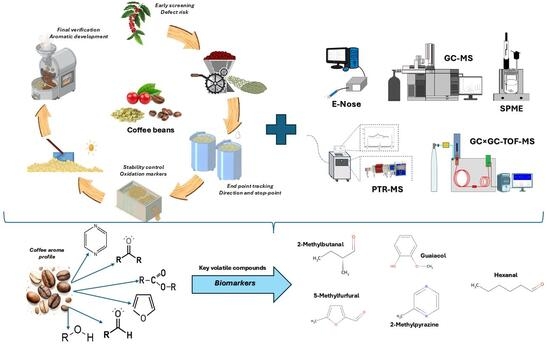
1. Introduction
2. Biosynthesis Routes and Abiotic Mechanisms of Aroma Compound Formation During Coffee Postharvest Processing
2.1. Biosynthetic Pathways
2.2. Abiotic Mechanism
3. Volatile Compounds in Coffee Harvest
3.1. Harvest as a Determinant of Volatile Potential in Coffee
3.2. Physiological Status and Early Volatile Signatures
4. Biomarkers in the Coffee Bean Postharvest Stages
4.1. Pulping
4.2. Fermentation
4.3. Washing
4.4. Drying
4.5. Roasting
5. Analytical Approaches for Coffee Volatiles
5.1. Headspace–Solid-Phase Microextraction–Gas Chromatography–Mass Spectrometry (HS-SPME-GC-MS)
5.2. Dynamic Headspace (DHS)
5.3. Solvent-Assisted Flavor Evaporation (SAFE)
5.4. Gas Chromatography–Olfactometry (GC–O)
5.5. Comprehensive Two-Dimensional Gas Chromatography–Time-of-Flight Mass Spectrometry (GC×GC–TOF-MS)
5.6. Proton-Transfer-Reaction Time-of-Flight Mass Spectrometry (PTR-ToF-MS)
5.7. Gas Chromatography–Ion Mobility Spectrometry (GC–IMS)
6. Future Perspectives
6.1. Biomarkers as Indicators of Cup Quality
6.2. Validation of Coffee Volatile Biomarkers
7. Conclusions
Author Contributions
Funding
Institutional Review Board Statement
Informed Consent Statement
Data Availability Statement
Acknowledgments
Conflicts of Interest
References
- Freitas, V.V.; Borges, L.L.R.; Vidigal, M.C.T.R.; Dos Santos, M.H.; Stringheta, P.C. Coffee: A Comprehensive Overview of Origin, Market, and the Quality Process. Trends Food Sci. Technol. 2024, 146, 104411. [Google Scholar] [CrossRef] [Scilit]
- Melese, Y.Y.; Kolech, S.A. Coffee (Coffea arabica L.): Methods, Objectives, and Future Strategies of Breeding in Ethiopia—Review. Sustainability 2021, 13, 10814. [Google Scholar] [CrossRef] [Scilit]
- Tieghi, H.; Pereira, L.D.A.; Viana, G.S.; Katchborian-Neto, A.; Santana, D.B.; Mincato, R.L.; Dias, D.F.; Chagas-Paula, D.A.; Soares, M.G.; De Araújo, W.G.; et al. Effects of Geographical Origin and Post-Harvesting Processing on the Bioactive Compounds and Sensory Quality of Brazilian Specialty Coffee Beans. Food Res. Int. 2024, 186, 114346. [Google Scholar] [CrossRef] [Scilit] [PubMed]
- Worku, M.; Astatkie, T.; Boeckx, P. Shade and Postharvest Processing Effects on Arabica Coffee Quality and Biochemical Composition in Lowland and Midland Coffee-Growing Areas of Southwestern Ethiopia. J. Food Compos. Anal. 2023, 115, 105027. [Google Scholar] [CrossRef] [Scilit]
- Ayseli, M.T. The Role of Volatile and Non-Volatile Compounds as Quality Indicators and Marker Candidates in Coffee: A Systematic Review. J. Food Compos. Anal. 2025, 137, 106846. [Google Scholar] [CrossRef] [Scilit]
- Caporaso, N.; Whitworth, M.B.; Cui, C.; Fisk, I.D. Variability of Single Bean Coffee Volatile Compounds of Arabica and Robusta Roasted Coffees Analysed by SPME-GC-MS. Food Res. Int. 2018, 108, 628–640. [Google Scholar] [CrossRef] [Scilit]
- Pazmiño-Arteaga, J.D.; Ruíz-Márquez, A.F. Evaluación Sensorial y de Compuestos Volátiles Aromáticos Del Café (Coffea arábica var. Caturra Chiroso) de Tres Orígenes Geográficos de Antioquia. CTA 2022, 24, 2846. [Google Scholar] [CrossRef] [Scilit]
- Iwasa, K.; Seta, H.; Matsuo, Y.; Nakahara, K. Evaluation of 3-Methylbutanoic Acid Methyl Ester as a Factor Influencing Flavor Cleanness in Arabica Specialty Coffee. Appl. Sci. 2021, 11, 5413. [Google Scholar] [CrossRef] [Scilit]
- Yuan, S.; Liu, Y.; Yu, J.; Yang, P.; Yong, W.; Zhao, Z.; Guo, T.; Song, H. Molecular Sensory Insights into Odor Activity and Formation Pathway of Volatile Compounds across Roasting Degrees in Coffee Beans. J. Food Compos. Anal. 2025, 145, 107712. [Google Scholar] [CrossRef] [Scilit]
- Couto, C.D.C.; Chávez, D.W.H.; Oliveira, E.M.M.; Freitas-Silva, O.; Casal, S. SPME-GC-MS Untargeted Metabolomics Approach to Identify Potential Volatile Compounds as Markers for Fraud Detection in Roasted and Ground Coffee. Food Chem. 2024, 446, 138862. [Google Scholar] [CrossRef] [Scilit]
- Pholtaisong, J.; Kongsinkaew, C.; On-Mee, T.; Chittapun, S.; Pornpukdeewattana, S.; Todhanakasem, T.; Kunyanee, K.; Panya, A.; Phonsatta, N.; Yingcharoen, P.; et al. Natural versus Saccharomyces boulardii Self-Induced Anaerobic Coffee Fermentation: Effects on Physicochemical Properties and Microbial Ecology, and Their Influence on Volatile Profiles and Sensory Attributes across Roast Levels. Food Chem. 2025, 488, 144871. [Google Scholar] [CrossRef] [Scilit] [PubMed]
- Silva, M.E.D.S.; De Oliveira, R.L.; De Moraes, M.M.; Da Camara, C.A.G.; Arruda, L.L.D.A.L.; Silva, S.P.; Porto, T.S. Impact of Fermentation Time on the Bioactive and Volatile Composition of Coffee: Insights for Producers and Researchers. Food Chem. 2025, 490, 145067. [Google Scholar] [CrossRef] [Scilit] [PubMed]
- Aswathi, K.N.; Shirke, A.; Praveen, A.; Chaudhari, S.R.; Murthy, P.S. Pulped Natural/Honey Robusta Coffee Fermentation Metabolites, Physico-Chemical and Sensory Profiles. Food Chem. 2023, 429, 136897. [Google Scholar] [CrossRef] [Scilit] [PubMed]
- Borém, F.M.; Rabelo, M.H.S.; De Carvalho Alves, A.P.; Santos, C.M.; Pieroni, R.S.; Nakajima, M.; Sugino, R. Fermentation of Coffee Fruit with Sequential Inoculation of Lactiplantibacillus plantarum and Saccharomyces cerevisiae: Effect on Sensory Attributes and Chemical Composition of the Beans. Food Chem. 2024, 446, 138820. [Google Scholar] [CrossRef] [Scilit]
- Cassimiro, D.M.D.J.; Batista, N.N.; Fonseca, H.C.; Naves, J.A.O.; Dias, D.R.; Schwan, R.F. Coinoculation of Lactic Acid Bacteria and Yeasts Increases the Quality of Wet Fermented Arabica Coffee. Int. J. Food Microbiol. 2022, 369, 109627. [Google Scholar] [CrossRef] [Scilit]
- Schaffel, I.D.F.; Filete, C.A.; Simmer, M.M.B.; Fim, T.D.S.; Bottocim, R.R.T.; Neto, Á.C.; Moreli, A.P.; Pereira, L.L.; Oliveira, E.C.D.S. Impact of Harvest Seasons on the Volatile and Non-Volatile Chemical Composition of Conilon Coffee. Food Res. Int. 2025, 218, 116896. [Google Scholar] [CrossRef] [Scilit]
- Zhang, K.; Cheng, J.; Hong, Q.; Dong, W.; Chen, X.; Wu, G.; Zhang, Z. Identification of Changes in the Volatile Compounds of Robusta Coffee Beans during Drying Based on HS-SPME/GC-MS and E-Nose Analyses with the Aid of Chemometrics. LWT 2022, 161, 113317. [Google Scholar] [CrossRef] [Scilit]
- Cassimiro, D.M.D.J.; Batista, N.N.; Fonseca, H.C.; Oliveira Naves, J.A.; Coelho, J.M.; Bernardes, P.C.; Dias, D.R.; Schwan, R.F. Wet Fermentation of Coffea canephora by Lactic Acid Bacteria and Yeasts Using the Self-Induced Anaerobic Fermentation (SIAF) Method Enhances the Coffee Quality. Food Microbiol. 2023, 110, 104161. [Google Scholar] [CrossRef] [Scilit]
- Silva, M.E.D.S.; de Oliveira, R.L.; de Lucena, R.M.; da Silva, S.P.; Porto, T.S. Coffee Fermentation as a Tool for Quality Improvement: An Integrative Review and Bibliometric Analysis. Int. J. Food Sci. Technol. 2024, 59, 5912–5925. [Google Scholar] [CrossRef] [Scilit]
- Debona, D.G.; Lyrio, M.V.V.; Da Luz, J.M.R.; Frinhani, R.Q.; Araújo, B.Q.; Oliveira, E.C.D.S.; Agnoletti, B.Z.; Coura, M.R.; Pereira, L.L.; De Castro, E.V.R. Comprehensive Evaluation of Volatile Compounds and Sensory Profiles of Coffee throughout the Roasting Process. Food Chem. 2025, 478, 143586. [Google Scholar] [CrossRef] [Scilit]
- Obando, A.M.; Figueroa, J.G. Effect of Roasting Level on the Development of Key Aroma-Active Compounds in Coffee. Molecules 2024, 29, 4723. [Google Scholar] [CrossRef] [Scilit]
- Rusinek, R.; Dobrzański, B., Jr.; Gawrysiak-Witulska, M.; Siger, A.; Żytek, A.; Karami, H.; Umar, A.; Lipa, T.; Gancarz, M. Effect of the Roasting Level on the Content of Bioactive and Aromatic Compoundsin Arabica Coffee Beans. Int. Agrophys. 2023, 38, 31–42. [Google Scholar] [CrossRef] [Scilit]
- Wu, H.; Lu, P.; Liu, Z.; Sharifi-Rad, J.; Suleria, H.A.R. Impact of Roasting on the Phenolic and Volatile Compounds in Coffee Beans. Food Sci. Nutr. 2022, 10, 2408–2425. [Google Scholar] [CrossRef] [Scilit] [PubMed]
- Chen, X.; Wu, P.; Wang, S.; Sun, J.; Chen, H. Identification of Key Aroma-Active Compounds in Commercial Coffee Using GC-O/AEDA and OAV Analysis. Foods 2025, 14, 3192. [Google Scholar] [CrossRef] [Scilit] [PubMed]
- Santos, J.R.; Rodrigues, J.A. Characterization of Volatile Carbonyl Compounds in Defective Green Coffee Beans Using a Fan Assisted Extraction Process. Food Control 2020, 108, 106879. [Google Scholar] [CrossRef] [Scilit]
- Alcantara, G.M.R.N.; Martins, L.C.; Gomes, W.P.C.; Dresch, D.; Rocha, F.R.P.; Melchert, W.R. Effect of Roasting on Chemical Composition of Coffee. Food Chem. 2025, 477, 143169. [Google Scholar] [CrossRef] [Scilit]
- Cao, X.; Wu, H.; Viejo, C.G.; Dunshea, F.R.; Suleria, H.A.R. Effects of Postharvest Processing on Aroma Formation in Roasted Coffee—A Review. Int. J. Food Sci. Tech. 2023, 58, 1007–1027. [Google Scholar] [CrossRef] [Scilit]
- De Melo Pereira, G.V.; De Carvalho Neto, D.P.; Magalhães Júnior, A.I.; Vásquez, Z.S.; Medeiros, A.B.P.; Vandenberghe, L.P.S.; Soccol, C.R. Exploring the Impacts of Postharvest Processing on the Aroma Formation of Coffee Beans—A Review. Food Chem. 2019, 272, 441–452. [Google Scholar] [CrossRef] [Scilit]
- Del Terra, L.; Lonzarich, V.; Asquini, E.; Navarini, L.; Graziosi, G.; Suggi Liverani, F.; Pallavicini, A. Functional Characterization of Three Coffea arabica L. Monoterpene Synthases: Insights into the Enzymatic Machinery of Coffee Aroma. Phytochemistry 2013, 89, 6–14. [Google Scholar] [CrossRef] [Scilit]
- Marie, L.; Breitler, J.-C.; Bamogo, P.K.A.; Bordeaux, M.; Lacombe, S.; Rios, M.; Lebrun, M.; Boulanger, R.; Lefort, E.; Nakamura, S.; et al. Combined Sensory, Volatilome and Transcriptome Analyses Identify a Limonene Terpene Synthase as a Major Contributor to the Characteristic Aroma of a Coffea arabica L. Specialty Coffee. BMC Plant Biol. 2024, 24, 238. [Google Scholar] [CrossRef] [Scilit]
- Martinez, S.J.; Bressani, A.P.P.; Dias, D.R.; Simão, J.B.P.; Schwan, R.F. Effect of Bacterial and Yeast Starters on the Formation of Volatile and Organic Acid Compounds in Coffee Beans and Selection of Flavors Markers Precursors During Wet Fermentation. Front. Microbiol. 2019, 10, 1287. [Google Scholar] [CrossRef] [Scilit] [PubMed]
- Haure, M.; Nguyen, T.K.C.; Cendrès, A.; Perino, S.; Licandro, H.; Waché, Y. Glycosidically Bound Volatile Profiles of Green and Roasted Coffee Beans and Aromatic Potential of the Spent Coffee Ground. Eur. Food Res. Technol. 2022, 248, 2125–2134. [Google Scholar] [CrossRef] [Scilit]
- Ho, C.-T.; Zheng, X.; Li, S. Tea Aroma Formation. Food Sci. Human Wellness 2015, 4, 9–27. [Google Scholar] [CrossRef] [Scilit]
- Vezzulli, F.; Lambri, M.; Bertuzzi, T. Volatile Compounds in Green and Roasted Arabica Specialty Coffee: Discrimination of Origins, Post-Harvesting Processes, and Roasting Level. Foods 2023, 12, 489. [Google Scholar] [CrossRef] [Scilit]
- Cerny, C.; Schlichtherle-Cerny, H.; Gibe, R.; Yuan, Y. Furfuryl Alcohol Is a Precursor for Furfurylthiol in Coffee. Food Chem. 2021, 337, 128008. [Google Scholar] [CrossRef] [Scilit]
- Kim, C.-H.; Park, S.J.; Yu, J.S.; Lee, D.Y. Interactive Effect of Post-Harvest Processing Method, Roasting Degree, and Brewing Method on Coffee Metabolite Profiles. Food Chem. 2022, 397, 133749. [Google Scholar] [CrossRef] [Scilit]
- Rabelo, M.H.S.; Borém, F.M.; Lima, R.R.D.; Alves, A.P.D.C.; Pinheiro, A.C.M.; Ribeiro, D.E.; Santos, C.M.D.; Pereira, R.G.F.A. Impacts of Quaker Beans over Sensory Characteristics and Volatile Composition of Specialty Natural Coffees. Food Chem. 2021, 342, 128304. [Google Scholar] [CrossRef] [Scilit]
- Toci, A.T.; Azevedo, D.A.; Farah, A. Effect of Roasting Speed on the Volatile Composition of Coffees with Different Cup Quality. Food Res. Int. 2020, 137, 109546. [Google Scholar] [CrossRef] [Scilit]
- Guerrero, Á.; Sanz-Uribe, J.R.; Peñuela-Martínez, A.E.; Ramírez, C.A. Mediverdes®: Un Método Para Medir La Calidad de La Recolección Del Café En El Campo. AVT 2022, 536, 1–8. [Google Scholar] [CrossRef] [Scilit]
- Martinez, H.E.P.; Andrade, S.A.L.D.; Santos, R.H.S.; Baptistella, J.L.C.; Mazzafera, P. Agronomic Practices toward Coffee Sustainability. A Review. Sci. Agric. 2024, 81, e20220277. [Google Scholar] [CrossRef] [Scilit]
- Kazama, E.H.; Da Silva, R.P.; Tavares, T.D.O.; Correa, L.N.; De Lima Estevam, F.N.; Nicolau, F.E.D.A.; Maldonado Júnior, W. Methodology for Selective Coffee Harvesting in Management Zones of Yield and Maturation. Precis. Agric. 2021, 22, 711–733. [Google Scholar] [CrossRef] [Scilit]
- Cortés-Macías, E.T.; López, C.F.; Gentile, P.; Girón-Hernández, J.; López, A.F. Impact of Post-Harvest Treatments on Physicochemical and Sensory Characteristics of Coffee Beans in Huila, Colombia. Postharvest Biol. Technol. 2022, 187, 111852. [Google Scholar] [CrossRef] [Scilit]
- Ferreira, L.J.C.; Casé, I.N.; Bertarini, P.L.L.; Oliveira, L.M.D.; Santos, L.D. Impact of Immature Coffee Fruits and Water Addition during Spontaneous Fermentation Process: Chemical Composition and Sensory Profile. Electron. J. Biotechnol. 2024, 69, 21–29. [Google Scholar] [CrossRef] [Scilit]
- Borém, F.M.; Matias, G.C.; Alves, A.P.C.; Haeberlin, L.; Santos, C.M.D.; Rosa, S.D.V.F.D. Effect of Storage Conditions on the Chemical and Sensory Quality of Pulped Natural Coffee. J. Stored Prod. Res. 2023, 104, 102183. [Google Scholar] [CrossRef] [Scilit]
- Rabelo, H.S.; Borém, F.M.; Alves, A.P.D.C.; Pieroni, R.S.; Santos, C.M.; Nakajima, M.; Sugino, R. Fermentation of Coffee Fruit with Sequential Inoculation of Lactiplantibacillus plantarum and Saccharomyces cerevisiae: Effects on Volatile Composition and Sensory Characteristics. Food Chem. 2024, 444, 138608. [Google Scholar] [CrossRef] [Scilit]
- Zhang, S.J.; Page-Zoerkler, N.; Genevaz, A.; Roubaty, C.; Pollien, P.; Bordeaux, M.; Mestdagh, F.; Moccand, C. Unlocking the Aromatic Potential of Native Coffee Yeasts: From Isolation to a Biovolatile Platform. J. Agric. Food Chem. 2023, 71, 4665–4674. [Google Scholar] [CrossRef] [Scilit] [PubMed]
- Dippong, T.; Dan, M.; Kovacs, M.H.; Kovacs, E.D.; Levei, E.A.; Cadar, O. Analysis of Volatile Compounds, Composition, and Thermal Behavior of Coffee Beans According to Variety and Roasting Intensity. Foods 2022, 11, 3146. [Google Scholar] [CrossRef] [Scilit]
- Tolessa, K.; D’heer, J.; Duchateau, L.; Boeckx, P. Influence of Growing Altitude, Shade and Harvest Period on Quality and Biochemical Composition of Ethiopian Specialty Coffee. J. Sci. Food Agric. 2017, 97, 2849–2857. [Google Scholar] [CrossRef] [Scilit]
- Acquaticci, L.; Angeloni, S.; Cela, N.; Galgano, F.; Vittori, S.; Caprioli, G.; Condelli, N. Impact of Coffee Species, Post-Harvesting Treatments and Roasting Conditions on Coffee Quality and Safety Related Compounds. Food Control 2023, 149, 109714. [Google Scholar] [CrossRef] [Scilit]
- Ferreira Júnior, L.D.G.; Silva, F.M.D.; Ferreira, D.D.; Souza, C.E.P.D.; Pinto, A.W.M.; Borges, F.E.D.M. Dynamic Behavior of Coffee Tree Branches during Mechanical Harvest. Comput. Electron. Agric. 2020, 173, 105415. [Google Scholar] [CrossRef] [Scilit]
- Yu, Y.; Cao, Y.; Lai, Q.; Zhao, Q.; Sun, Z.; Zhou, S.; Song, D. Design and Operation Parameters of Vibrating Harvester for Coffea arabica L. Agriculture 2023, 13, 700. [Google Scholar] [CrossRef] [Scilit]
- Bekedam, E.K.; Loots, M.J.; Schols, H.A.; Van Boekel, M.A.J.S.; Smit, G. Roasting Effects on Formation Mechanisms of Coffee Brew Melanoidins. J. Agric. Food Chem. 2008, 56, 7138–7145. [Google Scholar] [CrossRef] [Scilit] [PubMed]
- Zakidou, P.; Plati, F.; Matsakidou, A.; Varka, E.-M.; Blekas, G.; Paraskevopoulou, A. Single Origin Coffee Aroma: From Optimized Flavor Protocols and Coffee Customization to Instrumental Volatile Characterization and Chemometrics. Molecules 2021, 26, 4609. [Google Scholar] [CrossRef] [Scilit]
- Martins, P.M.M.; Batista, N.N.; Naves, J.A.O.; Dias, D.R.; Schwan, R.F. Use of Microencapsulated Starter Cultures by Spray Drying in Coffee under Self-Induced Anaerobiosis Fermentation (SIAF). Food Res. Int. 2023, 172, 113189. [Google Scholar] [CrossRef] [Scilit] [PubMed]
- Santinato, F.; Silva, R.P.D.; Silva, V.D.A.; Silva, C.D.D.; Tavares, T.D.O. Mechanical Harvesting of Coffee in High Slope. Rev. Caatinga 2016, 29, 685–691. [Google Scholar] [CrossRef] [Scilit]
- Jimenez, E.J.M.; Martins, P.M.M.; Vilela, A.L.D.O.; Batista, N.N.; Rosa, S.D.V.F.D.; Dias, D.R.; Schwan, R.F. Influence of Anaerobic Fermentation and Yeast Inoculation on the Viability, Chemical Composition, and Quality of Coffee. Food Biosci. 2023, 51, 102218. [Google Scholar] [CrossRef] [Scilit]
- Lee, B.-H.; Huang, C.-H.; Liu, T.-Y.; Liou, J.-S.; Hou, C.-Y.; Hsu, W.-H. Microbial Diversity of Anaerobic-Fermented Coffee and Potential for Inhibiting Ochratoxin-Produced Aspergillus Niger. Foods 2023, 12, 2967. [Google Scholar] [CrossRef] [Scilit]
- Elhalis, H.; Cox, J.; Zhao, J. Coffee Fermentation: Expedition from Traditional to Controlled Process and Perspectives for Industrialization. Appl. Food Res. 2023, 3, 100253. [Google Scholar] [CrossRef] [Scilit]
- Várady, M.; Tauchen, J.; Fraňková, A.; Klouček, P.; Popelka, P. Effect of Method of Processing Specialty Coffee Beans (Natural, Washed, Honey, Fermentation, Maceration) on Bioactive and Volatile Compounds. LWT 2022, 172, 114245. [Google Scholar] [CrossRef] [Scilit]
- Elhalis, H.; Cox, J.; Frank, D.; Zhao, J. Microbiological and Chemical Characteristics of Wet Coffee Fermentation Inoculated With Hansinaspora uvarum and Pichia kudriavzevii and Their Impact on Coffee Sensory Quality. Front. Microbiol. 2021, 12, 713969. [Google Scholar] [CrossRef] [Scilit]
- Shen, X.; Wang, Q.; Wang, H.; Fang, G.; Li, Y.; Zhang, J.; Liu, K. Microbial Characteristics and Functions in Coffee Fermentation: A Review. Fermentation 2024, 11, 5. [Google Scholar] [CrossRef] [Scilit]
- Abreu, D.J.M.d.; Nadaleti, D.H.S.; Andrade, R.P.; Santos, T.L.d.; Tavares, D.G.; Botelho, C.E.; Resende, M.L.V.d.; Duarte, W.F. Kluyveromyces lactis and Saccharomyces cerevisiae for Fermentation of Four Different Coffee Varieties. Foods 2025, 14, 111. [Google Scholar] [CrossRef] [Scilit] [PubMed]
- Han, D.; Yang, Y.; Guo, Z.; Dai, S.; Jiang, M.; Zhu, Y.; Wang, Y.; Yu, Z.; Wang, K.; Rong, C.; et al. A Review on the Interaction of Acetic Acid Bacteria and Microbes in Food Fermentation: A Microbial Ecology Perspective. Foods 2024, 13, 2534. [Google Scholar] [CrossRef] [Scilit] [PubMed]
- Qin, S.; Hu, F.; Yang, N.; Li, L.; Yang, H.; Suo, Y.; He, F. Influence of Native Coffee Yeast Fermentation on Phenolic Content, Organic Acids, and Volatile Compounds in Cascara. LWT 2024, 210, 116860. [Google Scholar] [CrossRef] [Scilit]
- Wang, Y.; Wang, X.; Hu, G.; Zhang, Z.; Al-Romaima, A.; Bai, X.; Li, J.; Zhou, L.; Li, Z.; Qiu, M. Comparative Studies of Fermented Coffee Fruits Post-Treatments on Chemical and Sensory Properties of Roasted Beans in Yunnan, China. Food Chem. 2023, 423, 136332. [Google Scholar] [CrossRef] [Scilit]
- Costa, C.A.R.D.; Pinheiro, F.S.; Silva, L.G.M.D.; Silva, F.M.O.D.; Toro, M.J.U. Evaluation of Physicochemical Properties, Bioactive Compounds, and Antioxidant Activity in Traditional and Decaffeinated Coffee Blends from the Cerrado Mineiro Region in Brazil. Food Humanit. 2024, 3, 100388. [Google Scholar] [CrossRef] [Scilit]
- Rocha, H.A.; Borém, F.M.; Alves, A.P.D.C.; Santos, C.M.D.; Schwan, R.F.; Haeberlin, L.; Nakajima, M.; Sugino, R. Natural Fermentation with Delayed Inoculation of the Yeast Torulaspora delbrueckii: Impact on the Chemical Composition and Sensory Profile of Natural Coffee. Food Res. Int. 2023, 174, 113632. [Google Scholar] [CrossRef] [Scilit]
- Wu, H.; Gonzalez Viejo, C.; Fuentes, S.; Dunshea, F.R.; Suleria, H.A.R. Evaluation of Spontaneous Fermentation Impact on the Physicochemical Properties and Sensory Profile of Green and Roasted Arabica Coffee by Digital Technologies. Food Res. Int. 2024, 176, 113800. [Google Scholar] [CrossRef] [Scilit]
- Tan, Y.; Wu, H.; Shi, L.; Barrow, C.; Dunshea, F.R.; Suleria, H.A.R. Impacts of Fermentation on the Phenolic Composition, Antioxidant Potential, and Volatile Compounds Profile of Commercially Roasted Coffee Beans. Fermentation 2023, 9, 918. [Google Scholar] [CrossRef] [Scilit]
- Yang, J.; Zhao, J.; Jiang, J.; Lu, D.; Lv, Y.; Liu, L.; Li, H. Dynamic Changes of Volatile Compounds during Coffee-Grounds Beer Fermentation with Different Yeast Strains: An Integrated HS-SPME-GC/MS, Electronic Tongue and Electronic Nose Analysis. Food Chem. X 2025, 31, 103149. [Google Scholar] [CrossRef] [Scilit]
- Vignoli, J.A.; Viegas, M.C.; Bassoli, D.G.; Benassi, M.D.T. Roasting Process Affects Differently the Bioactive Compounds and the Antioxidant Activity of Arabica and Robusta Coffees. Food Res. Int. 2014, 61, 279–285. [Google Scholar] [CrossRef] [Scilit]
- Wu, H.; Gu, J.; Bk, A.; Nawaz, M.A.; Barrow, C.J.; Dunshea, F.R.; Suleria, H.A.R. Effect of Processing on Bioaccessibility and Bioavailability of Bioactive Compounds in Coffee Beans. Food Biosci. 2022, 46, 101373. [Google Scholar] [CrossRef] [Scilit]
- Freitas, V.V.; Rodrigues Borges, L.L.; Dias Castro, G.A.; Henrique Dos Santos, M.; Teixeira Ribeiro Vidigal, M.C.; Fernandes, S.A.; Stringheta, P.C. Impact of Different Roasting Conditions on the Chemical Composition, Antioxidant Activities, and Color of Coffea canephora and Coffea arabica L. Samples. Heliyon 2023, 9, e19580. [Google Scholar] [CrossRef] [Scilit] [PubMed]
- Alamri, E.; Rozan, M.; Bayomy, H. A Study of Chemical Composition, Antioxidants, and Volatile Compounds in Roasted Arabic Coffee. Saudi J. Biol. Sci. 2022, 29, 3133–3139. [Google Scholar] [CrossRef] [Scilit] [PubMed]
- Ludwig, I.A.; Sánchez, L.; De Peña, M.P.; Cid, C. Contribution of Volatile Compounds to the Antioxidant Capacity of Coffee. Food Res. Int. 2014, 61, 67–74. [Google Scholar] [CrossRef] [Scilit]
- Shi, X.; Li, Y.; Huang, D.; Chen, S.; Zhu, S. Characterization and Discrimination of Volatile Compounds in Roasted Arabica Coffee Beans from Different Origins by Combining GC-TOFMS, GC-IMS, and GC-E-Nose. Food Chem. 2025, 481, 144079. [Google Scholar] [CrossRef] [Scilit]
- Dryahina, K.; Smith, D.; Španěl, P. Quantification of Volatile Compounds Released by Roasted Coffee by Selected Ion Flow Tube Mass Spectrometry. Rapid Comm. Mass. Spectrom. 2018, 32, 739–750. [Google Scholar] [CrossRef] [Scilit]
- Heo, J.; Adhikari, K.; Choi, K.S.; Lee, J. Analysis of Caffeine, Chlorogenic Acid, Trigonelline, and Volatile Compounds in Cold Brew Coffee Using High-Performance Liquid Chromatography and Solid-Phase Microextraction—Gas Chromatography-Mass Spectrometry. Foods 2020, 9, 1746. [Google Scholar] [CrossRef] [Scilit]
- De Souza Costa, A.M.; Lirio Soares, K.; De Souza Silveira, L.; Carlos Verdin Filho, A.; Louzada Pereira, L.; Moreira Osório, V.; Fronza, M.; Scherer, R. Influence of Maturation and Roasting on the Quality and Chemical Composition of New Conilon Coffee Cultivar by Chemometrics. Food Res. Int. 2024, 176, 113791. [Google Scholar] [CrossRef] [Scilit]
- Lee, S.J.; Kim, M.K.; Lee, K.-G. Effect of Reversed Coffee Grinding and Roasting Process on Physicochemical Properties Including Volatile Compound Profiles. Innov. Food Sci. Emerg. Technol. 2017, 44, 97–102. [Google Scholar] [CrossRef] [Scilit]
- Teixeira, S.L.; Santos, J.R.; Almeida, P.J.; Rodrigues, J.A. Fan Assisted Extraction and HPLC-DAD-MS/MS Identification of Volatile Carbonyl Compounds as Chemical Descriptors of Healthy and Defective Roasted Coffee Beans. Food Control 2022, 138, 109014. [Google Scholar] [CrossRef] [Scilit]
- Dong, R.; Zhu, M.; Long, Y.; Yu, Q.; Li, C.; Xie, J.; Huang, Y.; Chen, Y. Exploring Correlations between Green Coffee Bean Components and Thermal contaminants in Roasted Coffee Beans. Food Res. Int. 2023, 167, 112700. [Google Scholar] [CrossRef] [Scilit] [PubMed]
- Mehaya, F.M.; Mohammad, A.A. Thermostability of Bioactive Compounds during Roasting Process of Coffee Beans. Heliyon 2020, 6, e05508. [Google Scholar] [CrossRef] [Scilit] [PubMed]
- Bolka, M.; Emire, S. Effects of Coffee Roasting Technologies on Cup Quality and Bioactive Compounds of Specialty Coffee Beans. Food Sci. Nutr. 2020, 8, 6120–6130. [Google Scholar] [CrossRef] [Scilit] [PubMed]
- Bobková, A.; Hudáček, M.; Jakabová, S.; Belej, Ľ.; Capcarová, M.; Čurlej, J.; Bobko, M.; Árvay, J.; Jakab, I.; Čapla, J.; et al. The Effect of Roasting on the Total Polyphenols and Antioxidant Activity of Coffee. J. Environ. Sci. Health Part B 2020, 55, 495–500. [Google Scholar] [CrossRef] [Scilit]
- Odžaković, B.; Džinić, N.; Kukrić, Z.; Grujić, S. Effect of Roasting Degree on the Antioxidant Activity of Different Arabica Coffee Quality Classes. Acta Sci. Pol. Technol. Aliment. 2016, 15, 409–417. [Google Scholar] [CrossRef] [Scilit]
- Díaz, F.O.; Ormaza, A.M.; Rojano, B.A. Efecto de La Tostión Del Café (Coffea arabica L. Var. Castillo) Sobre El Perfil de Taza, Contenido de Compuestos Antioxidantes y La Actividad Antioxidante. Inf. Technol. 2018, 29, 31–42. [Google Scholar] [CrossRef] [Scilit]
- Herdt, D.; Teumer, T.; Keck, S.P.; Kunz, T.; Schiwek, V.; Kühnemuth, S.; Methner, F.-J.; Rädle, M. Quantitative Analysis of Chlorogenic Acid during Coffee Roasting via Raman Spectroscopy. Chemosensors 2024, 12, 106. [Google Scholar] [CrossRef] [Scilit]
- Lang, R.; Yagar, E.F.; Wahl, A.; Beusch, A.; Dunkel, A.; Dieminger, N.; Eggers, R.; Bytof, G.; Stiebitz, H.; Lantz, I.; et al. Quantitative Studies on Roast Kinetics for Bioactives in Coffee. J. Agric. Food Chem. 2013, 61, 12123–12128. [Google Scholar] [CrossRef] [Scilit]
- Mojica, B.E.; Fong, L.E.; Biju, D.; Muharram, A.; Davis, I.M.; Vela, K.O.; Rios, D.; Osorio-Camacena, E.; Kaur, B.; Rojas, S.M.; et al. The Impact of the Roast Levels of Coffee Extracts on Their Potential Anticancer Activities. J. Food Sci. 2018, 83, 1125–1130. [Google Scholar] [CrossRef] [Scilit]
- Ilze, L.; Kruma, Z. Influence of the Roasting Process on Bioactive Compounds and Aroma Profile in Specialty Coffee: A Review. In Proceedings of the 13th Baltic Conference on Food Science and Technology, Jelgava, Latvia, 2–3 May 2019; pp. 7–12. [Google Scholar]
- Pacheco-Coello, F.; Rabottini-Villamizar, T. Cafeína, compuestos fenólicos y actividad antioxidante en granos de café orgánico (Coffea arabica, var. Caturra) sometidos a tres tiempos de tostado, Nirgua, estado Yaracuy, Venezuela. Saber 2022, 34, 20–27. [Google Scholar] [CrossRef]
- Tamimi, O.A.; Awwad, S.H.; Issa, R.; Al-Qaisi, T.; Abazid, H.; Daraosheh, A.; Mohammad, B.; Filipova, T.; Abu-Samak, M. The Effect of Roasting Degrees on Bioactive Compounds Levels in Coffea Arabica and Their Associations with Glycated Hemoglobin Levels and Kidney Function in Diabetic Rats. J. Appl. Pharm. Sci. 2024, 14, 139–151. [Google Scholar] [CrossRef] [Scilit]
- Park, H.-H.; Nam, D.; Lee, J.-Y.; Song, J.; Lee, H.; Jung, M.Y.; Lee, S.M.; Kim, Y.-S. Effects of Chlorogenic Acid on the Formations of Furan, Acrylamide, α-Dicarbonyls and Volatile Compounds in Canned Coffee Model Systems. LWT 2023, 188, 115338. [Google Scholar] [CrossRef] [Scilit]
- Vichi, S.; Jerí, Y.; Cortés-Francisco, N.; Palacios, O.; Caixach, J. Determination of Volatile Thiols in Roasted Coffee by Derivatization and Liquid Chromatography–High Resolution Mass Spectrometric Analysis. Food Res. Int. 2014, 64, 610–617. [Google Scholar] [CrossRef] [Scilit]
- Sun, Z.; Cui, H.; Yang, N.; Ayed, C.; Zhang, X.; Fisk, I.D. Enhancement of Coffee Brew Aroma through Control of the Aroma Staling Pathway of 2-Furfurylthiol. Food Chem. 2020, 322, 126754. [Google Scholar] [CrossRef] [Scilit]
- Marek, G.; Dobrzański, B.; Oniszczuk, T.; Combrzyński, M.; Ćwikła, D.; Rusinek, R. Detection and Differentiation of Volatile Compound Profiles in Roasted Coffee Arabica Beans from Different Countries Using an Electronic Nose and GC-MS. Sensors 2020, 20, 2124. [Google Scholar] [CrossRef] [Scilit]
- Ogutu, C.; Cherono, S.; Ntini, C.; Wang, L.; Han, Y. Comprehensive Analysis of Quality Characteristics in Main Commercial Coffee Varieties and Wild Arabica in Kenya. Food Chem. X 2022, 14, 100294. [Google Scholar] [CrossRef] [Scilit]
- Mestanza, M.; Mori-Culqui, P.L.; Chavez, S.G. Changes of Polyphenols and Antioxidants of Arabica Coffee Varieties during Roasting. Front. Nutr. 2023, 10, 1078701. [Google Scholar] [CrossRef] [Scilit]
- Mourão, R.S.; Sanson, A.L.; Poleti Martucci, M.E. HS-SPME-GC-MS Combined with Metabolomic Approach to Discriminate volatile Compounds of Brazilian Coffee from Different Geographic Origins. Food Biosci. 2023, 56, 103395. [Google Scholar] [CrossRef] [Scilit]
- Giannetti, V.; Di Fabio, M.; Boccacci Mariani, M.; Rapa, M. Development of an Integrated HS-SPME/GC–MS and a Chemometric Method for the Classification of Specialty Arabica Coffee Beans. Food Anal. Methods 2026, 19, 32. [Google Scholar] [CrossRef] [Scilit]
- Pua, A.; Goh, R.M.V.; Huang, Y.; Tang, V.C.Y.; Ee, K.-H.; Cornuz, M.; Liu, S.Q.; Lassabliere, B.; Yu, B. Recent Advances in Analytical Strategies for Coffee Volatile Studies: Opportunities and Challenges. Food Chem. 2022, 388, 132971. [Google Scholar] [CrossRef] [Scilit]
- Eggermont, D.; Spadafora, N.D.; Aspromonte, J.; Purcaro, G. Unraveling the Impact of the Capsule Material on the Aroma of Brewed Coffee by Headspace Analysis Using a HiSorb Probe Followed by Reverse Fill/Flush Flow Modulation GC×GC-MS. Anal. Bioanal. Chem. 2023, 415, 2511–2521. [Google Scholar] [CrossRef] [Scilit] [PubMed]
- Schlumpberger, P.; Stübner, C.A.; Steinhaus, M. Development and Evaluation of an Automated Solvent-Assisted Flavour Evaporation (aSAFE). Eur. Food Res. Technol. 2022, 248, 2591–2602. [Google Scholar] [CrossRef] [Scilit]
- Grosch, W. Gas Chromatography—Olfactometry of Aroma Compounds. In Flavours and Fragrances; Berger, R.G., Ed.; Springer: Berlin/Heidelberg, Germany, 2007; pp. 363–378. ISBN 978-3-540-49338-9. [Google Scholar]
- Cai, W.; Feng, T.; Yao, L.; Sun, M.; Song, S.; Wang, H.; Yu, C.; Liu, Q. Characterisation of Differential Aroma Markers in Roasted Coffee Powder Samples by GC×GC- TOF- MS and Multivariate Statistical Analysis. Food Biosci. 2024, 59, 104207. [Google Scholar] [CrossRef] [Scilit]
- Fang, X.; Chen, Y.; Gao, J.; Run, Z.; Chen, H.; Shi, R.; Li, Y.; Zhang, H.; Liu, Y. Application of GC–TOF/MS and GC×GC–TOF/MS to Discriminate Coffee Products in Three States (Bean, Powder, and Brew). Foods 2023, 12, 3123. [Google Scholar] [CrossRef] [Scilit]
- Sánchez López, J.A.; Wellinger, M.; Gloess, A.N.; Zimmermann, R.; Yeretzian, C. Extraction Kinetics of Coffee Aroma Compounds Using a Semi-Automatic Machine: On-Line Analysis by PTR-ToF-MS. Int. J. Mass Spectrom. 2016, 401, 22–30. [Google Scholar] [CrossRef] [Scilit]
- Wieland, F.; Gloess, A.N.; Keller, M.; Wetzel, A.; Schenker, S.; Yeretzian, C. Online Monitoring of Coffee Roasting by Proton Transfer Reaction Time-of-Flight Mass Spectrometry (PTR-ToF-MS): Towards a Real-Time Process Control for a Consistent Roast Profile. Anal. Bioanal. Chem. 2012, 402, 2531–2543. [Google Scholar] [CrossRef] [Scilit]
- Borém, F.M.; Salvio, L.G.A.; Correa, J.L.G.; Alves, A.P.C.; Santos, C.M.D.; Haeberlin, L.; Cirillo, M.A.; Schwan, R.F. Influence of Fermentation Time and Inoculation of Starter Culture on the Chemical Composition of Fermented Natural Coffee Followed by Depulping. An. Acad. Bras. Cienc. 2024, 96, e20240083. [Google Scholar] [CrossRef] [Scilit]
- Shen, X.; Wang, Q.; Zheng, T.; Yuan, B.; Yin, Z.; Liu, K.; Yuan, W. Effect of Fermentation Duration on the Chemical Compounds of Coffea Arabica from Ultra Performance Liquid Chromatography–Triple Quadrupole Mass Spectrometry and Gas Chromatography–Mass Spectrometry Analysis During the Washed Processing. Fermentation 2024, 10, 560. [Google Scholar] [CrossRef] [Scilit]
- Anwar, H.; Anwar, T.; Murtaza, S. Review on Food Quality Assessment Using Machine Learning and Electronic Nose System. Biosens. Bioelectron. X 2023, 14, 100365. [Google Scholar] [CrossRef] [Scilit]
- Gonzalez Viejo, C.; Tongson, E.; Fuentes, S. Integrating a Low-Cost Electronic Nose and Machine Learning Modelling to Assess Coffee Aroma Profile and Intensity. Sensors 2021, 21, 2016. [Google Scholar] [CrossRef] [Scilit]
- Aurum, F.S.; Imaizumi, T.; Thammawong, M.; Suhandy, D.; Zaman, M.Z.; Purwanto, E.; Praseptiangga, D.; Nakano, K. Predicting Indonesian Coffee Origins Using Untargeted SPME−GCMS—Based Volatile Compounds Fingerprinting and Machine Learning Approaches. Eur. Food Res. Technol. 2023, 249, 2137–2149. [Google Scholar] [CrossRef] [Scilit]
- Núñez, N.; Moret, E.; Lucci, P.; Moret, S.; Saurina, J.; Núñez, O. SPME-GC–MS and Chemometrics for Coffee Characterization, Classification and Authentication. Microchem. J. 2025, 213, 113771. [Google Scholar] [CrossRef] [Scilit]
- Lv, B.; Mo, W.; Jian, C.; Li, S.; Guo, Y. Recent Progress in Food Quality Control through Flavor Analysis Using Gas Chromatography–Ion Mobility Spectrometry. Food Meas. 2024, 18, 8002–8015. [Google Scholar] [CrossRef] [Scilit]
- Jurado-Campos, N.; Martín-Gómez, A.; Saavedra, D.; Arce, L. Usage Considerations for Headspace-Gas Chromatography-Ion Mobility Spectrometry as a Suitable Technique for Qualitative Analysis in a Routine Lab. J. Chromatogr. A 2021, 1640, 461937. [Google Scholar] [CrossRef] [Scilit] [PubMed]
- Te Brinke, E.; Arrizabalaga-Larrañaga, A.; Blokland, M.H. Insights of Ion Mobility Spectrometry and Its Application on Food Safety and Authenticity: A Review. Anal. Chim. Acta 2022, 1222, 340039. [Google Scholar] [CrossRef] [Scilit]
- Wang, M.; Chen, Y. Electronic Nose and Its Application in the Food Industry: A Review. Eur. Food Res. Technol. 2024, 250, 21–67. [Google Scholar] [CrossRef] [Scilit]
- Rudnitskaya, A. Calibration Update and Drift Correction for Electronic Noses and Tongues. Front. Chem. 2018, 6, 433. [Google Scholar] [CrossRef] [Scilit]
- Perez, J.; Calderon, M.S.; Bustamante, D.E.; Caetano, A.C.; Mendoza, J.E.; Fernandez-Güimac, S.L.J. Variability of Volatile Compound Profiles during Two Coffee Fermentation Times in Northern Peru Using SPME-GC/MS. Braz. J. Food Technol. 2023, 26, e2022077. [Google Scholar] [CrossRef] [Scilit]
- Zhai, H.; Dong, W.; Tang, Y.; Hu, R.; Yu, X.; Chen, X. Characterization of the Volatile flavour Compounds in Yunnan Arabica Coffee Prepared by Different Primary Processing Methods Using HS-SPME/GC-MS and HS-GC-IMS. LWT 2024, 192, 115717. [Google Scholar] [CrossRef] [Scilit]



| Microorganism | Group | Reported Volatiles | Aroma/Descriptor | References |
|---|---|---|---|---|
| Saccharomyces cerevisiae | Yeast | Ethanol; ethyl acetate; isoamyl acetate; 2-phenylethanol | Fruity, floral, sweet (esters and higher alcohols) | [46] |
| Hanseniaspora spp. (H. uvarum, H. opuntiae) | Yeast | Ethyl acetate; phenylethyl acetate; aromatic alcohols | Fruity, floral; contributes to fruity esters in early fermentation | [58] |
| Pichia/Issatchenkia (P. kudriavzevii) | Yeast | Ethanol; ethyl acetate; isoamyl acetate; 2-phenylethanol | Fruity, alcoholic; enhances fruity notes | [60] |
| Wickerhamomyces anomalus | Yeast | 2-phenylethanol; acetates; various alcohols | Floral, fruity; increases aromatic compounds in inoculation trials | [61] |
| Kluyveromyces/Kazachstania (K. marxianus) | Yeast | Higher alcohols, esters | Fruity, floral | [62] |
| Weissella/Leuconostoc/Lactobacillus (LAB) | Lactic acid bacteria | Diacetyl (2,3-butanedione), acetoin (3-hydroxy-2-butanone), ethyl lactate | Creamy, buttery, milky notes; can modulate acidity and produce ester precursors | [57] |
| Acetobacter/Gluconobacter (AAB) | Acetic acid bacteria | Acetic acid; ethyl acetate; other acetates | Acidic/vinegary if excessive; moderate levels add fruity complexity | [63] |
| Bacillus spp. | Bacilli | 2,3-butanedione (diacetyl), 2,3-butanediol, nitrogenous compounds | Creamy, buttery, earthy (depending on species) | [58] |
| Filamentous/Environmental Fungi (Geotrichum, Mucor, Penicillium) | Fungi | Aldehydes, alcohols, rancid compounds if proliferating | Green, earthy, rancid (indicative of contamination or poor handling) | [61] |
| Stage | Predominant Volatile Compounds | Chemical/Biochemical Origin | Sensory Descriptor | Interpretation as Biomarker | References |
|---|---|---|---|---|---|
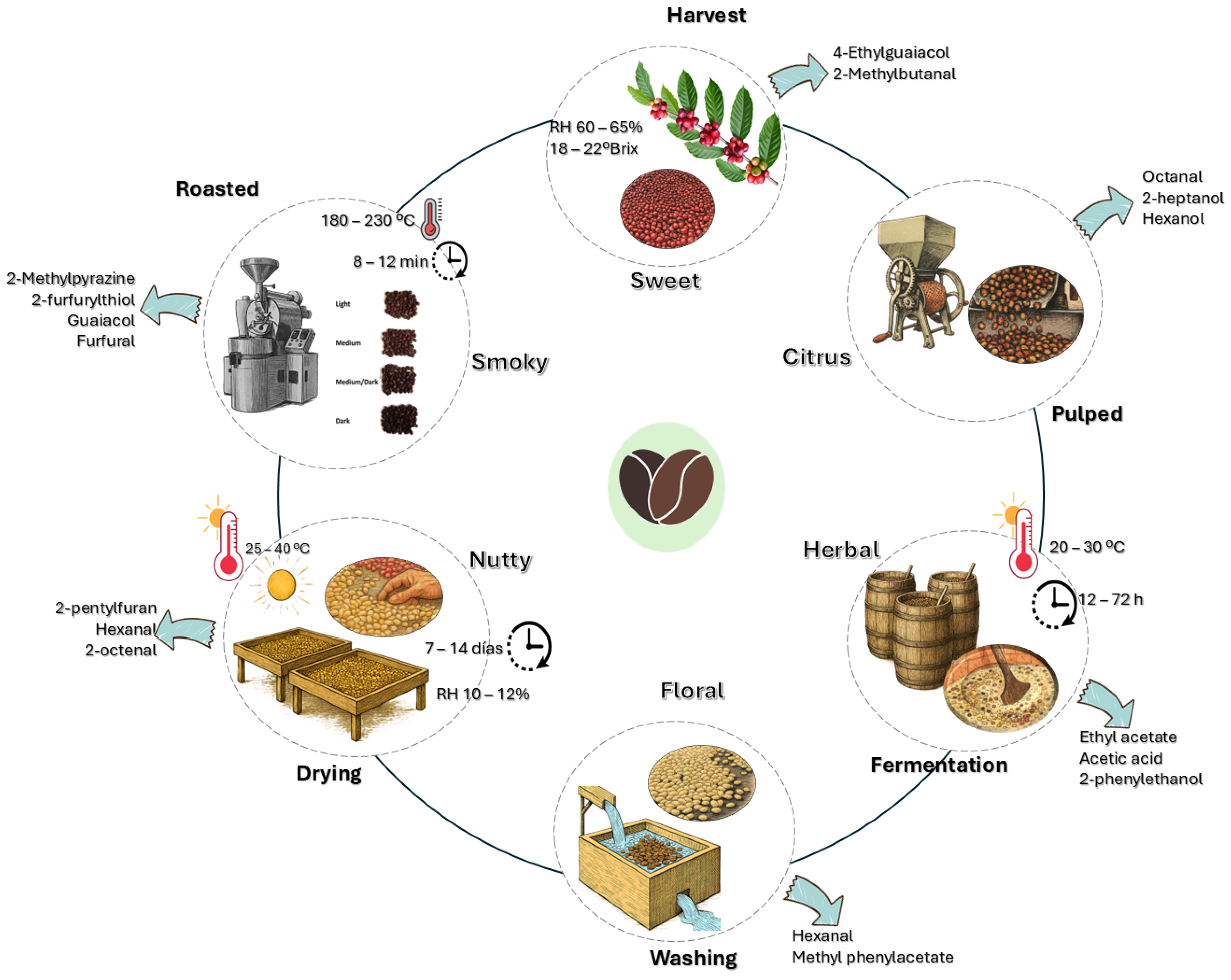
| Harvesting | 2-methylbutanal, 4-ethylguaiacol, butanal, benzaldehyde, 3-methylbutanal | Lipid oxidation and tissue damage associated with fruit maturity, mechanical stress, and oxygen exposure | Green, fresh, herbaceous | Early indicators related to fruit integrity and oxidative status of green coffee beans; potential candidate markers associated with harvesting conditions | [1,25,34] |
| Pulping | Hexanol, 2-heptanol, octanal | Enzymatic oxidation post-cell rupture | Fruity, green | Marks the onset of microbial and oxidative activity | [51] |
| Fermentation | 2-phenylethanol, ethyl acetate, phenylethyl acetate, acetic acid | Alcoholic and lactic acid fermentation (yeasts and LAB) | Floral, fruity, acidic | Indicators of controlled fermentation and aromatic quality | [54,59,70] |
| Washing | Medium-chain aldehydes, aliphatic alcohols | Mild oxidation of residual sugars and lipids | Clean, fresh | Evidence of transition toward dehydration | [59] |
| Drying | Hexanal, 2-octenal, 2-pentylfuran, butyric acid | Oxidation of lipids and phenolic compounds | Fatty, cereal-like, rancid (if excessive) | Biomarkers of green coffee oxidative stability | [5,17] |
| Roasting | 2-methylpyrazine, 2,5-dimethylpyrazine, 5-methylfurfural, furfural, guaiacol, 2-furfurylthiol | Maillard, Strecker degradation, pyrolysis | Roasted, nutty, caramel, coffee | Indicators of roast degree and final aromatic development | [6,23,27] |
Disclaimer/Publisher’s Note: The statements, opinions and data contained in all publications are solely those of the individual author(s) and contributor(s) and not of MDPI and/or the editor(s). MDPI and/or the editor(s) disclaim responsibility for any injury to people or property resulting from any ideas, methods, instructions or products referred to in the content. |
© 2026 by the authors. Licensee MDPI, Basel, Switzerland. This article is an open access article distributed under the terms and conditions of the Creative Commons Attribution (CC BY) license.
Share and Cite
Pajuelo-Muñoz, A.J.; Cayo-Colca, I.S.; Granda-Wong, C.; Chisté, R.C.; Castro-Alayo, E.M.; Balcázar-Zumaeta, C.R. Tracking Aromatic Volatile Biomarkers Through Coffee Bean Postharvest Stages. Molecules 2026, 31, 853. https://doi.org/10.3390/molecules31050853
Pajuelo-Muñoz AJ, Cayo-Colca IS, Granda-Wong C, Chisté RC, Castro-Alayo EM, Balcázar-Zumaeta CR. Tracking Aromatic Volatile Biomarkers Through Coffee Bean Postharvest Stages. Molecules. 2026; 31(5):853. https://doi.org/10.3390/molecules31050853
Chicago/Turabian StylePajuelo-Muñoz, Alexa J., Ilse S. Cayo-Colca, Carlos Granda-Wong, Renan Campos Chisté, Efraín M. Castro-Alayo, and César R. Balcázar-Zumaeta. 2026. "Tracking Aromatic Volatile Biomarkers Through Coffee Bean Postharvest Stages" Molecules 31, no. 5: 853. https://doi.org/10.3390/molecules31050853
APA StylePajuelo-Muñoz, A. J., Cayo-Colca, I. S., Granda-Wong, C., Chisté, R. C., Castro-Alayo, E. M., & Balcázar-Zumaeta, C. R. (2026). Tracking Aromatic Volatile Biomarkers Through Coffee Bean Postharvest Stages. Molecules, 31(5), 853. https://doi.org/10.3390/molecules31050853