Skip to Content
MoleculesMolecules
  • Review
  • Open Access

19 January 2026

Triazole and Pyrazole Hybrids of Electrophilic Natural Products as Promising Anticancer Agents

,
,
,
and
Department of Pharmacy and Biotechnology, Alma Mater Studiorum—University of Bologna, Via Belmeloro, 6, 40126 Bologna, Italy
*
Author to whom correspondence should be addressed.
This article belongs to the Special Issue Heterocycles in Medicinal Chemistry III

Abstract

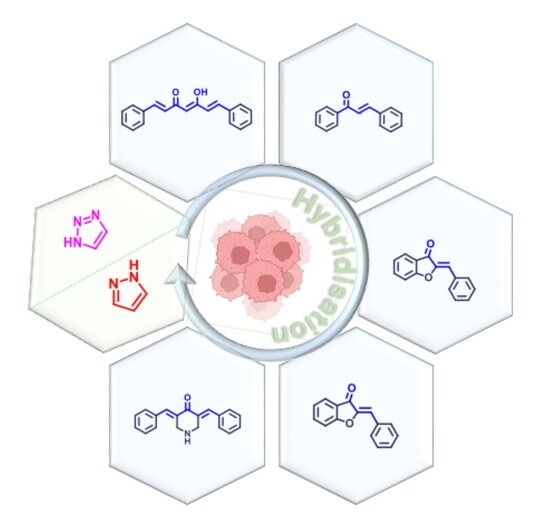
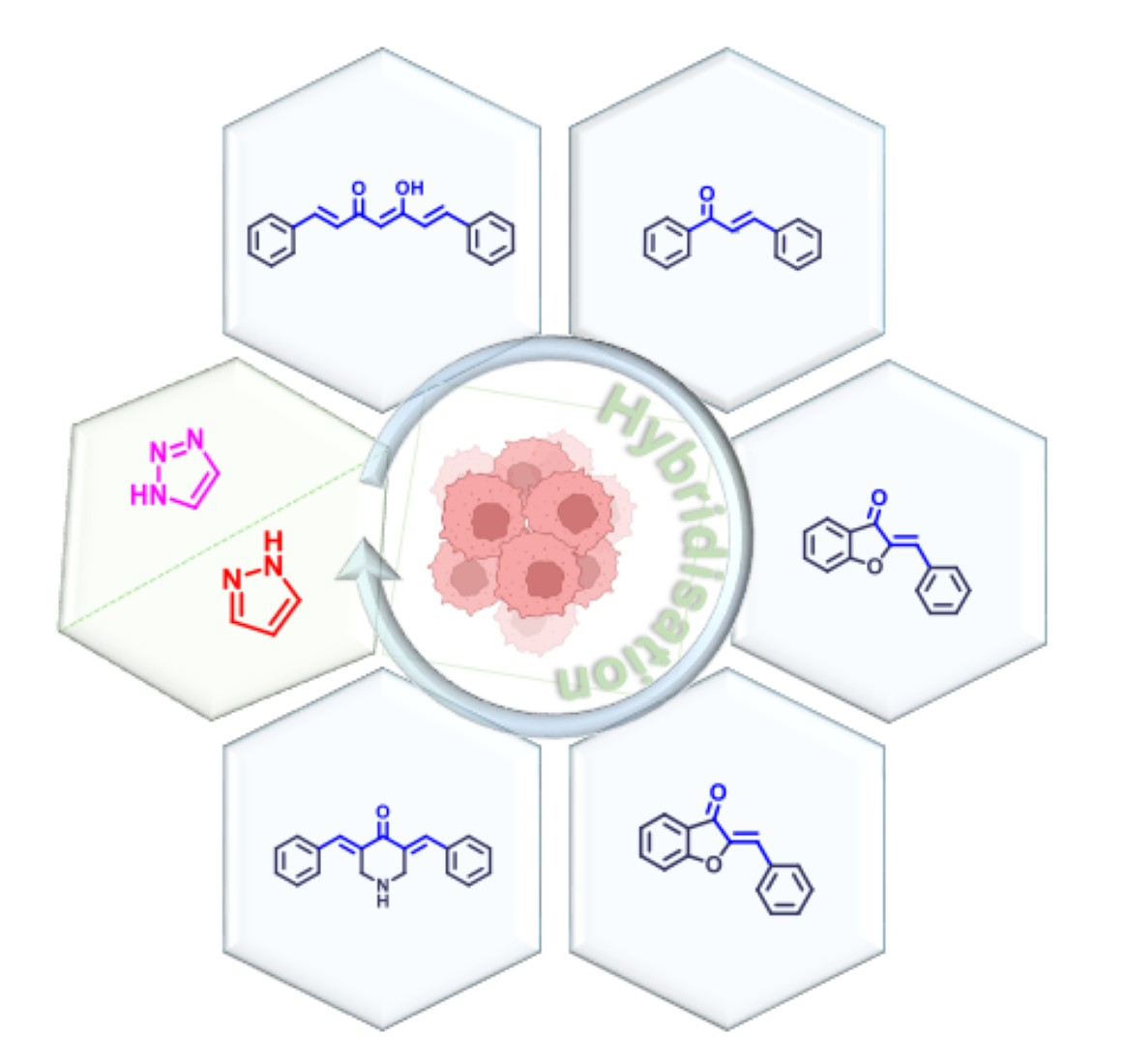
Naturally inspired electrophilic scaffolds, such as chalcone, curcumin, aurone, C-5-monocarbonyl-curcumin, and bis-(arylidene)piperidone, are considered privileged structures because of their ability to interact with a variety of biological macromolecules, including receptors and enzymes. They thus serve as versatile platforms for drug discovery efforts aimed at developing structurally related analogues endowed with improved bioactivity. Five-membered nitrogen-based heterocycles, such as triazole and pyrazole, have been widely used in medicinal chemistry both as templates and spacers for the design of bioactive compounds; they indeed provide the advantage of enhancing favourable interactions with the target, while also improving solubility and bioavailability, along with reducing toxicity. This review reports the latest advances in the development of hybrids incorporating the above classes of synthons acting as potential anticancer chemotherapeutics and provides a critical summary of the design strategies that have guided the development of antitumor agents.

1. Introduction

Currently, cancer remains a significant global public health issue in developed countries, being the second most common cause of death. According to the Global Cancer Observatory (GLOBOCAN) 19,976,499 [1] cases of malignancies were diagnosed worldwide, with lung, breast, colorectal, and prostate cancers being the most prevalent [2]. Available treatments such as chemotherapy, radiotherapy, hormone therapy, and immunotherapy are often associated with adverse effects. For example, the inability of anticancer agents to distinguish between cancerous and normal cells results in inherent toxicity, while the emergence of chemoresistance is associated with reduced clinical outcomes and long-term survival. In this scenario, cancer prevention and treatment represent significant public health challenges. Despite intensive research efforts, effective treatments remain elusive, emphasising the need to develop new, potent, and safe chemotherapeutics.
The molecular hybridisation strategy, by combining different pharmacophore units into a single chemical entity, has enabled the development of multitarget or multifunctional agents with broadened or improved biological activity, thus emerging as a promising medicinal chemistry approach [3,4,5,6]. Indeed, this approach also offers the promise of addressing several drawbacks by improving pharmacokinetic and pharmacodynamic properties, as well as bioavailability, thereby facilitating transport across cell membranes and providing protection from enzymatic breakdown.
Different design approaches to hybridisation can be categorised by how the underlying molecular frameworks, whether partial or complete structures, are assembled, resulting in conjugation, fusion, and merging as the main approaches.
(a)
Conjugation by using a specific molecular linker that is chemically distinct from the connected synthons. A cleavable or non-cleavable tether can be used advantageously. In the first case, a metabolically unstable linkage facilitates the release of the unmodified bioactive synthons, which then interact independently with their respective biological counterparts. In the former, the main structures were covalently connected via the linker, ensuring the hybrid stability within the metabolic environment.
(b)
Fusion of the selected pharmacophores or their components leads to their direct integration, with the parts coming into close contact.
(c)
Merging of the selected pharmacophores, by exploiting the common chemical features among their structures, allows obtaining a smaller and simpler chemical entity [7].
Nitrogen-based heterocycles are regarded as “privileged fragments” in medicinal chemistry due to their metabolic stability and favourable binding properties, i.e., ability to make various non-covalent interactions, including hydrogen bonds, dipole–dipole interactions, and van der Waals contacts, with biological macromolecules. Among others, the five-membered rings triazoles and pyrazoles have been widely used in medicinal chemistry as pharmacophores, building blocks, and linkers [8,9,10,11,12,13], thus enabling the development of bioactive chemical entities across different therapeutic areas, including neurodegeneration, inflammation, and infectious diseases, with cancer being the most prevalent [14]. Moreover, they have proved to be stable molecular linkers, providing chemical stability, structural rigidity, and reliable connectivity to the designed hybrids. This peculiar versatility has been extensively exploited in drug discovery, strongly supporting the design and optimisation of bioactive compounds. In particular, 1,5- and 1,4-disubstituted 1,2,3-triazoles can be readily prepared by the Huisgen 1,3-dipolar cycloaddition, also known as Cu-catalysed azide-alkyne cycloaddition (CuAAC) or “click chemistry” reaction, which offers high yields, broad substrate suitability, and short reaction times [15].
Natural products (NPs) remain a limitless source of drug candidates and lead compounds for the design of new and effective bioactive chemical entities [16]. Several NPs belonging to the chalcones, curcuminoids, and aurones classes are characterised by a wide spectrum of bioactivities, including anti-inflammatory, antioxidant, and chemopreventive, which make them suitable for targeting the onset and progression of multifunctional disorders, such as cancers and neurodegeneration. This peculiar feature can arise from the presence of an electrophilic α,β-unsaturated carbonyl fragment in their structure, which can undergo thia-Michael reactions with cysteine-rich residues in biological macromolecules [17]. The versatility of these scaffolds has attracted interest in medicinal chemistry, where they are considered “privileged structures” for developing new therapeutics, as evidenced by many published papers.
The general classification of NPs as pan-assay interference compounds (PAINS) has sparked concerns about their druggability and has become a significant challenge in drug discovery. Actually, properly tailored modifications of NP-privileged scaffolds have enabled the development of bioactive agents able to selectively modulate well-defined targets. These outcomes thus demonstrate that the biological activity of NPs and their analogues can be deliberately exploited for intended purposes [18,19]. For instance, NPs functionalisation has successfully allowed the development of potential therapeutics acting through the modulation of different targets involved in tumour progression and development, namely histone deacetylases (HDACs), epidermal growth factor receptor (EGFR), vascular endothelial growth factor receptor (VEGFR), microtubules, topoisomerases, and nuclear factor-kB (NF-kB) [20].

2. Electrophilic Natural Product Hybrids as Anticancer Agents

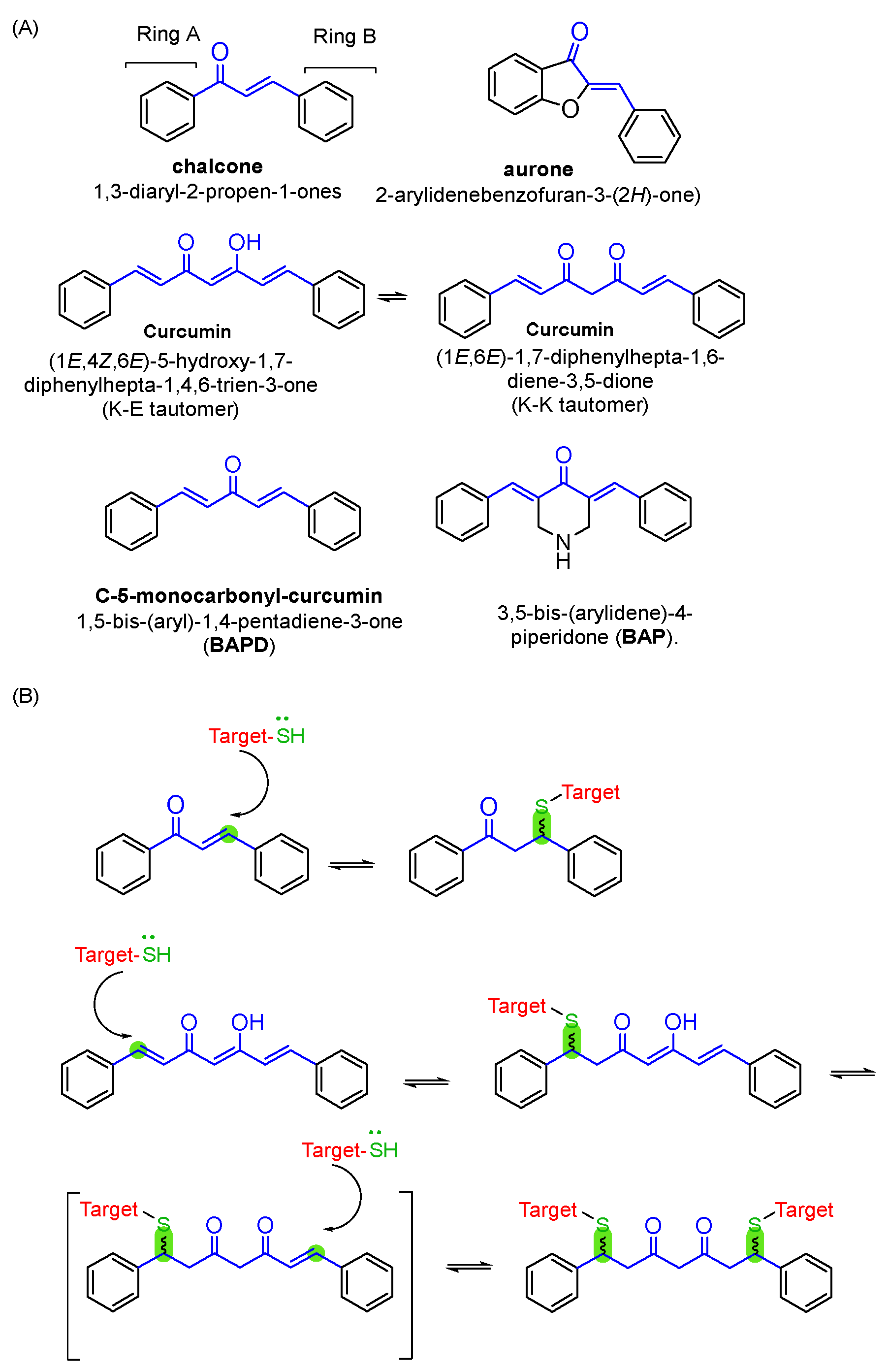
This review article will survey the most significant findings related to anti-cancer agents developed through the hybridisation strategy between an NPs-based electrophile scaffold, such as curcumin, chalcone, aurone, and the corresponding modified templates 1,5-bis(aryl)-1,4-pentadiene-3-one (BAPD) and 3,5-bis(arylidene)-4-piperidone (BAP) (Figure 1A), and a nitrogen-based heterocycle, particularly triazole and pyrazole.
Figure 1. (A) Structure of the NPs-based electrophile scaffolds curcumin, chalcone, and aurone and the structurally modified templates BAPD and BAP (the α,β-unsaturated carbonyl fragment is highlighted in blue). (B) Michael Addition reaction of a thiol-based moiety to the electron-rich fragment of chalcone or curcumin main templates.
Scaffolds containing an electrophilic α,β-unsaturated carbonyl group, known as a potential Michael acceptor, typically exhibit bioactivity. They are involved in regulating various signalling pathways and can be used as probes in chemical biology research [21]. The electrophilic moiety can readily undergo a Michael reaction, forming covalent bonds with the thiol groups of glutathione or cysteine residues, resulting in an adduct (Figure 1B) [22,23,24]. In biological systems, this process may be crucial for improving the bioactivity of molecules. For example, modulation of the Keap1-Nrf2-ARE pathway by covalent modification of Keap1 cysteine residues leads to the release of Nrf2, which in turn promotes the induction of phase II enzymes [17]. The electron density in the aromatic rings connected to the α,β-unsaturated carbonyl fragment influences its electrophilic character [25].
The present contribution reports on medicinal chemistry efforts involving various scaffolds bearing an α,β-unsaturated system. The aim is to provide a broad and comprehensive overview of N-heterocycle hybridisation-driven bioactivity in the context of electrophilic-based compounds. The top-performing derivatives among the chosen series of compounds were reported. In certain instances, an inactive representative compound was also included to underscore the chemical features crucial for inducing the anticancer effect. Indeed, comparing active and less active molecules provides valuable insights into how specific modifications may influence biological effectiveness. This enhances scientific understanding and supports the rational design of new bioactive compounds. Focus will be given to articles published between 2020 and 2025.

3. Chalcones

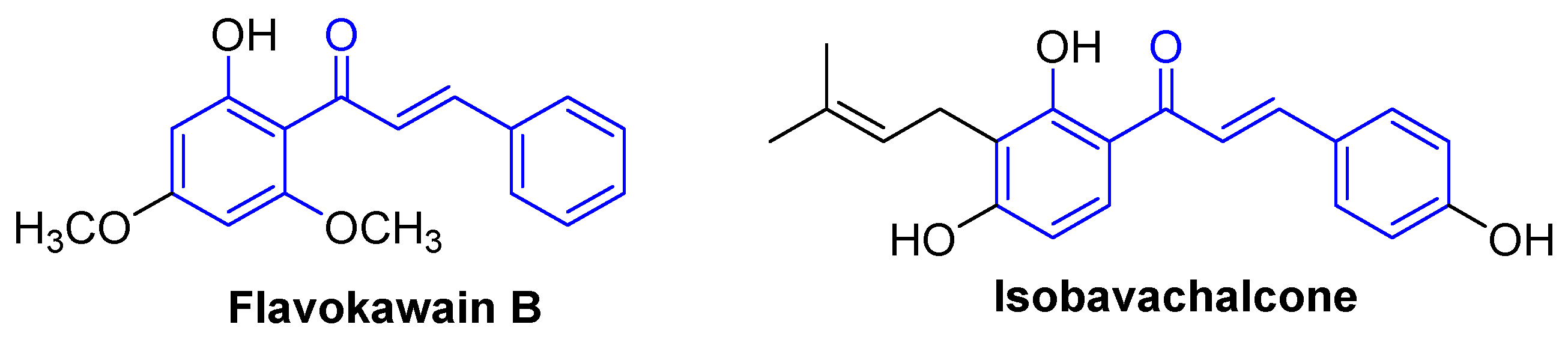
Chalcones (1,3-diaryl-2-propen-1-ones; Figure 1A), members of the flavonoid family, play a prominent role among biologically active NPs due to their broad pharmacological profile, which includes anticancer, neuroprotective, anti-inflammatory, and antimicrobial effects [26]. Several natural chalcones are marketed or under clinical investigation for the treatment of various pathologies, including metochalcone (choleretic/diuretic) and sofalcone (antiulcer/mucoprotective) [27]. Flavokawain B and Isobavachalcone (Figure 2) were found to exhibit anticancer effects by inducing apoptosis, thereby increasing the Bax/Bcl-2 ratio or activating caspase-3 and -9; a blockage in the cell cycle at the G2/M phase has also been documented [28,29]. The chalcone scaffold has been extensively used in medicinal chemistry to develop effective anticancer agents [30,31]. Numerous structural analogues have been generated through appropriate functionalization of the aryl moieties, commonly referred to as Ring A and Ring B, which are adjacent to the carbonyl group and the C=C double bond, respectively (Figure 1A). Moreover, hybridisation of this scaffold through nitrogen heterocycles has been particularly successful, as evidenced by numerous primary studies and review articles [32,33].
Figure 2. Structure of the naturally occurring chalcones Flavokawain B and Isobavachalcone [28,29].

3.1. Triazole-Based Chalcone Hybrids

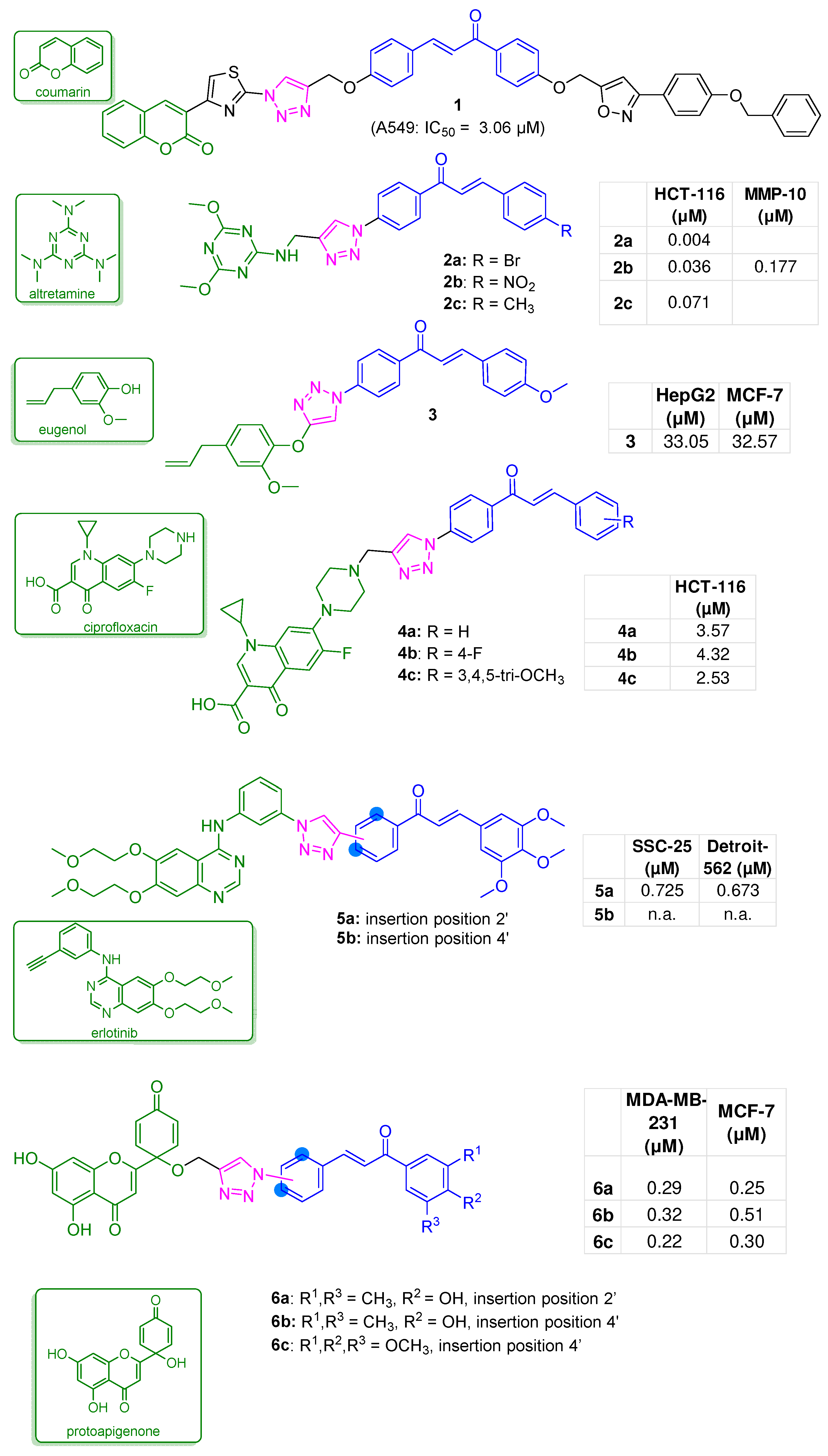
The hybrid 1 (Figure 3) was developed, characterised by a phenyl-benzyloxy-isoxazole function at the 4-position of the chalcone A-ring, in which a thiazole-coumarin moiety was inserted into the 4′-position of the B-ring through a 1,2,3-triazole linker. The compound exhibited good antiproliferative potency against A549 lung cancer cells (IC50 of 3.06 µM), while it showed a moderate effect on Capan-1 pancreatic cancer cells (IC50 of 65.41 µM). In contrast, when tested in the healthy L929 fibroblast cell line, 1 showed low cytotoxic effect (IC50 of 36.38 µM). In Capan-1 cells, the hybrid displayed a remarkable necrotic effect, likely due to its ability to induce nuclear condensation. Docking simulations on 1 revealed strong binding affinities to phosphodiesterase (PDE)-10A and the Epidermal Growth Factor Receptor (EGFR): −13.425 kcal/mol and −13.07 kcal/mol, respectively, indicating these as possible targets. Specifically, the following interaction patterns were noted: (a) PDE10A: H-bonds with Tyr683 and Gln716 (oxygen atoms of the coumarin moiety); van der Waals interactions with Met703, Ile701, Tyr720, Ser667, and Leu665; π–π stacking interactions with Phe686 (thiazole ring), and with Phe719 (coumarin ring). (b) EGFR: H-bonds with Lys745 (1,2,3-triazole ring); π–π stacking interactions with Phe723; π–cation interactions with Arg841, Lys745, and Arg803; and a water-bridged hydrogen bond involving the catalytic Mg2+ ion further stabilised the complex (Table S1) [34].
Matrix metalloproteinases (MMPs), zinc-dependent endopeptidases deregulated in nearly all human cancers, are regarded as validated anticancer targets [35]. In particular, inhibition of the MMP-10 and -13 isoforms has emerged as a strategy for managing colorectal cancer (CRC) [36]. Thus, a series of hybrid compounds was designed to obtain antitumor agents targeting MMPs. Considering the pharmacophore model for the design of MMP inhibitors, which encompasses an electrophilic pharmacophore linked through amido groups to a planar ring (Figure 3), the structures of these compounds included: (a) an aryl moiety, (b) an electrophilic warhead, (c) an amide bond, (d) a heteroaromatic function. Specifically, the chalcone scaffold (a–b) was connected via a triazole spacer (c), to an s-triazine moiety (d) found in the FDA-approved anticancer agent altretamine [37]. Among the designed compounds 2ac (Figure 3), potently inhibited colon carcinoma HCT-116 cell proliferation (IC50s = 4.36 and 71 nM, respectively) and showed favourable selectivity indices, thus emerging as potential CRC therapeutic opportunities. Analogue 2b was the only compound of the series that effectively inhibited MMP-10 (IC50 = 0.177 µM) without affecting MMP-13 [38].
A series of hybrids was created by connecting, via a 1,2,3-triazole spacer, the chalcone scaffold to eugenol (4-allyl-2-methoxyphenol), a prominent aromatic NP found in plants within the Ocimum genus, and endowed with an anticancer potential mainly related to pro-apoptotic effects [39]. Within the series, compound 3 (Figure 3) was the most effective, demonstrating a mild antiproliferative effect against the HepG2 human hepatocellular carcinoma and MCF-7 human breast cancer cells (IC50s of 33.05 and 32.57 µM, respectively) [40].
To develop multipotent anticancer agents, a substituted chalcone scaffold, known for inhibiting tubulin polymerisation, was linked via a 1,2,3-triazole connector to the piperazine moiety of ciprofloxacin (CP). CP is a broad-spectrum antibacterial agent that has recently demonstrated anticancer properties by inhibiting topoisomerase-II, inducing apoptosis, and arresting the cell cycle [41]. Compounds 4ac (Figure 3) induced a remarkable antiproliferative effect in various cancer cell lines, proving particularly effective in colon HCT-116 cells (IC50 of 3.57, 4.32, 2.53 µM, respectively). In contrast, a very low toxicity profile was observed in normal human embryonic kidney (HEK) 293 cells. The effects on topoisomerase I and II inhibition were evaluated in HCT-116 cells. Notably, 4a, with an unsubstituted chalcone, was the most potent in inhibiting topoisomerase I, followed by 4b (4-F substituted), while 4c (3,4,5-trimethoxy-substituted) was almost inactive. Concerning topoisomerase II inhibition, CP hybrids 4ac demonstrated notable effects even at a low concentration (10 µM). Docking studies on topoisomerase I (Top-I, PDB ID: 1T8I) showed that 4a adopts a camptothecin-like binding mode, establishing three key H-bonds with Asp533, Lys532, and Arg364 (Table S1). In contrast, for topoisomerase II (Topo II, PDB ID: 6ZY7), 4ac displayed binding modes distinct from those of etoposide; in particular, 4a formed H-bonds with Ala65 and Ser64, whereas 4c interacted with Ser800 (Table S1). A significant disruptive effect on tubulin polymerisation was observed for 4c (assayed at the IC50 value in HCT116 cells), thereby confirming the design strategy. DNA-damage studies in HCT116 cells revealed that, at their respective IC50 values, the above CP-chalcone hybrids induced DNA double-strand breaks, consistent with the interference in topoisomerase activity and microtubule dynamics. Moreover, 4c was found to induce a G2/M phase cell cycle arrest [42].
Given the crucial role of EGFR in carcinogenesis, hybrid compound 5a was designed by linking the EGFR inhibitor erlotinib to a 3,4,5-trimethoxy chalcone through a 1,2,3-triazole function (Figure 3). Analogue 5a, in which the erlotinib pharmacophore is linked via a triazole linker to the chalcone A-ring at position 2′, demonstrated remarkable efficacy in inhibiting HNSCC cells viability (Detroit 562 cell line: IC50 = 0.673 µM, SSC-25 cell line: IC50 = 0.725 µM), higher than analogue 5b (4′-insertion), erlotinib (Detroit 562 cell line: IC50 = 4035 µM, SSC-25 cell line: IC50 = 150 µM), and the unsubstituted 3,4,5-trimethoxychalcone (Detroit 562 cell line: IC50 = 3.074 µM, SSC-25 cell line: IC50 = 2.777 µM). Hybrid 5a, at 2.5 µM, induced necrotic cell death (Detroit 562 cells) and triggered apoptosis (SCC-25 cells) by affecting mitochondrial membrane potential, cytoplasmic vacuolisation, and nuclear shrinkage. Unfortunately, unlike erlotinib, it did not inhibit EGFR, suggesting that an alternative mechanism underlies the observed antiproliferative effects [43].
The inhibition of ataxia-telangiectasia and Rad3-related protein (ATR)-mediated activation of checkpoint kinase 1 (Chk1), along with the induction of oxidative stress and suppression of mitochondrial membrane potential, is regarded as a valuable, multifunctional anticancer strategy. Modulation of these targets can enhance tumour sensitivity by inducing cell death or exploiting synthetic lethality [44]. In this context, hybrids were created by linking, via a triazole connector, the ATR inhibitor and oxidative stress inducer protoapigenone (Figure 3) [33] to the chalcone B-ring (at 2′- and 4′-positions). Compounds 6a,b, with a 3,5-dimethyl-4-hydroxy substitution pattern, and 6c, with a 3,4,5-trimethoxy substitution pattern, on the A-ring (Figure 3) demonstrated consistent cytotoxicity in cancer cell lines, specifically MCF-7 and MDA-MB-231 (sub-µM IC50 values), and outperformed cisplatin. Both 6a and 6b significantly induced late apoptosis, while 6c altered the MDA-MB-231 cell cycle by increasing the hypodiploid (subG1) phase and decreasing the G1 phase, and triggered apoptotic cell death by increasing caspase-3 activity. Compound 6b inhibited ATR-mediated Chk1 activation and induced mitochondrial membrane depolarisation, leading to disruption in the redox balance, thus validating the design strategy [45].
Figure 3. Structures of chalcone-1,2,3-triazole hybrids bearing antiproliferative pharmacophores (1 [34], 2ac [38], 3 [40], 4ac [42], 5a,b [43], 6ac [45]); bioactivities are reported in tables.
Molecules 31 00355 g003
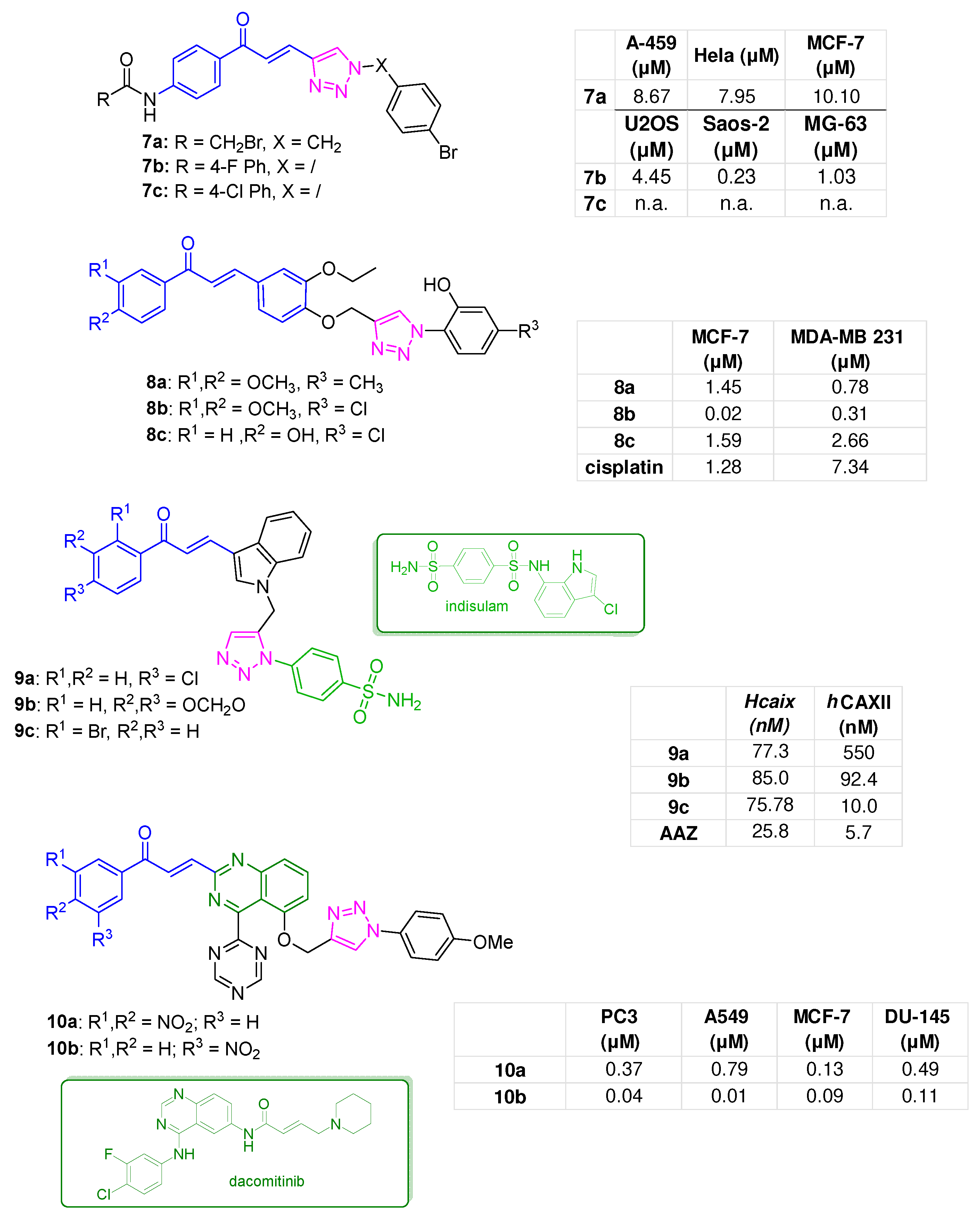
A series of chalcones characterised by a functionalised benzyl-1,2,3-triazole as the B-ring was developed by Nagarapua et al. Among them, compound 7a (Figure 4) emerged as the most promising one, displaying a broad cytotoxic profile against four human cancer cell lines, namely MCF-7, HeLa (cervical cancer), A549, and SKNSH (human neuroblastoma), with IC50 values ranging from 7.41 µM to 9.76 µM. Finally, docking studies indicated that the compound can chelate the Zn+2 ion in the active site of histone deacetylase-8 (HDAC-8, PDB ID: 3SFH) via its carbonyl group (Table S1) [46].
In parallel, aiming to achieve tumour regression by inhibiting the phosphatidylinositol 3-kinases/mammalian target of rapamycin (PI3K/mTOR) pathways, a set of chalcones bearing a 4-bromophenyl-1,2,3-triazole moiety as the B-ring and a para-substituted phenyl-benzamide moiety as the A-ring were developed. Derivative 7b (Figure 4), featuring a 4-F substituent, exhibited IC50 values of 4.23 and 2.30 nM against PI3K and mTOR, respectively, and substantial antiproliferative effects on human U2OS and Saos-2 osteosarcoma cells (IC50s of 0.45 and 0.23 µM, respectively), MG-63 cervical cancer cells (IC50 of 1.03 µM), and the HeLa cell line (IC50 of 8.12 µM). No toxic effects (IC50 = 200 µM) were recorded against normal human lung cells (BEAS-2B) and a non-tumorigenic epithelial cell line (MCF-10A), highlighting a favourable selectivity. At 10 µM, this compound induced apoptosis in Saos-2 cells, confirming its anti-osteosarcoma activity. Analogue 7c (Figure 4), with a 4-Cl atom, did not inhibit PI3K and mTOR enzymes or suppress the growth of U2OS and Saos-2 cells. [47].
Antiproliferative agents against a panel of human breast cancer cells, specifically MCF-7 and MDA-MB-231, were developed by hybridisation of a chalcone scaffold via 1,2,3-triazole with a phenol-based aryl ring. The top-performing derivatives, 8ac (Figure 4), were as potent as cisplatin (low- to sub-micromolar IC50 values) and exhibited a favourable selectivity index. 8b showed IC50 values of 0.02 and 0.31µM againstMCF-7 and MDA-MB-23 cancel cells, respectively [48].
Among the human carbonic anhydrases (hCAs), the isoforms CAIX and CAXII, overexpressed in solid tumours, have been regarded as valuable anticancer targets [49]. The chalcone scaffold, previously shown to be suitable for hCA inhibition [50,51], was decorated with an indole heterocycle as the B-ring and linked via a 1,2,3-triazole to an arylsulfonamide moiety. The latter is regarded as a classical CA-targeting pharmacophore also found in indisulam (E7070, Figure 4), a CAIX inhibitor entered phase II clinical trials. From this design strategy, interesting analogues emerged, such as 9a and 9b (Figure 4), characterised by a 4-Cl- and 3,4-methylenedioxy-substituted chalcone A-ring, respectively, and both of which inhibited CAIX with nanomolar Ki values (73.3 and 85 nM, respectively). In contrast, 9c (Figure 4), bearing a 2-Br substitution pattern, was the most potent inhibitor of the CAXII isoform (Ki = 10 nM) [52].
Given the prominent chemotherapeutic potential of dacomitinib, a quinazoline-based EGFR inhibitor (Figure 4), approved for the treatment of non-small cell lung cancer [41], Gundla et al. designed a series of chalcone-quinazoline hybrids. In particular, the triazine-quinazoline pharmacophore was decorated with a 4-methoxyphenyl fragment while different substituents were inserted in the chalcone A-ring. Derivatives 10a and 10b (Figure 4) showed broad antiproliferative activity against a panel of human cancer cell lines, including PC3 (prostate cancer), A549, MCF-7, and DU-145 (prostate cancer). Specifically, compound 10a, with a 3,5-dinitrophenyl A-ring, displayed sub-micromolar IC50 values (IC50s: PC3 = 0.04 μM; A549 = 0.01 μM; MCF7 = 0.09 μM, and DU145 = 0.11 μM). On the other hand, a lowered anticancer effect was observed for the 4-nitro substituted compound 10b (IC50s: PC3 = 0.37 μM; A549 = 0.79 μM; MCF7 = 0.13 μM, and DU145 = 0.49 μM). Finally, a docking study was performed for compound 10a using tubulin crystal structure (PDB ID: 1SA0), revealing strong interactions (H-bonds, π–π stacking, and hydrophobic contacts) with key amino acids within the binding active site of colchicine, such as Ile165, Asp199, Met259, Val260, Phe262, Pro263, and Val315 (Table S1) [53].
Figure 4. B-ring hybridisation of the chalcone scaffold (compounds 7a [46], 7b,c [47], 8ac [48], 9ac [52], 10a,b [53]); bioactivities are reported in tables.
Molecules 31 00355 g004
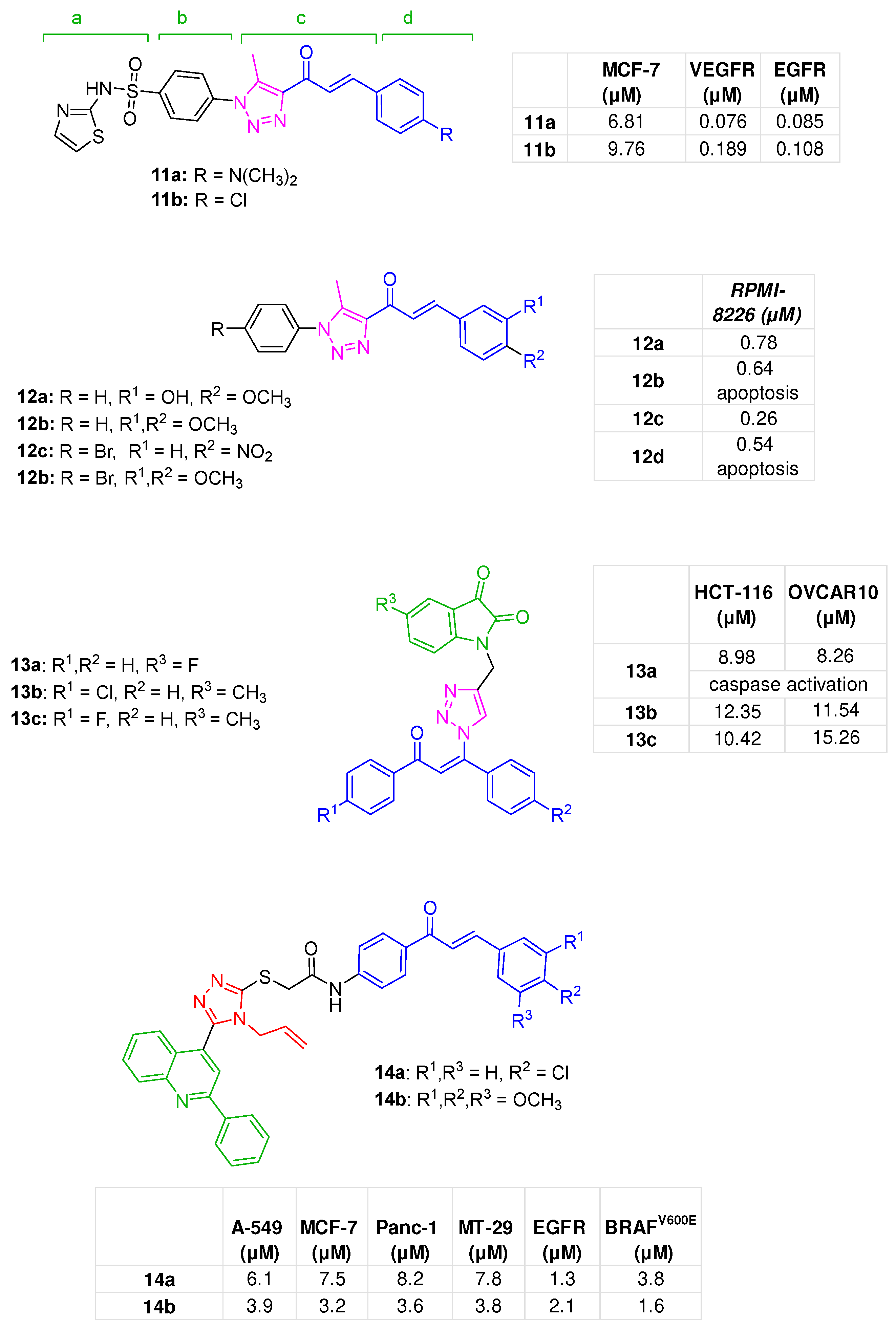
Given the synergistic roles of VEGFR-2 and EGFR in tumour development and angiogenesis [54], Mostafa et al. rationally developed a series of dualistic inhibitors based on a pharmacophore model for VEGFR-2 inhibition derived from the binding mode of the FDA-approved inhibitor sorafenib [44] in which four main portions (a–d) can be distinguished: (a) “ATP binding moiety”, (b) “linker”, (c) “hydrogen-bonding” moiety (interacting with the Asp-Phe-Gly (DFG) motif of the target, (d) “tail”, composed of an hydrophobic moiety. Starting from these guidelines, a new series of VEGFR-2 inhibitors was rationally designed and composed as follows: (a) a sulfathiazole synthon, (b) an aryl function, (c,d) a chalcone moiety characterised by a 1,2,3-triazole heterocycle as A-ring and a differently substituted B-ring. Compounds 11a and 11b (Figure 5), both bearing a N,N-dimethylamine moiety and a chlorine atom, respectively, into the para position of the B-ring, showed a notable antiproliferative effect against MCF-7 cells (IC50s = 6.81 and 9.76 µM, respectively), thus being as potent as sorafenib (IC50s = 9.18 µM). In MCF-7 cells, these analogues significantly inhibited VEGFR-2 (IC50s of 0.076 and 0.189 µM for 11a and 11b, respectively) and EGFR (IC50s of 0.085 and 0.108 µM for 11a and 11b, respectively), supporting an antiangiogenic effect. Molecular docking studies enabled the understanding of the binding mode of 11a with the two kinases. Regarding VEGFR-2, the sulfonyl group interacted with Asp1046 and Lys868 through H-bonds, while a π-sulfur interaction was observed with Cys1045; the chalcone oxygen contacted Cys919; π-alkyl interactions were observed among the triazole ring and Val916, Leu1035, and Leu840 residues. Concerning EGFR binding mode, the sulfonyl oxygens engaged Asp831, Thr830, and Lys721 via H-bonds and interacted with Met742 via a π-sulfur interaction. Conversely, the triazole ring established a hydrogen bond with Met769 (Table S1). In MCF-7 cells, 11a induced pro-apoptotic effects, resulting in both early- and late-stage apoptosis (11.53% and 19.90%, respectively). A block in the cell cycle during the S phase was also documented for this compound [55].
Figure 5. Hybrids 11a,b [55], 12a,b [56], 12c,d [57], 13ac [58], and 14a,b [59], bioactivities are reported in tables.
A small series of hybrids was designed by Selim et al., featuring a 5-methyl-1-phenyl-1H-1,2,3-triazole as the chalcone A-ring, while different substituents were introduced into the B-ring. In detail, analogues 12a and 12b (Figure 5), in which the chalcone B-ring was decorated with 3-hydroxy-4-methoxy and 3,4-dimethoxy substitution patterns, respectively, exhibited broad-spectrum cytotoxicity. Notably, both compounds strongly inhibited the proliferation of RPMI-8226 leukaemia cell line, with IC50 values of 0.78 and 0.64 µM, respectively, and showed good selectivity indices (SI = 45.19 and 45.53, respectively). From a mechanistic perspective, derivative 12b induced cell cycle arrest at the G2/M phase at 6 µM concentration by triggering the mitochondrial apoptotic pathway, which involved the accumulation of reactive oxygen species (ROS), an increase in the Bax/Bcl-2 ratio, and the activation of caspases-3, -7, and -9 [56].
Another set of analogues based on the same 5-methyl-1-phenyl-1H-1,2,3-triazole template was reported by Abulkhair et al., among which 12c and 12d (Figure 5), exhibited broad antiproliferative effects, particularly against leukaemia cell lines, such as RPMI-8226 (IC50 values of 0.26 and 0.54 µM, respectively). In particular, in RPMI-8226 cells, 12c demonstrated to exert the anti-leukemic effect through a pro-apoptotic mechanism, specifically by inhibiting the apoptosis-inducing factor poly(ADP-ribose) polymerase-1 (PARP-1), increasing the BAX/BCL-2 expression ratio (i.e., a decrease in the anti-apoptotic gene BCL-2, and an upregulation of the pro-apoptotic BAX gene), and upregulating caspases-3 and -9. A cell cycle arrest in the S-phase and a favourable safety profile (SI = 12.19) were also observed [57].
The 1H-indole-2,3-dione (isatin) pharmacophore, a “privilege synthon” widely exploited in drug discovery [52], was introduced into the β-position of a chalcone unsaturated carbonyl moiety, through a 1,2,3-triazole linker, to obtain a series of hybrids endowed with antiproliferative activity. The structure-activity relationship (SAR) study performed identified 13ac (Figure 5) as the most potent cytotoxic agents in the series, particularly against colon HCT-116 and ovarian OVCAR-10 cancer cell lines, more active than the reference compounds cisplatin and 5-FU. In detail, 13a, with an unsubstituted chalcone scaffold and a 5-fluoro isatin, exhibited low-µM IC50 values against HCT116 and OVCAR10 cells (IC50s = 8.98 and 8.26 μM, respectively) and a favourable SI (2.13 for HCT-116 and 2.32 for OVCAR-10) superior to the reference drugs (5-FU: SI = 0.95 and cisplatin: SI = 1.37). Apoptosis studies conducted at 10 μM (HCT-116 cells) revealed a significant increase in the number of apoptotic cells after 48 h of treatment (42.65%), with activation of caspases-3 and -7. Finally, docking analysis was used to examine how 13a binds to the selected potential targets VEGFR-2 and EGFR. In the VEGFR-2 active site, 13a formed a hydrogen bond between the isatin carbonyl and Arg1027, with the chalcone ring B fitting into a hydrophobic pocket of the enzyme. For EGFR, π-π interactions were observed between the aromatic rings of the chalcone scaffold and the Tyr318 and His193 residues in the enzyme’s active site (Table S1) [58].
A series of quinoline-chalcone hybrids bearing a 1,2,4-triazole linker was designed to develop antiproliferative agents targeting EGFR and BRAFV600E kinases. Among the series, compounds 14a and 14b (Figure 5), both featuring an allyl-substituted triazole, emerged as the most effective agents, exhibiting broad and potent antiproliferative activity across multiple cancer cell lines, i.e., A-549, MCF-7, Panc-1, and HT-29, with low-micromolar IC50 values. A potent inhibition of BRAFV600E (IC50s of 3.8 µM for 14a and 1.6 µM for 14b) and EGFR-TK (IC50s of 1.3 µM for 14a and 2.1 µM for 14b) also emerged, supported by molecular docking studies that demonstrated an appropriate fit of the hybrids into the active sites of the studied kinases (Table S1). Analogue 14a also caused cell cycle arrest at G2/M transition and a significant induction of apoptosis [59].

3.2. Chalcone Pyrazole Hybrids

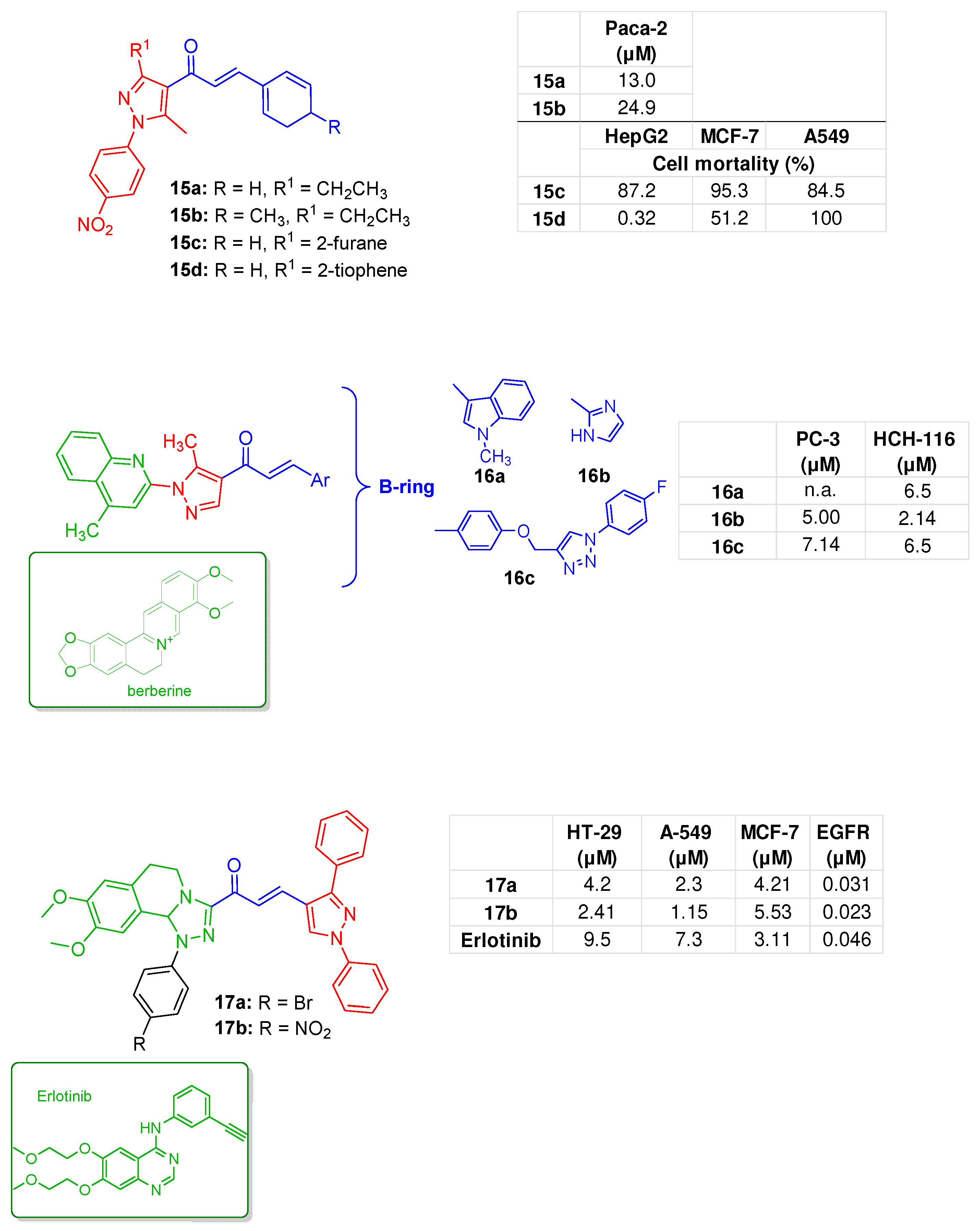
A library of chalcones characterised by a 3-ethyl-5-methyl-1-(4-nitrophenyl)-1H-pyrazole moiety as the A-ring was developed by Hassaneen et.al. for pancreatic cancer treatment. In detail, derivatives 15a and 15b (Figure 6), characterised by a benzene or a tolyl function as B-ring, emerged as the most representative due to their ability to inhibit pancreatic cancer (PaCa-2) cells proliferation in vitro, showing IC50 values of 13.0 and 24.9 µM, respectively, comparable to that of doxorubicin (28.3 µM). The mechanism underlying the anticancer effects of these analogues involved the activation of caspases-3 and -8, the upregulation of the anticancer-related gene cyclin-dependent kinase 6 (CDK6), and the induction of the DNA damage response. Analogue 15a also demonstrated the ability to induce cell cycle arrest at the S and G2/M phases [60].
Moreover, another series of hybrids was developed in which the pyrazole, as the chalcone A-ring, was functionalised at the 3-position with a 5-membered heterocycle. Analogues 15c and 15d (Figure 6), which feature a furan and a thiophene moiety, respectively, and an unsubstituted benzene as B-ring, demonstrated a broad antiproliferative effect. Compound 15d was the most promising, with IC50 values of 27.7 µg/mL (A549 cells) and 26.6 µg/mL (HepG2 cells), proving to be as potent as doxorubicin. This analogue was found to reduce the expression levels of genes associated with lung and liver cancers. Furthermore, in HepG2 cells, treatment with 15d increased DNA damage and DNA fragmentation. [61].
A series of chalcones was designed with the (5-methyl-1H-pyrazol-1-yl)quinoline pharmacophore as the chalcone A-ring, resulting in 16ac (Figure 6), which showed good antiproliferative activity against HCT-116 colon cancer cells (IC50 values ranging from 2.1 µM to 6.50 µM). Moreover, 16b and 16c also exhibited considerable effects against prostate PC-3 cancer cells (IC50s: 5.00 and 7.14 µM, respectively). Unfortunately, these derivatives did not possess a favourable safety profile, as evidenced by the remarkable antiproliferative effect observed in normal breast epithelial cell lines (FR 2). The binding mode of 16b to EGFR was studied, and it was shown that the pyrazole and imidazole rings interacted with Asp831 via anion-π interactions, and that the imidazole ring also interacted with Phe699. The quinoline moiety interacted with Leu694, Leu820 and Val702, with the methyl group contacting Ala719 (Table S1) [62].
The tetrahydroisoquinoline (THiQ) heterocycle, found in several NPs with EGFR-inhibitory properties, such as berberine ([63], inspired the rational design of a series of chalcone-based hybrids characterised by a fused N1-aryl-1,2,4-triazole-THiQ moiety as the A-ring and a 1,3-diphenyl-1H-pyrazole B-ring. Derivatives 17a and 17b (Figure 6) showed notable antiproliferative effects with low micromolar IC50 values against HT-29 (colorectal adenocarcinoma), A549, and MCF-7 cell lines, demonstrating potency comparable to that of erlotinib. These hybrids also effectively inhibited total EGFR (IC50 values of 0.031 µM and 0.023 µM for 17a and 17b, respectively). Moreover, 17b was the most active against the mutated EGFR proteins EGFRL858R and EGFRT790M, with IC50 values of 34.78 µM and 199.53 µM, respectively. EGFR inhibition was confirmed by molecular docking studies, which demonstrated a high affinity of 17b for the EGFR binding pocket through key interactions, including an H-bond with Met742, a π-H interaction with Lys721, and pi-cation interactions with Lys721 (Table S1). In A549 cells, both hybrids, tested at their respective IC50s, induced apoptosis and necrosis, and arrested the cell cycle in G2/M and pre-G1 phases [64].
Figure 6. Chalcone-pyrazole hybrids 15a,b [60], 15c,d [61], 16ac [62], 17a,b [64]; bioactivities are reported in tables.
Molecules 31 00355 g006

4. Curcuminoids

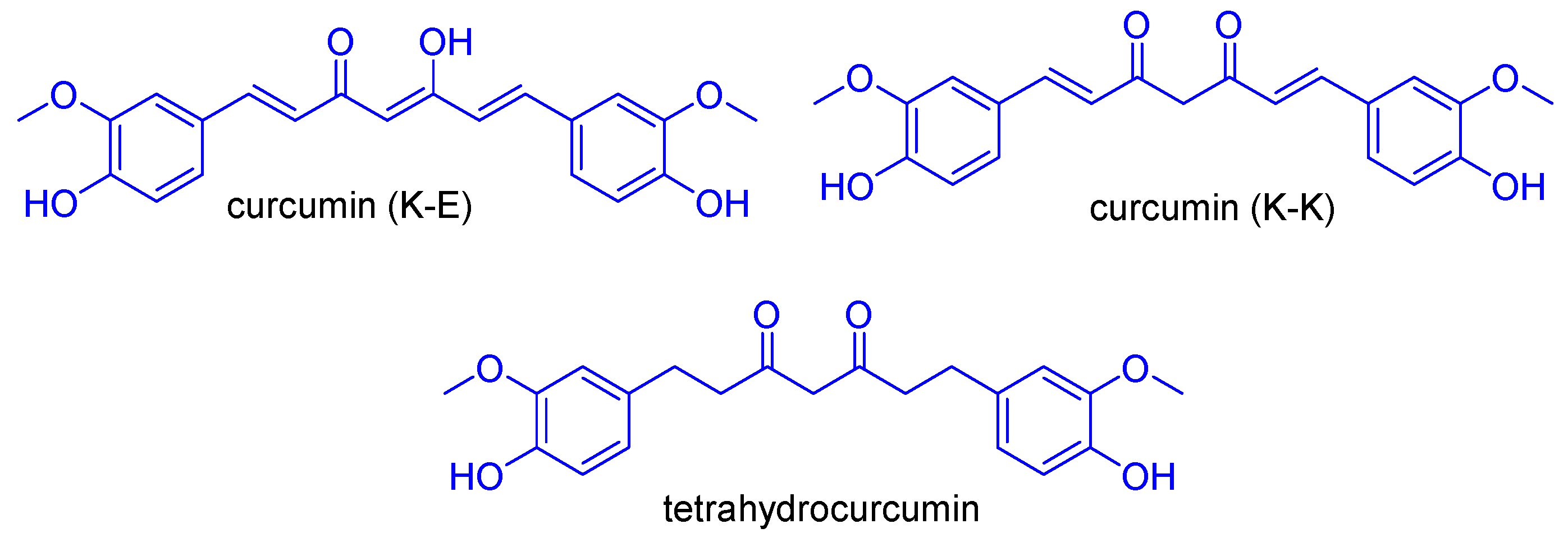
The polyphenol curcumin ((1E,6E)-1,7-bis(4-hydroxy-3-methoxyphenyl)hepta-1,6-diene-3,5-dione, the main bioactive component of the rhizomes of Curcuma longa L., is among the most extensively studied NPs, with established efficacy and safety profiles for the prevention and treatment of various multifactorial disorders, including cancer and neurodegeneration. In particular, curcumin demonstrated a wide range of anticancer effects both in vitro and in vivo, inhibiting cancer cell proliferation, metastasis, and invasion, and inducing apoptosis [65]. The molecular mechanisms underlying curcumin’s antitumor potential involve the ability to interfere with various targets and signalling pathways, such as NF-κB, TNF (Tumour Necrosis Factor)-α, and signal transducer and activator of transcription 3 (STAT3) [66]. The safety profile of curcumin has been primarily demonstrated through clinical trials [67]. The curcuminoid pharmacophore consists of a mixture of tautomers that can interconvert, specifically the asymmetric β-keto-enol and the symmetric diketo structures (K-E and K-K, respectively, Figure 7). The K-E tautomer is the most prevalent form because the intramolecular H-bond stabilises the central structure fragment. The versatility of this scaffold is underscored by the extensive literature on curcumin-inspired analogues as anticancer agents [68,69].
Figure 7. Structures of curcumin’s tautomer and tetrahydrocurcumin [68,69].

4.1. Curcumin-1,2,3-triazole Hybrids

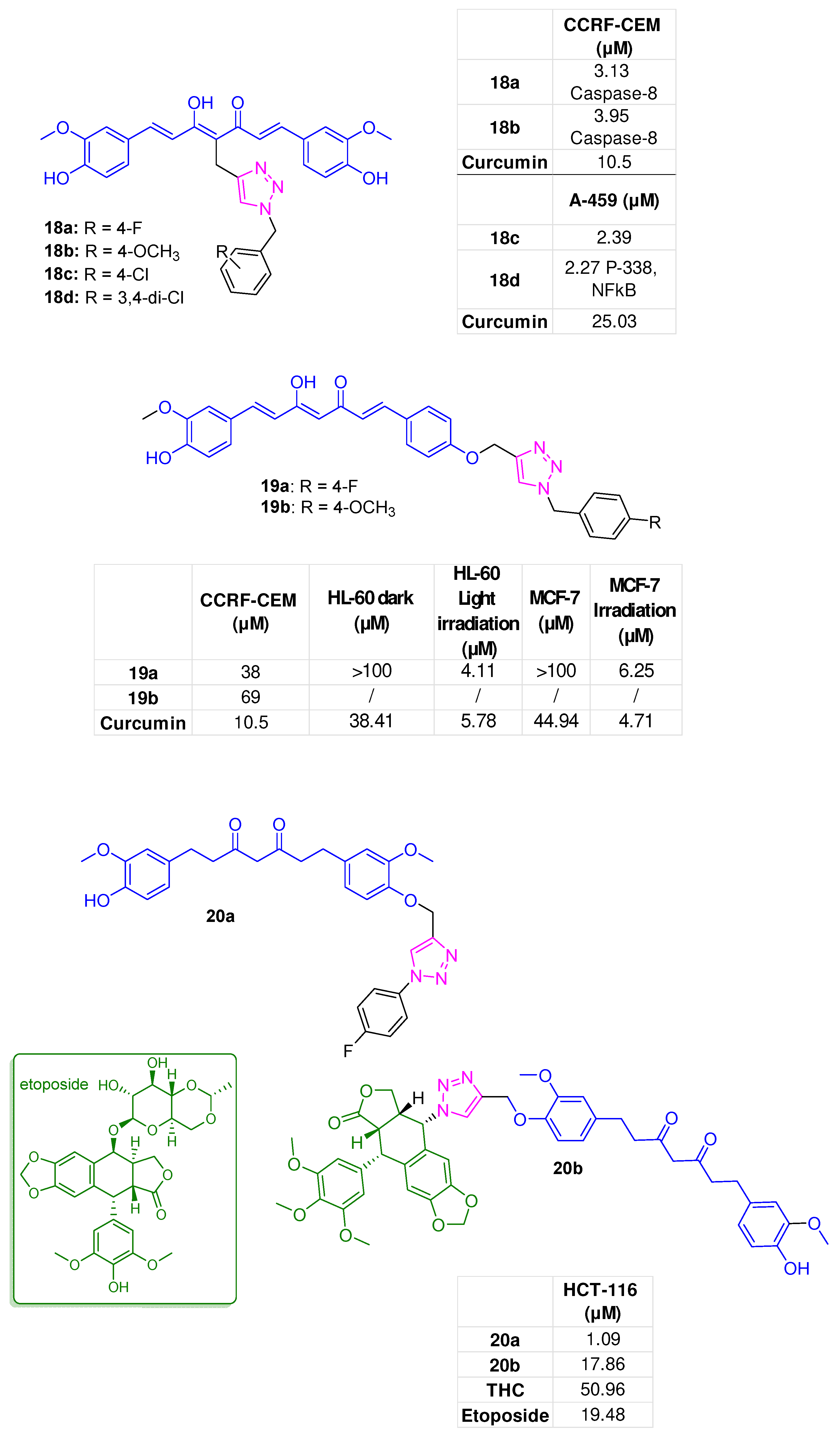
Seghetti et al. functionalized the curcumin template at different positions with a para-fluorine or para-methoxy benzyl moiety via a 1,2,3-triazole spacer to investigate the structural requirements of this scaffold for developing effective anticancer agents. Specifically, by retaining the entire curcumin structure, decoration of the central C-4 position of the heptadienone fragment produced compounds 18a and 18b (Figure 8) as a mixture of K-K and K-E tautomers. These derivatives exhibited notable antiproliferative effects on the T-acute lymphoblastic leukaemia cell line (CCRF–CEM) with IC50 values of 3.13 and 3.95 µM, respectively, and were more effective than curcumin itself (IC50 = 10.5 µM). The induction of apoptosis was the main molecular mechanism by which analogue 18a, at 3 µM, caused apoptosis in CCRF–CEM cells as evidenced by decreased mitochondrial transmembrane potential and marked activation of caspase-8, thus affecting both the intrinsic (mitochondria-related) and extrinsic cell-death pathways [70].
Figure 8. 1,2,3-triazole hybrids corresponding to curcumin and THC (18a,b [70], 18c,d [71], 19a,b [70,72], 20a [73], 20b [74]); bioactivities are reported in tables.
Functionalization of the C-4 central position of the curcumin scaffold also afforded derivatives 18c and 18d (Figure 8), with 4-Cl and 3,4-di-Cl substitution patterns on the benzyl moiety, respectively, that inhibited the proliferation of A549 lung cancer cells at low micromolar potencies (IC50 = 2.93 and 2.27 μM, respectively). Once more, the functionalization of the C-4 position of curcumin yielded hybrids more effective than curcumin itself (IC50 = 25.03 μM). Regarding the mechanism underlying the anticancer effect of 18d, an increase in phosphorylation of p38, c-Jun N-terminal kinase (JNK), and extracellular signal-regulated kinase (ERK), along with a decrease in NF-kB expression and an upregulation of nuclear factor IkBα, was reported. Moreover, in a zebrafish xenograft tumor model, this analogue, at a 2.5 μM concentration, showed a consistent decrease in tumor focal areas, while little effect was recorded on normally developing cells (zebrafish embryos) [71].
On the contrary, when the same modification involved one aryl side group, derivatives 19a and 19b, obtained as K-E tautomers (Figure 8), exhibited markedly reduced cytotoxicity (IC50 = 38 and 69 µM, respectively) compared to the C4-functionalized counterparts 18a and 18b. The above data indicated that the simultaneous presence of both 4-hydroxy-3-methoxyphenyl side groups is crucial for achieving optimal anticancer effects. Interestingly, in a follow-up study, 19a was identified as a promising photosensitizer agent, suitable for photodynamic anticancer therapy. Indeed, photoactivation of 19a by exposure to low-irradiance white LED light led to a significant enhancement of cytotoxicity against promyelocytic leukaemia HL-60 and MCF-7 cancer cells (IC50 = 4.11 and 6.25 µM, respectively); these effects were mediated by pro-apoptotic and pro-ferroptotic mechanisms, as demonstrated by increased PARP cleavage and decreased GPX4 expression [72].

4.2. Tetrahydrocurcumin-Hybrids

Decoration of one aryl side of tetrahydrocurcumin (THC) with a para-fluorophenyl group via a 1,2,3-triazole yielded 20a (Figure 8). This compound showed consistent anticancer activity against human colon carcinoma HCT-116 cells, with an IC50 of 1.09 µM, and caused cell cycle arrest at the G1 phase, before DNA synthesis. Conversely, only weak effects were observed on A549 and HepG2 cells. The binding of 20a with the APC-Asef protein, known for its key role in the development of colon cancer, was studied using molecular docking and several H-bonding and hydrophobic interactions were observed. In particular, Asp459, Glu460, Arg463, and Arg549 were involved. Asp459 and Phe510 interacted with the benzene and triazole moieties via hydrophobic interactions (Table S1) [73].
The THC scaffold was also connected via a 1,2,3-triazole to a synthon related to podophyllotoxin (PPT), an NP known for its essential role in cancer therapy. [63]. The THC-PPT hybrid 20b (Figure 8) demonstrated an antiproliferative activity against HCT-116 cells with an IC50 of 17.86 µM. It was more effective than THC (IC50 = 50.96 µM) and showed comparable efficacy to etoposide (IC50 = 19.48 µM) [74].

5. Monocarbonyl Curcumin Analogues

Different strategies have been employed to address some curcumin-related issues, specifically its limited chemical stability and poor aqueous solubility, which impair bioavailability and restrict its therapeutic window [64]. For instance, simplification of the central curcumin 5-hydroxy-1,7-diarylhepta-1,4,6-trien-3-one core by replacing it with a 1,4-pentadiene-3-one fragment resulted in the C5-curcumin analogue family (BAPD, Figure 1A). Michael’s reactivity has been reported as a potential feature underlying the bioactivity of this class (Figure S1) [75].

5.1. C-5-Monocarbonyl Curcumin-1,2,3-triazole Hybrids

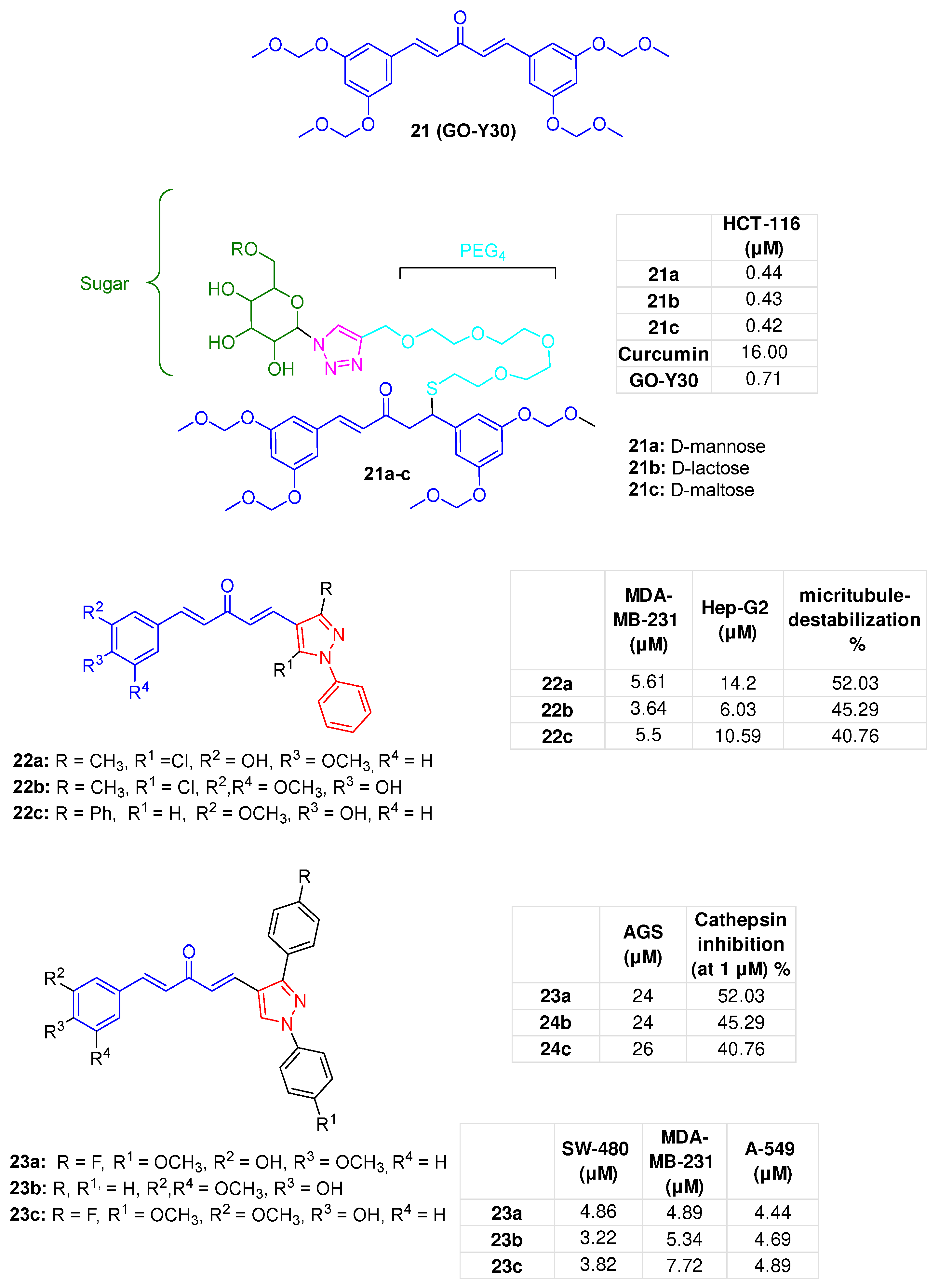
The monocarbonyl-C5-curcuminoid GO-Y030 (21, Figure 9), recognised for its anticancer properties [76,77], was converted into a Michael adduct by attaching a hydrophilic thiol-based linker composed of a polyethene glycol (PEG) unit connected via a 1,2,3-triazole with a sugar moiety. The designed glycoconjugates (21ac, Figure 9), which contain D-mannose, D-lactose, and D-maltose sugar units, respectively, can be considered prodrugs because they can undergo a retro-thia-Michael reaction with intracellular thiols, particularly glutathione, leading to the formation of the parent compound 21. In HCT-116 cells, 21ac showed low-micromolar antiproliferative potencies (IC50 = 0.42–0.55 µM range), superior to that of curcumin (IC50 = 16 µM) and comparable to that of the lead 21 (IC50 = 0.72 µM) [78].
Figure 9. Triazole and pyrazole hybrids based on the BAPD scaffold (21 [76], 21ac [78], 22ac [79], 23ac [80]); bioactivities are reported in tables.

5.2. C-5-Monocarbonyl-curcumin-pyrazole-hybrids

Truong and colleagues created a series of asymmetric BAPD analogues 22ac (Figure 9), with one side of the pentadienone tether bearing an N1-aryl-1H-pyrazole group and the other side featuring a phenyl ring with electron-rich substituents such as alkoxy and hydroxy groups. The compounds effectively inhibited the growth of MDA-MB-231 (IC50 range: 2.43−7.84 μM) and HepG2 (IC50 range: 4.98−14.65 μM) cancer cells. Moreover, in MDA-MB-231 cells, they triggered apoptosis at 1 μM, induced G2/M phase cell cycle arrest at 5 μM, and elevated caspase-3 activity at 10 μM. At 20 μM, microtubule-destabilizing effects ranging from 40.76% to 52.03% were observed [79].
The same authors also developed another set of BAPD hybrids (23ac, Figure 9) bearing a 1,3-diphenyl-1H-pyrazole moiety. Derivatives demonstrated significant cytotoxicity (low micromolar IC50 values) against three human cancer cell lines that overexpress EGFR, namely colon cancer SW480, MDA-MB-231, and A549. Treating SW480 cells with 10 μM of 23b caused 13.26% of the cells to undergo apoptosis, with a corresponding increase in caspase-3 activity 2.37-fold. Additionally, the percentage of cells in the G2/M phase consistently rose to 21.90% and 22.16%. Finally, 23b, at 5 µM, inhibited EGFR-related colorectal cancer forms, such as EGFRWT and EGFRL858R (30% and 35% inhibition, respectively) [80].

6. Aurones

Aurones (2-arylidenebenzofuran-3-(2H)-one, Figure 1A) are a class of NPs related to flavonoids that have been shown to exhibit diverse biological activities, including anticancer, anti-Alzheimer’s, and anti-inflammatory effects, making them valuable privileged structures in medicinal chemistry. The electrophilic α,β-unsaturated carbonyl fragment (Figure S1) not only imparts unique physicochemical characteristics but also crucially influences their biological activities by modulating various enzymes and receptors. A relevant anticancer potential has also been demonstrated, prompting medicinal chemists to exploit this scaffold to develop effective anticancer agents [81,82].

6.1. Aurone-1,2,3-triazole Hybrids

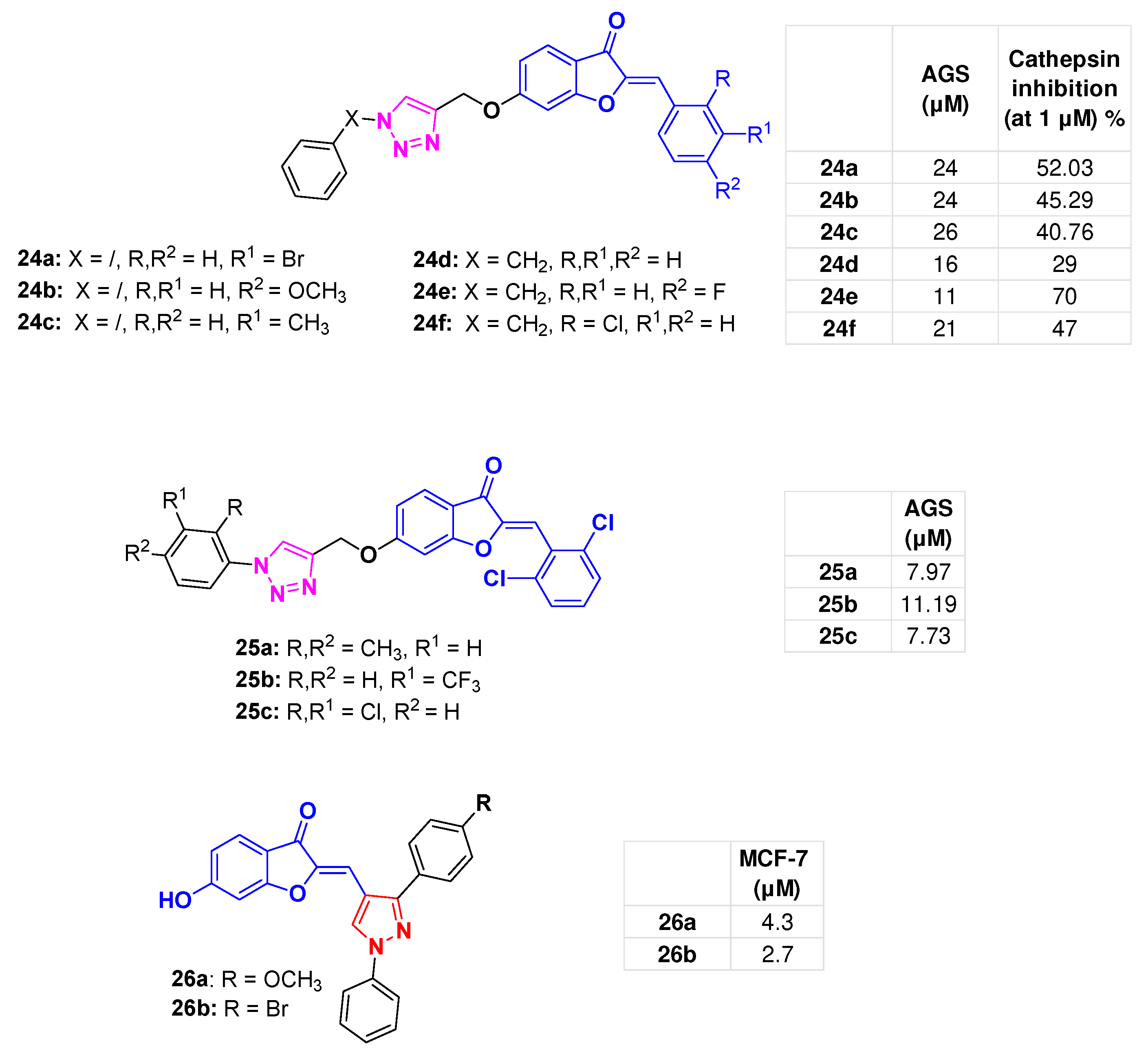
The study by Kumar et al. involved functionalising the aurone core by inserting a 1-phenyl-1,2,3-triazole group, via an oxymethylene spacer, at the 6-position of the benzofuran-3-one nucleus, while various substituents were introduced into the arylidene aromatic ring. Compounds 24ac (Figure 10) were identified, which showed a two-digit micromolar inhibitory potency against the proliferation of the gastric adenocarcinoma (AGS) cell line (IC50 = 24–26 µM range). Furthermore, 24a and 24b at 1 µM inhibited (by 42% and 36%, respectively) cathepsin B [83], a cysteine protease that plays a key role in cancer progression and apoptosis [84].
Figure 10. Aurone-1,2,3-triazole and pyrazole hybrids 24ac [83], 24df [85], 25ac [86], 26a,b [87]; bioactivities are reported in tables.
The above study was further expanded with the design of a set of analogues, in which a benzyl was introduced into the 1H-1,2,3-triazole instead of the corresponding phenyl, leading to the identification of 24d, 24e, and 24f (Figure 10), which inhibited AGS cells’ proliferation (IC50 = 16 μM, 11μM, and 21 μM, respectively). The data suggested a favourable effect of a halogen atom in the para-position of the arylidene aurone moiety due to an inductive effect (see 24e and 24f). Analogue 24e, tested at 10 µM, inhibited cathepsin B by 70%, while lower inhibition percentages were observed for 24d and 24f (29% and 47%, respectively). Molecular docking studies, conducted to assess the ability of the designed hybrids to interact with the active site of cathepsin B, revealed that the compounds bound to the protein’s active site. In particular, the observed nucleophilic attack of the Cys29 thiol group on the aurone α,β-unsaturated carbonyl moiety resulted in the formation of a stable tetrahedral intermediate, thus suggesting an active site-directed enzyme inhibition [85].
Kumara et al. designed a further series of aurone-based derivatives (25ac, Figure 10), bearing a 2′-6′-di-Cl decorated benzylidene moiety and different substituents on the 1H-1,2,3-triazole phenyl function, inserted at the 6-position of the benzofuran-3-one scaffold (Figure 10). Good antiproliferative activity was observed in AGS cells, with compound 25a showing an IC50 of 7.97 μM, 25b of 11.19 μM, and 25c of 7.73 μM. Compound 25c was computationally analysed against the HER2 receptor, yielding a docking score of −4.88. It established H-bond interactions with Cys805 and Thr862, as well as a π-cation interaction with Lys753 (Figure S1) [86].

6.2. Aurone-Pyrazole Hybrids

Aurones 26a,b (Figure 10) featuring a diaryl-pirazole and a hydroxyl group at the 6-position of the benzofuran-3-one core, showed a remarkable antiproliferative effect on MCF-7 cells (IC50s of 4.3 and 2.7 µM, respectively) [87].

7. 3,5-Bis(arylidene)-4-piperidones

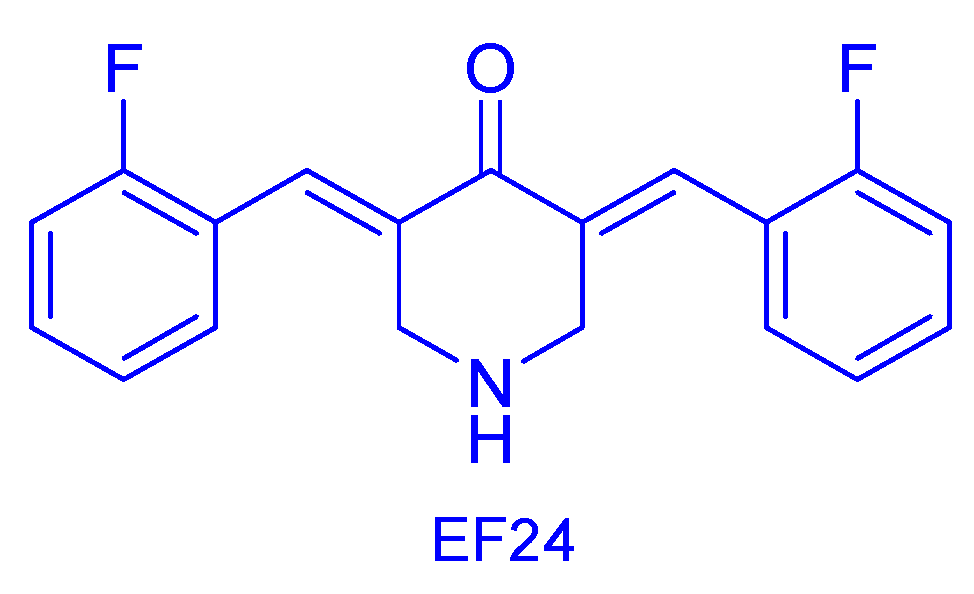
Among the curcumin mimics, an interesting class of bioactive compounds is represented by the 3,5-bis(arylidene)-4-piperidone (BAP, Figure 1A), which has been widely exploited for the design of anticancer agents [88]. In particular, 3,5-bis(2-fluomethoxybenzylidene)-4-piperidone (EF24, Figure 11) has emerged as a valuable anticancer agent with broad antiproliferative effects (MDA-MB-231 and PC3 cell lines) and the ability to inhibit hypoxia-inducible factor, an intracellular pro-angiogenic transcription factor [89]. The versatility of the BAP pharmacophore allowed for various modifications at the side aryl rings and the piperidone nitrogen atom; the latter is particularly suitable for hybridisation. This class of compounds is classified as Michael acceptors able to interact, under physiological conditions, with nucleophiles of biological macromolecules (Figure S1).
Figure 11. Structure of EF24 [89] as an anticancer agent.

3,5-Bis(arylidene)-4-piperidone-1,2,3-triazole Hybrids

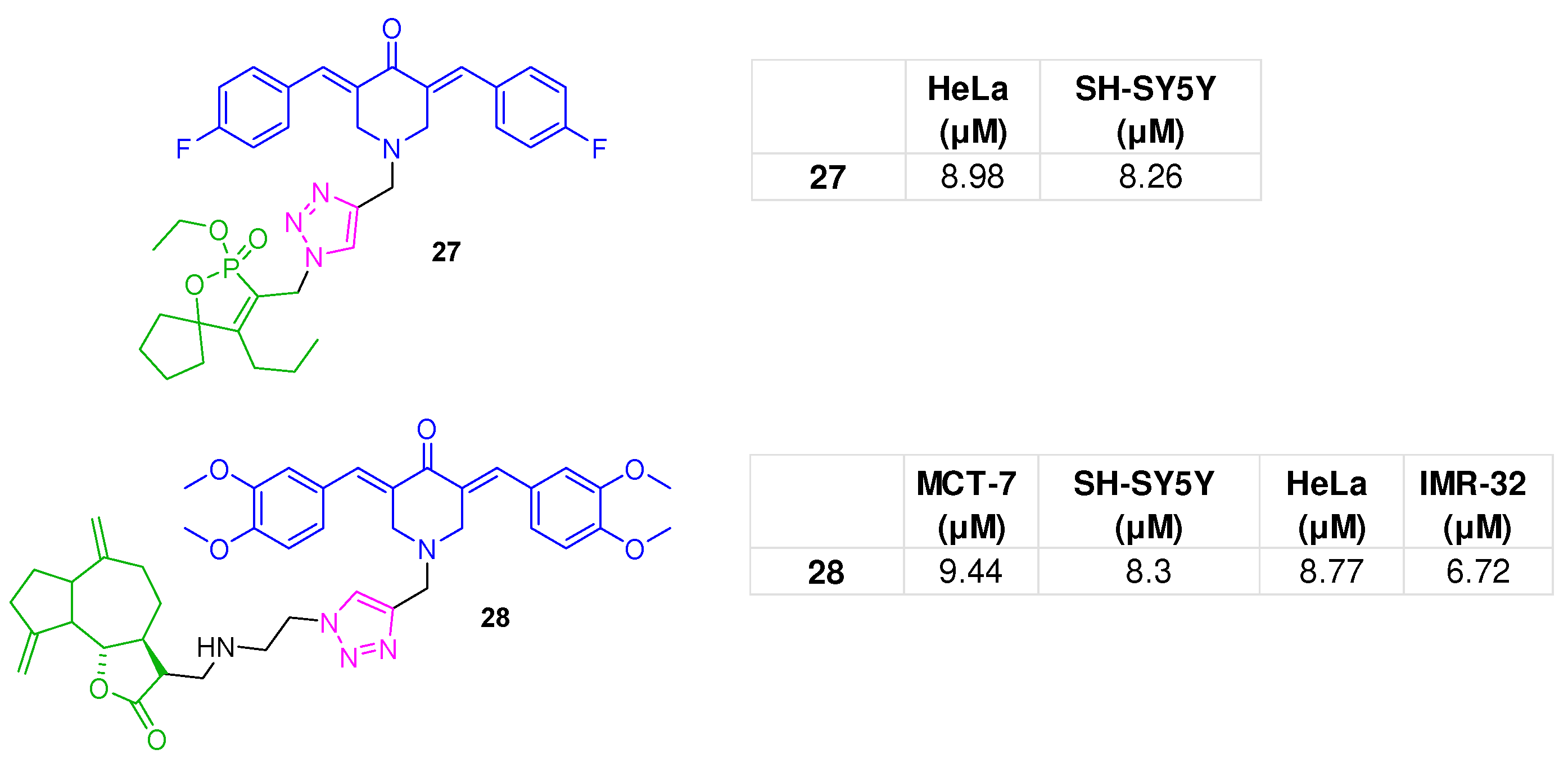
The BAP scaffold, bearing 4-F-phenyl side rings, was linked via a triazole to a 1,2-oxaphospholene-based pharmacophore at the N atom, affording compound 27 (Figure 12), which demonstrated potent antiproliferative effects against A549 and neuroblastoma (SH-SY5Y) cell lines, while modest effects were observed against Hep-G2 and HeLa cells. This analogue at 30 µM suppressed basal anaerobic glycolysis in HeLa cells, likely by inhibiting lactate production. Furthermore, under the same experimental conditions, it reduced the glycolytic reserve, indicating an influence on abnormal metabolism, such as glycolysis, a distinctive feature of cancer cells, also known as the Warburg effect. [90].
Figure 12. BAP-1,2,3-triazole hybrids 27 [90] and 28 [91]; bioactivities are reported in tables.
From the study by Brel et al., hybrid 28 (Figure 12), designed by combining a bis-3,5-demethoxyarylidene-4-piperidone framework with a sesquiterpene lactone pharmacophore via a 1,2,3-triazole linker, was identified as an antiproliferative agent active against a broad panel of cancer cell lines (MCF-7, SH-SY5Y, HeLa, and IMR-32). It also disrupted glycolytic metabolism of tumor cells, thus reducing the extracellular acidification rate related to glycolysis (by 34.30%), glycolytic capacity (by 56.40%), and glycolytic reserve (by 91.79%). In silico screening identified compound 28 as a potential inhibitor of pyruvate kinase M2 (PKM2), a key allosteric enzyme in glycolysis and a significant cancer-related target. In particular, the key interactions at the phosphoenolpyruvate binding site of PKM involved Ser362, Thr328, and Ile51 (Table S1) [91].

8. Conclusions

The development of an effective anticancer agent often depends on a hybridisation strategy that integrates selected biologically relevant motifs into a single molecular entity to optimise therapeutic effects. This approach has shown potential to optimise anticancer activity by enhancing antiproliferative effects against cancer cell lines while generally maintaining low toxicity towards normal cells. For instance, it supports the development of compounds with well-defined mechanisms of action, including modulation of specific molecular targets or multiple molecular pathways involved in the onset and progression of cancer. In this context, five-membered nitrogen heterocycles, such as triazoles and pyrazoles, have played a key role in enabling the design of hybrid molecules, likely due to their ability to strengthen interactions with the molecular targets. Likewise, NPs have also provided a valuable source of lead compounds and biologically relevant templates, with scaffolds bearing electrophilic α,β-unsaturated carbonyl systems playing a significant role. Indeed, chalcones, curcuminoids, aurones, and related derivatives, namely 1,5-bis(aryl)-1,4-pentadiene-3-ones (BAPDs) and 3,5-bis(arylidene)-4-piperidones (BAPs), have emerged as crucial platforms for the development of novel therapeutic agents through tailored structural modifications. By integrating these electrophilic frameworks with a triazole or pyrazole heterocycle, valuable anticancer agents have been developed, sometimes characterised by multitarget effects (Table S2).
Interesting results were achieved by incorporating an anticancer pharmacophore (2b, 4ac, 6c, 9c, 20b) or a “privileged synthon” (11a,b, 13a, 21, and 28).
Compound 2b (a chalcone-altretamine hybrid) exhibited potent inhibitory activity against HCT-116 cell proliferation (IC50 = 0.036 µM), also demonstrating the capability to selectively inhibit the MMP-10 enzyme (IC50 = 0.18 µM). Furthermore, derivatives 4ac (chalcone-ciprofloxacin hybrids: IC50s range of 2.53–4.32 µM on HCT-116 cells) demonstrated a multitarget effect by inhibiting topoisomerases and tubulin polymerisation, triggering DNA damage in HCT-116 cells and causing G2/M cell cycle arrest. Derivative 6c (chalcone-protoapigenone hybrid: IC50s ranging from 0.20 to 0.32 µM and 0.25 to 0.51 µM on MDA-MB-231 and MCF-7 cells, respectively) proved to negatively affect DNA synthesis and to induce apoptosis by increasing caspase-3 activity. The conjugation of the indeno-chalcone scaffold with an aryl sulphonamide moiety, as CA-targeting pharmacophores, enabled the development of 9c as a potent CAXII inhibitor (Ki = 10 nM). The THC-PPT hybrid 20b showed an antiproliferative activity superior to the corresponding synthon. The chalcone-sulfathiazole hybrids 11a,b demonstrated to affect the growth of MCF-7 cells. (IC50s = 6.81 and 9.76 µM, respectively), to inhibit VEGFR (IC50s = 0.076 and 0.189 µM, respectively) and EGFR (IC50s = 0.085 and 0.108 µM, respectively). These outcomes further support the VEGFR-2 pharmacophore model for the design of kinase inhibitors. Compound 13a (chalcone-isatin hybrid) showed a broad-spectrum cytotoxicity, achieved through induction of apoptosis and modulation of the cell cycle. Conjugation of a BAP-based synthon with an NP-derived sesquiterpene afforded 28, endowed with a wide cytotoxicity profile (low-micromolar IC50 values against MCF-7 and HeLa cell lines), likely due to glycolysis-inhibiting effects. An interesting design strategy encompassed the development of the prodrugs 21ac, which behave as PEG-glycoconjugated thia-Michael adduct of the C-5-monocarbonyl curcuminoid GO-Y030 (21), and showed a significant antiproliferative effect against HCT-116 cells (IC50 = 0.42–0.44 µM). Notably, their capacity to react with intracellular thiols suggests they act as prodrugs, underscoring their potential as bioresponsive anticancer agents.
Moreover, the quinoline-based privileged template, widely present in EGFR inhibitors, was extensively and successfully exploited to design hybrids (i.e., 14a,b, 16b, 17a,b). Hybrids 14a,b, bearing a 1,2,4-triazole spacer, exhibited broad-spectrum antiproliferative effects (low-micromolar IC50s against a panel of cancer cells, including MCF-7, A-549, and MT-29). At the molecular level, induction of apoptosis, modulation of the cell cycle (G2/M arrest), and inhibition of the kinases EGFR and BRAFV600E (IC50s = 1.3 and 2.1 µM, respectively) were observed. Hybrid 16b affected HCT-116 cell growth (IC50 = 2.14 µM); while the hybrids 17a,b with a THiQ synthon, proved to effectively inhibit the growth of different cancer cell lines, namely HT-29, A-549, and MCF-7 (IC50s values ranging from 1.15 to 5.5 µM) as a consequence of an inhibitory effect on EGFR (IC50s = 0.031 and 0.23 µM, respectively). Hybrids 10a,b have also been developed as broad-spectrum antiproliferative agents (sub-micromolar IC50s against PC3, A549, MCF-7, and DU-145 cell lines).
The para-fluorine aryl substitution pattern enabled the development of promising anticancer agents (18a, 19a and 20a). Indeed, by applying the click-chemistry strategy to the central C-4 position of the curcumin scaffold, 18a was designed to inhibit the proliferation of CCRF-CEM cells (IC50 = 3.13 µM) and to trigger programmed cell death by inhibiting mitochondrial transmembrane potential and activating caspase-8. On the contrary, when the same functionalisation was performed on one aryl moiety of curcumin, hybrid 19a, a potent photoinducible cytotoxic agent, was obtained. Derivative 20a (THC/4-F benzene hybrid) showed selective cytotoxicity against the HCT-116 cell line (IC50 = 1.09 µM), likely due to the capability of inducing cell cycle arrest in G1.
Furthermore, poly-methoxylated aryl groups were extensively utilised due to their behaviour as privileged structures. For instance, 3,4,5-trimethoxy and 3,4-dimethoxy aryl rings, which were incorporated into hybrids 4c, 5a, 6c, 14b, 8a,b, and 12b,d, enabled the development of broad antiproliferative agents (ICT-116, SSC-25, MDA-MB-231, and MCF-7 cancer cell lines). On the contrary, BAPD functionalised with a 3,5-dimethoxy-4-hydroxyphenyl moiety yielded hybrid 23b, which inhibited the proliferation of MDA-MB-231 and MCF-7 cancer cells (IC50s = 5.34 and 4.69 µM, respectively). At the molecular level, induction of apoptosis (increase in caspase-3 activity), G2/M cell-cycle arrest, microtubule destabilisation, and inhibition of EGFR (30% at 5 µM) were observed.
Together, these studies highlighted the importance of integrating a triazole or pyrazole heterocycle with an electron-rich NPs-inspired template as a strategic approach for obtaining hybrids capable of influencing cancer-related mechanisms.

9. Future Perspectives

The molecular hybridisation design strategy, using the “fragment-linking” approach, i.e., combining suitable anticancer pharmacophores, has successfully enabled the development of anticancer agents.
To this aim, the widespread exploration of privileged structures, often involving NPs, has been pursued. The significant results support the idea that a compound’s bioactivity can vary with context and can be adjusted to meet specific therapeutic objectives, thereby challenging the usual assumptions behind PAINS. Five-membered nitrogen-containing heterocycles, such as triazoles and pyrazoles, played a pivotal role in the development of bioactive molecules. They are appreciated not just for their ability to participate in different non-covalent interactions with molecular targets, but also for the structural flexibility they provide to the entire molecule. On the other hand, electrophilic NPs have been essential scaffolds in the rational design of anticancer agents. Moving forward, the strategic hybridisation of these fragment classes could further prove its crucial role in developing the next generation of anticancer drug candidates with improved bioactivity profiles.

Supplementary Materials

The following supporting information can be downloaded at: https://www.mdpi.com/article/10.3390/molecules31020355/s1, Figure S1: Michael Addition reaction of a thiol-based moiety to the electron-rich fragment of chalcone or curcumin main templates; Table S1: Docking Studies of the lead compounds described in the present review; Table S2: The best-performing hybrid molecules are described in the present review.

Author Contributions

Conceptualization, F.B.; methodology, A.D.F.; data curation, A.D.F., A.B. and S.G. and R.O.; writing—original draft preparation, F.B. and A.D.F.; writing—review and editing, A.B. and S.G.; visualization, R.O.; supervision, F.B.; project administration, F.B. All authors have read and agreed to the published version of the manuscript.

Funding

This research received no external funding.

Institutional Review Board Statement

Not applicable.

Data Availability Statement

Data are contained within the article and Supplementary Materials.

Conflicts of Interest

The authors declare no conflicts of interest.

Abbreviations

The following abbreviations are used in this manuscript:
ATRataxia-telangiectasia and Rad3-related protein
BAP3,5-bis(arylidene)-4-piperidone
BAPD1,5-bis(aryl)-1,4-pentadiene-3-one
Cacarbonic anhydrase
Chk1checkpoint kinase 1
CPciprofloxacin
CRCcolorectal cancer
CuAACCu-catalysed azide-alkyne cycloaddition
EGFRepidermal growth factor receptor
ERKextracellular signal-regulated kinase
HDACshistone deacetylases
HNSCCshead and neck squamous cell carcinomas
JNKc-Jun N-terminal kinase
K-Eβ-keto-enol
K-Kdiketo
MMPsMatrix metalloproteinases
NF-κBnuclear factor-kB
NPsNatural products
PAINSpan-assay interference compounds
PARP-1poly(ADP-ribose) polymerase-1
PEGpolyethene glycol
PKM2pyruvate kinase M2
PPTpodophyllotoxin
ROSreactive oxygen species
STAT3signal transducer and activator of transcription 3
THCtetrahydrocurcumin
THiQtetrahydroisoquinoline
VEGFRvascular endothelial growth factor receptor
Cancer cells lines
A549lung cancer
AGSgastric adenocarcinoma
Capan-1pancreatic cancer
CCRF–CEMT-acute lymphoblastic leukaemia cell line
Detroit 562squamous carcinoma
DU-145prostate cancer
HCT-116colon carcinoma
HEK293human embryonic kidney
HeLacervical cancer
HepG2human hepatoma carcinoma
HL-60promyelocytic leukaemia
HT-29colorectal adenocarcinoma
MCF-7human breast cancer
MDA-MB-231human breast cancer
MG-63cervical cancer
OVCAR-10ovarian cancer
PC3prostate cancer
RPMI-8226leukaemia
Saos-2osteocarcinoma
SH-SY5Yneuroblastoma
SKNSHhuman neuroblastoma
SSC-25tumorigenic keratinocyte
SW480colon cancer
U2OSosteocarcinoma

References

  1. GLOBCAN. (n.d.). Available online: https://gco.iarc.who.int/media/globocan/factsheets/cancers/39-all-cancers-fact-sheet.pdf (accessed on 24 November 2025).
  2. Siegel, R.L.; Kratzer, T.B.; Giaquinto, A.N.; Sung, H.; Jemal, A. Cancer statistics, 2025. CA Cancer J. Clin. 2025, 75, 10–45. [Google Scholar] [CrossRef]
  3. Kucuksayan, E.; Ozben, T. Hybrid Compounds as Multitarget Directed Anticancer Agents. Curr. Top. Med. Chem. 2017, 17, 907–918. [Google Scholar] [CrossRef]
  4. Shaaban, A.E.; Ali, A.R.; Ayyad, S.N.; Badria, F.A. Multi-target directed ligands inspired natural products as an effective approach for the treatment of complex chronic health disorders. Bioorganic Chem. 2025, 154, 108075. [Google Scholar] [CrossRef]
  5. Zheng, W.; Zhao, Y.; Luo, Q.; Zhang, Y.; Wu, K.; Wang, F. Multi-Targeted Anticancer Agents. Curr. Top. Med. Chem. 2017, 17, 3084–3098. [Google Scholar] [CrossRef]
  6. Singh, A.K.; Kumar, A.; Singh, H.; Sonawane, P.; Paliwal, H.; Thareja, S.; Pathak, P.; Grishina, M.; Jaremko, M.; Abdul-Hamid, E.; et al. Concept of Hybrid Drugs and Recent Advancements in Anticancer Hybrids. Pharmaceuticals 2022, 15, 1071. [Google Scholar] [CrossRef] [PubMed]
  7. Morphy, R.; Rankovic, Z. Designed Multiple Ligands. An Emerging Drug Discovery Paradigm. J. Med. Chem. 2005, 48, 6523–6543. [Google Scholar] [CrossRef] [PubMed]
  8. Zhang, S.; Ye, Y.; Zhang, Q.; Luo, Y.; Wang, Z.-C.; Wu, Y.-Z.; Zhang, X.-P.; Yi, C. Current Development of Pyrazole–Azole Hybrids with Anticancer Potential. Future Med. Chem. 2023, 15, 1527–1548. [Google Scholar] [CrossRef] [PubMed]
  9. Odeh, D.M.; Odeh, M.M.; Hafez, T.S.; Hassan, A.S. Bioactive Fused Pyrazoles Inspired by the Adaptability of 5-Aminopyrazole Derivatives: Recent Review. Molecules 2025, 30, 366. [Google Scholar] [CrossRef]
  10. Alam, M.M. 1,2,3-Triazole hybrids as anticancer agents: A review. Arch. Pharm. 2022, 355, e2100158. [Google Scholar] [CrossRef]
  11. Saroha, B.; Kumar, G.; Kumar, R.; Kumari, M.; Kumar, S. A minireview of 1,2,3-triazole hybrids with O-heterocycles as leads in medicinal chemistry. Chem. Biol. Drug Des. 2022, 100, 843–869. [Google Scholar] [CrossRef]
  12. Bozorov, K.; Zhao, J.; Aisa, H.A. 1,2,3-Triazole-containing hybrids as leads in medicinal chemistry: A recent overview. Bioorganic Med. Chem. 2019, 27, 3511–3531. [Google Scholar] [CrossRef]
  13. Pereira, D.; Pinto, M.; Correia-da-Silva, M.; Cidade, H. Recent Advances in Bioactive Flavonoid Hybrids Linked by 1,2,3-Triazole Ring Obtained by Click Chemistry. Molecules 2021, 27, 230. [Google Scholar] [CrossRef] [PubMed]
  14. Kerru, N.; Gummidi, L.; Maddila, S.; Gangu, K.K.; Jonnalagadda, S.B. A Review on Recent Advances in Nitrogen-Containing Molecules and Their Biological Applications. Molecules 2020, 25, 1909. [Google Scholar] [CrossRef] [PubMed]
  15. Kolb, H.C.; Finn, M.G.; Sharpless, K.B. Click Chemistry: Diverse Chemical Function from a Few Good Reactions. Angew. Chem. Int. Ed. 2001, 40, 2004–2021. [Google Scholar] [CrossRef]
  16. Newman, D.J.; Cragg, G.M. Natural Products as Sources of New Drugs over the Nearly Four Decades from 01/1981 to 09/2019. J. Nat. Prod. 2020, 83, 770–803. [Google Scholar] [CrossRef]
  17. Wilson, A.J.; Kerns, J.K.; Callahan, J.F.; Moody, C.J. Keap calm, and carry on covalently. J. Med. Chem. 2013, 56, 7463–7476. [Google Scholar] [CrossRef]
  18. Baell, J.B. Feeling Nature’s PAINS: Natural Products, Natural Product Drugs, and Pan Assay Interference Compounds (PAINS). J. Nat. Prod. 2016, 79, 616–628. [Google Scholar] [CrossRef]
  19. Bajorath, J. Activity artifacts in drug discovery and different facets of compound promiscuity. F1000Research 2014, 3, 233. [Google Scholar] [CrossRef]
  20. Floris, B.; Galloni, P.; Conte, V.; Sabuzi, F. Tailored Functionalization of Natural Phenols to Improve Biological Activity. Biomolecules 2021, 11, 1325. [Google Scholar] [CrossRef]
  21. Gersch, M.; Kreuzer, J.; Sieber, S.A. Electrophilic natural products and their biological targets. Nat. Prod. Rep. 2012, 29, 659–682. [Google Scholar] [CrossRef]
  22. Zhuang, C.; Zhang, W.; Sheng, C.; Zhang, W.; Xing, C.; Miao, Z. Chalcone: A Privileged Structure in Medicinal Chemistry. Chem. Rev. 2017, 117, 7762–7810. [Google Scholar] [CrossRef] [PubMed]
  23. Avonto, C.; Taglialatela-Scafati, O.; Pollastro, F.; Minassi, A.; Di-Marzo, V.; De-Petrocellis, L.; Appendino, G. An NMR spectroscopic method to identify and classify thiol-trapping agents: Revival of michael acceptors for drug discovery? Angew. Chem. Int. Ed. 2011, 50, 467–471. [Google Scholar] [CrossRef] [PubMed]
  24. Amslinger, S.; Al-Rifai, N.; Winter, K.; Wörmann, K.; Scholz, R.; Baumeister, P.; Wild, M. Reactivity assessment of chalcones by a kinetic thiol assay. Org. Biomol. Chem. 2013, 11, 549–554. [Google Scholar] [CrossRef] [PubMed]
  25. Amslinger, S. The Tunable Functionality of α,β-Unsaturated Carbonyl Compounds Enables Their Differential Application in Biological Systems. ChemMedChem 2010, 5, 351–356. [Google Scholar] [CrossRef]
  26. Jackson, P.A.; Widen, J.C.; Harki, D.A.; Brummond, K.M. Covalent Modifiers: A Chemical Perspective on the Reactivity of α,β-Unsaturated Carbonyls with Thiols via Hetero-Michael Addition Reactions. J. Med. Chem. 2017, 60, 839–885. [Google Scholar] [CrossRef]
  27. Zhou, B.; Xing, C. Diverse Molecular Targets for Chalcones with Varied Bioactivities. Med. Chem. 2015, 5, 388–404. [Google Scholar] [CrossRef]
  28. Chang, C.-T.; Hseu, Y.-C.; Thiyagarajan, V.; Lin, K.-Y.; Way, T.-D.; Korivi, M.; Liao, J.-W.; Yang, H.-L. Chalcone flavokawain B induces autophagic-cell death via reactive oxygen species-mediated signaling pathways in human gastric carcinoma and suppresses tumor growth in nude mice. Arch. Toxicol. 2017, 91, 3341–3364. [Google Scholar] [CrossRef]
  29. Constantinescu, T.; Lungu, C.N. Anticancer Activity of Natural and Synthetic Chalcones. Int. J. Mol. Sci. 2021, 22, 11306. [Google Scholar] [CrossRef]
  30. Ouyang, Y.; Li, J.; Chen, X.; Fu, X.; Sun, S.; Wu, Q. Chalcone Derivatives: Role in Anticancer Therapy. Biomolecules 2021, 11, 894. [Google Scholar] [CrossRef]
  31. Karati, D.; Kumar, D. An Insight into Synthetic Strategies, SAR Study and Anticancer Mechanism of Chalcone Derivatives: Medicinal Chemistry Perspective. Curr. Drug Res. Rev. 2025, 17, 237–253. [Google Scholar] [CrossRef]
  32. Bhukal, A.; Kumar, V.; Kumar, L.; Lal, K. Recent advances in chalcone-triazole hybrids as potential pharmacological agents. Results Chem. 2023, 6, 101173. [Google Scholar] [CrossRef]
  33. Yadav, S.; Vaishali; Pundeer, R. Recent Progress in the Design of Aryl/Hetaryl Chalcone Derivatives as Improved Anticancer Agents: An Insightful Review Focusing on Structure-Activity Relationship. ChemistrySelect 2025, 10, e04488. [Google Scholar] [CrossRef]
  34. Kınalı, M.; Çol, S.; Çoban, C.Ç.; Türk, M.; Aydın, G.; Emirik, M.; Baran, A. Chalcone-based dipolar cycloaddition of novel heteroaromatic compounds: Their anticancer examination. J. Mol. Struct. 2023, 1293, 136244. [Google Scholar] [CrossRef]
  35. Forget, M.A.; Desrosiers, R.R.; Béliveau, R. Physiological roles of matrix metalloproteinases: Implications for tumor growth and metastasis. Can. J. Physiol. Pharmacol. 1999, 77, 465–480. [Google Scholar] [CrossRef] [PubMed]
  36. Leeman, M.F.; Curran, S.; Murray, G.I. The Structure, Regulation, and Function of Human Matrix Metalloproteinase-13. Crit. Rev. Biochem. Mol. Biol. 2002, 37, 149–166. [Google Scholar] [CrossRef] [PubMed]
  37. Damia, G.; D’lncalci, M. Clinical Pharmacokinetics of Altretamine. Clin. Pharmacokinet. 1995, 28, 439–448. [Google Scholar] [CrossRef]
  38. Morcos, C.A.; Khattab, S.N.; Haiba, N.S.; Bassily, R.W.; Abu-Serie, M.M.; Teleb, M. Battling colorectal cancer via s-triazine-based MMP-10/13 inhibitors armed with electrophilic warheads for concomitant ferroptosis induction; the first-in-class dual-acting agents. Bioorganic Chem. 2023, 141, 106839. [Google Scholar] [CrossRef]
  39. Jaganathan, S.K.; Supriyanto, E. Antiproliferative and Molecular Mechanism of Eugenol-Induced Apoptosis in Cancer Cells. Molecules 2012, 17, 6290–6304. [Google Scholar] [CrossRef] [PubMed]
  40. Buduma, K.; Kumar A, N.; Srinivas KVN, S.; Kumar J, K.; Chinde, S.; Domatti, A.K.; Kumar, Y.; Grover, P.; Tiwari, A.; Khan, F. Synthesis and bioactivity evaluation of eugenol hybrids obtained by Mannich and 1,3 dipolar cycloaddition reactions. J. Heterocycl. Chem. 2021, 58, 2078–2089. [Google Scholar] [CrossRef]
  41. Sissi, C.; Palumbo, M. The quinolone family: From antibacterial to anticancer agents. Curr. Med. Chem. Anti-Cancer Agents 2003, 3, 439–450. [Google Scholar] [CrossRef]
  42. Mohammed, H.H.H.; Abd El-Hafeez, A.A.; Ebeid, K.; Mekkawy, A.I.; Abourehab, M.A.S.; Wafa, E.I.; Alhaj-Suliman, S.O.; Salem, A.K.; Ghosh, P.; Abuo-Rahma, G.E.-D.A.; et al. New 1,2,3-triazole linked ciprofloxacin-chalcones induce DNA damage by inhibiting human topoisomerase I& II and tubulin polymerization. J. Enzym. Inhib. Med. Chem. 2022, 37, 1346–1363. [Google Scholar] [CrossRef] [PubMed]
  43. Murányi, J.; Duró, C.; Gurbi, B.; Móra, I.; Varga, A.; Németh, K.; Simon, J.; Csala, M.; Csámpai, A. Novel Erlotinib–Chalcone Hybrids Diminish Resistance in Head and Neck Cancer by Inducing Multiple Cell Death Mechanisms. Int. J. Mol. Sci. 2023, 24, 3456. [Google Scholar] [CrossRef] [PubMed]
  44. Lecona, E.; Fernandez-Capetillo, O. Targeting ATR in cancer. Nat. Rev. Cancer 2018, 18, 586–595. [Google Scholar] [CrossRef] [PubMed]
  45. Latif, A.D.; Jernei, T.; Podolski-Renić, A.; Kuo, C.-Y.; Vágvölgyi, M.; Girst, G.; Zupkó, I.; Develi, S.; Ulukaya, E.; Wang, H.-C.; et al. Protoflavone-Chalcone Hybrids Exhibit Enhanced Antitumor Action through Modulating Redox Balance, Depolarizing the Mitochondrial Membrane, and Inhibiting ATR-Dependent Signaling. Antioxidants 2020, 9, 519. [Google Scholar] [CrossRef]
  46. Vanaparthi, S.; Bantu, R.; Jain, N.; Janardhan, S.; Nagarapu, L. Synthesis and anti-proliferative activity of a novel 1,2,3-triazole tethered chalcone acetamide derivatives. Bioorganic Med. Chem. Lett. 2020, 30, 127304. [Google Scholar] [CrossRef]
  47. Su, Q.; Xu, B.; Tian, Z.; Gong, Z. Design and development of novel 1,2,3-triazole chalcone derivatives as potential anti-osteosarcoma agents via inhibition of PI3K/Akt/mTOR signalling pathway. Acta Pharm. 2022, 72, 389–402. [Google Scholar] [CrossRef]
  48. Gurrapu, N.; Praveen Kumar, E.; Kolluri, P.K.; Putta, S.; Sivan, S.K.; Subhashini, N.J.P. Synthesis, biological evaluation and molecular docking studies of novel 1,2,3-triazole tethered chalcone hybrids as potential anticancer agents. J. Mol. Struct. 2020, 1217, 128356. [Google Scholar] [CrossRef]
  49. Supuran, C.T. Indisulam: An anticancer sulfonamide in clinical development. Expert Opin. Investig. Drugs 2005, 12, 283–287. [Google Scholar] [CrossRef]
  50. Arslan, T.; Türkoğlu, E.A.; Şentürk, M.; Supuran, C.T. Synthesis and carbonic anhydrase inhibitory properties of novel chalcone substituted benzenesulfonamides. Bioorganic Med. Chem. Lett. 2016, 26, 5867–5870. [Google Scholar] [CrossRef]
  51. Ramya, P.V.S.; Angapelly, S.; Angeli, A.; Digwal, C.S.; Arifuddin, M.; Babu, B.N.; Supuran, C.T.; Kamal, A. Discovery of curcumin inspired sulfonamide derivatives as a new class of carbonic anhydrase isoforms I, II, IX, and XII inhibitors. J. Enzym. Inhib. Med. Chem. 2017, 32, 1274–1281. [Google Scholar] [CrossRef]
  52. Singh, P.; Swain, B.; Thacker, P.S.; Sigalapalli, D.K.; Purnachander Yadav, P.; Angeli, A.; Supuran, C.T.; Arifuddin, M. Synthesis and carbonic anhydrase inhibition studies of sulfonamide based indole-1,2,3-triazole chalcone hybrids. Bioorganic Chem. 2020, 99, 103839. [Google Scholar] [CrossRef]
  53. Oggu, S.; Mallavarapu, B.D.; Natarajan, P.; Malempati, S.; Gundla, R. Synthesis, Cytotoxicity and Molecular Docking Studies of Chalcone Incorporated 1,2,3-Triazol-1,3,5-Triazin-Quinazoline as Anti-Cancer Agents. J. Mol. Struct. 2022, 1266, 133412. [Google Scholar] [CrossRef]
  54. Harrison, P.T.; Vyse, S.; Huang, P.H. Rare epidermal growth factor receptor (EGFR) mutations in non-small cell lung cancer. Semin. Cancer Biol. 2020, 61, 167–179. [Google Scholar] [CrossRef] [PubMed]
  55. Zeidan, M.A.; Othman, D.I.A.; Goda, F.E.; Mostafa, A.S. Identification of novel sulfathiazole-triazolo-chalcone hybrids as VEGFR-2/EGFR dual inhibitors with antiangiogenic activity and apoptotic induction. Arch. Pharm. 2024, 357, e2300320. [Google Scholar] [CrossRef]
  56. Ashour, H.F.; Abou-zeid, L.A.; El-Sayed, M.A.-A.; Selim, K.B. 1,2,3-Triazole-Chalcone hybrids: Synthesis, in vitro cytotoxic activity and mechanistic investigation of apoptosis induction in multiple myeloma RPMI-8226. Eur. J. Med. Chem. 2020, 189, 112062. [Google Scholar] [CrossRef] [PubMed]
  57. Othman, E.M.; Fayed, E.A.; Husseiny, E.M.; Abulkhair, H.S. Apoptosis induction, PARP-1 inhibition, and cell cycle analysis of leukemia cancer cells treated with novel synthetic 1,2,3-triazole-chalcone conjugates. Bioorganic Chem. 2022, 123, 105762. [Google Scholar] [CrossRef] [PubMed]
  58. Swati; Raza, A.; Chowdhary, S.; Anand, A.; Shaveta; Sharma, A.K.; Kumar, K.; Kumar, V. Rational Design and Synthesis of Isatin-Chalcone Hybrids Integrated with 1H-1,2,3-Triazole: Anti-Proliferative Profiling and Molecular Docking Insights. ChemMedChem 2024, 19, e202400015. [Google Scholar] [CrossRef]
  59. Mohassab, A.M.; Hassan, H.A.; Abdelhamid, D.; Gouda, A.M.; Youssif, B.G.M.; Tateishi, H.; Fujita, M.; Otsuka, M.; Abdel-Aziz, M. Design and synthesis of novel quinoline/chalcone/1,2,4-triazole hybrids as potent antiproliferative agent targeting EGFR and BRAFV600E kinases. Bioorganic Chem. 2021, 106, 104510. [Google Scholar] [CrossRef]
  60. Kamel, M.G.; Sroor, F.M.; Hanafy, M.K.H.; Mahrous, K.F.; Hassaneen, H.M. Design, synthesis and potent anti-pancreatic cancer activity of new pyrazole derivatives bearing chalcone, thiazole and thiadiazole moieties: Gene expression, DNA fragmentation, cell cycle arrest and SAR. RSC Adv. 2024, 14, 26954–26970. [Google Scholar] [CrossRef]
  61. Helmy, M.T.; Sroor, F.M.; Mahrous, K.F.; Mahmoud, K.; Hassaneen, H.M.; Saleh, F.M.; Abdelhamid, I.A.; Mohamed Teleb, M.A. Anticancer activity of novel 3-(furan-2-yl)pyrazolyl and 3-(thiophen-2-yl)pyrazolyl hybrid chalcones: Synthesis and in vitro studies. Arch. Pharm. 2022, 355, e2100381. [Google Scholar] [CrossRef]
  62. Kamra, N.; Rani, S.; Thakral, S.; Singh, A.; Sangwan, P.L.; Singh, S.K.; Thakral, S.; Singh, V.; Kumar, D. Synthesis, Biological Activity and Molecular Docking Studies of Heterocyclic Chalcones. Chem. Biodivers. 2022, 19, e202200560. [Google Scholar] [CrossRef]
  63. Jabbarzadeh Kaboli, P.; Leong, M.P.-Y.; Ismail, P.; Ling, K.-H. Antitumor effects of berberine against EGFR, ERK1/2, P38 and AKT in MDA-MB231 and MCF-7 breast cancer cells using molecular modelling and in vitro study. Pharmacol. Rep. 2019, 71, 13–23. [Google Scholar] [CrossRef] [PubMed]
  64. Abdelaal, N.; Ragheb, M.A.; Hassaneen, H.M.; Elzayat, E.M.; Abdelhamid, I.A. Design, in silico studies and biological evaluation of novel chalcones tethered triazolo[3,4-a]isoquinoline as EGFR inhibitors targeting resistance in non-small cell lung cancer. Sci. Rep. 2024, 14, 26647. [Google Scholar] [CrossRef] [PubMed]
  65. Aggarwal, B.B.; Sundaram, C.; Malani, N.; Ichikawa, H. Curcumin: The Indian Solid Gold; Advances in Experimental Medicine and Biology; Springer: Boston, MA, USA, 2007; Volume 595, pp. 1–75. [Google Scholar] [CrossRef]
  66. Willenbacher, E.; Khan, S.Z.; Mujica, S.C.A.; Trapani, D.; Hussain, S.; Wolf, D.; Willenbacher, W.; Spizzo, G.; Seeber, A. Curcumin: New Insights into an Ancient Ingredient against Cancer. Int. J. Mol. Sci. 2019, 20, 1808. [Google Scholar] [CrossRef] [PubMed]
  67. Li, S.-Q.; Zhu, X.-R.; Qin, B.-C.; Chen, M.-B. Curcumin in colorectal cancer: Mechanistic insights, pharmacological limitations, and translational perspectives. Front. Pharmacol. 2025, 16, 1667731. [Google Scholar] [CrossRef]
  68. Di Martino, R.M.C.; Bisi, A.; Rampa, A.; Gobbi, S.; Belluti, F. Recent progress on curcumin-based therapeutics: A patent review (2012–2016). Part II: Curcumin derivatives in cancer and neurodegeneration. Expert Opin. Ther. Pat. 2017, 27, 953–965. [Google Scholar] [CrossRef]
  69. Tomeh, M.A.; Hadianamrei, R.; Zhao, X. A Review of Curcumin and Its Derivatives as Anticancer Agents. Int. J. Mol. Sci. 2019, 20, 1033. [Google Scholar] [CrossRef]
  70. Seghetti, F.; Di Martino, R.M.C.; Catanzaro, E.; Bisi, A.; Gobbi, S.; Rampa, A.; Canonico, B.; Montanari, M.; Krysko, D.V.; Papa, S.; et al. Curcumin-1,2,3-Triazole Conjugation for Targeting the Cancer Apoptosis Machinery. Molecules 2020, 25, 3066. [Google Scholar] [CrossRef]
  71. Zhi, T.X.; Liu, K.Q.; Cai, K.Y.; Zhao, Y.C.; Li, Z.W.; Wang, X.; He, X.H.; Sun, X.Y. Anti-Lung Cancer Activities of 1,2,3-Triazole Curcumin Derivatives via Regulation of the MAPK/NF-κB/STAT3 Signaling Pathways. ChemMedChem 2022, 17, e202100676. [Google Scholar] [CrossRef]
  72. Greco, G.; Turrini, E.; Ferrini, F.; Maffei, F.; Neggiani, G.; Calvaresi, M.; Di Sante, M.; Di Giosia, M.; Belluti, F.; Sestili, P.; et al. Boosting curcumin derivatives’ cytotoxicity in cancer cells with light: An in vitro study. Biomed. Pharmacother. 2025, 192, 118643. [Google Scholar] [CrossRef]
  73. Duan, M.; Mahal, A.; Alkouri, A.; Wang, C.; Zhang, Z.; Ren, J.; Obaidullah, A.J. Synthesis, Anticancer Activity, and Molecular Docking of New 1,2,3-Triazole Linked Tetrahydrocurcumin Derivatives. Molecules 2024, 29, 3010. [Google Scholar] [CrossRef]
  74. Duan, M.; Mahal, A.; Mohammed, B.; Zhu, Y.; Tao, H.; Mai, S.; Al-Haideri, M.; Zhu, Q. Synthesis and antitumor activity of new tetrahydrocurcumin derivatives via click reaction. Nat. Prod. Res. 2022, 36, 5268–5276. [Google Scholar] [CrossRef]
  75. Minassi, A.; Sánchez-Duffhues, G.; Collado, J.A.; Muñoz, E.; Appendino, G. Dissecting the Pharmacophore of Curcumin. Which Structural Element Is Critical for Which Action? J. Nat. Prod. 2013, 76, 1105–1112. [Google Scholar] [CrossRef] [PubMed]
  76. Ohori, H.; Yamakoshi, H.; Tomizawa, M.; Shibuya, M.; Kakudo, Y.; Takahashi, A.; Takahashi, S.; Kato, S.; Suzuki, T.; Ishioka, C.; et al. Synthesis and biological analysis of new curcumin analogues bearing an enhanced potential for the medicinal treatment of cancer. Mol. Cancer Ther. 2006, 5, 2563–2571. [Google Scholar] [CrossRef] [PubMed]
  77. Kudo, C.; Yamakoshi, H.; Sato, A.; Ohori, H.; Ishioka, C.; Iwabuchi, Y.; Shibata, H. Novel Curcumin Analogs, GO-Y030 and GO-Y078, Are Multi-targeted Agents with Enhanced Abilities for Multiple Myeloma. Anticancer Res. 2011, 31, 3719–3726. [Google Scholar] [PubMed]
  78. Yamakoshi, H.; Fukuda, M.; Ikeda, H.; Fujiki, S.; Kohyama, A.; Nagasawa, S.; Shinozaki, H.; Shibata, H.; Iwabuchi, Y. Design, Synthesis, and Biological Evaluation of Water-Soluble Prodrugs of C5-Curcuminoid GO-Y030 Based on Reversible Thia-Michael Reaction. Chem. Pharm. Bull. 2024, 72, 127–134. [Google Scholar] [CrossRef]
  79. Doan, N.Q.H.; Nguyen, N.T.K.; Duong, V.B.; Nguyen, H.T.T.; Vong, L.B.; Duong, D.N.; Nguyen, N.-T.T.; Nguyen, T.L.T.; Do, T.T.H.; Truong, T.N. Synthesis, Biological Evaluation, and Molecular Modeling Studies of 1-Aryl-1H-pyrazole-Fused Curcumin Analogues as Anticancer Agents. ACS Omega 2022, 7, 33963–33984. [Google Scholar] [CrossRef]
  80. Doan, N.Q.H.; Nguyen, N.T.K.; Nguyen, N.B.; Tran, T.T.; Tran, Q.N.; Truong, T.N. Design, synthesis, in vitro and in silico evaluation of anti-colorectal cancer activity of curcumin analogues containing 1,3-diphenyl-1H-pyrazole targeting EGFR tyrosine kinase. Biochim. Biophys. Acta Gen. Subj. 2023, 1867, 130414. [Google Scholar] [CrossRef]
  81. Mazziotti, I.; Petrarolo, G.; La Motta, C. Aurones: A Golden Resource for Active Compounds. Molecules 2022, 27, 2. [Google Scholar] [CrossRef]
  82. Sui, G.; Li, T.; Zhang, B.; Wang, R.; Hao, H.; Zhou, W. Recent advances on synthesis and biological activities of aurones. Bioorganic Med. Chem. 2021, 29, 115895. [Google Scholar] [CrossRef]
  83. Saroha, B.; Kumar, G.; Kumar, S.; Kumari, M.; Rani, M.; Raghav, N.; Sahoo, P.K.; Ghosh, S.; Mahata, S.; Nasare, V.D. Ultrasound assisted a one pot multicomponent and greener synthesis of 1,2,3-triazole incorporated aurone hybrids: Cathepsin B inhibition, anti-cancer activity against AGS cell line, and in-silico docking evaluation. Curr. Res. Green Sustain. Chem. 2022, 5, 100295. [Google Scholar] [CrossRef]
  84. Gondi, C.S.; Rao, J.S. Cathepsin B as a Cancer Target. Expert Opin. Ther. Targets 2013, 17, 281–291. [Google Scholar] [CrossRef] [PubMed]
  85. Saroha, B.; Kumar, G.; Kumar, S.; Kumari, M.; Rani, M.; Raghav, N.; Sahoo, P.K.; Ghosh, S.; Mahata, S.; Nasare, V.D. Novel 1,2,3-triazole-aurone hybrids as cathepsin B inhibitors: One-pot synthesis, anti-proliferative, and drug modeling studies. Eur. J. Med. Chem. Rep. 2022, 5, 100056. [Google Scholar] [CrossRef]
  86. Kumar, G.; Saroha, B.; Arya, P.; Ghosh, S.; Kumari, B.; Nassare, V.D.; Raghav, N.; Kumar, S. 1,2,3-triazole clubbed and dichloro substituted novel aurones as potential anticancer agents targeting digestive enzymes: Design, synthesis, DFT, ADME and molecular docking studies. J. Mol. Struct. 2025, 1319, 139460. [Google Scholar] [CrossRef]
  87. Kumar, S.; Lathwal, E.; Kumar, G.; Saroha, B.; Kumar, S.; Mahata, S.; Sahoo, P.K.; Nasare, V.D. Synthesis of pyrazole based novel aurone analogs and their cytotoxic activity against MCF-7 cell line. Chem. Data Collect. 2020, 30, 100559. [Google Scholar] [CrossRef]
  88. Adams, B.K.; Ferstl, E.M.; Davis, M.C.; Herold, M.; Kurtkaya, S.; Camalier, R.F.; Hollingshead, M.G.; Kaur, G.; Sausville, E.A.; Rickles, F.R.; et al. Synthesis and biological evaluation of novel curcumin analogs as anti-cancer and anti-angiogenesis agents. Bioorganic Med. Chem. 2004, 12, 3871–3883. [Google Scholar] [CrossRef]
  89. He, Y.; Li, W.; Hu, G.; Sun, H.; Kong, Q. Bioactivities of EF24, a Novel Curcumin Analog: A Review. Front. Oncol. 2018, 8, 614. [Google Scholar] [CrossRef]
  90. Neganova, M.E.; Aleksandrova, Y.R.; Nikolaeva, N.S.; Brel, V.K. Synthesis and biological testing of 3,5-bis(arylidene)-4-piperidone conjugates with 2,5-dihydro-5H-1,2-oxaphospholenes. Bioorganic Med. Chem. Lett. 2022, 74, 128940. [Google Scholar] [CrossRef]
  91. Neganova, M.E.; Aleksandrova, Y.R.; Sharova, E.V.; Smirnova, E.V.; Artyushin, O.I.; Nikolaeva, N.S.; Semakov, A.V.; Schagina, I.A.; Akylbekov, N.; Kurmanbayev, R.; et al. Conjugates of 3,5-Bis(arylidene)-4-piperidone and Sesquiterpene Lactones Have an Antitumor Effect via Resetting the Metabolic Phenotype of Cancer Cells. Molecules 2024, 29, 2765. [Google Scholar] [CrossRef]
Disclaimer/Publisher’s Note: The statements, opinions and data contained in all publications are solely those of the individual author(s) and contributor(s) and not of MDPI and/or the editor(s). MDPI and/or the editor(s) disclaim responsibility for any injury to people or property resulting from any ideas, methods, instructions or products referred to in the content.

Article Metrics

Citations

Article Access Statistics

Multiple requests from the same IP address are counted as one view.