Article

Imidazole-Based AT1 Receptor Ligands: Design, Synthesis and Pharmacological Evaluation

1
Univ. Lille, Inserm, CHU Lille, U1172—LilNCog—Lille Neuroscience & Cognition, 59000 Lille, France
2
University Lille, CHU Lille, ULR 7365 GRITA—Groupe de Recherche sur les Formes Injectables et Technologies Associées, 59000 Lille, France
*
Authors to whom correspondence should be addressed.
Molecules 2026, 31(11), 1971; https://doi.org/10.3390/molecules31111971 (registering DOI)
Submission received: 30 April 2026 / Revised: 27 May 2026 / Accepted: 28 May 2026 / Published: 5 June 2026

Abstract

The angiotensin II type 1 (AT1) receptor is a key component of the renin–angiotensin system (RAS) and a validated target for cardiovascular and renal disorders. Developing small molecules with defined AT1 versus AT2 binding profiles remains important for both therapeutic and mechanistic studies. Here, a series of novel imidazole-based compounds was synthesized and evaluated for their binding affinities toward angiotensin II type 1 (AT1) and type 2 (AT2) receptors. Binding studies were conducted by measuring the displacement of radiolabeled [3H]-angiotensin II ([3H]-AII) in PLC-PRF-5 human hepatoma cells for AT1 receptors and calf cerebellum membranes for AT2 receptors. Structure–activity relationship (SAR) analysis revealed that sulfonamide substitution significantly enhanced AT1 receptor affinity, whereas sterically hindered derivatives and ester-containing compounds were less active. Molecular docking studies using the AT1 receptor crystal structure (PDB: 8TH4) rationalized the observed activity trends. The most active compound showed high AT1 affinity (Ki = 5 nM), comparable to losartan, and all compounds displayed preferential binding for AT1 over AT2 receptors.

1. Introduction

The renin–angiotensin system (RAS) plays a central role in the regulation of cardiovascular homeostasis and blood pressure. Angiotensin II, the main effector peptide of the RAS, exerts its physiological and pathological effects primarily through activation of the angiotensin II type 1 (AT1) receptor, which mediates vasoconstriction, aldosterone secretion, sympathetic activation, and vascular remodeling [1,2]. In contrast, the AT2 receptor is generally associated with counter-regulatory and protective effects [3]. Consequently, selective AT1 receptor antagonists (angiotensin receptor blockers, ARBs) have become major therapeutic agents in the management of hypertension and related cardiovascular disorders [4].
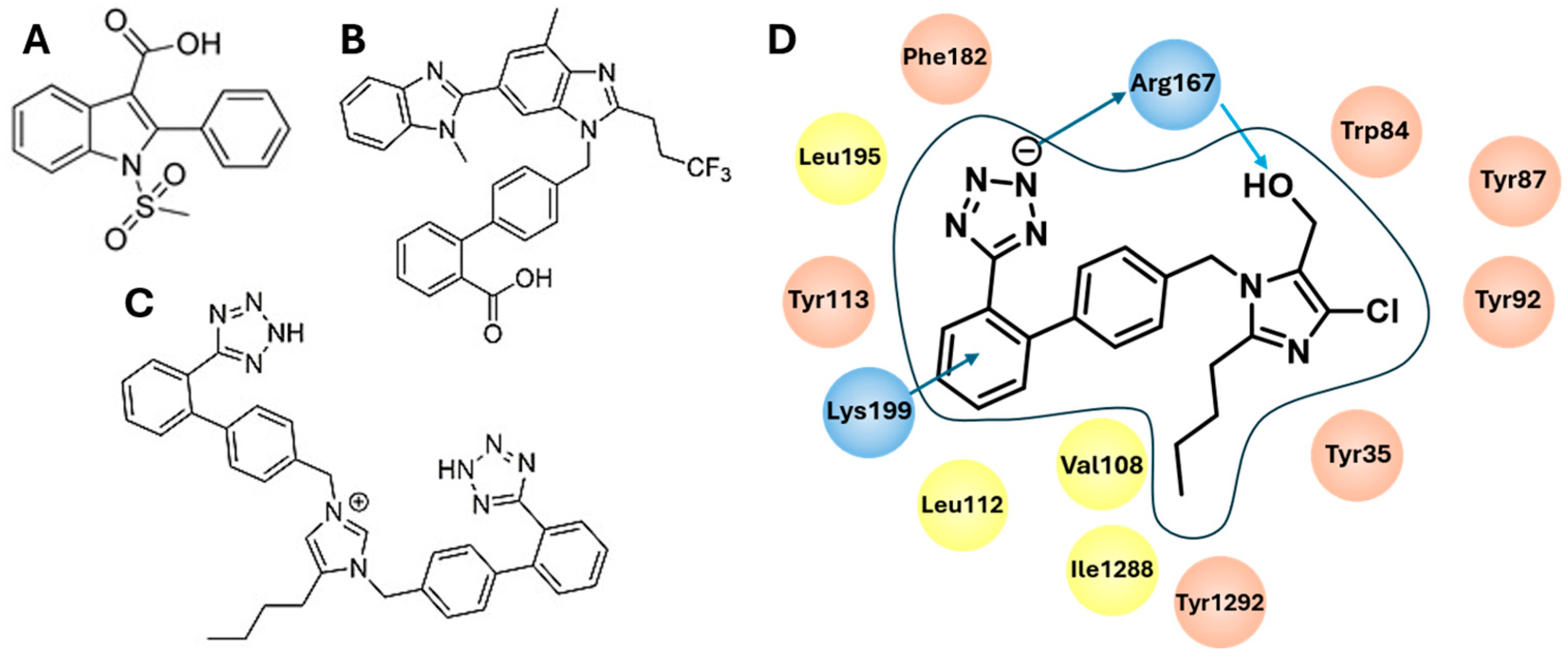
After nearly a decade with very few newly described inhibitors, novel nonpeptide AT1 antagonists have recently begun to emerge and can be broadly classified into three main categories: sartan derivatives, non-sartan derivatives, and bisartan derivatives [5] (Figure 1). Sartan derivatives, mainly inspired by losartan, are generally built around a biphenyl scaffold bearing an acidic or acidic-mimetic moiety that anchors the ligand within the orthosteric pocket; small changes around this pharmacophore strongly modulate potency and selectivity [6,7]. Medicinal chemistry and review articles summarize how substitutions at the biphenyl 2′-position and adjacent R1/R2 sites, as well as bioisosteric replacement of the acidic function, influence receptor recognition and pharmacokinetic properties [8,9,10].
The selection of a losartan-inspired scaffold was based on the well-established structure–activity relationships of nonpeptide AT1 receptor antagonists. Previous studies demonstrated that the biphenyl-tetrazole moiety plays a crucial role in anchoring the ligand within the receptor binding pocket, while the imidazole nucleus tolerates structural modifications at the C4 and C5 positions that can significantly influence receptor affinity and pharmacokinetic properties. In particular, substitutions at the biphenyl acidic function and at the imidazole ring were shown to modulate AT1/AT2 selectivity, duration of action and oral bioavailability. Furthermore, hydrophobic interactions involving the biphenyl system together with ionic interactions of the acidic group are considered essential for effective AT1 receptor recognition (Figure 1). These observations provided the rationale for the design of the present losartan-derived imidazole analogs. Building on this established pharmacophore, we designed a series of imidazole-based biphenyl derivatives to systematically explore key structural determinants of AT1 receptor binding. The study was organized around three main parameters, examined sequentially: (i) the nature of the ionizable acidic or acidic-mimetic group at the biphenyl 2′-position from tetrazole to ester, carboxylic acid, sulfonamide and N-acyl sulfonamide; (ii) the oxidation state of the benzylic linker connecting the imidazole and biphenyl units (secondary alcohol, methylene, ketone); and (iii) substitution patterns at aromatic R2 position to probe steric and electronic effects within the binding pocket. These variations were designed to evaluate how ionic anchoring interactions, particularly with the conserved Lys199 residue together with hydrophobic and aromatic contacts in the orthosteric pocket, govern receptor affinity (Figure 1). In parallel, the series enabled assessment of how polarity, conformational preference, and steric constraints modulate the ability of non-classical acidic motifs, such as N-acyl sulfonamides, to mimic tetrazole or carboxylate anchors [6,8,11].
In this work, we report the synthesis and biological evaluation of this series. Binding affinities were determined by displacement of radiolabeled [3H]-angiotensin II at human AT1 (PLC-PRF-5 cells) and at AT2 (calf cerebellum membranes). To rationalize experimental SAR trends, retrospective molecular docking was performed using the antagonist-bound AT1 crystal structure (PDB: 8TH4). The combined experimental and computational analyses identify key structural determinants: linker oxidation state, sulfonamide substitution, and presence of an ionizable anchor that govern AT1 affinity and selectivity in these new losartan-inspired imidazole derivatives.

2. Results and Discussion

2.1. Chemical Design

A novel series of imidazole-based derivatives was designed by incorporating either a biphenylmethylene or a benzophenone linker, two structural motifs commonly encountered in clinically validated angiotensin II type 1 (AT1) receptor antagonists. Structural diversification focused on substituents at the biphenyl 2′-position (R1) and at the 2-alkoxyphenyl position (R2) (Table 1).
A butyl chain was deliberately conserved at the imidazole 2-position, consistent with pharmacophoric features identified in losartan-like AT1 antagonists. This substitution was maintained to preserve key hydrophobic interactions and ensure comparability within the series.
The present work builds on earlier key contributions from our laboratory, which reported pyrazolidine-3,5-dione derivatives as potent and selective AT1 receptor antagonists capable of replacing classical imidazole cores. Those investigations demonstrated that scaffold rigidity and the precise spatial orientation of acidic moieties are critical determinants for receptor recognition and antagonist potency [6,7].
Expanding on this framework, we explored systematic variations at R1 and R2. Sulfonamide substitution patterns were modulated to evaluate steric effects, lipophilic contributions, and the capacity of N-acyl sulfonamides to act as bioisosteres of acidic functions. In parallel, linker oxidation states (secondary alcohol, methylene, ketone) were varied to probe the influence of flexibility, polarity, and conformational constraints on receptor affinity.
Finally, the requirement for an ionizable acidic group was investigated by comparing ester and carboxylic acid analogs. In addition, a tetrazole derivative was synthesized as an alternative polar bioisostere, enabling evaluation of non-classical acidic replacements within the series.

2.2. Rational Design

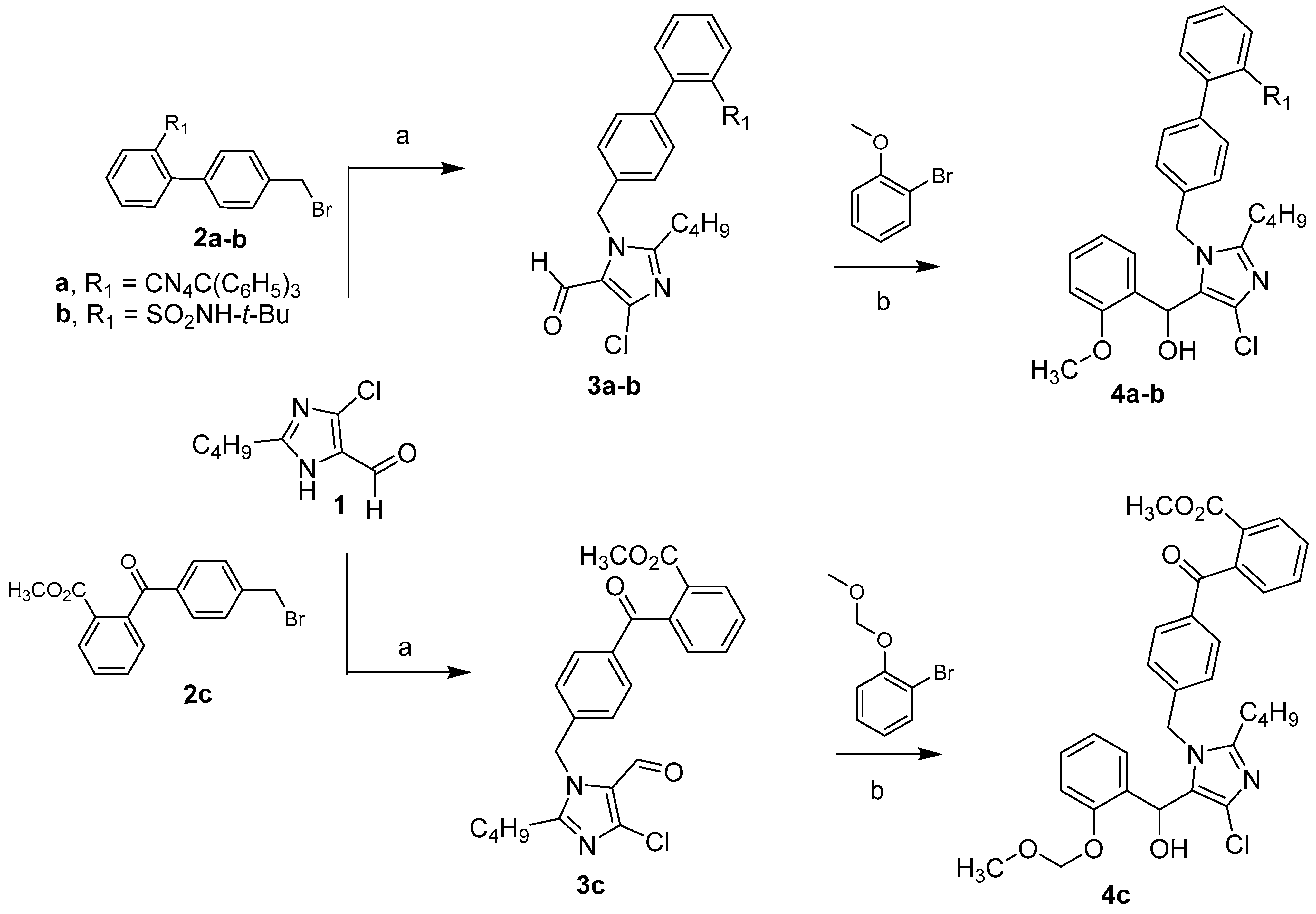
The synthesis of secondary alcohols 4ac was accomplished through a two-step reaction sequence (Scheme 1). In the first step (a), N-alkylation of imidazole 1 [10] with bromomethyl derivatives 2ac [12,13,14] was carried out in DMF at 70 °C using K2CO3 as the base [6,8]. This reaction afforded the N-alkylated intermediates 3ac in good yields (77%, 78%, and 77%, respectively). In the second step (b), secondary alcohols 4ac were prepared via a Grignard-type reaction. Magnesium metal was reacted with the corresponding bromobenzene derivatives [6] to form the organomagnesium reagents, which subsequently reacted with the aldehyde function of 3ac, yielding secondary alcohols 4ac in 72%, 75%, and 73% yields, respectively.
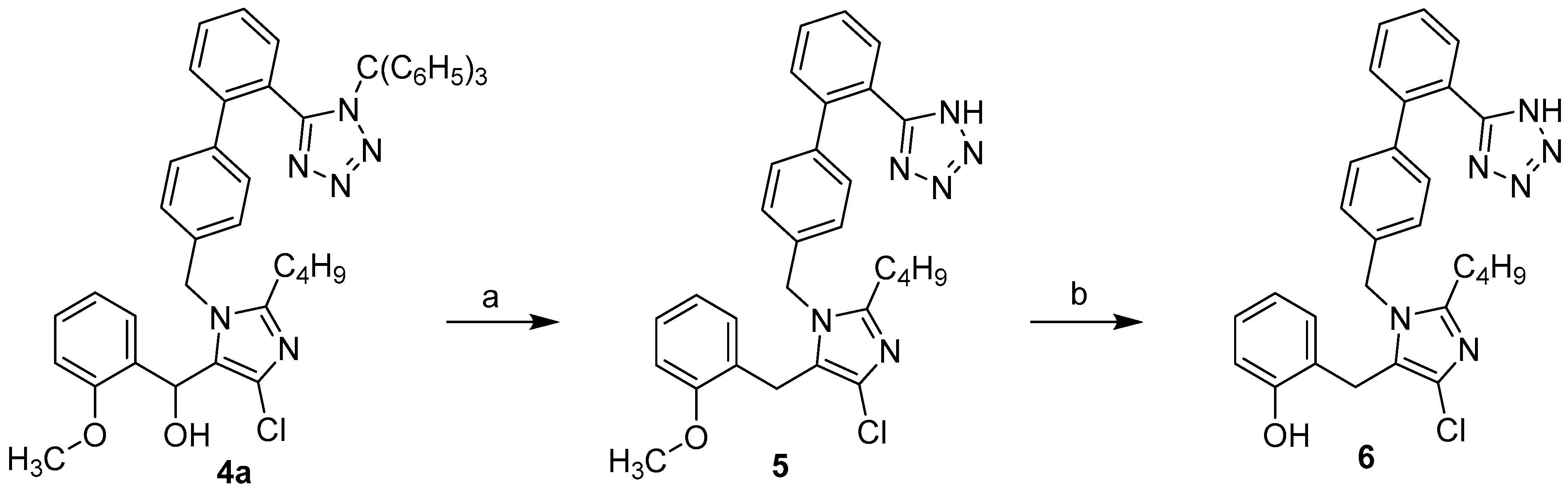
Scheme 2 outlines the two-step synthesis of compound 6 starting from alcohol 4a. In step (a), the secondary alcohol of 4a was selectively reduced to a methylene group using triethylsilane and trifluoroacetic acid at room temperature. Simultaneously, the tetrazole protecting group was removed, affording compound 5 in 85% yield. In step (b), compound 5 underwent selective demethylation of the methoxy group upon treatment with BBr3 in DCM, producing compound 6 in 65% yield. This sequence illustrates an efficient strategy combining alcohol reduction and protecting group removal.
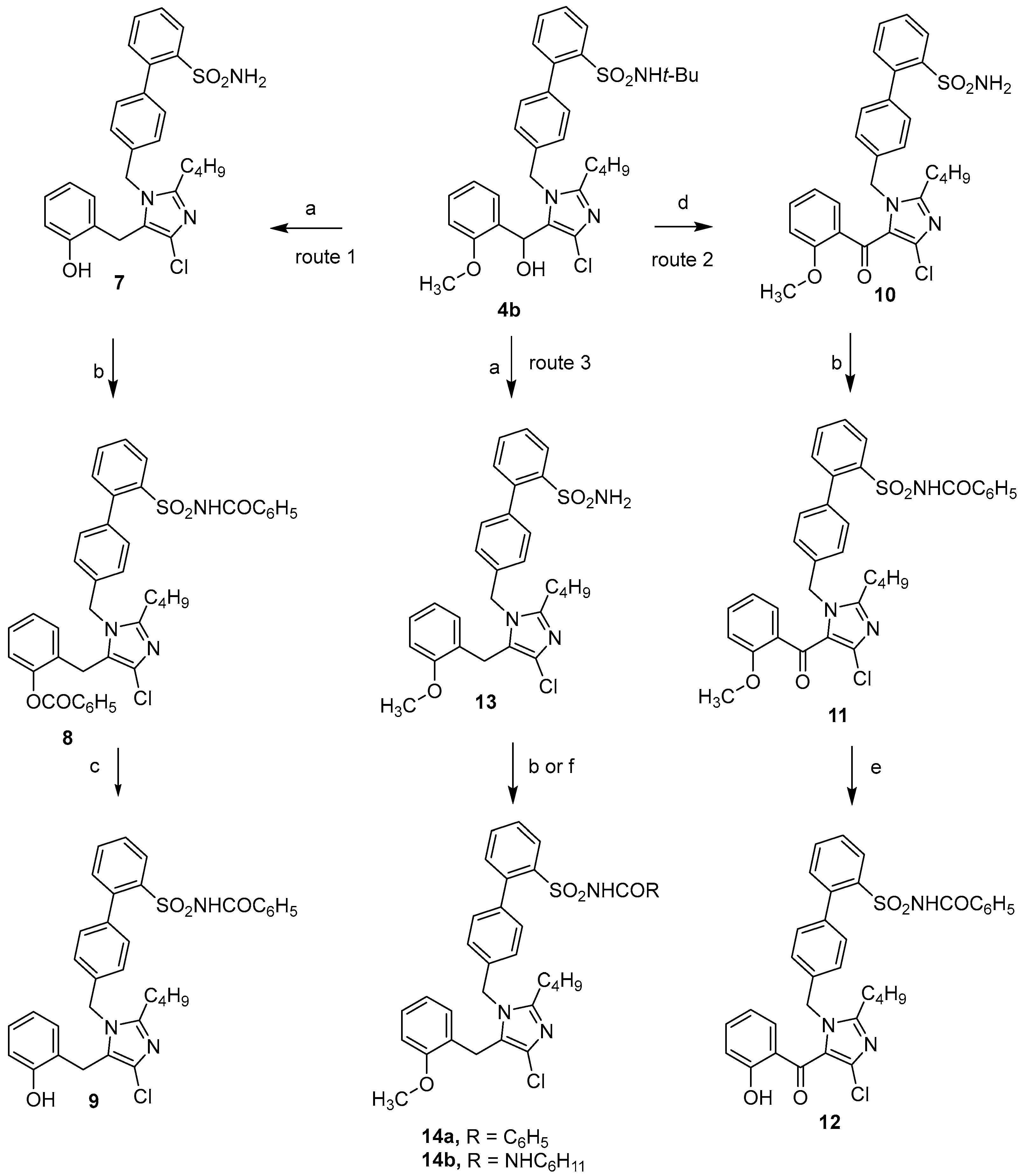
The synthesis of target compounds 89, 1112, and 14ab is described in Scheme 3 through three distinct synthetic routes originating from intermediate 4b.
Route 1. Treatment of 4b with triethylsilane and TFA simultaneously reduced the secondary alcohol and removed the sulfonamide protecting group. The resulting intermediate was subjected to BBr3-mediated demethylation in DCM to afford phenol 7. Reaction of 7 with benzoic anhydride at 80 °C yielded compound 8, which was subsequently hydrolyzed under basic conditions (NaOH in methanol/water). This route provides a simple, yet effective, method for synthesizing disubstituted compounds and performing selective ester hydrolysis.
Route 2. Oxidation of 4b with MnO2 in DCM afforded the corresponding ketone. Subsequent sulfonamide deprotection using TFA/anisole gave compound 10, which was further transformed by amidation and BBr3-mediated demethylation to provide compound 12. This sequence showcases a combination of oxidation, deprotection, and selective demethylation to prepare phenolic compounds.
Route 3. Reduction of 4b with triethylsilane/TFA produced intermediate 13, which was then reacted with benzoic anhydride or cyclohexyl isocyanate to yield derivatives 14a and 14b, respectively. This route highlights the flexibility of sulfonamide chemistry, enabling the formation of both amide and urea derivatives.
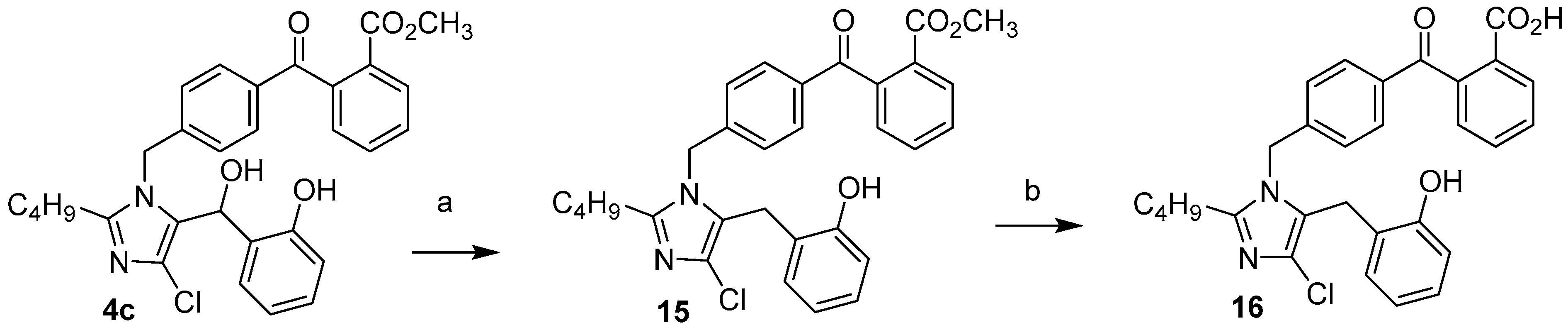
Compound 16 was synthesized starting from alcohol 4c. Treatment with triethylsilane and TFA reduced the secondary alcohol to a methylene group and simultaneously removed the methoxymethyl protecting group, affording ester 15. Subsequent basic hydrolysis (NaOH in methanol/water) produced acid 16 in excellent yield.
The synthesis of compound 16 begins with the treatment of alcohol 4c with triethylsilane and TFA at room temperature allowing, the reduction of the alcohol to a methylene group and simultaneously removing the methoxymethyl protection. In the second step, the ester group in the intermediate compound 15 is hydrolyzed under basic conditions (NaOH in methanol/water) at 60 °C, yielding the desired acid 16 in 88% yield. This Scheme 4 illustrates an efficient strategy for reducing alcohols, deprotecting functional groups, and performing ester hydrolysis in a single sequence.

2.3. Biological Activity—Structure–Activity Relationships

The title compounds were evaluated for their binding affinities toward AT1 and AT2 receptors by measuring their ability to displace radiolabeled [3H]-angiotensin II ([3H]-AII). AT1 binding assays were performed using the PLC-PRF-5 human hepatoma cell line [15], whereas AT2 assays employed calf cerebellum membranes [16].
Initial structural modifications focused on functionalization of the imidazole core with a biphenylmethylene moiety, a key pharmacophoric feature common to most nonpeptide angiotensin II receptor antagonists. Consistent with the structural requirements observed in irbesartan and losartan analogs, all derivatives retained a butyl substituent on the imidazole ring. Most clinically relevant losartan-type antagonists possess an ionizable acidic function (carboxylate, tetrazole, or acylsulfonamide) located at the biphenyl 2′-position [7,17,18]. This negatively charged group is considered essential for receptor recognition, primarily through electrostatic interaction with positively charged residues such as Lys199 [7,17,18,19].
The binding affinities and functional activities of 4b16 toward the AT1 receptor are summarized in Table 1. Clear SAR trends emerged from these data that are summarized in Table 1. Losartan (Ki = 3 nM) served as the reference compound, highlighting the importance of a biphenyl scaffold bearing an ionizable tetrazole moiety for high-affinity AT1 receptor binding. Consistent with this pharmacophore, tetrazole-containing derivatives 5 and 6 retained significant affinity (Ki = 25 nM, IC50 = 32 nM and Ki = 16 nM, IC50 = 20 nM, respectively), with the slightly improved potency of 6 (R2 = H) suggesting a modest steric influence near the acidic region. Replacement of the tetrazole with ester 15 resulted in loss of activity, whereas hydrolysis to the corresponding acid 16 partially restored binding (Ki = 251 nM, IC50 = 501 nM), confirming the requirement for an ionizable acidic function. Similarly, substitution with a sulfonamide group reduced receptor affinity, as illustrated by the weakly active unsubstituted derivative 7 (Ki = 1000 nM), while bulky substitution (4b, Ki = 158 nM, IC50 = 794 nM) partially compensated for this decrease.
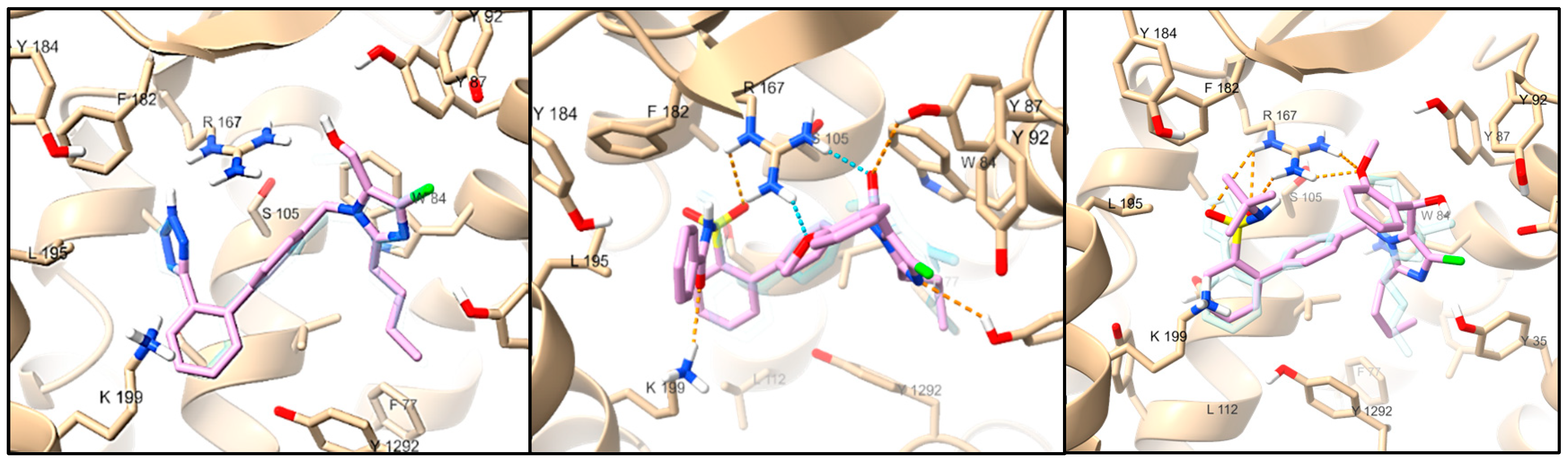
Molecular docking studies using the antagonist-bound AT1 receptor structure (PDB: 8TH4) indicated that the compounds adopt binding poses comparable to losartan, consistent with the SAR observations (Figure 2).
Docking analysis of 4b suggests that the secondary alcohol linker induces subtle geometric differences, resulting in a slightly displaced pose within the orthosteric pocket and less optimal alignment of the biphenyl scaffold and sulfonamide pharmacophore (Figure 2). This shift is consistent with steric interference involving the nearby residue Tyr92, an effect not observed for the methylene-linked analog 5.
Further introduction of an aromatic substituent on the sulfonamide nitrogen produced a pronounced increase in receptor affinity. Comparison of the unsubstituted sulfonamide 13 (Ki = 501 nM, IC50 = 1000 nM) with N-benzoyl derivative 14a (Ki = 16 nM, IC50 = 32 nM) and the urea homolog 14b (Ki = 20 nM, IC50 = 40 nM) highlights the favorable contribution of aromatic functionalization. This effect is consistent with docking observations, which indicate that the benzoyl group enhances hydrophobic complementarity and enables stabilizing aromatic interactions, notably involving residues Tyr184 and Phe182. These interactions likely contribute to improved pocket occupancy and ligand stabilization, with a preference for aromatic moiety, as seen with the slight decrease for the saturated 14b.
Variation in the linker oxidation state significantly affected receptor binding, as seen with 4b. Exploring this phenomenon, replacement of the methylene linker with a carbonyl group resulted in improved affinity, as illustrated by 10 (Ki = 25 nM, IC50 = 50 nM) and 11 (Ki = 5 nM, IC50 = 10 nM) compared with their methylene analogs 13 and 14a. Docking analysis suggests that the carbonyl linker promotes a more favorable orientation of the phenyl/biphenyl system within the orthosteric pocket (Figure 1). In particular, the ketone functionality appears to reduce steric interference near Tyr92, while enabling improved alignment of the aromatic scaffold. Additionally, the carbonyl oxygen may participate in stabilizing polar interactions, including potential hydrogen bonding with residues such as Arg167 and Tyr87, contributing to enhanced ligand recognition.
Finally, modification of the R2 substituent further modulated receptor affinity. Conversion of the methoxy group to the corresponding phenol (11 vs. 12, Ki = 5 nM vs. 10 nM) resulted in a modest decrease in potency. Docking observations suggest that the phenolic hydroxyl group introduces unfavorable interactions, including potential repulsion or suboptimal contacts near Tyr87. Similarly, incorporation of bulky R2 substituents (8 vs. 14a) reduced receptor affinity, consistent with steric crowding effects involving the nearby residue Tyr92.
The structure–activity trends observed here suggest that specific functional groups such as sulfonamide, tetrazole and aromatic substituents are critical for improving the inhibitory activity of these compounds at the AT1 receptor. These findings underscore the importance of fine-tuning substituents at positions R1 and R2 to achieve optimal receptor affinity.
Importantly, all compounds exhibited negligible AT2 receptor affinity (percentage of inhibition below 20% at 10−5 M), demonstrating a high degree of selectivity for the AT1 receptor, which is a desirable feature for drugs targeting AT1-mediated pathways. In silico predictions were run on the three best overall compounds, 11, 12 and 14a, with the Deep-PK API [20] and resulted in similar properties compared to losartan, with drug-like properties (Table S1). Noticeably, our compounds, without the tetrazole moiety, replaced with substituted sulfonamide, present slightly better predicted oral bioavailability and slightly less hepatic metabolism.

3. Discussion

A series of novel losartan-inspired imidazole derivatives were identified as potent and selective AT1 receptor antagonists. SAR analysis highlighted the key roles of the ionizable tetrazole and N-acyl sulfonamide groups as well as the favorable impact of aromatic substitution and linker oxidation state. Docking studies confirmed binding modes consistent with losartan, providing structural insight into the observed pharmacological trends, explaining the contribution of key substituents to receptor binding.
These findings expand the chemical space of AT1 antagonists and establish a strong foundation for further optimization. Additional functional and pharmacokinetic studies will be essential to advance these compounds toward potential therapeutic applications in diseases with renin–angiotensin system dysregulation.

4. Experimental Section

4.1. Chemistry

Chemicals and solvents were obtained from commercial sources and used without further purification unless otherwise noted. Reactions were monitored by TLC performed on Macherey-Nagel Alugram® Sil 60/UV254 sheets (thickness 0.2 mm, Macherey-Nagel GmbH & Co. KG, Düren, Germany). Purification of products was carried out by recrystallization or column chromatography. Column chromatography was carried out using Macherey-Nagel silica gel (230–400 mesh, Macherey-Nagel GmbH & Co. KG, Düren, Germany). Melting points were determined on a Büchi SMP-20 capillary apparatus (Büchi SARL, Villebon sur Yvette, France) and are uncorrected. NMR spectra were recorded on a Bruker DRX 300 spectrometer (Division Biospin, Wissembourg, France) operating at 300 MHz for 1H and 75 MHz for 13C). Chemical shifts are expressed in ppm relative to tetramethylsilane. Chemical shifts are reported as position (δ in ppm), multiplicity (s = singlet, d = doublet, t = triplet, q = quartet, dd = double doublet, br = broad, and m = multiplet), coupling constant (J in Hz), relative integral, and assignment. Infrared spectra were obtained on a Perkin-Elmer FT-IR S1000 on KBr paths. Mass spectra were recorded with decimal precision using a Waters AcQuity UPLC I-Class with UV detection (PDA) and an electrospray mode (ESI) (Waters Corporation, Milford, MA, USA). UPLC-MS Waters system was equipped with a UPLC I SMP MGR-FTN sample manager, an ACQUITY UPLC I-Class eK photodiode array detector (210–400 nm), and an ACQUITY QDa (Performance) detector (scan 50–1250) (Waters Corporation, Milford, MA, USA). Acquity BEH C18 column (50 mm × 2.1 mm, 1.7 μm, Waters) was used. The injection volume was 0.5 μL. A mixture of water and acetonitrile was used as mobile phase in gradient elution. The pH of the mobile phase was adjusted with HCOOH and NH3 (aq) to form a buffer solution at pH 3.8. The analysis time was 5 min (at a flow rate of 600 μL/min), 10 min (at a flow rate of 600 μL/min), or 30 min (at a flow rate of 600 μL/min). Unless otherwise specified, the purity of evaluated compounds was judged to be >95% as determined by UPLC-UV-MS system. HRMS analysis was performed on a LC–MS system equipped with a LCT Premier XE mass spectrometer (Waters) using an XBridge C18 column (50 mm × 4.6 mm, 3.5 μm, Waters). A gradient starting from 98% H2O 5 mM ammonium formate pH 3.8 and reaching 100% CH3CN 5 mM ammonium formate pH 3.8 within 3 min at a flow rate of 1 mL/min was used. NMR, LC-MS and HRMS spectra are provided as Supplementary Materials.

4.1.1. General Procedure for the N-Alkylation Reaction

Potassium carbonate (30 mmol) was added in portions to a solution of compound 1 (10 mmol) in anhydrous DMF (60 mL). The appropriate alkyl bromide (2ac, 10.2 mmol) was subsequently introduced into the reaction mixture, which was stirred at 70 °C for 3 h. Following the reaction, water (150 mL) was added to the mixture, resulting in a suspension that was extracted twice with Et2O. The organic phase was washed with water, dried over MgSO4, and concentrated under reduced pressure. The resulting solid was purified by recrystallization from the suitable solvent.

4.1.2. Synthesis of 2-Butyl-4-chloro-1-((2′-(1-trityl-1H-tetrazol-5-yl)-[1,1′-biphenyl]-4-yl)methyl)-1H-imidazole-5-carbaldehyde (3a)

White solid (77%); mp 127–129 °C (CH3CN). 1H NMR (300 MHz, DMSO-d6) δ 9.67 (s, 1H), 7.79 (d, J = 6.8 Hz, 1H), 7.74–7.50 (m, 2H), 7.49–7.26 (m, 10H), 7.69 (d, J = 8.1 Hz, 2H), 6.95 (d, J = 8.1 Hz, 2H), 6.85 (d, J = 7.5 Hz, 6H), 5.53 (s, 2H), 2.65 (t, J = 7.2 Hz, 2H), 1.47 (quint, J = 7.8 Hz, 2H), 1.16 (sext, J = 7.3 Hz, 2H), 0.76 (t, J = 7.4 Hz, 3H). 13C NMR (75 MHz, DMSO-d6) δ 178.3, 163.8, 154.7, 141.5, 141.3, 140.8, 139.6, 134.9, 130.7, 130.5, 130.3, 129.6, 129.3, 128.3, 126.6, 126.1, 124.4, 82.7, 47.5, 28.9, 25.9, 22.2, 14.0. LCMS tr = 2.78 min, m/z calc for [M+H]+: 663, found: 663.

4.1.3. Synthesis of N-tert-Butyl-2-[4-[(2-butyl-4-chloro-5-formyl-imidazol-1-yl)methyl]phenyl] Benzene Sulfonamide (3b)

White solid (78%); mp 117–119 °C (Isopropyl ether). 1H NMR (500 MHz, DMSO-d6) δ 9.72 (s, 1H), 8.03 (dd, J = 7.9, 1.5 Hz, 1H), 7.61 (td, J = 7.5, 1.5 Hz, 1H), 7.59–7.53 (m, 1H), 7.38 (d, J = 7.9 Hz, 2H), 7.27 (dd, J = 7.5, 1.4 Hz, 1H), 7.13 (d, J = 7.9 Hz, 2H), 6.57 (s, 1H), 5.65 (s, 2H), 2.68 (t, J = 7.6 Hz, 2H), 1.57 (quint, J = 7.6 Hz, 2H), 1.29 (hex, J = 7.5 Hz, 2H), 0.95 (s, 9H), 0.84 (t, J = 7.3 Hz, 3H). 13C NMR (126 MHz, DMSO-d6) δ 178.0, 154.4, 142.1, 141.0, 139.5, 139.2, 135.3, 132.5, 131.8, 129.7, 128.0, 127.8, 125.8, 124.0, 53.4, 47.2, 29.3, 28.5, 25.5, 21.7, 13.6. LCMS tr = 2.50 min, m/z calc for [M+H]+: 488, found: 488; [M-H]: 486, found: 486.

4.1.4. Synthesis of Methyl 2-(4-((2-Butyl-4-chloro-5-formyl-1H-imidazol-1-yl)methyl)benzoyl) Benzoate (3c)

White solid (77%); mp 98–100 °C (MeOH). 1H NMR (300 MHz, DMSO-d6): δ 9.72 (s, 1H), 8.12 (dd, J = 1.2, 8.2 Hz, 1H), 7.75–7.70 (m, 2H), 7.65 (d, J = 8.2 Hz, 2H), 7.45 (dd, J = 7.4, 1.20 Hz, 1H), 7.22 (d, J = 8.2 Hz, 2H), 5.70 (s, 2H), 3.56 (s, 3H), 2.65 (t, J = 7.3 Hz, 2H), 1.62 (qt, J = 7.3 Hz, 2H), 1.30 (sext, J = 3.0 Hz, 2H), 0.80 (t, J = 7.3 Hz, 3H). 13C NMR (75 MHz, DMSO-d6): δ 196.3, 189.1, 168.2, 155.9, 141.2, 140.6, 136.0, 135.4, 133.8, 132.7, 132.4, 132.2, 130.2, 128.4, 127.8, 127.2, 51.5, 47.3, 30.8, 25.3, 22.3, 14.2. LCMS tr = 2.40 min, m/z calc for [M+H]+: 439, found: 439; [M-H]: 437, found: 437.

4.1.5. General Procedure for the Grignard Reaction

To a suspension of magnesium turnings (160 mg, 6 mmol) in dry THF (40 mL) under an argon atmosphere was added, dropwise, a solution of the bromine derivative (5.5 mmol) in dry THF (30 mL). The mixture was stirred at reflux for 1 h. Subsequently, the obtained solution was added dropwise to a solution of the desired carbaldehyde (5 mmol) in dry THF (30 mL). The resulting solution was stirred for an additional 3 h. The reaction was quenched with a saturated solution of NH4Cl (20 mL). The reaction mixture was then extracted with ethyl acetate, washed with brine, and dried over MgSO4. The organic layer was evaporated under reduced pressure, and the crude product was triturated in Et2O, filtered and recrystallized from the appropriate solvent.

4.1.6. Synthesis of N-tert-Butyl-2-[4-[[2-butyl-4-chloro-5-[hydroxy-(2-methoxyphenyl)methyl] imidazol-1-yl]methyl]phenyl] Benzene Sulfonamide (4b)

White solid (75%); mp 167–168 °C (CH3CN). 1H NMR (300 MHz, DMSO-d6) δ 8.04 (dd, J = 7.8, 1.5 Hz, 1H), 7.70–7.47 (m, 3H), 7.33–7.22 (m, 3H), 7.22–7.11 (m, 1H), 6.97–6.81 (m, 4H), 6.41 (s, 1H), 5.96 (s, 2H), 5.28 (s, 2H), 3.68 (s, 3H), 2.37 (t, J = 7.6 Hz, 2H), 1.47 (quint, J = 8.2 Hz, 2H), 1.22 (sext, J = 7.3 Hz, 2H), 0.94 (s, 9H), 0.79 (t, J = 7.3 Hz, 3H). 13C NMR (75 MHz, DMSO-d6) δ 155.8, 146.7, 142.0, 139.6, 138.5, 136.2, 132.6, 131.8, 129.4, 129.2, 128.2, 128.0, 127.7, 126.7, 126.2, 125.3, 124.8, 119.9, 110.4, 60.7, 55.3, 53.3, 46.4, 29.3, 28.7, 25.8, 21.7, 13.7. LCMS tr = 2.44 min, m/z calc for [M+H]+: 596, found: 596; [M-H]: 594, found: 594. HRMS m/z calc for C32H39ClN3O4S [M+H]+ 596.2350, found 596.2349.

4.1.7. Synthesis of Methyl 2-(4-((2-Butyl-4-chloro-5-(hydroxy(2-(methoxymethoxy)phenyl)methyl)-1H-imidazol-1-yl)methyl)benzoyl)benzoate (4c)

White solid (73%); mp 144–146 °C (EtOH). 1H NMR (300 MHz, DMSO-d6) δ 7.99 (dd, J = 7.6, 1.4 Hz, 1H), 7.77 (td, J = 7.4, 1.4 Hz, 1H), 7.69 (td, J = 7.6, 1.4 Hz, 1H), 7.56 (dd, J = 7.7, 1.7 Hz, 1H), 7.49–7.38 (m, 3H), 7.13–7.02 (m, 1H), 6.94–6.85 (m, 3H), 6.81 (t, J = 7.5 Hz, 1H), 6.06 (d, J = 4.6 Hz, 1H), 5.94 (d, J = 4.2 Hz, 1H), 5.38 (d, J = 17.9 Hz, 1H), 5.27 (d, J = 17.8 Hz, 1H), 5.14 (d, J = 6.9 Hz, 1H), 5.04 (d, J = 6.9 Hz, 1H), 3.56 (s, 3H), 3.11 (s, 3H), 2.34–2.25 (m, 2H), 1.47–1.30 (m, 2H), 1.15 (hept, J = 7.3 Hz, 2H), 0.73 (t, J = 7.3 Hz, 3H). 13C NMR (75 MHz, DMSO-d6) δ 195.6, 165.9, 152.9, 146.7, 142.6, 141.0, 135.4, 132.8, 130.2, 129.7, 129.7, 128.9, 128.7, 128.0, 127.8, 126.7, 126.2, 125.9, 125.3, 120.7, 112.6, 92.8, 60.7, 55.3, 52.2, 46.5, 28.8, 25.6, 21.6, 13.5. LCMS tr = 2.25 min, m/z calc for [M+H]+: 577, found: 577; m/z calc for [M-H]: 575, found: 575. HRMS m/z calc for C32H34ClN2O6 [M+H]+ 577.2105, found 577.2127.

4.1.8. Synthesis of 5-(4′-((2-Butyl-4-chloro-5-(2-methoxybenzyl)-1H-imidazol-1-yl)methyl)-[1,1′-biphenyl]-2-yl)-1H-tetrazole (5)

Trifluoroacetic acid (4.5 mL, 30 mmol) was added dropwise to a solution of compound 4a (1.54 g, 2 mmol) in DCM (60 mL), followed by the dropwise addition of Et3SiH (3.23 mL, 20 mmol). The resulting reaction mixture was stirred at ambient temperature for 18 h. After completion of the reaction, the mixture was concentrated under reduced pressure, and water was added to the residue. The resulting precipitate was collected by filtration, washed with n-hexane, and dried to afford the desired product. The solid was further purified by recrystallization in EtOH. White solid (85%); mp 176–178 °C (EtOH). 1H NMR (300 MHz, DMSO-d6) δ 9.62 (br s, 1H), 7.70–7.54 (m, 2H), 7.62 (m, 1H), 7.54 (m,1H), 7.10–6.92 (m, 3H), 6.82 (m, 2H), 6.75 (m, 2H), 6.64 (m, 1H), 5.05 (s, 2H), 3.72 (s, 2H), 3.78 (s, 3H), 2.42 (t, J = 7.6 Hz, 2H), 1.45 (quint, J = 7.2 Hz, 2H), 1.22 (sext, J = 7.2 Hz, 2H), 0.80 (t, J = 7.3 Hz, 3H). 13C NMR (75 MHz, DMSO-d6) δ 155.5, 154.2, 146.4, 141.0, 137.4, 134.8, 131.2, 130.5, 128.1, 128.9, 127.9, 127.6, 125.8, 125.4, 124.7, 124.1, 123.7, 123.4, 119.2, 115.1, 57.8, 46.4, 29.0, 25.8, 22.3, 21.7, 13.5. LCMS tr = 2.20 min, m/z calc for [M+H]+: 513, found: 513; [M-H]: 511, found: 511.

4.1.9. Synthesis of 2-((1-((2′-(1H-Tetrazol-5-yl)-[1,1′-biphenyl]-4-yl)methyl)-2-butyl-4-chloro-1H-imidazol-5-yl)methyl)phenol (6)

To a stirred solution of compound 5 (0.51 g, 1 mmol) in anhydrous DCM (50 mL), BBr3 (0.14 mL, 1.2 mmol) was added, dropwise, at 0 °C under an inert nitrogen atmosphere. The reaction mixture was allowed to warm to room temperature and stirred for 2 h. The reaction mixture was quenched by the slow addition of water. The crude product was purified by recrystallization in CH3CN. White solid (65%); mp 223–225 °C (CH3CN). 1H NMR (300 MHz, DMSO-d6) δ 9.62 (br s, 1H), 7.71–7.64 (m, 2H), 7.60 (m, 1H), 7.51 (m,1H), 7.03–6.97 (m, 3H), 6.82 (m, 2H), 6.77 (m, 2H), 6.66 (m, 1H), 5.07 (s, 2H), 3.74 (s, 2H), 2.45 (t, J = 7.6 Hz, 2H), 1.45 (quint, J = 7.2 Hz, 2H), 1.24 (sext, J = 7.2 Hz, 2H), 0.79 (t, J = 7.3 Hz, 3H). 13C NMR (75 MHz, DMSO-d6) δ 154.4, 146.5, 141.0, 138.3, 136.0, 131.1, 130.6, 129.1, 128.9, 127.8, 127.5, 125.9, 124.7, 124.4, 123.8, 123.4, 119.1, 115.0, 46.3, 29.0, 25.9, 22.2, 21.6, 13.6. LCMS tr = 2.01 min, m/z calc for [M+H]+: 499, found: 499; [M-H]: 497, found: 497. HRMS m/z calc for C28H28ClN6O [M+H]+ 499.2013, found 499.2013.

4.1.10. Synthesis of 4′-((2-Butyl-4-chloro-5-(2-hydroxybenzyl)-1H-imidazol-1-yl)methyl)-[1,1′-biphenyl]-2-sulfonamide (7)

TFA (4.5 mL, 30 mmol) was added dropwise to a solution of compound 4b (1.16 g, 2 mmol) in DCM (60 mL), followed by the dropwise addition of Et3SiH (3.23 mL, 20 mmol). The resulting reaction mixture was stirred at room temperature for 18 h. After completion of the reaction, the mixture was concentrated under reduced pressure, and water was added to the residue. The resulting precipitate was collected by filtration, washed with n-hexane, dried, and used for the next step without further purification. The solid was dissolved in anhydrous DCM (50 mL), and BBr3 (0.28 mL, 1.5 mmol) was added dropwise at 0 °C under an inert nitrogen atmosphere. The reaction mixture was allowed to warm to room temperature and stirred for 4 h. The reaction mixture was quenched by the slow addition of water. The crude product was collected by filtration, dried, and purified by recrystallization in CH3CN. White solid (72%); mp 155–157 °C (CH3CN). 1H NMR (500 MHz, DMSO-d6) δ 9.69 (br s, 1H), 8.01 (dd, J = 7.9, 1.5 Hz, 1H), 7.61 (td, J = 7.5, 1.5 Hz, 1H), 7.56 (td, J = 7.7, 1.5 Hz, 1H), 7.30 (d, J = 8.0 Hz, 2H), 7.25 (dd, J = 7.5, 1.5 Hz, 1H), 7.18 (s, 2H), 7.01 (td, J = 7.6, 1.8 Hz, 1H), 6.91 (d, J = 8.0 Hz, 2H), 6.80–6.76 (m, 2H), 6.70 (t, J = 7.2 Hz, 1H), 5.12 (s, 2H), 3.78 (s, 2H), 2.53 (t, J = 7.6 Hz, 2H), 1.49 (quint, J = 7.6 Hz, 2H), 1.25 (sext, J = 7.4 Hz, 2H), 0.80 (t, J = 7.3 Hz, 3H). 13C NMR (126 MHz, DMSO-d6) δ 154.5, 146.7, 142.3, 139.4, 139.2, 135.9, 132.4, 131.6, 129.6, 128.9, 127.8, 127.4, 125.3, 125.1, 124.5, 124.0, 119.3, 115.1, 46.5, 29.2, 26.1, 22.3, 21.8, 13.7.
LCMS tr = 2.12 min, m/z calc for [M+H]+: 510, found: 510; [M-H]: 508, found: 508. HRMS m/z calc for C27H29ClN3O3S [M+H]+ 510.1618, found 510.1626.

4.1.11. Synthesis of 2-((1-((2′-(N-Benzoylsulfamoyl)-[1,1′-biphenyl]-4-yl)methyl)-2-butyl-4-chloro-1H-imidazol-5-yl)methyl) Phenyl Benzoate (8)

Benzoic anhydride (0.57 mL, 3 mmol) was added dropwise to a stirred solution of compound 7 (0.51 g, 1 mmol) in pyridine (10 mL) at room temperature. The reaction mixture was heated to 80 °C and maintained at this temperature for 4 h. After completion, the mixture was allowed to cool to room temperature and was then transferred to an ice/water bath (100 mL). The resulting precipitate was isolated by filtration and washed with water and Et2O. The crude product was recrystallized from EtOH to yield compound 8 as a white solid in 85% yield. White solid (85%); mp 148–150 °C (EtOH). 1H NMR (300 MHz, DMSO) δ 8.10–7.98 (m, 3H), 7.75–7.60 (m, 3H), 7.53 (t, J = 7.7 Hz, 2H), 7.44–7.14 (m, 10H), 6.96–6.82 (m, 2H), 6.66 (d, J = 7.9 Hz, 2H), 4.91 (s, 2H), 3.73 (s, 2H), 2.56 (m, 2H), 1.56 (quint, J = 7.5 Hz, 2H), 1.30 (hex, J = 7.4 Hz, 2H), 0.86 (t, J = 7.3 Hz, 3H). 13C NMR (75 MHz, CDCl3) δ 164.3, 148.5, 147.0, 143.4, 140.5, 139.0, 134.1, 134.0, 131.3, 129.8, 129.8, 129.5, 129.5, 129.3, 129.2, 129.1, 128.9, 128.5, 128.2, 127.9, 127.0, 126.4, 125.9, 124.2, 122.8, 122.3, 46.7, 29.1, 25.9, 23.2, 21.7, 13.8. LCMS tr = 2.40 min, m/z calc for [M+H]+: 718, found: 718; [M-H]: 716, found: 716. HRMS m/z calc for C41H37ClN3O5S [M+H]+ 718.2142, found 718.2165.

4.1.12. Synthesis of N-((4′-((2-Butyl-4-chloro-5-(2-hydroxybenzyl)-1H-imidazol-1-yl)methyl)-[1,1′-biphenyl]-2-yl)sulfonyl) Benzamide (9)

Sodium hydroxide (NaOH, 0.12 g, 3 mmol) was dissolved in water (30 mL) and added to a stirred solution of compound 8 (0.72 g, 1 mmol) in methanol (MeOH, 10 mL). The reaction mixture was heated to reflux and stirred for 2 h. After the reaction was complete, the solvent was removed under reduced pressure, and water was added to the residue. The aqueous solution was then acidified with 1 M HCl. The resulting precipitate was isolated by filtration and washed with water and Et2O. The crude product was purified by recrystallization from ethanol (EtOH). White solid (62%); mp 267–269 °C (EtOH). 1H NMR (300 MHz, DMSO-d6) δ 12.08 (br s, 1H), 9.88 (br s, 1H), 8.17 (dd, J = 7.9, 1.5 Hz, 1H), 7.79–7.54 (m, 5H), 7.40 (t, J = 7.7 Hz, 2H), 7.26 (dd, J = 7.4, 1.6 Hz, 1H), 7.22 (d, J = 8.2 Hz, 2H), 7.05 (td, J = 7.6, 1.8 Hz, 1H), 6.93 (d, J = 8.0 Hz, 2H), 6.92–6.78 (m, 2H), 6.71 (td, J = 7.4, 1.2 Hz, 1H), 5.28 (s, 2H), 3.82 (s, 2H), 2.71 (t, J = 7.7 Hz, 2H), 1.57 (quint, J = 7.7 Hz, 2H), 1.27 (sext, J = 7.4 Hz, 2H), 0.83 (t, J = 7.3 Hz, 3H). 13C NMR (75 MHz, DMSO-d6) δ 165.1, 154.8, 147.0, 139.8, 138.1, 137.7, 135.1, 133.3, 133.2, 132.7, 131.1, 129.5, 129.3, 128.4, 128.4, 128.3, 128.0, 126.2, 125.6, 122.7, 121.0, 119.2, 115.2, 47.0, 28.7, 25.3, 22.7, 21.7, 13.6. LCMS tr = 2.15 min, m/z calc for [M+H]+: 614, found: 614; [M-H]: 612, found: 612. HRMS m/z calc for C34H33ClN3O4S [M+H]+ 614.1880, found 614.1887.

4.1.13. Synthesis of 4′-((2-Butyl-4-chloro-5-(2-methoxybenzoyl)-1H-imidazol-1-yl)methyl)-[1,1′-biphenyl]-2-sulfonamide (10)

MnO2 (0.35 g, 4 mmol) was added to a solution of the compound 4b (0.6 g, 1 mmol) in DCM. The mixture was stirred under reflux for 4 h, and then filtered. Trifluoroacetic acid (5 mL) and anisole (0.1 mL, 1 mmol) were added, and the solution was stirred for 3 h and evaporated. The residue was triturated with Et2O and filtered. The precipitate was recrystallized from EtOH. White solid (56%); mp 147–148 °C (EtOH). 1H NMR (300 MHz, DMSO-d6) δ 8.03 (dd, J = 7.4, 1.9 Hz, 1H), 7.65–7.46 (m, 3H), 7.39 (d, J = 8.1 Hz, 2H), 7.29–7.23 (m, 2H), 7.20–7.08 (m, 5H), 7.04 (t, J = 7.4 Hz, 1H), 5.72 (s, 2H), 3.74 (s, 3H), 2.68 (t, J = 7.6 Hz, 2H), 1.56 (quint, J = 7.6 Hz, 2H), 1.30 (sext, J = 7.1 Hz, 2H), 0.84 (t, J = 7.3 Hz, 3H). 13C NMR (75 MHz, DMSO-d6) δ 184.4, 166.5, 157.0, 153.1, 142.3, 139.4, 139.2, 136.5, 135.8, 132.5, 131.4, 129.5, 129.1, 128.6, 127.7, 127.3, 125.5, 120.7, 111.7, 55.8, 47.5, 28.6, 25.7, 21.7, 13.6. LCMS tr = 2.28 min, m/z calc for [M+H]+: 538, found: 538; [M-H]: 536, found: 536. HRMS m/z calc for C28H29ClN3O4S [M+H]+ 538.1567, found 538.1580.

4.1.14. Synthesis of N-((4′-((2-Butyl-4-chloro-5-(2-methoxybenzoyl)-1H-imidazol-1-yl)methyl)-[1,1′-biphenyl]-2-yl)sulfonyl) Benzamide (11)

This compound was prepared following the same procedure as compound 8, using compound 10 (0.65 g, 1.2 mmol) and benzoic anhydride (0.27 mL, 1.44 mmol) in pyridine (10 mL). Recrystallization from EtOH yielded compound 11. White solid (82%); mp 169–170 °C (EtOH). 1H NMR (500 MHz, DMSO-d6) δ 12.08 (br s, 1H), 8.17 (dd, J = 8.0, 1.4 Hz, 1H), 7.72 (td, J = 7.5, 1.5 Hz, 1H), 7.66 (td, J = 7.7, 1.5 Hz, 1H), 7.59–7.54 (m, 2H), 7.55–7.46 (m, 2H), 7.36 (t, J = 7.7 Hz, 2H), 7.32–7.25 (m, 4H), 7.10 (d, J = 8.4 Hz, 3H), 7.05 (t, J = 7.4 Hz, 1H), 5.73 (s, 2H), 3.65 (s, 3H), 2.66 (t, J = 7.6 Hz, 2H), 1.60 (quint, J = 7.6 Hz, 2H), 1.31 (sext, J = 7.4 Hz, 2H), 0.86 (t, J = 7.4 Hz, 3H). 13C NMR (126 MHz, DMSO-d6) δ 184.5, 165.1, 157.0, 153.1, 140.0, 137.8, 137.6, 136.6, 136.3, 133.2, 133.0, 132.7, 132.6, 131.1, 129.7, 129.4, 129.1, 128.7, 128.3, 128.2, 128.1, 125.7, 125.6, 120.7, 111.7, 55.7, 28.5, 25.7, 21.7, 13.7. LCMS tr = 2.31 min, m/z calc for [M+H]+: 642, found: 642; [M-H]: 640, found: 640. HRMS m/z calc for C35H33ClN3O5S [M+H]+ 642.1829, found 642.1796.

4.1.15. Synthesis of N-((4′-((2-Butyl-4-chloro-5-(2-hydroxybenzoyl)-1H-imidazol-1-yl)methyl)-[1,1′-biphenyl]-2-yl)sulfonyl) Benzamide (12)

This compound was prepared following the same procedure as compound 6, using compound 11 (0.42 g, 0.65 mmol) and BBr3 (0.092 mL, 0.98 mmol). Recrystallization from EtOH gave compound 12. White solid (77%); mp 189–191 °C (EtOH). 1H NMR (500 MHz, DMSO) δ 12.09 (br s, 1H), 10.17 (br s, 1H), 8.16 (dd, J = 8.0, 1.4 Hz, 1H), 7.71 (td, J = 7.5, 1.4 Hz, 1H), 7.65 (td, J = 7.7, 1.4 Hz, 1H), 7.59–7.50 (m, 3H), 7.43–7.34 (m, 3H), 7.33 (m, 1H), 7.28–7.21 (m, 3H), 7.16–7.10 (m, 2H), 6.95 (m, 2H), 5.64 (s, 2H), 2.65 (t, J = 7.3 Hz, 2H), 1.59 (quint, J = 7.6 Hz, 2H), 1.30 (sext, J = 7.4 Hz, 2H), 0.85 (t, J = 7.3 Hz, 3H). 13C NMR (126 MHz, DMSO) δ 186.2, 165.1, 156.9, 156.5, 153.6, 152.6, 140.0, 137.8, 137.6, 136.3, 135.5, 133.2, 133.1, 132.7, 131.2, 130.2, 129.8, 129.3, 128.3, 128.2, 128.1, 126.4, 125.9, 123.3, 119.2, 116.4, 47.3, 28.5, 25.7, 21.7, 13.7. LCMS tr = 2.29 min, m/z calc for [M+H]+: 628, found: 628; [M-H]: 626, found: 626. HRMS m/z calc for C34H31ClN3O5S [M+H]+ 628.1673, found 628.1703.

4.1.16. Synthesis of 4′-((2-Butyl-4-chloro-5-(2-methoxybenzyl)-1H-imidazol-1-yl)methyl)-[1,1′-biphenyl]-2-sulfonamide (13)

This compound was prepared following the same procedure as compound 5, using compound 4b (1.2 g, 2 mmol), Et3SiH (3.23 mL, 20 mmol) and TFA (4.46 mL, 60 mmol). Recrystallization from CH3CN gave compound 13. White solid (52%); mp 182–184 °C (CH3CN). 1H NMR (500 MHz, DMSO-d6) δ 8.02 (dd, J = 7.9, 1.4 Hz, 1H), 7.61 (t, J = 7.5 Hz, 1H), 7.57 (t, J = 7.5 Hz, 1H), 7.29 (d, J = 8.0 Hz, 2H), 7.25 (d, J = 7.3, 1H), 7.21–7.15 (m, 3H), 6.92 (d, J = 8.2 Hz, 1H), 6.90–6.79 (m, 4H), 5.11 (s, 2H), 3.79 (s, 2H), 3.75 (s, 3H), 2.54 (t, J = 2.5 Hz, 2H), 1.52 (quint, J = 7.6 Hz, 2H), 1.27 (sext, J = 7.4 Hz, 2H), 0.82 (t, J = 7.3 Hz, 3H). 13C NMR (126 MHz, DMSO-d6) δ 156.5, 146.7, 142.2, 139.4, 139.0, 135.7, 132.4, 131.5, 129.5, 128.7, 127.9, 127.7, 127.3, 125.4, 125.3, 125.0, 123.9, 120.4, 110.7, 55.3, 46.4, 29.1, 26.0, 22.5, 21.7, 13.7. LCMS tr = 2.32 min, m/z calc for [M+H]+: 524, found: 524; [M-H]: 522, found: 522. HRMS m/z calc for C28H31ClN3O3S [M+H]+ 524.1775, found 524.1777.

4.1.17. Synthesis of N-((4′-((2-Butyl-4-chloro-5-(2-methoxybenzyl)-1H-imidazol-1-yl)methyl)-[1,1′-biphenyl]-2-yl)sulfonyl) Benzamide (14a)

This compound was prepared following the same procedure as compound 8, using compound 13 (0.65 g, 1.2 mmol) and benzoic anhydride (0.27 mL, 1.44 mmol). Recrystallization from CH3CN gave compound 14a. White solid (76%); mp 204–206 °C (CH3CN). 1H NMR (300 MHz, DMSO-d6) δ 12.02 (s, 1H), 8.16 (dd, J = 7.8, 1.5 Hz, 1H), 7.72 (td, J = 7.5, 1.6 Hz, 1H), 7.65 (td, J = 7.6, 1.6 Hz, 1H), 7.62–7.52 (m, 3H), 7.42–7.34 (m, 2H), 7.26 (dd, J = 7.5, 1.5 Hz, 1H), 7.23–7.14 (m, 3H), 6.93 (d, J = 8.2 Hz, 1H), 6.88–6.78 (m, 4H), 5.09 (s, 2H), 3.78 (s, 2H), 3.76 (s, 3H), 2.55 (t, J = 7.6 Hz, 2H), 1.59 (quint, J = 8.3, 7.8 Hz, 2H), 1.30 (sext, J = 7.5 Hz, 2H), 0.85 (t, J = 7.3 Hz, 3H). 13C NMR (75 MHz, DMSO-d6) δ 165.0, 156.5, 146.6, 139.9, 137.7, 137.6, 136.1, 133.2, 133.1, 132.7, 131.2, 129.5, 129.3, 128.7, 128.2, 128.1, 127.9, 125.2, 123.8, 120.4, 110.7, 55.3, 46.3, 29.0, 25.9, 22.6, 21.7, 13.8. LCMS tr = 2.31 min, m/z calc for [M+H]+: 628, found: 628; [M-H]: 626, found: 626. HRMS m/z calc for C35H35ClN3O4S [M+H]+ 628.2037, found 628.2067.

4.1.18. Synthesis of 4′-((2-Butyl-4-chloro-5-(2-methoxybenzyl)-1H-imidazol-1-yl)methyl)-N-(cyclohexylcarbamoyl)-[1,1′-biphenyl]-2-sulfonamide (14b)

Cyclohexyl isocyanate (0.15 mL, 1.2 mmol) was added dropwise to a stirred mixture of sulfonyl amine 13 (520 mg, 1 mmol) and K2CO3 (0.41 g, 3 mmol) in acetone (50 mL). The reaction mixture was refluxed for 24 h. After cooling to room temperature, the mixture was transferred to an ice/water bath (100 mL) and acidified with 3 M hydrochloric acid (HCl). The resulting precipitate was isolated by filtration, washed with water and Et2O, and dried. The crude product was recrystallized from acetonitrile, yielding compound 14b. White solid (77%); mp 176–178 °C (CH3CN). 1H NMR (500 MHz, DMSO-d6) δ 7.98 (dd, J = 7.9, 1.5 Hz, 1H), 7.53–7.38 (m, 2H), 7.32 (d, J = 6.4 Hz, 2H), 7.22–7.16 (m, 1H), 7.13–7.08 (m, 1H), 6.94 (d, J = 8.2 Hz, 1H), 6.89–6.78 (m, 4H), 5.56 (s, 1H), 5.08 (s, 2H), 3.79 (s, 2H), 3.77 (s, 3H), 3.21–3.13 (m, 1H), 2.56 (t, J = 7.4 Hz, 2H), 1.66–1.51 (m, 7H), 1.51–1.43 (m, 1H), 1.29 (sext, J = 7.3 Hz, 2H), 1.22–0.92 (m, 5H), 0.84 (t, J = 7.4 Hz, 3H). 13C NMR (126 MHz, DMSO-d6) δ 156.5, 146.6, 139.8, 139.3, 135.0, 131.8, 130.4, 129.5, 129.0, 128.5, 127.9, 126.9, 125.4, 125.3, 124.5, 123.7, 120.4, 110.7, 55.3, 47.6, 46.5, 33.0, 29.1, 26.0, 25.3, 24.5, 22.6, 21.8, 13.7. LCMS tr = 2.54 min, m/z calc for [M+H]+: 649, found: 649; [M-H]: 647, found: 647. HRMS m/z calc for C35H42ClN4O4S [M+H]+ 649.2615, found 649.2601.

4.1.19. Synthesis of Methyl 2-(4-((2-Butyl-4-chloro-5-(2-hydroxybenzyl)-1H-imidazol-1-yl)methyl) benzoyl)benzoate (15)

This compound was prepared by the same procedure as compound 5, using compound 4c (1.15 g, 2 mmol), Et3SiH (1.61 mL, 10 mmol) and TFA (4.46 mL, 60 mmol). Recrystallization from MeOH gave compound 15. White solid (68%); mp 215–217 °C (MeOH). 1H NMR (300 MHz, DMSO-d6) δ 9.60 (br s, 1H), 7.98 (dd, J = 7.7, 1.4 Hz, 1H), 7.77 (td, J = 7.5, 1.5 Hz, 1H), 7.69 (td, J = 7.6, 1.5 Hz, 1H), 7.57–7.48 (m, 2H), 7.44 (dd, J = 7.3, 1.4 Hz, 1H), 7.03–6.89 (m, 3H), 6.81–6.60 (m, 3H), 5.28 (s, 2H), 3.71 (s, 2H), 3.56 (s, 3H), 2.49–2.46 (m, 2H), 1.47 (quint, J = 7.5 Hz, 2H), 1.26–1.17 (m, 2H), 0.78 (t, J = 7.3 Hz, 3H). 13C NMR (75 MHz, DMSO-d6) δ 195.5, 165.9, 154.4, 146.5, 142.3, 140.9, 135.7, 132.8, 130.2, 129.7, 129.2, 128.9, 128.7, 127.8, 127.5, 126.0, 125.1, 124.5, 123.7, 119.1, 115.0, 52.2, 46.4, 29.0, 25.9, 22.1, 21.6, 13.6. LCMS tr = 2.28 min, m/z calc for [M+H]+: 517, found: 517; [M-H]: 515, found: 515. HRMS m/z calc for C30H30ClN2O4 [M+H]+ 517.1894, found 517.1903.

4.1.20. Synthesis of 2-(4-((2-Butyl-4-chloro-5-(2-hydroxybenzyl)-1H-imidazol-1-yl)methyl)benzoyl) Benzoic Acid (16)

NaOH (200 mg, 5 mmol) in water (30 mL) was added to a stirred solution of compound 15 (0.52 g, 1 mmol) in CH3OH (10 mL). The resulting mixture was refluxed for 3 h and then concentrated in reduced pressure. The residue was diluted with water. The aqueous layer was acidified by addition of 1 M HCl and filtered. The precipitate was recrystallized in acetonitrile to give compound 16. White solid (88%); mp 195–196 °C (CH3CN). 1H NMR (300 MHz, DMSO) δ 13.15 (br s, 1H), 9.59 (br s, 1H), 7.99 (dd, J = 7.6, 1.5 Hz, 1H), 7.72 (td, J = 7.4, 1.5 Hz, 1H), 7.64 (td, J = 7.5, 1.5 Hz, 1H), 7.52 (d, J = 8.3 Hz, 2H), 7.36 (dd, J = 7.4, 1.5 Hz, 1H), 7.02–6.92 (m, 3H), 6.83–6.52 (m, 3H), 5.16 (s, 2H), 3.71 (s, 2H), 2.45 (t, J = 7.8 Hz, 2H), 1.47 (quint, J = 6.9 Hz, 2H), 1.23 (sext, J = 7.3 Hz, 2H), 0.78 (t, J = 7.3 Hz, 3H). 13C NMR (75 MHz, DMSO) δ 195.9, 166.8, 154.4, 146.5, 142.1, 141.4, 135.9, 132.4, 129.9, 129.7, 129.3, 128.9, 127.5, 127.3, 125.9, 125.1, 124.5, 123.7, 119.1, 115.0, 46.4, 29.0, 25.9, 22.1, 21.6, 13.6. LCMS tr = 2.02 min, m/z calc for [M+H]+: 503, found: 503; [M-H]: 501, Found: 501. HRMS m/z calc for C29H28ClN2O4 [M+H]+ 503.1738, Found 503.1708.

4.2. Biological Methods

4.2.1. Membrane Preparation

PLC-PRF Membranes (Human Hepatoma Cell Line): Crude membranes were prepared following the protocol described by Maeda et al. [21]. Cells were lysed in Tris/HCl buffer (50 mM, MgCl2 2 mM, pH 7.4) using a Polytron (1100 rpm, maximum setting, 10 s). The homogenate was centrifuged at 30,000× g for 15 min at 4 °C, and the pellet was resuspended in Tris/HCl buffer (20 mM, sucrose 250 mM, pH 7.4) at a membrane concentration of 2 mM, and then stored at −70 °C until use.
Calf Cerebellum Membranes: Prepared using the same protocol after dissection on dental wax over ice. Tissue was homogenized in 40 volumes of ice-cold Tris/HCl buffer using a Polytron (setting 5, 20 s) before the centrifugation step.

4.2.2. AT1 Receptor Radiobinding Assay (PLC-PRF Cells)

Aliquots containing 100 µg of protein were incubated at 25 °C for 1 h in the same Tris/HCl buffer used for membrane preparation. Incubation was initiated by adding 3 nM [3H]AII in a total volume of 500 µL. Non-specific binding was measured in the presence of 1 µM losartan. Test compounds were studied in a concentration range of 10−10 to 10−5 M. Binding was terminated by rapid vacuum filtration onto glass fiber filters (GF/C Whatman pre-incubated in 0.1% polyethyleneimine for 2 h). Filters were washed four times with 1 mL of ice-cold buffer. Dry filters were placed into vials containing 2 mL of scintillation fluid, and radioactivity was measured using a scintillation counter (model 1609, Wallac, Turku, Finland). Ki values (concentration for 50% displacement of specifically bound [3H]AII) were calculated using the Cheng and Prussof equation integrated into graphic software (Kaleidagraph for Macintosh, version 5.0.6).

4.2.3. AT2 Receptor Radiobinding Assay (Calf Cerebellum Cortex)

Membranes were pre-incubated without [3H]AII in sodium phosphate buffer (100 mM, pH 7.0) at 37 °C for 30 min in the presence of DTT (1 mM), PMSF (0.1 mM), EDTA (5 mM), and BSA (0.5%) to eliminate residual AT1 receptor binding. Membranes were pelleted and resuspended in the same assay mixture. Membranes (300 µg) were incubated with [3H]AII (5 nM) at 25 °C for 60 min. Filtration, washing, and calculation procedures were performed as described above. Non-specific binding was measured in the presence of PD 123177 (1 µM), a selective AT2 receptor ligand.

4.3. Bioinformatics

The AT1 structure bound to losartan was sourced from the Protein Data Bank (PDB ID: 8TH4). Losartan was removed, and both polar and nonpolar hydrogen atoms and assigned Gasteiger charges were added to the structure with ChimeraX [22]. The docking was performed with GNINA [23] from the prebuild binary. Docking parameters were set with autobox function around the losartan recovered (PDB ID: 8TH4), with 3 Å added for each side and exhaustiveness at 64. Initial docking yielded cnn_pose_score and cnn_affinity scores; GNINA’s CNN algorithm then prioritized conformations based on cnn_pose_score (ranging from 0 to 1, indicating binding potential), while cnn_affinity provided additional binding potential assessment, with higher values indicating stronger binding. Binding poses matching the imidazole position from losartan were selected to perform comparison of the interactions.

Supplementary Materials

The following supporting information can be downloaded at: https://www.mdpi.com/article/10.3390/molecules31111971/s1, Table S1: Output of the Deep-PK API (https://biosig.lab.uq.edu.au/deeppk/) for in this order: compound 14a, 11 & 12 compared to losartan as last molecule; LCMS, 1H & 13C NMR data for all compounds and HRMS data for all final compounds.

Author Contributions

Conceptualization, S.Y.; methodology, S.Y. and J.-F.G.; software, M.L. and F.D.; validation, F.D., S.Y. and J.-F.G.; investigation, F.D., S.Y. and J.-F.G.; writing—original draft preparation, S.Y. and M.L.; writing—review and editing, F.D., M.L. and S.Y.; visualization, F.D. and M.L.; supervision, P.M. and S.Y.; funding acquisition, S.Y.; M.R.: Validation, Investigation. All authors have read and agreed to the published version of the manuscript.

Funding

This work was financially supported by grants from le Ministère de l’Education et de la Recherche and the University of Lille (France).

Institutional Review Board Statement

Not applicable.

Informed Consent Statement

Not applicable.

Data Availability Statement

The original contributions presented in this study are included in the article/Supplementary Material. Further inquiries can be directed to the corresponding authors.

Acknowledgments

We thank UCB Pharma Sector for technical assistance. We express our thanks to the NMR facility (Lille University), the Region Hauts-de-France (France), the Ministère de la Jeunesse, de l’Education Nationale et de la Recherche (MJENR) and the Fonds Européens de Développement Régional (FEDER).

Conflicts of Interest

The authors report no conflicts of interest. The authors alone are responsible for the content and writing of this article.

References

  1. De Gasparo, M.; Catt, K.J.; Inagami, T.; Wright, J.W.; Unger, T. International union of pharmacology. XXIII. The angiotensin II receptors. Pharmacol. Rev. 2000, 52, 415–472. [Google Scholar] [CrossRef]
  2. Ruiz-Ortega, M.; Lorenzo, O.; Rupérez, M.; Esteban, V.; Suzuki, Y.; Mezzano, S.; Plaza, J.J.; Egido, J. Role of the renin–angiotensin system in vascular diseases. Hypertension 2001, 38, 1382–1387. [Google Scholar] [CrossRef]
  3. Hunyady, L.; Catt, K.J. Pleiotropic AT1 receptor signaling pathways mediating physiological and pathogenic actions of angiotensin II. Mol. Endocr. Rev. 2006, 20, 953–970. [Google Scholar] [CrossRef]
  4. Sica, D.A. Angiotensin receptor blockers: New considerations in their mechanism of action. J. Clin. Hypertens. 2006, 8, 381–385. [Google Scholar] [CrossRef] [PubMed]
  5. Chatzipieris, F.P.; Petsas, E.; Lambrinidis, G.; Matsoukas, J.M.; Mavromoustakos, T. Structural and Computational Insights into the Angiotensin II Type 1 Receptor: Advances in Antagonist Design and Implications for Hypertension Therapy (2020–2024). Biomolecules 2025, 16, 20. [Google Scholar] [CrossRef]
  6. Carini, D.J.; Duncia, J.V.; Aldrich, P.E.; Chiu, A.T.; Johnson, A.L.; Pierce, M.E.; Price, W.A.; Santella, J.B., III; Wells, G.J.; Wexler, R.R.; et al. Nonpeptide angiotensin II receptor antagonists: The discovery of a series of N-(biphenylmethyl)-imidazoles as potent, orally active antihypertensives. J. Med. Chem. 1991, 34, 2525–2547. [Google Scholar] [CrossRef] [PubMed]
  7. Le Bourdonnec, B.; Meulon, E.; Yous, S.; Goossens, J.F.; Houssin, R.; Hénichart, J.-P. Synthesis and pharmacological evaluation of new pyrazolidine-3,5-diones as AT1 angiotensin II receptor antagonists. J. Med. Chem. 2000, 43, 2685–2697. [Google Scholar] [CrossRef] [PubMed]
  8. Naylor, E.M.; Chakravarty, P.K.; Costello, C.A.; Chang, R.S.; Chen, T.-B.; Faust, K.A.; Lotti, V.J.; Kivlighn, S.D.; Zingaro, G.J.; Siegl, P.K.S.; et al. Potent imidazole angiotensin II antagonists: Acyl sulfonamides and acyl sulfamides as tetrazole replacements. Bioorg. Med. Chem. Lett. 1994, 4, 69–74. [Google Scholar] [CrossRef]
  9. Burnier, M.; Brunner, H.R. Angiotensin II receptor antagonists. Lancet 2000, 355, 637–645. [Google Scholar] [CrossRef]
  10. Shah, D.I.; Sharma, M.; Bansal, Y.; Bansal, G.; Singh, M. Angiotensin II–AT1 receptor antagonists: Design, synthesis and evaluation of substituted carboxamido benzimidazole derivatives. Eur. J. Med. Chem. 2008, 43, 1808–1812. [Google Scholar] [CrossRef]
  11. Watson, S.P. A convenient synthesis of 2-butyl-4(5)-chloro-1H-imidazole-5(4)-carboxaldehyde. Synth. Commun. 1992, 22, 2971–2977. [Google Scholar] [CrossRef]
  12. Schoen, W.R.; Pisano, J.M.; Prendergast, K.; Wyvratt, M.J.; Fisher, M.H.; Cheng, K.; Chan, W.W.S.; Butler, B.; Smith, R.G.; Ball, R.G. A novel 3-substituted benzazepinone growth hormone secretagogue (L-692,429). J. Med. Chem. 1994, 37, 897–906. [Google Scholar] [CrossRef]
  13. Duncia, J.V.; Chiu, A.T.; Carini, D.J.; Gregory, G.B.; Johnson, A.L.; Price, W.A.; Wells, G.J.; Wong, P.C.; Calabrese, J.C.; Timmermans, P.B.M.W.M. The discovery of potent nonpeptide angiotensin II receptor antagonists: A new class of potent antihypertensives. J. Med. Chem. 1990, 33, 1312–1329. [Google Scholar] [CrossRef]
  14. Carini, D.J.; Duncia, J.V.; Johnson, A.L.; Chiu, A.T.; Price, W.A.; Wong, P.C.; Timmermans, P.B.M.W.M. Part VI. Nonpeptide angiotensin II receptor antagonists: N-[(benzyloxy)benzyl]imidazoles and related compounds as potent antihypertensives. J. Med. Chem. 1990, 33, 1330–1336. [Google Scholar] [CrossRef]
  15. Wintersgill, H.P.; Warburton, P.; Bryson, S.E.; Ball, S.G.; Balmforth, A.J. Characterization of the angiotensin II receptor expressed by the human hepatoma cell line PLC-PRF-5. Eur. J. Pharmacol. 1992, 227, 283–291. [Google Scholar] [CrossRef]
  16. Robertson, M.J.; Barnes, J.C.; Drew, G.M.; Clark, K.L.; Marshall, F.H.; Michel, A.; Middlemiss, D.; Ross, B.C.; Scopes, D.; Dowle, M.D. Pharmacological profile of GR117289 in vitro: A novel, potent and specific non-peptide angiotensin AT1 receptor antagonist. Br. J. Pharmacol. 1992, 107, 1173–1180. [Google Scholar] [CrossRef]
  17. Wexler, R.R.; Greenlee, W.J.; Irvin, J.D.; Goldberg, M.R.; Prendergast, K.; Smith, R.D.; Timmermans, P.B.M.W.M. Nonpeptide angiotensin II receptor antagonists: The next generation in antihypertensive therapy. J. Med. Chem. 1996, 39, 625–656. [Google Scholar] [CrossRef] [PubMed]
  18. Noda, K.; Saad, Y.; Kinoshita, A.; Boyle, T.P.; Graham, R.M.; Husain, A.; Karnik, S.S. Tetrazole and carboxylate groups of angiotensin receptor antagonists bind to the same subsite by different mechanisms. J. Biol. Chem. 1995, 270, 2284–2289. [Google Scholar] [CrossRef]
  19. Yamano, Y.; Ohyama, K.; Kikyo, M.; Sano, T.; Nakagomi, Y.; Inoue, Y.; Nakamura, N.; Morishima, I.; Guo, D.-F.; Hamakubo, T.; et al. Mutagenesis and molecular modeling of the rat angiotensin II receptor (AT1). J. Biol. Chem. 1995, 270, 14024–14030. [Google Scholar] [CrossRef] [PubMed]
  20. Myung, Y.; de Sá, A.; Ascher, D. Deep-PK: Deep learning for small molecule pharmacokinetic and toxicity prediction. Nucleic Acids Res. 2024, 52, W469–W475. [Google Scholar] [CrossRef] [PubMed]
  21. Maeda, T.; Balakrishnan, K.; Mehdi, S.Q. A simple and rapid method for the preparation of plasma membranes. Biochim. Biophys. Acta 1983, 731, 115–120. [Google Scholar] [CrossRef] [PubMed]
  22. Meng, E.C.; Goddard, T.D.; Pettersen, E.F.; Couch, G.S.; Pearson, Z.J.; Morris, J.H.; Ferrin, T.E. UCSF ChimeraX: Tools for structure building and analysis. Protein Sci. 2023, 32, e4792. [Google Scholar] [CrossRef] [PubMed]
  23. McNutt, A.; Francoeur, P.; Aggarwal, R.; Masuda, T.; Meli, R.; Ragoza, M.; Sunseri, J.; Koes, D.R. GNINA 1.0: Molecular docking with deep learning. J. Cheminformatics 2021, 13, 43. [Google Scholar] [CrossRef] [PubMed]
Figure 1. Recently published nonpeptide AT1 antagonists with examples of non-sartan (A), sartan (B) and bisartan (C) derivatives [5]. (D) Binding map for sartan derivatives, showing losartan and the main amino acids from AT1 from PDB 8TH4.
Molecules 31 01971 g001
Scheme 1. Synthesis of 4ac. Reagents and conditions: (a) K2CO3, DMF, 70 °C, 77% for 3a, 78% for 3b, 77% for 3c; (b) Mg, anhydrous THF, 50 °C, 72% for 4a, 75% for 4b,73% for 4c.
Molecules 31 01971 sch001
Scheme 2. Synthesis of 56. Reagents and conditions: (a) (Et)3SiH, TFA, rt, 85%; (b) BBr3, DCM, rt, 65%.
Molecules 31 01971 sch002
Scheme 3. Synthesis of 914. Reagents and conditions: (a) (i) (Et)3SiH, CF3CO2H, rt, (ii) BBr3, DCM, 72% for 7, 52% for 13; (b) (C6H5CO)2O, pyridine, 80 °C, 85% for 8, 82% for 11, 76% for 14a; (c) (i) NaOH, CH3OH/H2O, 60 °C, (ii) 1 M HCl, 62%; (d) (i) MnO2, DCM, reflux, (ii) CF3CO2H, anisole, rt, 56%; (e) BBr3, DCM, rt, 77%; (f) C6H11N=C=O, acetone, K2CO3, reflux, 77%.
Molecules 31 01971 sch003
Scheme 4. Synthesis of 1516. Reagents and conditions: (a) (Et)3SiH, TFA, rt, 68%; (b) (i) NaOH, CH3OH/H2O, 60 °C; (ii) 1 M HCl, 88%.
Molecules 31 01971 sch004
Figure 2. Docking poses within the AT1 receptor orthosteric site compared with the X-ray structure of losartan (transparent blue, PDB ID: 8TH4). (Left) Docked losartan showing close superposition with the crystallographic pose. (Middle) 11, exhibiting good overlap of both the biphenyl scaffold and the imidazole core. The benzoyl-sulfonamide moiety establishes an extended network of polar and hydrophobic contacts involving residues Arg167, Lys199, Tyr184, and Phe182, while preserving the ionizable character typically associated with the tetrazole group of losartan. Replacement of the benzylic alcohol by a methoxyphenyl substituent combined with a carbonyl linker modifies local geometry and enables additional stabilizing interactions, notably with Tyr87 and Tyr92. (Right) 4b, bearing a secondary alcohol, is predicted to lose key hydrogen-bond interactions with Arg167 and Tyr87. In addition, a slight shift of the biphenyl scaffold is observed, which may contribute to its reduced activity.
Molecules 31 01971 g002
Table 1. AT1 receptor binding affinities (Ki) and functional IC50 values of imidazole derivatives.
Molecules 31 01971 i001
4b, 5–1415–16Losartan
R1R2XKi (nM) a
AT1
IC50 (nM) b
AT1
losartan---320 b
4bSO2NHt-BuCH3CHOH158794
5tetrazoleCH3CH22532
6tetrazoleHCH21620
7SO2NH2HCH210001585
8SO2NHCOC6H5COC6H5CH22540
9SO2NHCOC6H5HCH22550
10SO2NH2CH3CO2550
11SO2NHCOC6H5CH3CO510
12SO2NHCOC6H5HCO1016
13SO2NH2CH3CH25011000
14aSO2NHCOC6H5CH3CH21632
14bSO2NHCONHC6H11CH3CH22040
15CO2CH3HCH2nd c-
16CO2HHCH2251501
a AT1 binding, human hepatoma cell line, PLC-PRF-5. Each value represents the mean values. b IC50 value from Burnier et al. [9] c Inhibition of 35% at 10−5 M. For the AT2 affinity, the percentage of inhibition is <20% at 10−5 M for all the compounds.
Disclaimer/Publisher’s Note: The statements, opinions and data contained in all publications are solely those of the individual author(s) and contributor(s) and not of MDPI and/or the editor(s). MDPI and/or the editor(s) disclaim responsibility for any injury to people or property resulting from any ideas, methods, instructions or products referred to in the content.