Nutritional Value of Tomato Pomace as a By-Product from the Processing of Several Tomato (Solanum lycopersicum L.) Cultivars

 , , ,
, , , 
Abstract
1. Introduction
2. Results and Discussion
2.1. Proximate Analysis of Pomace By-Products
2.2. Mineral Elements in Tomato Pomace
2.3. Lipid Content, Fatty Acids
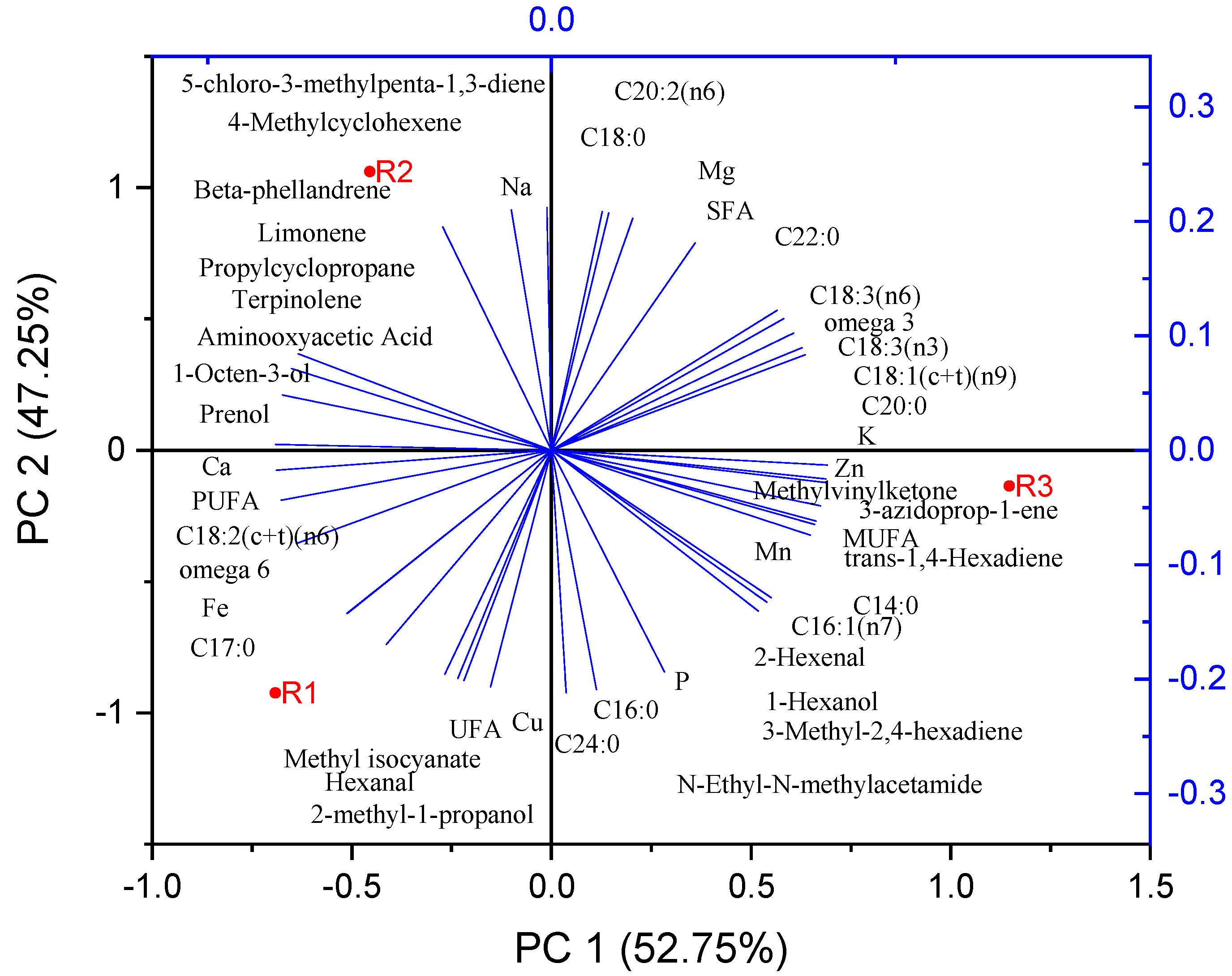
2.4. HS-SPME GC-MS Analysis of Volatile Organic Compounds
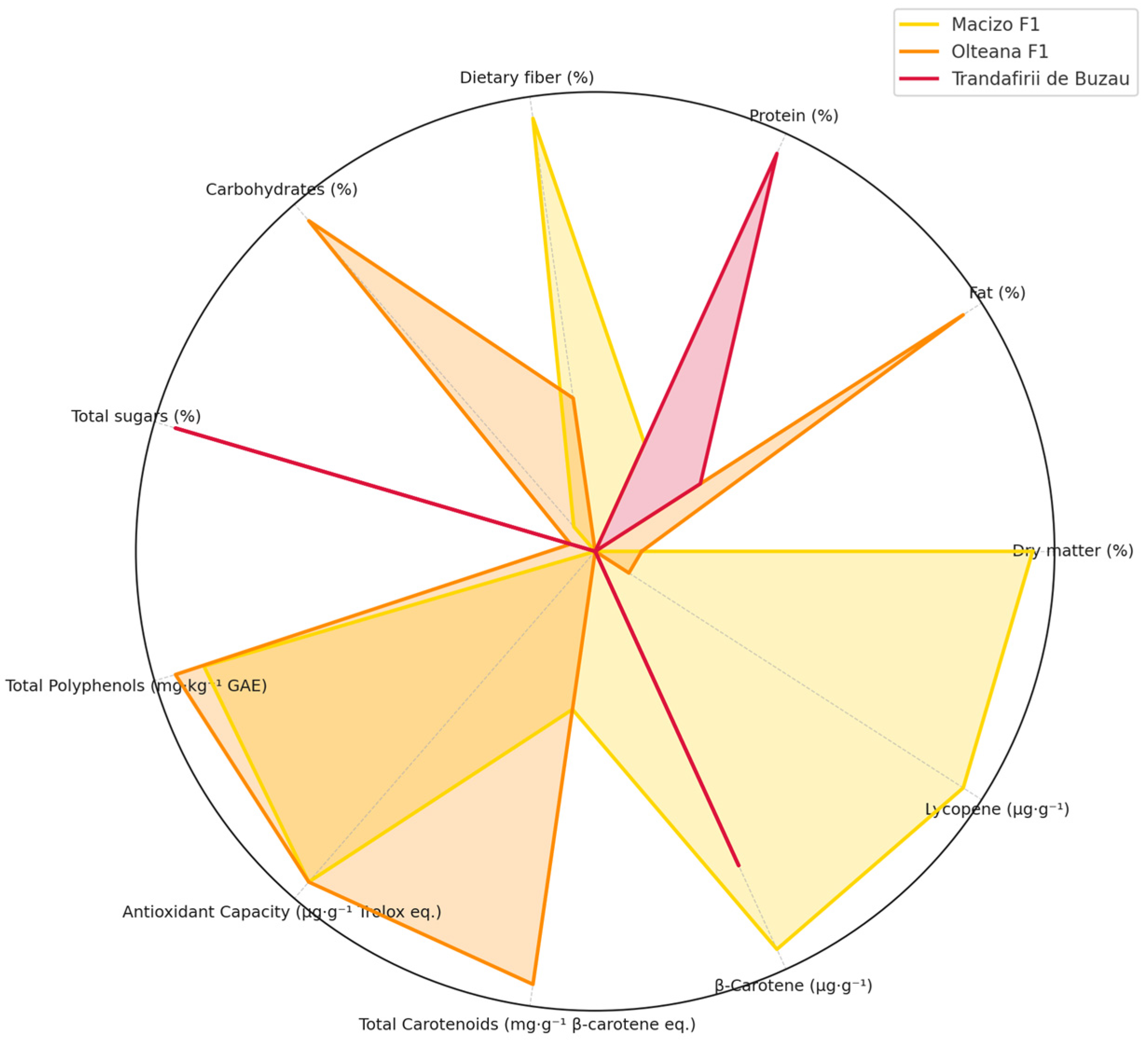
2.5. Bioactive Compounds and Antioxidant Capacity
2.6. Nutritional Quality Indices
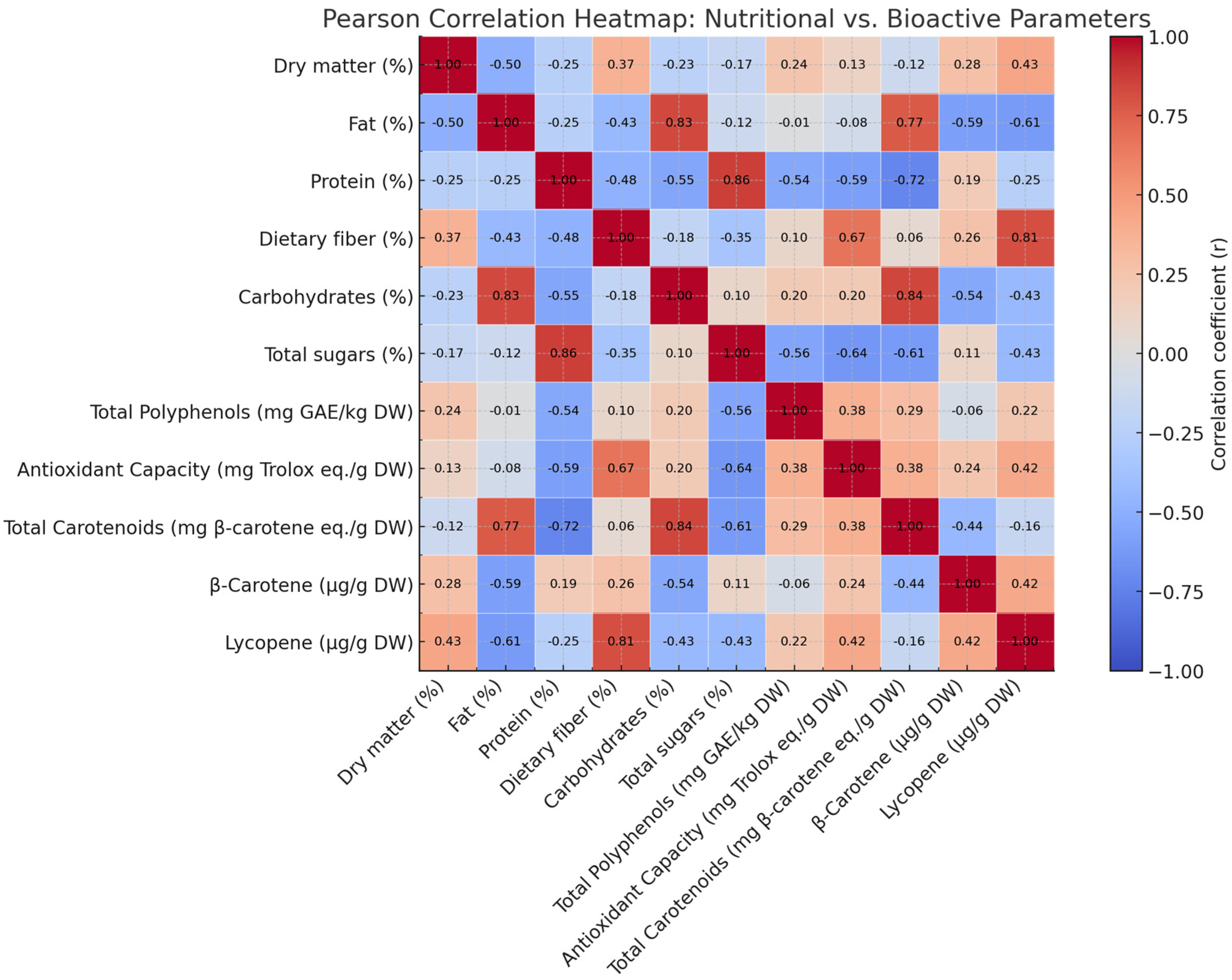
2.7. Statistical Analysis
3. Materials and Methods
3.1. Tomato Samples and Preparation of Tomato Pomace as By-Products
3.2. Chemicals, Analytical Instrumentation, and Analytical Methods
3.2.1. Reagent, Standard Solutions, and Certified Reference Materials (CRMs)
3.2.2. Determination of Proximate Analysis of Tomato Pomace By-Products
3.2.3. Analysis of the Mineral Composition of Tomato Pomace
3.2.4. Analysis of Fatty Acids Compositions
Extraction of Lipids from the Samples of Tomato Pomace and Fatty Methyl Esters (FAMEs)
Determination of Fatty Acid Methyl Esters (FAMEs) Content Using GC-FID
3.2.5. Estimation of Volatile Compounds
3.2.6. Determination of Total Polyphenolic Content (Folin–Ciocalteu Method)
3.2.7. Determination of Total Antioxidant Capacity
3.2.8. Determination of Total Carotenoids
3.2.9. HPLC DAD Determination of Lycopene and β-Carotene
3.2.10. Nutritional Quality Indices and Calculation Formulas
3.2.11. Statistical Analyses
4. Conclusions
Author Contributions
Funding
Institutional Review Board Statement
Informed Consent Statement
Data Availability Statement
Conflicts of Interest
Abbreviations
| PUFA | Polyunsaturated fatty acid |
| MUFA | Monounsaturated fatty acids |
| SFA | Saturated fatty acids |
| K | Potassium |
| Ca | Calcium |
| P | Phosphorus |
| Mg | Magnesium |
| Fe | Iron |
| Cu | Cooper |
| Zn | Zinc |
| Na | Sodium |
| Mn | Manganese |
| B | Boron |
| Cd | Cadmium |
| Pb | Lead |
| Hg | Mercury |
| As | Arsenic |
| Al | Aluminum |
| GC-FID | Gas chromatograph equipped with a flame ionization detector |
| FAMEs | Fatty acid methyl esters |
| GC-MS | Gas chromatograph coupled with a mass spectrometer |
| RPA | Relative peak area |
| TIC | Total ion chromatogram |
| GAE | Gallic acid equivalents |
| TE | Trolox equivalents |
| DAD | Diode array detector |
| AI | Atherogenic index |
| TI | Thrombogenic Index |
| h/H | Hypocholesterolemic/hypercholesterolemic ratio |
| HPI | Health-promoting index |
| NVI | Nutritive value index |
| PI | Polyene index |
| DFA | Desirable fatty acids |
| ATP | Adenosine triphosphate |
| LDL | Low-density lipoproteins |
| UFA | Unsaturated fatty acids |
| LA | Linoleic acid |
| GLA | Gama-linolenic acid |
References
- Lu, Z.; Wang, J.; Gao, R.; Ye, F.; Zhao, G. Sustainable Valorisation of Tomato Pomace: A Comprehensive Review. Trends Food Sci. Technol. 2019, 86, 172–187. [Google Scholar] [CrossRef]
- Petrotos, K.; Gerasopoulos, K. 12—Sustainable Use of Tomato Pomace for the Production of High Added Value Food, Feed, and Nutraceutical Products; Iulianelli, A., Cassano, A., Conidi, C., Petrotos, K., Eds.; Membrane Engineering in the Circular Economy; Elsevier: Amsterdam, The Netherlands, 2022; pp. 315–342. ISBN 9780323852531. [Google Scholar]
- Coelho, M.C.; Rodrigues, A.S.; Teixeira, J.A.; Pintado, M.E. Integral valorisation of tomato by-products towards bioactive compounds recovery: Human health benefits. Food Chem. 2023, 410, 135319. [Google Scholar] [CrossRef]
- Bhat, M.A.; Ahsan, H. Quality Characteristics of Freeze and Cabinet Dried Tomato Pomace. Int. J. Pure Appl. Biosci. 2018, 6, 891–897. [Google Scholar] [CrossRef]
- Kumar, H.; Guleria, S.; Kimta, N.; Nepovimova, E.; Dhalaria, R.; Dhanjal, D.S.; Sethi, N.; Alomar, S.Y.; Kuca, K. Selected fruit pomaces: Nutritional profile, health benefits, and applications in functional foods and feeds. Curr. Res. Food Sci. 2024, 9, 100791. [Google Scholar] [CrossRef] [PubMed]
- Garofalo, S.F.; Mallen, V.; Fino, D. Extraction of carotenoids from tomato pomace using deep eutectic solvents composed of short and medium-chain fatty acids and menthol. Food Chem. 2025, 484, 144342. [Google Scholar] [CrossRef] [PubMed]
- Marinaccio, L.; Zengin, G.; Bender, O.; Cichelli, A.; Novellino, E.; Stefanucci, A.; Mollica, A. Ultrasound assisted lycopene extraction from tomato skin waste by volatile natural deep eutectic solvent. Food Chem. Adv. 2024, 4, 100656. [Google Scholar] [CrossRef]
- Farinon, B.; Felli, M.; Sulli, M.; Diretto, G.; Savatin, D.V.; Mazzucato, A.; Merendino, N.; Costantini, L. Tomato pomace food waste from different variants as a high antioxidant potential resource. Food Chem. 2024, 452, 139509. [Google Scholar] [CrossRef]
- Ramírez, M.Q.; Valdez, E.A.; Aguirre, N.C.; Duno, D.; Ocampo, G.T. Volatilomic profile of the tree tomato (Solanum betaceum Cav.) pulp during ripening and senescence using HS–SPME with GC–MS. LWT 2023, 186, 115213. [Google Scholar] [CrossRef]
- Rodríguez, L.; Lagos, F.; Mastrogiovanni, M.; Flores, A.; Plaza, A.; Telleria, F.; Palomo, I.; Fuentes, E.; Trostchansky, A. Tomato pomace-derived nitrated fatty acids: Synthesis and antiplatelet activity. Biomed. Pharmacother. 2024, 177, 117154. [Google Scholar] [CrossRef]
- Chabi, I.B.; Zannou, O.; Dedehou, E.S.C.A.; Ayegnon, B.P.; Odouaro, O.B.O.; Maqsood, S.; Galanakis, C.M.; Kayodé, A.P.P. Tomato pomace as a source of valuable functional ingredients for improving physicochemical and sensory properties and extending the shelf life of foods: A review. Heliyon 2024, 1, e25261. [Google Scholar] [CrossRef]
- Rehal, J.K.; Aggarwal, P.; Dhaliwal, I.; Sharma, M.; Kaushik, P.A. Tomato Pomace Enriched Gluten-Free Ready-to-Cook Snack’s Nutritional Profile, Quality, and Shelf Life Evaluation. Horticulturae 2022, 8, 403. [Google Scholar] [CrossRef]
- Vorobyova, V.; Skiba, M.; Andrey, K. Tomato pomace extract as a novel corrosion inhibitor for the steel in industrial media: The role of chemical transformation of the extract and proinhibition effect. J. Mol. Struct. 2022, 1264, 133155. [Google Scholar] [CrossRef]
- Bajrami, D.; Hossain, S.I.; Barbarossa, A.; Sportelli, M.C.; Picca, R.A.; Gentile, L.; Mastrolonardo, F.; Rosato, A.; Carocci, A.; Colabufo, N.A.; et al. A scalable route to quaternary ammonium-functionalized AgCl colloidal antimicrobials inhibiting food pathogenic bacteria and biofilms. Heliyon 2024, 10, e25260. [Google Scholar] [CrossRef]
- Senila, M. Metal and metalloid monitoring in water by passive sampling—A review. Rev. Anal. Chem. 2023, 42, 20230065. [Google Scholar] [CrossRef]
- Ali, M.Y.; Sina, A.A.; Khandker, S.S.; Neesa, L.; Tanvir, E.M.; Kabir, A.; Khalil, M.I.; Gan, S.H. Nutritional Composition and Bioactive Compounds in Tomatoes and Their Impact on Human Health and Disease: A Review. Foods 2020, 10, 45. [Google Scholar] [CrossRef]
- Calvalho, M.E.A.; Piotto, F.A.; Gaziola, S.A.; Jacomino, A.P.; Jozefczak, M.; Cuypers, A.; Azevedo, R.A. New insights about cadmium impacts on tomato: Plantacclimation, nutritional changes, fruit quality and yield. Food Energy Secur. 2018, 7, e00131. [Google Scholar] [CrossRef]
- Navarro-González, I.; García-Valverde, J.G.-A.; Periago, M.J. Chemical profile, functional and antioxidant properties of tomato peel fiber. Food Res. Int. 2011, 44, 1528–1535. [Google Scholar] [CrossRef]
- Elbadrawy, E.; Sello, A. Evaluation of nutritional value and antioxidant activity of tomato peel extracts. Arab. J. Chem. 2016, 9, S1010–S1018. [Google Scholar] [CrossRef]
- Ramesh, K.; Paul, V.; Pandey, R. Dynamics of mineral nutrients in tomato (Solanum lycopersicum L.) fruits during ripening: Part II—Off the plant. Plant Physiol. Rep. 2021, 26, 284–300. [Google Scholar] [CrossRef]
- Akubor, P.I.; Owuse, A.U. Chemical Composition, functional and biscuit making properties of tomato peel flour. South Asian J. Food Technol. Environ. 2020, 6, 874–884. [Google Scholar] [CrossRef]
- Isik, F.; Yapar, A. Effect of tomato seed supplementation on chemical and nutritional properties of tarhana. J. Food Meas. Charact. 2017, 11, 667–674. [Google Scholar] [CrossRef]
- Sánchez-Moreno, C.; Plaza, L.; De Ancos, B.; Cano, M.P. Impact of high-pressure and traditional thermal processing of tomato purée on carotenoids, vitamin C and antioxidant activity. J. Sci. Food Agric. 2006, 86, 171–179. [Google Scholar] [CrossRef]
- Kumar, M.; Chandran, D.; Tomar, M.; Bhuyan, D.J.; Grasso, S.; Sá, A.G.A.; Carciofi, B.A.M.; Radha, D.; Singh, S.; Senapathy, M.; et al. Valorization potential of tomato (Solanum lycopersicum L.) seed: Nutraceutical quality, food properties, safety aspects, and application as a health-promoting ingredient in foods. Horticulturae 2022, 8, 265. [Google Scholar] [CrossRef]
- Kiralan, M.; Ketenoglu, O. Utilization of tomato (Solanum lycopersicum) by-products: An overview. In Mediterranean Fruits Bio-Wastes: Chemistry, Functionality and Technological Applications; Springer International Publishing: Cham, Switzerland, 2022; pp. 799–818. [Google Scholar]
- Kaboré, K.; Konaté, K.; Sanou, A.; Dakuyo, R.; Sama, H.; Santara, B.; Compaoré, E.W.R.; Dicko, M.H. Tomato by-products, a source of nutrients for the prevention and reduction of malnutrition. Nutrients 2022, 14, 2871. [Google Scholar] [CrossRef]
- Rivas, M.Á.; Ruiz-Moyano, S.; Vázquez-Hernández, M.; Benito, M.J.; Casquete, R.; Córdoba, M.D.G.; Martín, A. Impact of Simulated Human Gastrointestinal Digestion on the Functional Properties of Dietary Fibres Obtained from Broccoli Leaves, Grape Stems, Pomegranate and Tomato Peels. Foods 2024, 13, 2011. [Google Scholar] [CrossRef]
- Anđelini, M.; Major, N.; Išić, N.; Kovačević, T.K.; Ban, D.; Palčić, I.; Radunić, M.; Goreta, B.S. Sugar and Organic Acid Content Is Dependent on Tomato (Solanum Lycoperiscum L.) Peel Color. Horticulturae 2023, 9, 313. [Google Scholar] [CrossRef]
- Mehta, D.; Prasad, P.; Sangwan, R.S.; Yadav, S.K. Tomato processing byproduct valorization in bread and muffin: Improvement in physicochemical properties and shelf life stability. J. Food Sci. Technol. 2018, 55, 2560–2568. [Google Scholar] [CrossRef]
- Stone, M.S.; Martyn, L.; Weaver, C.M. Potassium Intake, Bioavailability, Hypertension, and Glucose Control. Nutrients 2016, 8, 444. [Google Scholar] [CrossRef]
- Heane, R.P. Phosphorus. In Present Knowledge in Nutrition, 10th ed.; Erdman, J.W., Macdonald, I.A., Zeisel, S.H., Eds.; Wiley-Blackwell: Washington, DC, USA, 2012; pp. 447–458. [Google Scholar]
- Rude, R.K. Magnesium. In Encyclopedia of Dietary Supplements, 2nd ed.; Coates, P.M., Betz, J.M., Blackman, M.R., Cragg, G.M., Levine, M., Moss, J., White, J.D., Eds.; Informa Healthcare: New York, NY, USA, 2010; pp. 527–537. [Google Scholar]
- Ryu, M.-S.; Aydemir, T.B. Zinc. In Present Knowledge in Nutrition, 11th ed.; Marriott, B.P., Birt, D.F., Stallings, V.A., Yates, A.A., Eds.; Wiley-Blackwell: Cambridge, MA, USA, 2020; pp. 393–408. [Google Scholar]
- Collins, J.F. Copper. In Modern Nutrition in Health and Disease, 11th ed.; Ross, A.C., Caballero, B., Cousins, R.J., Tucker, K.L., Ziegler, T.R., Eds.; Lippincott Williams & Wilkins: Baltimore, MD, USA, 2014; pp. 206–216. [Google Scholar]
- Abbaspour, N.; Hurrell, R.; Kelishadi, R. Review on iron and its importance for human health. J. Res. Med. Sci. 2014, 19, 164–174. [Google Scholar]
- Rowley, C.E.; Singh, Z.; Steck, A.; Schuetz, B.; Spraul, M.; Brockman, H.; Wang, Y.; Itsiopoulos, C.; Nicholson, J.K.; Lodge, S.; et al. NMR spectroscopy-derived index for the nutritional assessment of extra virgin olive oils based on fatty acids profiling. Food Chem. 2025, 490, 144241. [Google Scholar] [CrossRef]
- Tutunchi, H.; Ostadrahimi, A.; Saghafi-Asl, M. The Effects of Diets Enriched in Monounsaturated Oleic Acid on the Management and Prevention of Obesity: A Systematic Review of Human Intervention Studies. Adv. Nutr. 2020, 11, 864–877. [Google Scholar] [CrossRef]
- Selmin, O.I.; Papoutsis, A.J.; Hazan, S.; Smith, C.; Greenfield, N.; Donovan, M.G.; Wren, S.N.; Doetschman, T.C.; Snider, J.M.; Snider, A.J.; et al. n-6 High Fat Diet Induces Gut Microbiome Dysbiosis and Colonic Inflammation. Int. J. Mol. Sci. 2021, 22, 6919. [Google Scholar] [CrossRef]
- Pérez, L.R.; Lagos, F.; Palomo, I.; Trostchansky, A.; Fuentes, E. Synthesis and antiplatelet activity of nitrated fatty acids from tomato pomace. Free Radic. Biol. Med. 2023, 208, S137. [Google Scholar] [CrossRef]
- Hashem, C.; Hochrinner, J.; Burgler, M.B.; Rinnofner, C.; Pichler, H.; Winkler, M. From linoleic acid to hexanal and hexanol by whole cell catalysis with a lipoxygenase, hydroperoxide lyase and reductase cascade in Komagataella Phaffii. Front. Mol. Biosci. 2022, 9, 965315. [Google Scholar] [CrossRef]
- Mahizan, N.A.; Yang, S.K.; Song, A.A.L.; Chong, C.M.; Chong, C.E.; Abushelaibi, A.; Lim, S.H.E.; Lai, K.S. Terpene Derivatives as a Potential Agent against Antimicrobial Resistance (AMR) Pathogens. Molecules 2019, 24, 2631. [Google Scholar] [CrossRef]
- Pizzo, J.S.; Rutz, T.; Ojeda, A.S.; Kartowikromo, K.Y.; Hamid, A.M.; Simmons, A.; da Silva, A.L.B.R.; Rodrigues, C. Quantifying terpenes in tomato leaf extracts from different species using gas chromatography-mass spectrometry (GC-MS). Anal. Biochem. 2024, 689, 115503. [Google Scholar] [CrossRef]
- Boumba, V.A.; Ziavrou, K.S.; Vujuk, T. Biochemical pathways generating post-mortem volatile compounds co-detected during forensic ethanol analyses. Forensic Sci. Int. 2018, 174, 133–151. [Google Scholar] [CrossRef]
- González-Coria, J.; Mesirca-Prevedello, C.; Lozano-Castellón, J.; Casadei, E.; Valli, E.; López-Yerena, A.; Jaime-Rodríguez, C.; Pinto, D.; Illan, M.; Torrado, X.; et al. Chemometric study on the effect of cooking on bioactive compounds in tomato pomace enriched sauces. npj Sci. Food 2024, 8, 58. [Google Scholar] [CrossRef]
- Ragab, A. Recent advances in the synthesis, reaction, and bio-evaluation potential of purines as precursor pharmacophores in chemical reactions: A review. RSC Adv. 2025, 15, 3607–3645. [Google Scholar] [CrossRef]
- Bolaño, J.; Insuasty, D.C.; Rodríguez, M.D.; Grande-Tovar, J.D. Potential use of tomato peel, a rich source of lycopene, for cancer treatment. Molecules 2024, 29, 3079. [Google Scholar] [CrossRef]
- Madia, V.N.; Vita, D.D.; Ialongo, D.; Tudino, V.; Leo, A.D.; Scipione, L.; Santo, R.D.; Costi, R.; Messore, A. Recent advances in recovery of lycopene from tomato waste: A potent antioxidant with endless benefits. Molecules 2021, 26, 4495. [Google Scholar] [CrossRef]
- Tran, Q.T.; Nguyen, H.V. Optimization of enzyme-assisted lycopene extraction from tomato (Lycopersicon esculentum) peel using rice bran oil. J. Food Meas. Charact. 2023, 17, 5154–5162. [Google Scholar] [CrossRef]
- Kenneth, R.; Feingold, M.D. The Effect of Diet on Cardiovascular Disease and Lipid and Lipoprotein Levels. In Endotext; Feingold, K.R., Ahmed, S.F., Anawalt, B., Eds.; MDText.com, Inc.: South Dartmouth, MA, USA, 2000. Available online: https://www.ncbi.nlm.nih.gov/books/NBK570127/ (accessed on 5 September 2025).
- Maki, K.C.; Eren, F.; Cassens, M.E.; Dicklin, M.R.; Davidson, M.H. ω-6 Polyunsaturated Fatty Acids and Cardiometabolic Health: Current Evidence, Controversies, and Research Gaps. Adv. Nutr. 2018, 9, 688–700. [Google Scholar] [CrossRef]
- Dongmo, Y.K.M.; Tali, M.B.T.; Dize, D.; Mbouna, C.D.J.; Fotsing, S.K.; Ngouana, V.; Pinlap, B.R.; Menkem, E.Z.; Tchokouaha, L.R.Y.; Wabo, G.F.; et al. Anti-Shigella and Antioxidant-based screening of some Cameroonian Medicinal Plants, UHPLC-L IT-M S/MS fingerprints, and Prediction of Pharmacokinetic and Drug-Likeness Properties of Identified Chemicals. J. Ethnopharmacol. 2024, 324, 117788. [Google Scholar] [CrossRef] [PubMed]
- Ali, A.H.; Hachem, M.; Banat, F.; Ayyash, M. Effect of bovine and buffalo ghee fractionation on triacylglycerol profile, lipid nutritional quality indices, thermal behavior, and tocopherol content: A comparative analysis with 2 categories of infant formula fat. J. Dairy Sci. 2025, 108, 3181–3198. [Google Scholar] [CrossRef] [PubMed]
- Senila, M.; Resz, M.A.; Torok, I.; Senila, L. Nutritional composition and health risk of toxic metals of some edible wild mushrooms growing in a mining area of Apuseni Mountains, Western Carpathians. J. Food Compos. Anal. 2024, 128, 106061. [Google Scholar] [CrossRef]
- Kalogeropoulos, N.; Chiou, A.; Pyriochou, V.; Peristeraki, A.; Karathanos, V.T. Bioactive phytochemicals in industrial tomatoes and their processing byproducts. LWT-Food Sci. Technol. 2012, 49, 213–216. [Google Scholar] [CrossRef]
- Bobková, A.; Hudáček, M.; Jakabová, S.; Belej, Ľ.; Capcarová, M.; Čurlej, J.; Bobko, M.; Árvay, J.; Jakab, I.; Čapla, J.; et al. The effect of roasting on the total polyphenols and antioxidant activity of coffee. J. Environ. Sci. Health 2020, 55, 495–500. [Google Scholar] [CrossRef]



| Code | Dry Matter | Fat | Protein | Ash | Dietary Fiber | Carbohydrates | Total Sugars |
|---|---|---|---|---|---|---|---|
| R1 | 33.31 ± 1.36 b | 2.4 ± 0.25 a | 6.66 ± 0.33 b | 0.95 ± 0.09 b | 7.97 ± 0.71 b | 32.7 ± 3.30 a | 5.1 ± 0.52 b |
| R2 | 33.14 ± 1.44 ab | 1.9 ± 0.16 b | 8.43 ± 0.69 a | 0.88 ± 0.11 b | 7.27 ± 0.71 b | 26.0 ± 2.36 b | 6.7 ± 0.61 a |
| R3 | 34.74 ± 1.90 a | 1.7 ± 0.17 c | 7.14 ± 0.36 b | 1.33 ± 0.14 a | 9.25 ± 0.85 a | 26.5 ± 2.74 b | 5.0 ± 0.55 b |
| Element | R1 | R2 | R3 |
|---|---|---|---|
| P | 2980 ± 233 a | 2461 ± 185 a | 2990 ± 310 a |
| K | 11,940 ± 1020 a | 13,130 ± 1220 a | 14,200 ± 1230 a |
| Ca | 1210 ± 142 a | 1185 ± 173 a | 969 ± 145 a |
| Mg | 765 ± 110 a | 981 ± 137 a | 890 ± 110 a |
| Na | 166 ± 18 b | 385 ± 45 a | 224 ± 22 b |
| Fe | 19.2 ± 2.2 a | 10.1 ± 1.8 b | 7.8 ± 1.1 b |
| Mn | 6.30 ± 0.71 ab | 5.79 ± 0.66 b | 7.86 ± 0.79 a |
| Cu | 3.52 ± 0.40 a | 2.69 ± 0.36 b | 3.03 ± 0.45 ab |
| Zn | 10.3 ± 1.7 b | 10.5 ± 1.2 ab | 13.4 ± 2.0 a |
| Type of Acids | R1 | R2 | R3 | |
|---|---|---|---|---|
| myristic acid | C14:0 | 0.30 ± 0.03 b | 0.21 ± 0.020 c | 0.38 ± 0.021 a |
| palmitic acid | C16:0 | 14.89 ± 0.87 a | 10.19 ± 0.60 b | 13.72 ± 0.80 a |
| palmitoleic acid | C16:1(n7) | 0.28 ± 0.016 a | 0.24 ± 0.014 a | 0.31 ± 0.018 a |
| heptadecanoic acid | C17:0 | 1.08 ± 0.063 a | 0.88 ± 0.084 ab | 0.83 ± 0.08 b |
| stearic acid | C18:0 | 8.41 ± 0.85 a | 10.19 ± 1.03 a | 9.09 ± 0.92 a |
| cis + trans-oleic acid | C18:1(c + t)(n9) | 11.09 ± 1.13 b | 14.58 ± 1.48 ab | 17.05 ± 1.73 a |
| cis + trans-linoleic acid | C18:2(c + t)(n6) | 55.14 ± 5.62 a | 50.26 ± 5.12 a | 45.19 ± 4.60 b |
| gama-linolenic acid | C18:3(n6) | 3.05 ± 0.31 b | 4.15 ± 0.42 a | 4.75 ± 0.48 a |
| α-linolenic acid | C18:3(n3) | 2.09 ± 0.21 a | 2.48 ± 0.25 a | 2.66 ± 0.27 a |
| arachidic acid | C20:0 | 0.23 ± 0.023 c | 0.32 ± 0.032 b | 0.41 ± 0.042 a |
| eicosadienoic acid | C20:2(n6) | 2.03 ± 0.20 c | 4.04 ± 0.41 a | 3.15 ± 0.32 b |
| behenic acid | C22:0 | 1.00 ± 0.10 b | 2.25 ± 0.22 a | 2.12 ± 0.20 a |
| lignoceric acid | C24:0 | 0.42 ± 0.040 a | 0.22 ± 0.021 b | 0.35 ± 0.035 a |
| Saturated fatty acids | SFA | 11.44 ± 1.16 a | 14.07 ± 1.43 a | 13.17 ± 1.34 a |
| Monounsaturated fatty acids | MUFA | 25.98 ± 2.64 a | 24.77 ± 2.52 a | 30.77 ± 3.13 a |
| Polyunsaturated fatty acids | PUFA | 62.30 ± 6.35 a | 60.92 ± 6.21 a | 55.75 ± 5.68 a |
| omega 6 | 57.17 ± 6.5 a | 54.29 ± 5.53 a | 48.34 ± 4.93 a | |
| omega 3 | 2.09 ± 0.21 a | 2.48 ± 0.25 a | 2.66 ± 0.27 a | |
| UFA | 88.28 ± 9.0 a | 85.69 ± 8.74 a | 86.52 ± 8.82 a |
| Nr. Crt. | Retention Time (min) | Compound Name | R1 | R2 | R3 | Sensory Descriptors |
|---|---|---|---|---|---|---|
| Hydrocarbon | ||||||
| 1. | 2.793 | 1,5-Hexadiyne | 1.00 ± 0.12 a | ND | ND | Slightly sweet and mildly pungent |
| 2. | 3.006 | 3-Methyl-2,4-hexadiene | 0.90 ± 0.091 b | ND | 7.39 ± 0.75 a | Green, resinous, and slightly sweet |
| 3. | 3.019 | 4-Methylcyclohexene | ND | 3.43 ± 0.28 a | ND | Mildly sweet, and less fragrant |
| 4. | 8.717 | 5-chloro -methylpenta-1,3-diene | ND | 5.40 ± 0.34 a | ND | Green, herbaceous, and slight sweet |
| 5. | 8.736 | 3-azidoprop-1-ene | ND | ND | 1.76 ± 0.12 a | Pungent, acrid, and irritant |
| 6. | 8.930 | trans-1,4-Hexadiene | ND | ND | 19.78 ± 1.24 a | Light green, slight sweet |
| 7. | 9.374 | 1,3-Butadiene | ND | 0.12 ± 0.02 a | ND | Mildly sweet and minor green |
| 8. | 9.718 | 2-Vinylbicyclo [2.1.1]hex-2-ene | ND | 0.38 ± 0.028 a | ND | Slight sweet, light, and resinous notes |
| 9. | 9.781 | 2,4-Octadiyne | ND | 0.25 ± 0.021 a | ND | Slightly metallic, pungent |
| 10. | 10.187 | Propylcyclopropane | 6.70 ± 0.58 a | 7.62 ± 0.71 a | ND | Hydrocarbon odor, mild |
| 11. | 10.737 | 1-Butene | 0.02 ± 0.01 b | 0.06 ± 0.005 b | 0.78 ± 0.08 a | Light hydrocarbon odor, slight sweet |
| 12. | 12.383 | (E)-1,2-Dimethylcyclopropane | 0.13 ± 0.01 a | ND | 0.03 ± 0.0003 a | Light hydrocarbon odor and slight sweet |
| 13. | 13.934 | 1,5-Heptadien-3-yne | ND | 1.29 ± 0.14 a | ND | Sharp, pungent, and green |
| 14. | 15.936 | 3,7,7-Trimethylcyclohepta-1,3,5-triene | ND | 1.72 ± 0.15 a | ND | Pine, fresh, and woody |
| 15. | 16.486 | 1-Pentene | 0.05 ± 0.004 a | ND | ND | Light hydrocarbon odor, slight sweet |
| 16. | 17.844 | 2-methyl-1,3-pentadiene | ND | 0.07 ± 0.007 a | ND | Greem, herbaceous, and middle fruity |
| 17. | 18.438 | 3-Methyl-4-methylenebicyclo(3.2.1)oct-2-ene | ND | 0.11 ± 0.012 a | ND | Woody, resinous, and herbal |
| 18. | 19.895 | N-Methylene-ethenamine | 0.05 ± 0.004 a | ND | ND | Sharp, pungent amine odor |
| 19. | 21.640 | 1-Fluoroheptane | 0.42 ± 0.04 a | ND | ND | Low odor |
| Nitrogen Compounds | ||||||
| 20. | 2.699 | 2-Nitrophenyl azide | 0.24 ± 0.02 a | ND | ND | Pungent and slightly sweet |
| 21. | 15.473 | 3-Azido-1-propene | 0.03 ± 0.002 a | ND | ND | Sharp, pungent |
| Terpenes | ||||||
| 22. | 5.777 | Prenol | ND | 4.74 ± 0.32 a | ND | Green, fruity, floral, and fresh |
| 23. | 17.299 | Terpinolene | ND | 20.05 ± 1.98 a | ND | Fresh, herbal, and green |
| 24. | 17.625 | Limonene | ND | 1.57 ± 0.14 a | ND | Citrus, sweet, fresh, and fruity |
| 25. | 18.106 | Ocimene | ND | 0.52 ± 0.03 a | ND | Sweet, fresh, green, and slight citrus |
| 26. | 18.638 | Beta-phellandrene | ND | 47.23 ± 4.1 a | ND | Minty, light citrus, green and herbal |
| 27. | 29.272 | Cholestanone | ND | ND | 0.47 ± 0.05 a | Slight waxy |
| Alcohols | ||||||
| 28. | 3.875 | 1-Octen-3-ol | 1.48 ± 0.15 b | 1.93 ± 0.087 a | ND | Waxy, fatty, green, and light citrus |
| 29. | 8.917 | 2-methyl-1-propanol | 4.24 ± 0.32 a | 0.70 ± 0.06 c | 1.76 ± 0.13 b | Green, herbaceous, fruity, and fresh |
| 30. | 10.212 | 1-Hexanol | ND | ND | 30.91 ± 2.87 a | Fatty, waxy, green, herbaceous |
| Aldehydes | ||||||
| 31. | 5.783 | Hexanal | 6.96 ± 0.71 a | ND | 1.76 ± 0.01 b | Green, herbal, and fresh notes |
| 32. | 8.711 | 2-Hexenal | 9.98 ± 0.87 b | ND | 19.63 ± 1.2 a | Green, fruity, herbal, and sharp |
| 33. | 10.512 | Acrolein | 0.16 ± 0.01 b | 0.03 ± 0.002 c | 0.66 ± 0.05 a | Pungent, acrid |
| 34. | 15.648 | 2-Ethylhexenal | 0.09 ± 0.008 a | ND | ND | Green, fruity, citrusy, and slight sweet |
| 35. | 17.056 | Pent-2-ynal | ND | 0.30 ± 0.02 a | ND | Sharp, green, fresh, and metallic |
| Ketones | ||||||
| 36. | 4.682 | Methylvinylketone | 0.10 ± 0.01 b | ND | 5.98 ± 0.42 a | Pungent, acrid, unpleasant |
| 37. | 16.861 | 6-Methyl-5-heptene-2-one | 2.20 ± 0.18 a | ND | ND | Fruity, green, and fresh |
| 38. | 39.118 | Cyclohexane-1,3-dione, 2-allylaminomethylene-5,5-dimethyl | 0.03 ± 0.002 c | 0.15 ± 0.01 b | 0.89 ± 0.07 a | Fresh, green, and herbal nuances |
| Amines | ||||||
| 39. | 4.507 | Aminooxyacetic Acid | 0.16 ± 0.01 | 0.21 ± 0.01 | 0.04 ± 0.002 | Pungent, acidic, and amine-like odors |
| 40. | 6.065 | Allylamine | 0.07 ± 0.006 a | ND | 0.005 ± 0.0004 b | Ammoniacal, fishy, sharp, pungent |
| 41. | 9.649 | 2-Amino-1,3-propanediol | 0.08 ± 0.007 a | ND | 0.08 ± 0.006 a | Slight sweet |
| 42. | 10.888 | 2-Propyn-1-amine | 0.01 ± 0.001 a | ND | ND | Sharp, pungent, and irritant |
| 43. | 19.220 | 2,5-Norbornadiene | 0.12 ± 0.01 a | ND | ND | Light sweet, fresh, and herbal nuances |
| 44. | 40.163 | Methallylamine | ND | ND | 0.62 ± 0.52 a | Pungent, acrid, and ammoniacal notes |
| Nitriles | ||||||
| 45. | 9.305 | 2-Propenenitrile | 0.06 ± 0.008 b | ND | 0.15 ± 0.02 a | Acrid, sharp, pungent, and irritating |
| 46. | 9.874 | Propiolonitrile | ND | 0.14 ± 0.01 a | ND | Acrid, almond like |
| Amides | ||||||
| 47. | 18.788 | N-Ethyl-N-methylacetamide | 0.80 ± 0.07 b | ND | 4.28 ± 0.24 a | Slight sweet |
| 48. | 18.801 | Acrylamide | ND | 0.32 ± 0.02 a | ND | Slight acrid, plastic like |
| Pyrazines | ||||||
| 49. | 16.887 | 2,3-Dimethylpyrazine | ND | 0.59 ± 0.06 b | 0.63 ± 0.04 a | Fruity, sweet, and green |
| 50. | 38.574 | 2-Methyl-3-(2-propenyl)pyrazine | 0.18 ± 0.01 a | ND | ND | Nutty and roasted |
| Pyridines | ||||||
| 51. | 35.752 | 2-Methyl-3-(prop-2-ynyloxy)pyridine | 0.10 ± 0.01 a | ND | ND | Mildly acrid and slight bitter |
| 52. | 36.278 | 1H-Dipyrido [2,3-b:3′,2′-d]pyrrole | 0.01 ± 0.001 a | ND | ND | Sharp, pungent nitrogenous odor |
| 53. | 39.574 | 2-Methyl-3-[(prop-2-yn-1-yl)oxy]pyridine | 0.14 ± 0.01 a | ND | ND | Pungent, herbal |
| Esters | ||||||
| 54. | 15.636 | Methylthiophosphonamidic acid, S-methyl ester | ND | ND | 0.04 ± 0.005 a | Pungent, garlic-like, and acrid |
| Heterocyclic | ||||||
| 55. | 2.825 | Azetidine | ND | 1.26 ± 0.12 a | 1.09 ± 0.11 a | Ammoniacal, fishy, pungent |
| Furans | ||||||
| 56. | 17.049 | 2-Pentylfuran | 0.72 ± 0.05 b | ND | 1.27 ± 0.15 a | Green, grassy, nutty, and woody |
| Isocyanates | ||||||
| 57. | 17.693 | Methyl isocyanate | 0.06 ± 0.004 a | ND | ND | Sharp, pungent, acid |
| Sample Name | Total Polyphenols (mg GAE.kg−1) | Antioxidant Capacity (µg eq Trolox. g−1 ) | Total Carotenoids (mg eq. β-carotene. g−1) | β-Carotene (µg g−1) | Lycopene (µg g−1) |
|---|---|---|---|---|---|
| R1 | 134.71 ± 12.3 ab | 0.34 ± 0.03 a | 4.24 ± 0.40 a | 2.95 ± 0.27 b | 6.22 ± 0.63 b |
| R2 | 122.03 ± 10.0 b | 0.31 ± 0.03 b | 2.24 ± 0.22 c | 3.10 ± 0.29 a | 6.10 ± 0.56 b |
| R3 | 133.85 ± 11.5 a | 0.34 ± 0.03 a | 2.97 ± 0.27 b | 3.14 ± 0.30 a | 7.41 ± 0.68 a |
| Index | R1 | R2 | R3 |
|---|---|---|---|
| MUFA/SFA | 2.27 | 1.76 | 2.34 |
| PUFA/SFA | 5.45 | 4.33 | 4.23 |
| 0.037 | 0.046 | 0.055 | |
| 27.35 | 21.89 | 18.17 | |
| TI | 0.10 | 0.09 | 0.11 |
| AI | 0.18 | 0.13 | 0.18 |
| h/H | 6.54 | 9.64 | 7.34 |
| HPI | 5.81 | 8.24 | 6.14 |
| NVI | 69.62 | 103.19 | 84.30 |
| PI | 5.45 | 4.33 | 4.23 |
| DFA | 96.7 | 95.9 | 95.6 |
| Parameter | Calculation Formulas | |
|---|---|---|
| TI a | (1) | |
| AI b | (2) | |
| h/H c | (3) | |
| HPI d | (4) | |
| NVI e | (5) | |
| PI f | (6) | |
| DFA g | C18:0 + | (7) |
Disclaimer/Publisher’s Note: The statements, opinions and data contained in all publications are solely those of the individual author(s) and contributor(s) and not of MDPI and/or the editor(s). MDPI and/or the editor(s) disclaim responsibility for any injury to people or property resulting from any ideas, methods, instructions or products referred to in the content. |
© 2025 by the authors. Licensee MDPI, Basel, Switzerland. This article is an open access article distributed under the terms and conditions of the Creative Commons Attribution (CC BY) license (https://creativecommons.org/licenses/by/4.0/).
Share and Cite
Becze, A.; Senila, L.; Multescu, M.; Popa, A.; Serbancea, F.; Senila, M. Nutritional Value of Tomato Pomace as a By-Product from the Processing of Several Tomato (Solanum lycopersicum L.) Cultivars. Molecules 2025, 30, 4502. https://doi.org/10.3390/molecules30234502
Becze A, Senila L, Multescu M, Popa A, Serbancea F, Senila M. Nutritional Value of Tomato Pomace as a By-Product from the Processing of Several Tomato (Solanum lycopersicum L.) Cultivars. Molecules. 2025; 30(23):4502. https://doi.org/10.3390/molecules30234502
Chicago/Turabian StyleBecze, Anca, Lacrimioara Senila, Mihaela Multescu, Aglaia Popa, Floarea Serbancea, and Marin Senila. 2025. "Nutritional Value of Tomato Pomace as a By-Product from the Processing of Several Tomato (Solanum lycopersicum L.) Cultivars" Molecules 30, no. 23: 4502. https://doi.org/10.3390/molecules30234502
APA StyleBecze, A., Senila, L., Multescu, M., Popa, A., Serbancea, F., & Senila, M. (2025). Nutritional Value of Tomato Pomace as a By-Product from the Processing of Several Tomato (Solanum lycopersicum L.) Cultivars. Molecules, 30(23), 4502. https://doi.org/10.3390/molecules30234502