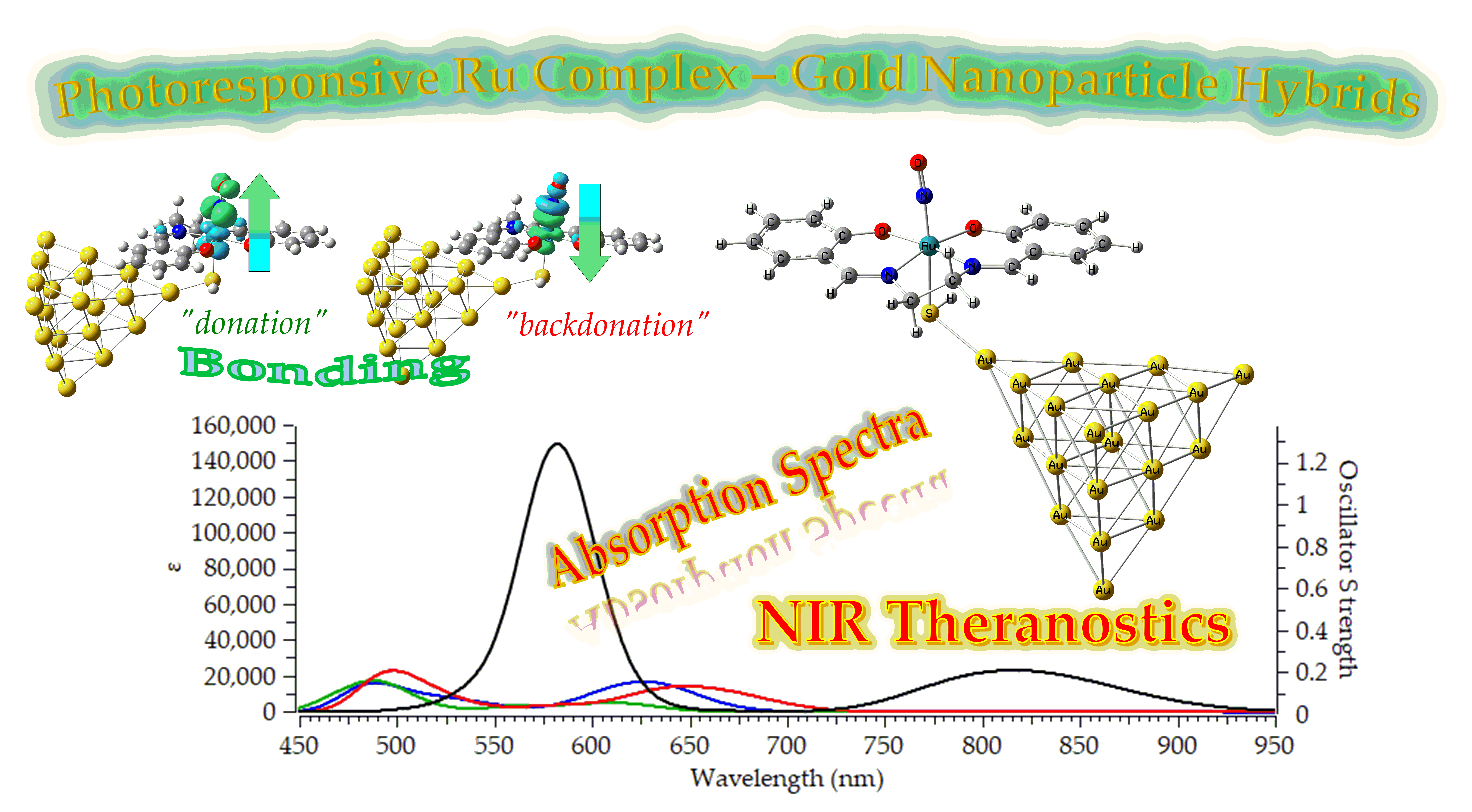
Photoresponsive Ru Complex–Gold Nanoparticle Hybrids for Theranostics: A Theoretical Study of Electronic Structure and Luminescence-Based Detection


Abstract
Share and Cite
Catevas, N.; Tsipis, A. Photoresponsive Ru Complex–Gold Nanoparticle Hybrids for Theranostics: A Theoretical Study of Electronic Structure and Luminescence-Based Detection. Molecules 2025, 30, 4432. https://doi.org/10.3390/molecules30224432
Catevas N, Tsipis A. Photoresponsive Ru Complex–Gold Nanoparticle Hybrids for Theranostics: A Theoretical Study of Electronic Structure and Luminescence-Based Detection. Molecules. 2025; 30(22):4432. https://doi.org/10.3390/molecules30224432
Chicago/Turabian StyleCatevas, Niq, and Athanassios Tsipis. 2025. "Photoresponsive Ru Complex–Gold Nanoparticle Hybrids for Theranostics: A Theoretical Study of Electronic Structure and Luminescence-Based Detection" Molecules 30, no. 22: 4432. https://doi.org/10.3390/molecules30224432
APA StyleCatevas, N., & Tsipis, A. (2025). Photoresponsive Ru Complex–Gold Nanoparticle Hybrids for Theranostics: A Theoretical Study of Electronic Structure and Luminescence-Based Detection. Molecules, 30(22), 4432. https://doi.org/10.3390/molecules30224432