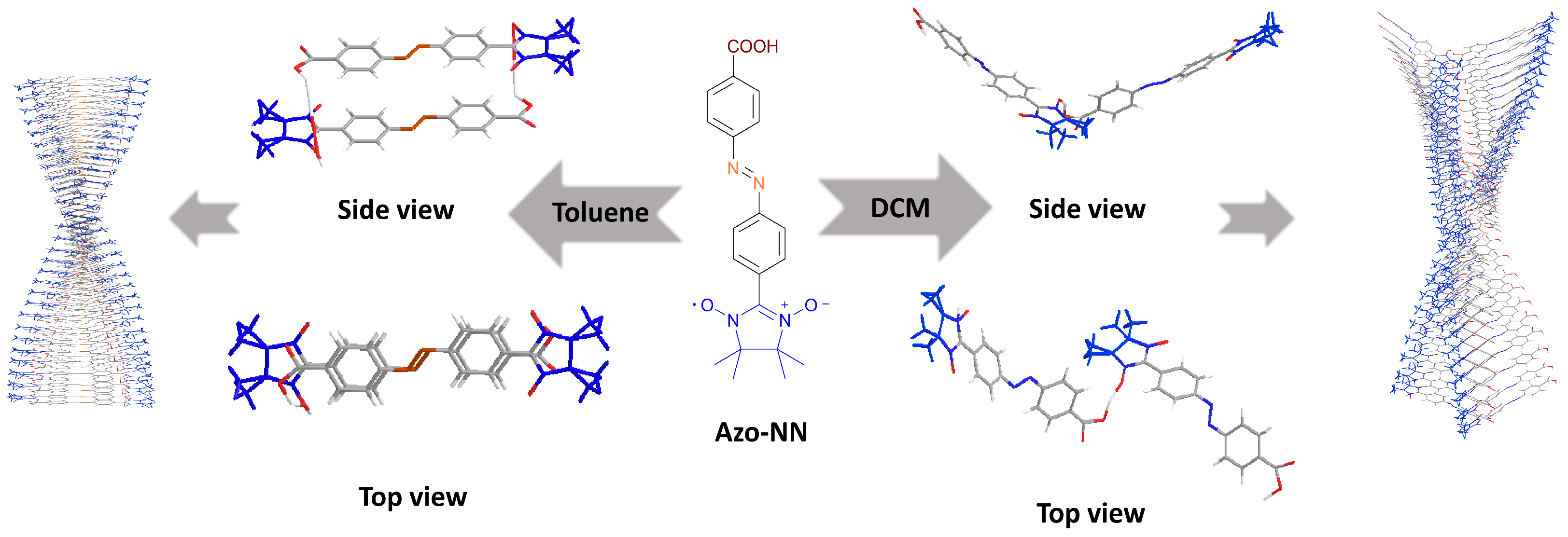
Study of Molecular Dimer Morphology Based on Organic Spin Centers: Nitronyl Nitroxide Radicals
 , ,
, , Abstract
Share and Cite
Wei, D.; Qin, Y.; Xu, Z.; Liu, H.; Chen, R.; Yu, Y.; Wang, D. Study of Molecular Dimer Morphology Based on Organic Spin Centers: Nitronyl Nitroxide Radicals. Molecules 2024, 29, 2042. https://doi.org/10.3390/molecules29092042
Wei D, Qin Y, Xu Z, Liu H, Chen R, Yu Y, Wang D. Study of Molecular Dimer Morphology Based on Organic Spin Centers: Nitronyl Nitroxide Radicals. Molecules. 2024; 29(9):2042. https://doi.org/10.3390/molecules29092042
Chicago/Turabian StyleWei, Dongdong, Yongliang Qin, Zhipeng Xu, Hui Liu, Ranran Chen, Yang Yu, and Di Wang. 2024. "Study of Molecular Dimer Morphology Based on Organic Spin Centers: Nitronyl Nitroxide Radicals" Molecules 29, no. 9: 2042. https://doi.org/10.3390/molecules29092042
APA StyleWei, D., Qin, Y., Xu, Z., Liu, H., Chen, R., Yu, Y., & Wang, D. (2024). Study of Molecular Dimer Morphology Based on Organic Spin Centers: Nitronyl Nitroxide Radicals. Molecules, 29(9), 2042. https://doi.org/10.3390/molecules29092042