Article

Spectroscopic and Quantum Chemical Evidence of Amine–CO2 and Alcohol–CO2 Interactions: Confirming an Intriguing Affinity of CO2 to Monoethanolamine (MEA)


by
Sahar Hafizi Yazdabadi
1,2,
Dmytro Mihrin
1,2,
Karen Louise Feilberg
2 and
René Wugt Larsen
1,*
1
Department of Chemistry, Technical University of Denmark, Kemitorvet 206, 2800 Kongens Lyngby, Denmark
2
DTU Offshore, Technical University of Denmark, Elektrovej 375, 2800 Kongens Lyngby, Denmark
*
Author to whom correspondence should be addressed.
Molecules 2024, 29(23), 5521; https://doi.org/10.3390/molecules29235521

Submission received: 30 October 2024 / Revised: 14 November 2024 / Accepted: 19 November 2024 / Published: 22 November 2024
(This article belongs to the Special Issue Molecular Spectroscopy in Applied Chemistry)

Abstract

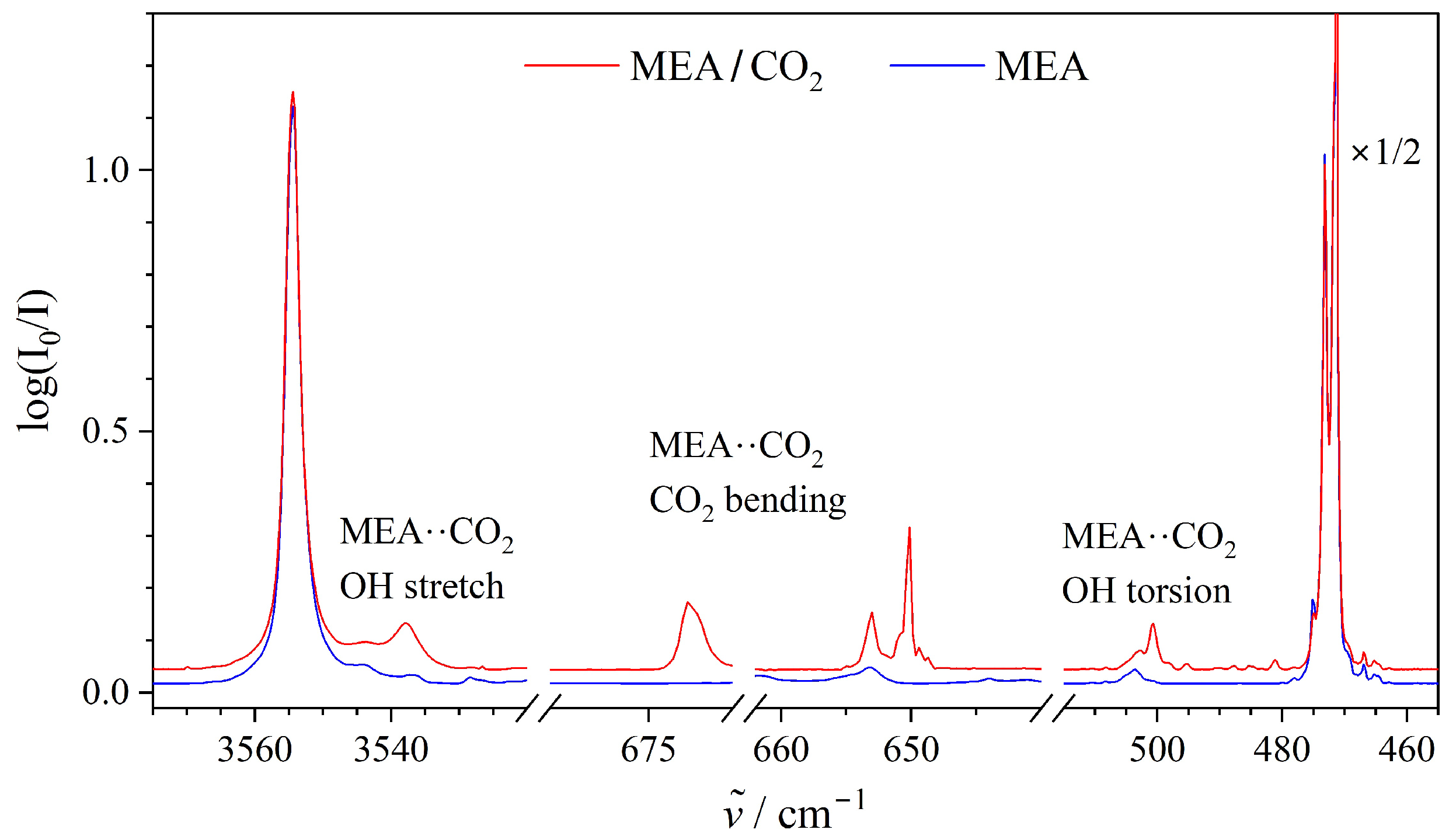
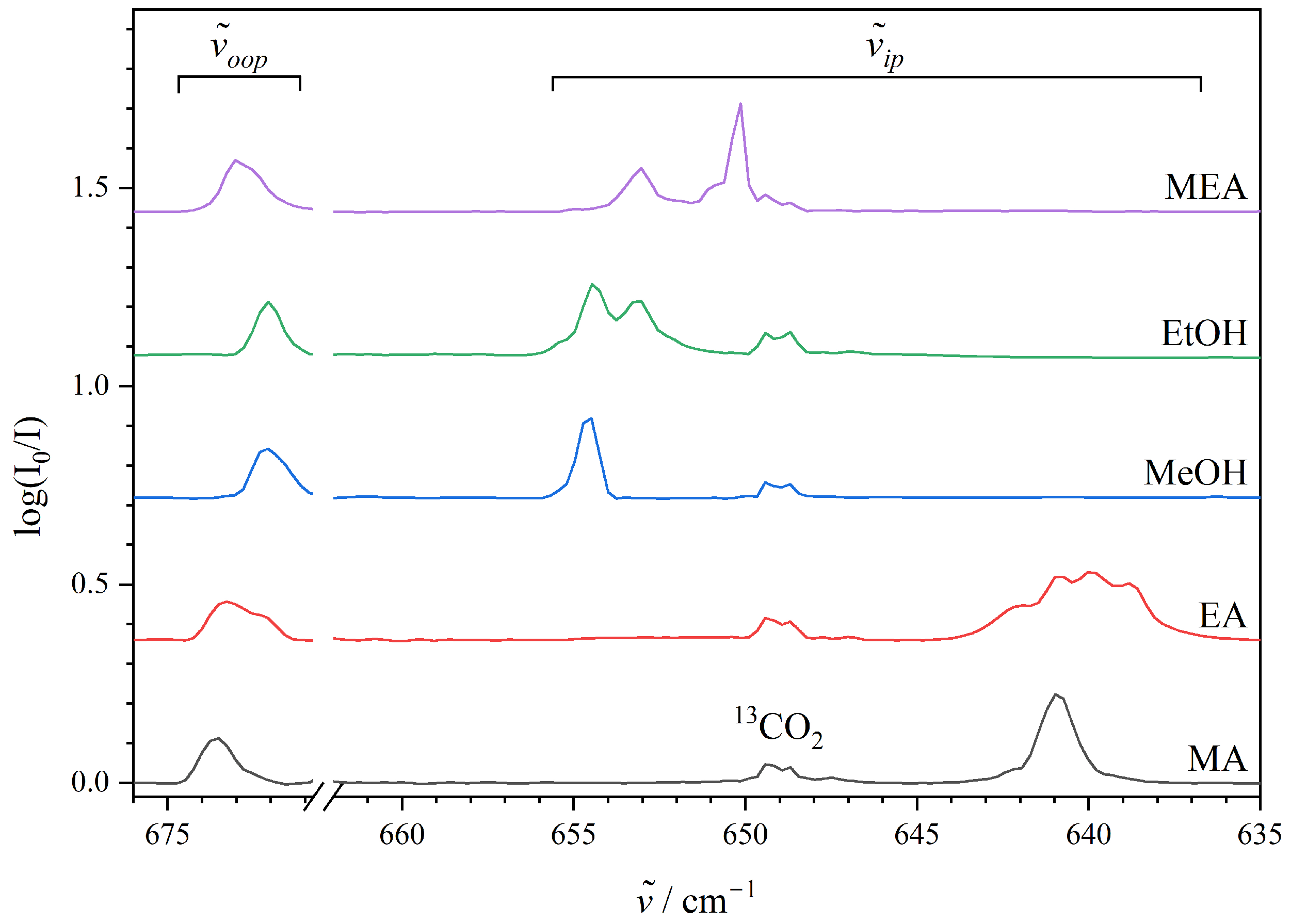
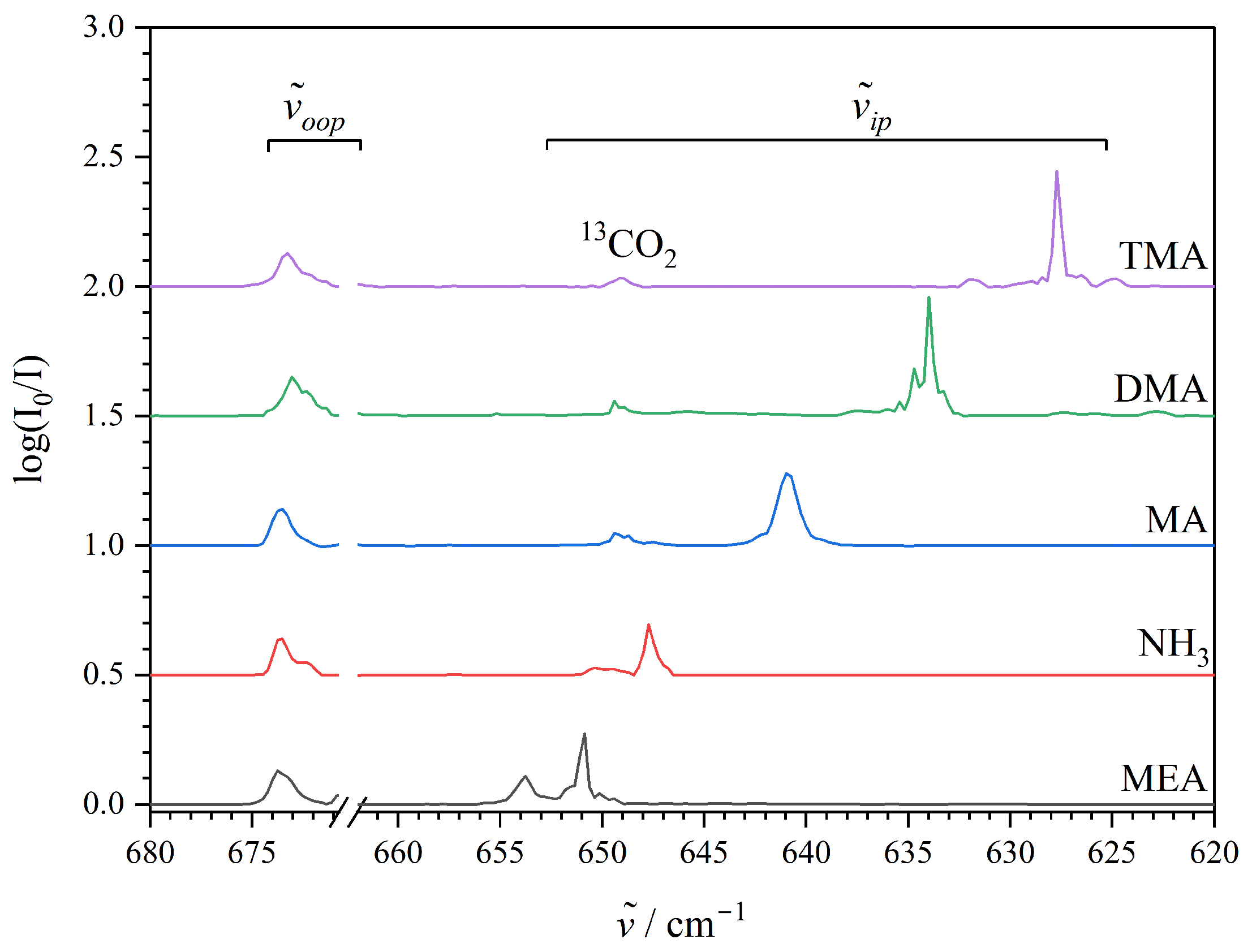
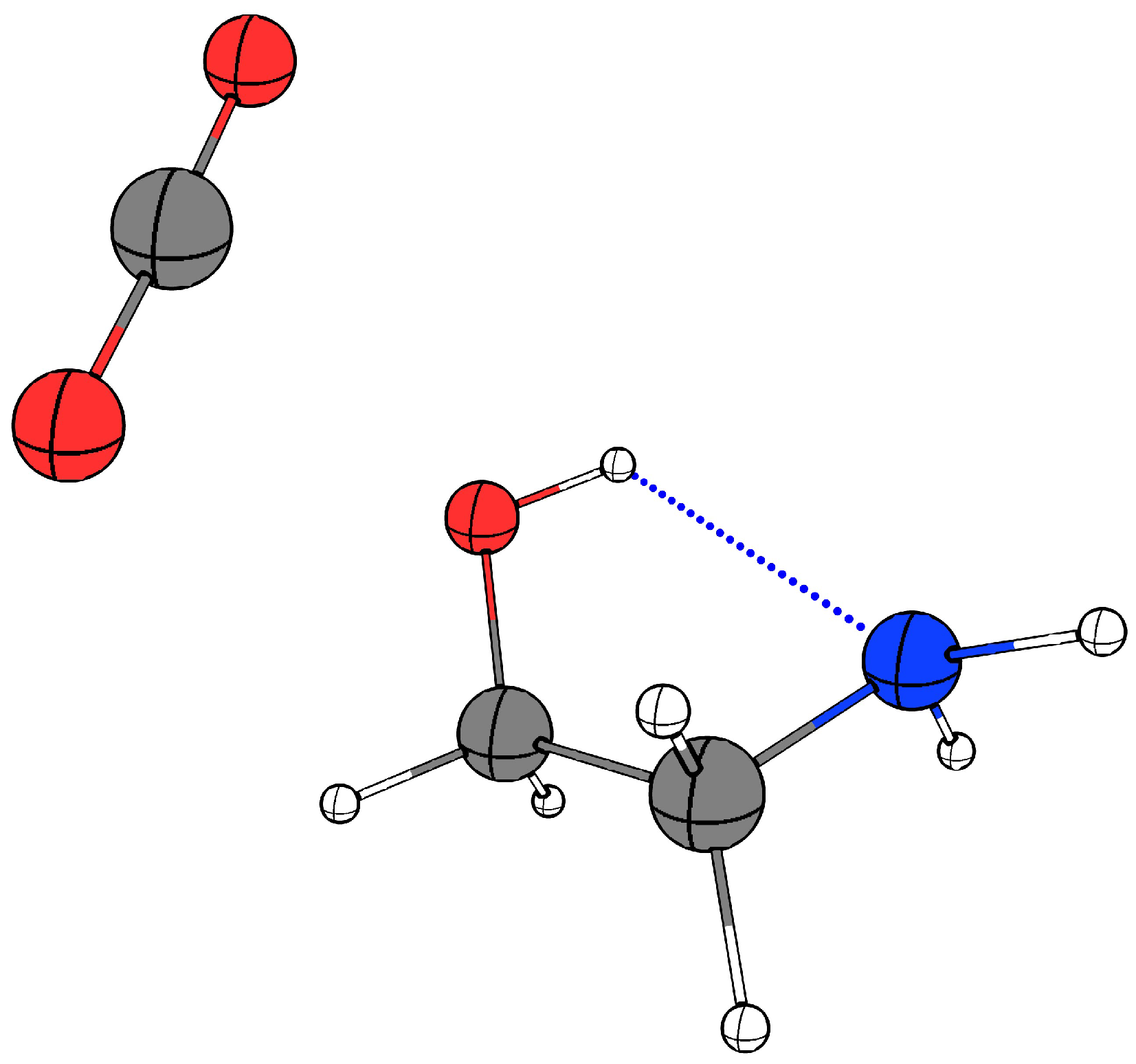
A recent broadband rotational spectroscopic investigation of the cross-association mechanisms of CO2 with monoethanolamine (MEA) in molecular beams [F. Xie et al., Angew. Chem. Int. Ed., 2023, 62, e202218539] revealed an intriguing affinity of CO2 to the hydroxy group. These findings have triggered the present systematic vibrational spectroscopic exploration of weakly bound amine··CO2 and alcohol··CO2 van der Waals cluster molecules embedded in inert “quantum” matrices of neon at 4.2 K complemented by high-level quantum chemical conformational analyses. The non-covalent interactions formed between the amino and hydroxy groups and the electron-deficient carbon atom of CO2 are demonstrated to lift the degeneracy of the doubly degenerate intramolecular CO2-bending fundamental significantly with characteristic observed spectral splittings for the amine··CO2 (≈35–45 cm−1) and alcohol··CO2 (≈20–25 cm−1) interactions, respectively, despite the almost identically predicted total association energies (≈12–14 kJ·mol−1) for these van der Waals contacts, as revealed by benchmark Domain-based Local Pair Natural Orbital Coupled Cluster DLPNO-CCSD(T) theory. These high-level theoretical predictions reveal significantly higher “geometry preparation energies” for the amine··CO2 systems leading to a more severe distortion of the CO2 linearity upon complexation in agreement with the infrared spectroscopic findings. The systematic combined spectroscopic and quantum chemical evidences for cross-association between CO2 and amines/alcohols in the present work unambiguously confirm an intriguing binding preference of CO2 to the hydroxy group of the important carbon capture agent MEA, with an accurate vibrational zero-point energy corrected association energy (D0) of 13.5 kJ·mol−1 at the benchmark DLPNO-CCSD(T)/aug-cc-pV5Z level of theory.
Keywords: carbon capture; CO2; monoethanolamine (MEA); amines; alcohols; vibrational spectroscopy; neon matrices; molecular association; non-covalent interactions; DLPNO-CCSD(T); local energy decomposition carbon capture; CO2; monoethanolamine (MEA); amines; alcohols; vibrational spectroscopy; neon matrices; molecular association; non-covalent interactions; DLPNO-CCSD(T); local energy decomposition