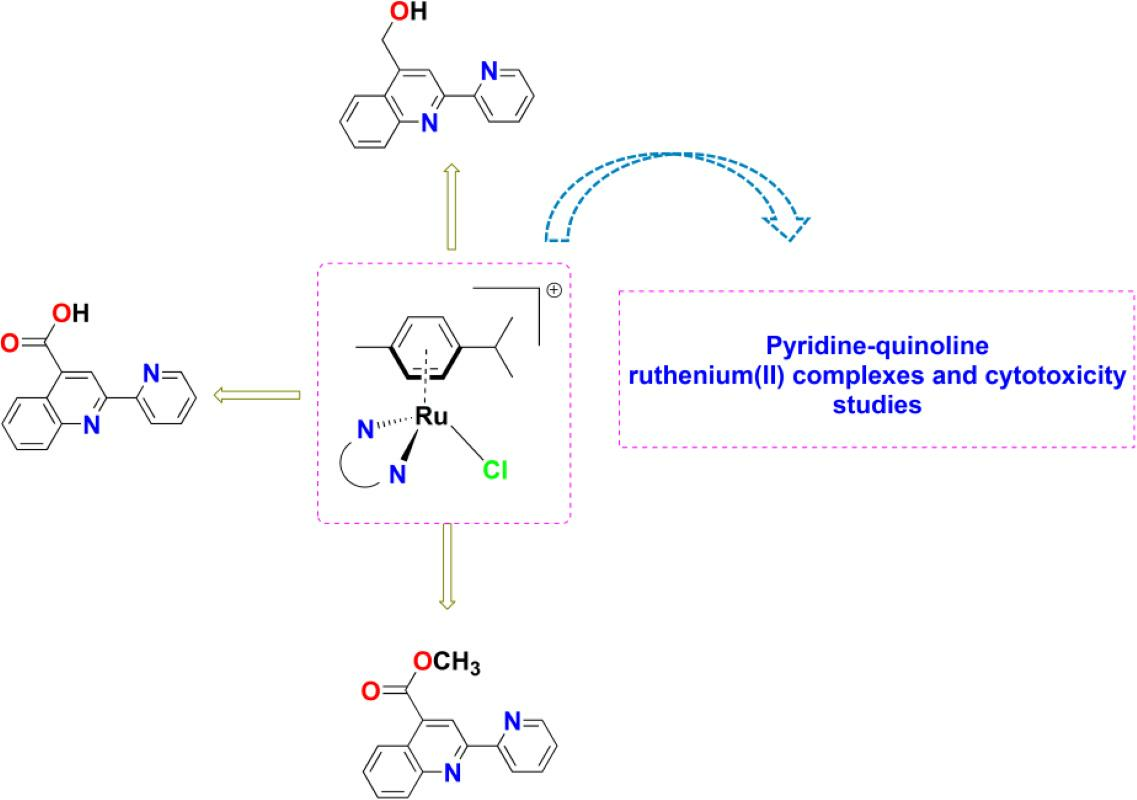
Ruthenium p-Cymene Complexes Incorporating Substituted Pyridine–Quinoline-Based Ligands: Synthesis, Characterization, and Cytotoxic Properties
 ,
,  , ,
, ,  ,
,  ,
,  and
and 
Abstract
Share and Cite
Kokkosi, A.; Garofallidou, E.; Zacharopoulos, N.; Tsoureas, N.; Diamanti, K.; Thomaidis, N.S.; Cheilari, A.; Machalia, C.; Emmanouilidou, E.; Philippopoulos, A.I. Ruthenium p-Cymene Complexes Incorporating Substituted Pyridine–Quinoline-Based Ligands: Synthesis, Characterization, and Cytotoxic Properties. Molecules 2024, 29, 3215. https://doi.org/10.3390/molecules29133215
Kokkosi A, Garofallidou E, Zacharopoulos N, Tsoureas N, Diamanti K, Thomaidis NS, Cheilari A, Machalia C, Emmanouilidou E, Philippopoulos AI. Ruthenium p-Cymene Complexes Incorporating Substituted Pyridine–Quinoline-Based Ligands: Synthesis, Characterization, and Cytotoxic Properties. Molecules. 2024; 29(13):3215. https://doi.org/10.3390/molecules29133215
Chicago/Turabian StyleKokkosi, Afroditi, Elpida Garofallidou, Nikolaos Zacharopoulos, Nikolaos Tsoureas, Konstantina Diamanti, Nikolaos S. Thomaidis, Antigoni Cheilari, Christina Machalia, Evangelia Emmanouilidou, and Athanassios I. Philippopoulos. 2024. "Ruthenium p-Cymene Complexes Incorporating Substituted Pyridine–Quinoline-Based Ligands: Synthesis, Characterization, and Cytotoxic Properties" Molecules 29, no. 13: 3215. https://doi.org/10.3390/molecules29133215
APA StyleKokkosi, A., Garofallidou, E., Zacharopoulos, N., Tsoureas, N., Diamanti, K., Thomaidis, N. S., Cheilari, A., Machalia, C., Emmanouilidou, E., & Philippopoulos, A. I. (2024). Ruthenium p-Cymene Complexes Incorporating Substituted Pyridine–Quinoline-Based Ligands: Synthesis, Characterization, and Cytotoxic Properties. Molecules, 29(13), 3215. https://doi.org/10.3390/molecules29133215