


Agarose Film-Based Liquid–Solid Conversion for Heavy Metal Detection of Water Samples by Laser-Induced Breakdown Spectroscopy

 ,
, 
Abstract
1. Introduction
2. Results and Discussion
2.1. Sample Comparison
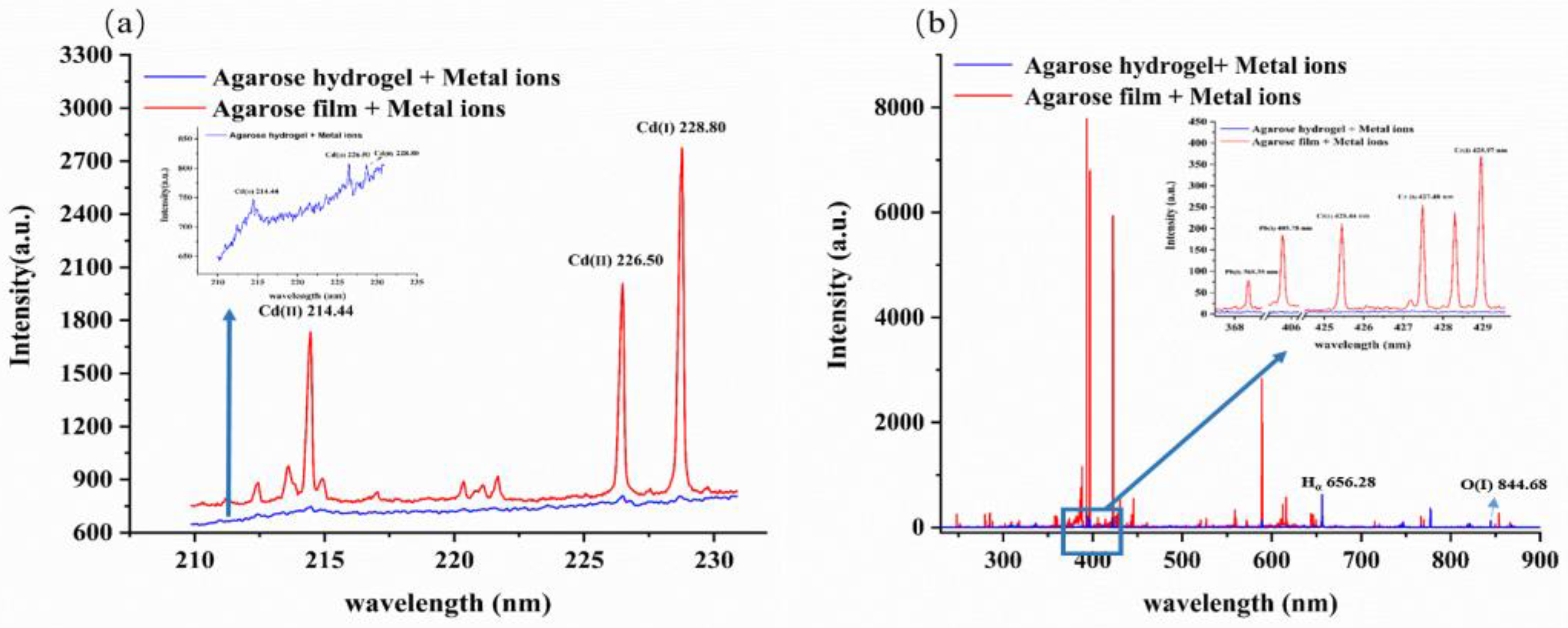
2.1.1. Spectral Intensity
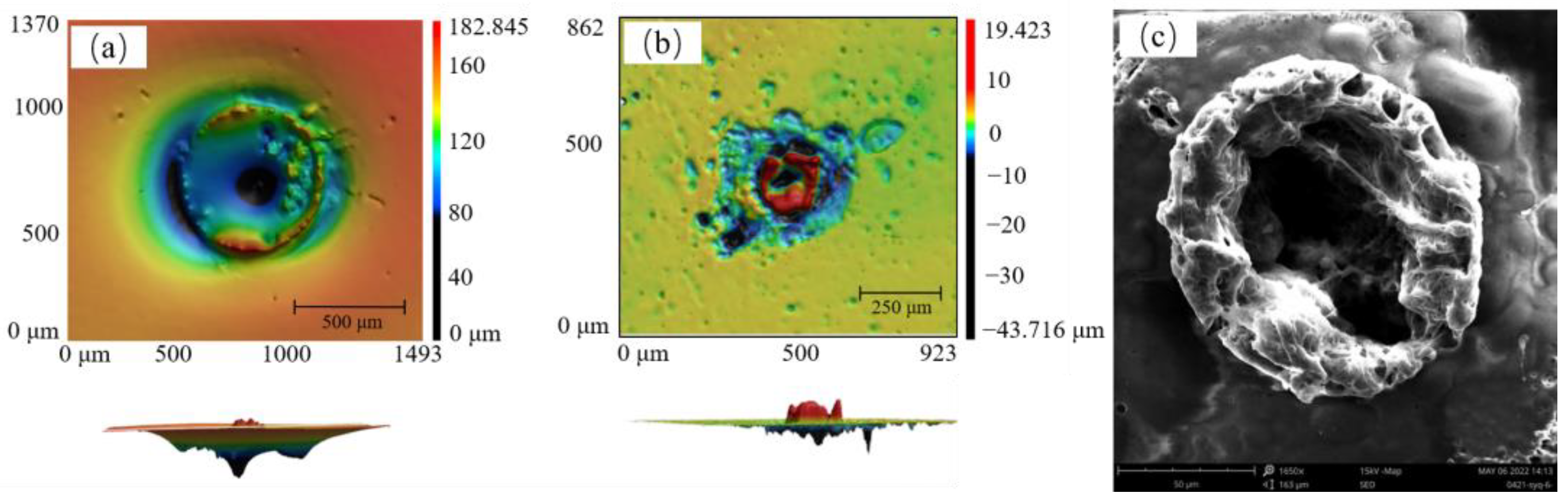
2.1.2. Ablation Crater Morphology
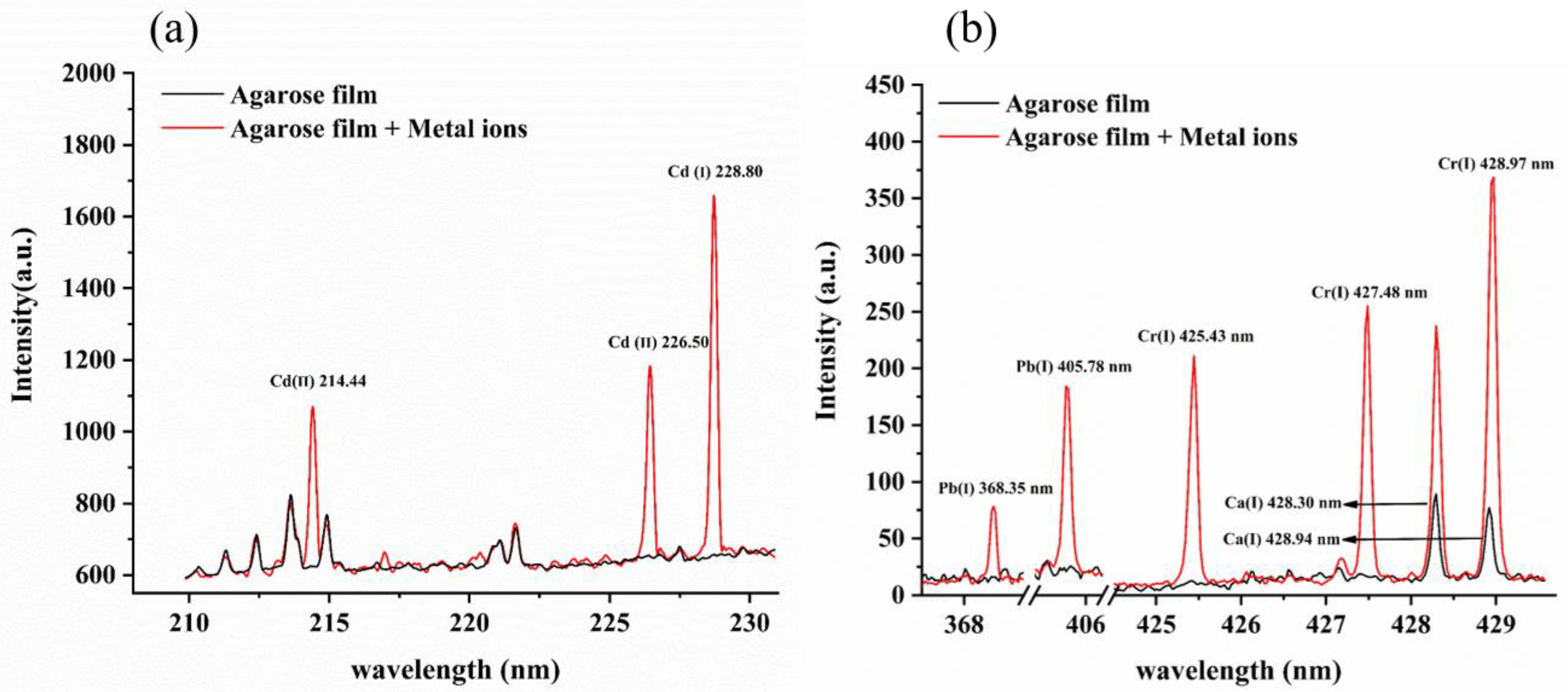
2.2. Characteristic Lines Selection
2.3. Optimizing the Experimental Parameters
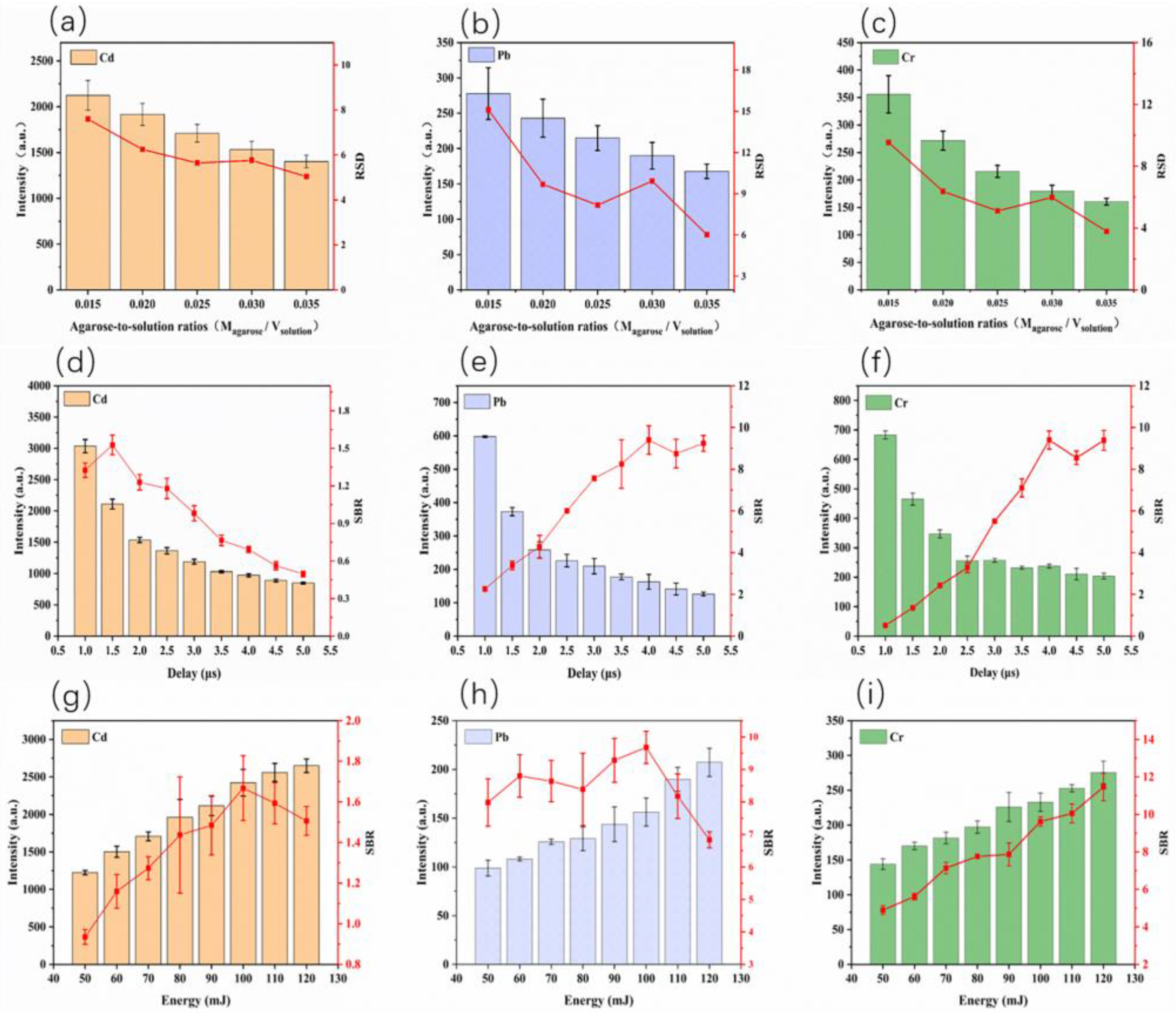
2.3.1. Optimizing the Agarose-to-Solution Ratio
2.3.2. Optimizing the Delay Time
2.3.3. Optimizing the Laser Pulse Energy
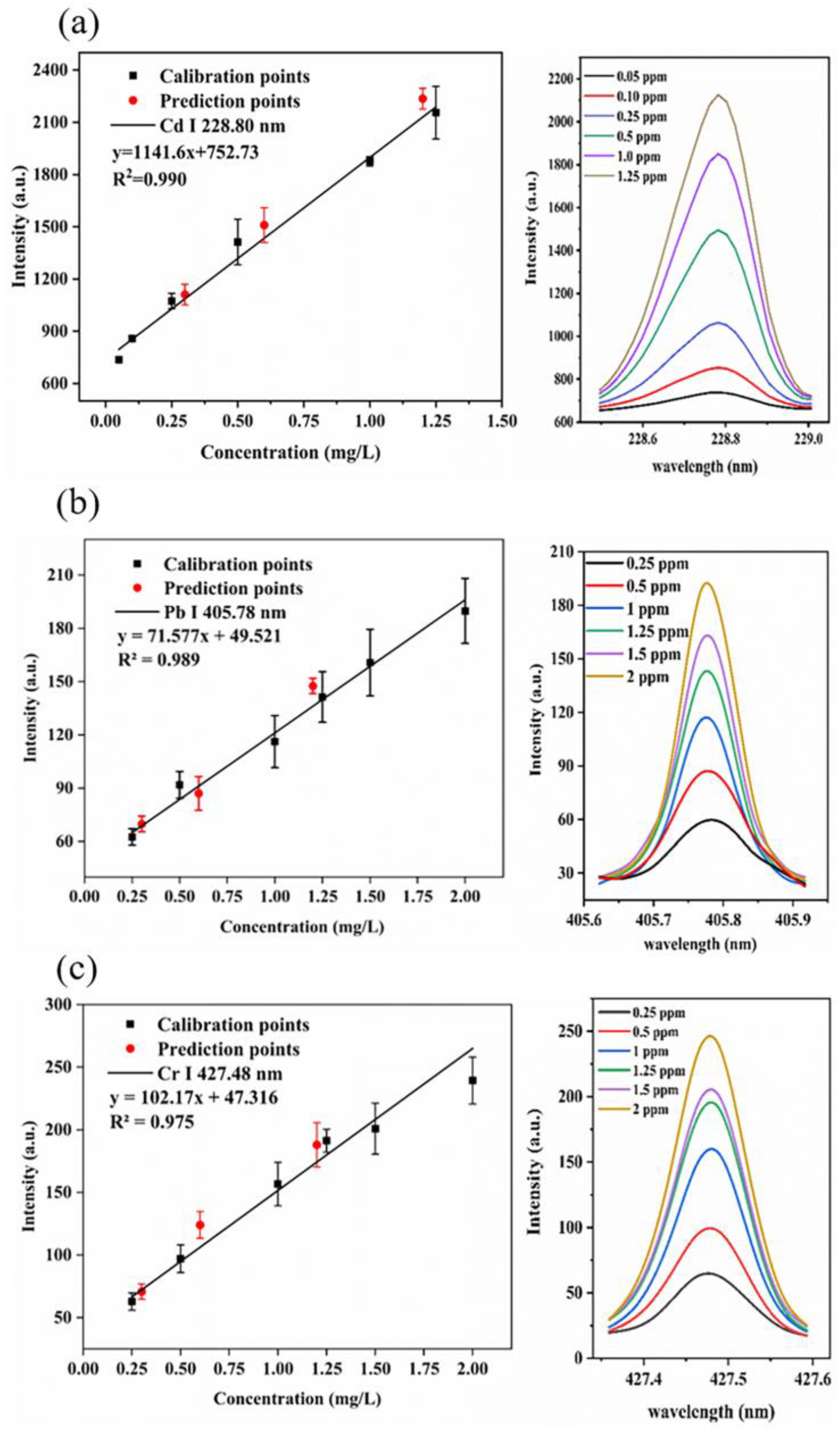
2.4. Quantitative Analysis
3. Materials and Methods
3.1. Heavy Metal Solution Preparation
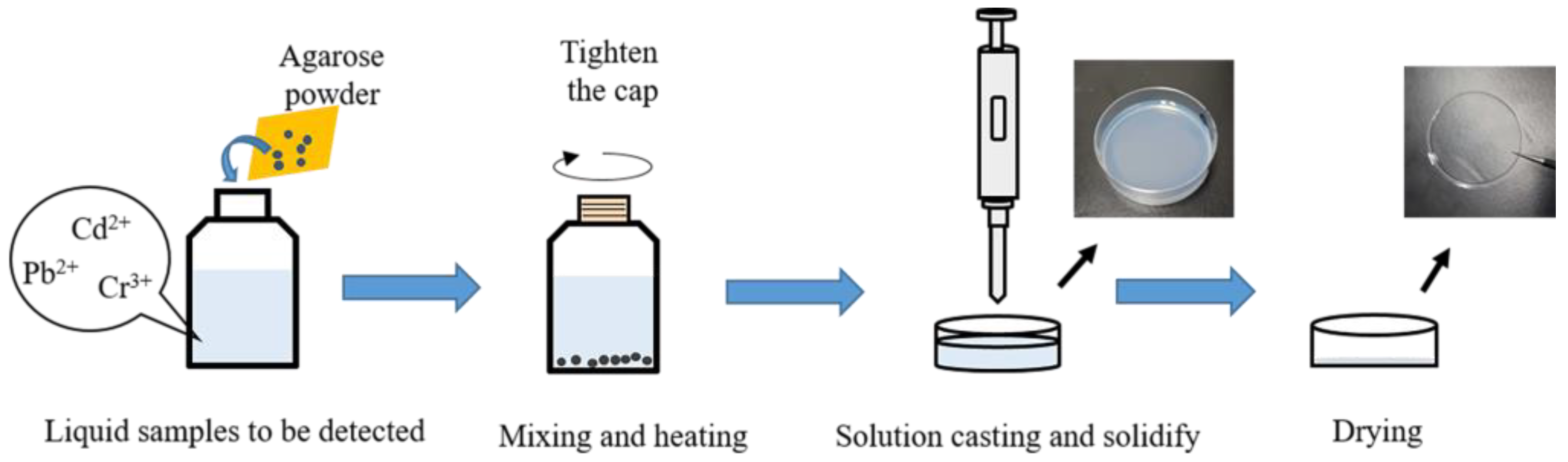
3.2. Sample Preparation
- (1)
- Weighing 0.125 g of agarose powder with an electronic balance and adding to a screw cap reagent bottle containing 5 mL of standard heavy metal solution.
- (2)
- Screwing the reagent bottle tightly and placing it in the water bath heater for 15 min at 100 °C in order to make sure the agarose is completely dissolved.
- (3)
- Transferring 3.0 g of the solutions into a 3.5 cm diameter petri dish and placing the dishes at room temperature cooling for 5 min to transform the solution into the agarose hydrogel with a smooth surface and homogeneous inside. A portion of the agarose hydrogel samples was kept as a reserve.
- (4)
- Placing the rest agarose hydrogel samples in a ventilated environment until the water completely evaporates.
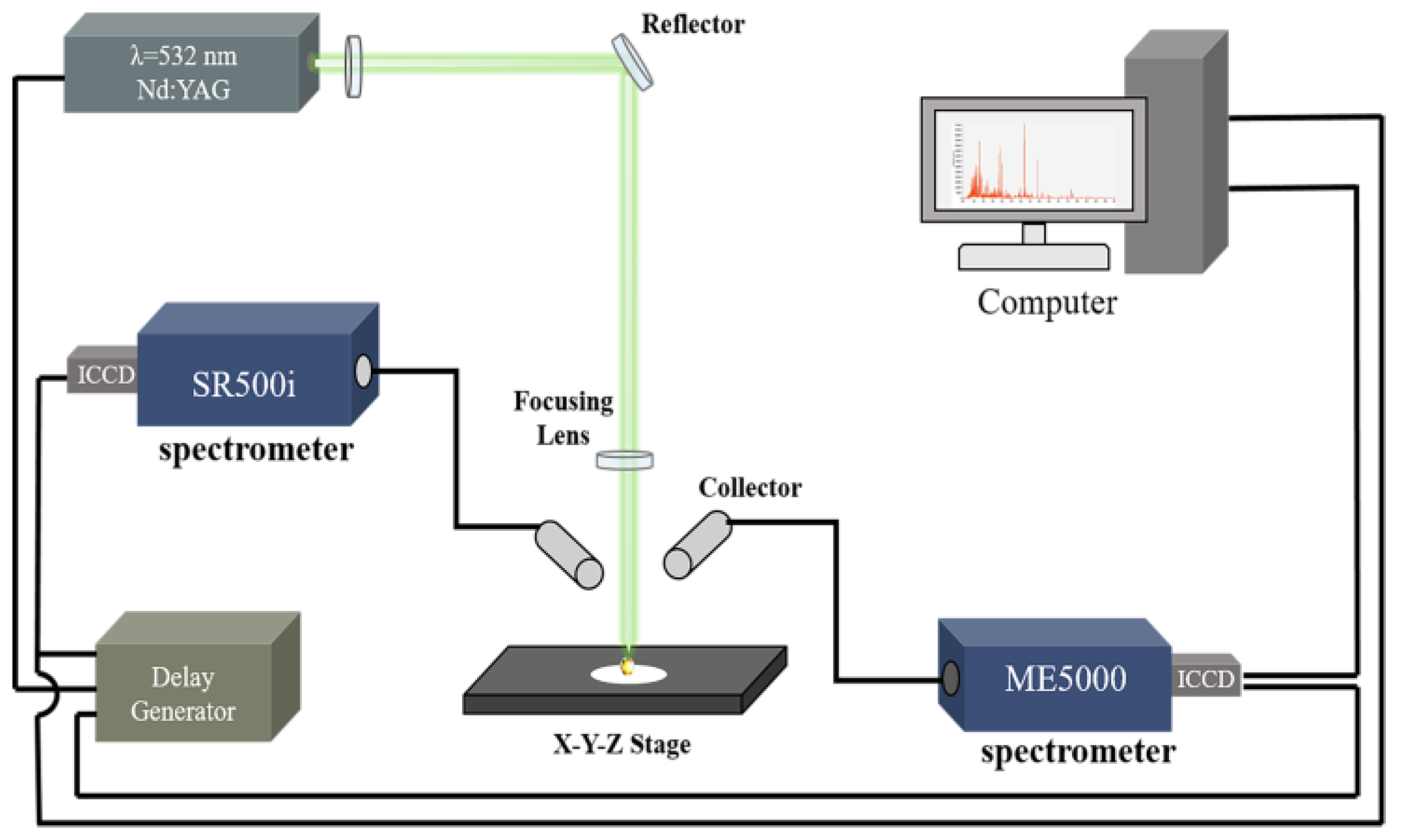
3.3. Experimental Setup
4. Conclusions
Author Contributions
Funding
Institutional Review Board Statement
Informed Consent Statement
Data Availability Statement
Conflicts of Interest
Sample Availability
References
- Zamora-Ledezma, C.; Negrete-Bolagay, D.; Figueroa, F.; Zamora-Ledezma, E.; Ni, M.; Alexis, F.; Guerrero, V.H. Heavy metal water pollution: A fresh look about hazards, novel and conventional remediation methods. Environ. Technol. Innov. 2021, 22, 101504. [Google Scholar] [CrossRef] [Scilit]
- Zhou, Q.; Yang, N.; Li, Y.; Ren, B.; Ding, X.; Bian, H.; Yao, X. Total concentrations and sources of heavy metal pollution in global river and lake water bodies from 1972 to 2017. Glob. Ecol. Conserv. 2020, 22, e00925. [Google Scholar] [CrossRef] [Scilit]
- Carolin, C.F.; Kumar, P.S.; Saravanan, A.; Joshiba, G.J.; Naushad, M. Efficient techniques for the removal of toxic heavy metals from aquatic environment: A review. J. Environ. Chem. Eng. 2017, 5, 2782–2799. [Google Scholar] [CrossRef] [Scilit]
- Szynkowska, M.I.; Pawlaczyk, A.; Maćkiewicz, E. Bioaccumulation and biomagnification of trace elements in the environment. Recent Adv. Trace Elem. 2018, 251–276. [Google Scholar] [CrossRef] [Scilit]
- Mitra, S.; Chakraborty, A.J.; Tareq, A.M.; Emran, T.B.; Nainu, F.; Khusro, A.; Idris, A.M.; Khandaker, M.U.; Osman, H.; Alhumaydhi, F.A. Impact of heavy metals on the environment and human health: Novel therapeutic insights to counter the toxicity. J. King Saud Univ. -Sci. 2022, 34, 101865. [Google Scholar] [CrossRef] [Scilit]
- Khanam, R.; Kumar, A.; Nayak, A.K.; Shahid, M.; Tripathi, R.; Vijayakumar, S.; Bhaduri, D.; Kumar, U.; Mohanty, S.; Panneerselvam, P. Metal (loid) s (As, Hg, Se, Pb and Cd) in paddy soil: Bioavailability and potential risk to human health. Sci. Total Environ. 2020, 699, 134330. [Google Scholar] [CrossRef] [Scilit]
- Kumar, A.; Kumar, A.; MMS, C.-P.; Chaturvedi, A.K.; Shabnam, A.A.; Subrahmanyam, G.; Mondal, R.; Gupta, D.K.; Malyan, S.K.; Kumar, S.S.; et al. Lead toxicity: Health hazards, influence on food chain, and sustainable remediation approaches. Int. J. Environ. Res. Public Health 2020, 17, 2179. [Google Scholar] [CrossRef] [Scilit]
- Rakhunde, R.; Deshpande, L.; Juneja, H. Chemical speciation of chromium in water: A review. Crit. Rev. Environ. Sci. Technol. 2012, 42, 776–810. [Google Scholar] [CrossRef] [Scilit]
- Jin, M.; Yuan, H.; Liu, B.; Peng, J.; Xu, L.; Yang, D. Review of the distribution and detection methods of heavy metals in the environment. Anal. Methods 2020, 12, 5747–5766. [Google Scholar] [CrossRef] [Scilit] [PubMed]
- Fernandes Andrade, D.; Pereira-Filho, E.R.; Amarasiriwardena, D. Current trends in laser-induced breakdown spectroscopy: A tutorial review. Appl. Spectrosc. Rev. 2021, 56, 98–114. [Google Scholar] [CrossRef] [Scilit]
- Noll, R.; Noll, R. Laser-Induced Breakdown Spectroscopy; Springer: Berlin/Heidelberg, Germany, 2012. [Google Scholar]
- Gonçalves, D.A.; Senesi, G.S.; Nicolodelli, G. Laser-induced breakdown spectroscopy applied to environmental systems and their potential contaminants. An overview of advances achieved in the last few years. Trends Environ. Anal. Chem. 2021, 30, e00121. [Google Scholar] [CrossRef] [Scilit]
- Thakur, S.N.; Singh, J.P. Fundamentals of LIBS and recent developments. Laser-Induc. Breakdown Spectrosc. 2020, 3–22. [Google Scholar] [CrossRef] [Scilit]
- Noll, R.; Fricke-Begemann, C.; Brunk, M.; Connemann, S.; Meinhardt, C.; Scharun, M.; Sturm, V.; Makowe, J.; Gehlen, C. Laser-induced breakdown spectroscopy expands into industrial applications. Spectrochim. Acta Part B At. Spectrosc. 2014, 93, 41–51. [Google Scholar] [CrossRef] [Scilit]
- Qiao, S.; Ding, Y.; Tian, D.; Yao, L.; Yang, G. A review of laser-induced breakdown spectroscopy for analysis of geological materials. Appl. Spectrosc. Rev. 2015, 50, 1–26. [Google Scholar] [CrossRef] [Scilit]
- Badday, M.A.; Bidin, N.; Rizvi, Z.H.; Hosseinian, R. Determination of environmental safety level with laser-induced breakdown spectroscopy technique. Chem. Ecol. 2015, 31, 379–387. [Google Scholar] [CrossRef] [Scilit]
- Yu, X.; Li, Y.; Gu, X.; Bao, J.; Yang, H.; Sun, L. Laser-induced breakdown spectroscopy application in environmental monitoring of water quality: A review. Environ. Monit. Assess. 2014, 186, 8969–8980. [Google Scholar] [CrossRef] [Scilit] [PubMed]
- Ruas, A.; Matsumoto, A.; Ohba, H.; Akaoka, K.; Wakaida, I. Application of laser-induced breakdown spectroscopy to zirconium in aqueous solution. Spectrochim. Acta Part B At. Spectrosc. 2017, 131, 99–106. [Google Scholar] [CrossRef] [Scilit]
- Meneses-Nava, M.; Rosas-Roman, I.; Barbosa-García, O.; Rodriguez, M.; Maldonado, J. Stability evaluation of water droplets levitated by a TinyLev acoustic levitator for laser induced breakdown spectroscopy. Spectrochim. Acta Part B At. Spectrosc. 2020, 168, 105855. [Google Scholar] [CrossRef] [Scilit]
- Aras, N.; Yeşiller, S.Ü.; Ateş, D.A.; Yalçın, Ş. Ultrasonic nebulization-sample introduction system for quantitative analysis of liquid samples by laser-induced breakdown spectroscopy. Spectrochim. Acta Part B: At. Spectrosc. 2012, 74, 87–94. [Google Scholar] [CrossRef] [Scilit]
- Keerthi, K.; George, S.D.; Kulkarni, S.D.; Chidangil, S.; Unnikrishnan, V. Elemental analysis of liquid samples by laser induced breakdown spectroscopy (LIBS): Challenges and potential experimental strategies. Opt. Laser Technol. 2022, 147, 107622. [Google Scholar] [CrossRef] [Scilit]
- Yao, Y.; He, F.; Lin, Q.; Tian, Y.; Zhang, T.; Xu, B.; Qi, X.; Duan, Y. Synchronous detection of heavy metal ions in aqueous solution by gold nanoparticle surface-enhanced laser-induced breakdown spectroscopy. J. Anal. At. Spectrom. 2021, 36, 2639–2648. [Google Scholar] [CrossRef] [Scilit]
- Lin, Q.; Bian, F.; Wei, Z.; Wang, S.; Duan, Y. A hydrogel-based solidification method for the direct analysis of liquid samples by laser-induced breakdown spectroscopy. J. Anal. At. Spectrom. 2017, 32, 1412–1419. [Google Scholar] [CrossRef] [Scilit]
- Wang, Y.; Bu, Y.; Cai, Y.; Wang, X. Quantitative analysis of mercury in liquid samples using laser-induced breakdown spectroscopy combined with shear thickening fluid. J. Anal. At. Spectrom. 2022, 37, 1023–1031. [Google Scholar] [CrossRef] [Scilit]
- Tian, H.; Jiao, L.; Dong, D. Rapid determination of trace cadmium in drinking water using laser-induced breakdown spectroscopy coupled with chelating resin enrichment. Sci. Rep. 2019, 9, 10443. [Google Scholar] [CrossRef] [Scilit] [PubMed]
- Wu, M.; Wang, X.; Niu, G.; Zhao, Z.; Duan, Y. Ultrasensitive and simultaneous detection of multielements in aqueous samples based on biomimetic array combined with laser-induced breakdown spectroscopy. Anal. Chem. 2021, 93, 10196–10203. [Google Scholar] [CrossRef] [Scilit]
- Liu, Y.; Pan, J.; Hu, Z.; Chu, Y.; Khan, M.S.; Tang, K.; Guo, L.; Lau, C. Stability improvement for dried droplet pretreatment by suppression of coffee ring effect using electrochemical anodized nanoporous tin dioxide substrate. Microchim. Acta 2020, 187, 664. [Google Scholar] [CrossRef] [Scilit]
- Ma, S.; Tang, Y.; Ma, Y.; Chu, Y.; Chen, F.; Hu, Z.; Zhu, Z.; Guo, L.; Zeng, X.; Lu, Y. Determination of trace heavy metal elements in aqueous solution using surface-enhanced laser-induced breakdown spectroscopy. Opt. Express 2019, 27, 15091–15099. [Google Scholar] [CrossRef] [Scilit]
- Li, F.; Mingjun, M.; Deshuo, M.; Yao, J.; HUANG, X.; Wenqing, L.; Jianguo, L. Detection of heavy metals in water samples by laser-induced breakdown spectroscopy combined with annular groove graphite flakes. Plasma Sci. Technol. 2018, 21, 034002. [Google Scholar]
- Ogrenci, A.S.; Pekcan, O.; Kara, S.; Bilge, A.H. Mathematical characterization of thermo-reversible phase transitions of agarose gels. J. Macromol. Sci. Part B 2018, 57, 364–376. [Google Scholar] [CrossRef] [Scilit]
- Chen, M.; Yuan, T.; Hou, Z.; Wang, Z.; Wang, Y. Effects of moisture content on coal analysis using laser-induced breakdown spectroscopy. Spectrochim. Acta Part B: At. Spectrosc. 2015, 112, 23–33. [Google Scholar] [CrossRef] [Scilit]
- Peng, J.; He, Y.; Ye, L.; Shen, T.; Liu, F.; Kong, W.; Liu, X.; Zhao, Y. Moisture influence reducing method for heavy-metal detection in plant materials using laser-induced breakdown spectroscopy: A case study for chromium content detection in rice leaves. Anal. Chem. 2017, 89, 7593–7600. [Google Scholar] [CrossRef] [Scilit] [PubMed]
- Paris, P.; Piip, K.; Lepp, A.; Lissovski, A.; Aints, M.; Laan, M. Discrimination of moist oil shale and limestone using laser induced breakdown spectroscopy. Spectrochim. Acta Part B: At. Spectrosc. 2015, 107, 61–66. [Google Scholar] [CrossRef] [Scilit]
- Brouard, D.; Gravel, J.-F.Y.; Viger, M.L.; Boudreau, D. Use of sol–gels as solid matrixes for laser-induced breakdown spectroscopy. Spectrochimica Acta Part B: At. Spectrosc. 2007, 62, 1361–1369. [Google Scholar] [CrossRef] [Scilit]
- Sobral, H.; Sanginés, R.; Trujillo-Vázquez, A. Detection of trace elements in ice and water by laser-induced breakdown spectroscopy. Spectrochim. Acta Part B At. Spectrosc. 2012, 78, 62–66. [Google Scholar] [CrossRef] [Scilit]
- Lee, Y.; Oh, S.W.; Han, S.H. Laser-induced breakdown spectroscopy (LIBS) of heavy metal ions at the sub-parts per million level in water. Appl. Spectrosc. 2012, 66, 1385. [Google Scholar] [CrossRef] [Scilit]
- Schmidt, N.E.; Goode, S.R. Analysis of aqueous solutions by laser-induced breakdown spectroscopy of ion exchange membranes. Appl. Spectrosc. 2002, 56, 370–374. [Google Scholar] [CrossRef] [Scilit]
- Shi, Q.; Niu, G.; Lin, Q.; Wang, X.; Wang, J.; Bian, F.; Duan, Y. Exploration of a 3D nano-channel porous membrane material combined with laser-induced breakdown spectrometry for fast and sensitive heavy metal detection of solution samples. J. Anal. At. Spectrom. 2014, 29, 2302–2308. [Google Scholar] [CrossRef] [Scilit]
- Niu, G.; Shi, Q.; Xu, M.; Lai, H.; Lin, Q.; Liu, K.; Duan, Y. Dehydrated carbon coupled with laser-induced breakdown spectrometry (LIBS) for the determination of heavy metals in solutions. Appl. Spectrosc. Soc. Appl. Spectrosc. 2015, 69, 1190–1198. [Google Scholar] [CrossRef] [Scilit]
- Peng, J.; Song, K.; Zhu, H.; Kong, W.; Liu, F.; Shen, T.; He, Y. Fast detection of tobacco mosaic virus infected tobacco using laser-induced breakdown spectroscopy. Sci. Rep. 2017, 7, 44551. [Google Scholar] [CrossRef] [Scilit]

| Spectrum (nm) | Sample Methodology | Matrix Material | LOD (mg L−1) | Ref. |
|---|---|---|---|---|
| Cd (II) 214.44 | Ice solidification | Water | 1.4 | [35] |
| Cd (II) 214.44 | Chelating resin enrichment | Chelating resin | 0.036 | [25] |
| Cd (I) 226.50 | Biomimatic array droplets | Glass with super hydrophobic surface | 0.0135 | [26] |
| Cd (I) 228.80 | Agarose film-based liquid–solid conversion | Agarose film | 0.011 | This work |
| Pb (I) 405.78 | Filter papers absorption | Filter papers | 2.7 | [36] |
| Pb (I) 405.78 | Ion exchange polymer membranes filtration | Ion exchange polymer membranes | 1.1 | [37] |
| Pb (I) 405.78 | 3D nano-channel porous membrane absorption | 3D nano-channel porous membrane | 0.081 | [38] |
| Pb (I) 405.78 | Agarose film-based liquid–solid conversion | Agarose film | 0.122 | This work |
| Cr (I) 425.43 | Hydrogel based solidification | Sodium poly acrylate resin | 4.44 | [23] |
| Cr (I) 425.43 | Ion exchange polymer membranes filtration | Ion exchange polymer membranes | 0.46 | [39] |
| Cr (I) 427.48 | 3D nano-channel porous membrane absorption | 3D nano-channel porous membrane | 0.11 | [38] |
| Cr (I) 427.48 | Agarose film-based liquid–solid conversion | Agarose film | 0.118 | This work |
| Element | Spiked (mg·L−1) | Found Value (mg·L−1) | Recovery (%) |
|---|---|---|---|
| Cd | 0 | ND a | / |
| 0.6 | 0.621 ± 0.082 | 103.50% | |
| Pb | 0 | ND a | / |
| 0.6 | 0.547 ± 0.078 | 91.20% | |
| Cr | 0 | ND a | / |
| 0.6 | 0.647 ± 0.027 | 107.90% |
Disclaimer/Publisher’s Note: The statements, opinions and data contained in all publications are solely those of the individual author(s) and contributor(s) and not of MDPI and/or the editor(s). MDPI and/or the editor(s) disclaim responsibility for any injury to people or property resulting from any ideas, methods, instructions or products referred to in the content. |
© 2023 by the authors. Licensee MDPI, Basel, Switzerland. This article is an open access article distributed under the terms and conditions of the Creative Commons Attribution (CC BY) license (https://creativecommons.org/licenses/by/4.0/).
Share and Cite
You, Z.; Li, X.; Huang, J.; Chen, R.; Peng, J.; Kong, W.; Liu, F. Agarose Film-Based Liquid–Solid Conversion for Heavy Metal Detection of Water Samples by Laser-Induced Breakdown Spectroscopy. Molecules 2023, 28, 2777. https://doi.org/10.3390/molecules28062777
You Z, Li X, Huang J, Chen R, Peng J, Kong W, Liu F. Agarose Film-Based Liquid–Solid Conversion for Heavy Metal Detection of Water Samples by Laser-Induced Breakdown Spectroscopy. Molecules. 2023; 28(6):2777. https://doi.org/10.3390/molecules28062777
Chicago/Turabian StyleYou, Zhengkai, Xiaolong Li, Jing Huang, Rongqin Chen, Jiyu Peng, Wenwen Kong, and Fei Liu. 2023. "Agarose Film-Based Liquid–Solid Conversion for Heavy Metal Detection of Water Samples by Laser-Induced Breakdown Spectroscopy" Molecules 28, no. 6: 2777. https://doi.org/10.3390/molecules28062777
APA StyleYou, Z., Li, X., Huang, J., Chen, R., Peng, J., Kong, W., & Liu, F. (2023). Agarose Film-Based Liquid–Solid Conversion for Heavy Metal Detection of Water Samples by Laser-Induced Breakdown Spectroscopy. Molecules, 28(6), 2777. https://doi.org/10.3390/molecules28062777



