Review

Application of Mathematical Modeling and Computational Tools in the Modern Drug Design and Development Process

by
Md Rifat Hasan
1,2,
Ahad Amer Alsaiari
3,
Burhan Zain Fakhurji
4,
Mohammad Habibur Rahman Molla
5,
Amer H. Asseri
6,7,
Md Afsar Ahmed Sumon
8,
Moon Nyeo Park
9,
Foysal Ahammad
5,* and
Bonglee Kim
9,*
1
Department of Mathematics, Faculty of Science, King Abdul-Aziz University, Jeddah 21589, Saudi Arabia
2
Department of Applied Mathematics, Faculty of Science, Noakhali Science and Technology University, Noakhali 3814, Bangladesh
3
College of Applied Medical Science, Clinical Laboratories Science Department, Taif University, Taif 21944, Saudi Arabia
4
iGene Medical Training and Molecular Research Center, Jeddah 21589, Saudi Arabia
5
Department of Biological Sciences, Faculty of Science, King Abdul-Aziz University, Jeddah 21589, Saudi Arabia
6
Biochemistry Department, Faculty of Science, King Abdul-Aziz University, Jeddah 21589, Saudi Arabia
7
Centre for Artificial Intelligence in Precision Medicines, King Abdul-Aziz University, Jeddah 21589, Saudi Arabia
8
Department of Marine Biology, Faculty of Marine Sciences, King Abdul-Aziz University, Jeddah 21589, Saudi Arabia
9
College of Korean Medicine, Kyung Hee University, Hoigidong, Dongdaemungu, Seoul 02453, Korea
*
Authors to whom correspondence should be addressed.
Molecules 2022, 27(13), 4169; https://doi.org/10.3390/molecules27134169

Submission received: 31 May 2022 / Revised: 22 June 2022 / Accepted: 27 June 2022 / Published: 29 June 2022
(This article belongs to the Special Issue Role of Computer Aided Drug Design in Drug Development)

Abstract

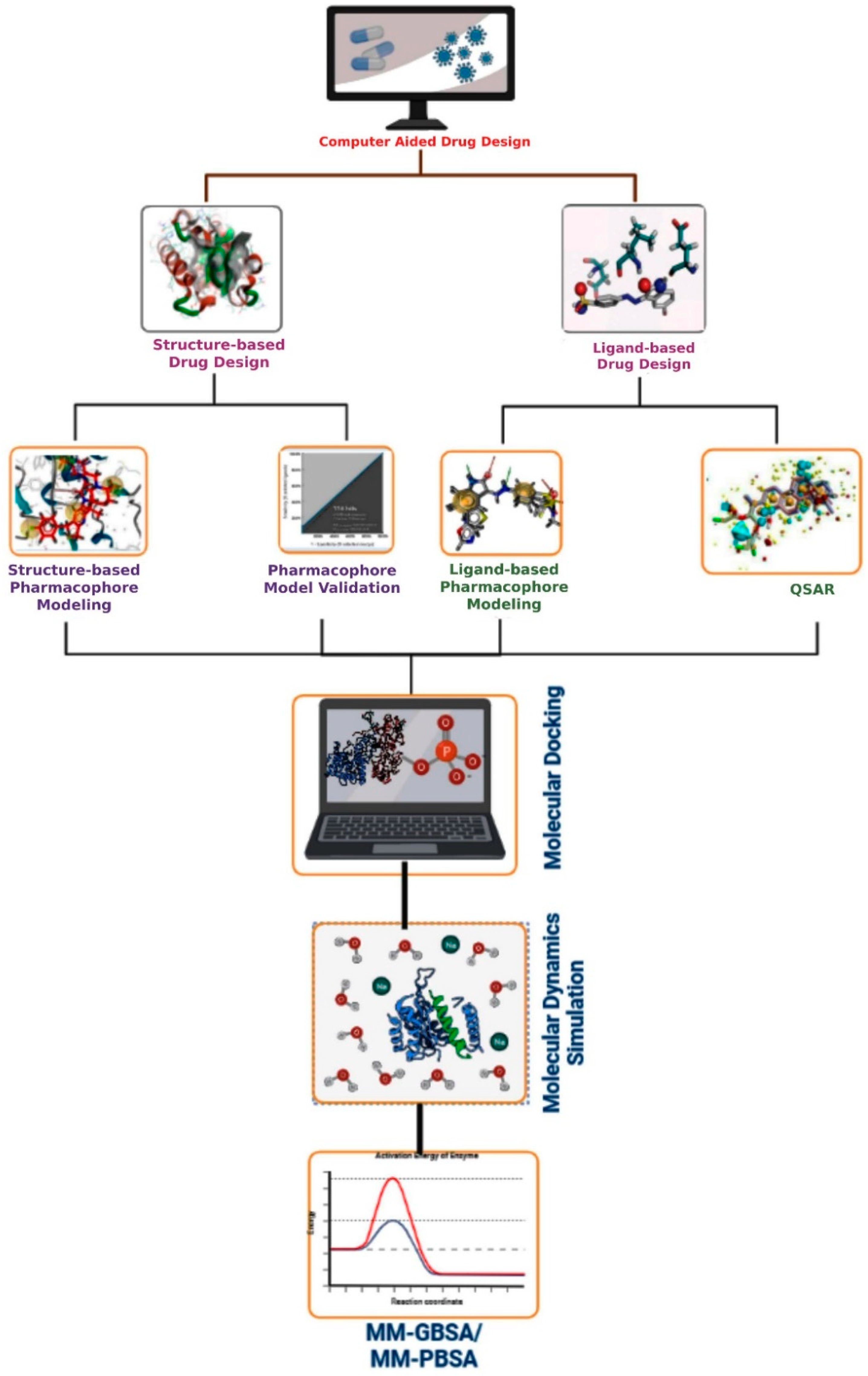
The conventional drug discovery approach is an expensive and time-consuming process, but its limitations have been overcome with the help of mathematical modeling and computational drug design approaches. Previously, finding a small molecular candidate as a drug against a disease was very costly and required a long time to screen a compound against a specific target. The development of novel targets and small molecular candidates against different diseases including emerging and reemerging diseases remains a major concern and necessitates the development of novel therapeutic targets as well as drug candidates as early as possible. In this regard, computational and mathematical modeling approaches for drug development are advantageous due to their fastest predictive ability and cost-effectiveness features. Computer-aided drug design (CADD) techniques utilize different computer programs as well as mathematics formulas to comprehend the interaction of a target and drugs. Traditional methods to determine small-molecule candidates as a drug have several limitations, but CADD utilizes novel methods that require little time and accurately predict a compound against a specific disease with minimal cost. Therefore, this review aims to provide a brief insight into the mathematical modeling and computational approaches for identifying a novel target and small molecular candidates for curing a specific disease. The comprehensive review mainly focuses on biological target prediction, structure-based and ligand-based drug design methods, molecular docking, virtual screening, pharmacophore modeling, quantitative structure–activity relationship (QSAR) models, molecular dynamics simulation, and MM-GBSA/MM-PBSA approaches along with valuable database resources and tools for identifying novel targets and therapeutics against a disease. This review will help researchers in a way that may open the road for the development of effective drugs and preventative measures against a disease in the future as early as possible.
Keywords: mathematical modeling; CADD; QSAR; MM-GBSA; MM-PBSA; pharmacophore modeling; MD simulation; biological activity; drug design mathematical modeling; CADD; QSAR; MM-GBSA; MM-PBSA; pharmacophore modeling; MD simulation; biological activity; drug design