


Probiotic Yoghurts with Sea Buckthorn, Elderberry, and Sloe Fruit Purees

Abstract
1. Introduction
2. Results
2.1. Chemical Composition of Fruit Purees and Probiotic Yoghurts
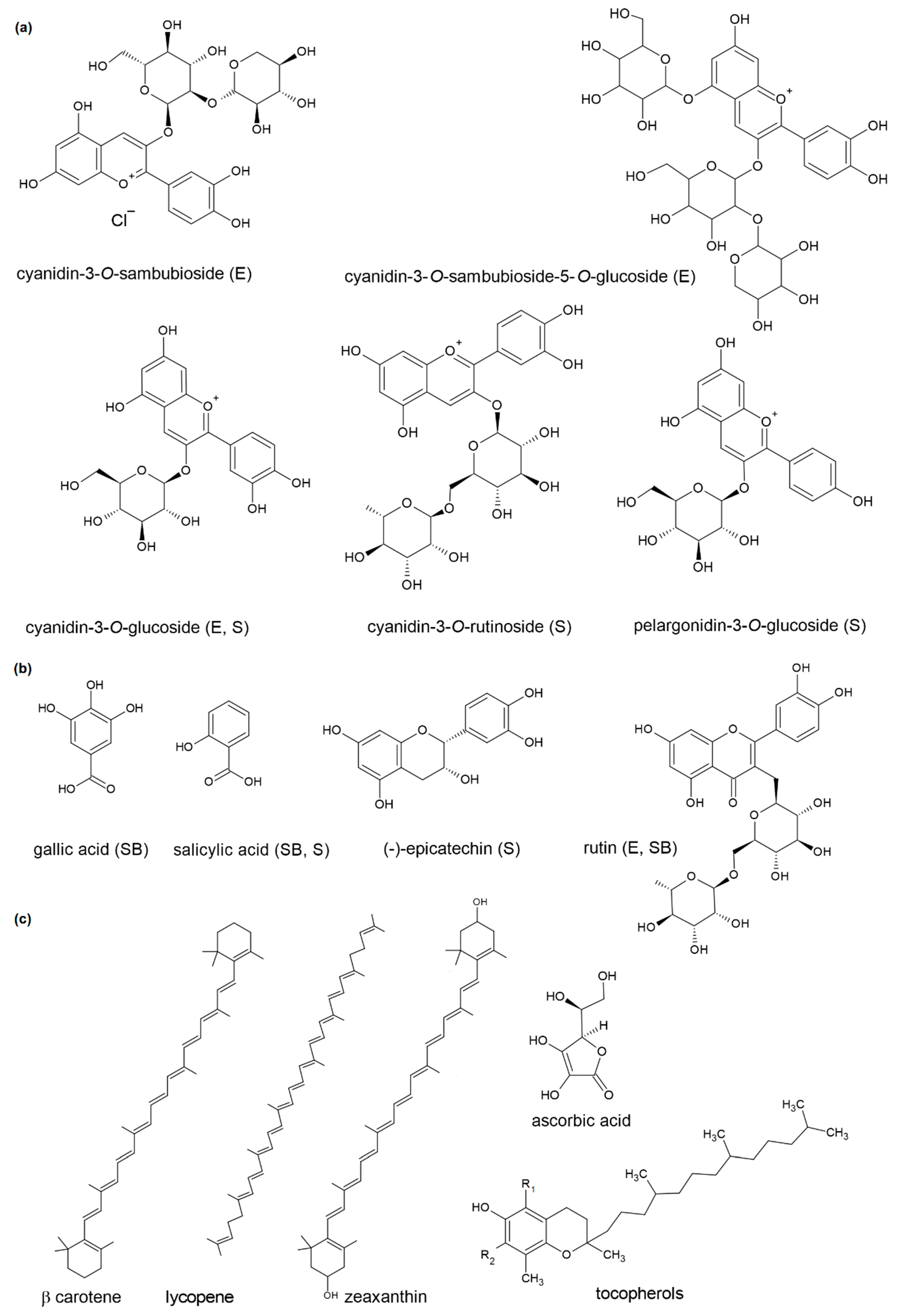
2.2. Antioxidant Substances and Capacity
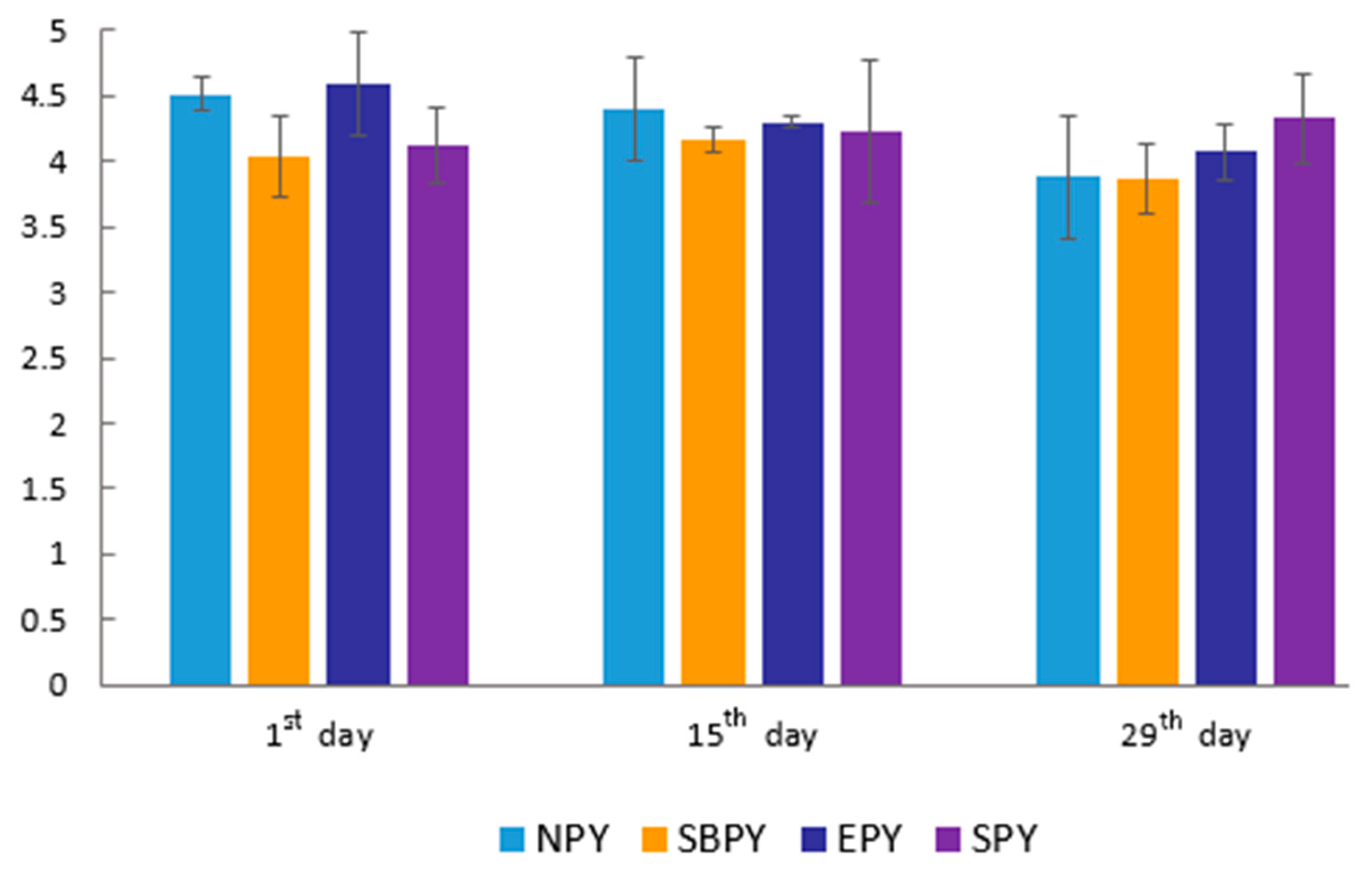
2.3. Acidity and Microbiological Quality
2.4. Aromatic Compounds
2.5. Texture and Color Parameters
2.6. Sensory Analysis
3. Discussion
3.1. Acidity and Aromatic Compounds
3.2. Microbiology
3.3. Antioxidant Capacity
3.4. Color
3.5. Texture and Syneresis
3.6. Sensory Quality
4. Materials and Methods
4.1. Materials
4.2. Preparation of Fruit Purees
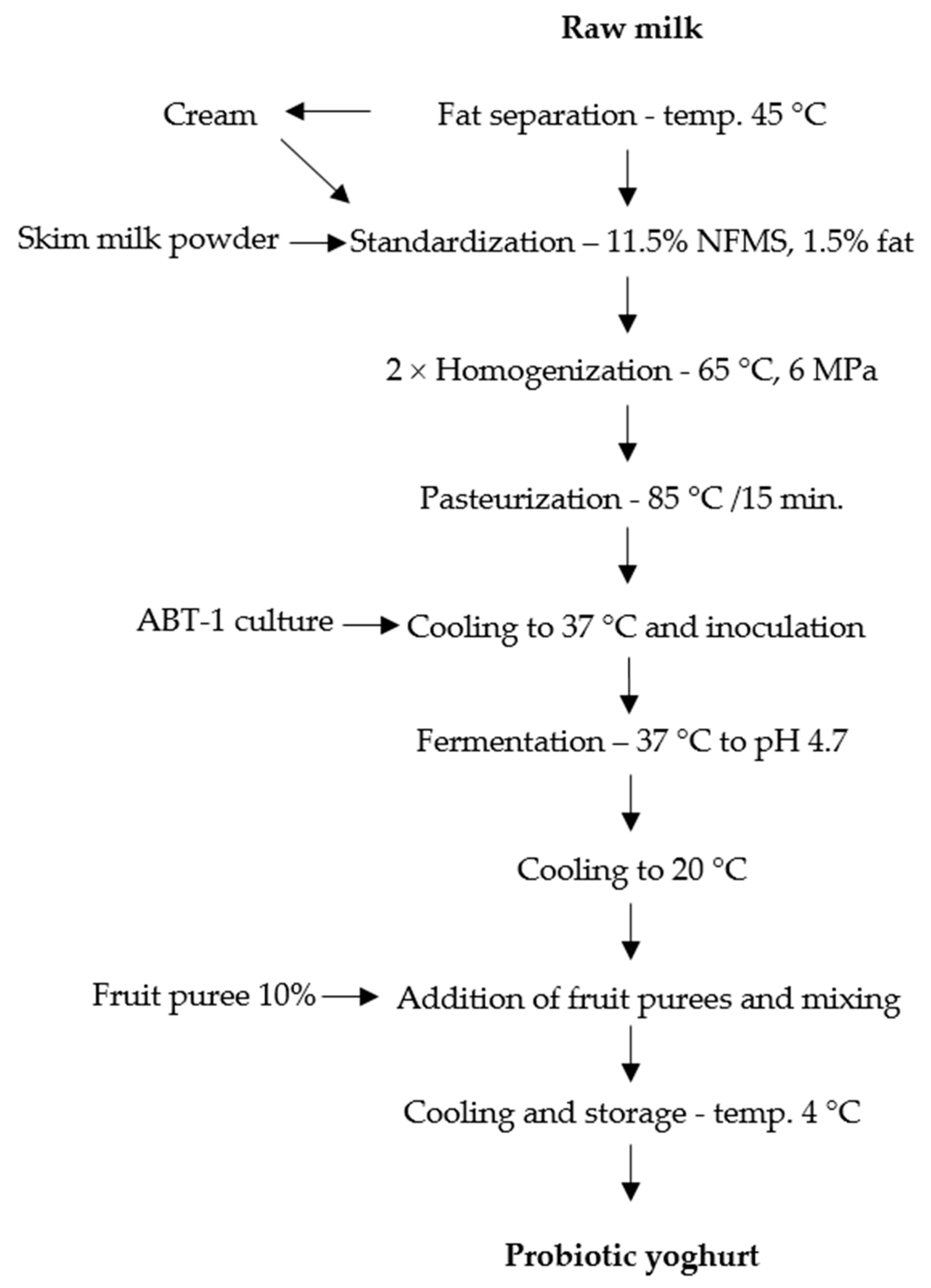
4.3. Production of Natural and Fruit Probiotic Yoghurts
- Natural (plain) probiotic yoghurt without any fruit additive (NPY);
- Probiotic yoghurt with 10% sea buckthorn fruit puree (SBPY);
- Probiotic yoghurt with 10% elderberry puree (EPY);
- Probiotic yoghurt with 10% sloe fruit puree (SPY).
4.4. Methods
4.4.1. Chemical Composition
4.4.2. Acidity
4.4.3. Antioxidant Capacity
4.4.4. Total Phenolic Content (TPC)
4.4.5. Total Monomeric Anthocyanin Content (TMAC)
4.4.6. HPLC Analysis of Phenolic Acids and Flavonoids in Fruit Purees
4.4.7. Microbiological Analyses
4.4.8. Acetaldehyde and Diacetyl Contents in Probiotic Yoghurts
4.4.9. Textural Studies
4.4.10. Susceptibility to Syneresis
4.4.11. Color Profile
4.4.12. Sensory Analysis
4.5. Experimental Design and Statistical Analysis
5. Conclusions
Author Contributions
Funding
Data Availability Statement
Acknowledgments
Conflicts of Interest
Sample Availability
References
- Aryana, K.J.; Olson, D.W. A 100-year review: Yoghurt and other cultured dairy products. J. Dairy Sci. 2017, 100, 9987–10013. [Google Scholar] [CrossRef]
- Tamime, A.Y.; Robinson, R.K. Yoghurt Science and Technology, 2nd ed.; Woodhead Publishing Ltd.: Cambridge, UK, 1999. [Google Scholar]
- O’Rell, K.R.; Chandan, R.C. Yogurt: Fruit preparations and flavoring materials. In Manufacturing Yogurt and Fermented Milks; Chandan, R.C., White, C.H., Kilara, A., Hui, Y.H., Eds.; Blackwell Publishing: Hoboken, NJ, USA, 2006; pp. 151–166. [Google Scholar] [CrossRef]
- Selvamuthukumaran, M.; Farhath, K. Evaluation of shelf stability of antioxidant rich seabuckthorn fruit yoghurt. Int. Food Res. J. 2014, 21, 759–765. [Google Scholar]
- Selvamuthukumaran, M.; Khanum, F. Optimization of seabuckthorn fruit yogurt formulation using response surface methodology. J. Food Sci. Technol. 2015, 52, 831–839. [Google Scholar] [CrossRef] [PubMed][Green Version]
- Sidor, A.M.; Gutt, G.; Dabija, A.; Sanduleac, E.T.; Sidor, V. The effect of yogurt enrichment with sea buckthorn powder on its sensory acceptance, rheological, textural and physicochemical properties. In International Multidisciplinary Scientific GeoConference; SGEM: Sofia, Bulgaria, 2017; Volume 17, pp. 11117–11128. [Google Scholar] [CrossRef]
- Tifrea, A.; Tiţa, O.; Máthé, E.; Ketney, O. Physicochemical parameters of probiotic yoghurt with bioactive natural products from sea buckthorn. Acta Univ. Cibiniensis Ser. E Food Technol. 2013, 17, 27–38. [Google Scholar] [CrossRef]
- Da Silva, R.F.; Barreira, J.; Heleno, S.A.; Barros, L.; Calhelha, R.C.; Ferreira, I.C. Anthocyanin profile of elderberry juice: A natural-based bioactive colouring ingredient with potential food application. Molecules 2019, 24, 2359. [Google Scholar] [CrossRef]
- Szalóki-Dorkó, L.; Stéger-Máté, M.; Abrankó, L. Evaluation of colouring ability of main European elderberry (Sambucus nigra L.) varieties as potential resources of natural food colourants. Int. J. Food Sci. Technol. 2015, 50, 1317–1323. [Google Scholar] [CrossRef]
- Domínguez, R.; Zhang, L.; Rocchetti, G.; Lucini, L.; Pateiro, M.; Munekata, P.E.; Lorenzo, J.M. Elderberry (Sambucus nigra L.) as potential source of antioxidants. Characterization, optimization of extraction parameters and bioactive properties. Food Chem. 2020, 330, 127266. [Google Scholar] [CrossRef] [PubMed]
- Natić, M.; Pavlović, A.; Bosco, F.L.; Stanisavljević, N.; Zagorac, D.D.; Akšić, M.F.; Papetti, A. Nutraceutical properties and phytochemical characterization of wild Serbian fruits. Eur. Food Res. Technol. 2019, 245, 469–478. [Google Scholar] [CrossRef]
- Ürkek, B.; Şengül, M.; Akgül, H.İ.; Kotan, T.E. Antioxidant activity, physiochemical and sensory characteristics of ice cream incorporated with sloe berry (Prunus spinosa L.). Int. J. Food Eng. 2019, 15. [Google Scholar] [CrossRef]
- Bal, L.M.; Meda, V.; Naik, S.N.; Satya, S. Sea buckthorn berries: A potential source of valuable nutrients for nutraceuticals and cosmoceuticals. Food Res. Int. 2011, 44, 1718–1727. [Google Scholar] [CrossRef]
- Routray, W.; Mishra, H.N. Scientific and technical aspects of yogurt aroma and taste: A review. Compr. Rev. Food Sci. Food Saf. 2011, 10, 208–220. [Google Scholar] [CrossRef]
- Baranowska, M. Intensification of the synthesis of flavour compounds in yogurt by milk enrichment with their precursors. Pol. J. Food Nutr. Sci. 2006, 15, 5–11. [Google Scholar]
- Veberic, R.; Jakopic, J.; Stampar, F.; Schmitzer, V. European elderberry (Sambucus nigra L.) rich in sugars, organic acids, anthocyanins and selected polyphenols. Food Chem. 2009, 114, 511–515. [Google Scholar] [CrossRef]
- Cirlini, M.; Ricci, A.; Galaverna, G.; Lazzi, C. Application of lactic acid fermentation to elderberry juice: Changes in acidic and glucidic fractions. LWT 2020, 118, 108779. [Google Scholar] [CrossRef]
- Ricci, A.; Cirlini, M.; Levante, A.; Dall’Asta, C.; Galaverna, G.; Lazzi, C. Volatile profile of elderberry juice: Effect of lactic acid fermentation using L. plantarum, L. rhamnosus and L. casei strains. Food Res. Int. 2018, 105, 412–422. [Google Scholar] [CrossRef] [PubMed]
- Ranadheera, C.S.; Evans, C.A.; Adams, M.C.; Baines, S.K. Probiotic viability and physico-chemical and sensory properties of plain and stirred fruit yogurts made from goat’s milk. Food Chem. 2012, 135, 1411–1418. [Google Scholar] [CrossRef]
- Kailasapathy, K.; Harmstorf, I.; Phillips, M. Survival of Lactobacillus acidophilus and Bifidobacterium animalis ssp. lactis in stirred fruit yogurts. LWT 2008, 41, 1317–1322. [Google Scholar] [CrossRef]
- Meybodi, N.M.; Mortazavian, A.M.; Arab, M.; Nematollahi, A. Probiotic viability in yoghurt: A review of influencial factors. Int. Dairy J. 2020, 109, 1–10. [Google Scholar] [CrossRef]
- Sun-Waterhouse, D.; Zhou, J.; Wadhwa, S.S. Drinking yoghurts with berry polyphenols added before and after fermentation. Food Control 2013, 32, 450–460. [Google Scholar] [CrossRef]
- Gunenc, A.; Khoury, C.; Legault, C.; Mirrashed, H.; Rijke, J.; Hosseinian, F. Seabuckthorn as a novel prebiotic source improves probiotic viability in yogurt. LWT 2016, 66, 490–495. [Google Scholar] [CrossRef]
- Terpou, A.; Gialleli, A.I.; Bosnea, L.; Kanellaki, M.; Koutinas, A.A.; Castro, G.R. Novel cheese production by incorporation of sea buckthorn berries (Hippophae rhamnoides L.) supported probiotic cells. LWT 2017, 79, 616–624. [Google Scholar] [CrossRef]
- Terpou, A.; Papadaki, A.; Bosnea, L.; Kanellaki, M.; Kopsahelis, N. Novel frozen yogurt production fortified with sea buckthorn berries and probiotics. LWT 2019, 105, 242–249. [Google Scholar] [CrossRef]
- Qureshi, T.M.; Nadeem, M.; Ahmad, M.M.; Hussain, S.; Rehman, S.; Shaukat, A. Antioxidant potential of natural fruit flavored yogurt-a review. Pak. J. Agric. Res. 2017, 55, 85–99. [Google Scholar]
- Najgebauer-Lejko, D.; Sady, M. Estimation of the antioxidant activity of the commercially available fermented milks. Acta Sci. Pol. Technol. Aliment. 2015, 14, 387–396. [Google Scholar] [CrossRef]
- Zadernowski, R.; Naczk, M.; Czaplicki, S.; Rubinskiene, M.; Szałkiewicz, M. Composition of phenolic acids in sea buckthorn (Hippophae rhamnoides L.) berries. J. AOCS 2005, 82, 175–179. [Google Scholar] [CrossRef]
- Cosmulescu, S.; Trandafir, I.; Nour, V. Phenolic acids and flavonoids profiles of extracts from edible wild fuits and their antioxidant properties. Int. J. Food Prop. 2017, 20, 3124–3134. [Google Scholar] [CrossRef]
- Trigueros, L.; Wojdyło, A.; Sendra, E. Antioxidant activity and protein-polyphenol interactions in a pomegranate (Punica granatum L.) yoghurt. J. Agric. Food Chem. 2014, 62, 6417–6425. [Google Scholar] [CrossRef] [PubMed]
- Karaaslan, M.; Ozden, M.; Vardin, H.; Turkoglu, H. Phenolic fortification of yogurt using grape and callus extracts. LWT 2011, 44, 1065–1072. [Google Scholar] [CrossRef]
- Skrede, G.; Larsen, V.B.; Aaby, K.; Jørgensen, A.S.; Birkeland, S.E. Antioxidative properties of commercial fruit preparations and stability of bilberry and black currant extracts in milk products. J. Food Sci. 2004, 69, S351–S356. [Google Scholar] [CrossRef]
- Gao, X.; Ohlander, M.; Jeppsson, N.; Björk, L.; Trajkovski, V. Changes in antioxidant effects and their relationship to phytonutrients in fruits of sea buckthorn (Hippophae rhamnoides L.) during maturation. J. Agric. Food Chem. 2000, 48, 1485–1490. [Google Scholar] [CrossRef]
- Gawai, K.M.; Mudgal, S.P.; Prajapati, J.B. Stabilizers, colorants, and exopolysaccharides in yogurt. In Yogurt in Health and Disease Prevention; Shah, N., Ed.; Academic Press: London, UK, 2017; pp. 49–68. [Google Scholar]
- Du, X.; Myracle, A.D. Development and evaluation of kefir products made with aronia or elderberry juice: Sensory and phytochemical characteristics. Int. Food Res. J. 2018, 25, 1373–1383. [Google Scholar]
- Wrolstad, R.E.; Durst, R.W.; Lee, J. Tracking color and pigment changes in anthocyanin products. Trends Food Sci. Technol. 2005, 16, 423–428. [Google Scholar] [CrossRef]
- Ścibisz, I.; Ziarno, M.; Mitek, M. Color stability of fruit yogurt during storage. J. Food Sci. Technol. 2019, 56, 1997–2009. [Google Scholar] [CrossRef]
- Christaki, E. Hippophae rhamnoides L. (Sea Buckthorn): A potential source of nutraceuticals. Food Public Health 2012, 2, 69–72. [Google Scholar] [CrossRef]
- Sikora, E.; Bieniek, M.I.; Borczak, B. Composition and antioxidant properties of fresh and frozen stored blackthorn fruits (Prunus spinosa L.). Acta Sci. Pol. Technol. Aliment. 2013, 12, 365–372. [Google Scholar]
- Sánchez, L.; Pérez, M.D. Physical properties of dairy products. In Physical Properties of Foods: Novel Measurement Techniques and Applications; Arana, I., Ed.; CRC Press: Boca Raton, FL, USA, 2012; pp. 355–398. [Google Scholar]
- Amal, A.; Eman, A.; Nahla, S.Z. Fruit flavored yogurt: Chemical, functional and rheological properties. Int. J. Environ. Agric. Res. 2016, 2, 57–66. [Google Scholar]
- Polish Standard: PN-75/A 86130. Mleko i Przetwory Mleczarskie—Napoje Mleczne—Metody Badań [Milk and Dairy Products—Fermented Milks—Analytical Methods]; Polski Komitet Normalizacyjny: Warszawa, Poland, 1975. (In Polish) [Google Scholar]
- Association of Official Analytical Chemists. Official Methods of Analysis, 14th ed.; Association of Official Analytical Chemists: Rockville, MD, USA, 1985; Volume 43, p. 399. [Google Scholar]
- Polish Standard: PN-A-86061:2002/Az1:2006. Mleko i Przetwory Mleczne—Mleko Fermentowane [Milk and Dairy Products—Fermented Milks]; Polski Komitet Normalizacyjny: Warszawa, Poland, 2006. (In Polish) [Google Scholar]
- Najgebauer-Lejko, D.; Sady, M.; Grega, T.; Walczycka, M. The impact of tea supplementation on microflora, pH and antioxidant capacity of yoghurt. Int. Dairy J. 2011, 21, 568–574. [Google Scholar] [CrossRef]
- Lee, J.; Durst, R.W.; Wrolstad, R.E. Determination of total monomeric anthocyanin pigment content of fruit juices, beverages, natural colorants, and wines by the pH differential method: Collaborative study. J. AOAC Int. 2005, 88, 1269–1278. [Google Scholar] [CrossRef]
- Klimczak, I.; Małecka, M.; Szlachta, M.; Gliszczyńska-Świgło, A. Effect of storage on the content of polyphenols, vitamin C and the antioxidant activity of orange juices. J. Food Compos. Anal. 2007, 20, 313–322. [Google Scholar] [CrossRef]
- ISO 7889/IDF 117. Yogurt—Enumeration of Characteristic Microorganisms-Colony-Count Technique at 37 Degrees C; International Dairy Federation: Brussels, Belgium, 2003. [Google Scholar]
- IDF Standard 149A. Dairy Starter Cultures of Lactic Acid Bacteria (LAB). Standardof Identity; International Dairy Federation: Brussels, Belgium, 1997. [Google Scholar]
- Dave, R.I.; Shah, N.P. Evaluation of media for selective enumeration of Streptococcus thermophilus, Lactobacillus delbrueckii ssp. bulgaricus, Lactobacillus acidophilus, and bifidobacteria. J. Dairy Sci. 1996, 79, 1529–1536. [Google Scholar] [CrossRef]
- IDF 94:2004. Milk and Milk Products—Enumeration of Colony-Forming Units of Yeasts And/Or Moulds—Colony-Count Technique at 25 Degrees C; International Dairy Federation: Brussels, Belgium, 2004. [Google Scholar]
- Lees, G.J.; Jago, G.R. Methods for the estimation of acetaldehyde in cultured dairy products. Aust. J. Dairy Technol. 1969, 24, 181–185. [Google Scholar]
- Pien, J. Etude de beurre. Tech. Lait. 1974, 29, 813–821. [Google Scholar]

| Phenolic Compound | Type of Fruit Puree | ||
|---|---|---|---|
| Sea Buckthorn Berry | Elderberry | Sloe Berry | |
| TPC (mg GAE/100 g DW) | 740.59 ± 0.38 a | 1617.03 ± 2.44 c | 1065.26 ± 22.78 b |
| TMAC (mg CGE/100 g DW) | 81.65 ± 3.78 a | 301.98 ± 1.81 b | 312.03 ± 44.31 b |
| Caffeic acid (mg/100 g DW) | 325.75 ± 3.07 c | 11.34 ± 0.39 a | 100.39 ±1.88 b |
| p-Coumaric acid (mg/100 g DW) Salicylic acid (mg/100 g DW) | 65.45 ± 2.33 c 740.64 ± 26.88 | 2.22 ± 0.23a nd | 7.18 ± 0.09 b nd |
| Ferulic acid (mg/100 g DW) | 306.55 ± 15.99 b | nd | 4.11 ± 0.10 a |
| Chlorogenic acid (mg/100 g DW) | 450.82 ± 16.59 b | nd | 144.98 ± 1.32 a |
| t-Cinnamic acid (mg/100 g DW) | 51.28 ± 1.58 | nd | nd |
| Myricetin (mg/100 g DW) | 51.08 ± 3.42 b | nd | 14.39 ± 0.11 a |
| Quercetin (mg/100 g DW) | nd | 1.42 ± 0.04 | nd |
| Rutin (mg/100 g DW) | nd | 98.77 ± 3.66 | nd |
| (−)-Epicatechin (mg /100 g DW) | 1237.13 ± 48.00 | nd | nd |
| (+)-Catechin (mg/100 g DW) | nd | 176.06 ± 2.64 | nd |
| Component | Yoghurt Type | |||
|---|---|---|---|---|
| Natural | Sea Buckthorn Fruit | Elderberry | Sloe Berry | |
| Total solids | 14.07 ± 0.72 a | 16.08 ± 0.51 b | 16.14 ± 0.55 b | 16.08 ± 1.45 b |
| Protein | 4.61 ± 0.18 a | 4.23 ± 0.19 a | 4.38 ± 0.57 a | 4.13 ± 0.43 a |
| Fat | 1.59 ± 0.11 b | 1.63 ± 0.11 b | 1.58 ± 0.15 b | 1.28 ± 0.12 a |
| Carbohydrates | 6.37 ± 0.31 a | 9.22 ± 0.17 b | 9.13 ± 0.40 b | 9.64 ± 0.16 b |
| Fiber | 0.18 ± 0.00 a | 0.40 ± 0.00 b | 0.42 ± 0.00 c | 1.15 ± 0.00 d |
| Ash | 1.08 ± 0.02 c | 0.98 ± 0.02 a | 1.04 ± 0.02 b | 1.03 ± 0.02 b |
| Parameter | Storage Time (Day) | Natural Yoghurt | Sea Buckthorn Fruit Yoghurt | Elderberry Yoghurt | Sloe Berry Yoghurt |
|---|---|---|---|---|---|
| TPC (mg GAE/100 g) | 1 | 0.00 ± 0.00 a | 636.35 ± 0.21 c | 998.40 ± 5.37 i | 871.75 ± 1.34 g |
| 15 | 0.00 ± 0.00 a | 545.25 ± 13.79 b | 908.00 ± 0.42 h | 790.55 ± 0.77 f | |
| 29 | 0.18 ± 0.18 a | 558.80 ± 5.66 b | 724.70 ± 5.51 e | 685.00 ± 0.84 d | |
| TMAC (mg CGE/100 g) | 1 | 0.15 ± 0.14 a | 2.34 ± 1.45 ab | 13.37 ± 1.88 c | 9.96 ± 0.00 cd |
| 15 | 0.06 ± 0.08 a | 2.26 ± 0.11 ab | 14.13 ± 2.42 c | 8.56 ± 1.06 de | |
| 29 | 0.00 ± 0.00 a | 2.15 ± 0.22 ab | 12.19 ± 1.46 cd | 4.77 ± 0.41 be | |
| FRAP (mMFe2+/kg) | 1 | 1.82 ± 0.67 a | 1.73 ± 0.23 a | 7.77 ± 1.65 b | 7.45 ± 2.72 b |
| 15 | 2.61 ± 0.76 a | 2.07 ± 0.67 a | 9.33 ± 2.17 b | 8.26 ± 1.32 b | |
| 29 | 2.06 ± 1.34 a | 2.01 ± 0.56 a | 9.33 ± 2.14 b | 7.83 ± 2.30 b | |
| ARP (mMTE/kg) | 1 | 0.34 ± 0.14 a | 0.78 ± 0.67 a | 3.98 ± 1.31 b | 6.85 ± 2.15 d |
| 15 | 0.37 ± 0.32 a | 0.74 ± 0.48 a | 3.48 ± 0.69 b | 4.92 ± 0.86 bc | |
| 29 | 0.34 ± 0.15 a | 0.72 ± 0.32 a | 3.20 ± 0.45 b | 6.10 ± 1.25 cd | |
| Titratable acidity (% lactic acid) | 1 | 0.81 ± 0.18 a | 1.15 ± 0.06 c | 0.95 ± 0.02 ab | 1.11 ± 0.07 bc |
| 15 | 0.97 ± 0.10 abc | 1.15 ± 0.08 bc | 1.02 ± 0.01 bc | 1.06 ± 0.12 bc | |
| 29 | 1.06 ± 0.06 bc | 1.12 ± 0.03 bc | 1.02 ± 0.06 bc | 1.10 ± 0.06 bc | |
| pH | 1 | 4.69 ± 0.07 c | 4.34 ± 0.08 a | 4.64 ± 0.07 bc | 4.47 ± 0.09 abc |
| 15 | 4.54 ± 0.07 abc | 4.32 ± 0.07 a | 4.56 ± 0.08 abc | 4.44 ± 0.09 abc | |
| 29 | 4.44 ± 0.11 a | 4.31 ± 0.11 a | 4.41 ± 0.11 abc | 4.38 ± 0.18 ab | |
| Lb. acidophilus (log cfu/g) | 1 | 7.70 ± 0.43 a | 7.71 ± 0.49 a | 7.65 ± 0.40 a | 7.70 ± 0.40 a |
| 15 | 8.07 ± 0.33 a | 7.68 ± 0.56 a | 7.86 ± 0.43 a | 7.75 ± 0.53 a | |
| 29 | 7.62 ± 0.82 a | 7.70 ± 0.40 a | 7.89 ± 0.51 a | 8.01 ± 0.34 a | |
| Bifidobacterium animalis ssp. lactis (log cfu/g) | 1 | 6.32 ± 0.24 a | 6.37 ± 0.22 a | 6.32 ± 0.56 a | 6.32 ± 0.38 a |
| 15 | 6.44 ± 0.50 a | 6.35 ± 0.50 a | 6.35 ± 0.45 a | 6.32 ± 0.44 a | |
| 29 | 6.05 ± 0.19 a | 6.47 ± 0.46 a | 6.31 ± 0.44 a | 6.37 ± 0.42 a | |
| Str. thermophillus (log cfu/g) | 1 | 8.22 ± 0.49 a | 8.20 ± 0.15 a | 8.10 ± 0.31 a | 8.45 ± 0.25 a |
| 15 | 8.43 ± 0.25 a | 8.38 ± 0.40 a | 8.17 ± 0.11 a | 8.32 ± 0.27 a | |
| 29 | 8.31 ± 0.05 a | 8.52 ± 0.52 a | 8.33 ± 0.31 a | 8.47 ± 0.50 a | |
| Diacetyl (mg/100 g) | 1 | 2.44 ± 1.28 a | 3.91 ± 0.73 ab | 4.52 ± 2.43 ab | 3.45 ± 1.67 ab |
| 15 | 4.19 ± 1.39 ab | 5.06 ± 0.99 abc | 7.80 ± 0.22 c | 5.72 ± 0.19 bc | |
| 29 | 3.51 ± 1.21 ab | 5.37 ± 1.51 abc | 7.77 ± 1.14 c | 5.75 ± 0.92 bc | |
| Acetaldehyde (mg/100 mL) | 1 | 3.83 ± 0.18 abc | 4.51 ± 0.29 abc | 3.16 ± 0.63 ab | 2.38 ± 0.66 a |
| 15 | 4.36 ± 1.75 abc | 6.73 ± 0.76 c | 4.61 ± 1.45 abc | 3.29 ± 2.05 ab | |
| 29 | 4.72 ± 1.61 abc | 5.73 ± 0.60 bc | 4.23 ± 0.23 abc | 5.98 ± 2.36 bc |
| Parameter | Storage Time (Day) | Natural Yoghurt | Sea Buckthorn Fruit Yoghurt | Elderberry Yoghurt | Sloe Berry Yoghurt |
|---|---|---|---|---|---|
| Firmness (N) | 1 | 1.60 ± 0.04 a | 1.26 ± 0.15 a | 1.21 ± 0.36 a | 1.67 ± 0.01 a |
| 15 | 2.03 ± 0.76 a | 1.35 ± 0.20 a | 1.39 ± 0.12 a | 1.95 ± 0.29 a | |
| 29 | 2.14 ± 0.16 a | 1.52 ± 0.02 a | 1.45 ± 0.12 a | 1.90 ± 0.33 a | |
| Consistency (N⋅s) | 1 | 40.95 ± 0.56 a | 31.99 ± 3.05 a | 30.73 ± 10.10 a | 43.04 ± 0.16 a |
| 15 | 49.00 ± 15.13 a | 34.49 ± 6.02 a | 36.24 ± 2.39 a | 50.70 ± 6.75 a | |
| 29 | 54.43 ± 3.82 a | 40.65 ± 0.73 a | 37.44 ± 5.00 a | 49.90 ± 8.35 a | |
| Cohesiveness (∣N∣) | 1 | 2.50 ± 0.20 bc | 1.52 ± 0.12 ab | 1.46 ± 0.58 ab | 1.78 ± 0.03 abc |
| 15 | 2.16 ± 0.46 abc | 1.32 ± 0.23 a | 1.50 ± 0.19 ab | 2.09 ± 0.31 abc | |
| 29 | 2.71 ± 0.27 c | 1.38 ± 0.00 ab | 1.45 ± 0.19 ab | 1.61 ± 0.28 abc | |
| Index of viscosity (∣N⋅s∣) | 1 | 6.46 ± 0.05 a | 4.50 ± 0.35 a | 4.23 ± 1.62 a | 5.28 ± 0.21 a |
| 15 | 5.57 ± 1.08 a | 3.72 ± 0.74 a | 4.28 ± 0.35 a | 5.61 ± 0.73 a | |
| 29 | 6.39 ± 0.01 a | 3.83 ± 0.26 a | 4.14 ± 0.54 a | 4.45 ± 0.77 a | |
| Syneresis (% vol) | 1 | 14.40 ± 5.73 a | 19.28 ± 1.80 ab | 29.25 ± 3.72 b | 25.77 ± 4.32 b |
| 15 | 19.47 ± 3.44 ab | 21.13 ± 1.06 ab | 23.23 ± 4.63 ab | 20.58 ± 1.99 ab | |
| 29 | 21.52 ± 10.40 ab | 21.02 ± 5.54 ab | 28.50 ± 2.87 b | 24.08 ± 8.15 ab | |
| L* | 1 | 93.49 ± 0.25 d | 87.20 ± 1.31 c | 57.94 ± 0.21 a | 65.75 ± 3.24 b |
| 15 | 93.20 ± 0.15 d | 87.02 ± 0.29 c | 57.46 ± 0.65 a | 65.12 ± 2.16 b | |
| 29 | 93.60 ± 0.50 d | 87.02 ± 0.46 c | 57.59 ± 0.38 a | 65.33 ± 2.61 b | |
| a* | 1 | −2.22 ± 0.06 a | 5.73 ± 0.82 b | 15.83 ± 1.25 cd | 13.74 ± 2.67 c |
| 15 | −2.15 ± 0.20 a | 5.69 ± 0.34 b | 16.26 ± 2.07 cd | 15.63 ± 3.78 cd | |
| 29 | −2.07 ± 0.13 a | 5.87 ± 0.30 b | 16.88 ± 1.74 d | 15.16 ± 3.83 cd | |
| b* | 1 | 10.95 ± 0.21 b | 26.48 ± 2.86 c | −2.35 ± 0.51 a | −2.02 ± 2.44 a |
| 15 | 11.14 ± 0.04 b | 26.04 ± 0.86 c | −1.84 ± 0.53 a | −2.63 ± 2.88 a | |
| 29 | 11.36 ± 0.03 b | 26.13 ± 0.49 c | −1.66 ± 0.43 a | −2.63 ± 2.97 a | |
| h | 1 | 101.49 ± 0.31 b | 77.83 ± 0.52 a | 351.62 ± 1.19 c | 353.01 ± 7.56 c |
| 15 | 100.57 ± 0.82 b | 77.65 ± 1.08 a | 353.64 ± 1.05 c | 351.24 ± 4.88 c | |
| 29 | 100.32 ± 0.67 b | 77.33 ± 0.76 a | 354.46 ± 0.91 c | 351.10 ± 4.50 c | |
| C | 1 | 11.18 ± 0.22 a | 27.10 ± 2.97 c | 16.00 ± 1.31 b | 14.00 ± 3.05 ab |
| 15 | 11.34 ± 0.07 a | 26.66 ± 0.78 c | 16.37 ± 2.12 b | 15.93 ± 2.09 b | |
| 29 | 11.55 ± 0.01 a | 26.79 ± 0.45 c | 16.96 ± 1.77 b | 15.44 ± 2.56 b |
Publisher’s Note: MDPI stays neutral with regard to jurisdictional claims in published maps and institutional affiliations. |
© 2021 by the authors. Licensee MDPI, Basel, Switzerland. This article is an open access article distributed under the terms and conditions of the Creative Commons Attribution (CC BY) license (https://creativecommons.org/licenses/by/4.0/).
Share and Cite
Najgebauer-Lejko, D.; Liszka, K.; Tabaszewska, M.; Domagała, J. Probiotic Yoghurts with Sea Buckthorn, Elderberry, and Sloe Fruit Purees. Molecules 2021, 26, 2345. https://doi.org/10.3390/molecules26082345
Najgebauer-Lejko D, Liszka K, Tabaszewska M, Domagała J. Probiotic Yoghurts with Sea Buckthorn, Elderberry, and Sloe Fruit Purees. Molecules. 2021; 26(8):2345. https://doi.org/10.3390/molecules26082345
Chicago/Turabian StyleNajgebauer-Lejko, Dorota, Katarzyna Liszka, Małgorzata Tabaszewska, and Jacek Domagała. 2021. "Probiotic Yoghurts with Sea Buckthorn, Elderberry, and Sloe Fruit Purees" Molecules 26, no. 8: 2345. https://doi.org/10.3390/molecules26082345
APA StyleNajgebauer-Lejko, D., Liszka, K., Tabaszewska, M., & Domagała, J. (2021). Probiotic Yoghurts with Sea Buckthorn, Elderberry, and Sloe Fruit Purees. Molecules, 26(8), 2345. https://doi.org/10.3390/molecules26082345


