Ultralong π-Conjugated Bis(terpyridine)metal Polymer Wires Covalently Bound to a Carbon Electrode: Fast Redox Conduction and Redox Diode Characteristics


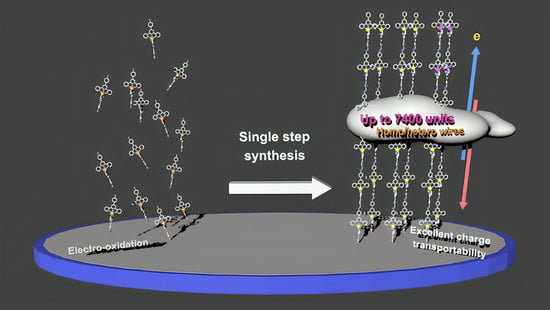
Abstract
Share and Cite
Wu, K.-H.; Sakamoto, R.; Maeda, H.; Phua, E.J.H.; Nishihara, H. Ultralong π-Conjugated Bis(terpyridine)metal Polymer Wires Covalently Bound to a Carbon Electrode: Fast Redox Conduction and Redox Diode Characteristics. Molecules 2021, 26, 4267. https://doi.org/10.3390/molecules26144267
Wu K-H, Sakamoto R, Maeda H, Phua EJH, Nishihara H. Ultralong π-Conjugated Bis(terpyridine)metal Polymer Wires Covalently Bound to a Carbon Electrode: Fast Redox Conduction and Redox Diode Characteristics. Molecules. 2021; 26(14):4267. https://doi.org/10.3390/molecules26144267
Chicago/Turabian StyleWu, Kuo-Hui, Ryota Sakamoto, Hiroaki Maeda, Eunice Jia Han Phua, and Hiroshi Nishihara. 2021. "Ultralong π-Conjugated Bis(terpyridine)metal Polymer Wires Covalently Bound to a Carbon Electrode: Fast Redox Conduction and Redox Diode Characteristics" Molecules 26, no. 14: 4267. https://doi.org/10.3390/molecules26144267
APA StyleWu, K.-H., Sakamoto, R., Maeda, H., Phua, E. J. H., & Nishihara, H. (2021). Ultralong π-Conjugated Bis(terpyridine)metal Polymer Wires Covalently Bound to a Carbon Electrode: Fast Redox Conduction and Redox Diode Characteristics. Molecules, 26(14), 4267. https://doi.org/10.3390/molecules26144267