Article

High-Throughput Computational Search for Half-Metallic Oxides
by
Laalitha S. I. Liyanage
1,2,*,
Jagoda Sławińska
1,
Priya Gopal
1,
Stefano Curtarolo
3,4,
Marco Fornari
5 and
Marco Buongiorno Nardelli
1,*
1
Department of Physics, University of North Texas, Denton, TX 76203, USA
2
Faculty of Computing and Technology, University of Kelaniya, Kelaniya 11600, Sri Lanka
3
Center for Autonomous Materials Design, Duke University, Durham, NC 27708, USA
4
Materials Science, Electrical Engineering, Physics and Chemistry, Duke University, Durham, NC 27708, USA
5
Department of Physics, Central Michigan University, Mount Pleasant, MI 48859, USA
*
Authors to whom correspondence should be addressed.
Molecules 2020, 25(9), 2010; https://doi.org/10.3390/molecules25092010

Submission received: 8 April 2020 / Revised: 21 April 2020 / Accepted: 22 April 2020 / Published: 25 April 2020

Abstract

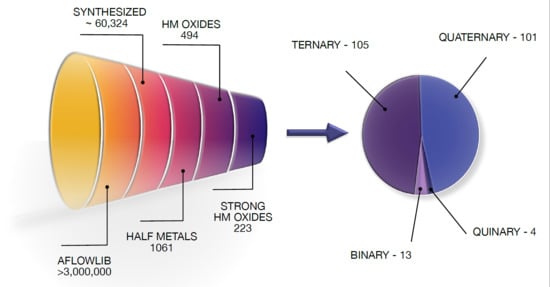
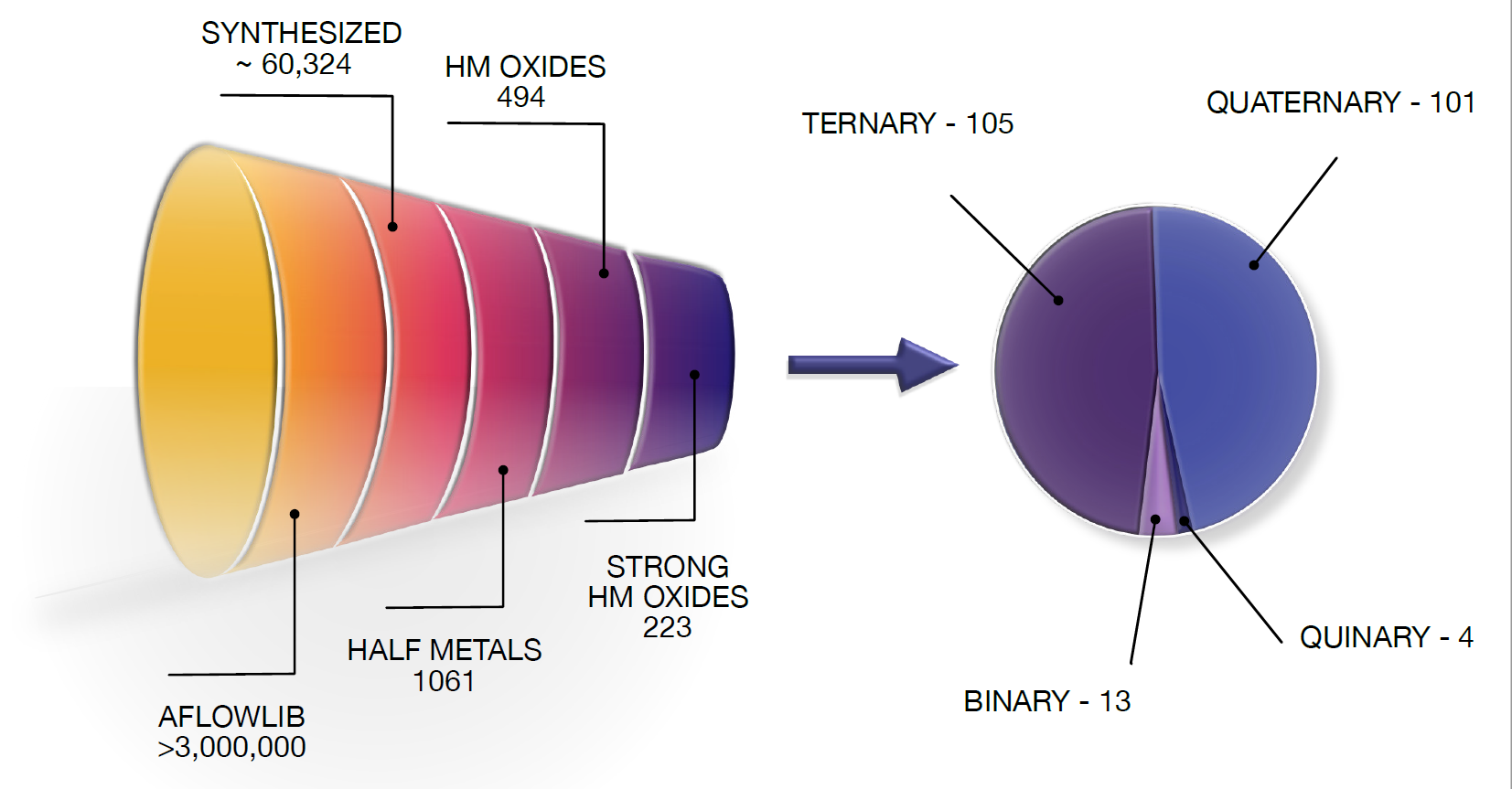
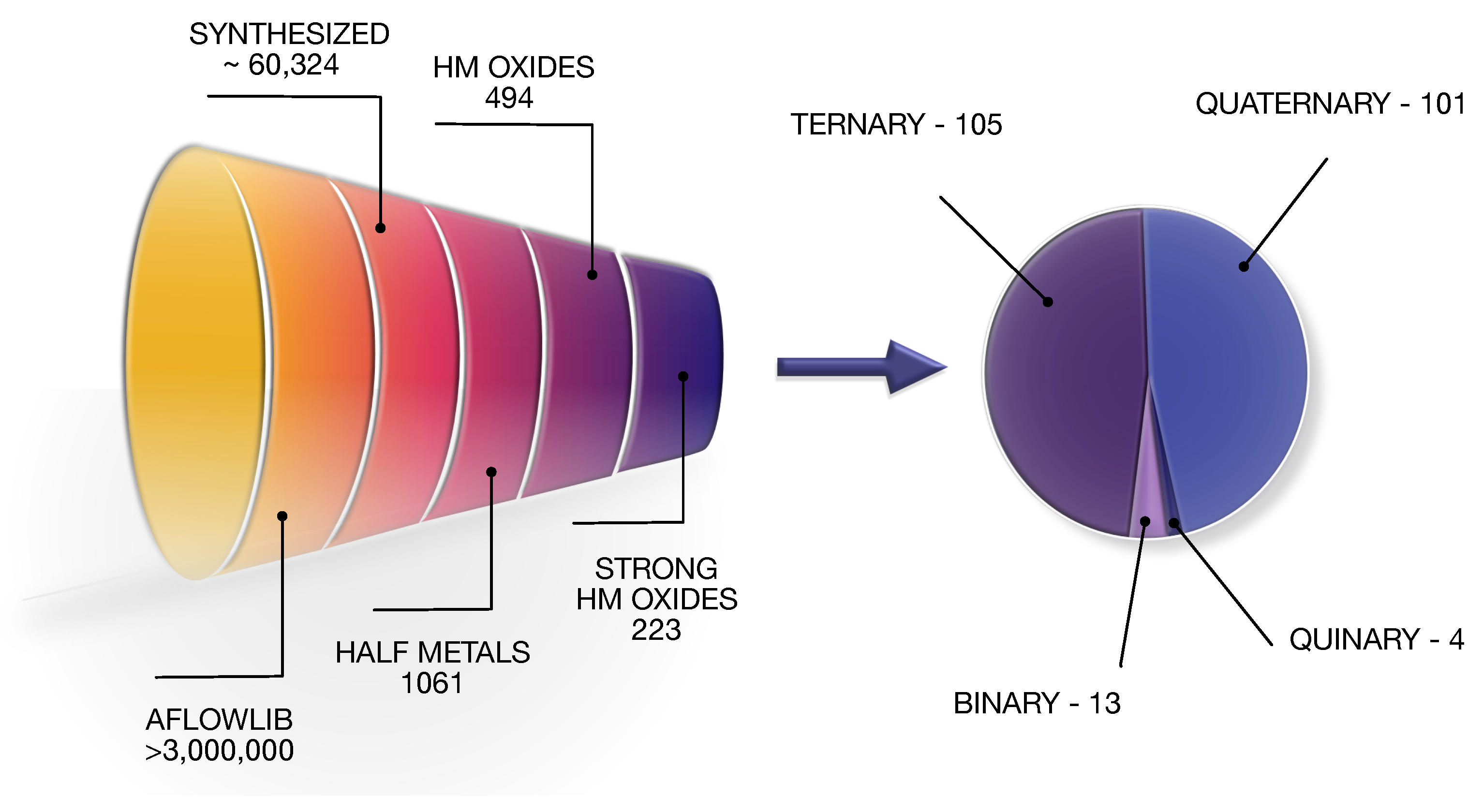
Half metals are a peculiar class of ferromagnets that have a metallic density of states at the Fermi level in one spin channel and simultaneous semiconducting or insulating properties in the opposite one. Even though they are very desirable for spintronics applications, identification of robust half-metallic materials is by no means an easy task. Because their unusual electronic structures emerge from subtleties in the hybridization of the orbitals, there is no simple rule which permits to select a priori suitable candidate materials. Here, we have conducted a high-throughput computational search for half-metallic compounds. The analysis of calculated electronic properties of thousands of materials from the inorganic crystal structure database allowed us to identify potential half metals. Remarkably, we have found over two-hundred strong half-metallic oxides; several of them have never been reported before. Considering the fact that oxides represent an important class of prospective spintronics materials, we have discussed them in further detail. In particular, they have been classified in different families based on the number of elements, structural formula, and distribution of density of states in the spin channels. We are convinced that such a framework can help to design rules for the exploration of a vaster chemical space and enable the discovery of novel half-metallic oxides with properties on demand.
Keywords: half metals; transition metal oxides; high-throughput search; aflowlib; spintronics half metals; transition metal oxides; high-throughput search; aflowlib; spintronics
Graphical Abstract