Review

Sunlight-Operated TiO2-Based Photocatalysts

by
Irene Barba-Nieto
1,
Uriel Caudillo-Flores
1,2,
Marcos Fernández-García
1,* and
Anna Kubacka
1,*
1
Instituto de Catálisis y Petroleoquímica (CSIC), C/Marie Curie 2, Cantoblanco, 28049 Madrid, Spain
2
Centro de Nanociencias y Nanotecnología, Universidad Nacional Autónoma de México, Ensenada 22800, Mexico
*
Authors to whom correspondence should be addressed.
Molecules 2020, 25(17), 4008; https://doi.org/10.3390/molecules25174008

Submission received: 22 July 2020 / Revised: 20 August 2020 / Accepted: 28 August 2020 / Published: 2 September 2020
(This article belongs to the Section Inorganic Chemistry)

Abstract

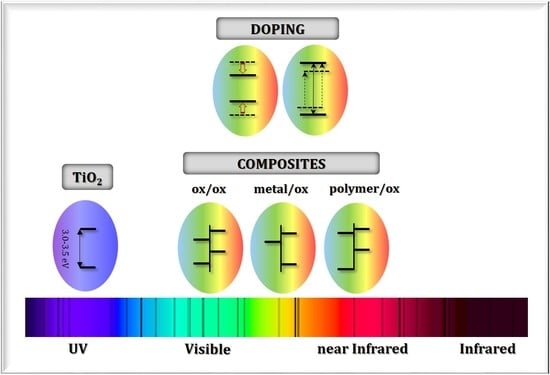
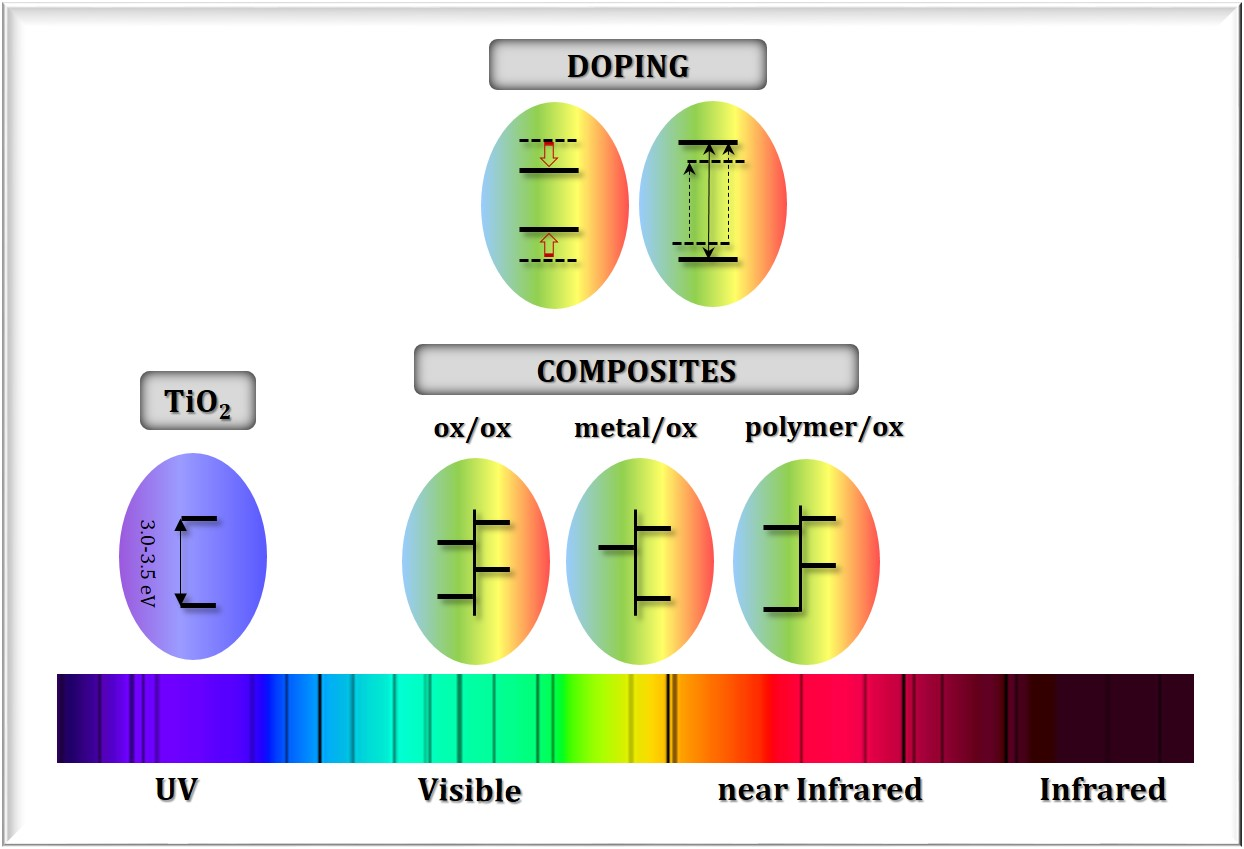
Photo-catalysis is a research field with broad applications in terms of potential technological applications related to energy production and managing, environmental protection, and chemical synthesis fields. A global goal, common to all of these fields, is to generate photo-catalytic materials able to use a renewable energy source such as the sun. As most active photocatalysts such as titanium oxides are essentially UV absorbers, they need to be upgraded in order to achieve the fruitful use of the whole solar spectrum, from UV to infrared wavelengths. A lot of different strategies have been pursued to reach this goal. Here, we selected representative examples of the most successful ones. We mainly highlighted doping and composite systems as those with higher potential in this quest. For each of these two approaches, we highlight the different possibilities explored in the literature. For doping of the main photocatalysts, we consider the use of metal and non-metals oriented to modify the band gap energy as well as to create specific localized electronic states. We also described selected cases of using up-conversion doping cations. For composite systems, we described the use of binary and ternary systems. In addition to a main photo-catalyst, these systems contain low band gap, up-conversion or plasmonic semiconductors, plasmonic and non-plasmonic metals and polymers.
Keywords: photocatalysts; titanium oxide; anatase; doping; composites; sunlight photocatalysts; titanium oxide; anatase; doping; composites; sunlight
Graphical Abstract