Chemical Reactivity Theory and Empirical Bioactivity Scores as Computational Peptidology Alternative Tools for the Study of Two Anticancer Peptides of Marine Origin




Abstract
1. Introduction
2. Computational Methodology
3. Results and Discussion
3.1. Calculation of Global Reactivity Descriptors
3.2. Determination of the Local Reactivity Descriptors
3.3. Calculation of the pKas of the Antimicrobial Peptides of Marine Origin and Quantification of the AGEs Inhibitor Ability
3.4. Bioactivity Scores
4. Conclusions
Author Contributions
Funding
Acknowledgments
Conflicts of Interest
References
- Mohammad, R.; Limvarapuss, C.; Wall, N.; Hamdy, N.; Beck, F.; Pettit, G.; Al-Katib, A. A new tubulin polymerization inhibitor, auristatin PE, induces tumor regression in a human waldenstrom’s macroglobulinemia xenograft model. Int. J. Oncol. 1999, 15, 367–439. [Google Scholar] [CrossRef] [Scilit] [PubMed]
- Toro-Labbé, A. (Ed.) Theoretical Aspects of Chemical Reactivity; Elsevier Science: Amsterdam, The Netherlands, 2007. [Google Scholar]
- Frau, J.; Glossman-Mitnik, D. Molecular reactivity and absorption properties of melanoidin blue-G1 through conceptual DFT. Molecules 2018, 23, 559. [Google Scholar] [CrossRef] [Scilit] [PubMed]
- Frau, J.; Glossman-Mitnik, D. Conceptual DFT study of the local chemical reactivity of the dilysyldipyrrolones A and B intermediate melanoidins. Theor. Chem. Acc. 2018, 137, 1210. [Google Scholar] [CrossRef] [Scilit]
- Frau, J.; Glossman-Mitnik, D. Conceptual DFT study of the local chemical reactivity of the colored BISARG melanoidin and its protonated derivative. Front. Chem. 2018, 6, 1–9. [Google Scholar] [CrossRef] [Scilit] [PubMed]
- Frau, J.; Glossman-Mitnik, D. Molecular reactivity of some maillard reaction products studied through conceptual DFT. Contemp. Chem. 2018, 1, 1–14. [Google Scholar]
- Frau, J.; Glossman-Mitnik, D. Computational study of the chemical reactivity of the blue-M1 intermediate melanoidin. Comput. Theor. Chem. 2018, 1134, 22–29. [Google Scholar] [CrossRef] [Scilit]
- Frau, J.; Glossman-Mitnik, D. Chemical reactivity theory applied to the calculation of the local reactivity descriptors of a colored maillard reaction product. Chem. Sci. Int. J. 2018, 22, 1–14. [Google Scholar] [CrossRef] [Scilit]
- Frau, J.; Glossman-Mitnik, D. Blue M2: An intermediate melanoidin studied via conceptual DFT. J. Mol. Model. 2018, 24, 1–13. [Google Scholar] [CrossRef] [Scilit]
- Frau, J.; Flores-Holguín, N.; Glossman-Mitnik, D. Chemical reactivity properties, pKa values, AGEs inhibitor abilities and bioactivity scores of the mirabamides A–H peptides of marine origin studied by means of conceptual DFT. Mar. Drugs 2018, 16, 302. [Google Scholar] [CrossRef] [Scilit]
- Frau, J.; Hernández-Haro, N.; Glossman-Mitnik, D. Computational prediction of the pKas of small peptides through conceptual DFT descriptors. Chem. Phys. Lett. 2017, 671, 138–141. [Google Scholar] [CrossRef] [Scilit]
- Frau, J.; Glossman-Mitnik, D. Chemical reactivity theory study of advanced glycation endproduct inhibitors. Molecules 2017, 22, 226. [Google Scholar] [CrossRef] [Scilit]
- Frisch, M.J.; Trucks, G.W.; Schlegel, H.B.; Scuseria, G.E.; Robb, M.A.; Cheeseman, J.R.; Scalmani, G.; Barone, V.; Mennucci, B.; Petersson, G.A.; et al. Gaussian 09 Revision E.01; Gaussian Inc.: Wallingford, UK, 2016. [Google Scholar]
- Peverati, R.; Truhlar, D.G. Screened-exchange density functionals with broad accuracy for chemistry and solid-state physics. Phys. Chem. Chem. Phys. 2012, 14, 16187–16191. [Google Scholar] [CrossRef] [Scilit]
- Weigend, F.; Ahlrichs, R. Balanced basis sets of split valence, triple zeta valence and quadruple zeta valence quality for H to Rn: Design and assessment of accuracy. Phys. Chem. Chem. Phys. 2005, 7, 3297–3305. [Google Scholar] [CrossRef] [Scilit]
- Weigend, F. Accurate Coulomb-fitting basis sets for H to R. Phys. Chem. Chem. Phys. 2006, 8, 1057–1065. [Google Scholar] [CrossRef] [Scilit]
- Marenich, A.; Cramer, C.; Truhlar, D. Universal solvation model based on solute electron density and a continuum model of the solvent defined by the bulk dielectric constant and stomic surface tensions. J. Phys. Chem. B 2009, 113, 6378–6396. [Google Scholar] [CrossRef] [Scilit]
- Halgren, T.A. Merck molecular force field. I. Basis, form, scope, parameterization, and performance of MMFF94. J. Comput. Chem. 1996, 17, 490–519. [Google Scholar] [CrossRef] [Scilit]
- Halgren, T.A. Merck molecular force field. II. MMFF94 van der Waals and electrostatic parameters for intermolecular interactions. J. Comput. Chem. 1996, 17, 520–552. [Google Scholar] [CrossRef] [Scilit]
- Halgren, T.A. MMFF VI. MMFF94s option for energy minimization studies. J. Comput. Chem. 1999, 20, 720–729. [Google Scholar] [CrossRef] [Scilit]
- Halgren, T.A.; Nachbar, R.B. Merck molecular force field. IV. Conformational energies and geometries for MMFF94. J. Comput. Chem. 1996, 17, 587–615. [Google Scholar] [CrossRef] [Scilit]
- Halgren, T.A. Merck molecular force field. V. Extension of MMFF94 using experimental data, additional computational data, and empirical rules. J. Comput. Chem. 1996, 17, 616–641. [Google Scholar] [CrossRef] [Scilit]
- Parr, R.; Yang, W. Density-Functional Theory of Atoms and Molecules; Oxford University Press: New York, NY, USA, 1989. [Google Scholar]
- Geerlings, P.; De Proft, F.; Langenaeker, W. Conceptual density functional theory. Chem. Rev. 2003, 103, 1793–1873. [Google Scholar] [CrossRef] [Scilit]
- Parr, R.; Szentpaly, L.; Liu, S. Electrophilicity index. J. Am. Chem. Soc. 1999, 121, 1922–1924. [Google Scholar] [CrossRef] [Scilit]
- Gázquez, J.; Cedillo, A.; Vela, A. Electrodonating and electroaccepting powers. J. Phys. Chem. 2007, 111, 1966–1970. [Google Scholar] [CrossRef] [Scilit]
- Chattaraj, P.; Chakraborty, A.; Giri, S. Net electrophilicity. J. Phys. Chem. 2009, 113, 10068–10074. [Google Scholar] [CrossRef] [Scilit]
- Morell, C.; Grand, A.; Toro-Labbé, A. New dual descriptor for chemical reactivity. J. Phys. Chem. 2005, 109, 205–212. [Google Scholar] [CrossRef] [Scilit]
- Morell, C.; Grand, A.; Toro-Labbé, A. Theoretical support for using the Δf(r) descriptor. Chem. Phys. Lett. 2006, 425, 342–346. [Google Scholar] [CrossRef] [Scilit]
- Martínez-Araya, J.I. Revisiting Caffeate’s capabilities as a complexation agent to silver cation in mining processes by means of the dual descriptor—A conceptual DFT approach. J. Mol. Model. 2012, 18, 4299–4307. [Google Scholar] [CrossRef] [Scilit]
- Martínez-Araya, J.I. Explaining reaction mechanisms using the dual descriptor: A complementary tool to the molecular electrostatic potential. J. Mol. Model. 2012, 19, 2715–2722. [Google Scholar] [CrossRef] [Scilit]
- Martínez-Araya, J.I. Why is the dual descriptor a more accurate local reactivity descriptor than Fukui functions? J. Math. Chem. 2015, 53, 451–465. [Google Scholar] [CrossRef] [Scilit]
- Ahmed, N. Advanced glycation endproducts—Role in pathology of diabetic complications. Diabetes Res. Clin. Pract. 2005, 67, 3–21. [Google Scholar] [CrossRef] [Scilit]
- Rahbar, S.; Figarola, J.L. Novel inhibitors of advanced glycation endproducts. Arch. Biochem. Biophys. 2003, 419, 63–79. [Google Scholar] [CrossRef] [Scilit]
- Peyroux, J.; Sternberg, M. Advanced glycation endproducts (AGEs): Pharmacological inhibition in diabetes. Pathol. Biol. 2006, 54, 405–419. [Google Scholar] [CrossRef] [Scilit]
- Domingo, L.R.; Perez, P. The nucleophilicity N index in organic chemistry. Org. Biomol. Chem. 2011, 9, 7168–7175. [Google Scholar] [CrossRef] [Scilit]
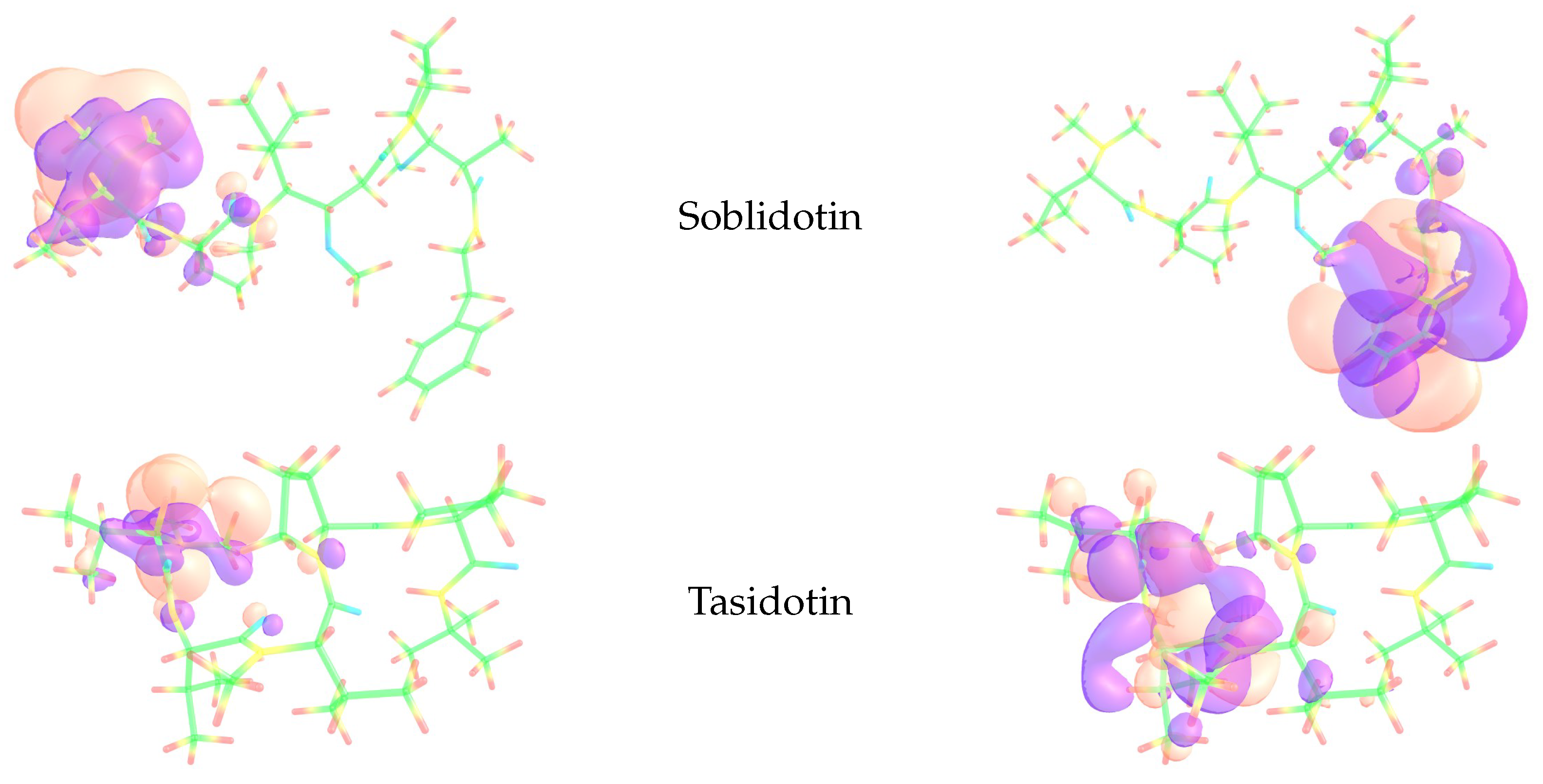

| Molecule | Total Electronic Energy | HOMO | LUMO | HOMO–LUMO Gap | |
|---|---|---|---|---|---|
| Soblidotin | −2250.5737 | −6.3060 | −0.7353 | 5.5707 | 223 |
| Tasidotin | −1958.1339 | −6.2790 | −0.6490 | 5.6300 | 220 |
| Molecule | Electronegativity | Global Hardness | Electrophilicity |
|---|---|---|---|
| Soblidotin | 3.5206 | 5.5707 | 1.1125 |
| Tasidotin | 3.4640 | 5.6300 | 1.0657 |
| Molecule | Electrodonating Power | Electroaccepting Power | Net Electrophilicity |
| Soblidotin | 4.3334 | 0.8128 | 5.1463 |
| tasidotin | 4.2152 | 0.7512 | 4.9964 |
| Molecule | pKa |
|---|---|
| Soblidotin | 11.70 |
| Tasidotin | 11.65 |
| Molecule | GPCR Ligand | Ion Channel Modulator | Kinase Inhibitor | Nuclear Receptor Ligand | Protease Inhibitor | Enzyme Inhibitor |
|---|---|---|---|---|---|---|
| Soblidotin | −0.30 | −1.30 | −1.07 | −1.34 | 0.19 | −0.83 |
| Tasidotin | 0.19 | −0.43 | −0.23 | 0.36 | 0.51 | −0.13 |
| Active | Moderately Active | Inactive |
|---|---|---|
| >0 | Between −5.0 and 0.0 | <−5.0 |
© 2019 by the authors. Licensee MDPI, Basel, Switzerland. This article is an open access article distributed under the terms and conditions of the Creative Commons Attribution (CC BY) license (http://creativecommons.org/licenses/by/4.0/).
Share and Cite
Frau, J.; Flores-Holguín, N.; Glossman-Mitnik, D. Chemical Reactivity Theory and Empirical Bioactivity Scores as Computational Peptidology Alternative Tools for the Study of Two Anticancer Peptides of Marine Origin. Molecules 2019, 24, 1115. https://doi.org/10.3390/molecules24061115
Frau J, Flores-Holguín N, Glossman-Mitnik D. Chemical Reactivity Theory and Empirical Bioactivity Scores as Computational Peptidology Alternative Tools for the Study of Two Anticancer Peptides of Marine Origin. Molecules. 2019; 24(6):1115. https://doi.org/10.3390/molecules24061115
Chicago/Turabian StyleFrau, Juan, Norma Flores-Holguín, and Daniel Glossman-Mitnik. 2019. "Chemical Reactivity Theory and Empirical Bioactivity Scores as Computational Peptidology Alternative Tools for the Study of Two Anticancer Peptides of Marine Origin" Molecules 24, no. 6: 1115. https://doi.org/10.3390/molecules24061115
APA StyleFrau, J., Flores-Holguín, N., & Glossman-Mitnik, D. (2019). Chemical Reactivity Theory and Empirical Bioactivity Scores as Computational Peptidology Alternative Tools for the Study of Two Anticancer Peptides of Marine Origin. Molecules, 24(6), 1115. https://doi.org/10.3390/molecules24061115