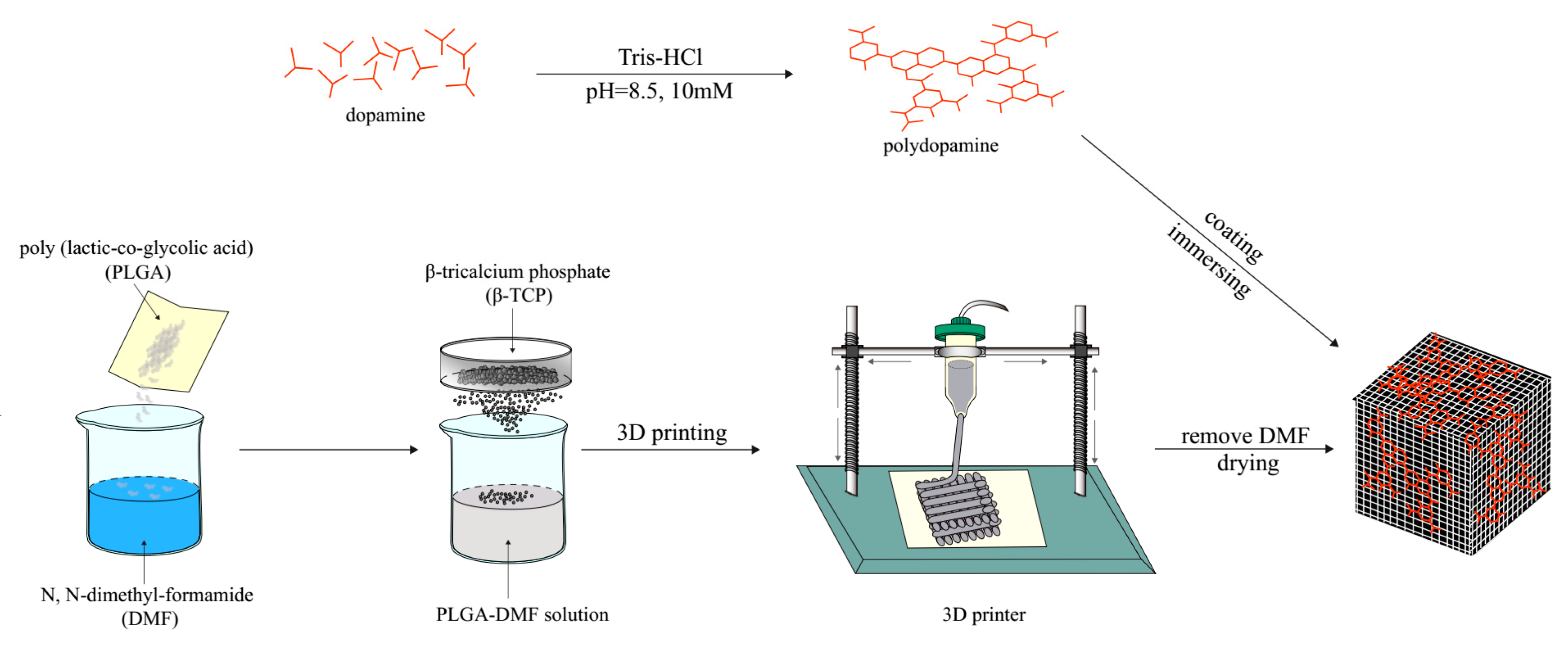
Poly(Dopamine) Coating on 3D-Printed Poly-Lactic-Co-Glycolic Acid/β-Tricalcium Phosphate Scaffolds for Bone Tissue Engineering

Abstract
Share and Cite
Xu, Z.; Wang, N.; Liu, P.; Sun, Y.; Wang, Y.; Fei, F.; Zhang, S.; Zheng, J.; Han, B. Poly(Dopamine) Coating on 3D-Printed Poly-Lactic-Co-Glycolic Acid/β-Tricalcium Phosphate Scaffolds for Bone Tissue Engineering. Molecules 2019, 24, 4397. https://doi.org/10.3390/molecules24234397
Xu Z, Wang N, Liu P, Sun Y, Wang Y, Fei F, Zhang S, Zheng J, Han B. Poly(Dopamine) Coating on 3D-Printed Poly-Lactic-Co-Glycolic Acid/β-Tricalcium Phosphate Scaffolds for Bone Tissue Engineering. Molecules. 2019; 24(23):4397. https://doi.org/10.3390/molecules24234397
Chicago/Turabian StyleXu, Zhimin, Ningning Wang, Peng Liu, Yidan Sun, Yumeng Wang, Fan Fei, Shichen Zhang, Jianying Zheng, and Bing Han. 2019. "Poly(Dopamine) Coating on 3D-Printed Poly-Lactic-Co-Glycolic Acid/β-Tricalcium Phosphate Scaffolds for Bone Tissue Engineering" Molecules 24, no. 23: 4397. https://doi.org/10.3390/molecules24234397
APA StyleXu, Z., Wang, N., Liu, P., Sun, Y., Wang, Y., Fei, F., Zhang, S., Zheng, J., & Han, B. (2019). Poly(Dopamine) Coating on 3D-Printed Poly-Lactic-Co-Glycolic Acid/β-Tricalcium Phosphate Scaffolds for Bone Tissue Engineering. Molecules, 24(23), 4397. https://doi.org/10.3390/molecules24234397