Article

Effect of Cross-Linking and Enzymatic Hydrolysis Composite Modification on the Properties of Rice Starches

1
National Engineering Laboratory for Rice and By-product Further Processing, Central South University of Forestry & Technology, Changsha 410004, China
2
Faculty of Food Science and Engineering, Central South University of Forestry & Technology, Changsha 410004, China
3
College of Life Science and Technology, Central South University of Forestry & Technology, Changsha 410004, China
*
Author to whom correspondence should be addressed.
Molecules 2012, 17(7), 8136-8146; https://doi.org/10.3390/molecules17078136

Submission received: 3 May 2012 / Revised: 22 June 2012 / Accepted: 3 July 2012 / Published: 6 July 2012

Abstract

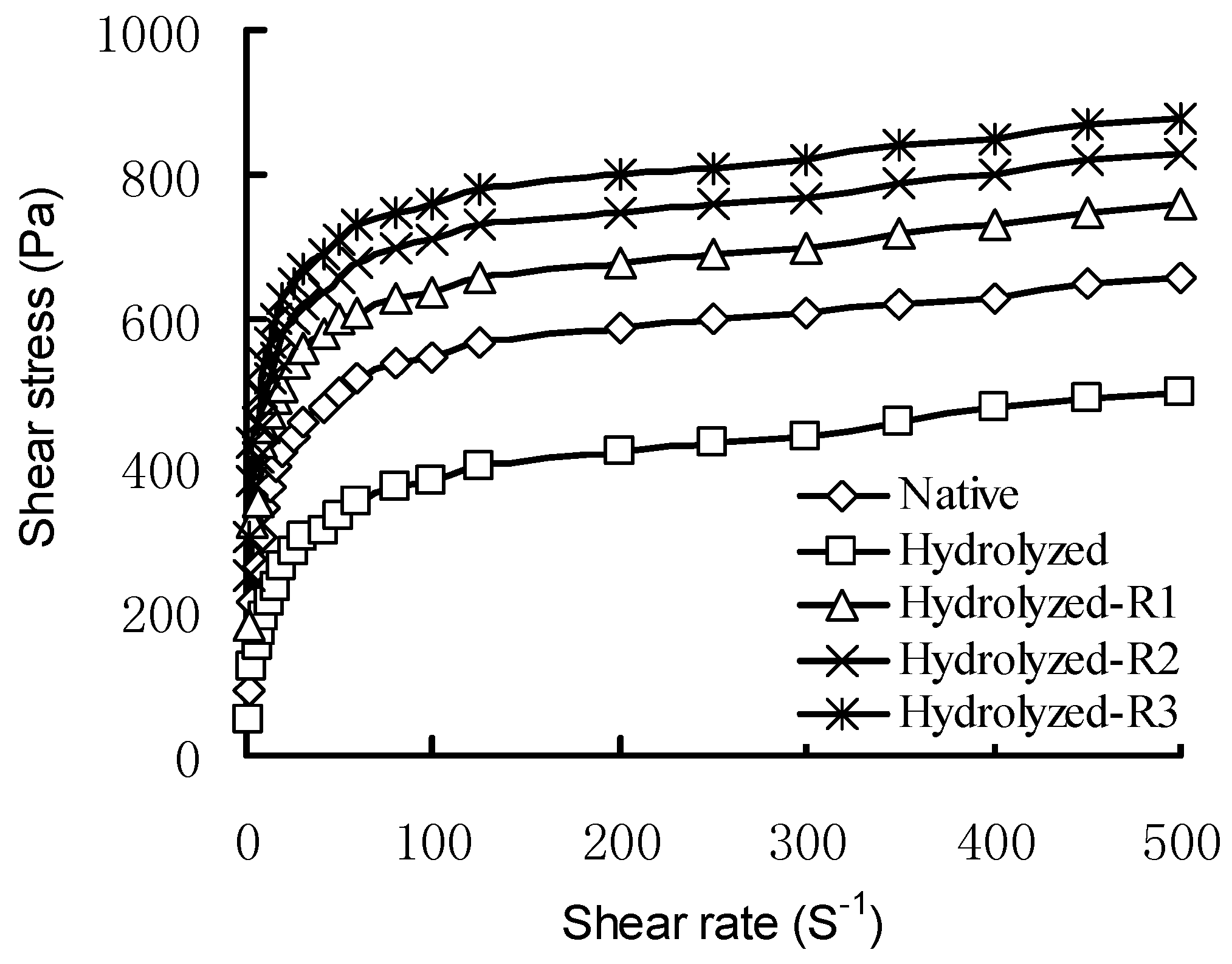
Native rice starch lacks the versatility necessary to function adequately under rigorous industrial processing, so modified starches are needed to meet the functional properties required in food products. This work investigated the impact of enzymatic hydrolysis and cross-linking composite modification on the properties of rice starches. Rice starch was cross-linked with epichlorohydrin (EPI) with different concentrations (0.5%, 0.7%, 0.9% w/w, on a dry starch basis), affording cross-linked rice starches with the three different levels of cross-linking that were named R1, R2, and R3, respectively. The cross-linked rice starches were hydrolyzed by α-amylase and native, hydrolyzed, and hydrolyzed cross-linked rice starches were comparatively studied. It was found that hydrolyzed cross-linked rice starches showed a lower the degree of amylase hydrolysis compared with hydrolyzed rice starch. The higher the degree of cross-linking, the higher the capacity to resist enzyme hydrolysis. Hydrolyzed cross-linked rice starches further increased the adsorptive capacities of starches for liquids and decreased the trend of retrogradation, and it also strengthened the capacity to resist shear compared to native and hydrolyzed rice starches.
Keywords: rice starch; cross-linking; enzymatic hydrolysis; hydrolyzed rice starch; cross-linked rice starch rice starch; cross-linking; enzymatic hydrolysis; hydrolyzed rice starch; cross-linked rice starch