Abstract
A new and efficient method for the synthesis of 1-(2,6-dichloro-4-trifluoro-methylphenyl)-4-alkyl-1H-[1,2,3]-triazoles by the room temperature 1,3-dipolar cycloaddition of (2-azido-1,3-dichloro-5-trifluoromethyl)benzene with terminal alkynes in the presence of Cu (I) salt as catalyst is reported. All the reactions gave 1,4-disubstituted products with high regioselectivity, as no 1,5-disubstituted product was formed. The structures of all the title compounds have been confirmed by elemental analysis, 1H- and 13C-NMR and in addition, the structure of compound 5a was investigated by X-ray crystallography.
Introduction
[1,2,3]-Triazoles have found wide use in pharmaceuticals, agrochemicals, dyes, photographic materials and corrosion inhibition, etc. [1]. For example, there are numerous examples in the literature of the biological activity of triazole compounds, including anti-HIV activity [2], antimicrobial activity against Gram positive bacteria [3] and selective β3 adrenergic receptor agonism [4]. Several methods have been described for the synthesis of [1,2,3]-triazoles. Among them, the most important and useful one is the 1,3-dipolar cycloaddition of azides with alkynes [5]. However, this reaction suffers from some drawbacks, usually needs elevated temperature and also forms a mixture of 1,4 and 1,5 regioisomers when unsymmetrical alkynes are used.
It has been known for some time that fluorine atom can lead to unexpected biological activity results arising due to the special properties of the fluorine atom, such as the highest electonegativity of fluorine and high carbon-fluorine bond energy [6]. As a consequence, trifluoromethyl-containing molecules have seen considerable utilization in pharmaceutical and agrochemical industry [6,7,8]. For example, heterocyclic compounds containing the (2,6-dichloro-4-trifluoromethyl)phenyl group are important intermediates in synthesis of biologically active compounds used as medicines and agrochemicals [9,10,11]. We desired to develop a new and convenient method for synthesizing (2,6-dichloro-4-trifluoromethyl)phenyltriazoles with good biological activity [10,11]. Herein, we present a method for the synthesis of (2-azido-1,3-dichloro-5-trifluoromethyl)benzenes 3 and their regiospecific reaction with terminal alkynes in the presence of Cu(I) salt as catalyst, and further studies on the reaction of other fluorine-containing azides with terminal alkynes.
Results and Discussion
Synthesis of the azides
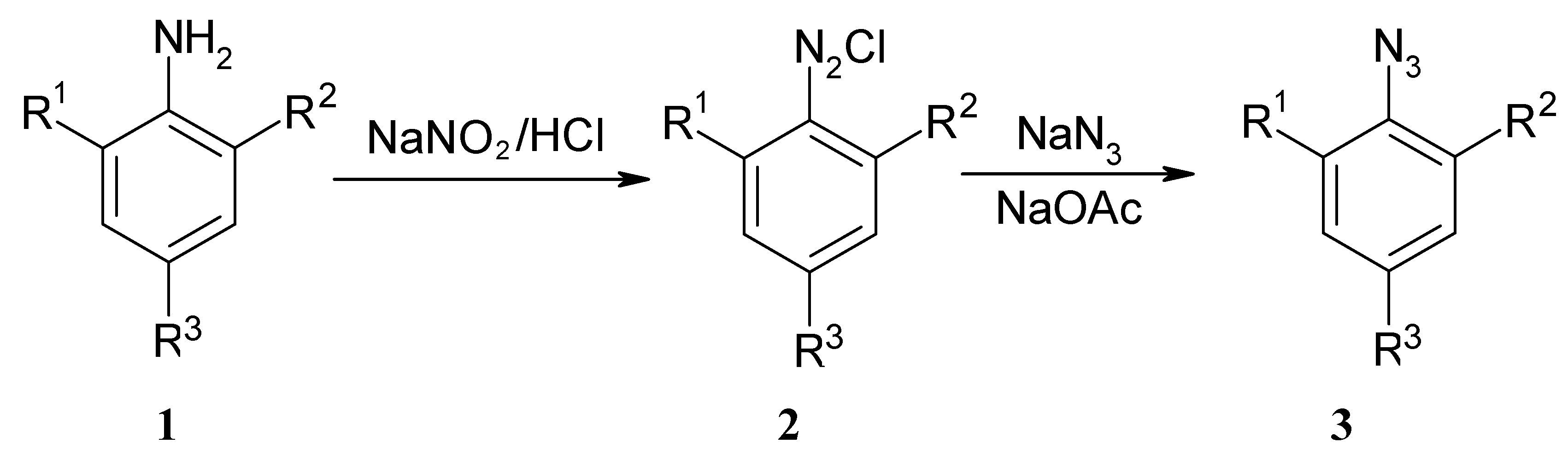
Azides 3 were synthesized from the appropriate fluorine-containing phenylamine (Scheme 1) [3]. Phenylamine was diazotizated with sodium nitrite, and then the azide derivatives were prepared in more than 90 % yields by the reaction of the diazotizated solution with sodium azide using NaOAc as a stabilizer. The results are summarized in Table 1.
Scheme 1.
Synthesis of azides 3.
Table 1.
The results of the synthesis of azides 3.
| Entry | R1/R2 | R3 | Product 3 | Yield/% 3 |
|---|---|---|---|---|
| 1 | Cl | CF3 | 3a | 95 |
| 2 | H | F | 3b | 92 |
| 3 | H | CF3 | 3c | 93 |
Synthesis of [1,2,3]-Triazoles
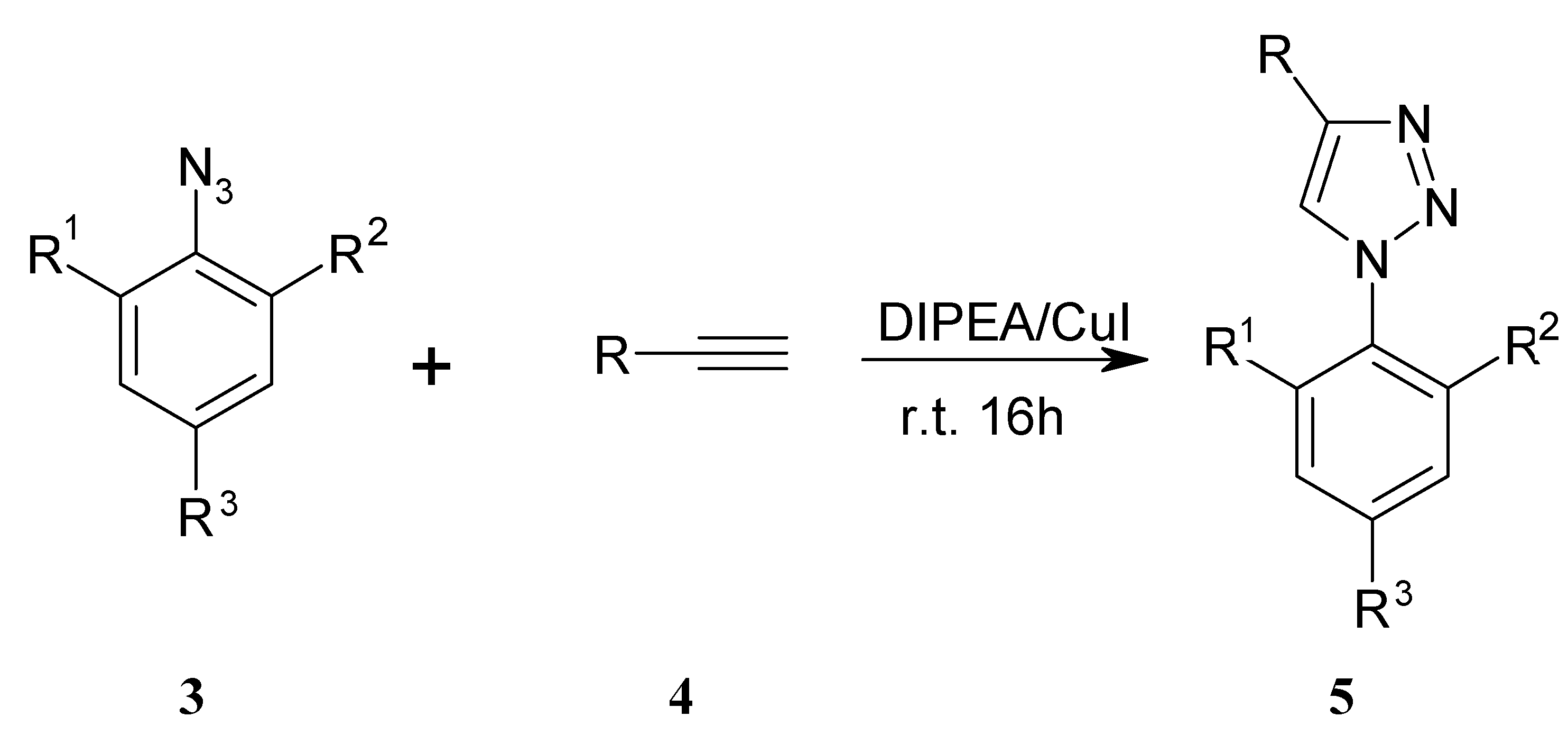
Several different methods have been described for the synthesis of [1,2,3]-triazoles, including the intramolecular cyclization of bishydrazones or mixed hydrazones, miscellaneous oxidations, as well as the 1,3-dipolar cycloaddition of azides to alkynes [1,12,13]. The cycloaddition between azides and alkynes is typically carried out in refluxing toluene, but labile molecules may not survive these conditions. Nevertheless, by using sodium [14], lithium or magnesium [15] salts of the alkyne, lower temperatures can be employed, although often with limited or little success. In a word, these methods are typically difficult to perform, need elevated temperature or, in the case of unsymmetrical alkynes, lead to a mixture of 1,4- and 1,5-regioisomers. Recently, studies on 1,4- versus 1,5-regioselectivity were reported. Sharpless [16] used a Cu(I) salt as a catalyst to promote the reaction of azide with terminal alkynes to give 1,4-substituted products with high regioselectivity. However, Chen has reported that when they used similar conditions as described by Sharpless, after stirring for 20 h at room temperature, the isolated yield of fluoroalkylated [1,2,3]-triazoles in their reactions was very poor [15]. Meldal [17] also regioselectively synthesized 1,4-substituted [1,2,3]-triazoles by 1,3-dipolar reaction of azides with polymer-supported terminal alkynes. The resin-bound copper acetylide was reacted with primary, secondary, and tertiary alkyl azides, aryl azides, and an azido sugar at 25 °C, affording diversely 1,4-substituted 1H-[1,2,3]-triazoles with quantitative conversions and purities ranging from 75 % to 99 %. The mechanism of that reaction may be suitable for other types of reactions, so we used similar conditions as described by Meldal (Scheme 2), and produced a series of 1-(2,6-dichloro-4-trifluoromethylphenyl)-4-alkyl-1H-[1,2,3]-triazoles in good yields. No 1,5-disubstituted product was found in these reactions.
Scheme 2.
1,3-Dipolar reaction of azide with terminal alkynes.
With another two fluorine-containing azides in hand, we started the study on the 1,3-dipolar cycloaddition reaction of other two fluorine-containing azides with 1-ethynylbenzene and hex-1-yne. We also observed that all the reactions were highly regioselective towards 1,4-disubstitution, and no 1,5-disubstituted products were seen. The results are summarized in Table 2.
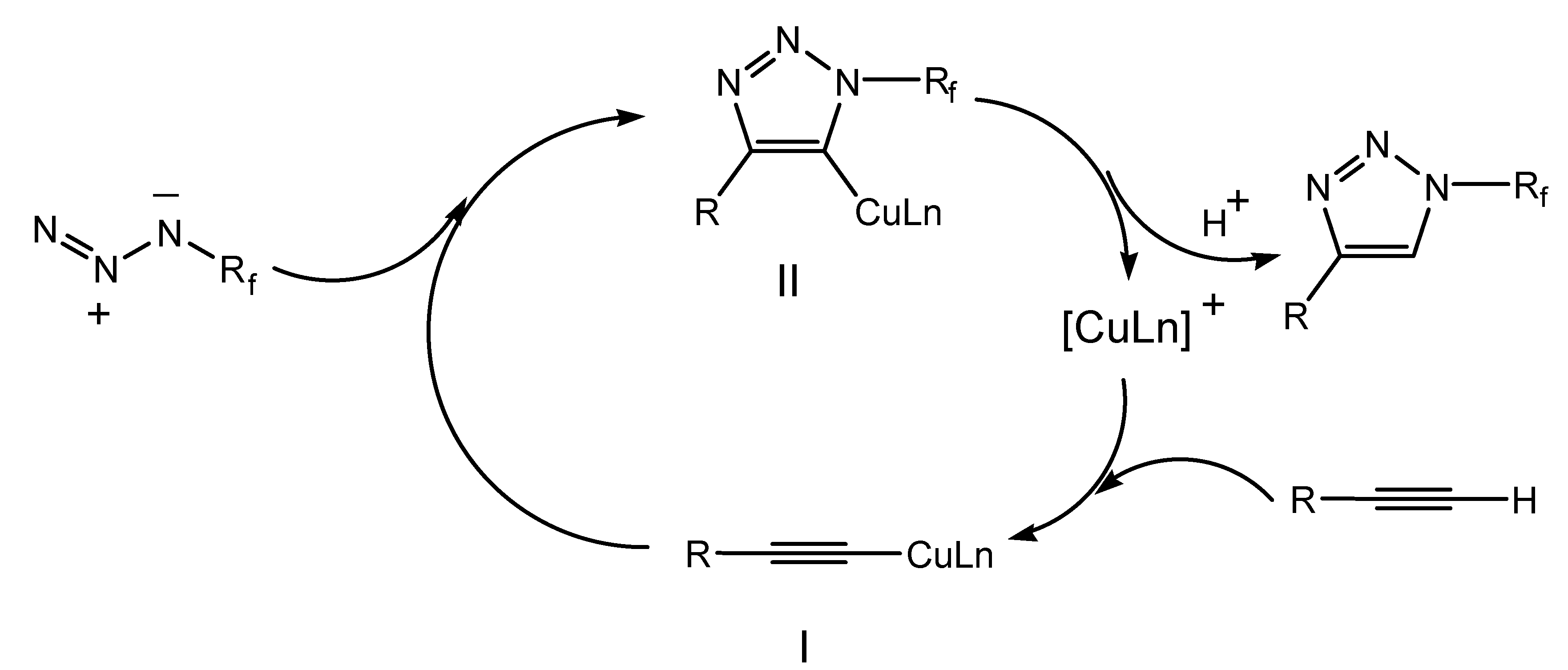
As proposed by Sharpless [16], the following reaction mechanism is suggested: Cu(I) first is inserted into the terminal alkyne, forming copper(I) acetylide I, then compound I reacts with azide to form the final product (Scheme 3). Because of the existence of copper(I) acetylide I, the reaction was regiospecific in that only a 1,4-disubstituted 1,2,3-triazole was formed.
Table 2.
The results of the reactions of azide with terminal alkynes.
| Entry | R1/R2 | R3 | Terminal alkyne(4) | Product (5) | Yield/%(5) * |
|---|---|---|---|---|---|
| 1 | Cl | CF3 | ![]() 4a | 5a | 93 |
| 2 | Cl | CF3 | ![]() 4b | 5b | 91 |
| 3 | Cl | CF3 | ![]() 4c | 5c | 88 |
| 4 | Cl | CF3 | ![]() 4d | 5d | 86 |
| 5 | C | CF3 | ![]() 4e | 5e | 82 |
| 6 | Cl | CF3 | ![]() 4f | 5f | 87 |
| 7 | Cl | CF3 | ![]() 4g | 5g | 85 |
| 8 | Cl | CF3 | ![]() 4h | 5h | 87 |
| 9 | Cl | CF3 | ![]() 4i | 5i | 88 |
| 10 | Cl | CF3 | ![]() 4j | 5j | 83 |
| 11 | H | F | ![]() 4k | 5k | 91 |
| 12 | H | F | ![]() 4l | 5l | 90 |
| 13 | H | CF3 | ![]() 4m | 5m | 92 |
| 14 | H | CF3 | ![]() 4n | 5n | 90 |
* Isolated yields.
Scheme 3.
Mechanism of 1,3-dipolar reaction catalyzed with Cu(I) salt.
X ray diffraction
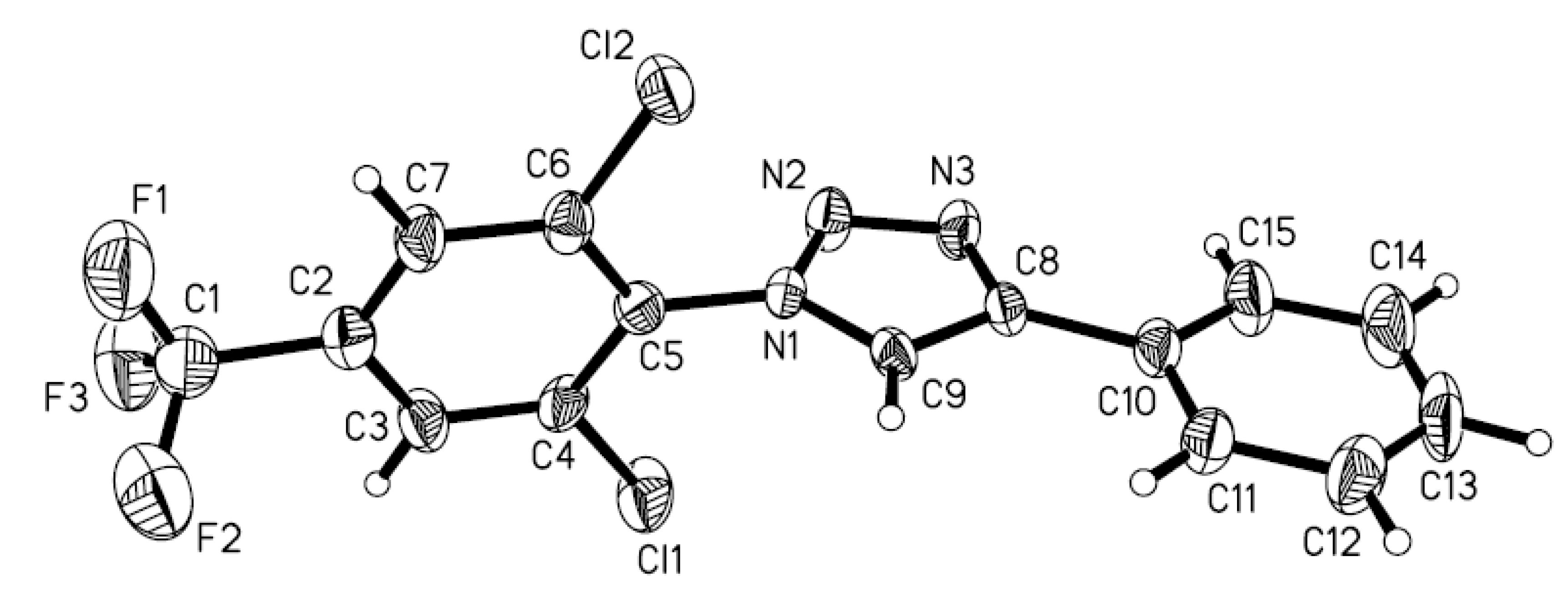
To verify the structural assignment compound 5a was selected as an example for an X-ray diffraction study. The purified product 5a was dissolved in 50 % ethanol/acetone (1:1 v/v) and kept at room temperature for 5 days until single crystals of 5a had formed. The structure of 5a assigned on the basis of its X-ray crystal structure (Figure 1 and Table 3) [18].
Conclusions
In summary, we have successfully developed a general method for the synthesis of a series of 1-(2,6-dichloro-4-trifluoromethylphenyl)-4-alkyl-1H-[1,2,3]-triazoles by the room temperature 1,3-dipolar cycloaddition of (2-azide-1,3-dichloro-5-trifluoromethyl)benzene and other two fluorine-containing azides with terminal alkynes in the presence of Cu (I) salt as catalyst for a short reaction time. All the reactions were performed in highly regioselective with only 1,4-disubstituted and no 1,5-disubstituted product being formed.
Figure 1.
ORTEP drawing of the compound 5a showing the atom numbering scheme.
Table 3.
Crystal data and summary of data collection and structure refinement.
| Compound | C15 H8 Cl2 F3 N3 |
|---|---|
| Color | Colorless |
| Formula weight | 358.14 |
| Crystal system | Orthorhombic |
| Temperature, °K | 25(298K) |
| Cell constants | |
| a (Å) | 15.5358(16) |
| b (Å) | 10.4697(11) |
| c (Å) | 9.3675(9) |
| α (˚) | 90 |
| β (˚) | 90 |
| γ (˚) | 90 |
| Volume (Å3) | 1523.7(3) |
| Formula units | 4 |
| Calculated density (g/cm-3 | 1.561 |
| F(000) | 720 |
| Absorption coefficient, mμ-3 | 0.459 |
| Limiting indices | -9<=h<=18, -12<=k<=12, -11<=l<=10 |
| Reflections collected / unique | 7651 / 2703 [R(int) = 0.0371] |
| Absorption correction | Multi-scan |
| Max. and min. transmission | 0.958 and 0.921 |
| Refinement method | Full-matrix least-squares on F2 |
| Data / restraints / parameters | 2703 / 35 / 208 |
| Goodness-of-fit on F2 | 1.160 |
| Final R indices | R1 = 0.0973, wR2 = 0.2342 |
| Largest diff. peak and hole (e Å-3) | 0.678 and -0.372 |
Experimental
General
All melting points were determined on an XT-4A apparatus and are uncorrected. TLC was performed using precoated silica gel GF254 (0.25mm), column chromatography was performed using silica gel (200-300 mesh). The 1H- and 13C-NMR spectra were measured at 25 oC at 300 and 75 MHz, respectively, on a Bruker Advance 300 spectrometer, using TMS as internal standard. J-values are given in Hz. The IR spectra were taken on a Bruker Vector 55 spectrometer. Elemental analyses were carried out with an EA 1112 elemental analyzer. All the reagents used were AR grade.
General procedure for the preparation of fluorine-containing azides 3
Phenylamine (7.5 mmol) was dissolved in concentrated HCl (10 mL) and water (10 mL) and then cooled to 0 °C, sodium nitrite (0.62 g, 9.0 mmol) was added and the yellow solution was stirred at 0 °C for 2 h. A solution of NaN3 (0.97 g, 15 mmol) and NaOAc (12.3 g, 150 mmol) was added dropwise to the mixture, the mixture was extracted with EtOAc and the combined extracts were washed with brine, and then dried by Na2SO4. Removal of solvent gave the products 3a-c as brown oils that were used without further purification.
(2-azido-1,3-dichloro-5-trifluoromethyl) benzene (3a). 1H-NMR (CDCl3) δ: 7.57 (s, 2H, Ar-H); 13C- NMR (CDCl3) δ: 136.1, 133.8 (q, J = 33.8 Hz), 129.5, 125.6, 123.2 (q, J = 271.6 Hz); IR (film, cm-1) ν: 3055 (ArH), 2115 (N3).
2-azido-5-fluorobenzene (3b). 1H-NMR (CDCl3) δ: 7.79 (d, J = 7.5 Hz, 2H, Ar-H), 7.67 (d, J = 7.5 Hz, 2H, Ar-H); 13C-NMR (CDCl3) δ: 135.3, 129.1 (q, J = 8.5 Hz), 126.3, 116.3 (q, J = 21.7 Hz); IR (film, cm-1) ν: 3050 (ArH), 2114 (N3).
(2-azido -5-trifluoromethyl) benzene (3c). 1H-NMR (CDCl3) δ: 7.65 (d, J = 8.6 Hz, 2H, Ar-H), 7.59 (d, J = 8.6 Hz, 2H, Ar-H); 13C-NMR (CDCl3) δ: 135.9, 133.6 (q, J = 34.7 Hz), 126.5, 125.1, 123.0 (q, J = 272.4 Hz); IR (film, cm-1) ν: 3049 (ArH), 2115 (N3).
General procedure for the preparation of 1-(2,6-dichloro-4-trifluoromethylphenyl)-4-alkyl-1H- [1,2,3]-triazoles 5
The terminal alkyne (1 mmol) was added to a stirred solution of DIPEA (25 mmol), CuI (1 mmol), and R-N3 (1 mmol) and reacted for 16 h at 25 °C. Then, the volatile substances were removed under reduced pressure. The residue was subjected to a chromatography on a column of silica gel, eluting with petroleum ether and ethyl acetate, solution was removed under reduced pressure, giving compounds 5a–n as solids.
1-((2,6-Dichloro-4-trifluoromethyl) phenyl)-4-phenyl-1H-[1,2,3]-triazole (5a). White solid; yield: 93%; M.p. 160-161 oC (lit. [10] 158.2-158.6 oC); 1H-NMR (CDCl3) δ: 8.01 (s, 1H, triazole H), 7.96 (d, J = 9.6 Hz, 2H, Ar-H), 7.82 (s, 2H, Ar-H), 7.41-7.52 (m, 3H, Ar-H); 13C-NMR (CDCl3) δ: 147.8, 135.9, 134.7, 133.6 (q, J = 34.5 Hz), 129.4, 128.8, 128.5, 125.8, 121.8 (q, J = 272.2 Hz), 121.2, 119.9; IR (KBr, cm-1) ν: 3090, 1596 (ArH); Anal. Calcd. (%) for C15H8Cl2F3N3: C, 50.30; H, 2.25; N, 11.73. Found: C, 50.40; H, 2.17; N, 11.82.
4-Butyl-1-((2,6-dichloro-4-trifluoromethyl) phenyl)-1H-[1,2,3]-triazole (5b). White solid; yield: 91%; M.p. 51-52oC (lit. [10] 48.4-49.9 oC); 1H-NMR (CDCl3) δ: 7.75 (s, 2H, Ar-H), 7.50 (s, 1H, triazole H), 2.82 (t, J = 7.5 Hz, 2H, -CH2CH2CH2CH3), 1.70-1.76 (m, 2H, -CH2CH2CH2CH3), 1.37-1.44 (m, 2H, -CH2CH2CH2CH3), 0.94 (t, J=7.2Hz, 3H, -CH2CH2CH2CH3); 13C-NMR (CDCl3) δ: 148.4, 136.2, 134.7, 133.6 (q, J = 34.3 Hz), 125.6, 122.3, 121.8 (q, J = 272.1 Hz), 31.0, 24.9, 21.9, 13.5; IR (KBr, cm-1) ν: 3077 (ArH), 2963, 2930 (CH3), 2863 (CH2); Anal. Calcd. (%) for C13H12Cl2F3N3: C, 46.17; H, 3.58; N, 12.43. Found: C, 46.20; H, 3.53; N, 12.46.
1-((2,6-Dichloro-4-trifluoromethyl) phenyl)-4-trimethylsilanyl-1H-[1,2,3]-triazole (5c). White solid; yield: 88%; M.p. 131-132 oC; 1H-NMR (CDCl3) δ: 7.79 (s, 2H, Ar-H), 7.73 (s, 1H, triazole H), 0.42 (s, 9H, -CH3); 13C-NMR (CDCl3) δ: 146.7, 136.0, 134.7, 133.6 (q, J = 34.2 Hz), 130.4, 125.7, 121.8 (q, J = 272.6 Hz), -1.35; IR (KBr, cm-1) ν: 3111(ArH), 2962 (CH3); Anal. Calcd. (%) for C12H12Cl2F3N3Si: C, 40.69; H, 3.41; N, 11.86. Found: C, 40.61; H, 3.51; N, 11.91.
2-[1-(2,6-Dichloro-4-trifluoromethylphenyl)-1H-[1,2,3]-triazole-4-yl]-propan-2-ol (5d). White solid; yield: 86%; M.p. 83-85 oC; 1H-NMR (CDCl3) δ: 7.75 (s, 2H, Ar-H), 7.70 (s, 1H, triazole H), 3.32 (br, 1H, O-H), 1.70 (s, 6H, -CH3); 13C-NMR (CDCl3) δ: 155.8, 136.0, 134.7, 133.6 (q, J = 34.5 Hz), 130.5, 125.7, 121.8 (q, J = 271.6Hz), 68.4, 30.2; IR (KBr, cm-1) ν: 3370 (OH), 3115 (ArH), 2958 (CH3); Anal. Calcd. (%) for C12H10Cl2F3N3O: C, 42.38; H, 2.96; N, 12.35. Found: C, 42.41; H, 2.88; N, 12.46.
1-[1-(2,6-Dichloro-4-trifluoromethylphenyl)-1H-[1,2,3]-triazole-4-ylmethyl]-diethyl-amine (5e). Light reddish solid; yield: 82%; M.p. 90-92 oC; 1H-NMR (CDCl3) δ: 7.76 (s, 2H, Ar-H), 7.65 (s, 1H, triazole H), 3.93 (s, 2H, -CH2-), 2.57 (q, J = 6.9 Hz, 4H, -CH2CH3), 1.10 (t, J = 6.9 Hz, 6H, -CH2CH3); 13C- NMR (CDCl3) δ: 145.4, 135.9, 134.7, 133.6 (q, J = 334.5 Hz), 125.8, 124.2, 121.8 (q, J = 272.0 Hz), 47.2, 46.8, 11.9; IR (KBr, cm-1) ν: 3112 (ArH), 2961 (CH3), 2866 (CH2); Anal. Calcd. (%) for C14H12Cl2F3N4: C, 45.79; H, 4.12; N, 15.26. Found: C, 45.69; H, 4.20; N, 15.32.
4-(1-Cyclohexenyl)-1-((2,6-dichloro-4-trifluoromethyl) phenyl)-1H-[1,2,3]-triazole (5f). Light yellow solid; yield: 87%; M.p. 109-111 oC; 1H-NMR (CDCl3) δ: 7.77 (s, 2H, Ar-H), 7.62 (s, 1H, triazole H), 6.68-6.71 (m, 1H, =CH), 2.42-2.47 (m, 2H), 2.23-2.27 (m, 2H), 1.68-1.82 (m, 4H); 13C-NMR (CDCl3) δ: 149.4, 136.1, 134.7, 133.6 (q, J = 34.6 Hz), 126.3, 126.1, 125.7, 121.8 (q, J = 272.2 Hz), 119.7, 26.1, 25.4, 22.2, 21.9; IR (KBr, cm-1) ν: 3135 (ArH), 3016 (=CH), 2836 (CH2), 1635 (C=C); Anal. Calcd. (%) for C15H12Cl2F3N3: C, 49.74; H, 3.34; N, 11.60. Found: C, 49.83; H, 3.27; N, 11.71.
1-[1-(2,6-Dichloro-4-trifluoromethylphenyl)-1H-[1,2,3]-triazole-4-yl]-cyclohexanol (5g). White solid; yield: 85%; M.p. 129-130 oC; 1H-NMR (CDCl3) δ: 7.77 (s, 2H, Ar-H), 7.72 (s, 1H, triazole H), 2.86 (br,1H, O-H), 2.04-2.14 (m, 2H), 1.41-1.97 (m, 6H), 1.24-1.38 (m, 2H); 13C-NMR (CDCl3) δ: 147.5, 136.5, 134.7, 133.6 (q, J = 33.8 Hz), 125.8, 124.6, 121.8 (q, J = 272.2 Hz), 75.1, 40.2, 27.6, 18.3; IR (KBr, cm-1) ν: 3380 (OH), 3114 (ArH), 2825 (CH2); Anal. Calcd. (%) for C15H14Cl2F3N3O: C, 47.39; H, 3.71; N, 11.05. Found: C, 47.27; H, 3.83; N, 11.00.
[1-(2,6-Dichloro-4-trifluoromethylphenyl)-1H-[1,2,3]-triazole-4-yl]-methanol (5h). White solid; yield: 87%; M.p. 130-131 oC; 1H-NMR (CDCl3) δ: 7.81 (s, 1H, triazole H), 7.77 (s, 2H, Ar-H), 4.92 (d, J = 5.7 Hz, 2H, -CH2), 4.06 (br, 1H, O-H); 13C-NMR (CDCl3) δ: 148.0, 136.0, 134.1, 133.8 (q, J = 34.6 Hz), 125.8, 123.7, 121.8 (q, J = 272.0 Hz), 55.9; IR (KBr, cm-1) ν: 3370 (OH), 3115 (ArH), 2832 (CH2); Anal. Calcd. (%) for C10H6Cl2F3N3O: C, 38.49; H, 1.94; N, 13.46. Found: C, 38.47; H, 1.96; N, 13.51.
4-Benzyloxymethyl-1-((2,6-dichloro-4-trifluoromethyl) phenyl)-1H-[1,2,3]-triazole (5i). White solid. yield: 88%; M.p. 72-73 oC; 1H-NMR (CDCl3) δ: 7.80 (s, 2H, Ar-H), 7.77 (s, 1H, triazole H), 7.38-7.40 (m, 5H), 4.84 (s, 2H), 4.69 (s, 2H); 13C-NMR (CDCl3) δ: 145.5, 137.3, 134.7, 133.6 (q, J = 33.6 Hz), 128.3, 127.8, 127.7, 125.7, 124.22, 121.8 (q, J = 272.3 Hz), 119.5, 72.5, 63.3; IR (KBr, cm-1) ν: 3112 (ArH), 2835 (CH2); Anal. Calcd. (%) for C17H12Cl2F3N3O: C, 50.77; H, 3.01; N, 10.45. Found: C, 50.88; H, 3.10; N, 10.48.
4-Bromomethyl-1-((2,6-dichloro-4-trifluoromethyl)phenyl)-1H-[1,2,3]-triazole (5j). White solid. yield: 83%; M.p. 135-137 oC; 1H-NMR (CDCl3) δ: 7.81 (s, 2H, J = 8.0 Hz, Ar-H), 7.79 (s, 1H, triazole H), 4.70 (s, 2H, -CH2); 13C-NMR (CDCl3) δ:146.5, 136.1, 134.7, 133.6 (q, J = 33.8 Hz), 125.8, 124.6, 121.8 (q, J = 272.0 Hz), 21.6; IR (KBr, cm-1) ν: 3316 (ArH), 2825 (CH2); Anal. Calcd. (%) for C10H5BrCl2F3N3: C, 32.03; H, 1.34; N, 11.21. Found: C, 32.16; H, 1.25; N, 11.24.
1-(4-Fluorophenyl)-4-phenyl-1H-[1,2,3]-triazole (5k). White solid. yield: 91%; M.p. 157-158 oC; 1H- NMR (CDCl3) δ: 7.85 (s, 1H, triazole H), 7.77 (d, 2H, Ar-H), 7.47-7.52 (m, 4H, Ar-H), 7.39 (m, 1H, Ar-H), 7.25-7.29 (m, 2H, Ar-H); 13C-NMR (CDCl3) δ: 147.8, 137.3, 134.7, 129.4 (q, J = 8.6 Hz), 129.6, 129.2, 127.9, 125.8, 121.2, 116.2 (q, J = 21.7 Hz); IR (KBr, cm-1) ν: 3111, 1596 (ArH); Anal. Calcd. (%) for C14H10FN3: C, 70.28; H, 4.21; N, 17.56. Found: C, 70.16; H, 4.32; N, 18.32.
4-Butyl-1-(4-fluorophenyl)-1H-[1,2,3]-triazole (5l). White solid. yield: 90%; M.p. 54-55 oC; 1H-NMR (CDCl3) δ: 7.83 (s, 1H, triazole H), 7.74-7.79 (m, 2H, Ar-H), 7.44-7.53 (m, 2H, Ar-H), 2.82 (t, J = 7.5 Hz, 2H, -CH2CH2CH2CH3), 1.70-1.74 (m, 2H, -CH2CH2CH2CH3), 1.38-1.44 (m, 2H, -CH2CH2CH2CH3), 0.89 (t, J=7.2Hz, 3H, -CH2CH2CH2CH3); 13C-NMR (CDCl3) δ: 146.7, 137.3, 132.7, 129.4 (q, J = 8.6 Hz), 129.2, 116.2 (q, J = 21.7 Hz), 31.0, 24.9, 21.9, 13.5; IR (KBr, cm-1) ν: 3087 (ArH), 2961, 2930 (CH3), 2863 (CH2); Anal. Calcd. (%) for C12H14FN3: C, 65.74; H, 6.44; N, 19.16. Found: C, 65.89; H, 6.55; N, 19.07.
4-Phenyl-1-(4-(trifluoromethyl)phenyl)-1H-[1,2,3]-triazole (5m). White solid. yield: 92%; M.p. 158-160 oC; 1H-NMR (CDCl3) δ: 7.91 (d, J = 8.5 Hz, 2H, Ar-H), 7.79-7.81 (m, 4H, Ar-H), 7.73 (s, 1H, triazole H), 7.41-7.52 (m, 3H, Ar-H); 13C-NMR (CDCl3) δ: 146.8, 137.9, 134.7, 132.7 (q, J = 34.6 Hz), 129.4, 128.6, 128.0, 125.8, 121.8 (q, J = 272.2 Hz), 121.2, 119.9; IR (KBr, cm-1) ν: 3088, 1596 (ArH); Anal. Calcd. (%) for C15H10F3N3: C, 62.29; H, 3.48; N, 14.53. Found: C, 62.11; H, 3.58; N, 14.68.
4-Butyl-1-(4-(trifluoromethyl)phenyl)-1H-[1,2,3]-triazole (5n). White solid. yield: 91%; M.p. 57-58 oC; 1H-NMR (CDCl3) δ: 7.89 (d, J = 8.5 Hz, 2H, Ar-H), 7.79 (d, J = 8.5 Hz, 2H, Ar-H), 7.76 (s, 1H, triazole H), 2.82 (t, J=7.5Hz, 2H, -CH2CH2CH2CH3), 1.70-1.75 (m, 2H, -CH2CH2CH2CH3), 1.37-1.44 (m, 2H, -CH2CH2CH2CH3), 0.94 (t, J=7.2Hz, 3H, -CH2CH2CH2CH3); 13C-NMR (CDCl3) δ: 147.4, 136.2, 134.5, 133.5 (q, J = 34.4 Hz), 126.6, 122.3, 121.0 (q, J = 272.1 Hz), 31.0, 24.7, 21.8, 13.5; IR (KBr, cm-1) ν: 3079 (ArH), 2966, 2926 (CH3), 2870 (CH2); Anal. Calcd. (%) for C13H14F3N3: C, 57.99; H, 5.24; N, 15.61. Found: C, 56.81; H, 5.34; N, 15.80.
References and Notes
- Fan, W. Q.; Katritsky, A. R. Comprehensive Heterocycle Chemistry II; Katritsky, A. R., Rees, C. W., Scriven, C. W. V., Eds.; Elsevier Science: Oxford, UK, 1996; vol. 4, pp. 1–126. [Google Scholar]
- Alvarez, R.; Elazquez, S. V.; San, F.; Aquaro, S.; De, C.; Perno, C. F.; Karlesson, A.; Balzarini, J.; Camarasa, M. J. 1,2,3-Triazole-[2,5-Bis-O-(tert-butyldimethylsilyl)-β-D-ribofuranosyl]-3'-spiro-5''-(4''-amino-1'',2''-oxathiole 2'',2''-dioxide) (TSAO) Analogs: Synthesis and Anti-HIV-1 Activity. J. Med. Chem. 1994, 37, 4185–4194. [Google Scholar] [CrossRef]
- Genin, M. J.; Allwine, D. A.; Anderson, D. J.; Barbachyn, M. R.; Emmert, D. E.; Garmon, S. A.; Graber, D. R.; Grega, K. C.; Hester, J. B.; Hutchinson, D. K.; Morris, J.; Reischer, R. J.; Ford, C. W.; Zurenco, G. E.; Hamel, J. C.; Schaadt, R. D.; Stapertand, D.; Yagi, B. H. Substituent Effects on the Antibacterial Activity of Nitrogen-Carbon-Linked (Azolylphenyl)oxazolidinones with Expanded Activity Against the Fastidious Gram-Negative Organisms Haemophilus influenzae and Moraxella catarrhalis. J. Med. Chem. 2000, 43, 953–970. [Google Scholar] [CrossRef]
- Brockunier, L. L.; Parmee, E. R.; Ok, H. O.; Candelore, M. R.; Cascieri, M. A.; Colwell, L. F.; Deng, L.; Feeney, W. P.; Forest, M. J.; Hom, G. J.; MacIntyre, D. E.; Tota, L.; Wyvratt, M. J.; Fisher, M. H.; Weber, A. E. Human β3-Adrenergic Receptor Agonists Containing 1,2,3-Triazole-substituted Benzenesulfonamides. Bioorg. Med. Chem. Lett. 2000, 10, 2111–2114. [Google Scholar] [CrossRef]
- Katritzky, A. R.; Zhang, Y. M.; Singh, S. K. 1,2,3-Triazole Formation under Mild Conditions via 1,3-Dipolar Cycloaddition of Acetylenes with Azides. Heterocycles 2003, 60, 1225–1239. [Google Scholar] [CrossRef]
- Welch, J. T. Tetrahedron report number 221: Advances in the Preparation of Biologically Active Organofluorine Compounds. Tetrahedron 1987, 43, 3123–3197. [Google Scholar] [CrossRef]
- Bertrand, F.; Pevere, V.; Quiclet-Sire, B.; Zard, S. Z. A Xanthate Transfer Radical Process for the Introduction of the Trifluoromethyl Group. Org. Lett. 2001, 3, 1069–1071. [Google Scholar] [CrossRef]
- Song, J. J.; Tan, Z.; Reeves, J. T.; Gallou, F.; Yee, N. K.; Senanayake, C. H. N-Heterocyclic Carbene Catalyzed Trifluoromethylation of Carbonyl Compounds. Org. Lett. 2005, 7, 2193–2196. [Google Scholar] [CrossRef]
- Yoshihisa, O.; Kazuo, Y.; Masafumi, N.; Miki, A.; Takashi, M.; Fumio, M. Fipronil-related Heterocyclic Compounds:Structure-Activity Relationships for Interaction with γ-Aminobutyric Acid- and Voltage-Gated Ion Channels and Insecticidal Action. Pest. Biochem. Physiol. 2000, 66, 92–104. [Google Scholar] [CrossRef]
- Alam, M. S.; Huang, J.; Ozoe, F.; Matsumura, F.; Ozoe, Y. Synthesis, 3D-QSAR, and Docking Studies of 1-Phenyl-1H-1,2,3-triazoles as Selective Antagonists for β3 over α1β2γ2 GABA Receptors. Bioorg. Med. Chem. 2007, 15, 5090–5104. [Google Scholar] [CrossRef]
- Alam, M. S.; Kajiki, R.; Hanatani, H.; Kong, X.; Ozoe, F.; Matsui, Y.; Matsumura, F.; Ozoe, Y. Synthesis and Structure-Activity Relationships of 1-Phenyl-1H-1,2,3-triazoles as Selective Insect GABA Receptor Antagonists. J. Agric. Food Chem. 2006, 54, 1361–1372. [Google Scholar] [CrossRef]
- Fuks, R.; Viehe, H. G. Chemistry of acetylenes; Viehe H., G., Ed.; Marcel Dekker: New York, 1969; pp. 425–593. [Google Scholar]
- Bastide, J.; Henri-Rousseau, O. The chemistry of the carbon-carbon triple bond; Patai, S., Ed.; Interscience Publishers: London, 1978; pp. 447–552. [Google Scholar]
- Boyer, J. H.; Mack, C. H.; Goebel, N.; Morgan, L. R., Jr. Reactions of Sodium Phenylacetylide and Sodium Alkoxide with Tosyl and Mesyl Azides. J. Org. Chem. 1958, 23, 1051–1053. [Google Scholar] [CrossRef]
- Wu, Y. M.; Deng, J.; Fang, X.; Chen, Q. Y. Regioselective Synthesis of Fluoroalkylated [1,2,3]-Triazoles by Huisgen Cycloaddition. J. Fluorine Chem. 2004, 125, 1415–1423. [Google Scholar]
- Rostovtsev, V. V.; Green, L. G.; Forkin, V. V.; Sharpless, K. B. A Stepwise Huisgen Cyclo-addition Process: Copper (I)-Catalyzed Regioselective “Ligation” of Azides and Terminal Alkynes. Angew. Chem. Int. Ed. Eng. 2002, 41, 2596–2599. [Google Scholar] [CrossRef]
- Tornoe, C. W.; Christensen, C.; Meldal, M. Peptidotriazoles on Solid Phase: [1,2,3]-Triazoles by Regiospecific Copper(I)-Catalyzed 1,3-Dipolar Cycloadditions of Terminal Alkynes to Azides. J. Org. Chem. 2002, 67, 3057–3064. [Google Scholar] [CrossRef]
- CCDC 668922 contains the supplementary crystallographic data for this paper. These data can be obtained free of charge from the Cambridge Crystallographic Data Centre, 12, Union Road, Cambridge, CB2 1EZ, UK; E-mail: deposit@ccdc.cam.ac.uk
- Sample Availability: Samples of the compounds 5a-n are available from the authors.
© 2008 by MDPI (http://www.mdpi.org). Reproduction is permitted for noncommercial purposes.