Article

Strategies to Improve School Meal Consumption: A Systematic Review
1
Department of Public Health and Nutrition, Merrimack College, 315 Turnpike Street, North Andover, MA 01845, USA
2
Department of Nutrition, Harvard T.H. Chan School of Public Health, 677 Huntington Ave., Boston, MA 02115, USA
3
Institute for Research on Poverty, University of Wisconsin-Madison, 1180 Observatory Drive, Madison, WI 53706, USA
4
Departments of Pediatrics and Epidemiology & Public Health, University of Maryland School of Medicine, Baltimore, MD 21201, USA
5
College of Education, Boise State University, 1910 University Drive, Boise, ID 83725, USA
6
College of Liberal Arts and Science, University of Connecticut, Storrs, CT 06269, USA
7
Rudd Center for Food Policy and Obesity, Department of Human Development and Family Sciences, University of Connecticut, 1 Constitution Plaza, Suite 600, Hartford, CT 06103, USA
*
Author to whom correspondence should be addressed.
Nutrients 2021, 13(10), 3520; https://doi.org/10.3390/nu13103520
Submission received: 3 September 2021 / Revised: 26 September 2021 / Accepted: 28 September 2021 / Published: 7 October 2021
(This article belongs to the Section Pediatric Nutrition)

Abstract

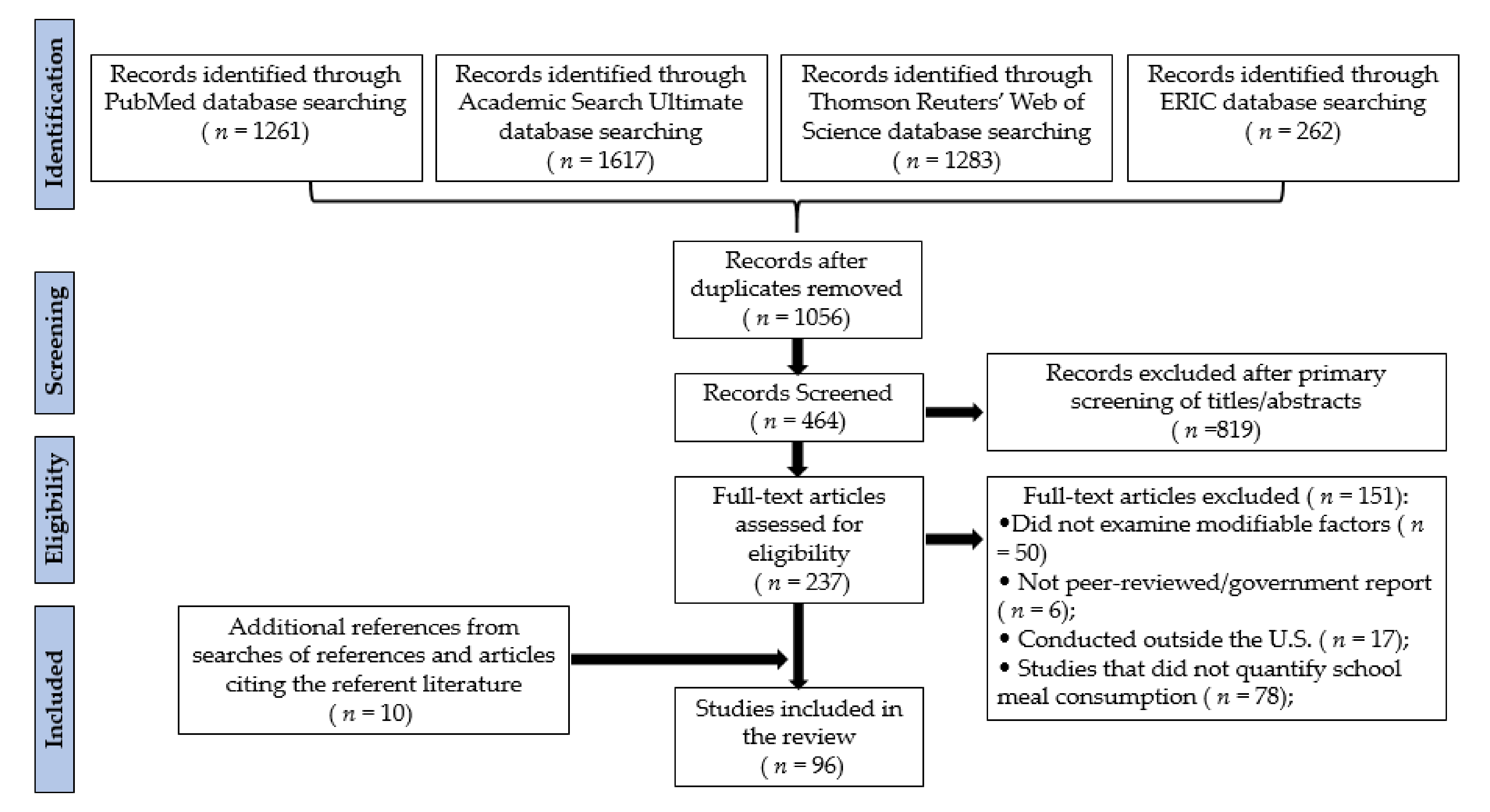
School meals can play an integral role in improving children’s diets and addressing health disparities. Initiatives and policies to increase consumption have the potential to ensure students benefit from the healthy school foods available. This systematic review evaluates studies examining initiatives, interventions, and policies to increase school meal consumption. Following PRISMA guidelines, this review was conducted using four databases and resulted in a total of 96 studies. The research evidence supports the following strategies to increase school meal consumption: (1) offering students more menu choices; (2) adapting recipes to improve the palatability and/or cultural appropriateness of foods; (3) providing pre-sliced fruits; (4) rewarding students who try fruits and vegetables; (5) enabling students to have sufficient time to eat with longer (~30 min) lunch periods; (6) having recess before lunch; and (7) limiting students’ access to competitive foods during the school day. Research findings were mixed when examining the impact of nutrition education and/or offering taste tests to students, although multiple benefits for nutrition education outside the cafeteria were documented. There is some evidence that choice architecture (i.e., “Smarter Lunchroom”) techniques increase the proportion of students who select targeted meal components; however, there is not evidence that these techniques alone increase consumption. There were limited studies of the impact of increasing portion sizes; serving vegetables before other meal components; and strengthening local district and/or school wellness policies, suggesting that further research is necessary. Additionally, longer-term studies are needed to understand the impact of policies that limit students’ access to flavored milk. Several studies found increases in students’ meal consumption following the Healthy Hunger-Free Kids Act (HHFKA) and concerns regarding an increase in food waste following the HHFKA were not supported. Overall, there are a range of effective strategies to increase school meal consumption that can be implemented by schools, districts, and policymakers at the local, state, and federal levels (PROSPERO registration: CRD42021244688).
Keywords: school meals; nutrition; breakfast; lunch; choice architecture; nutrition education; taste tests; policies; recess; choices; palatability; pre-sliced; competitive foods school meals; nutrition; breakfast; lunch; choice architecture; nutrition education; taste tests; policies; recess; choices; palatability; pre-sliced; competitive foods