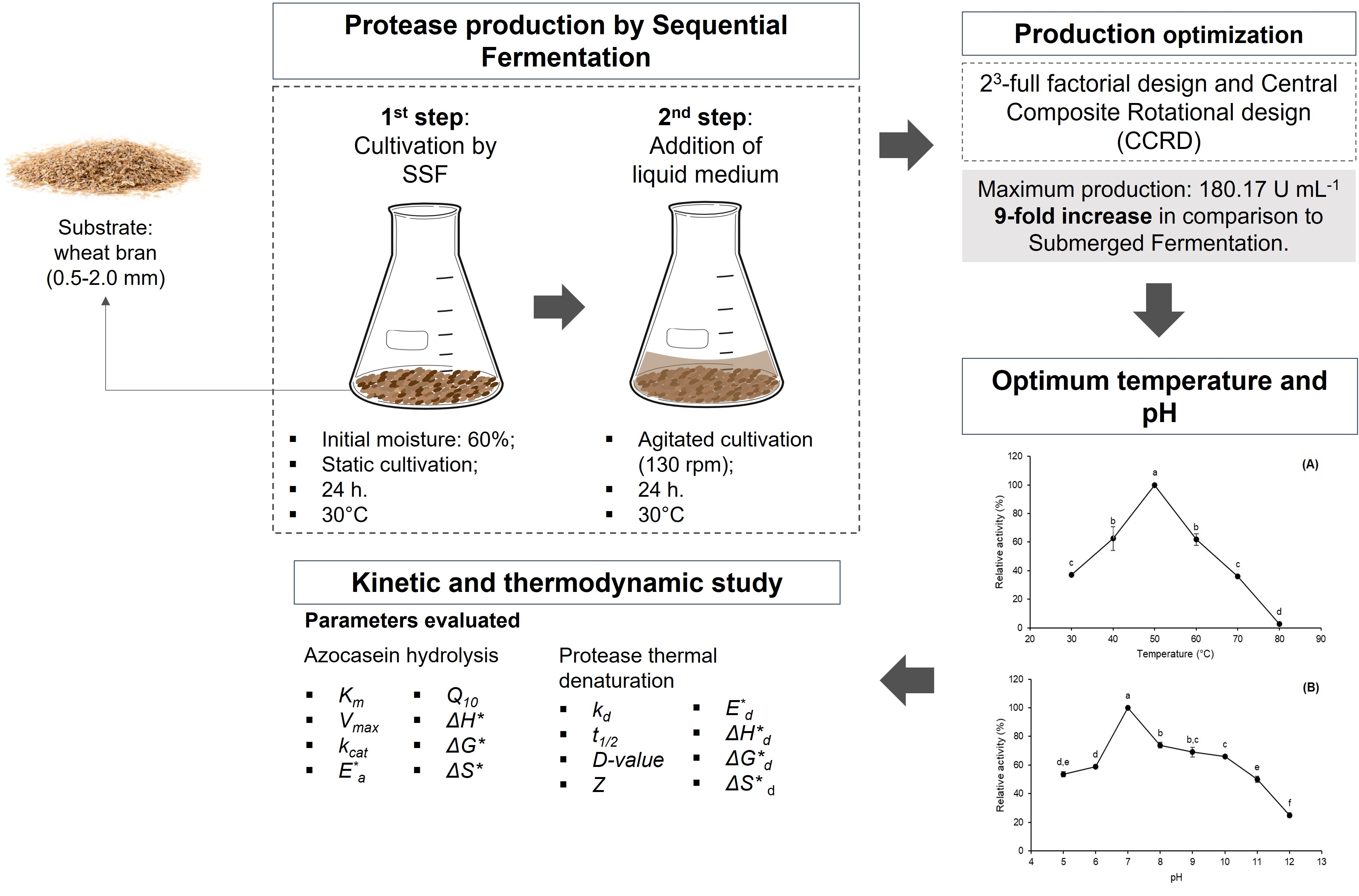

Use of a Sequential Fermentation Method for the Production of Aspergillus tamarii URM4634 Protease and a Kinetic/Thermodynamic Study of the Enzyme
 ,
,  and
and Abstract

Share and Cite
de Oliveira, R.L.; de Souza Claudino, E.; Converti, A.; Porto, T.S. Use of a Sequential Fermentation Method for the Production of Aspergillus tamarii URM4634 Protease and a Kinetic/Thermodynamic Study of the Enzyme. Catalysts 2021, 11, 963. https://doi.org/10.3390/catal11080963
de Oliveira RL, de Souza Claudino E, Converti A, Porto TS. Use of a Sequential Fermentation Method for the Production of Aspergillus tamarii URM4634 Protease and a Kinetic/Thermodynamic Study of the Enzyme. Catalysts. 2021; 11(8):963. https://doi.org/10.3390/catal11080963
Chicago/Turabian Stylede Oliveira, Rodrigo Lira, Emiliana de Souza Claudino, Attilio Converti, and Tatiana Souza Porto. 2021. "Use of a Sequential Fermentation Method for the Production of Aspergillus tamarii URM4634 Protease and a Kinetic/Thermodynamic Study of the Enzyme" Catalysts 11, no. 8: 963. https://doi.org/10.3390/catal11080963
APA Stylede Oliveira, R. L., de Souza Claudino, E., Converti, A., & Porto, T. S. (2021). Use of a Sequential Fermentation Method for the Production of Aspergillus tamarii URM4634 Protease and a Kinetic/Thermodynamic Study of the Enzyme. Catalysts, 11(8), 963. https://doi.org/10.3390/catal11080963