

Quantum Dynamics in a Fluctuating Environment


School of Science, Shandong Jianzhu University, Jinan 250101, China
Entropy 2019, 21(11), 1040; https://doi.org/10.3390/e21111040
Submission received: 22 September 2019
/
Revised: 17 October 2019
/
Accepted: 23 October 2019
/
Published: 25 October 2019
(This article belongs to the Special Issue Open Quantum Systems (OQS) for Quantum Technologies)
Abstract
We theoretically investigate the dynamics of a quantum system which is coupled to a fluctuating environment based on the framework of Kubo-Anderson spectral diffusion. By employing the projection operator technique, we derive two types of dynamical equations, namely, time-convolution and time-convolutionless quantum master equations, respectively. We derive the exact quantum master equations of a qubit system with both diagonal splitting and tunneling coupling when the environmental noise is subject to a random telegraph process and a Ornstein-Uhlenbeck process, respectively. For the pure decoherence case with no tunneling coupling, the expressions of the decoherence factor we obtained are consistent with the well-known existing ones. The results are significant to quantum information processing and helpful for further understanding the quantum dynamics of open quantum systems.
1. Introduction
A quantum system loses coherence information in the dynamical evolution resulting from the unavoidable environmental coupling. Understanding the dynamics of open quantum systems can help us know the essence of decoherence and the reason for the transition from quantum to classical [1,2,3,4,5,6]. How to effectively obtain the exact quantum master equation for an open quantum system is an extremely challenging but very meaningful problem, which helps us further understand the real dynamical evolution of the system. During the last few decades, people have generally described the dynamics of open quantum systems within Markov approximation [7,8]. Recently, it has increasingly drawn much attention to study the dynamical evolution of open quantum systems with methods beyond Markov approximation in the community of quantum information science, ranging from quantum computing to quantum measurements [9,10,11,12,13,14,15,16,17].
In general, the environmental effects on open quantum systems can be dealt with by stochastic noise processes within the framework of classical and quantum treatments [18,19,20,21,22,23,24,25,26,27,28,29,30,31,32,33,34,35,36,37,38]. For example, Ornstein-Uhlenbeck noise (OUN), as an important Gaussian stochastic process, has been generally used to model the environmental effects in a large number of quantum mechanical systems which exhibit Gaussian fluctuations, such as, Berry phase, dynamical decoherence and construction of robust quantum gates induced by classical fluctuating environments [39,40,41,42]. Random telegraph noise (RTN), as an important non-Gaussian stochastic process, has been generally used to model the environmental effects in various quantum mechanical systems, such as, dynamical decoherence induced by low-frequency noise and fluorescence spectra of single molecules [43,44,45,46,47,48,49,50,51,52,53,54]. Investigation of the quantum non-Markovian dynamics induced by the effects of the environmental noise resulting from classical fluctuating environments is important to understand the environmental backaction of coherence and useful for further potential applications in the manipulation and control of quantum coherence.
In this paper, we theoretically investigate the quantum dynamics of a qubit system with both diagonal splitting and tunneling coupling coupled to a fluctuating environment based on spectral diffusion model initiated by Kubo and Anderson. We derive two types of quantum master equations, namely, time-convolution (TC) and time-convolutionless (TCL) quantum master equations by employing the projection operator technique. The TC and TCL quantum master equations in the second order expansion give the exact dynamical evolution of the qubit system induced by the RTN and OUN, respectively. When there is no tunneling coupling, the qubit system undergoes pure decoherence and we obtain the expressions of the decoherence factor which are consistent with the well-known existing ones.
This paper is organized as follows. In Section 2 we introduce the stochastic model within the framework initiated by Kubo and Anderson and derive the TC and TCL equations for the reduced density matrix of the quantum system by employing the projection operator technique. In Section 3, we study the quantum dynamics of a qubit system induced by the RTN and OUN, respectively. In Section 4 we give the concluding remarks of the present study.
2. Theoretical Framework
We consider a quantum system which interacts with a fluctuating environment based on the framework initiated by Kubo and Anderson. The environmental effects on the system are described by means of stochastic Hamiltonian of the quantum system as [18,19]
where is the unperturbed Hamiltonian of the system and is caused by the environmental fluctuations which yields a stochastic noise process.
The time evolution of the stochastic density matrix satisfies the Liouville-von Neumann equation
where the notation indicates the dependence of the stochastic fluctuation term and we have used the super-operators for and . By taking the average over different realizations of the environmental fluctuations, wee can derive the reduced density matrix as .
In order to obtain the dynamical evolution of the reduced density matrix, we first transform Equation (2) into the interaction picture
where we have defined and .
We define the projection operator [1,20]
and the complementary projector
with the properties of the projectors , and . By performing the projection operators on Equation (3), we obtain the evolution
In terms of the identity , we can rewrite Equation (6) as
The solution for in Equation (7b) can be expressed as
where is the forward propagator which can be written as
with the chronological time-ordering operator . The forward propagator satisfies the evolution
initially with the condition .
By substituting the solution for back into Equation (7a), we obtain the evolution
with the inhomogeneous operator induced by the initial environmental correlation
If the quantum system and environment are initially uncorrelated, the initial state satisfies and and the third term on the right-hand side of Equation (11) vanishes.
Expanding the forward propagator in Dyson series with and in terms of the definitions in Equations (4) and (5), we obtain the TC master equation for the time evolution of the quantum system
where the time non-local operator satisfies
in terms of the partial cumulants
with q denoting the quantity of averages in the term and according to the time chronological order .
We further derive the TCL master equation for the dynamical evolution of the quantum system. On the right-hand side of Equation (8), we replace the expression of the stochastic density matrix by
where is the backward propagator expressed as
with indicating the antichronological time-ordering, we can express the solution for in Equation (8) as
Introducing the super-operator
the solution for can be reexpressed as
Substituting the solution for in Equation (20) back into Equation (7a) gives the evolution
with the inhomogeneous operator caused by the initial environmental correlation
The second term on the right-hand side of Equation (21) vanishes if the quantum system and environment are initially uncorrelated due to the fact that and .
Expanding the super-operator in series and in terms of the definitions in Equations (4) and (5), we obtain the TCL master equation for the dynamical evolution of the quantum system
where the time-local operator can be expressed as
based on the time-order cumulants
with the sum taken over all possible divisions by keeping the time chronological order and so on.
We have formally derived above two types of quantum master equations for dynamical evolution of the reduced density matrix of the system by employing the projection operator technique which are closely associated with the statistical properties of the environmental noise . However, only for a few simple cases, we can obtain the exact expression of the reduced density matrix of the quantum system based on the two types of quantum master equations we have derived. In most cases, we need to take some approximations to obtain the reduced density matrix of the system or we should know the closure of the higher-order correlation functions of the environmental noise [33,36]. In the following section, we will study two special models of which the reduced density matrix can be exact solved.
3. Application and Discussion
We consider a two state qubit system with the intrinsic Hamiltonian
where represent the Pauli matrices and and denote the diagonal splitting and tunneling coupling between the states and , respectively, In principle, the environmental effect gives rise to the stochastic fluctuations in both longitudinal and transverse directions in the presence of a fluctuating environment. We focus, here and in the following, mainly on the case that fluctuates longitudinally in diagonal splitting with the stochastic fluctuations
where denotes the environmental noise subject to a stochastic process. The case of transverse fluctuations in tunneling coupling can be dealt with in a similar way. For simplify, we make the assumption that the quantum system and environment are uncorrelated initially.
3.1. Quantum Dynamics Induced by the RTN Process
We first consider the dynamical evolution of the qubit system when the environmental noise yields a stationary RTN process of which the amplitude jumps between the two values randomly with an constant switching rate . The time evolution of the conditional probability for the RTN process obeys the master equation
where the initial condition is given by for . The solution of the conditional probability in Equation (28) can be written as
For positive and large time difference , we obtain the stationary distribution
Considering the noise process is Markov, the n-point probability distribution can be expressed as
Based on the stationary and Markovian statistical properties, the average of the noise process is zero
and its second-order correlation function is exponential
Its higher order correlation functions satisfy the factorization relation [55,56]
for all sets of the time sequences with . We can, based on the statistical characteristics of the environmental noise obtained above, derive that its partial cumulants beyond second order are zero
As a consequence, we can use the TC master equation to describe the time evolution for the reduced density matrix of the quantum system as [36]
where we use the definitions and . The dynamical evolution of the reduced density matrix elements can be written as
where denotes the eigen-splitting of the qubit system. We can take the Laplace transform over Equation (37) to obtain the solution of the reduced density matrix elements.
It is worth mentioning the uncoupled case and the system undergoes pure decoherence. For this case, the time evolution of the reduced density matrix elements in Equation (37) can be reduced to
By taking the Laplace transform over Equation (38), the reduced density matrix elements in the Laplace domain can be expressed as
We can, by means of the inverse Laplace transform of Equation (39), write the reduced density matrix in time domain as
where denotes the decoherence factor quantifying the coherence evolution of the quantum system
where . This expression is consistent with the well-known results obtained in References [57,58,59].
Figure 1 displays the decoherence factor as a function of the evolution time in the presence of the RTN for different jumping amplitude . As depict in the figure, with the increase of the jumping amplitude , the behavior in the decoherence factor displays a transition from monotonic decay to nonmonotonic oscillatory decay: the decoherence factor decays monotonically for the jumping amplitude (weak coupling region), which reflects that the decoherence dynamics of the quantum system is Markovian. The decoherence factor decays nonmonotonically with coherence revivals for the jumping amplitude (strong coupling region), which indicates that the decoherence dynamics of the quantum system becomes non-Markovian. In the weak coupling region, the decay of the decoherence factor increases with the increase of the jumping amplitude , which indicates that the strength of the coupling can enhance the decoherence dynamics of the quantum system. In the strong coupling region, the nonmonotonic oscillations in the decoherence factor become obvious, which reveals that the non-Markovian behavior in the decoherence dynamics of the quantum system is pronounced.
3.2. Quantum Dynamics Induced by the OUN Process
We now consider the dynamical evolution of the qubit system when the environmental noise obeys a stationary OUN process with the width and decay rate of the Gaussian distribution. The time evolution for the conditional probability of the OUN process satisfies the master equation
where the initial condition is given by . The expression of the conditional probability in Equation (42) can be solved as
For positive and large time difference , the stationary distribution of the noise process satisfies
Considering the noise process is Markov, the n-point probability distribution can be expressed as
Based on the stationary and Markovian statistical properties of the noise process, the average is zero
and its correlation function of second-order is exponential
All the cumulants beyond second order are zero [55,56]
for every ordered set of time instants . We can, in terms of the statistical characteristics of the environmental noise obtained above, derive that the time-order cumulants beyond second order vanish
Consequently, we can employ the TCL master equation to describe the time evolution forthe reduced density matrix of the quantum system [36]
The dynamical evolution of the reduced density matrix elements can be written as
We consider the uncoupled case . The system undergoes pure decoherence and the time evolution of the reduced density matrix elements in Equation (51) can be reduced to
We can, by taking the integral over Equation (52), express the reduced density matrix of the quantum system as
where the decoherence factor can be written as
This expression is compatible with the well-known results obtained in References [20,24].
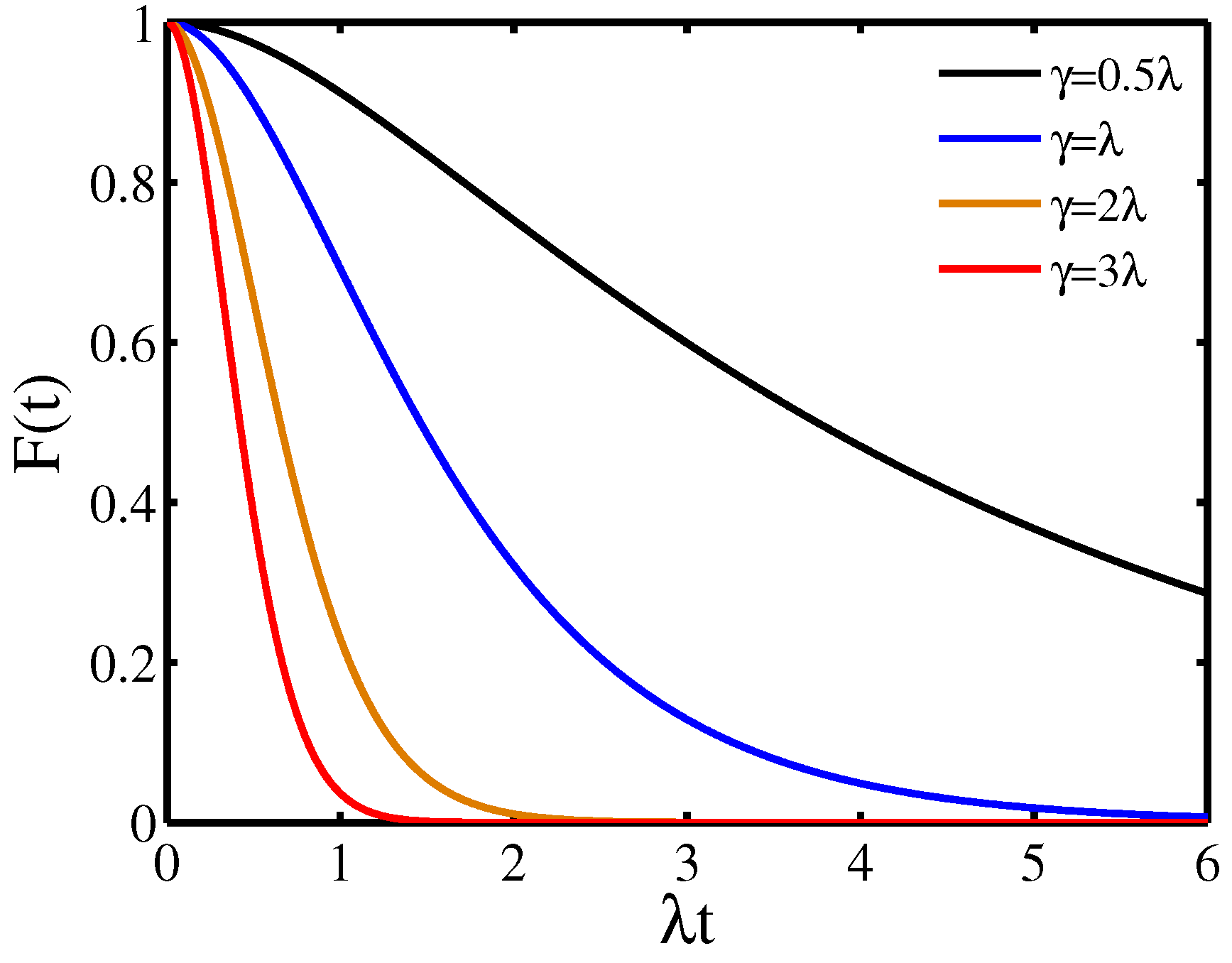
Figure 2 displays the decoherence factor as a function of the evolution time induced by the OUN for different width of the distribution . The decoherence factor decays monotonically for arbitrary values of the width of the distribution , which indicates that the decoherence dynamics of the quantum system is always Markovian. In addition, as the width of the distribution increases, the decay of the decoherence factor increases, which reveals that the width of the distribution can make the decoherence dynamics of the quantum system pronounced.
4. Conclusions
We have theoretically studied the dynamics of a quantum system which is coupled to a fluctuating environment within the framework of Kubo-Anderson spectral diffusion. By employing the projection operator technique, we derived the TC and TCL master equations for the dynamical evolution of the quantum system, respectively. Induced by the RTN and OUN, the second order expanded TC and TCL quantum master equations give the exact dynamical evolution of the qubit system, respectively. For the case with no tunneling coupling, the qubit system undergoes pure decoherence. The expressions of the decoherence factor we obtained return to the well-known existing ones. Induced by the RTN, the decoherence dynamics of the quantum system displays a transition from Markovian behavior with monotonic decay to non-Markovian behavior with nonmonotonic oscillatory decay. In the presence of the OUN, the decoherence dynamics of the quantum system decays monotonically and always only shows Markovian behavior. We hope that our investigation will contribute to further understanding of quantum dynamics and will be effective in the suppression and control of the dynamical decoherence of open quantum systems.
Funding
This work was supported by the Doctoral Research Fund of Shandong Jianzhu University under Grant No. XNBS1852.
Conflicts of Interest
The author declares no conflict of interest.
References
- Breuer, H.P.; Petruccione, F. The Theory of Open Quantum Systems; Oxford University Press: New York, NY, USA, 2002. [Google Scholar]
- Zurek, W.H. Decoherence, einselection, and the quantum origins of the classical. Rev. Mod. Phys. 2003, 75, 715. [Google Scholar] [CrossRef]
- Sauer, S.; Gneiting, C.; Buchleitner, A. Optimal Coherent Control to Counteract Dissipation. Phys. Rev. Lett. 2013, 111, 030405. [Google Scholar] [CrossRef]
- Di Stefano, P.G.; Paladino, E.; Pope, T.J.; Falci, G. Coherent manipulation of noise-protected superconducting artificial atoms in the Lambda scheme. Phys. Rev. A 2016, 93, 051801. [Google Scholar] [CrossRef]
- Suter, D.; Álvarez, G.A. Colloquium: Protecting quantum information against environmental noise. Rev. Mod. Phys. 2016, 88, 041001. [Google Scholar] [CrossRef]
- Kang, L.; Zhang, Y.; Xu, X.; Tang, X. Quantum measurement of a double quantum dot coupled to two kinds of environment. Phys. Rev. B 2017, 96, 235417. [Google Scholar] [CrossRef]
- Gorini, V.; Kossakowski, A.; Sudarshan, E.C.G. Completely positive dynamical semigroups of N-level systems. J. Math. Phys. 1976, 17, 821. [Google Scholar] [CrossRef]
- Lindblad, G. On the generators of quantum dynamical semigroups. Commun. Math. Phys. 1976, 48, 119. [Google Scholar] [CrossRef]
- Breuer, H.; Laine, E.; Piilo, J. Measure for the Degree of Non-Markovian Behavior of Quantum Processes in Open Systems. Phys. Rev. Lett. 2009, 103, 210401. [Google Scholar] [CrossRef] [PubMed]
- Rivas, A.; Huelga, S.F.; Plenio, M.B. Entanglement and Non-Markovianity of Quantum Evolutions. Phys. Rev. Lett. 2010, 105, 050403. [Google Scholar] [CrossRef]
- Tu, M.W.Y.; Zhang, W.M. Non-Markovian decoherence theory for a double-dot charge qubit. Phys. Rev. B 2008, 78, 235311. [Google Scholar] [CrossRef]
- Zhang, W.M.; Lo, P.Y.; Xiong, H.N.; Tu, M.W.Y.; Nori, F. General Non-Markovian Dynamics of Open Quantum Systems. Phys. Rev. Lett. 2012, 109, 170402. [Google Scholar] [CrossRef] [PubMed]
- Chruściński, D.; Maniscalco, S. Degree of Non-Markovianity of Quantum Evolution. Phys. Rev. Lett. 2014, 112, 120404. [Google Scholar] [CrossRef]
- Rivas, A.; Huelga, S.F.; Plenio, M.B. Quantum Non-Markovianity: Characterization, quantification and detection. Rep. Prog. Phys. 2014, 77, 094001. [Google Scholar] [CrossRef] [PubMed]
- Breuer, H.; Laine, E.; Piilo, J.; Vacchini, B. Colloquium : Non-Markovian dynamics in open quantum systems. Rev. Mod. Phys. 2016, 88, 021002. [Google Scholar] [CrossRef]
- de Vega, I.; Alonso, D. Dynamics of Non-Markovian open quantum systems. Rev. Mod. Phys. 2017, 89, 015001. [Google Scholar] [CrossRef]
- Alipour, S.; Rezakhani, A.T.; Babu, A.P.; Mølmer, K.; Möttönen, M.; Ala-Nissila, T. Correlation Picture Approach to Open-Quantum-System Dynamics. arXiv, 2019; arXiv:1903.03861. [Google Scholar]
- Anderson, P.W. A Mathematical Model for the Narrowing of Spectral Lines by Exchange or Motion. J. Phys. Soc. Jpn. 1954, 9, 316. [Google Scholar] [CrossRef]
- Kubo, R. Note on the Stochastic Theory of Resonance Absorption. J. Phys. Soc. Jpn. 1954, 9, 935. [Google Scholar] [CrossRef]
- Shibata, F.; Arimitsu, T. Expansion Formulas in Nonequilibrium Statistical Mechanics. J. Phys. Soc. Jpn. 1980, 49, 891. [Google Scholar] [CrossRef]
- Martens, C.C. Communication: Decoherence in a nonequilibrium environment: An analytically solvable model. J. Chem. Phys. 2010, 133, 241101. [Google Scholar] [CrossRef]
- Martens, C.C. Theory and simulation of the loss of coherence in thermal and nonequilibrium environments. J. Phys. B 2012, 45, 154008. [Google Scholar] [CrossRef]
- Martens, C.C. Quantum dephasing of a two-state system by a nonequilibrium harmonic oscillator. J. Chem. Phys. 2013, 139, 024109. [Google Scholar] [CrossRef] [PubMed]
- Ban, M.; Kitajima, S.; Shibata, F. Relaxation process of quantum system: Stochastic Liouville equation and initial correlation. Phys. Rev. A 2010, 82, 022111. [Google Scholar] [CrossRef]
- Chenu, A.; Beau, M.; Cao, J.; del Campo, A. Quantum Simulation of Generic Many-Body Open System Dynamics Using Classical Noise. Phys. Rev. Lett. 2017, 118, 140403. [Google Scholar] [CrossRef]
- Hsieh, C.Y.; Cao, J. A unified stochastic formulation of dissipative quantum dynamics. I. Generalized hierarchical equations. J. Chem. Phys. 2018, 148, 014103. [Google Scholar] [CrossRef]
- Hsieh, C.Y.; Cao, J. A unified stochastic formulation of dissipative quantum dynamics. II. Beyond linear response of spin baths. J. Chem. Phys. 2018, 148, 014104. [Google Scholar] [CrossRef]
- Magazzù, L.; Valenti, D.; Carollo, A.; Spagnolo, B. Multi-State Quantum Dissipative Dynamics in Sub-Ohmic Environment: The Strong Coupling Regime. Entropy 2015, 17, 2341. [Google Scholar] [CrossRef]
- Magazzù, L.; Carollo, A.; Spagnolo, B.; Valenti, D. Quantum dissipative dynamics of a bistable system in the sub-Ohmic to super-Ohmic regime. J. Stat. Mech. 2016, 2016, 054016. [Google Scholar] [CrossRef]
- Lombardo, F.C.; Villar, P.I. Nonunitary geometric phases: A qubit coupled to an environment with random noise. Phys. Rev. A 2013, 87, 032338. [Google Scholar] [CrossRef]
- Lombardo, F.C.; Villar, P.I. Corrections to the Berry phase in a solid-state qubit due to low-frequency noise. Phys. Rev. A 2014, 89, 012110. [Google Scholar] [CrossRef]
- Lombardo, F.C.; Villar, P.I. Correction to the geometric phase by structured environments: The onset of non-Markovian effects. Phys. Rev. A 2015, 91, 042111. [Google Scholar] [CrossRef]
- Cai, X.; Zheng, Y. Decoherence induced by non-Markovian noise in a nonequilibrium environment. Phys. Rev. A 2016, 94, 042110. [Google Scholar] [CrossRef]
- Cai, X.; Zheng, Y. Quantum dynamical speedup in a nonequilibrium environment. Phys. Rev. A 2017, 95, 052104. [Google Scholar] [CrossRef]
- Fuliński, A. Exact nonmarkovianity measure based on time autocorrelation functions. Europhys. Lett. 2017, 118, 60002. [Google Scholar] [CrossRef]
- Cai, X.; Zheng, Y. Non-Markovian decoherence dynamics in nonequilibrium environments. J. Chem. Phys. 2018, 149, 094107. [Google Scholar] [CrossRef]
- Cai, X.; Meng, R.; Zhang, Y.; Wang, L. Geometry of quantum evolution in a nonequilibrium environment. Europhys. Lett. 2019, 125, 30007. [Google Scholar] [CrossRef]
- Yan, Y.A.; Shao, J. Equivalence of stochastic formulations and master equations for open systems. Phys. Rev. A 2018, 97, 042126. [Google Scholar] [CrossRef]
- De Chiara, G.; Palma, G.M. Berry Phase for a Spin 1/2 Particle in a Classical Fluctuating Field. Phys. Rev. Lett. 2003, 91, 090404. [Google Scholar] [CrossRef]
- Rabenstein, K.; Sverdlov, V.A.; Averin, D.V. Qubit Decoherence by Gaussian Low-Frequency Noise. Jetp Lett. 2004, 79, 646. [Google Scholar] [CrossRef][Green Version]
- Kuvshinov, V.I.; Kuzmin, A.V. Decoherence induced by squeezing control errors in optical and ion trap holonomic quantum computations. Phys. Rev. A 2006, 73, 052305. [Google Scholar] [CrossRef]
- Huang, C.H.; Goan, H.S. Robust quantum gates for stochastic time-varying noise. Phys. Rev. A 2017, 95, 062325. [Google Scholar] [CrossRef]
- Bergli, J.; Galperin, Y.M.; Altshuler, B.L. Decoherence of a qubit by non-Gaussian noise at an arbitrary working point. Phys. Rev. B 2006, 74, 024509. [Google Scholar] [CrossRef]
- Burkard, G. Non-Markovian qubit dynamics in the presence of 1/f noise. Phys. Rev. B 2009, 79, 125317. [Google Scholar] [CrossRef]
- Paladino, E.; Faoro, L.; Falci, G.; Fazio, R. Decoherence and 1/f Noise in Josephson Qubits. Phys. Rev. Lett. 2002, 88, 228304. [Google Scholar] [CrossRef] [PubMed]
- Paladino, E.; Faoro, L.; DÁrrigoa, A.; Falci, G. Decoherence and 1/f Noise in Josephson Qubits. Physica E 2003, 18, 29. [Google Scholar] [CrossRef]
- Paladino, E.; Faoro, L.; Falci, G. Decoherence Due to Discrete Noise in Josephson Qubits. Adv. Sol. State Phys. 2003, 43, 747. [Google Scholar]
- Falci, G.; D’Arrigo, A.; Mastellone, A.; Paladino, E. Initial Decoherence in Solid State Qubits. Phys. Rev. Lett. 2005, 94, 167002. [Google Scholar] [CrossRef]
- Schriefl, J.; Makhlin, Y.; Shnirman, A.; Schön, G. Decoherence from ensembles of two-level fluctuators. New J. Phys. 2006, 8, 1. [Google Scholar] [CrossRef]
- Galperin, Y.M.; Altshuler, B.L.; Bergli, J.; Shantsev, D.V. Non-Gaussian Low-Frequency Noise as a Source of Qubit Decoherence. Phys. Rev. Lett. 2006, 96, 097009. [Google Scholar] [CrossRef]
- Paladino, E.; Galperin, Y.M.; Falci, G.; Altshuler, B.L. 1/f noise: Implications for solid-state quantum information. Rev. Mod. Phys. 2014, 86, 361. [Google Scholar] [CrossRef]
- Barkai, E.; Jung, Y.; Silbey, R. Time-Dependent Fluctuations in Single Molecule Spectroscopy: A Generalized Wiener-Khintchine Approach. Phys. Rev. Lett. 2001, 87, 207403. [Google Scholar] [CrossRef] [PubMed]
- Zheng, Y.; Brown, F.L.H. Single-Molecule Photon Counting Statistics via Generalized Optical Bloch Equations. Phys. Rev. Lett. 2003, 90, 238305. [Google Scholar] [CrossRef] [PubMed]
- Brokmann, X.; Hermier, J.P.; Messin, G.; Desbiolles, P.; Bouchaud, J.P.; Dahan, M. Statistical Aging and Nonergodicity in the Fluorescence of Single Nanocrystals. Phys. Rev. Lett. 2003, 90, 120601. [Google Scholar] [CrossRef] [PubMed]
- Bourret, R.C. Brownian motion of harmonic oscillator with stochastic frequency. Physica 1973, 65, 303. [Google Scholar] [CrossRef]
- Wódkiewicz, K.; Shore, B.W.; Eberly, J.H. Noise in strong laser-atom interactions: Frequency fluctuations and nonexponential correlations. Phys. Rev. A 1984, 30, 2390. [Google Scholar] [CrossRef]
- Abel, B.; Marquardt, F. Decoherence by quantum telegraph noise: A numerical evaluation. Phys. Rev. B 2008, 78, 201302. [Google Scholar] [CrossRef]
- Neuenhahn, C.; Kubala, B.; Abel, B.; Marquardt, F. Recent progress in open quantum systems: Non-Gaussian noise and decoherence in fermionic systems. Phys. Status Solidi B 2009, 246, 1018. [Google Scholar] [CrossRef]
- Ayachi, A.; Chouikha, W.B.; Jaziri, S.; Bennaceur, R. Telegraph noise effects on two charge qubits in double quantum dots. Phys. Rev. A 2014, 89, 012330. [Google Scholar] [CrossRef]
Figure 1.
Decoherence factor as a function of the evolution time induced by the random telegraph noise (RTN) for different jumping amplitude .
Figure 1.
Decoherence factor as a function of the evolution time induced by the random telegraph noise (RTN) for different jumping amplitude .
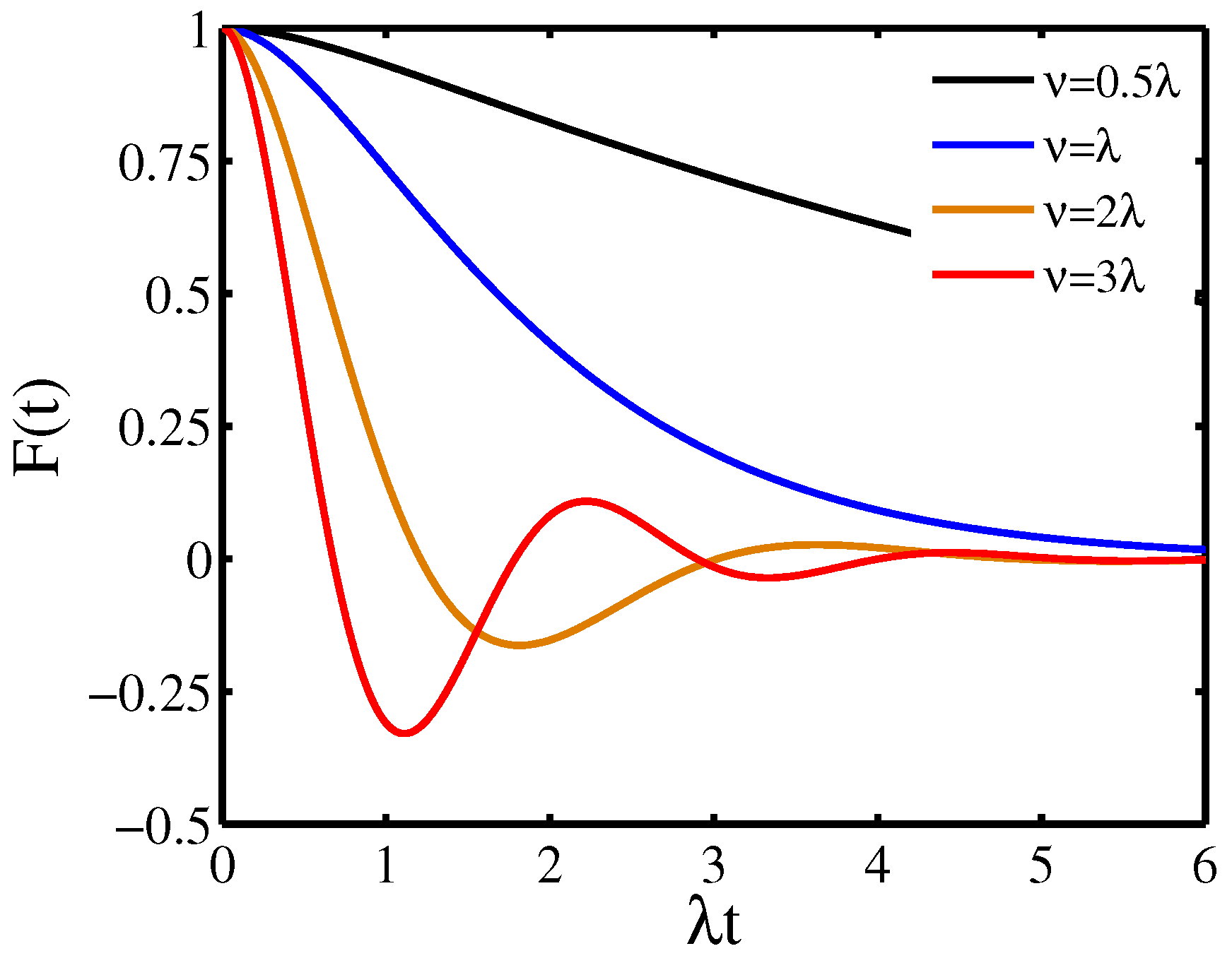
Figure 2.
Decoherence factor as a function of the evolution time in the presence of the Ornstein-Uhlenbeck noise (OUN) for different values of the width of the distribution .
Figure 2.
Decoherence factor as a function of the evolution time in the presence of the Ornstein-Uhlenbeck noise (OUN) for different values of the width of the distribution .
© 2019 by the author. Licensee MDPI, Basel, Switzerland. This article is an open access article distributed under the terms and conditions of the Creative Commons Attribution (CC BY) license (http://creativecommons.org/licenses/by/4.0/).
Share and Cite
MDPI and ACS Style
Cai, X. Quantum Dynamics in a Fluctuating Environment. Entropy 2019, 21, 1040. https://doi.org/10.3390/e21111040
AMA Style
Cai X. Quantum Dynamics in a Fluctuating Environment. Entropy. 2019; 21(11):1040. https://doi.org/10.3390/e21111040
Chicago/Turabian StyleCai, Xiangji. 2019. "Quantum Dynamics in a Fluctuating Environment" Entropy 21, no. 11: 1040. https://doi.org/10.3390/e21111040
APA StyleCai, X. (2019). Quantum Dynamics in a Fluctuating Environment. Entropy, 21(11), 1040. https://doi.org/10.3390/e21111040
Note that from the first issue of 2016, this journal uses article numbers instead of page numbers. See further details here.

