Review

High-Dose Vitamin C in Advanced-Stage Cancer Patients
by
Anna Zasowska-Nowak
1,*,
Piotr Jan Nowak
2 and
Aleksandra Ciałkowska-Rysz
1
1
Department of Palliative Medicine, Chair of Oncology, Medical University of Lodz, Ul. Zeromskiego 113, 90-549 Lodz, Poland
2
Department of Nephrology, Hypertension and Kidney Transplantation, Medical University of Lodz, Ul. Pomorska 251, 92-213 Lodz, Poland
*
Author to whom correspondence should be addressed.
Nutrients 2021, 13(3), 735; https://doi.org/10.3390/nu13030735
Submission received: 30 November 2020 / Revised: 3 February 2021 / Accepted: 22 February 2021 / Published: 26 February 2021
(This article belongs to the Special Issue Vitamin C in Human Health and Disease)

Abstract

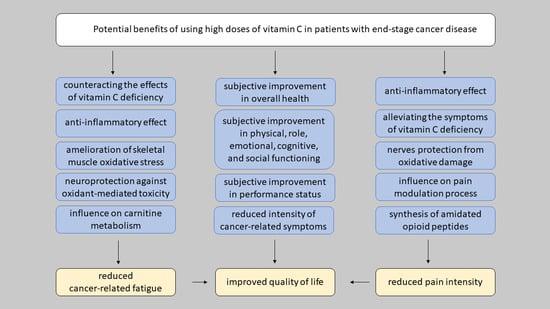
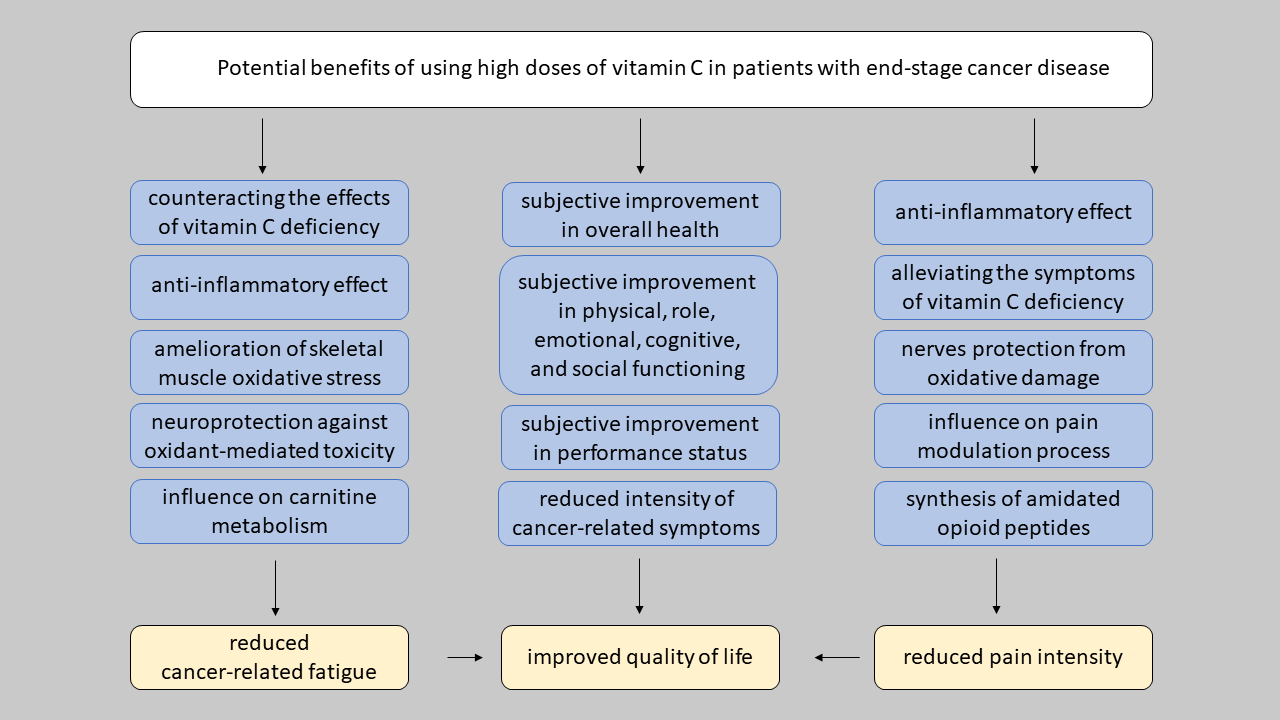
High-dose intravenously administered vitamin C (IVC) is widely used in cancer patients by complementary and alternative medicine practitioners. The most frequent indications for IVC therapy result from the belief in its effectiveness as a potent anti-cancer agent which additionally enhances chemosensitivity of cancer cells and reduces chemotherapy-related toxicities and fatigue intensity. In this narrative review, we decided to deal with this issue, trying to answer the question whether there is any scientific evidence supporting the rationale for application of high-dose IVC therapy in advanced-stage cancer patients. Although results obtained from preclinical studies demonstrated that millimolar ascorbate plasma concentrations achievable only after IVC administration were cytotoxic to fast-growing malignant cells and inhibited tumor growth as well as prolonged the survival of laboratory animals, such positive effects were not found in human studies with advanced-stage cancer patients. We also have not found the rationale for the use of IVC to increase the effectiveness of chemotherapy and to reduce the chemotherapy-induced toxicity in the above mentioned group. Nevertheless, in palliative care, high-dose IVC might be considered as a therapy improving the quality of life and reducing cancer-related symptoms, such as fatigue and bone pain. However, because of the absence of placebo-controlled randomized trials on IVC efficacy in advanced-stage cancer patients, the placebo effect cannot be excluded.
Keywords: vitamin C; cancer; quality of life; pain; cancer-related fatigue; palliative care vitamin C; cancer; quality of life; pain; cancer-related fatigue; palliative care
Graphical Abstract