1. Introduction
Social media platforms (SMPs) have become a dominant force in contemporary e-commerce, shaping how consumers discover products, evaluate brands, interact with content, and make purchasing decisions. Platforms such as Instagram, TikTok, YouTube, and Facebook have evolved beyond their original social networking functions into influential commercial ecosystems where digital experiences, influencer recommendations, and algorithm-driven content increasingly shape consumer behaviour [
1,
2,
3,
4,
5]. Consequently, organisations are investing heavily in social media marketing to strengthen brand visibility, foster consumer engagement, and support purchasing outcomes in highly competitive digital markets [
6].
Although social media marketing offers significant opportunities, its effectiveness is not determined solely by its ability to increase engagement or purchase intention. Many consumers exhibit varying degrees of resistance toward digital marketing practices, particularly when marketing messages are perceived as intrusive, overly personalised, manipulative, or lacking transparency. Consumer resistance has therefore emerged as an important challenge in AI-enabled marketing environments. It may arise from privacy concerns, scepticism toward algorithmic recommendations, distrust in influencer content, or discomfort with automated personalisation practices [
4,
5,
6]. Such resistance can limit the effectiveness of marketing campaigns and weaken the relationship between engagement and purchasing behaviour.
Previous research has identified several factors that influence consumer responses to social media marketing. Content personalisation can increase perceived relevance and user satisfaction, influencer trust can strengthen confidence in marketing messages, and platform interactivity can encourage active participation and deeper involvement with digital content [
7,
8,
9,
10,
11]. While these factors have been widely examined in relation to engagement and purchase intention, comparatively limited attention has been given to their relationship with consumer resistance. As a result, current understanding remains incomplete regarding how positive and negative consumer responses jointly shape purchasing outcomes in e-commerce environments.
Generational differences further complicate this relationship. Generations Z and Y represent two of the most influential consumer groups within digital commerce. Yet, they differ in their experiences with technology, media consumption habits, and expectations of online interactions. Generation Z, often characterised as digital natives, tends to prefer highly interactive, personalised, and visually immersive digital experiences [
12]. In contrast, Generation Y generally places greater emphasis on credibility, trustworthiness, and information quality when making online purchasing decisions [
13]. Drawing on Generational Cohort Theory, these differences suggest that consumers from different generations may respond differently to personalisation, influencer recommendations, and interactive platform features. Understanding these variations is essential for designing effective and targeted social media marketing strategies.
At the same time, advances in artificial intelligence have created new opportunities for adaptive marketing decision-making. Traditional marketing systems often rely on static or rule-based approaches that struggle to respond to rapidly changing consumer preferences and behavioural patterns. Deep Reinforcement Learning (DRL), by contrast, enables intelligent systems to learn from behavioural feedback and dynamically adapt marketing actions over time [
14,
15]. While DRL has demonstrated potential in recommendation systems and marketing optimisation, existing studies have largely examined AI-driven optimisation separately from behavioural marketing theory. Consequently, there is limited evidence on how behavioural constructs such as engagement, trust, interactivity, and consumer resistance can be directly incorporated into adaptive learning environments.
Several important research gaps therefore remain. First, consumer resistance has received considerably less attention than engagement and purchase intention despite its importance in determining the effectiveness of AI-enabled marketing strategies. Second, few studies have integrated content personalisation, influencer trust, platform interactivity, consumer resistance, user engagement, and purchase intention within a unified behavioural framework. Third, limited research has examined how behavioural relationships can inform adaptive optimisation through Deep Reinforcement Learning. Finally, existing evidence regarding generational differences remains fragmented and often lacks a strong theoretical explanation.
To address these gaps, this study investigates the relationships among content personalisation, influencer trust, platform interactivity, consumer resistance, user engagement, and purchase intention within e-commerce social media marketing environments. The study also examines differences between Generations Z and Y and evaluates the performance of a behaviour-informed Deep Reinforcement Learning framework designed to support adaptive marketing optimisation.
Accordingly, the study addresses the following research questions:
RQ1: How do content personalisation, influencer trust, and platform interactivity relate to user engagement in social media marketing environments?
RQ2: How is user engagement associated with purchase intention in e-commerce environments?
RQ3: Does user engagement mediate the relationship between social media marketing factors and purchase intention?
RQ4: Are there significant differences between Generation Z and Generation Y in their responses to social media marketing strategies?
RQ5: Can a behavioural-informed Deep Reinforcement Learning framework achieve higher optimisation performance than static and rule-based marketing approaches?
Using Partial Least Squares Structural Equation Modelling (PLS-SEM), Multi-Group Analysis (MGA), and Measurement Invariance of Composite Models (MICOM), the study examines behavioural relationships and generational differences, drawing on data collected from higher education students in Saudi Arabia. The behavioural findings are subsequently integrated into a Deep Reinforcement Learning environment in which empirically validated behavioural constructs inform a state representation, reward calculation, and adaptive marketing optimisation.
This study makes several theoretical, methodological, and practical contributions. Theoretically, it positions consumer resistance as a central behavioural construct in AI-enabled social media marketing. It proposes an integrated framework that links content personalisation, influencer trust, platform interactivity, user engagement, consumer resistance, and purchase intention. In doing so, it also extends Generational Cohort Theory by demonstrating how behavioural responses to social media marketing differ between Generations Z and Y. Methodologically, the study advances the literature by integrating behavioural modelling with a behaviourally informed Deep Reinforcement Learning (DRL) framework, in which empirically validated behavioural relationships directly guide adaptive optimisation. Practically, the findings provide actionable guidance for organisations seeking to develop transparent, trust-sensitive, and adaptive social media marketing strategies that enhance user engagement while reducing consumer resistance in digital commerce environments.
2. Theoretical Review and Research Hypotheses
2.1. Social Media Marketing, User Engagement, and Purchase Intention
Social media marketing has become one of the most influential factors shaping consumer behaviour in e-commerce environments. The growing integration of social networking platforms into commercial activities has transformed how organisations communicate with consumers, promote products, and influence purchasing decisions [
3,
4,
5,
6]. Previous studies have demonstrated that content personalisation, influencer marketing, and interactive digital environments are positively associated with user engagement and online purchasing behaviour [
7,
16]. Within this context, user engagement represents a multidimensional construct encompassing emotional, cognitive, and behavioural participation in digital interactions and is closely associated with purchase intention and long-term brand relationships.
The theoretical foundation of this study integrates the Technology Acceptance Model (TAM), Engagement Theory, Consumer Resistance Theory, and adaptive AI perspectives. The TAM proposes that perceived usefulness and relevance influence users’ behavioural intentions and digital interactions [
17]. Engagement Theory explains how personalised and interactive experiences encourage active participation in digital environments. Consumer Resistance Theory complements these perspectives by explaining why consumers may reject, avoid, or distrust marketing activities when they perceive them as intrusive, manipulative, excessive, or inconsistent with their expectations. Finally, adaptive AI perspectives provide the foundation for understanding how behavioural insights can be incorporated into intelligent optimisation systems.
Content personalisation has emerged as one of the most important determinants of digital marketing effectiveness. Personal recommendations and customised advertising increase perceived relevance, improve user satisfaction, and strengthen perceived value in online environments [
18]. Consumers are more likely to engage with marketing content that aligns with their preferences, interests, and behavioural patterns. Therefore, the following hypothesis is proposed:
H1: Content personalisation is positively associated with user engagement.
Influencer trust also plays a significant role in shaping online consumer behaviour. Influencers function as digital opinion leaders whose recommendations affect consumers’ attitudes, trust, and purchasing decisions. Previous research indicates that trust in influencers is associated with higher credibility, lower uncertainty, and stronger online engagement and behavioural intentions [
19]. Consequently, stronger trust in influencers is expected to increase user engagement.
H2: Influencer trust is positively associated with user engagement.
Platform interactivity represents another important component of social media marketing effectiveness. Interactive platform features such as comments, live communication, reactions, and user participation facilitate stronger emotional and cognitive involvement [
20]. Interactive digital environments create immersive experiences that encourage consumers to spend more time engaging with content and participating in online communities. Therefore, greater interactivity is expected to strengthen engagement behaviour.
H3: Platform interactivity is positively associated with user engagement.
User engagement has consistently been recognised as a major determinant of online behavioural intention and purchasing behaviour. Engaged users tend to demonstrate stronger brand attachment, higher levels of interaction, and a greater willingness to purchase products and services online [
16]. In e-commerce environments, engagement is associated with higher trust, satisfaction, and purchasing confidence, ultimately strengthening purchase intention.
H4: User engagement is positively associated with purchase intention.
The previous literature also suggests that engagement serves as an important mediating mechanism linking marketing stimuli to behavioural outcomes. Personalised content, trusted influencers, and interactive environments influence purchasing behaviour largely by increasing users’ emotional and behavioural involvement.
In addition to influencing engagement, social media marketing strategies may also affect consumer resistance. Consumer resistance is a negative behavioural response that may manifest as privacy concerns, scepticism toward persuasive messages, distrust of recommendation systems, perceptions of excessive personalisation, advertising avoidance, and concerns about algorithmic transparency. Within AI-enabled marketing environments, resistance has become increasingly important because recommendation systems continuously collect, analyse, and utilise consumer data to personalise content and optimise marketing decisions.
Although personalised marketing can improve relevance and convenience, excessive or opaque personalisation may trigger perceptions of surveillance, loss of autonomy, and psychological reactance. Recent studies further indicate that perceptions of explainability, transparency, fairness, and trustworthiness significantly influence consumer acceptance of AI-enabled marketing systems. Transparent recommendation systems are generally perceived as more trustworthy and less likely to generate privacy concerns, whereas opaque algorithms may increase scepticism and resistance. Consequently, understanding consumer resistance requires consideration of broader issues related to explainable AI, algorithmic transparency, and trust in AI systems.
Previous research suggests that relevant personalisation, trustworthy influencers, and interactive platform environments can reduce perceptions of intrusiveness and increase acceptance of marketing communications. Conversely, consumer resistance is expected to weaken consumers’ willingness to trust marketing messages and complete online purchases. Therefore, the following hypotheses are proposed:
H5a: User engagement mediates the positive relationship between content personalisation and purchase intention.
H5b: User engagement mediates the positive relationship between influencer trust and purchase intention.
H5c: User engagement mediates the positive relationship between platform interactivity and purchase intention.
Consumer resistance is therefore conceptualised as a central behavioural outcome through which social media marketing strategies influence purchasing behaviour and the effectiveness of AI-enabled marketing systems.
2.2. Deep Reinforcement Learning Enhancement
Generational differences represent an important factor influencing digital consumer behaviour and responses to social media marketing strategies. Generational Cohort Theory argues that individuals who experience similar technological, social, and cultural conditions during formative developmental periods develop distinct values, attitudes, and behavioural patterns [
19]. Consequently, generations may respond differently to digital technologies, marketing communications, and online purchasing environments.
Generation Z consumers are commonly characterised as digital natives because they have been exposed to internet technologies, mobile applications, social media platforms, and algorithm-driven content ecosystems from an early age [
21]. Continuous exposure to highly personalised and interactive digital environments has shaped expectations for immediate responsiveness, personalised experiences, and dynamic engagement. As a result, Generation Z consumers are expected to respond more positively to personalised content and interactive platform features.
In contrast, Generation Y experienced the transition from traditional media environments to digital ecosystems. Consequently, their online decision-making processes may place greater emphasis on credibility, trustworthiness, information quality, and source reliability [
22]. Compared with Generation Z, Generation Y consumers may rely more heavily on trusted influencers and credible information sources when evaluating marketing messages and purchasing opportunities.
These generational differences suggest that the behavioural effects of social media marketing are unlikely to be uniform across age cohorts. Accordingly, the following moderation hypotheses are proposed:
H6a: The relationship between content personalisation and user engagement is stronger for Generation Z than for Generation Y.
H6b: The relationship between influencer trust and user engagement is stronger for Generation Y than for Generation Z.
H6c: The relationship between platform interactivity and user engagement is stronger for Generation Z than for Generation Y.
H6d: The relationship between user engagement and purchase intention is stronger for Generation Z than for Generation Y.
Recent developments in artificial intelligence have introduced new opportunities for optimising digital marketing strategies. In the present study, Deep Reinforcement Learning is not treated as an independent computational module but as an adaptive optimisation mechanism informed by empirically validated behavioural relationships. Specifically, the behavioural constructs identified through the PLS-SEM model form a state representation, decision criteria, and reward structure of the reinforcement learning environment. Consequently, the DRL framework operationalises behavioural theory within a dynamic optimisation process rather than functioning as a separate analytical component [
23,
24]. Accordingly, the following hypotheses are proposed:
H7a: Content personalisation is negatively associated with consumer resistance.
H7b: Influencer trust is negatively associated with consumer resistance.
H7c: Platform interactivity is negatively associated with consumer resistance.
H7d: Consumer resistance is negatively associated with purchase intention.
Previous AI-related marketing studies have primarily focused on predictive analytics and recommendation accuracy without integrating adaptive behavioural optimisation. The current study extends this literature by incorporating DRL to optimise social media marketing strategies, drawing on behavioural insights from engagement, consumer resistance, purchase intention, and generational differences. Since DRL-based systems can dynamically adjust strategies in response to user interactions and behavioural feedback, they are expected to outperform traditional static and rule-based marketing approaches.
H8: Deep Reinforcement Learning-based marketing strategies achieve higher performance than static and rule-based marketing strategies in social media marketing environments.
3. Methods and Materials
The present study employed a behaviourally informed Deep Reinforcement Learning (DRL) framework that integrates behavioural modelling and adaptive optimisation into a unified analytical process. Rather than treating Partial Least Squares Structural Equation Modelling (PLS-SEM) and reinforcement learning as separate procedures, empirically validated behavioural relationships obtained from PLS-SEM were incorporated directly into the DRL environment. Specifically, content personalisation (CP), influencer trust (IT), platform interactivity (INT), user engagement (ENG), consumer resistance (CR), and purchase intention (PI) informed the behavioural state representation, reward structure, and decision logic of the reinforcement learning framework. Consequently, the DRL agent learned marketing policies based on observed behavioural patterns rather than purely on the computational alignment objective of the optimisation.
3.1. Population and Research Sample
Although the sample was drawn from higher education students, this population represents one of the most active user groups in social media and e-commerce ecosystems. Previous studies have consistently identified university students as intensive users of social networking platforms, influencer content, recommendation systems, and online purchasing applications [
25,
26]. Therefore, this population provides an appropriate context for examining behavioural responses to AI-enabled social media marketing. Nevertheless, the findings should be interpreted in light of this population’s characteristics, and future research should extend the framework to broader consumer groups.
The study focused on participants from Generation Y (born 1981–1996) and Generation Z (born 1997–2012) enrolled in higher education institutions in Saudi Arabia. The sample included undergraduate and postgraduate students from diverse academic disciplines who regularly used social media platforms for communication, entertainment, and online purchasing activities. A total of 619 valid responses were retained for analysis. Participants represented diverse educational, demographic, cultural, and national backgrounds, supporting greater variation in digital interaction patterns and consumer experiences.
Institutions were selected to ensure variation in institutional size, geographic location, and educational background. Data collection was conducted over four months during 2025 using an online questionnaire distributed through university communication platforms and social media channels. A non-probability voluntary-response sampling strategy was employed due to institutional accessibility constraints. Participation was voluntary and anonymous.
The final sample size exceeded the recommended thresholds for PLS-SEM. According to established methodological guidelines, the minimum sample size should be at least ten times the largest number of structural paths directed toward an endogenous construct [
27]. Consequently, the final sample of 619 participants provided sufficient statistical power and robust model estimation capability [
28].
To establish the behavioural foundation of the DRL environment, latent variable scores for CP, IT, INT, ENG, CR, and PI were extracted from the PLS-SEM model. These scores were used to construct behavioural state profiles representing different user conditions. Structural path coefficients estimated through PLS-SEM informed behavioural state transitions within the simulation environment, ensuring that simulated behavioural changes reflected empirically validated relationships rather than arbitrary assumptions. Thus, PLS-SEM served as the behavioural knowledge base, whereas DRL provided the adaptive optimisation mechanism [
29].
3.2. Data Collection and Research Instrument
Data were collected using a structured online questionnaire designed to measure social media marketing factors, user engagement, consumer resistance, purchase intention, and perceptions of AI-enabled marketing environments. Because the study employed a cross-sectional survey design, the findings should be interpreted as evidence of statistically significant associations and predictive relationships rather than definitive causal effects. Although the proposed relationships are theoretically grounded, causal conclusions cannot be established without longitudinal or experimental research designs. Participation was voluntary and anonymous, and the study adhered to recognised ethical principles for social science research [
30].
The questionnaire consisted of three sections. The first collected demographic information, including generation category, gender, educational level, and frequency of social media use. The second contained informed consent information. The third included measurement items for all study constructs.
All items were measured using a five-point Likert scale ranging from 1 (strongly disagree) to 5 (strongly agree). The instrument included content personalisation (CP1–CP3) [
18], influencer trust (IT1–IT3) [
19], platform interactivity (INT1–INT3) [
20], user engagement (ENG1–ENG3) [
16], and purchase intention (PI1–PI3) [
31]. The items were adapted from previously validated scales with minor contextual modifications to fit AI-enabled e-commerce environments.
To ensure content validity and clarity, the questionnaire was reviewed by specialists in digital marketing, artificial intelligence, and educational technology. A pilot study was conducted to evaluate readability, consistency, and item clarity. Minor revisions were subsequently implemented. A forward–backward translation procedure ensured equivalence between the Arabic and English versions of the instrument [
32]. All constructs were modelled as reflective latent variables.
Measurement model assessment included factor loadings, Cronbach’s alpha, Composite Reliability (CR), Average Variance Extracted (AVE), cross-loadings, the Fornell–Larcker criterion, and the Heterotrait–Monotrait ratio (HTMT). To ensure valid comparisons between Generations Z and Y, measurement invariance was evaluated using the MICOM procedure before conducting Multi-Group Analysis (MGA) [
33]. Mediation effects were examined using a bootstrapping procedure with 5000 resamples, while Variance Inflation Factor (VIF) values were assessed to evaluate potential collinearity among predictor constructs.
The statistically significant behavioural relationships identified through the PLS-SEM analysis were subsequently incorporated into the DRL environment. In particular, the relationships involving consumer resistance (H7a–H7d) informed the resistance-aware reward mechanism, enabling the agent to optimise marketing strategies while simultaneously considering engagement, purchase intention, and resistance outcomes.
3.3. Deep Reinforcement Learning Environment
To extend the behavioural analysis beyond explanation toward adaptive optimisation, this study implemented a Deep Reinforcement Learning (DRL) framework based on a Deep Q-Network (DQN) architecture. Unlike conventional reinforcement learning approaches that optimise generic reward functions or rely on predefined simulation assumptions, the proposed framework embeds empirically validated behavioural relationships obtained from the PLS-SEM model directly into the learning environment. Consequently, policy optimisation is driven by behavioural evidence, enabling the DRL agent to learn adaptive marketing strategies that simultaneously maximise desirable consumer outcomes while minimising behavioural resistance [
16,
27].
The DQN architecture consisted of an input layer representing the behavioural state vector, two fully connected hidden layers containing 128 and 64 neurons, respectively, and an output layer representing the available marketing actions. Rectified Linear Unit (ReLU) activation functions were employed in the hidden layers. At the same time, the Adam optimiser was used during network training because of its computational efficiency and stable convergence properties in Deep Reinforcement Learning applications [
27].
- (A)
State Space (S): The behavioural state space was constructed directly from the validated PLS-SEM model. Rather than defining artificial simulation variables, each state was represented by empirically estimated latent constructs, ensuring that the optimisation process remained grounded in observed consumer behaviour [
28] (see
Table 1).
The behavioural state representation constitutes the principal interface between the behavioural model and the reinforcement learning environment. Latent variable scores estimated through PLS-SEM define each behavioural state, whereas statistically significant structural path coefficients govern state transitions. Consequently, changes in the simulated environment reflect empirically observed consumer dynamics rather than arbitrary stochastic assumptions [
28].
- (B)
Action Space (A): At each decision step, the DRL agent selected one of five alternative marketing strategies:
Increase content personalisation;
Increase influencer-based promotion;
Increase platform interactivity;
Maintain the current strategy;
Apply a combined adaptive strategy.
These actions represent realistic managerial interventions commonly implemented within AI-enabled social media marketing environments.
- (C)
Reward Function (R): The reward function was defined as
where ENG represents user engagement, PI represents purchase intention, and CR represents consumer resistance.
Unlike conventional DRL applications that optimise click-through rate, engagement, or conversion independently, the proposed framework employs a resistance-aware multi-objective reward function. Consumer resistance is explicitly modelled as a behavioural constraint, ensuring that policies are rewarded only when they improve engagement and purchase intention while simultaneously reducing behavioural resistance. This design aligns the objective of the optimisation directly with the study’s central theoretical construct [
16,
27].
- (D)
Learning Process (L): During each training episode, the agent observed the current behavioural state, selected a marketing action according to an ε-greedy exploration policy, received an immediate behavioural reward, and transitioned to the subsequent state. Network parameters were updated through temporal-difference learning using mini-batches sampled from replay memory. In contrast, a periodically updated target network improved learning stability and mitigated value overestimation, following the standard DQN optimisation procedure [
34,
35].
To evaluate the proposed framework, a behavioural simulation environment was developed using latent variable distributions obtained from the PLS-SEM analysis. A total of 10,000 behavioural state transitions were generated from the empirically estimated structural path coefficients. The DQN agent was trained for 500 episodes and evaluated across 30 independent simulation runs, each using different random initialisations to assess robustness, reproducibility, and policy stability [
36,
37].
Convergence was considered achieved when the moving-average cumulative reward changed by less than 1% over 50 consecutive episodes. Across repeated experiments, stable convergence was consistently observed after approximately 420 training episodes, indicating reliable policy learning.
The hyperparameter configuration was selected based on the established reinforcement learning literature and subsequently refined through pilot experiments to achieve stable convergence and reproducible optimisation performance across repeated simulation runs [
16,
38,
39].
Model performance was validated through repeated simulation experiments, convergence monitoring, cumulative reward analysis, and moving-average reward trajectories. To evaluate the practical value of adaptive optimisation, the proposed DQN framework was benchmarked against two conventional decision strategies: (1) a Static Strategy, which maintained fixed marketing settings throughout all episodes, and (2) a Rule-Based Strategy, which selected marketing actions according to predefined behavioural thresholds.
Framework performance was evaluated using four complementary metrics: cumulative reward, average user engagement, average purchase intention, and average consumer resistance. Reporting multiple behavioural and optimisation metrics enabled a comprehensive assessment of both policy quality and behavioural effectiveness. Consistent results across 30 independent simulation runs demonstrated stable convergence, robust learning behaviour, and reproducible optimisation outcomes.
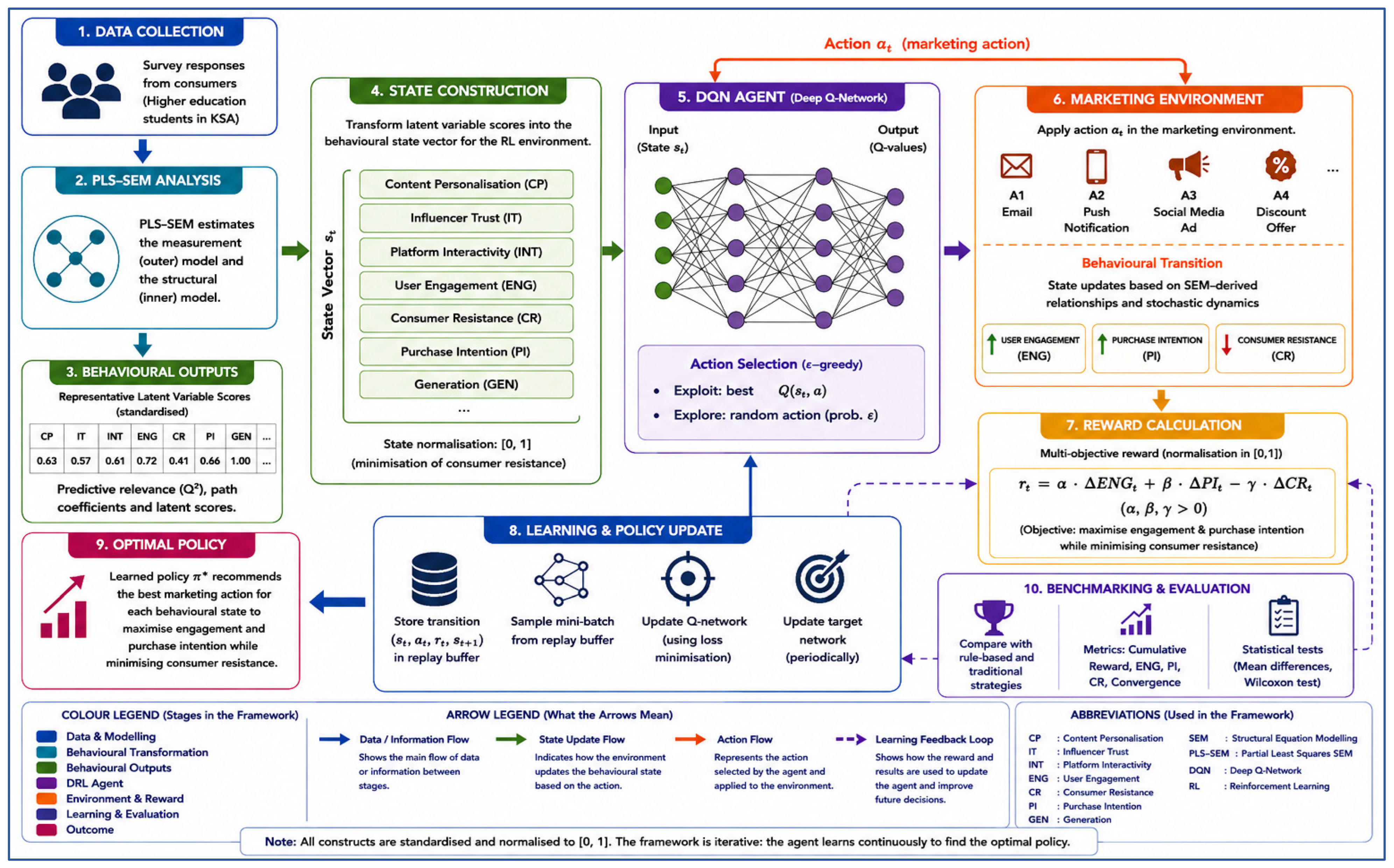
Figure 1 illustrates the complete workflow of the proposed behaviour-driven Deep Reinforcement Learning framework. The framework demonstrates how survey responses are first analysed using Partial Least Squares Structural Equation Modelling (PLS-SEM) to estimate latent constructs and structural relationships, thereby establishing an empirically validated behavioural knowledge base for the optimisation process [
28].
The resulting latent variable scores and statistically significant path coefficients are subsequently transformed into behavioural state representations that initialise the Deep Q-Network environment. During training, the agent selects marketing actions using an ε-greedy exploration strategy, receives rewards that simultaneously maximise user engagement and purchase intention while minimising consumer resistance, and iteratively updates its policy through experience replay and target network optimisation in accordance with the DQN learning paradigm [
27,
39].
The proposed framework therefore integrates data-driven behavioural modelling with sequential decision optimisation, enabling marketing policies to adapt dynamically to observed behavioural responses while remaining grounded in empirically validated consumer relationships. Finally, the learned policy is benchmarked against conventional static and rule-based marketing strategies. Similar DRL-based optimisation frameworks have demonstrated superior performance in recommender systems and sequential decision-making applications, supporting the suitability of the proposed approach for adaptive AI-enabled marketing environments [
16].
Collectively,
Figure 1 demonstrates that the computational component is not an independent optimisation module but a behaviourally informed adaptive decision-making framework in which the state representation, reward mechanism, and learning process are derived directly from empirical behavioural evidence. To facilitate methodological transparency and reproducibility, all architectural configurations, hyperparameter settings, convergence criteria, benchmarking procedures, and behavioural state-generation mechanisms are explicitly reported. The optimisation framework was intentionally designed as a behaviour-driven simulation environment, enabling future studies to reproduce, extend, or adapt it using alternative behavioural datasets or application domains.
Algorithm 1 summarises the complete optimisation procedure underlying the proposed framework. It illustrates how behavioural knowledge extracted from the PLS-SEM analysis is transformed into the DRL state representation, reward function, and policy learning process, thereby enhancing methodological transparency and facilitating reproducibility.
| Algorithm 1. xBehaviourally Informed DQN Framework |
Input:Behavioural latent variable scores obtained from the PLS-SEM model: (CP, IT, INT, ENG, CR, PI) and Generation. Statistically significant structural path coefficients.
|
| Output: |
For each episode (=1, U+2026, 500):- 1.
Observe the current behavioural state (S_t). - 2.
Select a marketing action (A_t) using the ε-greedy policy:
- ▪
Increase content personalisation; - ▪
Increase influencer promotion; - ▪
Increase platform interactivity; - ▪
Maintain the current strategy; - ▪
Apply a combined adaptive strategy.
- 3.
Execute the selected action. - 4.
Compute the behavioural reward: [ R = α(ENG) + β(PI) − γ(CR). ] - 5.
Generate the next behavioural state (S_{t + 1}). - 6.
Store the transition [ (S_t, A_t, R,S_{t + 1}) ] in replay memory. - 7.
Sample a mini-batch from replay memory. - 8.
Update network weights using temporal-difference learning. - 9.
Update the target network every ten episodes.
|
End For- 1.
Evaluate convergence - ○
Compute the moving-average cumulative reward. - ○
Stop training when the reward changes by less than 1% over 50 consecutive episodes.
- 2.
Policy evaluation - ○
Repeat training for 30 independent simulation runs. - ○
Compare the learned policy with:
- ▪
Static Strategy. - ▪
Rule-Based Strategy.
- ○
Evaluate using: - ▪
Cumulative reward. - ▪
User engagement. - ▪
Purchase intention. - ▪
Consumer resistance.
- 3.
Return - ○
Optimal resistance-aware adaptive marketing policy (π).
|
The proposed optimisation framework is deterministic given the same behavioural inputs and hyperparameter configuration. Although the behavioural environment is simulation-based, all state transitions are generated from empirically estimated structural path coefficients obtained through PLS-SEM rather than arbitrary stochastic assumptions. Consequently, the optimisation process remains reproducible while preserving behavioural realism, allowing future studies to replicate or extend the framework using alternative datasets or application domains.
4. Results
Table 2 presents the assessment of the measurement model quality for the conceptual framework, based on a sample of 619 higher education students. The results demonstrate strong reliability and validity across all constructs, indicating that the measurement model is appropriate for structural equation modelling analysis.
Table 3 presents the measurement model assessment results. All constructs demonstrate satisfactory reliability and validity. Indicator loadings exceeded recommended thresholds, Composite Reliability and Cronbach’s alpha values confirmed strong internal consistency, and all AVE values surpassed the minimum criterion of 0.50. These findings indicate that the measurement model has adequate psychometric quality and is suitable for subsequent evaluation of the structural model.
The discriminant validity results reported in
Table 3,
Table 4 and
Table 5 further support the robustness of the measurement model. The cross-loading analysis confirmed that each indicator loaded highest on its intended construct, while the Fornell–Larcker and HTMT assessments demonstrated satisfactory construct separation. Collectively, these results indicate that the latent variables are conceptually distinct and statistically reliable.
User engagement demonstrated the strongest positive association with purchase intention, supporting H4. This finding reinforces the central role of engagement as a behavioural mechanism linking social media marketing activities to purchasing behaviour.
The mediation results presented in
Table 6 provide additional insight into this relationship. User engagement significantly mediated the effects of content personalisation, influencer trust, and platform interactivity on purchase intention. Content personalisation and platform interactivity exhibited partial mediation, whereas influencer trust operated through full mediation. These findings suggest that the influence of social media marketing factors on purchasing behaviour is largely explained through their ability to foster consumer engagement.
Table 7a–c present the structural model results. Content personalisation, influencer trust, and platform interactivity were all significantly associated with user engagement, supporting H1–H3. Among these factors, content personalisation exhibited the strongest relationship with engagement, underscoring the importance of delivering relevant, customised experiences in social media marketing environments. Platform interactivity also demonstrated a substantial contribution, suggesting that active participation and two-way communication remain important drivers of consumer involvement. Although influencer trust showed a comparatively small effect, it remained a significant predictor of engagement, emphasising the enduring importance of credibility and authenticity in digital marketing.
The consumer resistance model produced complementary findings. Content personalisation, influencer trust, and platform interactivity were all negatively associated with consumer resistance, supporting H7a–H7c. Influencer trust emerged as the strongest predictor of reduced resistance, indicating that credible, trustworthy communication plays a critical role in mitigating scepticism toward AI-enabled marketing practices. Furthermore, consumer resistance was negatively associated with purchase intention, supporting H7d. This result confirms that resistance functions as a meaningful behavioural barrier that may weaken purchasing behaviour when consumers perceive marketing activities as intrusive, opaque, or untrustworthy.
Taken together, the structural model highlights two complementary behavioural pathways through which social media marketing influences purchasing outcomes. The first operates through increasing user engagement, while the second operates through reducing consumer resistance. These findings reinforce the conceptual importance of considering both positive and negative consumer responses when evaluating marketing effectiveness.
Before interpreting structural relationships, collinearity diagnostics were examined. The VIF values reported in
Table 6 remained well below recommended thresholds, indicating the absence of problematic multicollinearity and supporting the stability of the estimated relationships.
Table 8a,b present the model fit and predictive assessment results. The SRMR and NFI values indicate satisfactory model fit, suggesting that the proposed framework adequately represents the observed data. The model also demonstrated substantial explanatory power and predictive relevance, as evidenced by the R
2 and Q
2 values for user engagement and purchase intention. These findings confirm that the framework provides a robust explanation of consumer behaviour in social media marketing environments.
The Multi-Group Analysis results are presented in
Table 9. Significant differences were observed between Generations Z and Y across all hypothesised moderating relationships, supporting H6a–H6d. Generation Z exhibited stronger responses to content personalisation and platform interactivity, whereas Generation Y demonstrated greater responsiveness to influencer trust. These findings are consistent with Generational Cohort Theory, which suggests that consumers exposed to different technological and social environments develop distinct behavioural preferences. The stronger relationship between user engagement and purchase intention among Generation Z consumers further suggests that engagement translates more directly into purchasing behaviour for digitally native users.
The reported 36% performance improvement was calculated by comparing the average cumulative reward of the DRL strategy against the static baseline strategy:
Across repeated simulation runs, the DRL framework achieved an average improvement of approximately 36%, while simultaneously reducing consumer resistance by nearly 40% relative to the static baseline. These results suggest that adaptive optimisation, informed by behavioural variables, may yield superior marketing outcomes compared with fixed or manually designed decision rules under simulated conditions.
Table 10a,b summarise the comparative evaluation of the three optimisation approaches across 30 independent simulation runs. Performance values represent the average cumulative behavioural reward obtained after convergence. The reward function simultaneously maximised user engagement and purchase intention while minimising consumer resistance. Consequently, higher performance scores indicate more effective behavioural optimisation. The behaviour-informed DQN framework consistently achieved superior results compared with both static and rule-based strategies across Generations Z and Y.
The DRL strategy achieved the lowest levels of consumer resistance and the highest overall optimisation performance across both generational groups. Compared with the static baseline, the DRL framework reduced consumer resistance by approximately 40% and achieved an overall performance improvement of approximately 36%.
Importantly, these improvements were achieved through a resistance-aware optimisation process. Unlike traditional approaches that focus primarily on engagement or conversion outcomes, the proposed framework explicitly incorporates consumer resistance into the reward structure. Consequently, the DRL agent continuously adapted marketing decisions to maximise engagement and purchase intention while simultaneously minimising resistance. This finding demonstrates the practical value of integrating behavioural theory and adaptive AI within a unified optimisation framework.
The results also indicate slightly stronger optimisation gains among Generation Z consumers, which is consistent with the moderation results reported earlier. This pattern suggests that adaptive and personalised marketing strategies may be particularly effective for consumers who are highly accustomed to digital interaction and algorithm-driven experiences.
Finally,
Table 11 presents the MICOM assessment results. Configural invariance, compositional invariance, and equality of means and variances were successfully established across both generational groups. These findings confirm full measurement invariance and indicate that the observed differences between Generation Z and Generation Y reflect genuine structural variations rather than measurement inconsistencies. Consequently, the Multi-Group Analysis results can be interpreted with confidence.
5. Discussion
This study examined the relationships among social media marketing strategies, user engagement, consumer resistance, and purchase intention within e-commerce environments. By integrating behavioural marketing theory with a Deep Reinforcement Learning (DRL) framework, the study provides a comprehensive perspective on how adaptive marketing strategies are associated with positive consumer responses and addresses behavioural barriers to purchasing.
The findings indicate that content personalisation, influencer trust, and platform interactivity are positively associated with user engagement. These results are consistent with prior research suggesting that relevant content, credible information sources, and interactive digital experiences are associated with stronger emotional, cognitive, and behavioural involvement in online environments [
3,
4,
18,
19,
20]. Among these factors, content personalisation demonstrated the strongest association with engagement, highlighting the importance of relevance and contextual fit in contemporary social media marketing. The mediation findings further suggest that engagement may function as an important behavioural pathway through which social media marketing factors influence purchase intention, extending prior research that has largely focused on direct effects between marketing stimuli and purchase outcomes [
16,
35].
The central contribution of this study is the conceptualisation of consumer resistance as the primary behavioural mechanism that links AI-enabled social media marketing to adaptive optimisation. Whereas previous studies have primarily focused on maximising user engagement and purchase intention, the proposed framework is organised around reducing consumer resistance as the principal behavioural objective. Within this resistance-aware framework, user engagement and purchase intention are conceptualised as desirable outcomes resulting from the successful reduction in consumer resistance rather than as independent optimisation targets. This perspective repositions consumer resistance from a secondary behavioural outcome to the central construct governing adaptive marketing decisions. Consistent with this conceptualisation, the negative relationships between content personalisation, influencer trust, platform interactivity, and consumer resistance indicate that consumers are less likely to resist marketing initiatives when communications are perceived as relevant, credible, and interactive. Furthermore, the negative association between consumer resistance and purchase intention confirms that resistance represents a critical behavioural barrier that constrains purchasing decisions and ultimately limits the effectiveness of AI-enabled digital marketing strategies.
The findings also highlight the importance of transparency and trust in AI-driven marketing environments. Although personalised recommendations can enhance relevance, increase engagement, and reduce consumer resistance, excessive personalisation may also raise concerns regarding privacy, surveillance, behavioural manipulation, and the erosion of consumer autonomy. Likewise, limited transparency in algorithmic decision-making may undermine trust and increase scepticism, even when recommendation accuracy is high. These findings suggest that the effectiveness of AI-enabled marketing should be evaluated not only by engagement and conversion metrics but also by its ability to minimise consumer resistance through transparent, explainable, and trustworthy interactions. Consequently, adaptive marketing systems should incorporate principles of explainable artificial intelligence (XAI), privacy-by-design, informed consent, and algorithmic accountability to strengthen consumer trust and support sustainable, responsible digital marketing practices.
The Multi-Group Analysis revealed meaningful differences between Generations Z and Y, supporting the relevance of Generational Cohort Theory. Generation Z consumers were more responsive to content personalisation and platform interactivity, whereas Generation Y consumers were more responsive to influencer trust. These differences may reflect distinct patterns of digital socialisation and technology adoption. Having grown up within highly personalised and interactive digital ecosystems, Generation Z appears to place greater value on customised and immersive experiences. In contrast, Generation Y appears to rely more heavily on credibility, trustworthiness, and information quality when evaluating marketing messages [
22,
34]. The stronger relationship between engagement and purchase intention among Generation Z consumers further suggests that social media experiences are more directly connected to purchasing behaviour for digitally native users.
One of the most distinctive aspects of the study is the integration of behavioural theory with Deep Reinforcement Learning. Unlike previous research that has treated behavioural modelling and AI optimisation as separate analytical domains, the present framework embeds behavioural constructs directly within the optimisation process. User engagement, consumer resistance, purchase intention, personalisation, trust, and interactivity were incorporated into the behavioural state representation and reward structure of the DRL environment. Consequently, optimisation decisions were informed by empirically validated behavioural relationships rather than solely by computational performance objectives.
The optimisation results suggest that behaviour-informed DRL strategies may outperform conventional static and rule-based approaches under simulated conditions. Importantly, these improvements were achieved through a resistance-aware optimisation process that simultaneously considered engagement, purchase intention, and consumer resistance. This finding suggests that behavioural theory may provide a useful foundation for adaptive AI decision-making. Nevertheless, these results should be interpreted with caution, as the optimisation framework was evaluated in a simulation environment informed by behavioural survey data rather than deployed on a live commercial platform.
Several alternative explanations and limitations should also be considered. First, the observed relationships may partially reflect respondents’ general attitudes toward social media and digital technologies rather than the isolated effects of the specific marketing factors examined. Individuals who are more digitally engaged may naturally report higher engagement, lower resistance, and stronger purchase intentions. Second, a cross-sectional design precludes definitive conclusions about causality. Although the proposed framework assumes that marketing factors are associated with engagement and resistance, reciprocal relationships may also exist. Highly engaged consumers may actively seek personalised content, interactive experiences, and influencer recommendations. Third, because all constructs were measured using self-reported survey responses collected at a single point in time, common method bias cannot be completely excluded despite the satisfactory reliability and validity results. Future studies should incorporate behavioural analytics, transaction records, clickstream data, and platform-generated metrics to strengthen external validity.
The findings should also be interpreted within the specific cultural and technological context of Saudi Arabia, which is characterised by high levels of social media usage, mobile technology adoption, and digital transformation. Consumer responses to personalisation, influencer marketing, and AI-enabled recommendations may differ across countries with different cultural norms, regulatory frameworks, and attitudes toward privacy and technology. Consequently, further cross-cultural validation is required before generalising the findings to other contexts.
Overall, the study extends existing research by positioning consumer resistance as a central behavioural outcome, demonstrating meaningful generational differences in social media marketing responses, and integrating behavioural theory with adaptive AI optimisation. The findings suggest that effective AI-enabled marketing strategies should not focus exclusively on maximising engagement and conversion outcomes. Still, they should also address consumer resistance, transparency, trust, and responsible AI principles to support sustainable digital commerce.
6. Conclusions
This study proposes a resistance-aware behavioural optimisation framework that positions consumer resistance as the central behavioural construct governing adaptive AI-enabled social media marketing. By integrating consumer resistance directly into both the behavioural model and the reward mechanism of a Deep Reinforcement Learning (DRL) framework, the proposed approach shifts the optimisation objective from maximising user engagement alone to simultaneously reducing behavioural resistance while enhancing user engagement and purchase intention. In doing so, the study establishes a unified behavioural–computational framework in which empirically validated behavioural relationships directly inform adaptive marketing optimisation.
The findings indicate that content personalisation, influencer trust, and platform interactivity are positively associated with user engagement and negatively associated with consumer resistance. User engagement was positively associated with purchase intention, whereas consumer resistance was negatively associated with purchase intention, highlighting its role as a significant behavioural barrier that may constrain purchasing behaviour in AI-enabled digital commerce. The results also revealed meaningful differences between Generations Z and Y, underscoring the importance of generational segmentation when designing adaptive social media marketing strategies. Furthermore, the proposed behaviourally informed DRL framework achieved superior optimisation performance compared with conventional static and rule-based approaches within the simulated marketing environment.
Overall, the findings suggest that effective AI-enabled social media marketing should extend beyond maximising engagement and purchase outcomes to prioritise reducing consumer resistance through transparent, trustworthy, and adaptive marketing practices. By aligning adaptive optimisation with empirically validated behavioural evidence and responsible AI principles, the proposed framework provides a foundation for developing more effective, explainable, and consumer-centred digital marketing strategies.
7. Theoretical and Practical Contributions
The primary theoretical contribution of this study is the repositioning of consumer resistance from a secondary behavioural outcome to the central behavioural construct underpinning AI-enabled social media marketing optimisation. The proposed resistance-aware framework demonstrates that reducing consumer resistance constitutes the behavioural foundation of adaptive marketing decision-making, with user engagement and purchase intention emerging as complementary outcomes of effective resistance-aware optimisation. This perspective extends the existing behavioural marketing literature by shifting the focus from maximising engagement alone to balancing engagement with mitigating consumer resistance.
Second, the study advances behavioural marketing research by integrating content personalisation, influencer trust, platform interactivity, user engagement, consumer resistance, and purchase intention within a unified explanatory framework. By simultaneously examining both positive and negative behavioural responses, the proposed framework provides a more comprehensive understanding of consumer behaviour in AI-enabled social media marketing environments.
Third, the study extends Generational Cohort Theory by demonstrating that behavioural responses to content personalisation, influencer trust, and platform interactivity differ systematically between Generations Z and Y. These findings suggest that generational differences reflect distinct patterns of digital socialisation, technology adoption, and information processing rather than merely demographic variation, thereby highlighting the importance of generation-specific marketing strategies.
Fourth, the study contributes to the emerging literature on AI-enabled marketing by integrating empirically validated behavioural relationships directly into a behaviourally informed Deep Reinforcement Learning (DRL) framework. Unlike previous studies that have examined behavioural modelling and artificial intelligence separately, the proposed framework embeds latent behavioural constructs and structural relationships within the state representation, reward mechanism, and policy-learning process of the Deep Q-Network (DQN). This integration establishes a unified behavioural–computational framework in which adaptive marketing policies are learned from empirically validated behavioural evidence rather than predefined optimisation assumptions.
From a practical perspective, the findings provide actionable guidance for e-commerce organisations, social media marketers, and AI system designers. The results indicate that content personalisation, influencer trust, and platform interactivity are associated with higher user engagement and lower consumer resistance. Accordingly, organisations should design transparent, trustworthy, and user-centred marketing strategies that not only enhance engagement but also minimise resistance arising from privacy concerns, perceived intrusiveness, scepticism, and distrust of AI-enabled marketing practices.
The findings further indicate that marketing strategies should be adapted to generational preferences. Generation Z consumers respond more positively to personalised and interactive digital experiences, whereas Generation Y consumers place greater emphasis on influencer credibility, trust, and information quality. These differences underscore the importance of adaptive market segmentation rather than standardised marketing approaches.
Finally, this study demonstrates the value of integrating behavioural analytics with adaptive AI-driven decision-making. Although evaluated within a simulated environment, the proposed behaviourally informed DRL framework illustrates how empirically validated behavioural insights can be incorporated into intelligent marketing systems to support adaptive decision-making, enhance user engagement, reduce consumer resistance, and improve optimisation performance. Therefore, the proposed framework provides a foundation for future AI-enabled marketing systems that are not only more effective but also more transparent, trustworthy, and aligned with the principles of responsible artificial intelligence.
8. Opportunities, Limitations, and Future Research
Several opportunities emerge from the findings of this study. The integration of behavioural modelling and Deep Reinforcement Learning provides a foundation for future interdisciplinary research combining consumer behaviour, marketing analytics, and adaptive artificial intelligence. The framework may also be extended to other digital contexts, including online retail platforms, mobile commerce applications, recommendation systems, and personalised service environments.
Nevertheless, several limitations should be acknowledged. First, the study employed a cross-sectional design, which limits the ability to establish temporal ordering and causal direction among the examined relationships. Second, all constructs were measured using self-reported survey data, which may introduce common method bias despite the satisfactory reliability and validity of the measurement model. Third, the study was conducted among higher education students in Saudi Arabia, and the findings should therefore be interpreted within this specific cultural and technological context. Finally, the DRL framework was evaluated in a behavioural simulation environment rather than by implementing it on a live commercial platform.
Future research should address these limitations in several ways. Longitudinal and experimental designs would help clarify the stability and directionality of the relationships among social media marketing factors, engagement, consumer resistance, and purchase intention over time. Researchers should also incorporate behavioural and platform-generated data, including clickstream records, transaction histories, engagement analytics, and real-time interaction measures, to complement self-reported perceptions and provide more objective evidence of consumer behaviour.
Additional cross-cultural investigations are needed to evaluate the generalisability of the findings across different regulatory, technological, and cultural environments. Comparative studies may help determine whether the observed relationships remain stable across countries with different attitudes toward privacy, digital marketing, and AI adoption.
Future studies should also extend the framework by incorporating responsible AI constructs, including algorithmic transparency, explainability, perceived fairness, privacy concerns, and trust in AI systems. These variables may provide a deeper understanding of how ethical considerations influence consumer acceptance of AI-enabled marketing strategies. Finally, future research should evaluate behaviour-informed reinforcement learning systems in real-world commercial environments to assess their effectiveness, scalability, and ethical implications under dynamic market conditions.