
Article

Perception and Trust Construction in Rural Livestreaming E-Commerce: Evidence from Consumer Purchase Intention in Emerging Economies

1
College of Fashion and Design, Donghua University, Shanghai 200050, China
2
Aviation Industry Development Research Center of China, Beijing 100029, China
3
School of Business, Renmin University of China, Beijing 100872, China
*
Author to whom correspondence should be addressed.
These authors contributed equally to this work.
J. Theor. Appl. Electron. Commer. Res. 2026, 21(7), 216; https://doi.org/10.3390/jtaer21070216
Submission received: 4 May 2026 / Revised: 29 June 2026 / Accepted: 6 July 2026 / Published: 8 July 2026

Abstract

Against the backdrop of the rapid development of digital marketing in emerging economies, livestreaming e-commerce provides a new pathway for products from resource-constrained regions to overcome geographical limitations and expand market channels. Existing studies have largely focused on the sales performance, platform models, or general determinants of purchase intention in livestreaming e-commerce, while insufficient attention has been paid to the formation mechanism of consumers’ purchase intention within livestreaming interactions. Drawing on the S-O-R model and interaction ritual chain theory, this study constructs a theoretical model of how rural livestreaming e-commerce influences consumer purchase intention. Specifically, live streaming scenario atmosphere, product packaging, anchor interaction, and consumer engagement are identified as key stimulus factors. This study examines how these factors influence purchase intention through affective perception, cultural perception, and consumer trust, and further investigates the moderating role of emotional energy. The results show that: (1) the four livestreaming interaction factors significantly enhance consumers’ affective perception and cultural perception; (2) affective perception and cultural perception each form a chain mediation path with consumer trust, playing an important transmission role between livestreaming stimuli and purchase intention; and (3) emotional energy strengthens the effects of certain livestreaming stimuli on consumers’ psychological perceptions. This study reveals the pathway of “livestreaming stimuli–affective/cultural perception–consumer trust–purchase intention,” and provides strategic implications for livestreaming marketing, local brand communication, and rural economic development.

1. Introduction

Emerging economies are generally understood as economies undergoing rapid growth, market opening, and institutional transformation. Hoskisson et al. define emerging economies as low-income, high-growth countries or regions whose primary engine of growth is economic liberalization [1]. Compared with mature markets, marketing activities in emerging economies rely more heavily on channel innovation, trust construction, and the reconfiguration of consumer relationships within specific contexts. Sheth notes that emerging markets differ from mature markets in terms of consumer behavior, market structure, and resource conditions, and therefore existing marketing theories need to be re-examined in specific contexts [2]. Khanna et al. also show that the underdevelopment of intermediary institutions, regulatory systems, and enforcement mechanisms in emerging markets affects transactions and the formation of trust between firms and consumers [3]. Research on emerging economies does not merely describe the economic growth of particular countries or regions; rather, it emphasizes how firms, platforms, and consumers accomplish market exchange through new forms of organization, channel mechanisms, and trust relationships under conditions of limited resources, institutional imperfection, and complex market structures. Therefore, existing marketing theories need to be re-examined in specific contexts. These studies provide an important foundation for understanding digital marketing in emerging economies. However, their discussions have focused mainly on macro-level market conditions, institutional constraints, and firms’ adaptive strategies, while offering insufficient explanation of how digital platforms transform local resources, reconstruct consumer trust, and influence purchase intention in specific consumption contexts.
Rural e-commerce livestreaming can be understood as a concrete practice of digital marketing in emerging economies. Through real-time video, anchor explanations, platform recommendations, instant interaction, and consumer feedback, it integrates product presentation, relational communication, and transaction conversion within the same digital field. Zhao’s study on farmers’ adoption intention of livestreaming e-commerce shows that livestreaming e-commerce can provide new digital channels for the sale of agricultural products and promote the transformation of agricultural product circulation [4]. Meanwhile, situating rural e-commerce livestreaming within the context of emerging economies helps explain how resource-constrained regions can use platformized, interactive, and real-time forms of digital marketing to compensate for limited market reach, information asymmetry, and difficulties in trust construction. Kannan and Li argue that digital marketing is reshaping the touchpoints between firms and consumers, as well as marketing processes and modes of value creation [5]. Dwivedi et al. also point out that digital and social media marketing has become an important field for understanding consumer behavior, customer relationships, and business innovation [6]. The above studies have tended to focus more on general consumer interaction, information dissemination, brand communication, and purchase conversion, while paying insufficient attention to how resource-constrained regions use digital platforms to compensate for limited market reach, weak branding capabilities, and fragile foundations of trust. In particular, when rural products enter digital markets, consumers are confronted not only with product information or price signals, but also with complex cues such as authenticity of origin, local cultural meanings, visualization of the production process, and rural lifestyles. Existing research has not yet fully explained how these localized cues further influence purchase intention through consumers’ affective perception, cultural perception, and trust formation.
Compared with general livestreaming e-commerce, rural livestreaming e-commerce does not achieve transaction conversion merely through anchor recommendations, price discounts, and platform traffic. Instead, it places greater emphasis on the composite value of place-of-origin authenticity, green quality, and local cultural expression. Li et al. point out that livestreaming for agricultural assistance differs from general livestreaming e-commerce in that its goal is not only to sell products, but also to help farmers sell agricultural products, mobilize social resources, and promote increases in farmers’ income, thereby demonstrating certain public-oriented characteristics [7]. Meanwhile, Dong et al.’s study on livestreaming for green agricultural products shows that consumers’ purchase intention is influenced not only by the quality of livestreaming e-commerce, but also by psychological mechanisms such as green trust [8]. This suggests that trust building in the livestreaming of rural products is more critical than in the livestreaming of general commodities. In addition, Li et al. propose that the visualization of agricultural production processes can influence purchase intention in agricultural-assistance livestreaming through consumer trust [9]. These studies indicate that authenticity presentation and trust construction are of great significance in rural livestreaming. However, existing research still tends to treat trust primarily as a key psychological mechanism, while paying insufficient attention to the roles of affective perception, cultural perception, and emotional energy in the interactive process.
Therefore, this study attempts to address three research gaps. First, by taking rural e-commerce livestreaming in emerging economies as the research context, this study explains, from the perspective of consumers’ psychological mechanisms, how resource-constrained regions achieve local value communication and trust construction through livestreaming platforms. Second, it supplements current understanding of how authenticity of origin, rural cultural expression, and local value cues in rural e-commerce livestreaming influence consumers’ purchase intention. Third, by integrating the S-O-R framework with interaction ritual chain theory, this study incorporates affective perception, cultural perception, and emotional energy into a unified theoretical framework. It further analyzes the moderating effect of emotional energy in the process of livestreaming interaction, explaining how livestreaming interaction influences consumers’ purchase intention through emotional amplification and the recognition of cultural meaning.
On the basis of literature on livestreaming e-commerce, agricultural product livestreaming, and consumer behavior, this study extracts the stimulus factors. First, based on the S-O-R model, Shi et al. pointed out that atmospheric cues in e-commerce livestreaming, including the color and lighting design of the livestreaming room, the professionalism of the anchor, and consumers’ participation in the livestreaming room, influence consumers’ impulse buying behavior through social presence [10]. Xia et al. also examined social cues, including anchor interaction and peer interaction, and media cues, including vividness and authenticity, confirming that livestreaming environmental cues can trigger online impulse buying [11]. These studies indicate that scenario presentation, interactive atmosphere, and media characteristics in livestreaming contexts may influence consumer purchase intention through social presence, perceived trust, and emotional responses.
Second, Zhang et al. noted that product presentation in livestreaming differs from traditional e-commerce webpages. It provides richer visual cues through multi-angle display and sensory information, thereby influencing consumers’ understanding of product value [12]. Meanwhile, Tang et al. further found, in the context of agricultural product livestreaming, that the visual appearance of agricultural product packaging, namely the expression of cultural connotations through design symbols, influences consumers’ perceptions and repurchase intention [13]. Therefore, in rural e-commerce livestreaming, product packaging is not only a medium for presenting product information, but may also serve as an important visual cue that stimulates emotional perception and cultural perception.
In addition, apart from livestreaming atmosphere and product packaging presentation, interaction in the livestreaming room is also a major factor that promotes purchase behavior. This study divides the interaction factors in the livestreaming room into anchor interaction and consumer interaction. Li’s study shows that high interactivity in the livestreaming process can enhance consumers’ cognitive trust. Real-time communication and responses can improve consumers’ judgments of the anchor’s professionalism and reliability [14]. Moreover, Addo et al. find that customer engagement behaviors such as chatting, liking, visiting, and viewing duration are significantly related to attention and purchase intention [15]. Zheng et al. further explained from the perspective of customer engagement in livestreaming that customer engagement behavior can influence purchase intention and customer acquisition [16]. Therefore, both anchor-guided interaction and spontaneous consumer discussions around livestreaming content may influence consumers’ cognition, emotions, and trust toward products, thereby promoting purchase behavior.
It should be noted that the livestreaming cues identified in this study do not imply the same degree of controllability. Livestreaming scenarios and product packaging are relatively more designable and adjustable; anchor interaction can be organized and guided through communication strategies, response styles, and livestreaming rhythm; whereas consumer interaction is more of an emergent social cue. Although it can be encouraged or shaped through platform mechanisms, anchor guidance, and activity design, it cannot be fully controlled by merchants or anchors. Therefore, this study conceptualizes these factors as external cues in rural e-commerce livestreaming rather than as fully controllable marketing stimuli.
However, merely identifying these influencing factors is still insufficient to explain the formation process of consumers’ purchase intention. The key lies in clarifying how external livestreaming stimuli enter consumers’ psychological processing and are further transformed into purchase intention. Based on this, this paper introduces the S-O-R (Stimulus–Organism–Response) model. In 1929, Woodworth proposed the “S-O-R” formula, emphasizing the mediating role of the organism between stimulus and response [17]. He argued that after a stimulus (S) acts on the organism (O), a series of physiological and psychological changes occur within the organism. These changes function as mediating variables and eventually lead to a specific response (R). Subsequently, Mehrabian and Russell introduced the S-O-R theory into environmental psychology in 1974 [18], further developing the theory by emphasizing that consumer behavior is triggered by stimuli. These stimuli may originate not only from consumers’ internal physiological and psychological factors, but also from the external environment.
The formation of consumer purchase intention has long been an important issue in consumer behavior research. Existing studies have explained the relationships among consumer attitudes, cognitive judgments, and behavioral intentions from different theoretical perspectives. For example, the Theory of Reasoned Action emphasizes the influence of individual attitudes and subjective norms on behavioral intention; the Theory of Planned Behavior further introduces perceived behavioral control to explain how individuals form behavioral intentions under specific conditions; the Technology Acceptance Model mainly focuses on how perceived usefulness and perceived ease of use affect users’ acceptance of technological systems; and the Elaboration Likelihood Model explains how consumers form attitude judgments through central or peripheral routes from the perspective of information processing. These theories provide an important foundation for understanding consumer decision-making and offer necessary theoretical references for research on purchase intention in livestreaming commerce.
However, purchase intention in rural e-commerce livestreaming is not determined solely by consumers’ existing attitudes, technology acceptance, or rational behavioral judgments. Livestreaming contexts often involve multiple external cues, including scenario presentation, product packaging, anchor expression, real-time interaction, and collective participation. These cues jointly shape consumers’ psychological states through visual presentation, emotional arousal, cultural association, and social interaction. Therefore, this study requires an analytical framework that can connect external contextual cues, internal psychological responses, and behavioral intention.
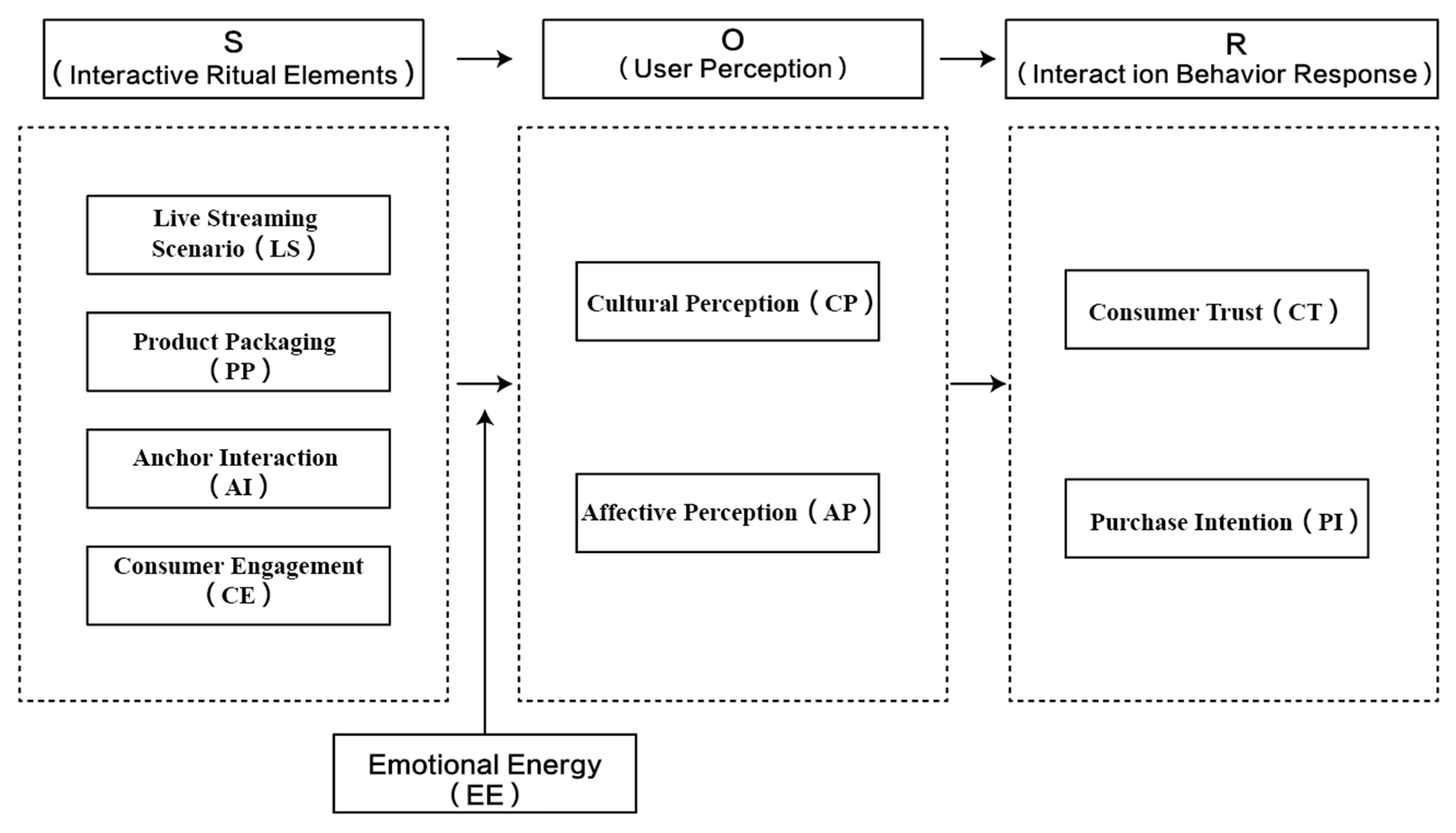
Based on this research objective, this study adopts the “Stimulus–Organism–Response” framework as the basic analytical structure. This framework provides a relatively clear explanation of how external environmental cues influence behavioral responses through individuals’ internal psychological states. In this study, rural livestreaming scenarios, product packaging, anchor interaction, and consumer interaction are regarded as external cues in the livestreaming context; emotional perception, cultural perception, and consumer trust are treated as consumers’ internal psychological states; and purchase intention is examined as the behavioral response. Through this structure, this study can more systematically analyze the pathways through which different types of cues in rural e-commerce livestreaming affect consumers’ purchase intention.
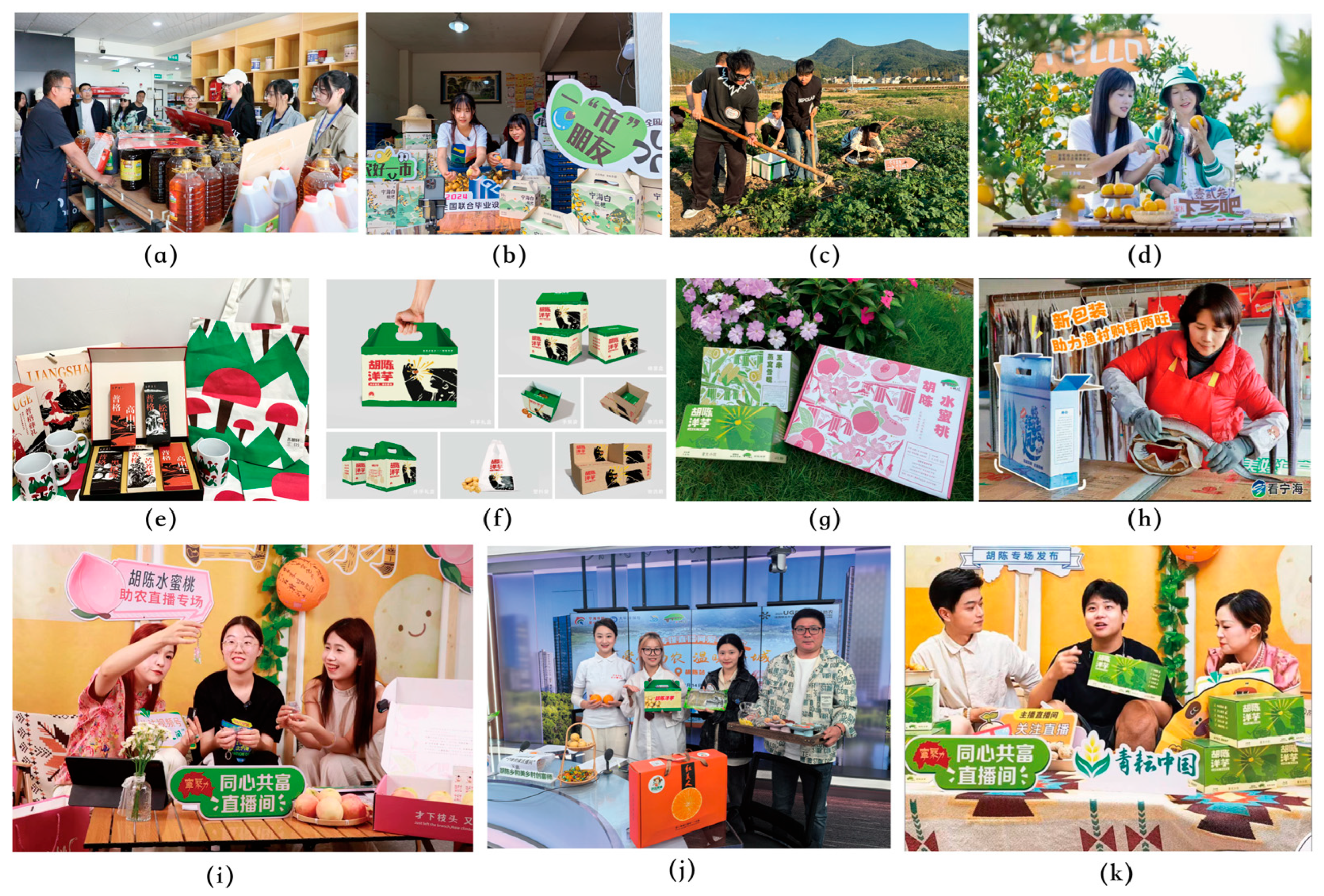
At the same time, livestreaming commerce is not a one-way process of information transmission, but a digital interaction field characterized by real-time interaction, emotional contagion, and collective co-presence. A linear structure of “stimulus–psychological state–behavioral response” alone remains insufficient to fully explain how emotions are continuously aroused, accumulated, and strengthened during livestreaming interactions. Therefore, this study further introduces interaction ritual chain theory to explain the generation of emotional energy in livestreaming interactions and its reinforcing effect on consumers’ psychological responses. Accordingly, the S-O-R framework provides the basic structure of “external cues–internal psychology–behavioral response,” while interaction ritual chain theory further reveals the emotional amplification mechanism embedded in livestreaming interaction. Based on the above literature review and practical cases of rural livestreaming e-commerce (Figure 1), this study identifies four key categories of stimulus factors: livestreaming scene, product packaging, anchor interaction, and consumer engagement. It examines how these factors influence consumers’ affective perception and cultural perception, and how they further affect purchase intention through consumer trust. Meanwhile, emotional energy is introduced as a moderating variable to analyze whether it strengthens the effects of anchor interaction and consumer engagement on consumers’ psychological perceptions. Around this objective, this paper aims to address three core questions:
RQ1: In the context of emerging economies, how can rural livestreaming e-commerce enhance consumers’ purchase intention toward rural products?
RQ2: How do scenarios, symbols, and interaction elements in rural livestreaming e-commerce affect consumers’ psychological perceptions and trust formation?
RQ3: How does emotional energy influence the transformation process from consumer perception to purchase intention in rural livestreaming e-commerce?
Compared with existing studies, this study makes three main contributions. First, it distinguishes rural livestreaming e-commerce from general livestreaming e-commerce research by emphasizing its local, cultural, and interactive characteristics. Second, it incorporates affective perception and cultural perception into the purchase intention model simultaneously, thereby explaining the psychological chain of “affection–culture–trust” in rural product consumption. Third, it introduces emotional energy from the interaction ritual chain theory to further reveal the boundary conditions through which the interactive atmosphere and emotional accumulation in livestreaming rooms influence consumer perception and purchase conversion.

2. Theory and Hypotheses

2.1. Rural Livestreaming E-Commerce

With the widespread adoption of digital platforms, mobile payment, short-video communication, and livestreaming technologies, livestreaming e-commerce has gradually expanded from urban consumption contexts to rural industrial contexts. It has become an important form of digital marketing for agricultural product sales, local brand communication, and rural economic transformation. Li et al. define farmer-assistance livestreaming as a new form of e-commerce that aims to serve the overall interests of farmers and rural areas, uses online livestreaming platforms as its tool, and takes the sale of agricultural products as its means. They further point out that its essence lies in livestreaming e-commerce with agricultural products as the primary transaction object [7]. Compared with traditional agricultural product e-commerce, rural livestreaming e-commerce not only presents product appearance, production environments, and production processes through real-time video, but also reduces consumers’ uncertainty about product quality, origin, and authenticity through anchor explanations, scenario-based presentation, and instant interaction. From the perspectives of emerging economies and rural economic development, existing research on the application of rural livestreaming e-commerce has mainly focused on three aspects. First, studies have examined the role of livestreaming e-commerce in expanding agricultural product sales channels, namely, how livestreaming platforms can break through the sales radius of traditional offline channels and improve the market reach of agricultural products [19]. Second, research has explored how livestreaming e-commerce promotes rural industrial development by facilitating industrial integration through models such as “livestreaming + agriculture” [4], “livestreaming + cultural tourism” [20], and “livestreaming + local branding” [21]. Third, studies have also addressed practical problems in the development of livestreaming e-commerce, such as the shortage of professional anchors and operational talent, insufficient platform governance mechanisms, and weak agricultural product branding.
Taken together, existing studies generally affirm the positive role of livestreaming e-commerce in promoting agricultural product sales, arguing that it can overcome the temporal and spatial limitations of traditional agricultural product sales and directly connect agricultural products to broader consumer markets through livestreaming platforms. However, clear research gaps remain. On the one hand, existing literature has paid more attention to the development value, operational paths, and optimization strategies of farmer-assistance livestreaming, while offering limited explanation from the buyer’s perspective of why consumers are moved by rural livestreaming and develop purchase intention. On the other hand, although some studies have recognized the importance of anchors, information, and interaction, they tend to overlook interaction among consumers and the group effects generated by livestreaming as an interactive social commerce field.

2.2. The S-O-R Model

The stimulus (S) refers to external environmental factors surrounding individuals and serves as the initial factor that triggers subsequent psychological and behavioral responses. The organism (O) refers to individuals’ internal psychological processing, functioning as the core mediator between stimulus and response. Emotion and perceived value were initially regarded as important constructs of the organism [22]. The response (R) refers to the final behavioral or attitudinal tendency exhibited by individuals after internal psychological processing. Behavioral responses include purchase decisions, clicking behavior, and sharing behavior, while attitudinal responses include positive evaluations and repurchase intention.
At present, S-O-R theory is mainly applied to the study of consumer psychological and behavioral mechanisms [23], environmental stimuli and consumer emotions [24], technology and immersive experiences [25], service quality and customer loyalty [26], social media and information behavior, and sustainable consumption and brand strategy [27]. S-O-R theory has also been gradually applied to cultural contexts, mainly focusing on users’ participation in cultural sharing, sharing intentions, and revisit intentions toward cultural destinations [28,29]. As a commonly used theoretical framework in psychology and consumer behavior research, S-O-R theory essentially explains how external stimuli trigger final behavioral responses through individuals’ internal psychological processes. It is therefore highly suitable for analyzing consumer behavior in rural livestreaming e-commerce in this study (Figure 2).

3. Hypothesis Development and Theoretical Framework

3.1. The Role of Livestreaming Scenarios

The livestreaming scenario is the first external stimulus that consumers encounter when entering a livestreaming shopping context. By placing livestreaming settings in outdoor planting spaces, it provides consumers with a direct sense of local rural atmosphere, while natural landscapes, farming activities and tools, natural lighting, colors, and ambient sounds further strengthen the sense of authentic presence. S-O-R theory suggests that environmental stimuli can elicit consumers’ cognitive and emotional responses and further influence their behavioral tendencies. Shi et al.’s study on atmospheric cues in livestreaming e-commerce shows that informational cues, design cues, and interactive cues can influence consumers’ purchase behavior through social presence [15]. Han et al. also found in their study of agricultural product livestreaming that presence and interactivity can influence consumer trust, resonance, and purchase intention [10]. Therefore, in rural livestreaming e-commerce, an authentic, approachable, and life-oriented scenario atmosphere can not only evoke consumers’ affective engagement but also strengthen their understanding of rural lifestyles and local cultural contexts. Accordingly, this study proposes the following hypotheses:
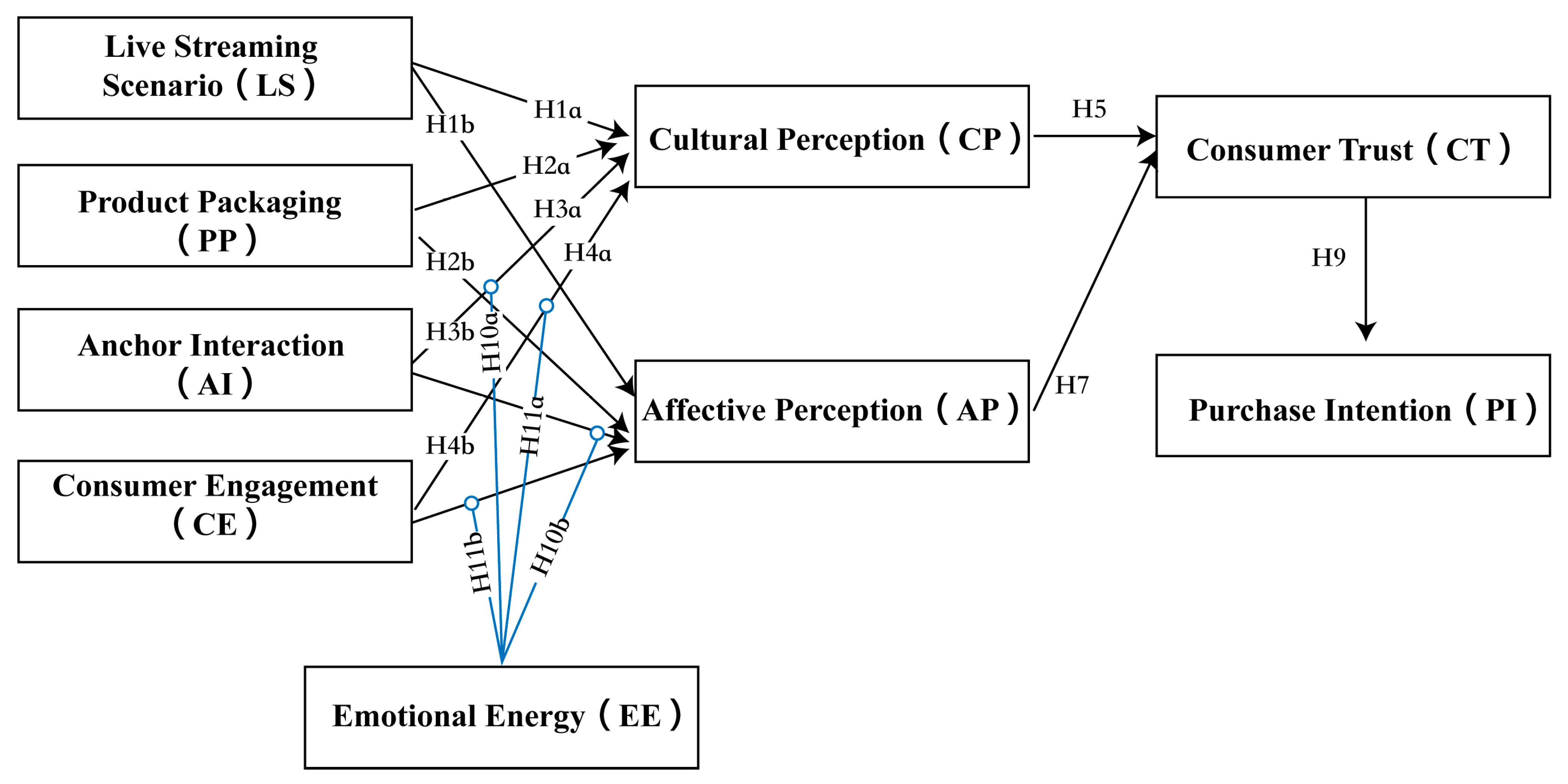
H1a. 
Livestreaming scenarios have a significant positive effect on consumers’ cultural perception.
H1b. 
Livestreaming scenarios have a significant positive effect on consumers’ affective perception.

3.2. The Role of Product Packaging

The application of local colors, regional patterns, folk images, origin stories, and traditional craft symbols in product packaging serves as an important visual and cultural cue that distinguishes rural products from general industrial goods. In livestreaming contexts, product presentation not only provides information about product functions, quality, and usage, but also enhances consumers’ perception of product quality through the presentation of product packaging. Compared with textual and verbal information, visual elements such as images have a more significant influence on consumers’ mental imagery [30]. Zhang et al. point out that the rich and intuitive visual characteristics of product presentation in livestreaming can enhance consumers’ judgments of a product’s utilitarian value and perceptibility [31]. Liu and Zhao’s study on traditional cultural symbol design further shows that the metaphorical design of traditional cultural symbols can influence consumer experience, emotional value, cultural identity, and purchase intention [12]. Therefore, the design application of product packaging can not only stimulate consumers’ sense of closeness, aesthetic interest, and emotional resonance, but also enhance their perception of the product’s locality and cultural connotations. Accordingly, this study proposes the following hypotheses:
H2a. 
Product packaging has a significant positive effect on consumers’ cultural perception.
H2b. 
Product packaging has a significant positive effect on consumers’ affective perception.

3.3. The Role of Anchor Interaction

In rural livestreaming e-commerce, Anchors are not only transmitters of product information, but also interpreters of rural scenarios, local stories, and the cultural meanings of products. Effective interactive guidance can make consumers feel responded to, accompanied, and involved, thereby enhancing their affective perception. Anchor interaction is an important mechanism that distinguishes livestreaming e-commerce from traditional image- and text-based e-commerce. It is mainly reflected in product explanation, instant response, emotional mobilization, storytelling, usage demonstration, and purchase guidance [32]. Existing studies have shown that the real-time, visual, and interactive features of livestreaming help enhance consumers’ perceived value, reduce perceived uncertainty, and promote purchase intention [33]. The anchor’s narration of the product’s place of origin, craftsmanship, customs, and rural life can create a sense of social presence similar to “bodily co-presence,” enhance consumers’ understanding of rural cultural value, and thereby indirectly strengthen their purchase intention. Accordingly, this study proposes the following hypotheses:
H3a. 
Anchor interaction has a significant positive effect on consumers’ cultural perception.
H3b. 
Anchor interaction has a significant positive effect on consumers’ affective perception.

3.4. The Role of Consumer Engagement

Consumer engagement is mainly reflected in comments, danmaku comments (real-time short text comments posted by viewers and displayed on the livestreaming screen), likes, sharing, questions, purchase feedback, and experience exchange. Unlike individualized browsing in traditional e-commerce, livestreaming e-commerce places consumers in an interactive field characterized by collective viewing, instant communication, and group feedback. Studies have found that customer engagement on livestreaming digital marketing platforms, including social behaviors such as chatting, liking, visiting, and viewing duration, is significantly associated with following and purchase intention [15]. At the same time, some studies have shown that in danmaku comments interaction within livestreaming e-commerce, group interaction through danmaku comments can generate “collective carnival” and emotional tendencies, further influencing consumers’ purchase behavior [34,35]. Therefore, in rural livestreaming e-commerce rooms, when viewers communicate around product quality, rural memories, and local life, emotional contagion and social identification are likely to emerge, thereby enhancing individual consumers’ affective perception and cultural perception. Accordingly, this study proposes the following hypotheses:
H4a. 
Consumer engagement has a significant positive effect on consumers’ cultural perception.
H4b. 
Consumer engagement has a significant positive effect on consumers’ affective perception.

3.5. The Role of Cultural Perception

This study considers cultural perception to be an important psychological variable that distinguishes rural livestreaming e-commerce from general livestreaming shopping. Cultural perception refers to consumers’ understanding and recognition of the regional culture, local lifestyle, traditional craftsmanship, place-of-origin authenticity, and rural values embedded in rural products and livestreaming content. A study on the cultural authenticity of Chinese brands shows that cultural authenticity can influence purchase intention either directly or through brand trust [36]. Rural products often embody multiple attributes, including local specialties, agricultural traditions, memories of everyday life, and regional culture. Consumers’ evaluations of their value are derived not only from function, price, and quality, but also from their understanding of the products’ cultural connotations, authenticity of origin, and local meanings. Therefore, cultural perception may further strengthen consumer trust. When consumers are able to perceive the authentic connections among products, places of origin, craftsmanship, and rural life, their judgments of the credibility of product sources, brand promises, and anchor narratives are also enhanced. Accordingly, this study proposes the following hypotheses:
H5. 
Cultural perception has a significant positive effect on consumer trust.
H6. 
Cultural perception and consumer trust play a chain mediating role between rural livestreaming e-commerce and consumer purchase intention.

3.6. The Role of Affective Perception

In rural livestreaming e-commerce, affective perception is an important psychological mechanism through which consumers move from external livestreaming stimuli to purchase responses. Rural livestreaming is not merely a process of displaying product information; rather, livestreaming scenarios, product packaging, anchor narratives, and viewer interaction jointly constitute an emotionally engaging consumption context, enabling consumers to develop a sense of closeness, pleasure, resonance, and affective involvement during viewing. Existing studies have shown that, in agricultural product livestreaming marketing, interactivity and presence can influence consumer trust, resonance, and purchase intention, indicating that emotional factors play an important role in agricultural product livestreaming consumption. Studies on livestreaming e-commerce have also pointed out that affective trust and perceived emotional value can serve as mediating variables that stimulate consumers’ purchase intention [37]. Therefore, in this study, affective perception can be regarded as consumers’ internal emotional response to rural livestreaming marketing stimuli. Positive affective experiences can enhance consumers’ acceptance of local symbols, rural life, and cultural narratives. Accordingly, this study proposes the following hypotheses:
H7. 
Affective perception has a significant positive effect on consumer trust.
H8. 
Affective perception and consumer trust play a chain mediating role between rural livestreaming e-commerce and consumer purchase intention.

3.7. The Role of Consumer Trust

Consumer trust is an important psychological mechanism influencing consumers’ purchase intention in livestreaming e-commerce contexts. Unlike traditional offline transactions, consumers in livestreaming e-commerce usually cannot directly access products. This is especially true in rural product livestreaming, where consumers may face certain uncertainties regarding product origin, quality authenticity, transportation guarantees, and after-sales service. However, livestreaming shopping can alleviate authenticity concerns and perceived risks arising from the lack of face-to-face interaction in traditional online shopping through real-time video display and danmaku comments-based Q&A [38]. Therefore, whether consumers trust anchor introductions, product information, and the livestreaming context directly influences their purchase judgments. Existing e-commerce research has shown that trust, perceived risk, perceived security, and electronic word-of-mouth are important factors affecting consumers’ online purchase decisions, among which trust is of general importance in digital purchasing environments [39]. In the context of livestreaming e-commerce, livestreaming stimuli such as anchor credibility, interactivity, and media richness can enhance consumers’ perceived value and reduce perceived risk, thereby strengthening purchase intention. Therefore, in rural livestreaming e-commerce, when consumers develop a higher level of consumer trust through livestreaming scenarios, product packaging, anchor interaction, and feedback from other viewers, they are more likely to form positive judgments about product quality, authenticity of origin, and transaction reliability, which in turn increases their purchase intention. Based on this, this study proposes the following hypothesis:
H9. 
Consumer trust has a significant positive effect on purchase intention.

3.8. The Moderating Role of Emotional Energy

In this study, emotional energy refers to the immediate affective experience formed when users participate in livestreaming interactions, manifested as a sense of vitality, belonging, and willingness to act. In the process of e-commerce livestreaming, emotional energy is a necessary component generated by livestreaming rituals, as well as an affective reserve for the formation of cultural perception and affective perception. This study focuses on the moderating role of emotional energy in the relationships among anchor interaction, consumer engagement, and consumers’ psychological perceptions. According to interaction ritual chain theory, emotional energy originates from shared focus, emotional synchronization, and interactive participation. Its formation depends on interactive behaviors in livestreaming rooms, such as anchor responses, viewer comments, danmaku comments feedback, likes and sharing, and collective purchasing. Compared with relatively stable environmental and visual stimuli such as livestreaming scenarios and product packaging, anchor interaction and consumer engagement are more immediate, responsive, and social, and are therefore more likely to be influenced by consumers’ level of emotional energy. When consumers have a higher level of emotional energy, they are more likely to interpret anchor explanations and viewer interactions as cues of authenticity, participation, and social support, thereby enhancing cultural perception and affective perception. Based on this, this study proposes the following hypotheses. The overall hypothesis roadmap is shown in Figure 3:
H10a. 
Emotional energy moderates the relationship between anchor interaction and cultural perception.
H10b. 
Emotional energy moderates the relationship between anchor interaction and affective perception.
H11a. 
Emotional energy moderates the relationship between consumer engagement and cultural perception.
H11b. 
Emotional energy moderates the relationship between consumer engagement interaction and affective perception.

4. Methodology

4.1. Sample and Data Collection

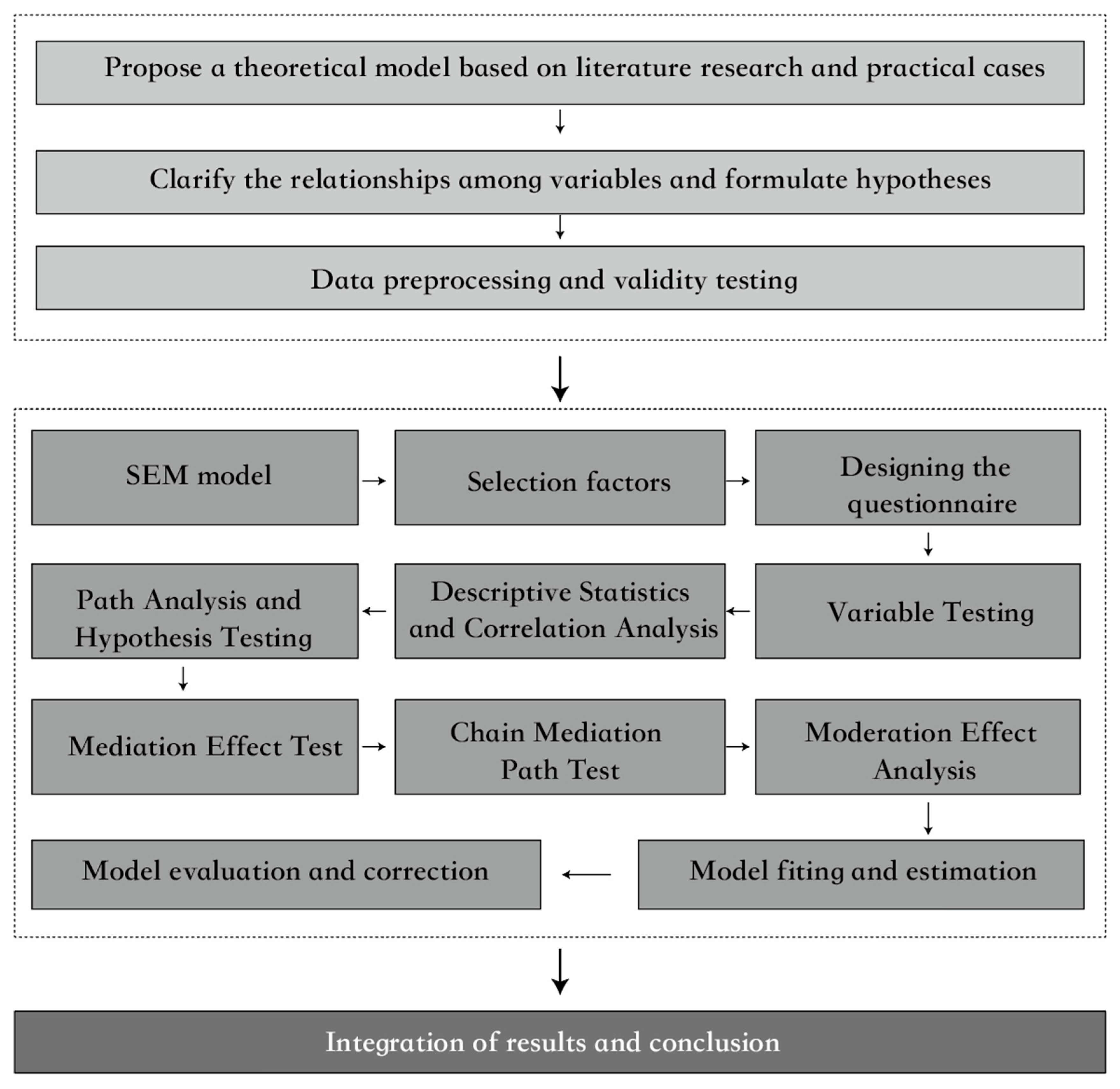
This study used convenience sampling and conducted a questionnaire survey on consumers’ purchase intention in rural livestreaming e-commerce. As of 25 March 2026, after excluding incomplete and inconsistent responses, a total of 747 valid samples were collected. Before the questionnaire was distributed, all respondents were informed of the research purpose, anonymity, and the principle of voluntary participation, and they completed the questionnaire only after confirming their informed consent. The technical roadmap is shown in Figure 4.

4.2. Variable Measurement

This study adopted seven established domestic and international scales to evaluate the interaction elements in rural livestreaming e-commerce (LS, PP, AI, and CE), users’ psychological responses (CP and AP), and consumer behavior conversion outcomes (CT and PI). All scales were adapted from Narrative Transportation Theory (NTS) [40], I Presence Questionnaire (IPQ) [41], Social Presence Scale (SPS) [42], Flow State Scale (FSS) [43], Interpersonal Reactivity Index (IRI) [44], System Usability Scale (SUS) [45], and Purchase intention was measured using items adapted from Pavlou’s e-commerce transaction intention scale [46], These scales were adapted to fit the consumption context of rural livestreaming e-commerce and were rigorously optimized. To improve the contextual relevance of the questionnaire, items with ambiguous wording or low relevance to rural livestreaming e-commerce were removed after pre-evaluation and pilot testing.
In terms of the measurement of psychological variables, this study treats cultural perception, affective perception, consumer trust, and emotional energy as latent variables, and measures them through a multi-item questionnaire. Since such variables cannot be directly observed, this paper follows the measurement logic of existing scales and adapts them to the context of rural livestreaming e-commerce, transforming them into specific perceptual statements that respondents can evaluate. All of the above psychological variables are measured using a five-point Likert scale. Respondents are asked to evaluate the degree to which each item corresponds to their actual feelings when watching rural livestreaming e-commerce, where 1 indicates “strongly disagree” and 5 indicates “strongly agree.” The final formal questionnaire consisted of 40 measurement items: LS (4 items), PP (5 items), AI (4 items), CE (4 items), EE (4 items), CP (5 items), AP (4 items), CT (5 items), and PI (5 items), as shown in Table 1.
Firstly, the data adequacy analysis yielded favorable results, with a KMO value of 0.934 (≥0.7) and a significant result in Bartlett’s test of sphericity (p < 0.001), indicating that the data were highly suitable for factor analysis. To verify the reliability of the scales, we calculated Cronbach’s alpha for each construct. As shown in Table 2, all alpha values significantly exceed the 0.7 threshold, demonstrating excellent internal consistency. To assess construct validity, we calculated the Composite Reliability (CR) for each construct. As indicated in Table 2, all CR values exceed 0.7, suggesting robust construct validity. Furthermore, to evaluate convergent validity, we calculated the Average Variance Extracted (AVE) for each construct. All AVE values are above 0.5, confirming that the scale possesses strong convergent validity.

4.3. Reliability and Validity Analysis

First, the data adequacy analysis yielded favorable results. The KMO value was 0.934 (≥0.7), and Bartlett’s test of sphericity was significant (p < 0.001), indicating that the data were highly suitable for factor analysis. To assess scale reliability, Cronbach’s alpha was calculated for each construct. As shown in Table 2, all alpha values substantially exceeded the threshold of 0.7, indicating good internal consistency. To evaluate construct reliability, composite reliability (CR) was calculated for each construct. All CR values exceeded 0.7, demonstrating strong construct reliability. To assess convergent validity, the average variance extracted (AVE) was calculated for each construct. All AVE values exceeded 0.5, confirming good convergent validity.
To ensure that the measurement model had good discriminant validity, this study further employed two mainstream and complementary methods for verification: the Fornell–Larcker criterion and the heterotrait–monotrait ratio (HTMT). The Fornell–Larcker criterion requires that the square root of the average variance extracted (AVE) for each construct be greater than its correlations with other constructs. The HTMT method provides a more rigorous criterion for assessing discriminant validity by comparing the ratio of heterotrait correlations to monotrait correlations across different constructs. In general, HTMT values are expected to be below 0.85 [47].
As shown in Table 3, the square root of the AVE for each construct (the diagonal values) was substantially greater than its correlations with the other constructs (the off-diagonal values). For example, the square root of the AVE for LS was 0.886, much higher than its correlation with CP (0.419); similarly, the square root of the AVE for PI was 0.896, higher than its correlation with CT (0.507). As shown in Table 4, all HTMT values among the constructs were below 0.85, with the maximum value being 0.666 between AP and CP, while most of the remaining values were below 0.50. These results are consistent with the criteria for assessing reliability, composite reliability, and convergent validity in established mature scales and related empirical studies. This indicates that, after the contextual adaptation of the NTS, IPQ, SPS, FSS, IRI, SUS, and purchase intention-related scales to the context of rural livestreaming e-commerce, the measurement instruments used in this study still maintain good measurement stability and validity. This indicates clear conceptual boundaries among the constructs and no significant issue of construct overlap. In summary, the results of the Fornell–Larcker criterion and the HTMT test are highly consistent, jointly confirming that all constructs in this study have good discriminant validity and providing a reliable psychometric foundation for subsequent hypothesis testing.

4.4. Common Method Bias Test

Because the independent variables, mediating variables, moderating variables, and dependent variables in this study were all obtained from the same group of respondents through the same questionnaire, common method bias may be a potential concern. To reduce its possible influence on the research results, this study adopted several procedural controls during questionnaire design and data collection. First, the questionnaire was completed anonymously to reduce respondents’ social desirability bias. Second, the questionnaire instructions emphasized that there were no right or wrong answers, and respondents were asked to answer based on their actual viewing experience. Third, the measurement items were worded as clearly and specifically as possible to avoid ambiguity and leading expressions. Finally, items belonging to different constructs were appropriately interspersed in the questionnaire to reduce respondents’ subjective inference about the relationships among variables.
In terms of statistical testing, this study adopted Harman’s single-factor test to assess common method bias. After all measurement items were included in an unrotated exploratory factor analysis, the results showed that the first factor explained 27.083% of the total variance, which is below the commonly used threshold of 40%. This indicates that no single factor accounted for the majority of the variance. Therefore, common method bias was not a serious concern in this study and is unlikely to have a significant impact on the research conclusions.

5. Data Analysis and Results

5.1. Descriptive Statistics and Correlation Analysis

To gain a preliminary understanding of the basic characteristics of each variable and their interrelationships, this study first conducted descriptive statistical analysis and Pearson correlation analysis. The results show that the mean values of the variables ranged from 1.907 to 3.259, and the standard deviations ranged from 0.398 to 0.666, indicating that the sample data were relatively concentrated and that no extreme outliers were observed (Table 5). The correlation matrix shows significant associations among the variables to varying degrees, providing support for subsequent hypothesis testing.
First, LS, PP, AI, and CE, as the four external stimulus elements of rural livestreaming e-commerce, all showed positive correlations with the two consumer perception variables, CP and AP. Among them, the correlation coefficient between LS and CP reached 0.419, while the correlation coefficient between PP and AP was as high as 0.511. These results indicate that carefully constructed authentic rural livestreaming environments and the visual presentation of product packaging play important roles in stimulating consumer perceptions.
Second, the correlation coefficient between CP and AP was 0.569, indicating a high degree of coordination between the two in consumers’ perceptions and suggesting that they jointly constitute a key dual “affective–cultural” cognitive mechanism in rural livestreaming e-commerce. In addition, the two behavioral response variables, CT and PI, were both strongly and positively correlated with the perception variables. Cultural perception (CP) was significantly correlated with consumer trust (CT) (r = 0.572) and purchase intention (PI) (r = 0.442). Affective perception (AP) was also positively correlated with consumer trust (CT) (r = 0.558) and purchase intention (PI) (r = 0.347), confirming the important driving role of psychological perceptions in actual behavioral transformation. It is worth noting that emotional energy (EE) showed generally weak correlations with other variables, suggesting that its role may not be direct, but may indirectly influence other variables through moderating paths. Overall, the descriptive statistics and correlation analysis provide preliminary support for the theoretical framework proposed in this study, indicating that interaction in rural livestreaming e-commerce can effectively stimulate consumers’ affective perception and cultural perception, thereby building consumer trust and transforming it into purchase intention.

5.2. Path Analysis and Hypothesis Testing

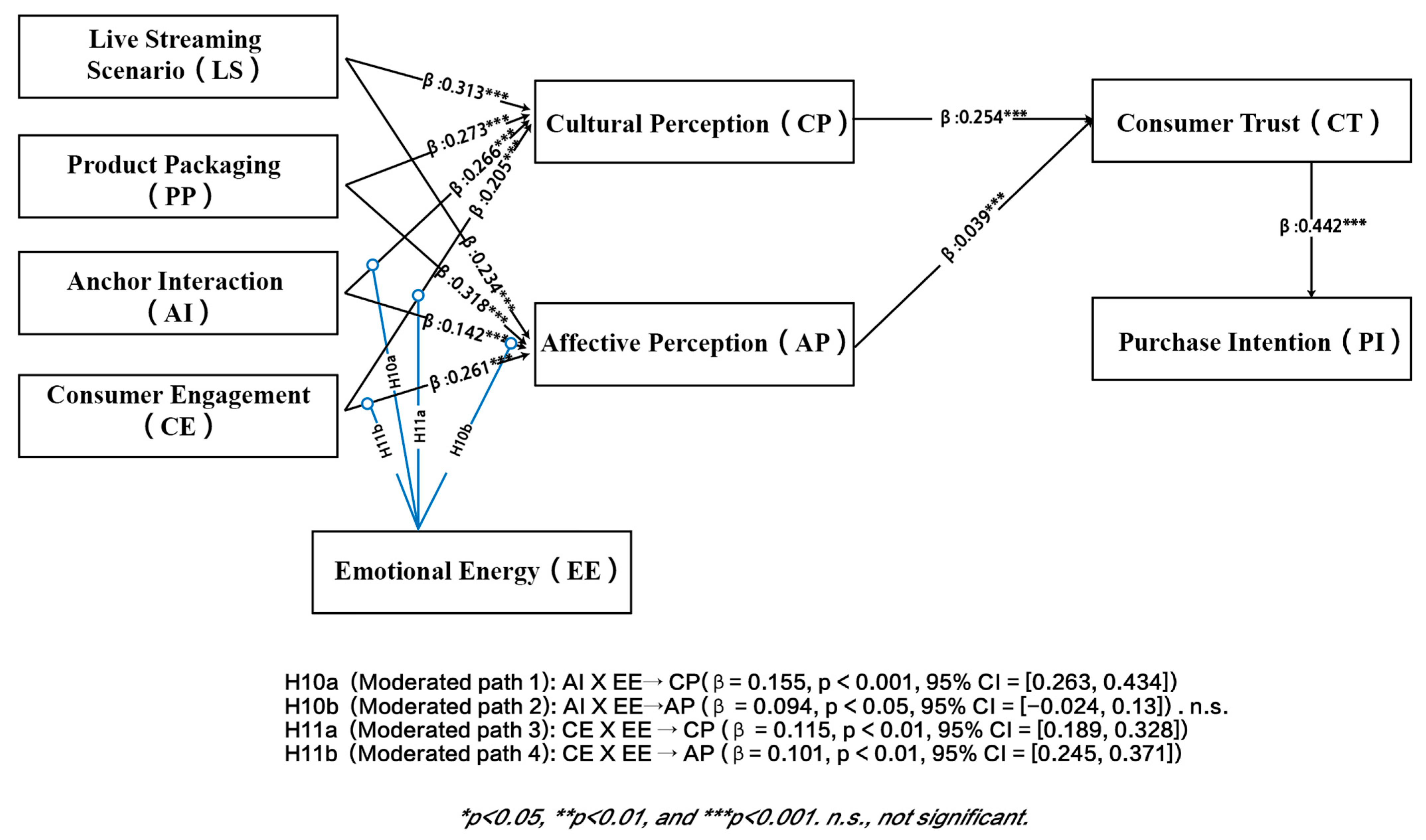
This study used structural equation modeling to test the proposed hypotheses. As shown in Figure 5, all core paths reached a significant level (p < 0.001), providing strong support for the theoretical model. Specifically, LS, PP, AI, and CE, as key components of rural livestreaming e-commerce, all had significant positive effects on users’ CP and AP. This indicates that livestreaming scenario, visual presentation, and interactive behaviors can effectively strengthen consumers’ affective and cultural perceptions of rural agricultural products. Among them, the effect of rural livestreaming atmosphere on cultural perception was the strongest (β = 0.313), while product packaging had the most prominent driving effect on affective perception (β = 0.318), highlighting the differentiated value of product packaging in livestreaming e-commerce. At the same time, cultural perception (CP) (β = 0.254) and affective perception (AP) (β = 0.309) both significantly and positively predicted consumer trust (CT), with the effect of affective perception (AP) being slightly stronger, indicating that affective perception plays a key role in driving consumer decision-making. In summary, H1a, H1b, H2a, H2b, H3a, H3b, H4a, H4b, H5, H7, and H9 are empirically supported, preliminarily verifying the effectiveness of the interaction mechanism in rural livestreaming e-commerce under the S-O-R framework (Table 6).

5.3. Mediation Effect Testing

According to the summary results of total effects, direct effects, and indirect effects in Table 7, the total effects of the four external stimulus variables (LS, PP, AI, and CE) on purchase intention (PI) were all highly significant (p < 0.001), with effect sizes ranging from 0.161 to 0.292. This indicates that all four interaction ritual elements have significant positive effects on consumers’ purchase intention toward rural agricultural products. Further decomposition of the effect structure shows that the indirect effect of AI accounted for a relatively high proportion, while its direct effect did not reach significance. This suggests that the influence of anchor interaction on purchase intention is mainly realized through the paths of affective perception, cultural perception, and consumer trust, while also indicating that there may still be potential mechanisms not fully captured by the current model.
The chain mediation path testing results further show (Table 8) that all eight dual chain mediation paths of “external stimulus → psychological state (CP/AP) → consumer trust (CT) → purchase intention (PI)” were significant (p < 0.01), and the upper and lower bounds of the bias-corrected 95% confidence intervals did not include 0. Among the cognitive paths, the indirect effect of LS → CP → CT → PI was the largest (0.044), indicating that livestreaming scenarios are more likely to enhance consumer trust and generate purchase intention by stimulating cultural perception. Among the affective paths, the indirect effect of PP → AP → CT → PI was the largest (0.057), suggesting that product packaging is most effective in enhancing consumer trust and purchase intention by stimulating affective perception. Comparing the effect strengths of the two paths, the overall effect of the affective path was slightly stronger than that of the cultural-cognitive path, indicating that affective perception plays a more prominent role in driving purchase intention in rural livestreaming e-commerce.
Second, to test the chain mediation mechanism, this study examined the complete paths from “livestreaming interaction elements → CP/AP → CT → PI.” As shown in Table 8, the indirect effects of all eight chain mediation paths did not include zero within the 95% confidence intervals, and their p-values were below 0.01 or 0.001, indicating that all chain mediation hypotheses were supported. Livestreaming scenarios exerted a significant effect through the “CP → CT → PI” path (β = 0.044, p < 0.001). Similarly, product packaging significantly promoted purchase intention through the “AP → CT → PI” path (β = 0.057, p < 0.001). These results confirm that consumers’ purchase intention is not directly driven by external stimuli, but is achieved through a multi-stage transformation process of “cognition–affection–behavior,” in which consumer trust serves as a key node bridging psychological experience and consumer behavioral practice.
In summary, H6 and H8 were supported. This indicates that cultural perception and affective perception are not only core psychological mediating variables in rural livestreaming e-commerce, but also jointly constitute a chain mediation mechanism centered on consumer trust, revealing the evolutionary path from livestreaming interaction to consumer behavior. Based on the above analytical results, Figure 5 presents the results of the structural equation modeling.

5.4. Moderation Effect Analysis

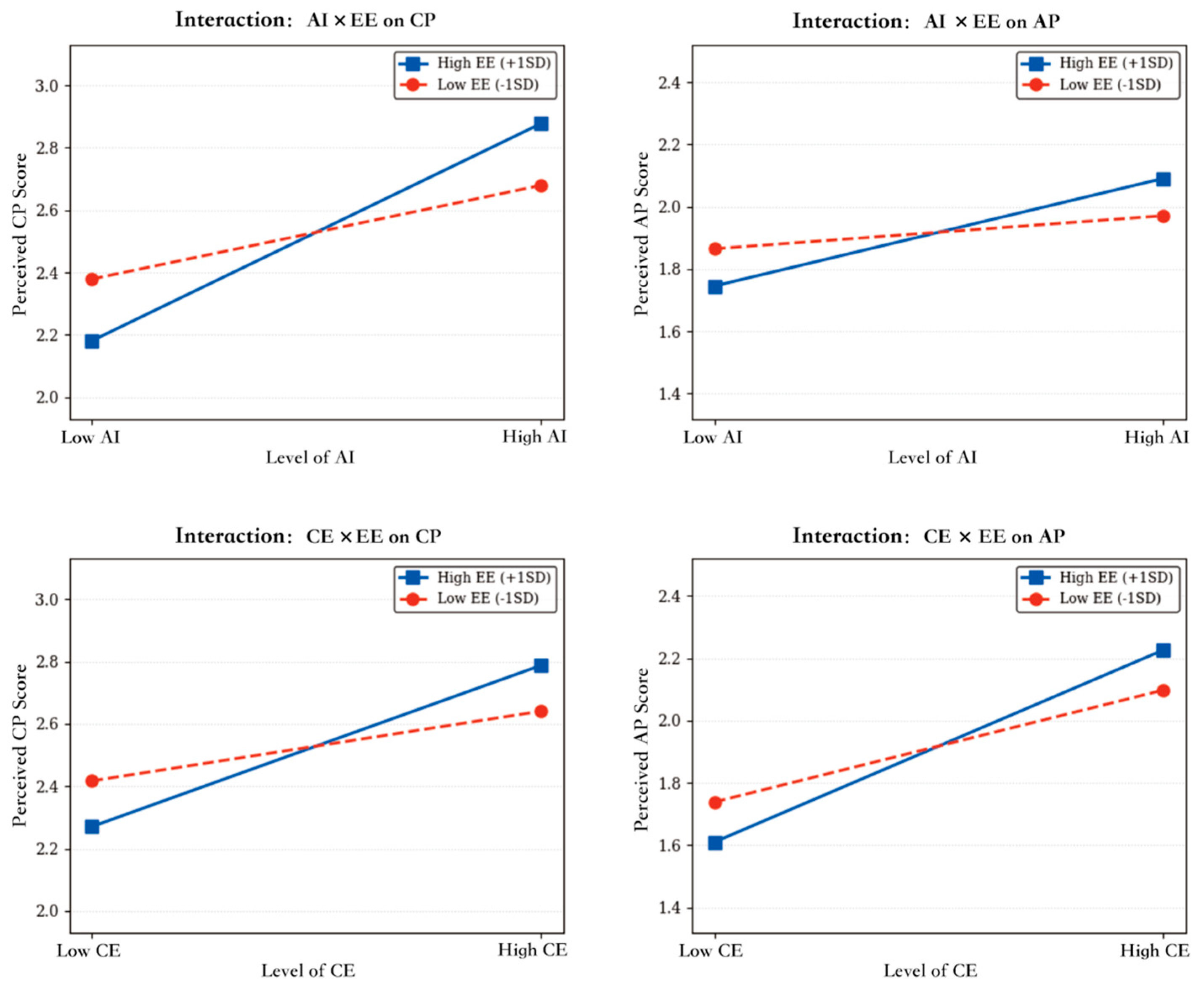
The moderation effect testing results show that EE, as a core outcome of interaction ritual chains, plays a significant boundary-condition role in two types of interaction paths in the context of rural livestreaming e-commerce (Bootstrap = 5000). As shown in Table 9, in the anchor interaction path, the moderating effect of EE on AI → CP was significant (β = 0.155, p < 0.001, 95% CI [0.093, 0.217]). Under the high-EE condition (+1 SD), the positive effect of AI on CP was significantly strengthened (simple slope = 0.348, 95% CI [0.263, 0.433]); under the low-EE condition (−1 SD), this effect was weakened but remained significant (simple slope = 0.150, 95% CI [0.071, 0.230]). This indicates that emotional energy effectively strengthens the driving effect of anchor interaction on consumers’ rural cultural perception. Therefore, H10a was supported. However, although the interaction coefficient for the moderating effect of EE on AI → AP was significant (β = 0.094, p < 0.05), indicating that emotional energy moderates the relationship between anchor interaction and affective perception, the simple slope analysis showed that this effect mainly appeared under the high-EE condition. Under the low-EE condition, the effect of anchor interaction on affective perception was not significant. Therefore, H10b was partially supported.
In the consumer engagement (CE) paths, EE showed robust positive moderating effects on both CE → CP (β = 0.115, p < 0.01, 95% CI [0.042, 0.188]) and CE → AP (β = 0.101, p < 0.01, 95% CI [0.038, 0.164]). Under the high-EE condition, the positive effects of CE on CP (slope = 0.259, 95% CI [0.189, 0.323]) and AP (slope = 0.308, 95% CI [0.245, 0.371]) were significantly stronger than those under the low-EE condition (slope = 0.112, 95% CI [0.039, 0.184]; slope = 0.180, 95% CI [0.114, 0.245]), and none of the confidence intervals included zero. Therefore, H11a and H11b were supported.
In summary, the moderating role of emotional energy shows clear contextual selectivity. It systematically amplifies the dual cognitive and affective effects of consumer engagement, while its moderating effect on anchor interaction is mainly reflected in consumers’ cultural perception of locality. This finding strongly supports the core proposition of interaction ritual chain theory: emotional energy can be effectively transformed only when it is grounded in genuine social connections.
This study further visualized the moderating effect of emotional energy (EE) through simple slope plots, and the results clearly revealed its boundary-condition effect on the relationships between “interactive behavior and psychological/behavioral responses” in the context of rural livestreaming e-commerce. As shown in Figure 6, the horizontal axis represents AI or CE, and the vertical axis represents the predicted values of CP or AP. The solid blue line indicates the high emotional energy condition (+1 SD), while the dashed red line indicates the low emotional energy condition (−1 SD). In the anchor interaction path, under the high-EE condition, the positive effects of AI on CP and AP were both significantly stronger than those under the low-EE condition, as reflected by steeper slopes. This indicates that when users are in an emotionally elevated atmosphere with a strong sense of ritual, the driving effects of anchor interaction on cultural perception and affective perception are effectively amplified. In the consumer engagement path, the effects of CE on CP and AP were likewise significantly enhanced under the high-EE condition. In particular, the difference in slopes between high and low emotional energy was more pronounced for affective perception, suggesting that the emotional energy generated by group interaction can deeply catalyze users’ empathic experiences and behavioral transformation.
Overall, the four moderation plots consistently show that emotional energy is not a passive outcome, but a key contextual variable that actively regulates interaction effectiveness. It systematically strengthens the entire process from interactive input to psychological experience and then to behavioral output, with a particularly pronounced effect in social interaction. This finding further supports the core proposition of interaction ritual chain theory: continuously accumulated emotional energy is an indispensable internal driving mechanism for sustaining the popularity of rural livestreaming e-commerce and enhancing consumers’ purchase intention.

6. Research Findings and Implications

6.1. Discussion

This study finds that rural livestreaming e-commerce is not merely a simple extension of the general livestreaming e-commerce model to the sale of agricultural products, but rather a complex digital marketing process shaped by the combined effects of rural scenarios, rural product symbols, anchor interaction, and consumer interaction. Meanwhile, the results show that although the four types of livestreaming factors all significantly influence consumers’ psychological perceptions, their directions and strengths of influence are not entirely the same. Although Yang et al. found that anchor attributes, product attributes, livestreaming field attributes, consumer trust, and impulsiveness in livestreaming e-commerce all positively influence consumers’ purchase intention [48], their study was still conducted within a general online livestreaming context. In contrast, this study examines e-commerce livestreaming within the rural consumption context and further points out that rural livestreaming e-commerce is a digital marketing context embedded in rural environments and local culture. In this specific context, livestreaming scenarios, rural product packaging, anchor interaction, and consumer engagement are not merely external stimuli that promote purchase; rather, they jointly constitute local value cues and further influence purchase intention through affective perception, cultural perception, and consumer trust.
First, this study finds that livestreaming scenarios have a positive effect on consumers’ purchase intention and exert a stronger influence on consumers’ cultural perception. In previous studies, Li et al. discussed the effect of “scenarios” on consumer trust formation and purchase behavior from the perspective of scene immersion [14], Dong et al. from the perspective of livestreaming presence [8], and Gu et al. from the perspectives of information quality and entertainment in livestreaming scenarios [49]. However, these studies have not analyzed consumer behavior by examining how livestreaming scenarios influence the mediating psychological variable of “rural cultural perception.”
This study finds that, in the context of rural livestreaming e-commerce, livestreaming scenarios are not merely external environmental stimuli that affect viewing experience and enhance consumers’ sense of presence. They also have a strong cultural interpretive function. Scenarios in rural livestreaming e-commerce are more likely to encourage consumers to connect products with the rural context and local culture in which they are embedded. Such recognition and understanding are often more direct than the arousal of pleasure or emotional resonance. Therefore, this study extends the basic research path of “scenario–trust–purchase” established in prior studies into a rural livestreaming e-commerce path of “scenario–cultural perception–trust–purchase.”
Second, this study finds that product packaging has a stronger effect on affective perception than on cultural perception. Although previous studies have found that the visual appearance, color and layout, graphic symbols, and logos of product packaging can influence consumers’ perceived value and further affect consumer attitudes and repurchase intention [13,50,51], their discussions have mainly remained at the level of packaging visual elements, brand experience, or perceived value. They have not yet sufficiently explained why packaging can evoke stronger emotional perception.
This study further finds that, in rural livestreaming e-commerce, rural product packaging is not merely a visual embellishment attached to the product, but an important medium through which consumers form emotional associations and emotional resonance. Compared with cultural perception, the formation of affective perception does not entirely depend on consumers’ in-depth understanding of specific regional culture, folk knowledge, or origin stories. Instead, it is more easily triggered by intuitive visual symbols. In their advertising research, Bambauer-Sachse and Gierl found that nostalgic advertising can evoke stronger mental imagery among consumers [52]. Chen further proposed that packaging design can generate positive emotions and enhance consumer satisfaction by evoking nostalgia [53]. These studies provide support for the present study from multiple perspectives.
Even when consumers come from different regions and have different cultural backgrounds, certain visual elements with rural and natural characteristics, such as rice fields, village houses, land, crops, handmade patterns, or simple material textures, may still evoke associations with rural life, the natural environment, childhood experiences, or local memories, thereby generating a sense of closeness, warmth, nostalgia, and emotional inclination to support rural products. Therefore, when regional symbols, folk imagery, local patterns, and origin stories are applied to rural product packaging, packaging can not only enhance product recognition, but also transform rural products into consumption objects with emotional warmth and local memory.
In terms of the interaction mechanism, this study finds that both anchor interaction and consumer engagement significantly influence cultural perception and affective perception, while consumer engagement shows a more stable amplification effect under the moderating role of emotional energy. Previous studies have also examined the roles of anchors and consumers as the two key interactive actors in livestreaming. However, most of these studies have focused on how to provide anchors and consumers with a stronger sense of presence in livestreaming experiences [54], or how to guide consumption through anchors’ information presentation and interactive guidance [34]. Although Liu et al. have begun to discuss the influence of consumer-to-consumer interaction on purchase intention [55], their discussion still revolves mainly around the construction of social presence and places greater emphasis on the consumption experience.
Building on these studies, the present study further finds that both anchor interaction and consumer engagement are important sources of emotional energy accumulation in livestreaming e-commerce. Interaction in livestreaming rooms not only provides informational references, but also forms group identification and emotional contagion through comments, danmaku comments, purchase feedback, and experience sharing. Therefore, this study does not merely treat anchor interaction and consumer engagement as external stimulus factors to examine whether they influence consumer behavior. Rather, under the theoretical framework of interaction ritual chain theory, it further regards them as “emotional amplifiers” and explores how the intensity of interaction affects purchase intention. Rural livestreaming e-commerce can generate a higher level of interaction through livestreaming interaction design, thereby accumulating higher emotional energy and promoting purchase behavior. In this way, the internal influence mechanism is further transformed into a specific behavioral pathway.
Second, affective perception and cultural perception demonstrate a dual-driving logic. Previous livestreaming e-commerce studies have mainly focused on the roles of emotional contagion, emotional trust, and perceived value in the relationship between livestreaming stimuli and consumers’ purchase intention. For example, Meng et al. explained how livestreaming interaction influences consumer responses from the perspective of emotional contagion [56]; Han et al. emphasized the role of emotional trust in the formation of purchase intention in agricultural product livestreaming [30]; and Zhou and Tong focused on the mediating role of perceived value in livestreaming e-commerce consumption decisions [37]. Together, these studies indicate that emotional factors are not merely incidental responses in livestreaming consumption, but important psychological mechanisms that influence consumer trust formation and purchase conversion.
However, existing studies have relatively rarely incorporated cultural perception as an independent psychological mechanism into models of purchase intention in livestreaming e-commerce, nor have they sufficiently explained how local cultural meanings further influence purchase intention through consumers’ psychological transformation.
In contrast, cultural perception is more reflected in consumers’ understanding, recognition, and acknowledgement of the regional culture, local lifestyles, traditional craftsmanship, and rural values carried by rural products. Although affective perception and cultural perception differ in their primary emphases, both can further influence purchase intention through consumer trust. Accordingly, this study extends the mediating explanatory framework in previous livestreaming e-commerce research, which has mainly focused on emotion, trust, and perceived value, and further reveals the complex psychological transformation mechanism of “affective perception/cultural perception–consumer trust–purchase intention” in rural livestreaming e-commerce.
In terms of the behavioral conversion path, this study further reveals the chain transmission logic of “livestreaming interaction elements–affective perception/cultural perception–consumer trust–purchase intention.” Consumers’ purchase intention is not directly generated by a single stimulus, but is gradually formed through the continuous effects of multiple psychological responses. Doanh et al. found that green agricultural product brand image and blockchain-based food traceability systems can enhance product trust and further influence consumers’ intention to purchase agricultural products online [57]. This study explains from the perspective of “traceability–trust–purchase” that consumers’ purchase judgments regarding agricultural products highly depend on authenticity, transparency, and credibility. By comparison, this paper does not stop at product authenticity or information transparency itself, but further reveals the psychological transformation process in rural livestreaming e-commerce: rural scenes provide authenticity cues, product packaging provides local meaning cues, and anchor interaction and consumer engagement provide relational and group cues. These elements jointly stimulate consumers’ affective perception and cultural perception, and are transformed into purchase intention through consumer trust.
Finally, regarding the moderating role of emotional energy, emotional energy is not merely an outcome variable in the traditional sense, but a dynamic “interaction amplifier.” Based on interaction ritual chain theory, Meng et al. found that, when consumers watch livestreams and interact with anchors and other viewers, they form interaction ritual chains and generate emotional energy, thereby understanding the emotional and functional meanings of livestreaming interaction [58]. The findings of this study further indicate that, in rural livestreaming e-commerce, when consumers accumulate a higher level of emotional energy in the livestreaming room, they are more likely to interpret anchor explanations, interactive responses, viewer comments, and group feedback as interaction cues characterized by authenticity, emotional warmth, and social support, thereby strengthening cultural perception and affective perception. The same rural scene, packaging design, or local narrative is more likely to be interpreted by consumers as authentic, intimate, and culturally valuable under conditions of high emotional energy.
It is worth noting that although the interaction term of H10b reached a significant level, the simple slope analysis showed that its moderating effect mainly existed under the condition of high emotional energy. Under the condition of low emotional energy, the effect of anchor interaction on affective perception was not significant. This indicates that the strengthening effect of anchor interaction on affective perception is context-dependent to some extent. Only when consumers have already entered a state of higher emotional involvement and interactive participation is anchor interaction more likely to be transformed into positive affective perception.

6.2. Contribution

First, this study extends livestreaming e-commerce research by providing a theoretical explanation grounded in the rural context. Li et al. proposed that both the social presence of the anchor and the social presence of other viewers can influence consumers’ purchase intention [54]. Ngo and Bui’s study based on Vietnamese consumers also showed that entertainment, information quality, interactivity, peer evaluation, and anchor-related factors affect purchase intention in social media live commerce [59]. This study resonates with these studies. However, they usually regard livestreaming e-commerce as a general online sales and social interaction scenario, paying insufficient attention to the locality, cultural attributes, and trust construction functions of rural livestreaming e-commerce. This study further argues that rural e-commerce livestreaming is not merely a simple application of general livestreaming e-commerce to the sale of agricultural products, but rather a digital marketing context embedded in the place of origin, culture, and local lifestyles. In this context, product characteristics do not merely transmit quality information, rural elements do not merely serve as visual decoration, and livestreaming interaction is not merely a communication means for promoting immediate purchase. Instead, they jointly function as key cues involved in the presentation of authenticity of origin, the expression of rural culture, and the construction of local trust. Accordingly, this study advances the commonly used explanatory logic of “interaction–trust–purchase” in general livestreaming e-commerce research into a rural digital marketing mechanism of “local value cues–Affective perception/cultural perception–consumer trust–purchase intention,” thereby enriching the theoretical understanding of livestreaming e-commerce research in rural consumption contexts.
Second, this study further clarifies the integrative mechanism between the S-O-R framework and interaction ritual chain theory in the study of rural e-commerce livestreaming. This study does not simply juxtapose the two theories, but rather assigns them different roles according to their explanatory functions. The S-O-R framework provides the overall explanatory path for this study: external factors such as the livestreaming atmosphere of rural e-commerce livestreaming, the cultural expression of rural product packaging, and livestreaming interaction constitute stimuli; consumers’ affective perception, cultural perception, and consumer trust constitute internal psychological states; and purchase intention constitutes the behavioral response. However, relying solely on the S-O-R framework makes it difficult to fully explain why livestreaming interaction produces different degrees of influence among different consumers, or how anchor interaction and consumer interaction strengthen consumers’ emotional, cultural, and trust responses. Therefore, this study introduces the interaction ritual chain theory to explain the processes of emotion generation and emotion reinforcement in livestreaming interaction. Specifically, livestreaming interaction can enable consumers to form stronger emotional engagement and a sense of on-site participation through mutual focus, instant response, emotional contagion, and participatory atmosphere, thereby further generating emotional energy.
Third, this study incorporates emotional energy, a core concept of interaction ritual chain theory, into consumer behavior research in rural e-commerce livestreaming and further examines its moderating role in the process through which livestreaming interaction cues influence consumers’ psychological responses. Meng et al. pointed out that consumers may form an interaction ritual chain and generate emotional energy when watching livestreams and interacting with anchors and other viewers [58]. Their study mainly conceptualized emotional energy as an important emotional outcome generated during livestreaming interaction, thereby providing an important basis for applying emotional energy to livestreaming interaction research. Building on this foundation, the present study further draws on interaction ritual chain theory to examine whether emotional energy may also function as an affective boundary condition that shapes the strength of consumers’ responses to livestreaming interaction cues.
The findings of this study show that livestreaming interaction does not automatically translate into emotional perception, cultural perception, or consumer trust. Only when consumers develop higher levels of emotional involvement, participation excitement, and shared attention during interaction are anchor interaction and consumer interaction more likely to be transformed into positive emotional experiences, cultural recognition, and trust judgments. In this sense, this study further reveals the “emotional amplification mechanism” in rural e-commerce livestreaming: emotional energy can strengthen the effects of interaction cues on consumers’ internal psychological states, making livestreaming interaction not merely a form of information exchange or social companionship, but an important condition for promoting emotional resonance, cultural identification, and trust generation. Different from previous studies that have mainly focused on emotional energy as an outcome of interaction, this study further examines its possible role as a moderating mechanism, thereby providing a more specific explanation of the “interaction–perception–trust–purchase intention” pathway in rural e-commerce livestreaming.
Fourth, this study further distinguishes the different roles of affective perception and cultural perception in rural e-commerce livestreaming, thereby strengthening the theoretical value of cultural perception as an independent psychological mechanism. This study argues that, in the context of rural e-commerce livestreaming, cultural perception is neither a subordinate variable of affective perception nor merely an extended outcome after consumers develop favorable feelings toward livestreaming content. More specifically, it refers to consumers’ understanding, recognition, and identification of the regional culture, local lifestyles, traditional craftsmanship, and rural values carried by rural products. This study finds that rural product characteristics, rural elements, and the interaction process can not only stimulate consumers’ emotional experiences, but also strengthen their perception of local cultural value, which further influences purchase intention through consumer trust. Therefore, distinguishing cultural perception from general emotional responses helps explain why cultural expression, origin narratives, and rural symbols in rural e-commerce livestreaming can become important psychological pathways influencing consumers’ purchase intention.
Finally, this study also responds to discussions on digital business research in the context of emerging economies. Bao et al.’s study on barriers to e-commerce in developing markets indicates that infrastructure, digital literacy, logistics services, trust and security, policy environments, and sociocultural factors all affect e-commerce growth [60]. Morepje et al.’s study on agricultural e-commerce platforms in Sub-Saharan Africa also shows that e-commerce platforms can improve smallholder farmers’ market access, but insufficient digital literacy and infrastructure remain major challenges [61]. From this perspective, the findings of this study are not only applicable to the context of rural livestreaming in China, but also offer implications for other emerging economies facing insufficient market reach, limited branding capabilities, information asymmetry, and underdeveloped trust mechanisms. Of course, the Chinese context has its own specificities, including its platform ecosystem, mobile payment system, logistics infrastructure, and rural revitalization policies. Therefore, this study focuses more on providing an analytical framework that can be tested across contexts: how digital platforms help resource-constrained regions achieve market connection, trust construction, and local value communication through scenario visualization, cultural symbolization, real-time interaction, and emotional connection. This study also provides clear directions for optimization:
1. Construct live streaming scenarios with a strong sense of realism and emotional appeal.
Rural livestreaming e-commerce can take orchards, tea gardens, farmlands, workshops, rural markets or countryside courtyards as live streaming scenarios. It enhances consumers’ sense of presence and closeness through natural surroundings, production processes, and daily life details. Emphasis should be placed on the situational construction function of live streaming scenarios themselves. Authentic spatial perception enables consumers to form an intuitive understanding of product origins and rural life.
2. Strengthen the design expression of product packaging to enhance cultural recognizability
Product packaging in livestreaming should not remain at the level of decoration. For rural products, the locally designed expression can enhance consumers’ memory and trust in the product, while also creating differentiated advantages in competition among homogeneous agricultural products or local specialties. Therefore, livestreaming operators should systematically integrate local elements into packaging design, livestreaming scripts, product presentation, and brand narratives, so that consumers can not only see the product during viewing, but also perceive its local culture.
3. Enhance the trust-building function of anchor interaction
Anchors play a core role in connecting products, scenarios, and consumers in rural livestreaming e-commerce. Their role should not be limited to introducing prices, urging consumers to place orders, or repeatedly delivering promotional messages. Especially for agricultural and rural products, consumers are often concerned about quality, origin, transportation, freshness preservation, authenticity, and after-sales guarantees. Anchors’ professional responses and sincere expressions can directly influence consumer trust and help consumers reduce information uncertainty.
4. Emphasize the group atmosphere formed by consumer engagement
Consumer engagement is an easily overlooked but highly important factor in rural livestreaming e-commerce. Comments, danmaku comments, likes, shares, questions, purchase feedback, and user reviews can provide references for other consumers and strengthen the sense of collective viewing in livestreaming rooms. In practice, livestreaming operators can activate communication among viewers by setting interactive topics, encouraging authentic reviews, guiding returning customers to share their experiences, and responding to frequently asked questions, thereby creating a more stable interactive atmosphere and affective connection in the livestreaming room.

7. Conclusions

Based on the S-O-R model and interaction ritual chain theory, this study constructs and verifies the formation mechanism of consumer purchase intention in rural livestreaming e-commerce. Specifically, it reveals how four types of livestreaming stimuli—livestreaming scenarios, product packaging, anchor interaction, and consumer engagement—stimulate consumers’ affective perception and cultural perception, and further promote purchase intention through consumer trust. At the same time, this study introduces emotional energy as a moderating variable, demonstrating that the emotional energy accumulated through shared focus, emotional synchronization, and interactive participation in livestreaming rooms can strengthen the effects of certain livestreaming stimuli on consumers’ psychological perceptions. These findings indicate that consumer conversion in rural livestreaming e-commerce is not simply a path from seeing products to purchasing them, but a continuous transformation process jointly shaped by scenario authenticity, cultural expression in packaging, anchor-led trust guidance, group interaction atmosphere, and the accumulation of emotional energy.
Although this study reveals the pathway of “livestreaming stimuli–affective/cultural perception–consumer trust–purchase intention” in rural livestreaming e-commerce, several limitations require further reflection. First, the empirical data in this study were mainly collected from consumers of rural livestreaming e-commerce in China. In the Chinese context, a relatively mature short-video platform ecosystem, mobile payment system, logistics network, algorithmic recommendation mechanism, and policy support for rural revitalization provide specific institutional and technological conditions for the development of rural livestreaming e-commerce.
Therefore, although the findings of this study help explain how resource-constrained regions in emerging economies can use digital platforms to compensate for insufficient market reach, information asymmetry, and difficulties in trust construction, they cannot be directly generalized to all emerging economies. In countries or regions with different levels of platform infrastructure, consumer digital literacy, logistics capacity, payment habits, and policy support, the mechanisms of rural livestreaming e-commerce may vary in strength. Future research could conduct comparative studies in different emerging economies, such as Southeast Asia, South Asia, Africa, and Latin America, to examine the cross-context applicability and boundary conditions of the model proposed in this study.
Second, this study uses questionnaire data to measure consumers’ perceptions, trust, and purchase intention in rural livestreaming e-commerce. Therefore, it is more suitable for revealing the associative paths among variables, but it is less able to fully explain the dynamic process through which consumers’ psychological responses change over time. In particular, emotional energy is clearly process-oriented in interaction ritual chain theory. It is often gradually generated and accumulated through continuous behaviors such as watching, interacting, commenting, resonating, and collective purchasing. Although this study verifies the moderating role of emotional energy, it still mainly relies on respondents’ subjective recall and self-reported data, and therefore cannot fully capture the real-time changes in emotional contagion and group interaction in livestreaming rooms. Future research could combine experimental methods, longitudinal surveys, livestreaming behavioral data, danmaku comment text analysis, and platform clickstream data to dynamically measure the generation, accumulation, and decline of emotional energy.
Third, this study incorporates cultural perception into the S-O-R framework and emphasizes its independent role in rural product consumption. However, cultural perception itself is highly context-dependent and interpretively complex. Different regions, product types, and consumer groups may understand “rural culture,” “local value,” and “authenticity” in different ways. Therefore, although the measurement of cultural perception in this study passed the reliability and validity tests within the current sample, it still needs to be further validated across more product types and cultural contexts. Future research could combine interviews, focus groups, and cross-cultural scale validation to further clarify the conceptual boundaries among cultural perception, affective perception, local identity, cultural authenticity, and brand trust.
Finally, this study mainly focuses on four types of stimulus factors: livestreaming scenario, product packaging, anchor interaction, and consumer engagement. It has not fully incorporated broader digital business ecosystem factors, such as pricing mechanisms, platform algorithms, logistics services, after-sales support, policy support, and farmers’ organizational capabilities. Purchase conversion in rural livestreaming e-commerce does not occur only within the livestreaming room; it is also influenced by platform governance, supply chain stability, product standardization, and local brand-building capabilities. Therefore, future research could integrate micro-level consumer psychological mechanisms with meso-level platform mechanisms and macro-level institutional environments to construct a more explanatory model of rural digital business. Such research would not only deepen the understanding of rural livestreaming e-commerce, but also further explain how digital platforms participate in local product circulation, trust construction, and inclusive market development in emerging economies.

Author Contributions

Conceptualization, Q.C. and M.W.; methodology, M.W.; formal analysis, M.W. and Z.Z.; investigation, M.W. and Z.Z.; resources, M.W.; data curation, D.X.; writing—original draft preparation, M.W.; writing—review and editing, D.X.; visualization, S.Y.; supervision, G.S. All authors have read and agreed to the published version of the manuscript.

Funding

This research was funded by “Study on the Theoretical Connotation and Practical Path of Rural Design from the Perspective of New Productivity”, a 2024 Planning Fund Project of the Ministry of Education’s Humanities and Social Sciences Research in Shanghai, 24YJA760009.

Institutional Review Board Statement

The study was conducted in accordance with the Declaration of Helsinki, and approved by the Scientific and Technological Ethics Committee of Donghua University (protocol code No. RLSSZYJ202509040050 and date of approval 22 January 2026).

Informed Consent Statement

Informed consent was obtained from all subjects involved in the study.

Data Availability Statement

The raw data supporting the conclusions of this article will be made available by the authors on request.

Acknowledgments

The authors sincerely thank the editor and the anonymous reviewers for their careful reading of the manuscript and their insightful comments and suggestions.

Conflicts of Interest

The authors declare no conflicts of interest.

References

  1. Hoskisson, R.E.; Eden, L.; Lau, C.M.; Wright, M. Strategy in Emerging Economies. Acad. Manag. J. 2000, 43, 249–267. [Google Scholar] [CrossRef] [PubMed]
  2. Sheth, J.N. Impact of Emerging Markets on Marketing: Rethinking Existing Perspectives and Practices. J. Mark. 2011, 75, 166–182. [Google Scholar] [CrossRef]
  3. Khanna, T.; Palepu, K.G.; Sinha, J. Strategies That Fit Emerging Markets. In International Business Strategy; Routledge: Oxfordshire, UK, 2015. [Google Scholar]
  4. Zhao, G. Agricultural Products Live Streaming E-Commerce Ecosystem Dynamics Research. Front. Sustain. Food Syst. 2025, 9, 1685996. [Google Scholar] [CrossRef]
  5. Kannan, P.K.; Li, H. Digital Marketing: A Framework, Review and Research Agenda. Int. J. Res. Mark. 2017, 34, 22–45. [Google Scholar] [CrossRef]
  6. Dwivedi, Y.K.; Ismagilova, E.; Hughes, D.L.; Carlson, J.; Filieri, R.; Jacobson, J.; Jain, V.; Karjaluoto, H.; Kefi, H.; Krishen, A.S.; et al. Setting the Future of Digital and Social Media Marketing Research: Perspectives and Research Propositions. Int. J. Inf. Manag. 2021, 59, 102168. [Google Scholar] [CrossRef]
  7. Li, G.; Chang, L.; Zhang, G. Increasing Consumers’ Purchase Intentions for the Sustainability of Live Farming Assistance: A Group Impact Perspective. Sustainability 2023, 15, 12741. [Google Scholar] [CrossRef]
  8. Dong, X.; Zhao, H.; Li, T. The Role of Live-Streaming E-Commerce on Consumers’ Purchasing Intention Regarding Green Agricultural Products. Sustainability 2022, 14, 4374. [Google Scholar] [CrossRef]
  9. Li, J.; Tao, Z.; Aisihaer, N. Effect of Visualization of Production Process on Consumers’ Purchase Intentions in Farmer-Assisted Livestreaming. Asia Pac. J. Mark. Logist. 2024, 36, 2577–2592. [Google Scholar] [CrossRef]
  10. Shi, W.; Li, F.; Hu, M. The influence of atmospheric cues and social presence on consumers’ impulse buying behaviors in e-commerce live streaming. Electron. Commer. Res. 2025, 25, 3325–3353. [Google Scholar]
  11. Xia, Y.X.; Chae, S.W.; Xiang, Y.C. How Social and Media Cues Induce Live Streaming Impulse Buying? SOR Model Perspective. Front. Psychol. 2024, 15, 1379992. [Google Scholar] [CrossRef] [PubMed]
  12. Zhang, N. Product Presentation in the Live-Streaming Context: The Effect of Consumer Perceived Product Value and Time Pressure on Consumer’s Purchase Intention. Front. Psychol. 2023, 14, 1124675. [Google Scholar] [CrossRef] [PubMed]
  13. Tang, H.; Liang, J.; Liu, J.; Shen, M.; Liu, X. From Visibility to Trust: The Impact of Agricultural Product Packaging Images in Livestreaming on Consumer Perception and Repurchase Intention. J. Theor. Appl. Electron. Commer. Res. 2025, 20, 248. [Google Scholar] [CrossRef]
  14. Li, W.; Cujilema, S.; Hu, L.; Xie, G. How Social Scene Characteristics Affect Customers’ Purchase Intention: The Role of Trust and Privacy Concerns in Live Streaming Commerce. J. Theor. Appl. Electron. Commer. Res. 2025, 20, 85. [Google Scholar] [CrossRef]
  15. Addo, P.C.; Fang, J.; Asare, A.O.; Kulbo, N.B. Customer Engagement and Purchase Intention in Live-Streaming Digital Marketing Platforms. Serv. Ind. J. 2021, 41, 767–786. [Google Scholar] [CrossRef]
  16. Zheng, R.; Li, Z.; Na, S. How Customer Engagement in the Live-Streaming Affects Purchase Intention and Customer Acquisition, E-Tailer’s Perspective. J. Retail. Consum. Serv. 2022, 68, 103015. [Google Scholar] [CrossRef]
  17. Woodworrth, R.S. Dynamics of Behavior; Henry Holt and Company, Inc.: Methuen, MA, USA, 1958. [Google Scholar]
  18. Mehrabian, A.; Russell, J.A. An Approach to Environmental Psychology; The MIT Press: Cambridge, MA, USA, 1974; pp. xii, 266. [Google Scholar]
  19. Guan, X.; He, L.; Hu, Z. Impact of Rural E-Commerce on Farmers’ Income and Income Gap. Agriculture 2024, 14, 1689. [Google Scholar] [CrossRef]
  20. Wang, Y.; Patrick L’ESPOIR DECOSTA, J.-N.; Gamage, A. Travel Live Streaming and Tourist Decision-Making: A Psychological and Behavioural Perspective on Bridging Virtual Engagement and Physical Travel. J. Travel Res. 2026, 00472875261430748. [Google Scholar] [CrossRef]
  21. Ruiyun, C. The Role of Regional Public Brands in Live Streaming Sales of Agricultural Products and Their Impact on Farmers’ Sustainable Income and Green Agricultural Development: An Empirical Analysis of Consumers in Guangdong, China. J. Inf. Syst. Eng. Manag. 2025, 10, 754–766. [Google Scholar] [CrossRef]
  22. Li, Y.; Peng, Y. What Drives Gift-Giving Intention in Live Streaming? The Perspectives of Emotional Attachment and Flow Experience. Int. J. Hum. Comput. Interact. 2021, 37, 1317–1329. [Google Scholar] [CrossRef]
  23. Manthiou, A.; Ayadi, K.; Lee, S.; Chiang, L.; Tang, L. Exploring the Roles of Self-Concept and Future Memory at Consumer Events: The Application of an Extended Mehrabian–Russell Model. J. Travel Tour. Mark. 2017, 34, 531–543. [Google Scholar]
  24. Sherman, E.; Mathur, A.; Smith, R.B. Store Environment and Consumer Purchase Behavior: Mediating Role of Consumer Emotions. Psychol. Mark. 1997, 14, 361–378. [Google Scholar] [CrossRef]
  25. Zhao, Y.; Wang, A.; Sun, Y. Technological Environment, Virtual Experience, and MOOC Continuance: A Stimulus–Organism–Response Perspective. Comput. Educ. 2020, 144, 103721. [Google Scholar]
  26. Hemsley-Brown, J.; Alnawas, I. Service Quality and Brand Loyalty: The Mediation Effect of Brand Passion, Brand Affection and Self-Brand Connection. Int. J. Contemp. Hosp. Manag. 2016, 28, 2771–2794. [Google Scholar]
  27. Masrom, M.B.; Busalim, A.H.; Abuhassna, H.; Mahmood, N.H.N. Understanding Students’ Behavior in Online Social Networks: A Systematic Literature Review. Int. J. Educ. Technol. High. Educ. 2021, 18, 6. [Google Scholar] [CrossRef]
  28. Theocharis, D.; Tsekouropoulos, G. Sustainable Consumption and Branding for Gen Z: How Brand Dimensions Influence Consumer Behavior and Adoption of Newly Launched Technological Products. Sustainability 2025, 17, 4124. [Google Scholar] [CrossRef]
  29. Lee, Y.-J.; Tsai, I.-Y.; Chang, T.-Y. Exploring Tourist Behavior in a Reused Heritage Site. J. Hosp. Tour. Res. 2023, 47, 1071–1088. [Google Scholar]
  30. Han, T.; Han, J.; Liu, J.; Li, W. Effect of emotional factors on purchase intention in live streaming marketing of agricultural products: A moderated mediation model. PLoS ONE 2024, 19, e0298388. [Google Scholar] [CrossRef] [PubMed]
  31. Wu, J.; Wang, F.; Liu, L.; Shin, D. Effect of Online Product Presentation on the Purchase Intention of Wearable Devices: The Role of Mental Imagery and Individualism–Collectivism. Front. Psychol. 2020, 11, 56. [Google Scholar] [CrossRef] [PubMed]
  32. Liu, L.; Zhao, H. Research on consumers’ purchase intention of cultural and creative products—Metaphor design based on traditional cultural symbols. PLoS ONE 2024, 19, e0301678. [Google Scholar] [CrossRef] [PubMed]
  33. Ma, X.; Ren, J.; Lang, X.; Yang, Z.; Li, T. The Influence of Live Video Hosts’ Speech Act on Purchase Behaviour. J. Retail. Consum. Serv. 2024, 81, 103984. [Google Scholar] [CrossRef]
  34. Lu, B.; Chen, Z. Live Streaming Commerce and Consumers’ Purchase Intention: An Uncertainty Reduction Perspective. Inf. Manag. 2021, 58, 103509. [Google Scholar] [CrossRef]
  35. Yang, L.; Yuan, X.; Yang, X. Study of the Influencing Mechanism of User Interaction Behavior of Short Video E-Commerce Live-Streaming from the Perspective of SOR Theory and Interactive Ritual Chains. Curr. Psychol. 2024, 43, 28403–28415. [Google Scholar] [CrossRef]
  36. Zheng, W.; Kanyan, L.R.; Shanat, M.B. Cultural Authenticity and Purchase Intention of Chinese Luxury Brand Logo. J. Graph. Eng. Des. 2025, 16, 5–16. [Google Scholar] [CrossRef]
  37. Zhou, R.; Tong, L. A Study on the Influencing Factors of Consumers’ Purchase Intention during Livestreaming e-Commerce: The Mediating Effect of Emotion. Front. Psychol. 2022, 13, 903023. [Google Scholar] [CrossRef] [PubMed]
  38. Sun, Y.; Shao, X.; Li, X.; Guo, Y.; Nie, K. How live streaming influences purchase intentions in social commerce: An IT affordance perspective. Electron. Commer. Res. Appl. 2019, 37, 100886. [Google Scholar] [CrossRef]
  39. Handoyo, S. Purchasing in the Digital Age: A Meta-Analytical Perspective on Trust, Risk, Security, and e-WOM in e-Commerce. Heliyon 2024, 10, e29714. [Google Scholar] [CrossRef] [PubMed]
  40. Green, M.C.; Brock, T.C. The Role of Transportation in the Persuasiveness of Public Narratives. J. Pers. Soc. Psychol. 2000, 79, 701–721. [Google Scholar] [CrossRef] [PubMed]
  41. Witmer, B.G.; Singer, M.J. Measuring Presence in Virtual Environments: A Presence Questionnaire. Presence Teleoper. Virtual Environ. 1998, 7, 225–240. [Google Scholar] [CrossRef]
  42. Parker, E.B.; Short, J.; Williams, E.; Christie, B. The Social Psychology of Telecommunications. In Proceedings of the Contemporary Sociology; Wiley: Hoboken, NJ, USA, 1978; Volume 7, p. 32. [Google Scholar]
  43. Jackson, S.A.; Marsh, H.W. Development and validation of a scale to measure optimal experience: The flow state scale. J. Sport Exerc. Psychol. 1996, 18, 17–35. [Google Scholar] [CrossRef]
  44. Davis, M.H. Measuring Individual Differences in Empathy: Evidence for a Multidimensional Approach. J. Personal. Soc. Psychol. 1983, 44, 113–126. [Google Scholar] [CrossRef]
  45. Brooke, J. SUS: A “quick and Dirty” Usability Scale. In Usability Evaluation In Industry; CRC Press: Boca Raton, FL, USA, 1996. [Google Scholar]
  46. Pavlou, P.A. Consumer Acceptance of Electronic Commerce: Integrating Trust and Risk with the Technology Acceptance Model. Int. J. Electron. Commer. 2003, 7, 101–134. [Google Scholar] [CrossRef]
  47. Henseler, J.; Ringle, C.M.; Sarstedt, M. A New Criterion for Assessing Discriminant Validity in Variance-Based Structural Equation Modeling. J. Acad. Mark. Sci. 2015, 43, 115–135. [Google Scholar] [CrossRef]
  48. Yang, G.; Chaiyasoonthorn, W.; Chaveesuk, S. Exploring the Influence of Live Streaming on Consumer Purchase Intention: A Structural Equation Modeling Approach in the Chinese E-Commerce Sector. Acta Psychol. 2024, 249, 104415. [Google Scholar] [CrossRef] [PubMed]
  49. Gu, C.; Sun, X.; Wei, W.; Sun, J.; Zeng, Y.; Zhang, L. How to Improve Users’ Purchase Intention of Agricultural Products through Live Streaming Systems? Acta Psychol. 2025, 254, 104883. [Google Scholar] [CrossRef] [PubMed]
  50. Liu, C.; Samsudin, M.R.; Zou, Y. The Impact of Visual Elements of Packaging Design on Purchase Intention: Brand Experience as a Mediator in the Tea Bag Product Category. Behav. Sci. 2025, 15, 181. [Google Scholar] [CrossRef] [PubMed]
  51. Prabowo, D.; Aji, H. Visual Packaging and Perceived Emotional Value: A Study on Islamic Branded Cosmetics. South East Asian J. Manag. 2021, 15, 4. [Google Scholar] [CrossRef]
  52. Bambauer-Sachse, S.; Gierl, H. Effects of Nostalgic Advertising through Emotions and the Intensity of the Evoked Mental Images. Adv. Consum. Res. 2009, 36, 391. [Google Scholar]
  53. Chen, J.C.-C. The Impact of Nostalgic Emotions on Consumer Satisfaction with Packaging Design. J. Bus. Retail Manag. Res. 2014, 8, 71–79. [Google Scholar]
  54. Li, N.; Xuan, C.; Chen, R. Different Roles of Two Kinds of Digital Coexistence: The Impact of Social Presence on Consumers’ Purchase Intention in the Live Streaming Shopping Context. J. Retail. Consum. Serv. 2024, 80, 103890. [Google Scholar] [CrossRef]
  55. Liu, X.; Zhang, L. Impacts of Different Interactive Elements on Consumers’ Purchase Intention in Live Streaming e-Commerce. PLoS ONE 2024, 19, e0315731. [Google Scholar] [CrossRef] [PubMed]
  56. Meng, L.; Duan, S.; Zhao, Y.; Lü, K.; Chen, S. The Impact of Online Celebrity in Livestreaming E-Commerce on Purchase Intention from the Perspective of Emotional Contagion. J. Retail. Consum. Serv. 2021, 63, 102733. [Google Scholar] [CrossRef]
  57. Doanh, D.C.; Tram, T.B.; Vu, P.Q.; Linh, L.T.N.; Huong, N.T.T. Blockchain-Based Food Traceability System and Green Brand Image: Enhancing Product Trust and Purchase Intentions for Online Agricultural Products. Clean. Responsible Consum. 2026, 20, 100368. [Google Scholar] [CrossRef]
  58. Meng, L.; Zhao, Y.; Jiang, Y.; Bie, Y.; Li, J. Understanding Interaction Rituals: The Impact of Interaction Ritual Chains of the Live Broadcast on People’s Wellbeing. Front. Psychol. 2022, 13, 1041059. [Google Scholar] [CrossRef] [PubMed]
  59. Ngo, T.T.A.; Bui, C.T.; Chau, H.K.L.; Tran, N.P.N. The Effects of Social Media Live Streaming Commerce on Vietnamese Generation Z Consumers’ Purchase Intention. Innov. Mark. 2023, 19, 269–283. [Google Scholar] [CrossRef]
  60. Bao, M.; Latif, S.; Bao, D.; Latif, Z.; Lu, J. Overcoming E-Commerce Barriers in Developing Markets: A Review of Data-Driven Strategies for Sustainable Growth. Sustain. Futur. 2025, 10, 101408. [Google Scholar] [CrossRef]
  61. Morepje, M.T.; Sithole, M.Z.; Msweli, N.S.; Agholor, A.I. The Influence of E-Commerce Platforms on Sustainable Agriculture Practices among Smallholder Farmers in Sub-Saharan Africa. Sustainability 2024, 16, 6496. [Google Scholar] [CrossRef]
Figure 1. Case Examples of Rural Livestreaming E-Commerce. (a) Rural E-commerce Live Streaming in Puge County (a county in Sichuan Province, China); (b) Rural E-commerce Live Streaming of White Loquats in Ninghai County (a county-level region in Ningbo, Zhejiang Province, China); (c) Rural E-commerce Live Streaming in Huchen (a township in Ninghai County, Ningbo, China); (d) Rural Live Streaming Site of Honey Oranges in Ninghai County, China; (e) Packaging of Alpine Cattle Products from Puge, China; (f) Huchen Potato Packaging; (g) Huchen Peach Packaging; (h) Packaging of Dried Eels from Qiangjiao Town, a coastal town in Ninghai County, Ningbo, China; (i) Village Officials of Xiweng Village (a village in Puge County, China). Serving as Streamers for Live Commerce; (j) New Farmers Serving as Streamers for Live Streaming; (k) Young Designers Serving as Streamers for Live Streaming.
Jtaer 21 00216 g001
Figure 2. The S-O-R Model of Consumer Interaction in Livestreaming E-Commerce.
Jtaer 21 00216 g002
Figure 3. Hypothesis Roadmap.
Jtaer 21 00216 g003
Figure 4. Research Method and Flowchart.
Jtaer 21 00216 g004
Figure 5. The research model with path coefficients.
Jtaer 21 00216 g005
Figure 6. Simple Slope Plots of the Moderating Effect of Emotional Energy.
Jtaer 21 00216 g006
Table 1. Questionnaire Design.
ConstructItemsMeasurement ItemMain Adapted Sources
Live
Streaming
Scenario
(LS)
LS1The rural livestreaming scenario makes me feel the authenticity of the product origin.NTS (Green & Brock, 2000) [40]; IPQ (Schubert et al., 2001) [41]; SPS (Gunawardena & Zittle, 1997) [42].
LS2The natural environment and production setting in the livestream enhance my sense of presence.
LS3The livestreaming scenario helps me better understand the rural context of the product.
LS4The overall rural atmosphere in the livestream is realistic and engaging.
Product
Packaging
(PP)
PP1The product packaging visually conveys the local characteristics of rural products.NTS (Green & Brock, 2000) [40]; Purchase intention scale (Pavlou, 2003) [46].
PP2The packaging design helps me understand the cultural value of the product.
PP3The colors, patterns, or symbols on the packaging make the product more recognizable.
PP4The packaging enhances my perception of the product’s quality and uniqueness.
PP5The packaging makes the rural product more attractive to me.
Anchor
Interaction
(AI)
AI1The anchor provides timely responses to consumers’ questions.SPS (Gunawardena & Zittle, 1997) [42]; SUS (Brooke, 1996) [45].
AI2The anchor clearly explains the product’s origin, quality, and usage.
AI3The anchor’s interaction makes me feel involved in the livestream.
AI4The anchor’s explanation increases my understanding of the product and its rural background.
Consumer
Engagement
(CE)
CE1Comments and danmaku comments from other viewers help me understand the product more clearly.SPS (Gunawardena & Zittle, 1997) [42]; SUS (Brooke, 1996) [45]; IRI (Davis, 1980/1983) [44].
CE2Other viewers’ feedback increases my confidence in the product.
CE3Interaction among viewers creates a shared atmosphere in the livestreaming room.
CE4Other consumers’ questions, comments, or purchase feedback influence my perception of the product.
Emotional Energy
(EE)
EE1I feel energized when participating in the livestreaming interaction.FSS (Jackson & Marsh, 1996) [43]; IRI (Davis, 1980/1983) [44].
EE2I feel a sense of belonging in the livestreaming room.
EE3The interactive atmosphere in the livestream makes me feel emotionally involved.
EE4The livestreaming interaction motivates me to continue watching or participating.
Cultural Perception
(CP)
CP1The livestream helps me understand the local culture behind the rural product.NTS (Green & Brock, 2000) [40]; IPQ (Schubert et al., 2001) [41]; SPS (Gunawardena & Zittle, 1997) [42].
CP2The livestream makes me perceive the cultural meaning of the product.
CP3The livestream helps me recognize the relationship between the product and its place of origin.
CP4The product presentation in the livestream reflects local lifestyle and rural traditions.
CP5The livestream strengthens my perception of the product’s regional and cultural value.
Affective Perception
(AP)
AP1The livestream makes me feel emotionally connected to rural products.NTS (Green & Brock, 2000) [40]; FSS (Jackson & Marsh, 1996) [43]; IRI (Davis, 1980/1983) [44].
AP2The livestream gives me a sense of closeness and warmth.
AP3The rural stories or product presentation in the livestream resonate with me emotionally.
AP4The livestream makes me feel more willing to support rural products.
Consumer Trust
(CT)
CT1The information provided in the livestream is trustworthy.SPS (Gunawardena & Zittle, 1997) [42]; SUS (Brooke, 1996) [45].
CT2I trust the authenticity of the product origin presented in the livestream.
CT3I believe the product quality shown in the livestream is credible.
CT4I trust the anchor’s explanation and recommendation of the product.
CT5I feel confident about purchasing products through this rural livestreaming channel.
Purchase Intention
(PI)
PI1I am willing to purchase rural products recommended in the livestream.The purchase intention measurement paradigm (Jordan and Philips Corporate Design, 1996) [46].
PI2I would consider buying similar rural products through livestreaming in the future.
PI3I am likely to try rural products introduced in the livestream.
PI4I would recommend the rural products from this livestream to others.
PI5If needed, I would prioritize purchasing rural products through livestreaming.
Table 2. Reliability and validity estimates.
ConstructItemsFactor LoadingCronbach’s α if Item DeletedCronbach’s AlphaαComposite ReliabilityConvergent ValidityKaiser-Meyer-OlkinBartlett’s Test of Sphericity
CRAVEKMOSig.
Live Streaming
Scenario
(LS)
LS10.8390.8770.90870.91410.93620.78580.934***
LS20.8330.884
LS30.8270.887
LS40.8420.878
Product
Packaging
(PP)
PP 10.8760.9350.94720.95950.8257
PP 20.8750.934
PP 30.8670.937
PP 40.8720.935
PP 50.8860.933
Anchor
Interaction
(AI)
AI10.8350.8580.88580.92120.7451
AI20.8450.854
AI30.8640.851
AI40.8560.850
Consumer
Engagement
(CE)
CE 10.8570.8910.91170.93820.7914
CE 20.8700.883
CE 30.8850.883
CE 40.8680.886
Emotional Energy
(EE)
EE10.9020.9090.92990.95010.8263
EE20.9040.906
EE30.9090.903
EE40.8840.916
Cultural Perception
(CP)
CP10.6890.8460.87390.90840.6649
CP20.7290.848
CP30.6820.841
CP40.6920.845
CP50.6140.855
Affective Perception
(AP)
AP10.6260.7890.83450.88970.6685
AP20.6670.791
AP30.6000.801
AP40.7350.782
Consumer Trust
(CT)
CT10.7500.8760.8980.92460.7103
CT20.7400.874
CT30.7150.881
CT40.7390.876
CT50.7640.871
Purchase Intention
(PI)
PI10.8430.9260.93830.95310.8027
PI20.8560.924
PI30.8570.922
PI40.8490.924
PI50.8590.924
Note. *** p < 0.001.
Table 3. Fornell–Larcker criterion.
LSPPAICEEECPAPCTPI
LS0.886
PP0.0100.909
AI0.032−0.0700.863
CE0.009−0.031−0.0440.890
EE0.0050.019−0.0410.0430.909
CP0.4190.3900.2530.2570.2860.815
AP0.3500.5110.1310.3590.0370.5690.818
CT0.4920.2940.1580.2090.1140.5720.5580.843
PI0.2850.2060.1600.1420.0920.4420.3470.5070.896
Note. LS: Live Streaming Scenario; PP: Product Packaging; AI: Anchor Interaction; EE: Emotional Energy; CP: Cultural Perception; AP: Affective Perception; CE: Consumer Engagement; CT: Consumer Trust; PI: Purchase Intention.
Table 4. Heterotrait–Monotrait ratio (HTMT).
LSPPAICEEECPAPCTPI
LS
PP0.033
AI0.0350.076
CE0.0290.0330.052
EE0.0170.0350.0560.046
CP0.4700.4290.2870.2880.317
AP0.4020.5750.1530.4110.0490.666
CT0.5450.3190.1770.2310.1240.6450.645
PI0.3080.2190.1750.1540.0980.4880.3920.552
Note. LS: Live Streaming Scenario; PP: Product Packaging; AI: Anchor Interaction; EE: Emotional Energy; CP: Cultural Perception; AP: Affective Perception; CE: Consumer Engagement; CT: Consumer Trust; PI: Purchase Intention.
Table 5. Descriptive Statistics and Pearson Correlation Matrix.
MeanSDLSPPAICEEECPAPCTPI
LS3.2590.5711.000
PP2.9690.6660.0101.000
AI2.8110.4880.032−0.0701.000
CE3.1950.5780.009−0.031−0.0441.000
EE2.5130.6380.0050.019−0.0410.0431.000
CP2.5290.4440.4190.3900.2530.2570.2861.000
AP1.9180.3980.3500.5110.1310.3590.0370.5691.000
CT2.5530.5000.4920.2940.1580.2090.1140.5720.5581.000
PI1.9070.6050.2850.2060.160 0.1420.0920.4420.3470.5071.000
Note. LS: Live Streaming Scenario; PP: Product Packaging; AI: Anchor Interaction; EE: Emotional Energy; CP: Cultural Perception; AP: Affective Perception; CE: Consumer Engagement; CT: Consumer Trust; PI: Purchase Intention.
Table 6. Hypotheses results.
HypothesisPathPath Coefficient (β)S.E.C.R. (t)pRemarks
H1aLS → CP0.3130.01916.317***Supported
H1bLS → AP0.2340.01713.594***Supported
H2aPP → CP0.2730.01616.586***Supported
H2bPP → AP0.3180.01521.468***Supported
H3aAI → CP0.2660.02311.815***Supported
H3bAI → AP0.1420.0207.050***Supported
H4aCE → CP0.2050.01910.800***Supported
H4bCE → AP0.2610.01715.343***Supported
H5CP → CT0.2540.0465.583***Supported
H7AP → CT0.3090.0516.082***Supported
H9CT → PI0.4420.0518.586***Supported
Note. LS: Live Streaming Scenario; PP: Product Packaging; AI: Anchor Interaction; EE: Emotional Energy; CP: Cultural Perception; AP: Affective Perception; CE: Consumer Engagement; CT: Consumer Trust; PI: Purchase Intention; *** indicates p < 0.001.
Table 7. Overview of Total, Direct, and Total Indirect Effects.
PathTotal EffectDirect EffectIndirect EffectVAF(%)p
LS0.292 ***0.023 (ns)0.26992.12%***
PP0.200 ***0.024 (ns)0.17688.00%***
AI0.214 ***0.067 (ns)0.14768.69%***
CE0.161 ***0.020 (ns)0.14187.58%***
Note. LS: Live Streaming Scenario; PP: Product Packaging; AI: Anchor Interaction; CE: Consumer Engagement; *** indicates p < 0.001.
Table 8. Specific Chain Mediation Path Testing.
PathIndirect EffectBias-Corrected 95% CIConclusions
LowerUpperp
LS → CP → CT → PI0.0440.0290.061***Supported
LS → AP → CT → PI0.0420.0270.059***Supported
PP → CP → CT → PI0.0390.0260.054***Supported
PP → AP → CT → PI0.0570.0380.078***Supported
AI → CP → CT → PI0.0360.0230.052***Supported
AI → AP → CT → PI0.0250.0150.038***Supported
CE → CP → CT→ PI0.0300.0190.043***Supported
CE → AP → CT → PI0.0470.0310.066***Supported
Note. LS: Live Streaming Scenario; PP: Product Packaging; AI: Anchor Interaction; EE: Emotional Energy; CP: Cultural Perception; AP: Affective Perception; CE: Consumer Engagement; CT: Consumer Trust; PI: Purchase Intention; *** indicates p < 0.001.
Table 9. Moderating effect values.
Moderation PathInteraction (β)p-ValueLevel of EESlopeBias-Corrected 95% CIConclusions
LowerUpper
AI × EE → CP0.1553***High (+1 SD)0.34830.2630.434AI × EE → CP
Low (−1 SD)0.15030.0710.230
AI × EE → AP0.0938*High (+1 SD)0.17260.0900.256AI × EE → AP
Low (−1 SD)0.0530−0.0240.130
CE × EE → CP0.1151**High (+1 SD)0.25850.1890.328CE × EE → CP
Low (−1 SD)0.11170.0390.184
CE × EE → AP0.1009**High (+1 SD)0.30810.2450.371CE × EE → AP
Low (−1 SD)0.17950.1140.245
Note. AI: Anchor Interaction; EE: Emotional Energy; CP: Cultural Perception; AP: Affective Perception; CE: Consumer Engagement. * p < 0.05, ** p < 0.01, *** p < 0.001.
Disclaimer/Publisher’s Note: The statements, opinions and data contained in all publications are solely those of the individual author(s) and contributor(s) and not of MDPI and/or the editor(s). MDPI and/or the editor(s) disclaim responsibility for any injury to people or property resulting from any ideas, methods, instructions or products referred to in the content.