

Explaining Inconsistent Privacy Effects: How Cognitive–Affective Inconsistency and Ambivalence Shape Online Information Disclosure

Abstract
1. Introduction
2. Literature Review
2.1. The Effect of Privacy Concerns and Explanations for Inconsistencies
2.2. Cognitive–Affective Inconsistency
2.3. Attitudinal Ambivalence
2.4. Conceptual Distinctions Between Ambivalence and Cognitive–Affective Inconsistency
2.5. The Relationship Between Cognitive–Affective Inconsistency and Ambivalence
3. Theoretical Foundation
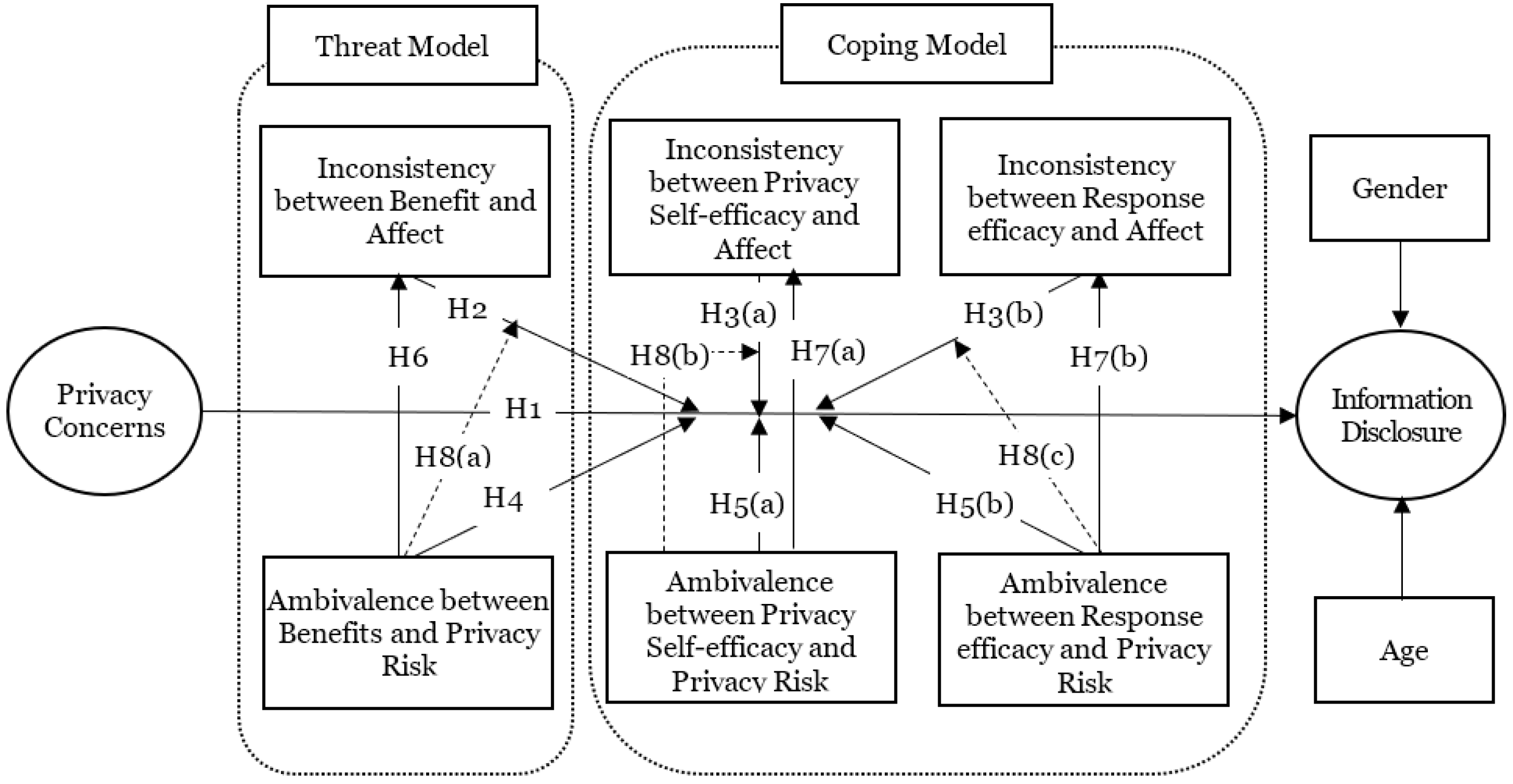
4. Hypotheses and Research Model
4.1. Research Model
4.2. Hypotheses
4.2.1. Effect of Privacy Concerns on Information Disclosure
4.2.2. Effect of Cognitive–Affective Inconsistency
4.2.3. Effect of Attitudinal Ambivalence
4.2.4. Effect of Attitudinal Ambivalence on the Level of Inconsistency
4.2.5. The Moderating Effect of Inconsistency Under Different Ambivalences
5. Study Design and Data Collection
5.1. Measurement Items
5.2. Data Collection
6. Analyses and Results
6.1. Demographic Statistics
6.2. Phase 1: The Effect of Inconsistency and Ambivalence
6.3. Phase 2: The Effect of Inconsistency Under Different Levels of Ambivalence
6.4. Additional Analysis
6.4.1. Multiple Models
6.4.2. Group Comparisons for Examining Ambivalences and Inconsistencies
6.4.3. Group Comparisons of the Relationship Between Ambivalences and Inconsistencies
7. Discussion
8. Theoretical and Practical Implications
8.1. Theoretical Implications
8.2. Practical Implications
9. Conclusions
Funding
Institutional Review Board Statement
Informed Consent Statement
Data Availability Statement
Conflicts of Interest
Appendix A

| Construct | Measurements |
|---|---|
| Privacy concerns |
|
| Benefits |
|
| Privacy risk |
|
| Privacy self-efficacy |
|
| Response efficacy |
|
| Affect toward information disclosure |
|
| Information disclosure | I am willing to provide my personal information to get benefits from online vendors. |
References
- Chevalier, S. Global Retail E-Commerce Sales 2014–2027. Available online: https://www.statista.com/statistics/379046/worldwide-retail-e-commerce-sales/ (accessed on 12 October 2025).
- Merhi, M.I. Multi-country analysis of e-commerce adoption: The impact of national culture and economic development. Pac. Asia J. Assoc. Inf. Syst. 2021, 13, 4. [Google Scholar] [CrossRef]
- Alhitmi, H.K.; Mardiah, A.; Al-Sulaiti, K.I.; Abbas, J. Data security and privacy concerns of AI-driven marketing in the context of economics and business field: An exploration into possible solutions. Cogent Bus. Manag. 2024, 11, 2393743. [Google Scholar] [CrossRef]
- Brough, A.R.; Martin, K.D. Critical roles of knowledge and motivation in privacy research. Curr. Opin. Psychol. 2020, 31, 11–15. [Google Scholar] [CrossRef] [PubMed]
- Curzon, J.; Kosa, T.A.; Akalu, R.; El-Khatib, K. Privacy and artificial intelligence. IEEE Trans. Artif. Intell. 2021, 2, 96–108. [Google Scholar] [CrossRef]
- Hajli, N.; Lin, X. Exploring the security of information sharing on social networking sites: The role of perceived control of information. J. Bus. Ethics 2016, 133, 111–123. [Google Scholar] [CrossRef]
- Baruh, L.; Secinti, E.; Cemalcilar, Z. Online privacy concerns and privacy management: A meta-analytical review. J. Commun. 2017, 67, 26–53. [Google Scholar] [CrossRef]
- Wang, N.; Rieger, L. Swaying individuals’ privacy concerns via amplifying versus diminishing counter argument. Pac. Asia J. Assoc. Inf. Syst. 2023, 15, 2. [Google Scholar] [CrossRef]
- Gu, J.; Xu, Y.; Xu, H.; Zhang, C.; Ling, H. Privacy concerns for mobile app download: An elaboration likelihood model perspective. Decis. Support Syst. 2017, 94, 19–28. [Google Scholar] [CrossRef]
- Zhang, X.; Liu, S.; Chen, X.; Wang, L.; Gao, B.; Zhu, Q. Health information privacy concerns, antecedents, and information disclosure intention in online health communities. Inf. Manag. 2018, 55, 482–493. [Google Scholar] [CrossRef]
- Gerber, N.; Gerber, P.; Volkamer, M. Explaining the privacy paradox: A systematic review of literature investigating privacy attitude and behavior. Comput. Secur. 2018, 77, 226–261. [Google Scholar] [CrossRef]
- Li, H.; Luo, X.R.; Zhang, J.; Xu, H. Resolving the privacy paradox: Toward a cognitive appraisal and emotion approach to online privacy behaviors. Inf. Manag. 2017, 54, 1012–1022. [Google Scholar] [CrossRef]
- Solove, D.J. The myth of the privacy paradox. Wash. Law Rev. 2021, 89, 1–51. [Google Scholar] [CrossRef]
- Brandimarte, L.; Acquisti, A.; Loewenstein, G. Misplaced confidences: Privacy and the control paradox. Soc. Psychol. Personal. Sci. 2013, 4, 340–347. [Google Scholar] [CrossRef]
- Waldman, A.E. Cognitive biases, dark patterns, and the ‘privacy paradox’. Curr. Opin. Psychol. 2020, 31, 105–109. [Google Scholar] [CrossRef] [PubMed]
- Conner, M.; Wilding, S.; van Harreveld, F.; Dalege, J. Cognitive-affective inconsistency and ambivalence: Impact on the overall attitude–behavior relationship. Personal. Soc. Psychol. Bull. 2021, 47, 673–687. [Google Scholar] [CrossRef]
- Chaiken, S.; Pomerantz, E.M.; Giner-Sorolla, R. Structural consistency and attitude strength. In Attitude Strength: Antecedents and Consequences, 1st ed.; Petty, R.E., Krosnick, J.A., Eds.; Erlbaum: Mahwah, NJ, USA, 1995; pp. 387–412. [Google Scholar]
- Crites, S.L., Jr.; Fabrigar, L.R.; Petty, R.E. Measuring the affective and cognitive properties of attitudes: Conceptual and methodological issues. Personal. Soc. Psychol. Bull. 1994, 20, 619–634. [Google Scholar] [CrossRef]
- Hsiao, C.C. Understanding content sharing on the internet: Test of a cognitive-affective-conative model. Online Inf. Rev. 2020, 44, 1289–1306. [Google Scholar] [CrossRef]
- Ormond, D.; Warkentin, M.; Crossler, R.E. Integrating cognition with an affective lens to better understand information security policy compliance. J. Assoc. Inf. Syst. 2019, 20, 1794–1843. [Google Scholar] [CrossRef]
- Vaghefi, I.; Qahri-Saremi, H.; Turel, O. Dealing with social networking site addiction: A cognitive-affective model of discontinuance decisions. Internet Res. 2020, 30, 1427–1453. [Google Scholar] [CrossRef]
- Haddock, G.; Foad, C.; Windsor-Shellard, B.; Dummel, S.; Adarves-Yorno, I. On the attitudinal consequences of being mindful: Links between mindfulness and attitudinal ambivalence. Personal. Soc. Psychol. Bull. 2017, 43, 439–452. [Google Scholar] [CrossRef]
- Schneider, I.K.; Schwarz, N. Mixed feelings: The case of ambivalence. Curr. Opin. Behav. Sci. 2017, 15, 39–45. [Google Scholar] [CrossRef]
- Bargh, J.A.; Chaiken, S.; Govender, R.; Pratto, F. The generality of the automatic attitude activation effect. J. Personal. Soc. Psychol. 1992, 62, 893–912. [Google Scholar] [CrossRef]
- Maio, G.R.; Bell, D.W.; Esses, V.M. Ambivalence and persuasion: The processing of messages about immigrant groups. J. Exp. Soc. Psychol. 1996, 32, 513–536. [Google Scholar] [CrossRef] [PubMed]
- Yang, L.; Unnava, H.R. Tipping the purchase with external cues: Influencing the behaviors of ambivalent consumers with contextual primes. J. Mark. Theory Pract. 2016, 24, 442–461. [Google Scholar] [CrossRef]
- Nohlen, H.U.; van Harreveld, F.; Rotteveel, M.; Barends, A.J.; Larsen, J.T. Affective responses to ambivalence are context-dependent: A facial EMG study on the role of inconsistency and evaluative context in shaping affective responses to ambivalence. J. Exp. Soc. Psychol. 2016, 65, 42–51. [Google Scholar] [CrossRef]
- Harmon-Jones, E.; Mills, J. An introduction to cognitive dissonance theory and an overview of current perspectives on the theory. In Cognitive Dissonance: Reexamining a Pivotal Theory in Psychology, 2nd ed.; Harmon-Jones, E., Ed.; American Psychological Association: Washington, DC, USA, 2019; pp. 3–24. [Google Scholar]
- van Harreveld, F.; van der Pligt, J.; de Liver, Y. The agony of ambivalence and ways to resolve it: Introducing the MAID model. Personal. Soc. Psychol. Rev. 2009, 13, 45–61. [Google Scholar] [CrossRef]
- van Harreveld, F.; Rutjens, B.T.; Schneider, I.K.; Nohlen, H.; Keskinis, K. In doubt and disorderly: Ambivalence promotes compensatory perceptions of order. J. Exp. Psychol. Gen. 2014, 143, 1666–1676. [Google Scholar] [CrossRef]
- Maddux, J.E.; Rogers, R.W. Protection motivation and self-efficacy: A revised theory of fear appeals and attitude change. J. Exp. Soc. Psychol. 1983, 19, 469–479. [Google Scholar] [CrossRef]
- Youn, S. Determinants of online privacy concern and its influence on privacy protection behaviors among young adolescents. J. Consum. Aff. 2009, 43, 389–418. [Google Scholar] [CrossRef]
- Dinev, T.; Hart, P. An extended privacy calculus model for e-commerce transactions. Inf. Syst. Res. 2006, 17, 61–80. [Google Scholar] [CrossRef]
- Smith, H.J.; Dinev, T.; Xu, H. Information privacy research: An interdisciplinary review. MIS Q. 2011, 35, 989–1015. [Google Scholar] [CrossRef]
- Chaiken, S.; Trope, Y. (Eds.) Dual-Process Theories in Social Psychology; Guilford Press: New York, NY, USA, 1999. [Google Scholar]
- Brown, M.; Muchira, R. Investigating the relationship between Internet privacy concerns and online purchase behavior. J. Electron. Commer. Res. 2004, 5, 62–70. [Google Scholar]
- Chellappa, R.K.; Sin, R.G. Personalization versus privacy: An empirical examination of the online consumer’s dilemma. Inf. Technol. Manag. 2005, 6, 181–202. [Google Scholar] [CrossRef]
- Son, J.Y.; Kim, S.S. Internet users’ information privacy-protective responses: A taxonomy and a nomological model. MIS Q. 2008, 32, 503–529. [Google Scholar] [CrossRef]
- Malhotra, N.K.; Kim, S.S.; Agarwal, J. Internet users’ information privacy concerns (IUIPC): The construct, the scale, and a causal model. Inf. Syst. Res. 2004, 15, 336–355. [Google Scholar] [CrossRef]
- Anic, I.D.; Škare, V.; Milaković, I.K. The determinants and effects of online privacy concerns in the context of e-commerce. Electron. Commer. Res. Appl. 2019, 36, 100868. [Google Scholar] [CrossRef]
- Hallam, C.; Zanella, G. Online self-disclosure: The privacy paradox explained as a temporally discounted balance between concerns and rewards. Comput. Human Behav. 2017, 68, 217–227. [Google Scholar] [CrossRef]
- Hui, K.L.; Teo, H.H.; Lee, S.Y.T. The value of privacy assurance: An exploratory field experiment. MIS Q. 2007, 31, 19–33. [Google Scholar] [CrossRef]
- Kokolakis, S. Privacy attitudes and privacy behaviour: A review of current research on the privacy paradox phenomenon. Comput. Secur. 2017, 64, 122–134. [Google Scholar] [CrossRef]
- Utz, S. The function of self-disclosure on social network sites: Not only intimate, but also positive and entertaining self-disclosures increase the feeling of connection. Comput. Human Behav. 2015, 45, 1–10. [Google Scholar] [CrossRef]
- Zlatolas, L.N.; Welzer, T.; Heričko, M.; Hölbl, M. Privacy antecedents for SNS self-disclosure: The case of Facebook. Comput. Human Behav. 2015, 45, 158–167. [Google Scholar] [CrossRef]
- Chen, H.T.; Chen, W. Couldn’t or wouldn’t? The influence of privacy concerns and self-efficacy in privacy management on privacy protection. Cyberpsychol. Behav. Soc. Netw. 2015, 18, 13–19. [Google Scholar] [CrossRef] [PubMed]
- Martin, K. Breaking the privacy paradox: The value of privacy and associated duty of firms. Bus. Ethics Q. 2020, 30, 65–96. [Google Scholar] [CrossRef]
- Taddicken, M. The ‘privacy paradox’ in the social web: The impact of privacy concerns, individual characteristics, and the perceived social relevance on different forms of self-disclosure. J. Comput. Mediat. Commun. 2014, 19, 248–273. [Google Scholar] [CrossRef]
- Dienlin, T.; Masur, P.K.; Trepte, S. A longitudinal analysis of the privacy paradox. New Media Soc. 2023, 25, 1043–1064. [Google Scholar] [CrossRef]
- Fox, G.; van der Werff, L.; Rosati, P.; Lynn, T. Investigating Citizens’ Acceptance of Contact Tracing Apps: Examining the Role of Trust and Privacy. JMIR Mhealth Uhealth 2024, 12, e48700. [Google Scholar] [CrossRef]
- Ioannou, A.; Tussyadiah, I.; Lu, Y. Privacy concerns and disclosure of biometric and behavioral data for travel. Int. J. Inf. Technol. 2020, 54, 102–122. [Google Scholar] [CrossRef]
- Chen, H.T. Revisiting the privacy paradox on social media with an extended privacy calculus model: The effect of privacy concerns, privacy self-efficacy, and social capital on privacy management. Am. Behav. Sci. 2018, 62, 1392–1412. [Google Scholar] [CrossRef]
- Krasnova, H.; Veltri, N.F.; Günther, O. Self-disclosure and privacy calculus on social networking sites: The role of culture: Intercultural dynamics of privacy calculus. Bus. Inf. Syst. Eng. 2012, 4, 127–135. [Google Scholar] [CrossRef]
- Cooper, J.C.; Wright, J. The missing role of economics in FTC privacy policy. In The Cambridge Handbook of Consumer Privacy; Selinger, E., Ed.; Cambridge University Press: Cambridge, UK, 2018; pp. 465–488. [Google Scholar]
- Fuller, C.S. Is the market for digital privacy a failure? Public Choice 2019, 180, 353–381. [Google Scholar] [CrossRef]
- Acquisti, A. Nudging privacy: The behavioral economics of personal information. IEEE Secur. Priv. 2009, 7, 82–85. [Google Scholar] [CrossRef]
- Acquisti, A.; John, L.K.; Loewenstein, G. The impact of relative standards on the propensity to disclose. J. Market. Res. 2012, 49, 160–174. [Google Scholar] [CrossRef]
- Kehr, F.; Kowatsch, T.; Wentzel, D.; Fleisch, E. Blissfully ignorant: The effects of general privacy concerns, general institutional trust, and affect in the privacy calculus. Inf. Syst. Res. 2015, 25, 607–635. [Google Scholar] [CrossRef]
- Baek, Y.M. Solving the privacy paradox: A counter-argument experimental approach. Comput. Human Behav. 2014, 38, 33–42. [Google Scholar] [CrossRef]
- Hargittai, E. An update on survey measures of web-oriented digital literacy. Soc. Sci. Comput. Rev. 2009, 27, 130–137. [Google Scholar] [CrossRef]
- Kesan, J.P.; Hayes, C.M.; Bashir, M.N. A comprehensive empirical study of data privacy, trust, and consumer autonomy. Ind. Law J. 2015, 91, 267–352. [Google Scholar] [CrossRef][Green Version]
- Park, Y.J. Provision of Internet privacy and market conditions: An empirical analysis. Telecomm. Policy 2011, 35, 650–662. [Google Scholar] [CrossRef]
- Dienlin, T.; Trepte, S. Is the privacy paradox a relic of the past? An in-depth analysis of privacy attitudes and privacy behaviors. Eur. J. Soc. Psychol. 2015, 45, 285–297. [Google Scholar] [CrossRef]
- Millar, M.G.; Tesser, A. The effects of affective-cognitive consistency and thought on the attitude-behavior relation. J. Exp. Soc. Psychol. 1989, 25, 189–202. [Google Scholar] [CrossRef]
- Schleicher, D.J.; Watt, J.D.; Greguras, G.J. Reexamining the job satisfaction-performance relationship: The complexity of attitudes. J. Appl. Phycol. 2004, 89, 165–177. [Google Scholar] [CrossRef]
- Visser, D.; Coetzee, S. Affective-cognitive consistency of attitude as a moderator of the job satisfaction-performance relationship. SA J. Ind. Psychol. 2005, 31, 62–69. [Google Scholar] [CrossRef][Green Version]
- Ajzen, I. The theory of planned behavior. Organ. Behav. Hum. Decis. Process. 1991, 50, 179–211. [Google Scholar] [CrossRef]
- Ajzen, I.; Fishbein, M. Attitudes and the attitude-behavior relation: Reasoned and automatic processes. Eur. Rev. Soc. Psychol. 2000, 11, 1–33. [Google Scholar] [CrossRef]
- Argyriou, E.; Melewar, T.C. Consumer attitudes revisited: A Review of attitude theory in marketing research. Int. J. Manag. Rev. 2011, 13, 431–451. [Google Scholar] [CrossRef]
- Kim, M.S.; Hunter, J.E. Attitude-behavior relations: A meta-analysis of attitudinal relevance and topic. J. Commun. 1993, 43, 101–142. [Google Scholar] [CrossRef]
- Glasman, L.R.; Albarracín, D. Forming attitudes that predict future behavior: A meta-analysis of the attitude-behavior relation. Psychol. Bull. 2006, 132, 778–822. [Google Scholar] [CrossRef] [PubMed]
- Thompson, M.M.; Zanna, M.P.; Griffin, D.W. Let’s not be indifferent about (attitudinal) ambivalence. In Attitude Strength: Antecedents and Consequences; Petty, R.E., Krosnick, J.A., Eds.; Lawrence Erlbaum: Mahwah, NJ, USA, 1995; pp. 361–386. [Google Scholar]
- Armitage, C.J.; Conner, M. Attitudinal ambivalence: A test of three key hypotheses. Personal. Soc. Psychol. Bull. 2000, 26, 1421–1432. [Google Scholar] [CrossRef]
- Jonas, K.; Broemer, P.; Diehl, M. Attitudinal ambivalence. Eur. Rev. Soc. Psychol. 2000, 11, 35–74. [Google Scholar] [CrossRef]
- Glick, P.; Fiske, S.T. Ambivalent sexism. Adv. Exp. Soc. Psychol. 2001, 33, 115–188. [Google Scholar] [CrossRef]
- Johnson, I.R.; Petty, R.E.; Briñol, P.; See, Y.H.M. Persuasive message scrutiny as a function of implicit-explicit discrepancies in racial attitudes. J. Exp. Soc. Psychol. 2017, 70, 222–234. [Google Scholar] [CrossRef]
- Majmundar, A.; Cornelis, E.; Moran, M.B. Examining the vulnerability of ambivalent young adults to e-cigarette messages. Health Mark. Q. 2020, 37, 73–88. [Google Scholar] [CrossRef] [PubMed]
- Pang, J.; Keh, H.T.; Li, X.; Maheswaran, D. “Every coin has two sides”: The effects of dialectical thinking and attitudinal ambivalence on psychological discomfort and consumer choice. J. Consum. Psychol. 2017, 27, 218–230. [Google Scholar] [CrossRef]
- Moody, G.D.; Lowry, P.B.; Galletta, D.F. It’s complicated: Explaining the relationship between trust, distrust, and ambivalence in online transaction relationships using polynomial regression analysis and response surface analysis. Eur. J. Inf. Syst. 2017, 26, 379–413. [Google Scholar] [CrossRef]
- Ng, K.C.; Zhang, X.; Thong, J.Y.; Tam, K.Y. Protecting against threats to information security: An attitudinal ambivalence perspective. J. Manag. Inf. Syst. 2021, 38, 732–764. [Google Scholar] [CrossRef]
- Chatzidakis, A.; Kastanakis, M.; Stathopoulou, A. Socio-cognitive determinants of consumers’ support for the fair trade movement. J. Bus. Ethics 2016, 133, 95–109. [Google Scholar] [CrossRef]
- Ciampa, V.; Sirowatka, M.; Schuh, S.C.; Fraccaroli, F.; van Dick, R. Ambivalent identification as a moderator of the link between organizational identification and counterproductive work behaviors. J. Bus. Ethics 2021, 169, 1–16. [Google Scholar] [CrossRef]
- Zampetakis, L.A.; Lerakis, M.; Kafetsios, K.; Moustakis, V.S. The moderating role of anticipated affective ambivalence in the formation of entrepreneurial intentions. Int. Entrep. Manag. J. 2016, 12, 815–838. [Google Scholar] [CrossRef]
- Drescher, F.; Ziegler, R. The interactive role of subjective attitudinal ambivalence, knowledge, and certainty for attitude stability: The case of driving electric vehicles. J. Theor. Soc. Psychol. 2021, 5, 238–248. [Google Scholar] [CrossRef]
- Luttrell, A.; Petty, R.E.; Briñol, P. Ambivalence and certainty can interact to predict attitude stability over time. J. Exp. Soc. Psychol. 2016, 63, 56–68. [Google Scholar] [CrossRef]
- Reid, A.E.; Taber, J.M.; Ferrer, R.A.; Biesecker, B.B.; Lewis, K.L.; Biesecker, L.G.; Klein, W.M. Associations of perceived norms with intentions to learn genomic sequencing results: Roles for attitudes and ambivalence. Health Psychol. 2018, 37, 553–561. [Google Scholar] [CrossRef]
- Nordgren, L.F.; Van Harreveld, F.; Van Der Pligt, J. Ambivalence, discomfort, and motivated information processing. J. Exp. Soc. Psychol. 2006, 42, 252–258. [Google Scholar] [CrossRef]
- Swann, W.B.; Griffin, J.J.; Predmore, S.C.; Gaines, B. The cognitive–affective crossfire: When self-consistency confronts self-enhancement. J. Personal. Soc. Psychol. 1987, 52, 881. [Google Scholar] [CrossRef]
- Jonas, K.; Ziegler, R. Attitudinal ambivalence. In The Scope of Social Psychology: Theory and Applications; Hewstone, M., Schut, H., de Wit, J.B.F., van den Bos, K., Stroebe, M.S., Eds.; Psychology Press: New York, NY, USA, 2007; pp. 29–42. [Google Scholar]
- Heslin, P.A.; Keating, L.A.; Minbashian, A. How situational cues and mindset dynamics shape personality effects on career outcomes. J. Manag. 2019, 45, 2101–2131. [Google Scholar] [CrossRef]
- Craig, S.C.; Cossette, P.; Martinez, M. Partisan ambivalence and electoral decision making. Am. Rev. Politics 2020, 37, 1–28. [Google Scholar] [CrossRef]
- Eagly, A.H.; Chaiken, S. Attitude structure and function. In The Handbook of Social Psychology, 4th ed.; Gilbert, D.T., Fiske, S.T., Lindzey, G., Eds.; McGraw-Hill: Columbus, OH, USA, 1998; pp. 269–322. [Google Scholar]
- Yang, Y.C.; Huang, L.T.; Su, Y.T. Are consumers more willing to pay for digital items in mobile applications? Consumer attitudes toward virtual goods. Pac. Asia J. Assoc. Inf. Syst. 2017, 9, 4. [Google Scholar] [CrossRef]
- Millar, M.G.; Tesser, A. Effects of affective and cognitive focus on the attitude–behavior relation. J. Personal. Soc. Psychol. 1986, 51, 270–276. [Google Scholar] [CrossRef]
- Harmon-Jones, E.; Amodio, D.M.; Harmon-Jones, C. Action-based model of dissonance: A review, integration, and expansion of conceptions of cognitive conflict. Adv. Exp. Soc. Psychol. 2009, 41, 119–166. [Google Scholar] [CrossRef]
- Harmon-Jones, E.; Harmon-Jones, C. Action-based model of dissonance: A review of behavioral, anterior cingulate, and prefrontal cortical mechanisms. Soc. Personal. Psychol. Compass 2008, 2, 1518–1538. [Google Scholar] [CrossRef]
- Fazio, R.H. Multiple processes by which attitudes guide behaviour: The MODE model as an integrative framework. Adv. Exp. Soc. Psychol. 1990, 15, 115–141. [Google Scholar] [CrossRef]
- Yu, J.; Hu, P.J.H.; Cheng, T.H. Role of affect in self-disclosure on social network websites: A test of two competing models. J. Manag. Inf. Systs. 2015, 32, 239–277. [Google Scholar] [CrossRef]
- Yu, J.; Albashrawi, M.; Tarhini, A. The determinants of the loyalty of mobile banking: The integrated model of IS success model and UTAUT. Pac. Asia J. Assoc. Inf. Syst. 2024, 16, 3. [Google Scholar]
- Angst, C.M.; Agarwal, R. Adoption of electronic health records in the presence of privacy concerns: The elaboration likelihood model and individual persuasion. MIS Q. 2009, 33, 339–370. [Google Scholar] [CrossRef]
- Li, H.; Sarathy, R.; Xu, H. The role of affect and cognition on online consumers’ decision to disclose personal information to unfamiliar online vendors. Decis. Support Syst. 2011, 51, 434–445. [Google Scholar] [CrossRef]
- Conner, M.; Sparks, P. Ambivalence and attitudes. Eur. Rev. Soc. Psychol. 2002, 12, 37–70. [Google Scholar] [CrossRef]
- Fazio, R.H.; Williams, C.J. Attitude accessibility as a moderator of the attitude-perception and attitude-behavior relations. An investigation of the 1984 presidential election. J. Personal. Soc. Psychol. 1986, 51, 505–514. [Google Scholar] [CrossRef]
- Chaiken, S.; Baldwin, M.W. Affective-cognitive consistency and the effect of salient behavioral information on the self-perception of attitudes. J. Personal. Soc. Psychol. 1981, 41, 1–12. [Google Scholar] [CrossRef]
- Xu, H.; Dinev, T.; Smith, J.; Hart, P. Information privacy concerns: Linking individual perceptions with institutional privacy assurances. J. Assoc. Inf. Syst. 2011, 12, 798–824. [Google Scholar] [CrossRef]
- Xu, H.; Teo, H.H.; Tan, B.C.Y.; Agarwal, R. The role of push-pull technology in privacy calculus: The case of location-based services. J. Manag. Inf. Systs. 2009, 26, 135–174. [Google Scholar] [CrossRef]
- Johnston, A.C.; Warkentin, M. Fear appeals and information security behaviors: An empirical study. MIS Q. 2010, 34, 549–566. [Google Scholar] [CrossRef]
- Jonas, K.; Diehl, M.; Brömer, P. Effects of attitudinal ambivalence on information processing and attitude-intention consistency. J. Exp. Soc. Psychol. 1997, 33, 190–210. [Google Scholar] [CrossRef]
- Götz, O.; Liehr-Gobbers, K.; Krafft, M. Evaluation of structural equation models using the partial least squares (PLS) approach. In Handbook of Partial Least Squares; Vinzi, V.E., Chin, W.W., Henseler, J., Wang, H., Eds.; Springer: Berlin/Heidelberg, Germany, 2010; pp. 691–711. [Google Scholar]
- Bagozzi, R.P.; Yi, Y. On the evaluation of structural equation models. J. Acad. Mark. Sci. 1988, 16, 74–94. [Google Scholar] [CrossRef]
- Henseler, J.; Ringle, C.M.; Sarstedt, M. A new criterion for assessing discriminant validity in variance-based structural equation modeling. J. Acad. Mark. Sci. 2015, 43, 115–135. [Google Scholar] [CrossRef]
- Hair, J.F.; Howard, M.C.; Nitzl, C. Assessing measurement model quality in PLS-SEM using confirmatory composite analysis. J. Bus. Res. 2020, 109, 101–110. [Google Scholar] [CrossRef]
- Hair, J.F.; Risher, J.J.; Sarstedt, M.; Ringle, C.M. When to use and how to report the results of PLS-SEM. Eur. Bus. Rev. 2019, 31, 2–24. [Google Scholar] [CrossRef]
- Lindell, M.K.; Whitney, D.J. Accounting for common method variance in cross-sectional research designs. J. Appl. Psychol. 2001, 86, 114–121. [Google Scholar] [CrossRef]
- Tehseen, S.; Ramayah, T.; Sajilan, S. Testing and controlling for common method variance: A review of available methods. J. Manag. Sci. 2017, 4, 142–168. [Google Scholar] [CrossRef]
- Jarque, C.M.; Bera, A.K. Efficient tests for normality, homoscedasticity and serial independence of regression residuals. Econ. Lett. 1980, 6, 255–259. [Google Scholar] [CrossRef]
- Jiang, G.; Yuan, K.H. Four new corrected statistics for SEM with small samples and nonnormally distributed data. Struct. Equ. Model. 2017, 24, 479–494. [Google Scholar] [CrossRef]
- Sarstedt, M.; Hair, J.F.; Ringle, C.M.; Thiele, K.O.; Gudergan, S.P. Estimation issues with PLS and CBSEM: Where the bias lies! J. Bus. Res. 2016, 69, 3998–4010. [Google Scholar] [CrossRef]
- Reinartz, W.; Haenlein, M.; Henseler, J. An empirical comparison of the efficacy of covariance-based and variance-based SEM. Int. J. Res. Mark. 2009, 26, 332–344. [Google Scholar] [CrossRef]
- Bandura, A. Sources of self-efficacy. In Self-Efficacy: The Exercise of Control; Brennan, S., Hastings, C., Eds.; WH Freeman and Company: New York, NY, USA, 1997; pp. 79–115. [Google Scholar]

| Dimension | Attitudinal Ambivalence | Cognitive–Affective Inconsistency |
|---|---|---|
| Scope/Structure | Intra-component (within cognition: positive and negative evaluations coexist) [71] | Inter-component (misalignment between cognitive evaluations and affective responses) [17] |
| Psychological Origin | Conflict from competing cognitive elements (e.g., benefits vs. risks) [71,72] | Divergence from emotional residues or contextual influences [64] |
| Measurement Approach | Capturing the intensity and equivalence of positive and negative evaluation: Griffin formula [72] | Operationalized as the absolute difference between cognitive evaluation and feelings about the attitude object [16]. |
| Behavioral Implications | Reduces attitude clarity and stability; motivates deliberation and resolution-seeking [73,74,91] | Undermines attitude coherence; conditions whether attitudes guide behavior at decision point [16,64] |
| Total Observation | Items | Frequency/ Average | Percent/Standard Deviation | |
|---|---|---|---|---|
| 540 | Gender | Female | 205 | 38.0% |
| Male | 335 | 62.0% | ||
| Age | 36.7 | 10.2 | ||
| Constructs | Cronbach Alpha | Composite Reliability | AVE |
|---|---|---|---|
| Perceived Benefits | 0.949 | 0.963 | 0.867 |
| Privacy Risk | 0.918 | 0.942 | 0.802 |
| Privacy Self-efficacy | 0.926 | 0.946 | 0.815 |
| Response Efficacy | 0.906 | 0.933 | 0.778 |
| Privacy Concerns | 0.909 | 0.936 | 0.785 |
| BEN | PRC | RES | RISK | SEL | |
|---|---|---|---|---|---|
| BEN | |||||
| PRC | 0.277 | ||||
| RES | 0.374 | 0.222 | |||
| RISK | 0.385 | 0.822 | 0.267 | ||
| SEL | 0.086 | 0.057 | 0.531 | 0.091 |
| BEN | PRC | RES | RISK | SEL | |
|---|---|---|---|---|---|
| JB statistics | 51.46 | 37.61 | 22.60 | 3.21 | 14.27 |
| p-value | 0.000 | 0.000 | 0.000 | 0.201 | 0.001 |
| Exogenous | Threat Model | Coping Model | Hypothesis Test Result |
|---|---|---|---|
| PRC → IDB | −0.335 *** (0.053) | −0.336 *** (0.049) | H1: Supported |
| INC-BA × PRC → IDB | −0.128 ** (0.037) | H2: Supported | |
| INC-SA × PRC → IDB | −0.161 (0.113) | H3(a): Not supported | |
| INC-RA × PRC → IDB | −0.244 * (0.122) | H3(b): Supported | |
| AMV-BR × PRC → IDB | −0.095 * (0.039) | H4: Supported | |
| AMV-SR × PRC → IDB | −0.163 * (0.076) | H5(a): Supported | |
| AMV-RR × PRC → IDB | −0.077 (0.080) | H5(b): Not supported | |
| AMV-BR → INC-BR | −0.422 *** (0.041) | H6: Supported | |
| AMV-SR → INC-SR | −0.285 *** (0.047) | H7(a): Supported | |
| AMV-RR → INC-RR | −0.433 *** (0.045) | H7(b): Supported | |
| GEN | −0.013 (0.076) | 0.046 (0.037) | Control Variables |
| AGE | 0.041 (0.035) | −0.007 (0.077) | |
| Adjust R2 (IDB) | 0.270 | 0.263 |
| Exogenous | High Ambivalence | Low Ambivalence | Hypothesis Test Result | |
|---|---|---|---|---|
| Benefits Model | PRC → IDB | −0.214 *** (0.055) | −0.538 *** (0.052) | |
| INC-BA × PRC → IDB | −0.137 * (0.054) | −0.157 ** (0.048) | H8(a): Not supported | |
| Privacy Self-efficacy Model | PRC → IDB | −0.286 *** (0.053) | −0.495 *** (0.055) | |
| INC-SA × PRC → IDB | −0.143 ** (0.054) | −0.070 (0.050) | H8(b): Supported | |
| Response Efficacy Model | PRC → IDB | −0.274 *** (0.053) | −0.486 *** (0.052) | |
| INC-RA × PRC → IDB | −0.120 * (0.052) | −0.123 * (0.048) | H8(c): Not supported | |
| Exogenous | Model 1 | Model 2 | Model 3 | Model 4 | Model 5 |
|---|---|---|---|---|---|
| PRC → IDB | −0.337 *** | −0.355 *** | −0.334 *** | −0.291 *** | −0.297 *** |
| INC-BA × PRC → IDB | −0.223 *** | −0.172 *** | −0.168 *** | −0.158 *** | |
| INC-SA × PRC → IDB | −0.121 ** | −0.040 | −0.114 * | ||
| INC-RA × PRC → IDB | −0.150 *** | −0.132 ** | −0.173 *** | ||
| AMV-BR × PRC → IDB | −0.204 *** | −0.114 * | −0.164 ** | −0.146 ** | |
| AMV-SR × PRC → IDB | −0.094 * | −0.028 | −0.021 | ||
| AMV-RR × PRC → IDB | −0.103 * | −0.018 | −0.021 | ||
| AMV-BR → INC-BR | −0.422 *** | −0.422 *** | −0.422 *** | ||
| AMV-SR → INC-SR | −0.504 *** | −0.504 *** | |||
| AMV-RR → INC-RR | −0.541 *** | −0.541 *** | |||
| GEN | −0.002 | 0.000 | −0.000 | −0.016 | −0.008 |
| AGE | 0.043 | 0.036 | 0.031 | 0.052 | 0.041 |
| Coefficient | Standard Deviation | Difference | |||
|---|---|---|---|---|---|
| High | Low | High | Low | ||
| AMV-BR | −0.251 | −0.627 | 0.054 | 0.04 | 0.376 *** |
| AMV-SR | −0.338 | −0.559 | 0.058 | 0.049 | 0.221 *** |
| AMV-RR | −0.310 | −0.579 | 0.051 | 0.048 | 0.269 *** |
| INC-BA | −0.265 | −0.591 | 0.046 | 0.048 | 0.326 *** |
| INC-SA | −0.341 | −0.564 | 0.052 | 0.050 | 0.223 *** |
| INC-RA | −0.306 | −0.573 | 0.050 | 0.050 | 0.267 *** |
| AMV-BR | AMV-SR | AMV-RR | ||||
|---|---|---|---|---|---|---|
| High | Low | High | Low | High | Low | |
| Mean of Inconsistency | 1.162 | 2.092 | 1.182 | 1.888 | 1.171 | 2.088 |
| t-value | −8.593 *** | −6.684 *** | −7.908 *** | |||
Disclaimer/Publisher’s Note: The statements, opinions and data contained in all publications are solely those of the individual author(s) and contributor(s) and not of MDPI and/or the editor(s). MDPI and/or the editor(s) disclaim responsibility for any injury to people or property resulting from any ideas, methods, instructions or products referred to in the content. |
© 2026 by the author. Licensee MDPI, Basel, Switzerland. This article is an open access article distributed under the terms and conditions of the Creative Commons Attribution (CC BY) license.
Share and Cite
Yu, J. Explaining Inconsistent Privacy Effects: How Cognitive–Affective Inconsistency and Ambivalence Shape Online Information Disclosure. J. Theor. Appl. Electron. Commer. Res. 2026, 21, 58. https://doi.org/10.3390/jtaer21020058
Yu J. Explaining Inconsistent Privacy Effects: How Cognitive–Affective Inconsistency and Ambivalence Shape Online Information Disclosure. Journal of Theoretical and Applied Electronic Commerce Research. 2026; 21(2):58. https://doi.org/10.3390/jtaer21020058
Chicago/Turabian StyleYu, Jongtae. 2026. "Explaining Inconsistent Privacy Effects: How Cognitive–Affective Inconsistency and Ambivalence Shape Online Information Disclosure" Journal of Theoretical and Applied Electronic Commerce Research 21, no. 2: 58. https://doi.org/10.3390/jtaer21020058
APA StyleYu, J. (2026). Explaining Inconsistent Privacy Effects: How Cognitive–Affective Inconsistency and Ambivalence Shape Online Information Disclosure. Journal of Theoretical and Applied Electronic Commerce Research, 21(2), 58. https://doi.org/10.3390/jtaer21020058