

From Avatars to Algorithms: Virtual Streamers and AI-Enabled Consumer Behavior in Live Streaming Commerce—A Systematic Review


Abstract
1. Introduction
- How have theoretical models and consumer psychology constructs been applied to understand consumer responses to virtual streamers?
- What knowledge gaps exist across platforms, cultural contexts, and user demographics?
- How can existing evidence inform an integrative framework for AI-enabled marketing communication?
2. Methods
2.1. Search Strategy
2.1.1. Literature Search and Study Selection
2.1.2. Eligibility and Filtering Criteria
2.2. Data Extraction
3. Results
3.1. Risk of Bias in Studies
3.2. Results of Studies
3.2.1. Platform and Geographic Trends
3.2.2. Theoretical Trends
3.2.3. Methodological Trends

| Author/ Year | Theoretical Foundation | Method | Sample Size | Key Variables | Key Findings | Journal |
|---|---|---|---|---|---|---|
| [15] | Social Identity Theory, Construal Levels Theory | Online scenario experiment, 2 × 2 between-subjects design | N = 214 | Anthropomorphism, Psychological Distance, Trust, Product Type, Willingness to Accept | Anthropomorphism significantly increases consumers’ willingness to accept virtual live streamers through the mediating roles of psychological distance and trust. This chain mediation is significant for utilitarian products but not for hedonic ones. | Computers in Human Behavior |
| [58] | Meaning Transfer Theory | Mixed-methods approach (secondary data analysis and situational experiments) | 50,867 online comments; Study 2–4: N = 582 | Streamer Type (RHS vs. HPVS), Consumer Empathy, Brand Reputation, Streamer Influence, Brand Forgiveness | Consumer brand forgiveness is higher when inappropriate remarks come from human-powered virtual streamers (HPVSs) than from real human streamers (RHSs). Consumer empathy mediates this effect; brand reputation and streamer influence moderate it—HPVSs enhance forgiveness, particularly when reputation or influence is high. | Journal of Retailing and Consumer Services |
| [32] | Social Response Theory | Empirical study with four laboratory experiments | Study 1a: N = 116; Study 1b: N = 122; Study 2: N = 240; Study 3: N = 220 | Socialness (high vs. low), Social Presence, Communication Style, Situation, Experiential Value | High-social streamers enhance utilitarian and hedonic value via social presence; effects vary by communication style and context. | Journal of Research in Interactive Marketing |
| [54] | Social Response Theory | Five-stage scale development process with exploratory and confirmatory factor analysis | 10 interviews; 216 (presurvey); 610 (EFA); 618 (CFA); 604 (nomological test) | Persona, Anthropomorphism, Interactivity | Developed a reliable 3-dimension, 10-item scale measuring AI virtual streamer traits (persona, anthropomorphism, interactivity). | International Journal of Human–Computer Interaction |
| [33] | Trust Theory, SOR Model | Study 1: Survey (PLS-SEM); Study 2: Mixed-design experiment (ANOVA) | Study 1: N = 411; Study 2: N = 160 | Integrity, Ability, Benevolence, Predictability, Social Presence, Perceived Enjoyment, Perceived Similarity, Trust, Purchase Intention | Integrity and social presence significantly predict trust; integrity drives trust in human streamers, while social presence drives trust and purchase intention for virtual streamers. | International Journal of Human–Computer Interaction |
| [54] | CASA Theory, The Stereotype Content Model | PLS-SEM | Study 1: N = 277; Study 2: N = 244; Study 3: N = 232 | Virtual Anchor Type (all-human-like vs. animal-human-like), Perceived Warmth, Perceived Competence, Product Type, Certainty of Consumer Needs | Animal-human-like anchors enhance purchase intention via warmth for hedonic products/low-need certainty; all-human-like anchors via competence for utilitarian products/high-need certainty. | Journal of Product & Brand Management |
| [11] | Source Credibility Theory | Quantitative study using multiple regression analysis on data from 300 streaming rooms | 300 virtual live streaming rooms | Trustworthiness, Expertise, Attractiveness, Interactivity, Online Sales Performance | Trustworthiness, expertise, and attractiveness positively affect sales, while interactivity negatively affects it. | SAGE Open |
| [44] | Image Transfer Theory | PLS-SEM | N = 400 | Emotional Richness, Physical Attractiveness, Social Attractiveness, Parasocial Relationship (PSR), Destination Attractiveness, Visit Intention, Streamer Type, Gender Incongruity | Virtual streamers’ emotional richness enhances perceived attractiveness and PSR, which increases destination attractiveness and visit intention; effects stronger for non-AI and opposite-gender streamers. | Journal of Destination Marketing & Management |
| [16] | Stereotype Content Model | Mixed-methods research combining experiments and focus group studies | Study 1: N = 321; Study 2: N = 292; Study 3: N = 120; Focus group: N = 9 | Linguistic Style (social- vs. task-oriented), Product Type (experience vs. search), Perceived Warmth, Perceived Competence, Streamer Type (human-like vs. animated) | Social-oriented language enhances purchase intention via perceived warmth and competence for experience products, especially with human-like virtual streamers. | Journal of Retailing and Consumer Services |
| [13] | Stimulus–Organism–Response (SOR) Framework | PLS-SEM | N = 378 | Likeability, Animacy, Responsiveness, Social Presence, Telepresence, Purchase Intention | Likeability and responsiveness directly boost purchase intention; animacy acts indirectly via social and telepresence; effects differ by streamer type. | Journal of Retailing and Consumer Services |
| [18] | Language Expectancy Theory | Three scenario-based experiments and one focus group study | Study 1: N = 208; Study 2: N = 171; Study 3: N = 254; Focus group: N = 8 | Sensory vs. Non-sensory Language, Language Expectancy Violation, Streamer Type (AI-backed vs. human-backed), Purchase Intention | Sensory language decreases purchase intention for AI-backed streamers but increases it when the streamer is perceived as human-backed. | Journal of Retailing and Consumer Services |
| [17] | Mind Perception Theory | Five experimental studies | Study 1: N = 155; Study 2: N = 149; Study 3: N = 161; Study 4: N = 234; Study 5: N = 216 | Language Style (emotional vs. rational), Perceived Agency, Perceived Experience, Imagery Difficulty, Purchase Motivation | Emotional language boosts consumers’ intention to follow advice via higher perceived mind (agency & experience); effects weaken with high imagery difficulty or utilitarian motivation. | Journal of Retailing and Consumer Services |
| [38] | Social Identity Theory (SIT), Experiential Value Theory | PLS-SEM | N = 354 | Personalization, Human-like Personality, System Quality, Content Quality, Parasocial Interaction, Experiential Value, Brand Image | Personalization, human-like traits, and system/content quality enhance parasocial interaction and experiential value, which improve brand image. | Asia Pacific Journal of Marketing and Logistics |
| [61] | Cognition–Affect–Behavior Model, Psychological Contract Theory | PLS-SEM | N = 414 | Perceived Competence, Perceived Interaction Quality, Perceived Warmth, Transactional Psychological Contract (TPC), Relational Psychological Contract (RPC), Purchase Intention | Perceived competence, interaction quality, and warmth enhance both TPC and RPC, which in turn increase consumers’ purchase intention toward virtual streamers. | Asia Pacific Journal of Marketing and Logistics |
| [8] | Innovation Resistance Theory, Shopping Motivation Theory, Personality Theory | Mixed methods (NCA, ANN, fsQCA) with online survey | N = 634 | Innovation Barriers (usage, value, risk, image, tradition), Shopping Motivations (hedonic, utilitarian), Personality Traits | Low barriers and strong motivation/affinity drive switching to virtual streamers; no single path but multiple optimal configurations exist. | Journal of Research in Interactive Marketing |
| [50] | Flow Theory, Stimulus–Organism–Response (S-O-R) Model | PLS-SEM | N = 274 | Vividness, Interactivity, Aesthetic Appeal, Novelty, Streamer Image–Scene Fit, Perceived Enjoyment, Concentration, Watching Intention | Interactivity, novelty, and image–scene fit enhance enjoyment and concentration, which boost watching intention. | Kybernetes |
| [23] | Avatar Theory | Three lab experiments | N = 604 | Form Realism, Behavioral Realism, Parasocial Interaction, Relationship Norm Orientation, Purchase Intention | Behavioral realism boosts purchase intention only when form realism is low; effect is mediated by parasocial interaction and moderated by relationship norm orientation. | Journal of Consumer Behaviour |
| [57] | Mental Imagery Quality Theory | Four experiments | Study 1: N = 188; Study 2: N = 217; Study 3: N = 242; Study 4: N = 421 | Streamer Type (virtual vs. human), Product Type (hedonic vs. utilitarian); Mental Imagery Quality; Implicit Personality; Purchase Intention | Virtual and human streamers are equally effective for utilitarian products, whereas human streamers generate higher purchase intention for hedonic products via enhanced mental imagery quality; this advantage disappears among incremental theorists but remains for entity theorists. | Marketing Intelligence & Planning |
| [34] | Expectancy Violations Theory (EVT) | Online survey; PLS-SEM | N = 307 | Professionalism Expectation Violation (PEV), Empathy Expectation Violation (EEV), Responsiveness Expectation Violation (REV); Distrust, Dissatisfaction; Discontinuance Behavior | Expectation violations in professionalism, empathy, and responsiveness increase consumers’ distrust and dissatisfaction, which in turn lead to discontinuance behavior toward virtual streamers. | Behavioral Sciences |
| [2] | Emotion Theory, Trust Theory, Personal Values Theory | Survey; PLS-SEM | Study 1: N = 663; Study 2: N ≈ 300 | Positive Emotions, Negative Emotions, Hedonic Value, Utilitarian Value; Consumer Engagement, Trust; Purchase Intention | Human internet celebrities elicit stronger positive emotions, trust, and purchase intention than AI virtual anchors; AI virtual anchors are generally less favored, except among consumers with extremely high hedonic values. | Journal of Retailing and Consumer Services |
| [53] | SOR Framework, Temporal Scale Perspective | Linear Mixed Model (LMM), Time-Varying Effect Model (TVEM) | 924,036 products from 21,190 livestreaming shows across 123 live rooms | Streamer Type (AI vs. human); Consumption Type (utilitarian vs. hedonic), Time; Monetary Engagement (sales, actual sales, pit output), Non-monetary Engagement (likes, danmaku, followers) | AI streamers can substitute for human streamers in monetary engagement under utilitarian consumption, but not in hedonic consumption; this substitution effect is short-lived, while AI’s effectiveness in hedonic contexts increases over time, though human streamers consistently outperform AI in non-monetary engagement. | Journal of Business Research |
| [55] | Stereotype Content Model (SCM) | Model (SCM); Coolness Theory Online survey; PLS-SEM; Multi-group analysis | N = 511 | Coolness Factors (attractiveness, subculture, utility, originality); Warmth, Competence; Purchase Intention | Virtual streamer coolness enhances purchase intention primarily through increased warmth and competence; however, subculture does not enhance warmth, and the effects of coolness factors differ depending on whether virtual streamers perform alone or with human streamers. | Journal of Retailing and Consumer Services |
| [45] | Social Cognitive Theory | Online survey; ANOVA; PROCESS mediation and moderated mediation | N = 387 | Streamer Type (AI vs. human); Perceived Intimacy, Perceived Responsiveness; Novelty Seeking; Purchase Intention | Consumers show higher purchase intention toward human streamers than AI streamers; perceived intimacy and perceived responsiveness mediate this effect, and novelty seeking moderates both the direct effect and the mediation paths. | International Journal of Human–Computer Interaction |
| [20] | Avatar Theory | Online survey; SEM (AMOS) | N = 503 | Appearance, Behavioral, Cognitive, Emotional Anthropomorphism; Cognitive Trust; Purchase Intention | Behavioral, cognitive, and emotional anthropomorphism significantly enhance purchase intention through cognitive trust, whereas appearance anthropomorphism affects purchase intention directly but does not build cognitive trust. | Behavioral Sciences |
| [62] | SOR Model | Survey; SEM (AMOS) | N = 343 | Personification; Utilitarian Shopping Value; Hedonic Shopping Value; Consumer Citizenship Behavior | Personification of e-commerce virtual anchors positively influences consumer citizenship behavior both directly and indirectly through utilitarian and hedonic shopping value. | IEEE Access |
| [63] | Expectancy Disconfirmation Theory | Survey; PLS-SEM; Multi-group analysis | N = 588 | Information Failure; Functional Failure; System Failure; Interaction Failure; Aesthetic Failure; Disappointment; Emotional Exhaustion; Discontinuance Behavior | Multiple dimensions of AI-oriented live-streaming service failure increase consumer disappointment and emotional exhaustion, which in turn lead to discontinuance behavior; the effects vary by platform type, with functional/system failures more salient on commercial platforms. | Journal of Theoretical and Applied Electronic Commerce Research |
| [46] | Signaling Theory, Technology Acceptance Model (TAM) | Analytical modeling; Signaling game | Not applicable | Product quality; Price; Consumer acceptance level of AI streamers; Information asymmetry (λ); Consumer belief; Firm profit; Signaling cost | In markets with moderate information asymmetry, high-quality firms achieve more profitable separation by jointly signaling through price and AI-streamer acceptance level, whereas under high asymmetry, separation becomes costly regardless of signaling strategy. | Journal of Theoretical and Applied Electronic Commerce Research |
| [64] | Computer-Mediated Communication (CMC) Theory, Sense of Community Theory | Mixed methods (survey and interviews) | Survey: N = 1795; Interviews: N = 10 | Platform Type; Perceived role of VTuber (idol vs. streamer); Spatial Presence; Social Presence; Immersion; Enjoyment Factors; Interaction Types; Fanwork Experience | Viewing platforms and perceived VTuber roles significantly shape audience presence and immersion, while fanwork experience and voluntary creation motivation strongly influence fandom engagement and content creation in VTuber concerts. | IEEE Access |
| [65] | Uses and Gratifications Theory | Two scenario-based experiments; ANCOVA; | Study 1: N = 402; Study 2: N = 428 | AI–Human Collaboration Type (assisted vs. supervised); Perceived Playfulness; Customer Engagement; Humorous Response; Product Attractiveness; | Virtual anchors driven by assisted AI–human collaboration generate higher customer engagement than those driven by supervised collaboration through increased perceived playfulness; humorous responses attenuate the difference in perceived playfulness between the two collaboration types. | Electronic Commerce Research |
| [66] | Appraisal–Emotion–Action Scheme, Persuasion Theory | Scenario-based online survey; SEM (ML) with Bayesian SEM cross-validation | N = 559 | Coolness; Congruence; Mind Perception; Arousal; Parasocial Interaction Intention; Urge to Buy Impulsively | Coolness, congruence, and mind perception of virtual AI streamers increase viewers’ parasocial interaction intention and impulsive buying urge primarily through arousal; these effects are stronger among viewers with higher impulsiveness and a more fixed mindset. | Information Systems Frontiers |
| [3] | 1. Self-Construal Theory 2. Antecedent–Belief–Consequence (ABC) framework 3.CASA Theory | Survey; PLS-SEM; Multi-group analysis | N = 402 | Anthropomorphism; Technophobia; Perceived Unwarm; Perceived Incompetent; Consumer Resonance; Disfluency; AI Virtual Streamers Aversion | Anthropomorphism and technophobia jointly shape consumer aversion to AI virtual streamers through a dual-stage belief process involving negative stereotypes and cognitive–emotional evaluations; these pathways differ between independent and interdependent consumers. | Technological Forecasting & Social Change |
| [59] | Attribution Theory, Expectation–Confirmation Theory | Multi-method research design: three experimental studies and one semi-structured interview study | Big data: 1,960,444 live comments from 30 brands; Experiments: Study 2 N = 416, Study 3 N = 613, Study 4 N = 600; Interviews: N = 20 | Streamer Type; Promotional and Product Information Seeking; Motivation Inference (cost reduction vs. service improvement); Product Category (promotional vs. new product); Purchase Intention | Consumers interacting with virtual streamers are more inclined to seek promotional information due to inferred cost-reduction motives, whereas human streamers trigger greater attention to product information; aligning virtual streamers with promotional products and human streamers with new products significantly enhances sales outcomes. | Journal of Retailing and Consumer Services |
| [56] | Social Presence Theory, Perceived Value Theory | Two scenario-based experiments and a laboratory experiment | Study 1: N = 500; Study 2: N = 431; Study 3: N = 188 | Anchor Type; Message Assertiveness; Excitement; Relaxation; Purchase Intention; Willingness to Pay; Perceived Price | Purchase intention is highest when message assertiveness matches anchor type: assertive messages are more effective for virtual anchors via excitement, whereas non-assertive messages are more effective for human anchors via relaxation. | Journal of Retailing and Consumer Services |
| [37] | Social Presence Theory, Perceived Value Theory, Service-Dominant Logic | Scenario-based experiments; ANOVA; PROCESS mediation and moderated mediation | Study 1 (Case 1): N = 100; Study 2 (Case 2): N = 201 | Interaction type (product vs. social); Social Presence; Perceived Value; Product Type (hedonic vs. utilitarian); Purchase Intention | Product interactions enhance purchase intention mainly through perceived value for utilitarian products, whereas social interactions increase purchase intention through social presence for hedonic products. | Journal of Retailing and Consumer Services |
| [59] | Consistency Theory and Dramaturgical Theory | Mixed methods: semi-structured interviews + questionnaire survey; PLS-SEM | Interviews: N = 21; Survey: N = 210 | Streamer’s Persona and Viewer’s Interest–Content Congruence; Viewer’s and Streamer’s Value Congruence; Immersion; Attitude; Role-playing Ability; Continuous Watching Intention; Gift-giving Intention | Interest and value congruence increase users’ behavioral intentions through a chain effect of immersion and attitude, while role-playing ability strengthens the impact of interest congruence but weakens the effect of persona–content congruence on immersion. | Electronic Commerce Research and Applications |
| [60] | Empathy Theory, Emotional Labor Theory | Survey; SEM; regression-based moderation analysis | N = 457 | Personalization of Emotional Expression; Interactivity of Emotional Expression; Authenticity of Emotional Expression; Empathy; Emotional Labor; Willingness to Make In-game Purchases | Personalization, interactivity, and authenticity of virtual streamers’ emotional expressions enhance players’ empathy and directly increase in-game purchase willingness; empathy mediates these effects, while emotional labor further strengthens the impact of empathy on purchase willingness. | Asia Pacific Journal of Marketing and Logistics |
| [67] | Justice Theory | Survey; PLS-SEM and ANN | N = 303 | Perceived Justice (distributive, procedural, interactional); Intrusiveness Risk; Privacy Disclosure Risk; Resistance Intention | Perceived justice significantly reduces intrusiveness and privacy disclosure risks, while both risks increase consumers’ resistance intention toward virtual streamers; privacy disclosure risk emerges as the dominant predictor of resistance. | Asia Pacific Journal of Marketing and Logistics |
| [47] | Game Theory | Building a game model + numerical simulation (based on MATLAB (R2024a)) | Not applicable | Live Streaming Channel Price; Cross-Price Elasticity; Market Share of Live Streaming Channel; Consumer sensitivity to LSC; Influencer Anchor; Virtual Anchor; Manufacturer Profit | Influencer-led modes dominate at low elasticity or low channel share, while virtual-anchor-combined modes become optimal when elasticity, channel share, or consumer sensitivity is high due to lower costs and continuous streaming advantages. | PLoS ONE |
| [68] | 1. Perceived Value Theory, 2. Brand Image Theory | Questionnaire survey; PLS-SEM; SEM–ANN two-stage analysis | N = 336 | Accuracy; Interactivity; Problem-solving Ability; Perceived Usefulness; Perceived Enjoyment; Novelty; Perceived Privacy Risk; Brand Image; Brand Loyalty | Perceived usefulness, perceived enjoyment, and novelty positively influence brand image, which in turn strongly enhances brand loyalty, while AI service accuracy, interactivity, problem-solving ability, and privacy risk show no significant direct effects on brand image. | Systems |
| [35] | 1. SOR Model 2. Trust Transfer Theory 3. Social Exchange Theory | Mixed methods (questionnaire + semi-structured interview) | Survey: N = 548; Interviews: N = 16 | Personalization; Visibility; Susceptibility to Informational Influence; Co-creation Behavior; Trust in Products; Trust in Streamers; Perceived Value; Continuance Intention | External stimuli influence continuance intention mainly through trust in products and perceived value, while personalization, visibility, informational influence, co-creation behavior, and trust in streamers exert indirect effects. | Cogent Business & Management |
| [29] | 1. SOR Model 2. Flow Theory | Online questionnaire survey; SEM; Multi-group analysis | N = 512 | Interactivity; Entertainment; Social Presence; Telepresence; Animacy; Vividness; Attractiveness; Intelligence; Flow Experience; Trust; Continuous Watching Intention; Purchase Intention | Live scene characteristics and virtual streamer attributes jointly enhance flow experience and trust, which in turn increase continuous watching and purchase intentions; gender differences emerge in the strength of several stimulus–organism relationships. | International Journal of Human–Computer Interaction |
3.3. Results of Syntheses
3.4. Reporting Biases
3.5. Certainty of Evidence
4. Discussion
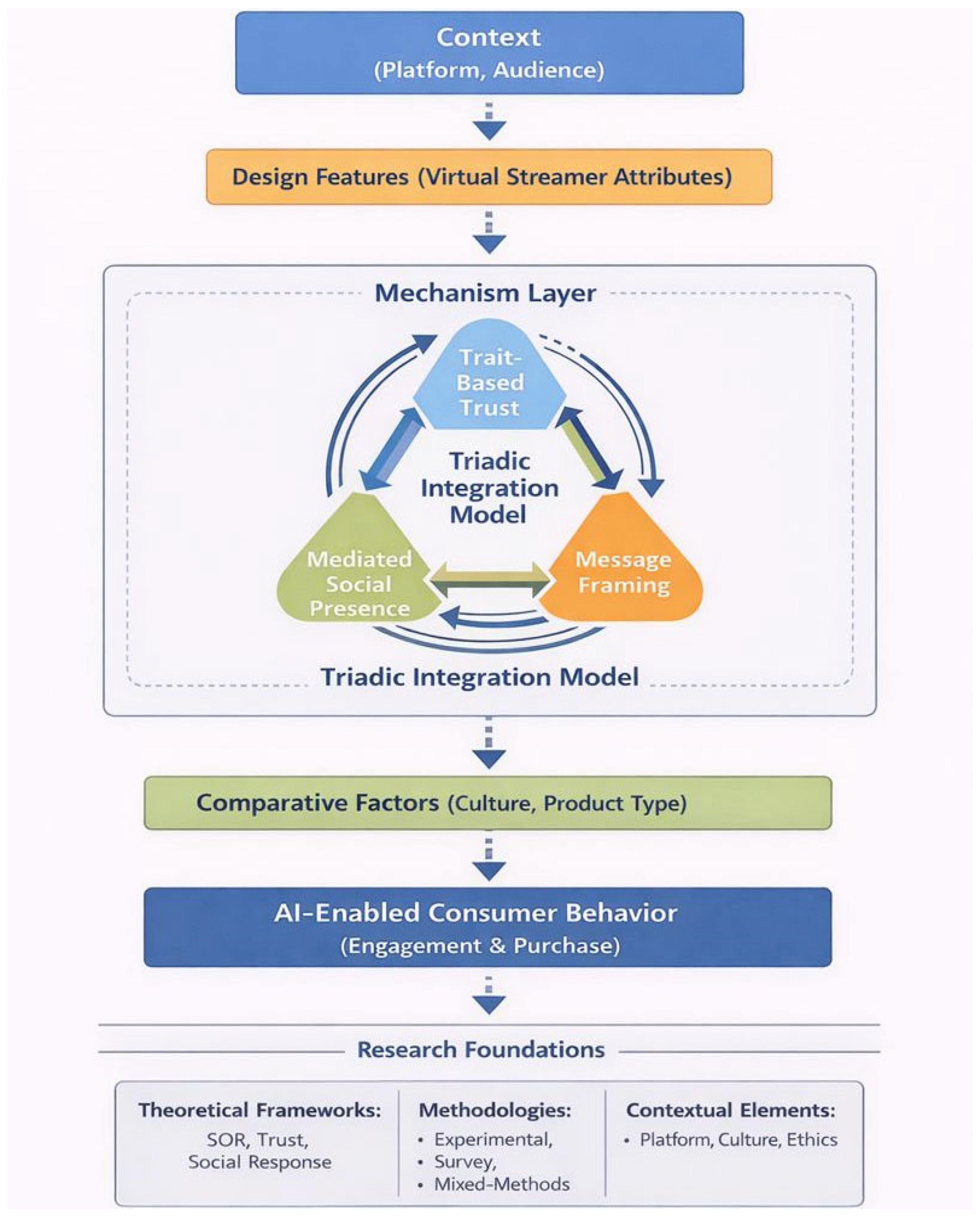
4.1. Conceptual Framework and Mechanisms
4.2. Implications
4.2.1. Theoretical Implications
4.2.2. Development of Conceptual Framework
4.2.3. Practical and Social Implications
5. Conclusions
6. Limitations and Suggestions
Supplementary Materials
Author Contributions
Funding
Institutional Review Board Statement
Informed Consent Statement
Data Availability Statement
Conflicts of Interest
References
- Yin, M.; Shen, C.; Xiao, R. Entertainers Between Real and Virtual-Investigating Viewer Interaction, Engagement, and Relationships with Avatarized Virtual Livestreamers. In Proceedings of the 2025 ACM International Conference on Interactive Media Experiences, Niterói Brazil, 3–6 June 2025; ACM: New York, NY, USA, 2025; pp. 243–257. [Google Scholar]
- Qixuan, L.; Ning, M.; Xiaoyi, Z. Can AI-virtual anchors replace human internet celebrities for live streaming sales of products? An emotion theory perspective. J. Retail. Consum. Serv. 2025, 82, 104107. [Google Scholar] [CrossRef]
- Xiao, Q.; Li, X.; Huang, W.; Zhang, X. Gimmick or genuineness? Exploring the antecedents of AI virtual streamers aversion in live-streaming commerce. Technol. Forecast. Soc. Change 2025, 212, 123981. [Google Scholar] [CrossRef]
- Liu, Y.; Wang, L.; Yang, S.; Wang, Y. AI-Powered Digital Streamers in Online Retail: Empirical Insights and Design Strategies from Experiments. Inf. Syst. Res. 2025. Available online: https://pubsonline.informs.org/doi/10.1287/isre.2023.0024 (accessed on 29 January 2026).
- Zhang, L.; Zhang, J.; Wang, D.; Mu, J. Development and Validation of an AI Virtual Streamer Scale for Live-Streaming E-Commerce. Int. J. Hum.–Comput. Interact. 2024, 41, 8525–8538. [Google Scholar] [CrossRef]
- iiMedia. Research Report on the Virtual Streamer Industry in China in 2023. 2023. Available online: https://www.iimedia.cn/c400/92519.html (accessed on 30 March 2023).
- Streamscharts. VTubers Q3 2024 Report—Audience Reach Declined for the First Time in 1.5 Years. 2024. Available online: https://streamscharts.com/news/vtubers-q3-2024-report (accessed on 25 October 2024).
- Shao, Z. Understanding the switching intention to virtual streamers in live streaming commerce: Innovation resistances, shopping motivations and personalities. J. Res. Interact. Mark. 2024, 19, 333–357. [Google Scholar] [CrossRef]
- Zhao, Z. The Live Commerce of VTuber. In Proceedings of the 2022 5th International Conference on Humanities Education and Social Sciences, Chongqing, China, 14–16 October 2022; Springer: Berlin/Heidelberg, Germany, 2022. [Google Scholar] [CrossRef]
- Jiang, L.; Li, M. Research on the impact path of virtual streamers characteristics on agricultural product consumers’ purchase intention. PLoS ONE 2025, 20, e0330021. [Google Scholar] [CrossRef]
- Ji, X. Influence of Virtual Live Streamers’ Credibility on Online Sales Performance. SAGE Open 2024, 14, 21582440241271171. [Google Scholar] [CrossRef]
- Diwanji, V.S. Should your brand hire virtual influencers? How realism and gender presentation shape trust and purchase intentions. J. Retail. Consum. Serv. 2026, 88, 104491. [Google Scholar] [CrossRef]
- Gao, W.; Jiang, N.; Guo, Q. How do virtual streamers affect purchase intention in the live streaming context? A presence perspective. J. Retail. Consum. Serv. 2023, 73, 103356. [Google Scholar] [CrossRef]
- Yu, J.; Dickinger, A.; So, K.K.F.; Egger, R. Artificial intelligence-generated virtual influencer: Examining the effects of emotional display on user engagement. J. Retail. Consum. Serv. 2024, 76, 103560. [Google Scholar] [CrossRef]
- Chen, H.; Shao, B.; Yang, X.; Kang, W.; Fan, W. Avatars in live streaming commerce: The influence of anthropomorphism on consumers’ willingness to accept virtual live streamers. Comput. Hum. Behav. 2024, 156, 108216. [Google Scholar] [CrossRef]
- Yao, R.; Qi, G.; Wu, Z.; Sun, H.; Sheng, D. Digital human calls you dear: How do customers respond to virtual streamers’ social-oriented language in e-commerce livestreaming? A stereotyping perspective. J. Retail. Consum. Serv. 2024, 79, 103872. [Google Scholar] [CrossRef]
- Gong, X.; Sun, P. Can virtual streamers express emotions? Understanding the language style of virtual streamers in livestreaming e-commerce. J. Retail. Consum. Serv. 2025, 82, 104148. [Google Scholar] [CrossRef]
- Hu, H.-h.; Ma, F. Human-like bots are not humans: The weakness of sensory language for virtual streamers in livestream commerce. J. Retail. Consum. Serv. 2023, 75, 103541. [Google Scholar] [CrossRef]
- Davlembayeva, D.; Chari, S.; Papagiannidis, S. Virtual Influencers in Consumer Behaviour: A Social Influence Theory Perspective. Br. J. Manag. 2024, 36, 202–222. [Google Scholar] [CrossRef]
- Li, C.; Huang, F. The Impact of Virtual Streamer Anthropomorphism on Consumer Purchase Intention: Cognitive Trust as a Mediator. Behav. Sci. 2024, 14, 1228. [Google Scholar] [CrossRef] [PubMed]
- Kim, D.; Wang, Z. Social media influencer vs. virtual influencer: The mediating role of source credibility and authenticity in advertising effectiveness within AI influencer marketing. Comput. Hum. Behav. Artif. Hum. 2024, 2, 100100. [Google Scholar] [CrossRef]
- Zhang, W. Differences in the influence of virtual influencers on different consumer groups. J. Infrastruct. Policy Dev. 2025, 9, 10831. [Google Scholar] [CrossRef]
- Sun, L.; Tang, Y. Avatar effect of AI-enabled virtual streamers on consumer purchase intention in e-commerce livestreaming. J. Consum. Behav. 2024, 23, 2999–3010. [Google Scholar] [CrossRef]
- Van Laer, T.; De Ruyter, K.; Visconti, L.M.; Wetzels, M. The extended transportation-imagery model: A meta-analysis of the antecedents and consequences of consumers’ narrative transportation. J. Consum. Res. 2014, 40, 797–817. [Google Scholar] [CrossRef]
- Smith, E.R.; DeCoster, J. Dual-Process Models in Social and Cognitive Psychology: Conceptual Integration and Links to Underlying Memory Systems. Personal. Soc. Psychol. Rev. 2000, 4, 108–131. [Google Scholar] [CrossRef]
- Pylyshyn, Z.W. Mental imagery: In search of a theory. Behav. Brain Sci. 2002, 25, 157–182. [Google Scholar] [CrossRef]
- Liu, F.; Lee, Y.-H. Virtually responsible? Attribution of responsibility toward human vs. virtual influencers and the mediating role of mind perception. J. Retail. Consum. Serv. 2024, 77, 103685. [Google Scholar] [CrossRef]
- Kim, D.; Wang, Z. The ethics of virtuality: Navigating the complexities of human-like virtual influencers in the social media marketing realm. Front. Commun. 2023, 8, 1205610. [Google Scholar] [CrossRef]
- Yu, T.; Teoh, A.P.; Bian, Q.; Liao, J.; Wang, C. What Drives Purchase Intention in Live Streaming E-Commerce? The Perspectives of Virtual Streamers. Int. J. Hum.–Comput. Interact. 2025, 41, 14689–14708. [Google Scholar] [CrossRef]
- Zhou, T.; Li, S. Examining Consumer Impulsive Purchase Intention in Virtual AI Streaming: A S-O-R Perspective. J. Theor. Appl. Electron. Commer. Res. 2025, 20, 204. [Google Scholar] [CrossRef]
- Liu, X.; Zhang, L. Virtual streamer anthropomorphism affects consumers’ purchase intention: The mediating role of social presence. Soc. Behav. Personal. Int. J. 2025, 53, 1–7. [Google Scholar] [CrossRef]
- Wu, Y.; Huang, H. Influence of Perceived Value on Consumers’ Continuous Purchase Intention in Live-Streaming E-Commerce—Mediated by Consumer Trust. Sustainability 2023, 15, 4432. [Google Scholar] [CrossRef]
- Wang, K.; Wu, J.; Sun, Y.; Chen, J.; Pu, Y.; Qi, Y. Trust in Human and Virtual Live Streamers: The Role of Integrity and Social Presence. Int. J. Hum.–Comput. Interact. 2023, 40, 8274–8294. [Google Scholar] [CrossRef]
- Chen, Y.; Li, X. Expectancy Violations and Discontinuance Behavior in Live-Streaming Commerce: Exploring Human Interactions with Virtual Streamers. Behav. Sci. 2024, 14, 920. [Google Scholar] [CrossRef]
- Imanuddin, K.A.; Handayani, P.W. User continuance intention to use social commerce livestreaming shopping based on stimulus-organism-response theory. Cogent Bus. Manag. 2025, 12, 2479178. [Google Scholar] [CrossRef]
- Wu, R.; Liu, J.; Chen, S.; Tong, X. The effect of E-commerce virtual live streamer socialness on consumers’ experiential value: An empirical study based on Chinese E-commerce live streaming studios. J. Res. Interact. Mark. 2023, 17, 714–733. [Google Scholar] [CrossRef]
- Liu, H.; Zhang, P.; Cheng, H.; Hasan, N.; Chiong, R. Impact of AI-generated virtual streamer interaction on consumer purchase intention: A focus on social presence and perceived value. J. Retail. Consum. Serv. 2025, 85, 104290. [Google Scholar] [CrossRef]
- Xu, B.; Dastane, O.; Aw, E.C.-X.; Jha, S. The future of live-streaming commerce: Understanding the role of AI-powered virtual streamers. Asia Pac. J. Mark. Logist. 2024, 37, 1175–1196. [Google Scholar] [CrossRef]
- Page, M.J.; McKenzie, J.E.; Bossuyt, P.M.; Boutron, I.; Hoffmann, T.C.; Mulrow, C.D.; Shamseer, L.; Tetzlaff, J.M.; Akl, E.A.; Brennan, S.E.; et al. The PRISMA 2020 statement: An updated guideline for reporting systematic reviews. BMJ 2021, 372, n71. [Google Scholar] [CrossRef] [PubMed]
- Gusenbauer, M.; Haddaway, N.R. Which academic search systems are suitable for systematic reviews or meta-analyses? Evaluating retrieval qualities of Google Scholar, PubMed, and 26 other resources. Res. Synth. Methods 2020, 11, 181–217. [Google Scholar] [CrossRef] [PubMed]
- Huang, Y.; Wang, T. Understanding Viewers’ Attitudes Toward Virtual Streamers: A Systematic Review. IEEE Access 2025, 13, 163949–163965. [Google Scholar] [CrossRef]
- Denyer, D.; Tranfield, D.; Van Aken, J.E. Developing design propositions through research synthesis. Organ. Stud. 2008, 29, 393–413. [Google Scholar] [CrossRef]
- Gusenbauer, M. Searchsmart.org: Guiding researchers to the best databases and search systems for systematic reviews and beyond. Res. Synth. Methods 2024, 15, 1200–1213. [Google Scholar] [CrossRef]
- Zhou, Z.; Wen, S.; Li, T.; Zhang, X.; Chi, M. Virtual streamer and destination visitation: An attractiveness transfer perspective. J. Destin. Mark. Manag. 2024, 33, 100922. [Google Scholar] [CrossRef]
- Gao, J.; Zhao, X.; Zhai, M.; Zhang, D.; Li, G. AI or Human? The Effect of Streamer Types on Consumer Purchase Intention in Live Streaming. Int. J. Hum.–Comput. Interact. 2024, 41, 305–317. [Google Scholar] [CrossRef]
- Yu, Y.; Yang, Y. Signaling Effects in AI Streamers: Optimal Separation Strategy Under Different Market Conditions. J. Theor. Appl. Electron. Commer. Res. 2024, 19, 2997–3016. [Google Scholar] [CrossRef]
- Bai, S.; Gu, X.; Xu, N.; Zheng, J.; Wu, W.; Jiang, M.; Xue, N. Live streaming mode selection strategy under the background of virtual anchor supplementation. PLoS ONE 2025, 20, e0321557. [Google Scholar] [CrossRef] [PubMed]
- Open Science, C. PSYCHOLOGY. Estimating the reproducibility of psychological science. Science 2015, 349, aac4716. [Google Scholar] [CrossRef]
- Li, J.; Chen, J.; Shi, Y.; Cui, Y. Exploring the impact of differences between AI streamers and human streamers on consumer purchase intention in live e-commerce: A grounded theory approach. PLoS ONE 2025, 20, e0334530. [Google Scholar] [CrossRef]
- Li, L.; Zhou, W.; Chen, Y. Factors influencing users’ watching intention in virtual streaming: The perspective of flow experience. Kybernetes 2024, 55, 895–921. [Google Scholar] [CrossRef]
- Tang, Q.; Liu, L.; Liu, Z. Understanding how the Chinese youth engages with virtual streamers in digital era: An approach of affordance. Int. Commun. Chin. Cult. 2025, 12, 17–35. [Google Scholar] [CrossRef]
- Khalfallah, D.; Keller, V. Authenticity, ethics, and transparency in virtual influencer marketing: A cross-cultural analysis of consumer trust and engagement: A systematic literature review. Acta Psychol. 2025, 260, 105573. [Google Scholar] [CrossRef]
- Yuan, H.; Lü, K.; Fang, W. Machines vs. humans: The evolving role of artificial intelligence in livestreaming e-commerce. J. Bus. Res. 2025, 188, 115077. [Google Scholar] [CrossRef]
- Zhang, Y.; Wang, X. The effect of virtual anchor appearance on purchase intention: A perceived warmth and competence perspective. J. Prod. Brand Manag. 2024, 34, 84–103. [Google Scholar] [CrossRef]
- Gao, W.; Jiang, N.; Guo, Q. How cool virtual streamer influences customer in live-streaming commerce? An explanation of stereotype content model. J. Retail. Consum. Serv. 2025, 82, 104139. [Google Scholar] [CrossRef]
- Gong, Y.; Huang, R.; Chen, Z.; Liu, Y.; Tan, Y. Are assertive messages more effective in live marketing? Matching effects of anchor type and message assertiveness on purchase intention. J. Retail. Consum. Serv. 2025, 85, 104286. [Google Scholar] [CrossRef]
- Yan, R.; Tang, Z.; Liu, D. Can virtual streamers replace human streamers? The interactive effect of streamer type and product type on purchase intention. Mark. Intell. Plan. 2024, 43, 297–322. [Google Scholar] [CrossRef]
- Xie, J.; Wu, H.; Liu, K.; Cui, Y.; Zhang, X. Is virtual streamer useful? Effect of streamer type on consumer brand forgiveness when streamers make inappropriate remarks. J. Retail. Consum. Serv. 2024, 79, 103899. [Google Scholar] [CrossRef]
- Chang, Y.; Wang, H.; Guo, Z. Artificial intelligence in live streaming: How can virtual streamers bring more sales? J. Retail. Consum. Serv. 2025, 84, 104247. [Google Scholar] [CrossRef]
- Li, Q.; He, W. Empathy and emotional labor: The role of virtual streamers in driving PC game players’ in-game purchases. Asia Pac. J. Mark. Logist. 2025, 37, 3984–4002. [Google Scholar] [CrossRef]
- Qin, M.; Liu, M. How consumer perceptions of virtual streamers affect purchase intention in live streaming commerce: Based on cognition-affect-behavior model. Asia Pac. J. Mark. Logist. 2024, 37, 1679–1695. [Google Scholar] [CrossRef]
- Zhong, L.; Yang, Y.; Mei, Z.; Xie, Y.; Yu, A. Exploring Consumer Citizenship Behavior by Personification of E-Commerce Virtual Anchors Based on Shopping Value. IEEE Access 2024, 12, 76469–76477. [Google Scholar] [CrossRef]
- Peng, Y.; Wang, Y.; Li, J.; Yang, Q. Impact of AI-Oriented Live-Streaming E-Commerce Service Failures on Consumer Disengagement—Empirical Evidence from China. J. Theor. Appl. Electron. Commer. Res. 2024, 19, 1580–1598. [Google Scholar] [CrossRef]
- Lee, S.; Lee, J.; Ju. T’aime My Idol, My Streamer: A Case Study on Fandom Experience as Audiences and Creators of VTuber Concert. IEEE Access 2023, 11, 31125–31142. [Google Scholar] [CrossRef]
- Zhang, Y.; Wang, X.; Zhao, X. Supervising or assisting? The influence of virtual anchor driven by AI–human collaboration on customer engagement in live streaming e-commerce. Electron. Commer. Res. 2025, 25, 3047–3070. [Google Scholar] [CrossRef]
- Zhang, X.; Shi, Y.; Li, T.; Guan, Y. How Do Virtual AI Streamers Influence Viewers’ Livestream Shopping Behavior? The Effects of Persuasive Factors and the Mediating Role of Arousal. Inf. Syst. Front. 2023, 26, 1803–1834. [Google Scholar] [CrossRef]
- Shao, Z.; Ho, J.S.Y. Revealing the resistance of virtual streamers: Intrusiveness, privacy disclosure and perceived justice. Asia Pac. J. Mark. Logist. 2025, 37, 3758–3781. [Google Scholar] [CrossRef]
- Zhu, Y.-P.; Xin, L.; Wang, H.; Park, H.-W. Effects of AI Virtual Anchors on Brand Image and Loyalty: Insights from Perceived Value Theory and SEM-ANN Analysis. Systems 2025, 13, 79. [Google Scholar] [CrossRef]
- Wang, X.; Zhang, Y. The influence of virtual streamer on purchase intention: The moderated mediating effect of message strategy and live-streaming environment. Electron. Commer. Res. Appl. 2025, 73, 101520. [Google Scholar] [CrossRef]
- Long, R.; Yuan, X.; Wu, M. Consumers’ green product purchase intention considering para-social interaction: An experimental study based on live-streaming e-commerce. J. Clean. Prod. 2024, 481, 144169. [Google Scholar] [CrossRef]
- Nazir, M.; Wani, T.A. Human vs. virtual influencers and message framing: Enhancing environmental awareness, activism and sustainable purchase intentions through effective messaging. Manag. Res. Rev. 2025, 48, 685–708. [Google Scholar] [CrossRef]
- Zheng, X.; Cui, C.; Zhang, C.; Li, D. Who says what? How message appeals shape virtual- versus human-influencers’ impact on consumer engagement. J. Res. Interact. Mark. 2025; ahead of print. [Google Scholar] [CrossRef]
- Erensoy, A.; Mathrani, A.; Schnack, A.; Elms, J.; Baghaei, N. Consumer behavior in immersive virtual reality retail environments: A systematic literature review using the stimuli-organisms-responses (S-O-r) model. J. Consum. Behav. 2024, 23, 2781–2811. [Google Scholar] [CrossRef]
- Nosek, B.A.; Ebersole, C.R.; DeHaven, A.C.; Mellor, D.T. The preregistration revolution. Proc. Natl. Acad. Sci. USA 2018, 115, 2600–2606. [Google Scholar] [CrossRef]
- Munafo, M.R.; Nosek, B.A.; Bishop, D.V.M.; Button, K.S.; Chambers, C.D.; du Sert, N.P.; Simonsohn, U.; Wagenmakers, E.J.; Ware, J.J.; Ioannidis, J.P.A. A manifesto for reproducible science. Nat. Hum. Behav. 2017, 1, 0021. [Google Scholar] [CrossRef]
- Kazdin, A.E. Unobtrusive measures in behavioral assessment. J. Appl. Behav. Anal. 1979, 12, 713–724. [Google Scholar] [CrossRef]
- Chen, Y.; Li, L.; Zhou, W. Impact of viewer-streamer-content congruence on users’ behavioral intention in virtual streaming: The moderating effect of role-playing. Electron. Commer. Res. Appl. 2025, 70, 101492. [Google Scholar] [CrossRef]
- Castelo, N.; Bos, M.W.; Lehmann, D.R. Task-dependent algorithm aversion. J. Mark. Res. 2019, 56, 809–825. [Google Scholar] [CrossRef]
- Waytz, A.; Gray, K.; Epley, N.; Wegner, D.M. Causes and consequences of mind perception. Trends Cogn. Sci. 2010, 14, 383–388. [Google Scholar] [CrossRef]
- Salmela, M. What is emotional authenticity? J. Theory Soc. Behav. 2005, 35, 209. [Google Scholar] [CrossRef]
- Terenzi, M. Modeling persuasion in social media: A theoretical approach to algorithmic content distribution and manipulation. J. Sociocybernetics 2024, 19. [Google Scholar] [CrossRef]
- Dehnert, M.; Mongeau, P.A. Persuasion in the age of artificial intelligence (AI): Theories and complications of AI-based persuasion. Hum. Commun. Res. 2022, 48, 386–403. [Google Scholar] [CrossRef]
- Huang, M.-H.; Rust, R.T. Artificial intelligence in service. J. Serv. Res. 2018, 21, 155–172. [Google Scholar] [CrossRef]
- Mariani, M.M.; Borghi, M. Artificial intelligence in service industries: Customers’ assessment of service production and resilient service operations. Int. J. Prod. Res. 2024, 62, 5400–5416. [Google Scholar] [CrossRef]
- Longoni, C.; Bonezzi, A.; Morewedge, C.K. Resistance to Medical Artificial Intelligence. J. Consum. Res. 2019, 46, 629–650. [Google Scholar] [CrossRef]
- Nass, C.; Moon, Y. Machines and Mindlessness: Social Responses to Computers. J. Soc. Issues 2002, 56, 81–103. [Google Scholar] [CrossRef]
- Schmidt, P.; Biessmann, F.; Teubner, T. Transparency and trust in artificial intelligence systems. J. Decis. Syst. 2020, 29, 260–278. [Google Scholar] [CrossRef]
- Chi, L. Research on the impact and application strategies of AI in virtual streamer based on the media industry. Highlights Bus. Econ. Manag. 2024, 41, 144–149. [Google Scholar] [CrossRef]
- De Mooij, M. Consumer Behavior and Culture: Consequences for Global Marketing and Advertising; Sage Publications: Thousand Oaks, CA, USA, 2019. [Google Scholar]
- Hofstede, G. Culture’s Consequences: Comparing Values, Behaviors, Institutions and Organizations Across Nations; Sage Publications: Thousand Oaks, CA, USA, 2001. [Google Scholar]
- Ohme, J.; Araujo, T.; de Vreese, C.H.; Piotrowski, J.T. Mobile data donations: Assessing self-report accuracy and sample biases with the iOS Screen Time function. Mob. Media Commun. 2021, 9, 293–313. [Google Scholar] [CrossRef]


| Effect Type | Description | Evidence Source Count | Study Designs | GRADE Rating |
|---|---|---|---|---|
| Core Effects | Avatar competence/social presence → Trust/purchase intention | 18 | Mostly experiments (RCT, 2 × 2) | ★★★★☆ |
| Framing Effects | Emotional vs. rational message framing → Engagement/intention | 10 | Mixed (surveys + experiments) | ★★★☆☆ |
| Moderation Effects | Platform type/cultural congruence → Path strength variation | 6 | Exploratory or small sample | ★★☆☆☆ |
| Mediating Processes | Warmth, empathy and social presence as mediators | 11 | Model-based/path analysis | ★★★☆☆ |
Disclaimer/Publisher’s Note: The statements, opinions and data contained in all publications are solely those of the individual author(s) and contributor(s) and not of MDPI and/or the editor(s). MDPI and/or the editor(s) disclaim responsibility for any injury to people or property resulting from any ideas, methods, instructions or products referred to in the content. |
© 2026 by the authors. Licensee MDPI, Basel, Switzerland. This article is an open access article distributed under the terms and conditions of the Creative Commons Attribution (CC BY) license.
Share and Cite
Wang, L.; Yeap, J.A.L.; Liu, J.; Li, Z. From Avatars to Algorithms: Virtual Streamers and AI-Enabled Consumer Behavior in Live Streaming Commerce—A Systematic Review. J. Theor. Appl. Electron. Commer. Res. 2026, 21, 57. https://doi.org/10.3390/jtaer21020057
Wang L, Yeap JAL, Liu J, Li Z. From Avatars to Algorithms: Virtual Streamers and AI-Enabled Consumer Behavior in Live Streaming Commerce—A Systematic Review. Journal of Theoretical and Applied Electronic Commerce Research. 2026; 21(2):57. https://doi.org/10.3390/jtaer21020057
Chicago/Turabian StyleWang, Lingyu, Jasmine A. L. Yeap, Jiaqi Liu, and Zongwei Li. 2026. "From Avatars to Algorithms: Virtual Streamers and AI-Enabled Consumer Behavior in Live Streaming Commerce—A Systematic Review" Journal of Theoretical and Applied Electronic Commerce Research 21, no. 2: 57. https://doi.org/10.3390/jtaer21020057
APA StyleWang, L., Yeap, J. A. L., Liu, J., & Li, Z. (2026). From Avatars to Algorithms: Virtual Streamers and AI-Enabled Consumer Behavior in Live Streaming Commerce—A Systematic Review. Journal of Theoretical and Applied Electronic Commerce Research, 21(2), 57. https://doi.org/10.3390/jtaer21020057