1. Introduction
Digital marketplaces now mediate a large share of consumer exchange, with platform design shaping how customers experience value beyond prices and assortments [
1]. On multi-sided platforms, customers form intentions to return not only from prices and assortments but also from how they are treated before, during, and after a transaction [
2]. Two facets of the service system are especially critical. Customer Service Orientation (CSO) reflects the platform’s outward, customer-facing stance, how promptly and accurately it responds to needs and how enjoyable and respectful the interaction feels [
3,
4,
5]. Internal Service Quality (ISQ) represents the backstage capability to deliver reliably through clear communication, efficient and transparent procedures, fair rewards, and trustworthy policies for payment, privacy, and returns.
While these two facets capture the frontstage and backstage of service provision, they are embedded within a broader process of value creation rather than existing as isolated components [
6,
7]. From a process perspective, digital service delivery unfolds through continuous interactions among multiple actors such as platform operators, sellers, and consumers [
8,
9]. These interactions involve resource integration, actor engagement, and agency, through which participants jointly create value [
10]. Incorporating this process perspective clarifies that the effectiveness of service delivery depends not only on the quality of frontstage and backstage elements but also on how they are dynamically coordinated throughout the service process [
11]. A useful approach that has been proposed for analyzing and visualizing such coordination is service blueprinting, a method of service design that maps customer actions, frontstage activities, and backstage processes to identify points of alignment or potential breakdown. This process view thus complements the structural distinction between CSO and ISQ and highlights how value emerges through their ongoing integration within the platform ecosystem [
12,
13].
In fast, remote, and information-asymmetric digital contexts, these two facets shape perceptions of safety and value in repurchase: when CSO and ISQ align, customers perceive coherence and reliability; when they diverge, uncertainty and risk increase [
14,
15].This study focuses on transaction-oriented e-commerce platforms, where value is created primarily through the facilitation of buyer–seller exchanges rather than the co-development of innovations or complementary products. This focus allows a clear examination of how frontstage service orientation and backstage operational quality jointly shape customer experience and repurchase intention.
In practice, these two facets are often misaligned. Platforms may promise warmth and responsiveness via chat or social media yet expose customers to opaque refunds, slow claim handling, or confusing policies. Conversely, well-engineered processes can be under-signaled by brusque or inattentive frontline contact, leaving value unrecognized at the moment of choice [
16,
17,
18]. Such mismatches are common in online retailing, where different teams own the interface and the execution layer, and rapid feature releases can outpace process redesign [
19]. For customers, misalignment creates expectancy violations and cue conflict: what the platform promises and what it can deliver do not cohere. The result is heightened uncertainty about payment, privacy, and redress, erosion of trust, and ultimately weaker repurchase intentions. Although service quality research has long emphasized customer satisfaction and trust, it has tended to examine individual cues in isolation. The alignment between frontstage promises and backstage delivery has been noted conceptually but rarely tested empirically. These recurring mismatches suggest that effective service management requires not only improving each facet independently but also ensuring their alignment [
20,
21,
22].
Existing research has established that customer-facing cues (CSO) and Internal Service Quality (ISQ) each matter for satisfaction, trust, and loyalty, yet level alone is an incomplete lens [
23]. Most prior studies have examined these constructs independently, providing limited insight into how their interaction shapes customer responses [
24]. Building on fit theory in strategy and services, outcomes depend on how complementary elements align [
25,
26]. Conceptually, CSO is the expectation-setting signal at the interface, whereas ISQ is the performance-delivering system behind the interface; customers compare the two [
23]. When they move together, expectations are confirmed and risk is reduced; when they diverge, disconfirmation and attributional blame follow [
27]. Although several studies acknowledge the importance of alignment, few have tested it directly or captured its nonlinear nature. This study extends prior work by treating CSO–ISQ alignment as a continuous surface rather than as a simple additive index, allowing the effects of fit and misfit to be estimated more precisely. Polynomial regression with response-surface analysis provides an effective means to separate these effects while avoiding the limitations of traditional difference-score methods [
28,
29,
30].
Beyond their joint level and alignment, two psychological mechanisms clarify how CSO and ISQ shape repeat patronage [
31]. The first is pride in membership, a sense of identification and self-enhancement that arises when customers associate themselves with a platform perceived as competent, fair, and caring [
32]. CSO conveys socioemotional signals of respect and responsiveness, while ISQ provides structural assurances of competence and procedural justice. When these signals are coherent, they elevate pride, which strengthens commitment and increases the likelihood of continued purchasing beyond direct utility effects [
31,
33]. The second mechanism is awareness of trust-and-security initiatives such as buyer protection, secure payment, and transparent privacy controls. These safeguards provide visible assurances of safety and reliability; when salient, they reduce the diagnostic weight customers place on other service cues, thereby weakening the incremental impact of further CSO or ISQ improvements [
22,
34]. Although prior studies have examined pride and trust as separate drivers of loyalty, their joint role in the CSO–ISQ alignment process remains underexplored. This study integrates both mechanisms to capture how emotional identification and perceived assurance jointly shape repurchase intentions [
35].
Against this backdrop, we examine how CSO and ISQ jointly shape repurchase intention on large e-commerce platforms, focusing on the mechanism of pride in membership and the boundary condition of trust-and-security awareness [
20]. This study fills the gap in prior research by empirically testing how alignment between frontstage orientation and backstage quality affects customer loyalty. We conceptualize congruence as the central structural condition for favorable outcomes and explicitly test both fit and misfit using response-surface logic [
36]. We further assess pride in membership as the mediating pathway and trust-and-security awareness as a substitutional moderator that flattens slopes and curvatures of the CSO–ISQ surface [
37,
38].
While the study builds primarily on fit theory, it also aligns with the service-dominant logic view that value in digital platforms is co-created through coordinated actions among multiple actors [
39]. In this sense, the alignment between customer-facing orientation and internal service quality reflects a structural condition for effective value co-creation. Beyond this structural view, digital service should be understood as a dynamic process in which value continuously emerges from ongoing exchanges of resources and competencies among participants [
40]. From a resource-based perspective, platforms operate as resource integrators that enhance resource density, the accessibility and diversity of valuable resources, and achieve resource orchestration by coordinating technological, human, and organizational assets to support adaptive service delivery [
41]. This dynamic configuration enables platforms to realign frontstage signals and backstage capabilities as conditions evolve, ensuring sustained value creation. Integrating this dynamic, resource-based view strengthens the theoretical foundation of the study and situates CSO–ISQ alignment within broader mechanisms of platform evolution and value co-creation [
42]. This study makes three contributions. Theoretically, it proposes a fit-based theory of digital service that links customer-facing orientation (CSO) with backstage execution (ISQ) and explains how their alignment, rather than level alone, drives customer loyalty. This perspective also identifies the benefits of alignment, the diminishing returns at high joint levels, and the penalties of misalignment [
43]. Empirically, it demonstrates the usefulness of modeling the joint effects of CSO and ISQ on repurchase intention, separating overall level from discrepancy, and testing the mediating role of pride in membership and the moderating effect of trust and security awareness [
44]. Managerially, it clarifies when investments in frontline orientation, process quality, or security assurance yield the greatest return, emphasizing that closing CSO–ISQ gaps and improving operational consistency should come before further enhancements, since alignment between promise and delivery is the key constraint on repeat business [
45,
46].
In this study, fit theory serves as the primary theoretical foundation because our core prediction concerns the alignment between CSO and ISQ and its geometric effects on repurchase intention. Expectation–confirmation theory provides the psychological micro-foundation explaining how aligned signals produce confirmation and behavioral intention. Service-dominant logic, value co-creation, and resource orchestration are incorporated as complementary, system-level perspectives that contextualize CSO–ISQ alignment within broader platform-based value creation processes. This hierarchy clarifies the study’s theoretical grounding and how each framework contributes to the overall model.
To preview the remainder of the paper,
Section 2 reviews the literature on fit theory and expectation-confirmation and develops the hypotheses.
Section 3 describes the research design and analytic approach, emphasizing second-order polynomial models with response-surface analysis (RSA) for fit and misfit, mediation tests in SEM, and moderation analyses.
Section 4 presents the empirical findings and robustness checks.
Section 5 discusses theoretical and managerial implications, acknowledges limitations, and concludes.
3. Hypothesis Development
CSO represents the platform’s outward, customer-facing stance that shapes what customers expect at the interface, including prompt and accurate responses and enjoyable, friendly interactions [
126]. ISQ reflects backstage capability to deliver reliably through clear communication, efficient and transparent problem solving, fair and timely rewards and benefits, and trustworthy policies for payment, privacy, and returns [
127]. In this study, CSO is measured with NEED and ENJOY items, ISQ with communication, support and procedures, rewards and benefits, and policies, and the focal outcome is repurchase intention. Building on fit theory and Expectation–Confirmation logic, we view CSO as the signal that sets expectations and ISQ as the system that fulfills them. When these facets are aligned at the same level, customers receive coherent cues that what is promised will be delivered, uncertainty and attributional conflict are reduced, and approach tendencies toward the next purchase strengthen [
25]. Accordingly, we predict a positive slope along the line of congruence where CSO and ISQ rise together.
H1a (fit; line of congruence). When CSO and ISQ are aligned at the same level, repurchase intention increases as their joint level increases.
Even under alignment, marginal gains should not be constant. Adaptation-level processes shift reference points upward as experience accumulates, multi-attribute utility exhibits saturation as attributes approach high performance, and quality above the zone of tolerance becomes less noticeable [
128]. Early improvements in aligned CSO and ISQ remove salient frictions, sharply reducing perceived risk, whereas later improvements address residual irritants with smaller incremental impact on choice. This implies concavity along the congruence path [
129].
H1b (diminishing returns under alignment). When CSO and ISQ are kept equal and are increased together from low through moderate to high levels, repurchase intention rises but at a decreasing rate.
When CSO and ISQ diverge, customers encounter inconsistent cues about value and reliability, which expectancy-violation and fairness–trust perspectives link to negative inferences and erosion of trust. If CSO is high while ISQ is low, the platform appears to over-promise and under-deliver; if CSO is low while ISQ is high, capability is under-signaled and quality gains go under-noticed, so perceived value remains muted. In both cases, cue conflict heightens uncertainty about payment, privacy, logistics, and redress, suppressing willingness to buy again [
130,
131]. Because inconsistencies are salient and subject to negativity bias, the penalty from misalignment grows more than proportionally as the discrepancy widens. Operationally, this corresponds to the LOIC, where the average level of CSO and ISQ is held constant while their difference increases, and where repurchase should decline [
132].
H1c (misfit penalty; line of incongruence). As the absolute discrepancy between CSO and ISQ increases, with one high while the other is low, repurchase intention decreases.
Pride in membership provides the principal psychological channel linking service cues to behavior [
133]. CSO supplies socioemotional cues of respect, warmth, responsiveness, and accurate need recognition that make customers feel valued, while ISQ supplies structural cues of predictability, transparency, and fairness that signal capability [
106]. Consistent signals across the interface and the system elevate pride, and pride fosters commitment, motivates self-consistent choice, reduces the attractiveness of alternatives, and ultimately increases the likelihood of buying again beyond any direct utility effects [
134].
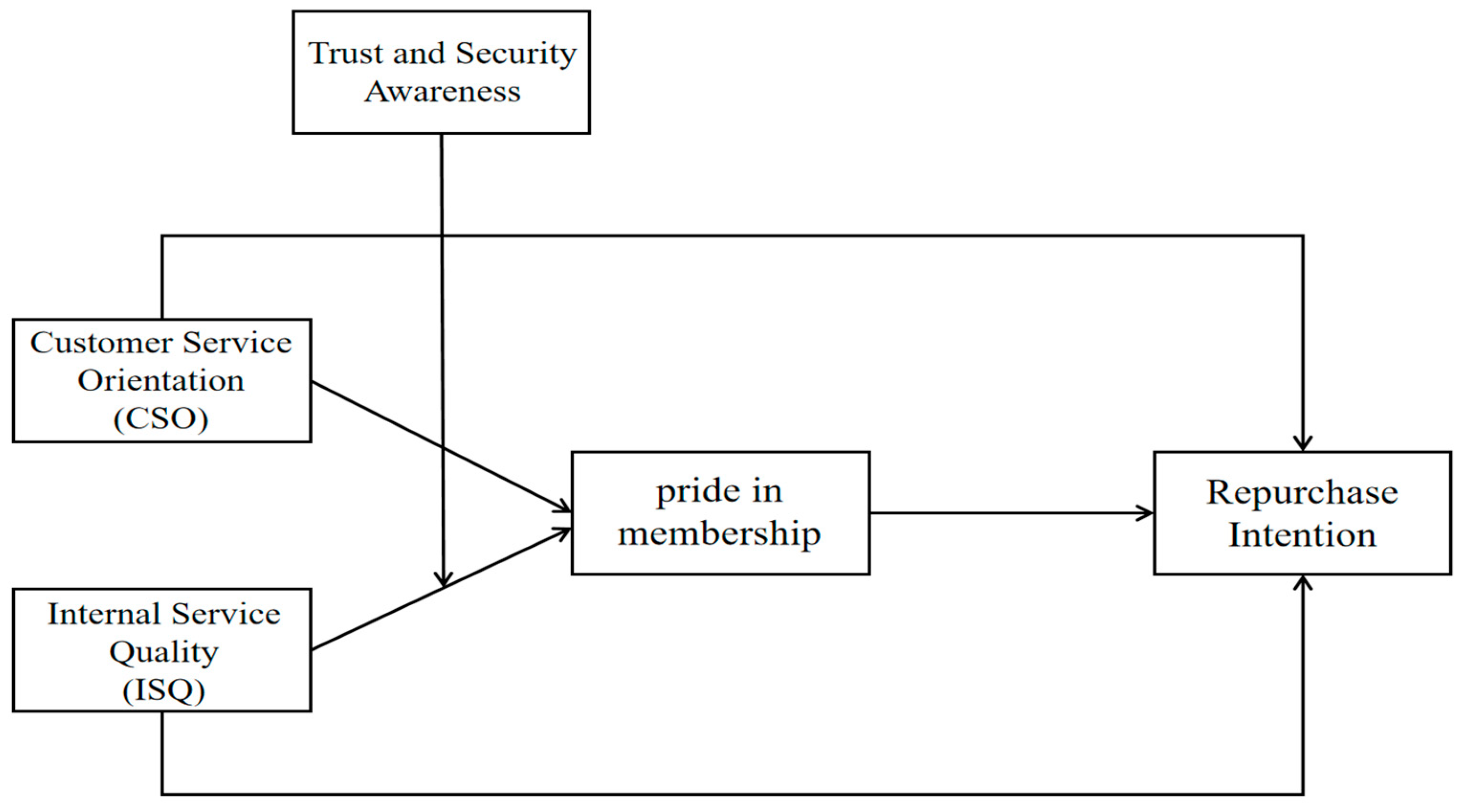
H2 (mediation via pride). Pride in membership mediates the effect of CSO and ISQ on repurchase intention, such that higher CSO and ISQ increase pride, and higher pride in turn increases repurchase intention.
Customers also rely on structural assurances that reduce uncertainty at a platform level, including buyer protection and refund guarantees, trusted payment, privacy controls, and visible anti-fraud enforcement [
135]. Awareness of these trust and security initiatives is highly diagnostic of transaction safety, and cue-diagnosticity logic holds that a more diagnostic cue reduces the weight placed on partially redundant cues [
136]. Because trust and security awareness communicates safety and procedural justice that overlap with what CSO and ISQ also convey, increases in awareness should attenuate the marginal returns to additional improvements in either CSO or ISQ [
137]. Geometrically, the response surface linking CSO and ISQ to repurchase becomes flatter as trust and security awareness rises, with smaller slopes and less pronounced curvature [
138].
H3 (substitutional moderation by trust and security awareness). Awareness of the platform’s trust and security initiatives attenuates the marginal, linear and higher-order, effects of CSO and ISQ on repurchase intention, flattening the response surface.
Finally, judgments at the point of choice place greater weight on vivid, temporally proximal cues. CSO directly shapes expectations and affect at the interface, whereas ISQ, although necessary, is partly backstage and becomes most visible when problems occur; once adequacy is met, further ISQ improvements tend to influence intentions indirectly (e.g., through identity) rather than through a large residual direct pull [
139]. Consequently, when modeled jointly and accounting for the mediating role of pride, the direct path from CSO to repurchase should exceed the direct path from ISQ.
H4 (relative weight of customer-facing cues). The direct effect of Customer Service Orientation on repurchase intention is greater than the direct effect of Internal Service Quality.
Figure 1 illustrates the structural model depicting the relationships among the variables. In the following section, we describe the measurement model, data, and estimation strategy used to test H1–H4.
4. Research Design
4.1. Sample Selection and Questionnaire Survey
We fielded a cross-sectional online survey to obtain respondent perceptions of customer-facing orientation, internal service quality, pride in membership, trust/security awareness, and repurchase intention on large e-commerce platforms. An online mode was chosen for its reach to active platform users and its fit with device-mediated shopping contexts. To ensure data quality, we implemented standard safeguards: one-response-per-IP filtering and pattern checks for straight-lining/invariant responding. Eligibility was screened with a qualifier (Q1) presented bilingually (English/Chinese): “In the past 6 months, how many of the following platforms have you used for online shopping? (Taobao, Tmall, JD.com, Pinduoduo, Xiaohongshu)” with response options 0/1/2. Respondents selecting “0” were automatically exited and shown: “Thank you for your interest. This survey is limited to users who have used one of the listed platforms in the past 6 months.”
Respondents then indicated the platform they use most often (Q2; five platforms), usage frequency (Q10; four ordered categories), and primary purchase type (Q11; three ordered categories). After exclusions via the Q1 screener and quality checks, the analytic sample comprised N = 605 platform users.
The questionnaire opened with a brief study description and consent statement emphasizing anonymity, confidentiality, and voluntary participation. Eligibility was implicitly established by asking respondents to identify their most-used e-commerce platform and usage frequency; only those reporting current use proceeded to the focal measures. To facilitate comprehension, items were presented in simplified Chinese with English back-translation and reconciliation; final wording was pilot-checked for clarity.
Focal constructs were measured with multi-item Likert scales (1 = strongly disagree, 7 = strongly agree). Customer Service Orientation (CSO) captured customer-facing cues using eight items reflecting Need (prompt, accurate, effective, convenient responses; Q12–Q15) and Enjoy (enjoyable, friendly, pleasant interactions; Q16–Q19). Internal Service Quality (ISQ) assessed backstage execution via four subdimensions—communication/interaction (Q20–Q23), support/problem solving (Q24–Q27), rewards/benefits (Q28–Q30), and policies/procedures (Q32–Q35)—which were combined as a higher-order ISQ construct in structural tests. Pride in membership (Q36–Q39) and trust and security awareness (Q40–Q43) were each measured with four items capturing identification-based affect and awareness of platform-level assurances (e.g., buyer protection, secure payment, privacy controls). Repurchase intention (Q44–Q47) was measured with four items indicating likelihood of buying again from the same platform.
To limit respondent burden, the core instrument was held to roughly 40 substantive items. Scale reliability and validity were assessed prior to hypothesis testing; results are reported in
Table 1 and
Table 2 (reliability and convergent validity) and summarized discriminant-validity checks are described alongside the structural results. Control variables (Q2 platform dummies, Q10 usage frequency, Q11 purchase type) were included in all regression and RSA models [
27].
4.2. Credibility and Validity Test
Table 1 indicates that most multi-item measures exhibit satisfactory to excellent internal consistency in our sample. The NEED facet of Customer Service Orientation (CSO) and three Internal Service Quality (ISQ) subscales—communication and interaction, support and problem solving, and rewards and benefits—show alphas in the 0.80–0.90 range, which is generally considered good. The single-factor constructs used downstream as mediator/moderator—pride in membership and trust and security awareness—and the dependent variable, repurchase intention, all exceed 0.90, indicating very high reliability. Two subscales are worth a brief clarification. First, the ENJOY facet of CSO yields α = 0.689, slightly below the conventional 0.70 threshold; given the short length (four items) and its affective breadth, this value is plausible and aligns with the moderate standardized loadings in the CSO CFA. Second, the ISQ policies and procedures subscale has α = 0.588. Because it aggregates heterogeneous content (policy clarity, payment security, privacy, and procedural simplicity), Cronbach’s alpha assumes tau-equivalence and strict unidimensionality, can understate reliability. In our analyses we address this by (i) using ISQ as a higher-order composite formed from multiple subdimensions and (ii) relying on latent-variable estimation (SEM), which relaxes alpha’s assumptions. Overall, the reliability evidence supports the use of these scales in subsequent tests, with caveats for CSO-ENJOY and ISQ-policy handled through the composite ISQ index and latent modeling.
As summarized in
Table 2, most multi-item constructs meet conventional benchmarks for convergent validity (CR ≥ 0.70; AVE ≥ 0.50). Specifically, CSO–Need (CR = 0.900, AVE = 0.692) and three ISQ subscales; Communication and Interaction (0.877, 0.641), Support and Problem Solving (0.842, 0.572), and Rewards and Benefits (0.812, 0.591) show satisfactory convergence. The single-factor constructs used as mediator/moderator and the dependent variable, Pride in membership (0.926, 0.759), Trust and security awareness (0.947, 0.817), and Repurchase intention (0.944, 0.808), all exhibit excellent convergent validity.
Two scales fall below the AVE benchmark. The CSO–Enjoy facet has CR = 0.689 and AVE = 0.356, which is consistent with a short, affectively broad subscale that tends to depress internal consistency and shared variance. The ISQ Policies and Procedures subscale (CR = 0.594, AVE = 0.273) aggregates heterogeneous content (policy clarity, payment security, privacy protection), for which AVE—assuming unidimensional, tau-equivalent indicators—can be conservative. At the higher order, the CSO composite performs strongly (CR = 0.922, AVE = 0.856), whereas the ISQ composite shows acceptable reliability with a marginal AVE (CR = 0.755, AVE = 0.473), reflecting the intentional breadth across ISQ subdimensions.
To address these nuances, our main analyses (i) treat CSO and ISQ at the higher-order level so that multiple subdimensions jointly inform each construct, and (ii) rely on latent-variable estimation (SEM) that freely estimates loadings and measurement error rather than relying solely on coefficient thresholds. Robustness checks indicate that the substantive results are unchanged when CSO and ISQ are modeled as higher-order factors versus composites. Overall, the evidence supports the adequacy of the measures for subsequent hypothesis testing (We evaluated discriminant validity with multiple recommended diagnostics for latent-variable models—heterotrait–monotrait (HTMT) ratios, Fornell–Larcker checks (√AVE compared to interconstruct correlations), and χ2 difference tests in which latent correlations were constrained to unity (φ = 1). Across these tests, the higher-order constructs used in our structural analyses exhibited adequate discriminant validity. In light of space constraints, detailed matrices and test statistics are not tabulated.).
The sample (N = 605) is overwhelmingly drawn from users who most often shop on Taobao (97.0%), with very small shares for Tmall (0.8%), JD.com (1.2%), Pinduoduo (0.7%), and Xiaohongshu (0.3%). Gender is effectively balanced (51.1% female, 48.9% male). Birth cohorts are well represented across generations—1939–1979 (36.0%), 1980–1996 (31.9%), and 1997–2010 (32.1%)—providing variability in age-related experience with platforms. Educational attainment is relatively high: 74.8% report at least an associate/vocational credential (36.0% associate/vocational, 38.8% bachelor’s, 6.6% master’s or above), with 18.5% high school or below. Personal income spans the distribution, with the largest group in 3000–5999 RMB (42.0%), followed by 6000–8999 RMB (26.3%), ≥9000 RMB (20.7%), and <3000 RMB (11.1%). Respondents are geographically diversified but concentrated in higher-development areas: Tier-2 cities (43.5%), Tier-1 (22.3%), Tier-3 (25.8%), and rural/lower-tier regions (8.4%).
Overall, the data reflect a broad cross-section of active online shoppers, skewed toward the dominant platform (Taobao) and toward urban, higher-education segments of the market. This composition supports external validity for mainstream platform users while also justifying the inclusion of platform, usage, and purchase-type controls in the models to absorb residual heterogeneity (
Table 3).
6. Conclusions
6.1. Discussion
This study examined how customer-facing orientation (CSO) and backstage execution (ISQ) jointly shape repurchase intention on large e-commerce platforms. Results from polynomial and response-surface analyses support a fit-based explanation rather than a simple additive one. Repurchase increases when CSO and ISQ rise together, but the gain tapers at high joint levels, and repurchase declines when they diverge. These geometric patterns, including the positive slope and concave curvature along the line of congruence and the negative curvature along the line of incongruence, are consistent with the idea that expectations formed at the interface are confirmed or disconfirmed by the system behind it. Taken together, results reinforce the fit-based theory of digital service, illustrating that customer outcomes in e-commerce platforms emerge not from the absolute level of service quality or orientation, but from their systemic alignment that creates coherence and reduces uncertainty in value realization.
The findings also suggest how service cues translate into behavior. Pride in membership mediates the pathway from CSO and ISQ to repurchase, consistent with an identification mechanism in which coherent signals of respect, responsiveness, competence, and fairness enhance pride and in turn encourage repeat purchasing. At the same time, awareness of trust and security initiatives acts as a structural assurance that reduces the diagnostic weight consumers place on other service cues. When such assurance is salient, the slopes and curvatures on the CSO–ISQ surface become flatter. Therefore, trust and security awareness do not replace service quality but moderate how strongly marginal improvements in CSO or ISQ influence repurchase intention.
Another pattern concerns the relative salience of interface and system cues. In the joint model, CSO has a stronger direct effect on repurchase than ISQ, which is consistent with the temporal proximity and vividness of customer-facing signals at the point of choice. However, this advantage coexists with penalties to misfit and diminishing returns when alignment is already high. Execution quality remains essential for interface promises to translate into sustained behavioral effects.
Methodologically, estimating the full second-order response surface proved crucial. This approach separates level from discrepancy, captures asymmetry when CSO exceeds ISQ versus the reverse, and provides concise tests of fit, misfit, and attenuation under structural assurance.
Taken together, the findings present a coherent picture. Repeat patronage peaks when what the platform signals and what it can deliver are aligned. The benefits of alignment level off at high joint levels, while incoherence is costly. Identity-based pride carries much of the effect, and visible assurances of safety temper the incremental payoff from further service enhancements. While this study does not employ service blueprinting empirically, the concept provides a useful visualization tool for future research and managerial practice to map CSO–ISQ coordination in platform ecosystems.
6.2. Theoretical Implications
This study contributes to developing a fit-based theoretical account of digital service by linking what a platform signals at the interface (CSO) to what its system can reliably deliver behind the interface (ISQ). Empirically, this linkage was confirmed through polynomial regression and response-surface analysis (
Table 4,
Table 5 and
Table 6), which jointly revealed a positive slope and concave curvature along the line of congruence, providing direct evidence of fit-based performance predicted by theory. Rather than treating service elements as additive drivers, we find that outcomes depend on their alignment. The positive slope and concave curvature along the line of congruence help explain how confirmation may operate when signals and systems rise together: expectations are met, risk falls, and gains taper at high levels as a zone of tolerance is reached. The negative curvature along the line of incongruence helps describe how mismatches between promise and system performance create cue conflict and depress intentions. This geometric account clarifies why “more of one” cannot fully compensate for “less of the other,” which extends classic fit theory to digitally mediated exchange.
Second, the results integrate Expectation–Confirmation logic with a configurational view of service quality. Mapping the response surface to EC mechanisms, the locus of confirmation corresponds to the congruence path, while disconfirmation corresponds to the incongruence path. The evidence that benefits taper at high joint levels provides a structural explanation for diminishing sensitivity, while the penalty to misfit captures the salience and asymmetry of negative information. In doing so, the findings knit together service quality, EC theory, and fit theory within a single empirical geometry.
Third, we identify pride in membership as a central psychological channel from service design to behavior. Prior work often emphasizes satisfaction or trust as the dominant mediators. By showing that coherent interface and system cues elevate identification-based pride, which then increases repurchase, we add an identity lens to the service quality literature. Pride captures self-relevant benefits of affiliating with a competent, fair, and caring platform and explains why aligned signals have effects that persist beyond immediate utilitarian gains.
Fourth, we propose and test a substitutional boundary condition: awareness of trust and security initiatives flattens both the slope and the curvature of the CSO–ISQ surface. This extends structural-assurance and cue-diagnosticity arguments by specifying how a highly diagnostic platform-level cue changes the marginal value of other cues. In other words, visible buyer protection, secure payment, and privacy controls reduce the inferential load placed on CSO and ISQ, so additional improvements in those dimensions yield smaller returns. This substitution logic helps reconcile mixed findings in prior work about the size of service-quality effects in high-assurance settings.
Fifth, the asymmetry we recover, with outcomes higher when CSO exceeds ISQ than when ISQ exceeds CSO at comparable gaps, sharpens theory about cue salience at the point of choice. CSO is temporally proximal and vivid in the purchase episode, while ISQ is partly backstage and becomes salient when problems arise. The larger direct effect of CSO in joint models is therefore theoretically consistent with attentional and accessibility accounts, without diminishing the necessity of strong execution to sustain repeat behavior.
Finally, the study contributes methodologically. Estimating the full second-order surface and testing slopes and curvatures along theoretically meaningful lines separate level from discrepancy, avoid the biases of difference scores, and helps reveal geometric features that additive models obscure. Extending this approach with a moderator that systematically flattens the surface shows how fit logics can incorporate boundary conditions in a principled way. Together, these contributions suggest a general template for theorizing digital service: specify complementary interface and system cues, test their alignment and misalignment on a surface, identify the psychological carrier of effects, and model structural assurances that modulate the surface itself.
6.3. Practical Implications
The findings indicate that service improvement should be managed as a problem of alignment between customer-facing signals and executional capability rather than as a pursuit of maximal scores on isolated dimensions. As summarized in
Table 9, all four hypotheses (H1a–H4) converge on the same managerial principle: optimizing the CSO–ISQ fit yields higher repurchase intention than maximizing either dimension independently. Repurchase is highest when Customer Service Orientation (CSO) and Internal Service Quality (ISQ) rise together, which implies cross-functional governance that links product, customer experience, operations, risk, and policy so that promises at the interface are matched by deliverable processes. In practice, organizations can institutionalize joint objectives for customer service and operations, blueprint end-to-end journeys, and use release gates that withhold new CSO features or copy until refund logic, claim handling, and policy text have been updated and verified.
The response surface exhibits concavity along the line of congruence, so marginal returns diminish at higher joint levels. Budgeting should therefore prioritize closing gaps and lifting both CSO and ISQ from low to moderate levels before attempting costly refinements at the top end. Once both are strong, investments that reduce variance typically yield greater impact than additional interface embellishment. Clearer policy language, tighter service-level agreements, faster refund settlement, and fewer handoffs are examples of variance-reduction levers. The documented penalty for incongruence cautions against over-promising: acceleration of reply speed or a warmer tone without resolving backstage lags is likely to depress intentions. Governance rules that prohibit promises exceeding operational capability are warranted for macros, chatbot scripts, and marketing copy.
The estimated asymmetry and the larger direct coefficient on CSO indicate that interface cues have greater immediate influence at the point of choice. This suggests a practical rule: raise the ISQ floor to the CSO ceiling. Communication clarity, problem-resolution pathways, rewards and benefits logic, and policy and returns should be at least as robust as customer-facing claims. In marketplace settings this extends to merchant management through the enforcement of seller service standards, standardized return windows, and the elevation of trustworthy sellers based on verifiable performance.
The implications of CSO–ISQ alignment may differ across types of e-commerce platforms. For service-oriented platforms, customer experience is shaped by real-time interactions and immediate service recovery. Here, ensuring that internal service processes match frontline promises is critical, as any CSO–ISQ gap becomes instantly apparent to customers. In contrast, product-oriented platforms rely more on logistics reliability, return handling, and policy transparency. For these platforms, consistent back-end operations and structural assurances (e.g., delivery guarantees, refund efficiency) are more crucial for sustaining trust. Managers should therefore align internal and external service standards according to the dominant value logic of their platform.
Pride in membership emerges as a central psychological carrier of repeat purchase. Platforms can cultivate pride by making competence, fairness, and care visible, for example, through transparent case timelines, proactive status updates, recognition of tenure, and equitable benefit rules that are easy to understand. These cues should signal respect and procedural justice as well as utility.
Awareness of trust and security initiatives attenuates both the slope and curvature of the CSO–ISQ surface. This supports investment in clear and low-friction assurances such as buyer protection, secure payment badges, and transparent privacy controls. Assurances should be visible at key decision points and written in plain language, with defaults set to secure options, while avoiding communications that prime risk. Where assurance is already salient, marginal resources can be reallocated from polishing high CSO or ISQ scores toward reliability improvements or identity-building features that strengthen pride.
Finally, managers should measure and manage alignment directly. A fit index that pairs external CSO indicators (for example, response latency, accuracy, first-contact resolution, and tone) with internal ISQ indicators (for example, refund cycle time, claim touchpoints, policy readability, and chargeback rate) can be tracked over time. Applying response-surface diagnostics to operational data helps prioritize interventions where diminishing returns are binding or where gaps between CSO and ISQ are widest.
6.4. Limitations and Future Research
This study relies on cross-sectional, self-report data, which limits causal inference and raises the possibility of common-method variance. Future research can pair our survey measures with behavioral traces from platforms such as actual repurchase, refund events, and ticket logs and can use longitudinal or experimental designs that manipulate CSO–ISQ alignment to identify dynamic and causal effects.
Measurement quality is uneven across a few subscales, particularly the CSO-Enjoy and ISQ-Policy facets that showed lower AVE. Because the AVE values for these two facets fall below recommended thresholds, they may introduce measurement noise, underscoring the need to further refine these scales to improve their reliability. Subsequent work can refine these instruments by expanding item pools, using item-response or bifactor modeling to separate general and facet variance, and triangulating survey responses with unobtrusive indicators, for example, NLP-based ratings of conversational tone for CSO and operational metrics for policy clarity and refund handling for ISQ.
External validity is constrained by the single-country context and the heavy concentration of respondents on one platform. In addition, because the sample is heavily dominated by Taobao users, the estimated RSA surface and moderation effects may partly reflect platform-specific design characteristics. Future research should validate the model across multiple platforms or cross-country contexts to assess the generalizability of the CSO–ISQ alignment effects. Replication across markets, platform types, and product categories can test whether the geometry of the CSO–ISQ surface is stable or shifts with institutional environments, competitive intensity, and category risk, and can examine whether platform design choices or governance regimes alter fit effects. Although the sample is dominated by users of a single platform, this pattern reflects the structure of China’s e-commerce market, where one leading platform accounts for a substantial share of national online transactions. As the study focuses on large, general-purpose e-commerce ecosystems, the findings capture mechanisms that are typical of such platforms. Nevertheless, future research should validate the robustness of the CSO–ISQ alignment effects across other major platforms and in service-oriented contexts to strengthen external validity.
Although purchase type was included as a control variable in all models (see
Table 4) and showed no significant effect, our sample primarily reflects product-oriented contexts. Future research could replicate these analyses in service-heavy platforms to assess whether similar alignment effects hold.
The response surface is modeled as a second-order polynomial, which is a disciplined but parametric approximation. Future studies can probe for thresholds, kinks, or regime changes using spline-based RSA, Gaussian-process surfaces, or machine-learning approximations, and can compare these to the polynomial benchmark to assess whether diminishing returns and misfit penalties remain after relaxing functional-form assumptions.
Unobserved confounding and endogeneity remain possible if factors that influence both service design and repurchase are omitted. Designs that exploit exogenous shocks (for example, policy rollouts, payment-security upgrades, or operational outages), instrumental-variables strategies, or difference-in-differences around staged process changes can strengthen identification of CSO, ISQ, and assurance effects.
The boundary conditions examined focus on trust and security awareness, and the mediator emphasizes pride in membership. Future research can broaden the mechanism and moderation space by testing sequential or competing mediators such as satisfaction, perceived value, habit, and risk, and by assessing moderators like price promotions, membership tier, relationship length, or marketplace heterogeneity using multilevel models that nest customers within sellers and platforms.
Finally, the outcome is repurchase intention, which is theoretically proximal yet not equivalent to realized behavior. Linking the modeled surface to revealed retention, repeat purchase frequency, basket value, and churn, ideally in field experiments that vary CSO signals and ISQ processes in coordinated releases, would establish whether the documented alignment logic translates into durable behavioral lift.