


Driving Service Stickiness in the AI Subscription Economy: The Roles of Algorithmic Curation, Technological Fluidity, and Cognitive Efficiency

Abstract
1. Introduction
2. Theoretical Background
2.1. Stimulus–Organism–Response (S-O-R) Framework
2.2. AI-Driven Stimuli: Algorithmic Curation and Technological Fluidity
2.3. Internal Organism: Cognitive Efficiency and Serendipity
2.4. Service Stickiness as a Behavioral Response
2.5. Subscription Fatigue as a Contextual Moderator
3. Research Model and Hypotheses
3.1. Research Model
3.2. Hypotheses Development
3.2.1. The Effect of AI Stimuli on Organismic States
3.2.2. The Effect of Organismic States on Service Stickiness
3.2.3. Exploratory Analysis of Moderating Effects
4. Methodology
4.1. Data Collection and Sample
4.2. Measures
5. Results
5.1. Measurement Model Assessment
5.2. Structural Model Assessment
5.3. Post Hoc Analysis: Moderating Effects
6. Discussion and Conclusions
6.1. Interpretation of Findings
6.2. Theoretical Implications and Propositions
- Proposition 1 (The Threshold of Novelty): In high-frequency algorithmic environments, the behavioral influence of experiential novelty (serendipity) diminishes as the user’s cognitive fatigue increases. This implies a boundary condition where Cognitive Efficiency serves as a prerequisite ‘hygiene factor’ that must be satisfied before hedonic factors can exert any meaningful impact on retention.
- Proposition 2 (The Fluidity-Serendipity Trade-off): As perceived Technological Fluidity approaches a maximum state of being perfectly frictionless, the user’s perception of Serendipity will follow an inverted U-shape or decline due to the loss of exploratory opportunities. This suggests that adaptive learning requires a certain degree of “meaningful friction” to prevent the formation of a filter bubble that inhibits discovery.
- Proposition 3 (Cognitive Dependence on Automation): The strong association between Algorithmic Curation and Cognitive Efficiency suggests that as users’ trust in algorithmic agency deepens, they progressively offload decision-making authority to the system. This leads to a state of ‘Cognitive Dependence,’ where service stickiness transforms from a voluntary choice into a structural reliance on automated decision aids.
6.3. Managerial Implications
6.4. Limitations and Future Research
Author Contributions
Funding
Institutional Review Board Statement
Informed Consent Statement
Data Availability Statement
Conflicts of Interest
References
- Kim, J.; Park, H. The evolution of subscription models in the digital era: From access to curation. Technol. Forecast. Soc. Change 2023, 186, 122134. [Google Scholar]
- Martinez-Lopez, F.J.; Merigó, J.M.; Valenzuela-Fernandez, L.; Nicolas, C. Review of the expected future of the subscription economy: The role of artificial intelligence. J. Theor. Appl. Electron. Commer. Res. 2024, 19, 123–145. [Google Scholar]
- Lee, H.; Lee, S.H.; Rooney, D. Subscription fatigue: Conceptualization and scale development. Int. J. Consum. Stud. 2023, 47, 123–138. [Google Scholar]
- Gong, X.; Zhang, K.Z.; Chen, C.; Cheung, C.M.; Lee, M.K. What drives subscription fatigue in mobile apps? An empirical investigation. Inf. Manag. 2024, 61, 103892. [Google Scholar]
- Alalwan, A.A.; Baabdullah, A.M.; Rana, N.P.; Tamilmani, K.; Dwivedi, Y.K. Consumer behavior in the era of artificial intelligence: Analysis of the past and future. Sustainability 2023, 15, 12345. [Google Scholar]
- Davis, F.D. Perceived usefulness, perceived ease of use, and user acceptance of information technology. MIS Q. 1989, 13, 319–340. [Google Scholar] [CrossRef]
- Bhattacherjee, A. Understanding information systems continuance: An expectation-confirmation model. MIS Q. 2001, 25, 351–370. [Google Scholar] [CrossRef]
- Silva, S.C.; Duarte, P.; Sundetova, A. Multichannel segmentation in the subscription-based e-commerce. J. Theor. Appl. Electron. Commer. Res. 2022, 17, 1370–1384. [Google Scholar]
- Chiu, C.M.; Wang, E.T.; Fang, Y.H.; Huang, H.Y. Understanding customers’ continuance intentions towards receivables management services. Int. J. Inf. Manag. 2021, 56, 102236. [Google Scholar]
- Kim, Y.; Kim, S. The role of serendipity in AI-based recommendations: Enhancing customer satisfaction and loyalty. Comput. Hum. Behav. 2022, 131, 107208. [Google Scholar]
- Mehrabian, A.; Russell, J.A. An Approach to Environmental Psychology; MIT Press: Cambridge, MA, USA, 1974. [Google Scholar]
- Eroglu, S.A.; Machleit, K.A.; Davis, L.M. Empirical testing of a model of online store atmospherics and shopper responses. Psychol. Mark. 2001, 18, 677–704. [Google Scholar] [CrossRef]
- Fiske, S.T.; Taylor, S.E. Social Cognition; McGraw-Hill: New York, NY, USA, 1991. [Google Scholar]
- Zhang, J.; Luximon, Y. The role of AI-based recommendations in enhancing customer experience. J. Retail. Consum. Serv. 2021, 58, 102350. [Google Scholar]
- Li, X.; Wang, Y. Artificial intelligence in e-commerce: A systematic review. Int. J. Inf. Manag. 2023, 66, 102521. [Google Scholar]
- Kim, S.J.; Lee, K.H. AI-driven serendipity: The impact of algorithmic novelty on user engagement. J. Bus. Res. 2023, 155, 113420. [Google Scholar]
- Chen, H.; Lin, C. The impact of technological fluidity on user experience in digital services. Comput. Hum. Behav. 2022, 128, 107085. [Google Scholar]
- Rauschnabel, P.A.; Felix, R.; Hinsch, C. Frictionless commerce: The role of technological fluidity in online shopping. J. Bus. Res. 2021, 132, 456–465. [Google Scholar]
- Gong, X.; Zhang, K.Z.K.; Chen, C.; Cheung, C.M.K. Understanding the cognitive drivers of subscription service retention: Efficiency vs. enjoyment. Inf. Syst. J. 2023, 33, 789–815. [Google Scholar]
- Mensah, I.K. Factors influencing the continuance intention of subscription services: A utilitarian perspective. Sustain. Futures 2022, 4, 100085. [Google Scholar]
- Liu, F.; Xiao, B.; Lim, E.T.K. Serendipity and user loyalty in mobile applications. Int. J. Mob. Commun. 2020, 18, 452–471. [Google Scholar]
- Hair, J.F.; Risher, J.J.; Sarstedt, M.; Ringle, C.M. When to use and how to report the results of PLS-SEM. Eur. Bus. Rev. 2019, 31, 2–24. [Google Scholar] [CrossRef]
- Reinartz, W.; Haenlein, M.; Henseler, J. An empirical comparison of the efficacy of covariance-based and variance-based SEM. Int. J. Res. Mark. 2009, 26, 332–344. [Google Scholar] [CrossRef]
- Faul, F.; Erdfelder, E.; Buchner, A.; Lang, A.-G. Statistical power analyses using G*Power 3.1: Tests for correlation and regression analyses. Behav. Res. Methods 2009, 41, 1149–1160. [Google Scholar] [CrossRef] [PubMed]
- Cohen, J. Statistical Power Analysis for the Behavioral Sciences, 2nd ed.; Lawrence Erlbaum Associates: Hillsdale, NJ, USA, 1988. [Google Scholar]
- Ramkumar, B.; Woo, H. Modeling consumers’ intention to use fashion and beauty subscription-based online services (SOS). Fash. Text. 2018, 5, 22. [Google Scholar] [CrossRef]
- Jiang, L.A.; Yang, Z.; Jun, M. Measuring consumer perceptions of online shopping convenience. J. Serv. Manag. 2013, 24, 191–214. [Google Scholar] [CrossRef]
- Overby, J.W.; Lee, E.J. The effects of utilitarian and hedonic online shopping value on consumer preference and intentions. J. Bus. Res. 2006, 59, 1160–1166. [Google Scholar] [CrossRef]
- Fornell, C.; Larcker, D.F. Evaluating structural equation models with unobservable variables and measurement error. J. Mark. Res. 1981, 18, 39–50. [Google Scholar] [CrossRef]
- Prentice, C.; Nguyen, M. The physical frictionless experience: A slippery slope for experience memorability of retail services? J. Retail. Consum. Serv. 2022, 67, 102978. [Google Scholar]
- Sodhi, M.S.; Tang, C.S. Why emerging supply chain technologies initially disappoint: Blockchain, IoT, and AI. Prod. Oper. Manag. 2022, 31, 2517–2524. [Google Scholar] [CrossRef]
- Kotkov, D.; Veijalainen, J.; Wang, S. An investigation on the serendipity problem in recommender systems. Int. J. Hum.-Comput. Interact. 2023, 39, 856–871. [Google Scholar]
- Berman, R.; Katona, Z. The impact of curation algorithms on social network content quality and structure. Manag. Sci. 2024, 70, 1542–1560. [Google Scholar] [CrossRef]
- Zarouali, B.; Boerman, S.C.; de Vreese, C.H. Resistance or compliance? The impact of algorithmic awareness on people’s attitudes toward online information. Media Psychol. 2021, 24, 650–676. [Google Scholar]
- Shin, D.; Park, Y.J. Role of fairness, accountability, and transparency in algorithmic affordance. Comput. Hum. Behav. 2023, 98, 277–284. [Google Scholar] [CrossRef]
- Andre, Q.; Reinholtz, N. Engineering Serendipity: Reclaiming Joyful Discovery in Hyper-Personalized AI Systems. J. Consum. Res. 2025, 52, 112–135. [Google Scholar]
- Lee, M.K.; Jain, A. Algorithmic fairness and user perception in the Global South: A methodological framework. Comput. Hum. Behav. 2025, 154, 108132. [Google Scholar]
- Fishbein, M.; Ajzen, I. Belief, Attitude, Intention, and Behavior: An Introduction to Theory and Research; Addison-Wesley: Reading, MA, USA, 1975. [Google Scholar]



| Characteristics | Category | Frequency | Percentage (%) |
|---|---|---|---|
| Gender | Male | 70 | 61.9 |
| Female | 43 | 38.1 | |
| Age | 20–29 | 29 | 25.7 |
| 30–39 | 49 | 43.4 | |
| 40–49 | 22 | 19.5 | |
| 50–59 | 12 | 10.6 | |
| 60 and above | 1 | 0.9 | |
| Education | High school or less | 12 | 10.6 |
| College/Vocational degree | 14 | 12.4 | |
| Bachelor’s degree | 71 | 62.8 | |
| Master’s degree or above | 16 | 14.2 | |
| Annual Income | Less than USD 30,000 | 16 | 14.2 |
| USD 30,000– USD 69,999 | 50 | 44.2 | |
| USD 70,000– USD 89,999 | 15 | 13.3 | |
| Over USD 90,000 | 32 | 28.3 | |
| Subscription Type | Food & Groceries | 58 | 51.3 |
| Non-Food (Fashion, Beauty, etc.) | 55 | 48.7 | |
| Subscription Duration | Less than 1 year | 18 | 15.9 |
| 1–3 years | 71 | 62.8 | |
| Over 3 years | 24 | 21.2 |
| Construct | Gender | n | Mean | SD | t-Value | p-Value |
|---|---|---|---|---|---|---|
| Algorithmic Curation | Male | 70 | 4.17 | 0.59 | −0.362 | 0.718 |
| Female | 43 | 4.22 | 0.69 | |||
| Technological Fluidity | Male | 70 | 4.21 | 0.62 | −0.774 | 0.441 |
| Female | 43 | 4.30 | 0.63 | |||
| Cognitive Efficiency | Male | 70 | 4.13 | 0.51 | 0.816 | 0.417 |
| Female | 43 | 4.03 | 0.66 | |||
| Serendipity | Male | 70 | 3.76 | 0.74 | 0.543 | 0.589 |
| Female | 43 | 3.67 | 0.90 | |||
| Service Stickiness | Male | 70 | 4.20 | 0.64 | −0.427 | 0.670 |
| Female | 43 | 4.26 | 0.83 |
| Construct | Item Code | Measurement Item | Source |
|---|---|---|---|
| Algorithmic Curation (AC) | AC1 | This service’s AI algorithm accurately analyzes my tastes and preferences. | [26] |
| AC2 | The more I use this service, the better the recommendation system understands my intent. | ||
| AC3 | The personalized recommendations provided by this service feel as sophisticated as if curated by an expert. | ||
| Technological Fluidity (TF) | TF1 | Thanks to the analytical information provided by AI, I can skip the complex process of comparing alternatives or agonizing over choices. | [27] |
| TF2 | The subscription renewal or payment process is handled automatically and fluidly by the system without requiring my intervention. | ||
| TF3 | All post-purchase processes, such as delivery and exchange, are predicted and perfectly coordinated by the system. | ||
| TF4 | The entire process of using this service flows seamlessly as one complete experience from start to finish. | ||
| Cognitive Efficiency (CE) | CE1 | It helps me make optimal choices without complicated comparison processes. | [28] |
| CE2 | It makes my daily decision-making process simple and efficient. | ||
| Serendipity (SER) | SER1 | I find joy in discovering completely unexpected new tastes through this service. | [10] |
| SER2 | The unexpected recommendations provided by this service give me a pleasant surprise. | ||
| SER3 | I look forward to what new products (or content) will be recommended next. | ||
| Service Stickiness (STI) | STI1 | It is hard to imagine my daily life without this service. | [7] |
| STI2 | I feel deeply connected to this service, both emotionally and functionally. | ||
| STI3 | For the time being, I will not consider any alternatives other than this service. | ||
| Subscription Fatigue (FAT) (Measured but used for context) | FAT1 | I feel overwhelmed by the number of subscription services I currently manage. | [3] |
| FAT2 | Checking monthly subscription fees and renewal dates is mentally exhausting. | ||
| FAT3 | I feel fatigued by the flood of subscription-based content or product information. | ||
| FAT4 | I often feel the urge to go on a digital diet or cancel subscriptions to reduce information overload. |
| Construct | Item | Factor Loading | Cronbach’s α | Composite Reliability (CR) | Average Variance Extracted (AVE) |
|---|---|---|---|---|---|
| Algorithmic Curation (AC) | AC1 | 0.696 | 0.749 | 0.750 | 0.500 |
| AC2 | 0.741 | ||||
| AC3 | 0.682 | ||||
| Technological Fluidity (TF) | TF1 | 0.689 | 0.814 | 0.814 | 0.523 |
| TF2 | 0.706 | ||||
| TF3 | 0.751 | ||||
| TF4 | 0.745 | ||||
| Cognitive Efficiency (CE) | CE1 | 0.759 | 0.732 | 0.731 | 0.576 |
| CE2 | 0.759 | ||||
| Serendipity (SER) | SER1 | 0.792 | 0.760 | 0.777 | 0.547 |
| SER2 | 0.860 | ||||
| SER3 | 0.523 | ||||
| Service Stickiness (STI) | STI1 | 0.814 | 0.888 | 0.888 | 0.726 |
| STI2 | 0.883 | ||||
| STI3 | 0.858 |
| Construct | AC | TF | CE | SER | STI |
|---|---|---|---|---|---|
| Algorithmic Curation (AC) | 0.707 | ||||
| Technological Fluidity (TF) | 0.526 | 0.723 | |||
| Cognitive Efficiency (CE) | 0.532 | 0.397 | 0.759 | ||
| Serendipity (SER) | 0.402 | 0.110 | 0.492 | 0.739 | |
| Service Stickiness (STI) | 0.608 | 0.501 | 0.450 | 0.291 | 0.852 |
| Construct | VIF |
|---|---|
| Algorithmic Curation | 2.044 |
| Technological Fluidity | 1.596 |
| Cognitive Efficiency | 2.563 |
| Serendipity | 1.580 |
| Service Stickiness | - |
| Hypothesis | Path | Std. Beta (β) | t-Value | p-Value | Result | ||
|---|---|---|---|---|---|---|---|
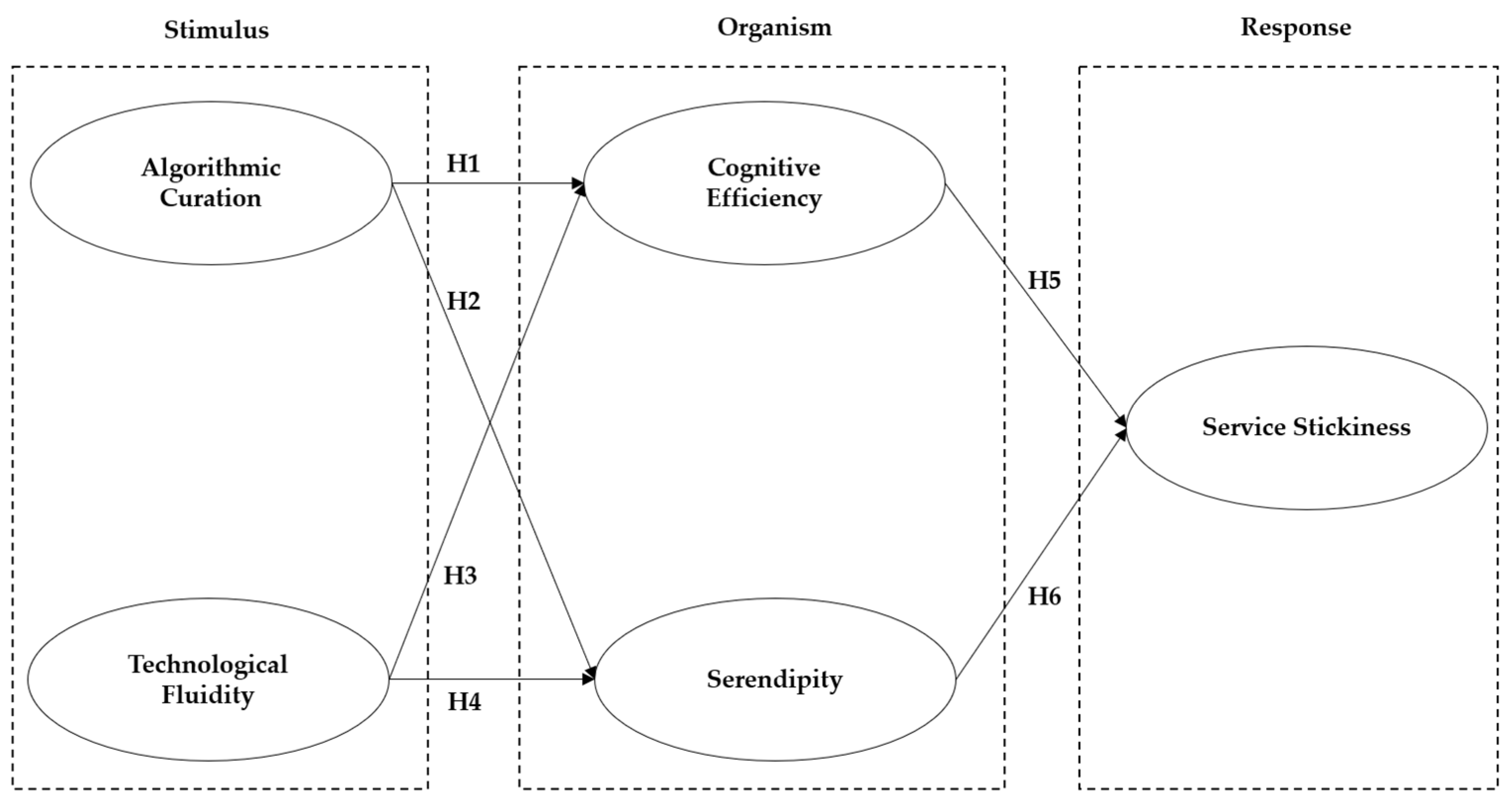
| H1 | Algorithmic Curation | → | Cognitive Efficiency | 0.462 | 5.843 | 0.000 *** | Supported |
| H2 | Algorithmic Curation | → | Serendipity | 0.501 | 5.034 | 0.000 *** | Supported |
| H3 | Technological Fluidity | → | Cognitive Efficiency | 0.341 | 4.314 | 0.000 *** | Supported |
| H4 | Technological Fluidity | → | Serendipity | −0.195 | −1.959 | 0.053 | Not Supported |
| H5 | Cognitive Efficiency | → | Service Stickiness | 0.598 | 7.230 | 0.000 *** | Supported |
| H6 | Serendipity | → | Service Stickiness | 0.040 | 0.477 | 0.634 | Not Supported |
| Path | Moderator | Interaction Coeff. (β) | p-Value | Result | Interpretation |
|---|---|---|---|---|---|
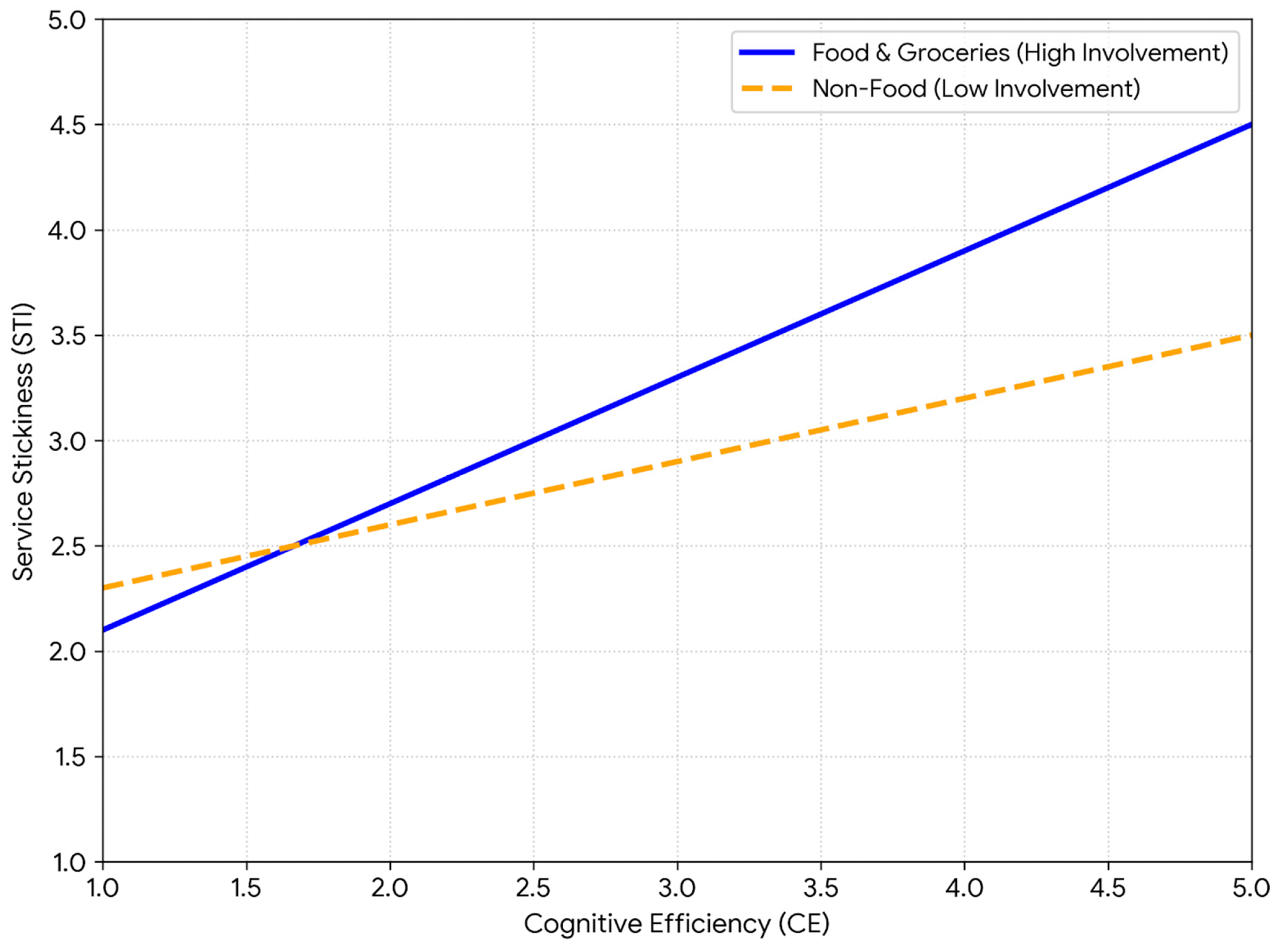
| CE → STI | Service Type (1 = Food) | 0.154 | 0.040 * | Significant | Efficiency matters more in high-frequency tasks (e.g., Food). |
| SER → STI | Service Type (1 = Food) | −0.042 | 0.658 | Not Sig. | Service type does not moderate the effect of enjoyment. |
| CE → STI | Income Level | −0.071 | 0.453 | Not Sig. | Efficiency is a universal driver regardless of income. |
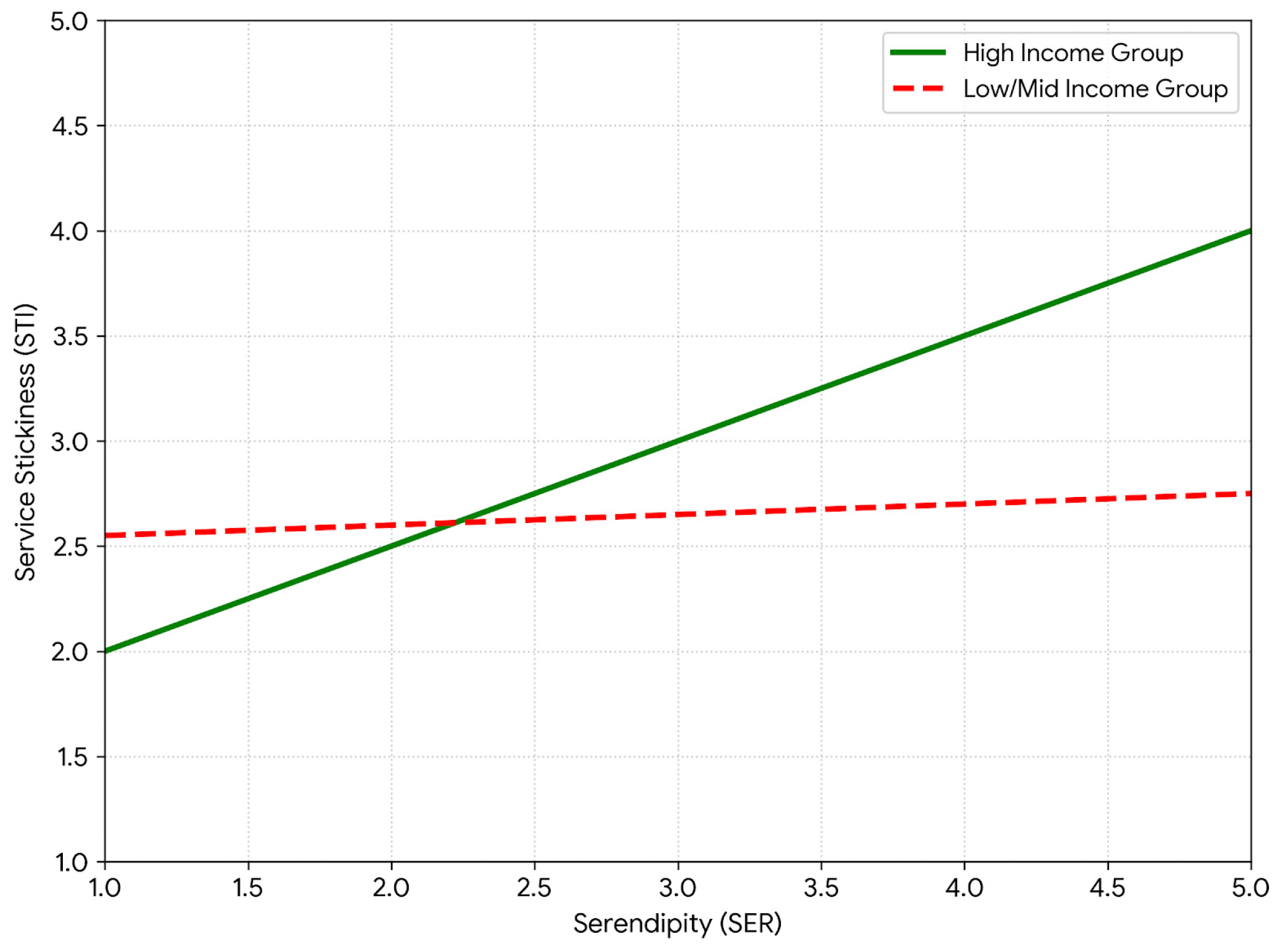
| SER → STI | Income Level | 0.237 | 0.038 * | Significant | High-income consumers are more responsive to serendipity. |
Disclaimer/Publisher’s Note: The statements, opinions and data contained in all publications are solely those of the individual author(s) and contributor(s) and not of MDPI and/or the editor(s). MDPI and/or the editor(s) disclaim responsibility for any injury to people or property resulting from any ideas, methods, instructions or products referred to in the content. |
© 2026 by the authors. Licensee MDPI, Basel, Switzerland. This article is an open access article distributed under the terms and conditions of the Creative Commons Attribution (CC BY) license.
Share and Cite
Kim, B.; Park, J. Driving Service Stickiness in the AI Subscription Economy: The Roles of Algorithmic Curation, Technological Fluidity, and Cognitive Efficiency. J. Theor. Appl. Electron. Commer. Res. 2026, 21, 30. https://doi.org/10.3390/jtaer21010030
Kim B, Park J. Driving Service Stickiness in the AI Subscription Economy: The Roles of Algorithmic Curation, Technological Fluidity, and Cognitive Efficiency. Journal of Theoretical and Applied Electronic Commerce Research. 2026; 21(1):30. https://doi.org/10.3390/jtaer21010030
Chicago/Turabian StyleKim, Bokyung, and Joonyong Park. 2026. "Driving Service Stickiness in the AI Subscription Economy: The Roles of Algorithmic Curation, Technological Fluidity, and Cognitive Efficiency" Journal of Theoretical and Applied Electronic Commerce Research 21, no. 1: 30. https://doi.org/10.3390/jtaer21010030
APA StyleKim, B., & Park, J. (2026). Driving Service Stickiness in the AI Subscription Economy: The Roles of Algorithmic Curation, Technological Fluidity, and Cognitive Efficiency. Journal of Theoretical and Applied Electronic Commerce Research, 21(1), 30. https://doi.org/10.3390/jtaer21010030