Article

Exploring the Mechanism of AI-Powered Personalized Product Recommendation on Generation Z Users’ Spontaneous Buying Intention on Short-Form Video Platforms: A Perceived Evaluation Perspective


1
Business School, Beijing Information Science and Technology University, Beijing 102206, China
2
College of Business Administration, Capital University of Economics and Business, Beijing 100070, China
3
School of Economics and Finance, Shanghai International Studies University, Shanghai 201620, China
*
Authors to whom correspondence should be addressed.
J. Theor. Appl. Electron. Commer. Res. 2025, 20(4), 290; https://doi.org/10.3390/jtaer20040290
Submission received: 10 September 2025 / Revised: 1 October 2025 / Accepted: 6 October 2025 / Published: 30 October 2025
(This article belongs to the Special Issue Human–Technology Synergies in AI-Driven E-Commerce Environments)

Abstract

With the rapid advancement and widespread adoption of artificial intelligence (AI), AI-powered personalized product recommendation (AI-PPR) has become a core tool for enhancing user experience and driving monetization on short-form video platforms, fundamentally reshaping consumer behavior. While prior research has largely focused on impulse buying intention (I-BI)—purchases triggered by emotional and sensory stimuli—there remains a lack of systematic exploration of spontaneous buying intention (S-BI), which emphasizes rational and cognitively driven decisions formed in unplanned contexts. Addressing this gap, this study integrates the Technology Acceptance Model (TAM) with a perceived evaluation perspective to propose and validate a dual-mediation framework: “AI-PPR → Perceived Usefulness/Perceived Trust → S-BI”. Using a large-scale survey of Generation Z users in mainland China (N = 754), data were analyzed via SPSS 26.0, including reliability and validity tests, regression analysis, and Bootstrap-based mediation analysis. The results indicate that AI-PPR not only has a significant positive direct effect on S-BI but also exerts strong indirect effects through perceived usefulness and perceived trust. Specifically, perceived usefulness accounts for 35.17% and perceived trust for 31.18% of the mediation, jointly constituting 66.35% of the total effect. The findings contribute theoretically by extending the boundary of purchase intention research, differentiating rational S-BI from emotion-driven impulse buying, and enriching the application of TAM in consumption contexts. Practically, the study highlights the importance for short-form video platforms and brand managers to enhance recommendation transparency, interpretability, and trust-building while pursuing algorithmic precision, thereby fostering rational spontaneous buying and achieving a balance between short-term conversions and long-term user value.

1. Introduction

With the rapid maturation and widespread penetration of artificial intelligence (AI), personalized recommendation technologies based on machine learning and deep neural networks have become a cornerstone of the digital economy and electronic commerce [1]. In short-form video platforms, AI-powered personalized product recommendation (AI-PPR) has emerged as both a critical mechanism for enhancing user experience and engagement, and a vital driver of monetization and competitive advantage. Short-form video platforms, characterized by their immersive environments, continuous exposure, and strong interactivity, have reshaped patterns of information discovery and consumption [2]. Within this context, AI-PPR captures users’ multidimensional interactions in real time (e.g., clicks, viewing duration, likes, and comments) and dynamically adjusts recommendation rankings, thereby profoundly transforming decision-making environments for spontaneous purchases [3]. Despite this technological progress, most existing research has focused on impulse buying—purchases triggered by sensory and emotional stimuli—while relatively little attention has been given to spontaneous buying intention (S-BI), a form of rational purchase intention formed rapidly and cognitively in unplanned contexts. This theoretical gap limits our understanding of the psychological and behavioral mechanisms underlying Generation Z’s consumption in short-form video environments [4].
To address this gap, the present study adopts a perceived evaluation perspective and develops a dual-mediation model of “AI-PPR → Perceived Usefulness/Perceived Trust → S-BI” [5]. Specifically, we integrate the rational assessment logic emphasized in the Technology Acceptance Model (TAM) with the contextual stimulus perspective of the Stimulus-Organism-Response (S-O-R) framework. In this way, AI-PPR is conceptualized both as an external stimulus that reduces information-matching and processing costs, and as an enabling mechanism that fosters rational instant decision-making through instrumental value and trust [6,7]. The study focuses on Generation Z—digital natives who prioritize efficiency and instant gratification in their consumption behaviors—making them an ideal group for examining rational spontaneous purchasing intention. By introducing S-BI as a distinct construct, the study seeks not only to differentiate rationally driven spontaneous buying from emotionally driven impulse buying [8], but also to highlight the managerial implications of this distinction for short-form video platforms and brands.
Methodologically, the study begins with a systematic literature review and theoretical integration to develop research hypotheses, followed by a questionnaire survey design based on established measurement scales. The survey covers perceptions of AI-PPR, perceived usefulness, perceived trust, S-BI, and control variables, and was distributed through Wenjuanxing across WeChat, Weibo, TikTok, rednote, and university forums. A total of 1043 questionnaires were collected between 15 October 2024, and 15 April 2025, with 754 valid responses retained after rigorous screening (effective rate = 72.3%). Empirical analyses conducted with SPSS 26.0 included reliability and validity tests, descriptive statistics, correlation analysis, stepwise regression, and bootstrap-based mediation analysis. The findings reveal that AI-PPR exerts a significant positive direct effect on Generation Z’s S-BI, while perceived usefulness and perceived trust play partial mediating roles, accounting for 35.17% and 31.18% of the total effect, respectively, with a combined mediation effect of 66.35%. These results support the validity of the dual-mediation model.
This study makes several key contributions. Theoretically, it systematically incorporates S-BI—defined as a rational and cognitively grounded form of immediate purchase intention—into the AI recommendation research framework, thereby extending consumer behavior research beyond the emotion-driven impulse buying paradigm. It further expands TAM by extending perceived usefulness into the purchase intention domain and positioning perceived trust as a complementary mediator, thus constructing a more holistic “algorithm–perceived evaluation–rational spontaneous buying” framework. Methodologically, the use of large-sample empirical data and mediation effect decomposition provides a replicable approach for future cross-cultural and cross-platform studies. Practically, the findings suggest that short-form video platforms and brand managers should not only enhance the accuracy of AI recommendations but also emphasize transparency, interpretability, privacy governance, and trust-building. By balancing emotional appeal with professional information delivery, platforms and brands can strengthen users’ perceptions of usefulness and trust, thereby promoting rational, spontaneous buying decisions and achieving both short-term conversion and long-term value co-creation.

2. Literature Review and Hypothesis Development

2.1. The Distinction Between S-BI and I-BI

In consumer behavior research, spontaneous buying intention (S-BI) and impulse buying intention (I-BI) are often used interchangeably; however, they represent fundamentally different constructs. I-BI refers to an irrational purchasing tendency triggered by external stimuli, such as auditory and visual emotional cues during livestream shopping that induce impulsive purchase behaviors [9,10]. Thus, I-BI emphasizes the dominant role of emotional arousal in the decision-making process [11]. Under this influence, consumers typically lack sufficient rational thinking, which often leads to regret or cognitive dissonance after making a purchase [12]. In contrast, S-BI refers to a consumer’s tendency to purchase in unplanned situations based on cognitive evaluation and rational judgment. For example, when a user intends to purchase toothpaste on an e-commerce platform and the system recommends a matching toothbrush, the user may generate an unplanned but rational buying intention as a result of this reminder [13]. Therefore, S-BI highlights the dominant role of product functionality and utility in the decision-making process [14]. In this context, when facing personalized recommendation information, consumers rapidly form rationalized, immediate purchase decisions based on factors such as relevance, matching degree, cost-effectiveness, and expected utility—a process that can be described as a “rationally driven immediate choice” [15].
In terms of antecedents and consequences, I-BI and S-BI also differ significantly. With respect to antecedents, I-BI is often driven by emotional stimulation (e.g., joy, excitement), situational cues (e.g., music, promotions), and psychological impulses [16], whereas S-BI is more strongly influenced by perceived usefulness, recommendation accuracy, trust, and cognitive convenience [13]. Regarding consequences, I-BI may produce short-term consumption satisfaction but often leads to regret and negative emotions due to poor functional fit and low utility of the purchased products [12]. Conversely, S-BI is more likely to result in decision satisfaction and repurchase intention, thereby fostering sustainable supply–demand relationships between the platform and its users [15]. Based on these distinctions, this study conceptualizes S-BI as a “cognitive form of unplanned purchase intention”, thereby establishing a clear theoretical boundary from the emotion-driven I-BI [17].

2.2. AI-PPR and Generation Z Users’ S-BI

In the context of e-commerce, AI-PPR refers to a set of technologies in which platform providers utilize intelligent algorithms such as machine learning, neural networks, and evolutionary computation to deliver highly personalized product suggestions, thereby enhancing user experience and consumer satisfaction [18]. It has become a critical component of core technologies and a major source of competitive advantage for short-form video platforms [19,20]. Unlike traditional “popular recommendations” or “editor’s picks” based on user browsing volume, AI-PPR leverages intelligent algorithms to analyze users’ historical behaviors, interest tags, and multidimensional interaction data (e.g., browsing time, clicks, likes, comments) to accurately predict user preferences, and subsequently match them with highly relevant product suggestions [21]. AI-PPR not only significantly reduces users’ information search costs but also enhances their comprehensive perception of product information, thereby becoming an important technological factor influencing users’ purchase intentions on platforms [22]. Prior studies have shown that AI-PPR can improve users’ decision-making efficiency and significantly increase S-BI among users engaging in “unplanned purchases” [22]. Moreover, Hallikainen et al. (2022) [23] and Wu et al. (2016) [24] further confirmed the positive effect of AI-PPR on users’ S-BI, pointing out that this mechanism operates through multiple factors such as perceived usefulness and perceived trust.
For Generation Z users, the impact of AI-PPR on S-BI is even more pronounced. Compared with other user groups, Generation Z, as digital natives, relies more heavily on digital technologies in their consumption decisions, and their decision-making logic tends to emphasize “efficiency first” and “instant gratification” [25]. AI-PPR delivers personalized products that meet users’ needs in real time, reducing information asymmetry and decision-making resistance, and thereby increasing their willingness to make spontaneous purchases [26]. Existing research, often based on the Stimulus-Organism-Response (SOR) model, suggests that AI-PPR, as an external stimulus, influences users’ perceptual states—such as perceived value, trust, or flow experience—thus driving higher levels of purchase intention [27]. Cheng et al. (2022) [28] found that AI-PPR improves users’ perception and understanding of product quality information, thereby increasing the likelihood of making spontaneous online purchase decisions. More recently, Yin et al. (2025) [29] demonstrated that the advantages of AI-PPR—such as relevance, inspiration, and insight—help accurately match users’ real needs and provide them with functional information and product reviews, thereby significantly enhancing their spontaneous buying intention.
In the context of short-form video platforms, the positive effect of AI-PPR on Generation Z’s S-BI is further reinforced. On the one hand, short-form video platforms are characterized by strong interactivity and high immersion. AI-PPR can dynamically adjust product recommendations based on users’ online behaviors (e.g., likes, viewing duration, sharing), thereby improving recommendation accuracy and matching [30]. On the other hand, compared with static e-commerce platforms, the content presentation of short-form video platforms tends to be more visually impactful and emotionally appealing, which further increases the likelihood of users generating spontaneous buying intentions [31]. Based on the above analysis, this study argues that in the short-form video platform context, AI-PPR can dynamically and in real time capture user behavioral data to provide more accurate personalized product recommendations, thereby significantly enhancing Generation Z users’ S-BI [32].
Based on the above analysis, this study proposes the following hypothesis:
H1. 
In the context of short-form video platforms, AI-PPR has a significant positive effect on Generation Z users’ spontaneous buying intention.

2.3. The Mediating Role of Perceived Usefulness

Perceived usefulness (PU), derived from the Technology Acceptance Model (TAM), is widely recognized as users’ subjective evaluation of the extent to which AI-PPR technologies can enhance task completion and efficiency, and it has become an important predictor of technology adoption behavior [33]. Put differently, when the recommended content is perceived as “useful”, users are more likely to develop favorable evaluations of the recommended products, which in turn exerts a significant influence on their purchase intentions and subsequent decision-making processes [26]. Jannach and Adomavicius (2016) [34] found that AI-PPR significantly strengthens users’ perception of instrumental value by optimizing product matching and information presentation efficiency through intelligent algorithms. Mican et al. (2020) [14] empirically demonstrated that in the context of algorithmic recommendation, the more users perceive AI-PPR as “helping me make better and faster decisions”, the higher their perceived usefulness. Bunea et al. (2024) [35], in their study on Generation Z consumers, discovered that AI-PPR influences S-BI through perceived usefulness and perceived ease of use. Moreover, research has shown that in digital retail and social commerce environments, perceived usefulness can shape users’ online impulsive buying intention and purchase behavior by reducing cognitive effort and enhancing decision confidence [14,36]. Based on this, for Generation Z users, when AI-PPR significantly reduces search costs and fulfills product needs, they are more likely to perceive a higher level of usefulness, which in turn promotes their online S-BI [37,38].
Short-form video platforms, as consumer scenarios dominated by “demand-driven + intelligent recommendation”, provide unique modes of information presentation and interactivity that can significantly enhance users’ purchase intention through perceived usefulness [39]. On the one hand, the immersive and contextualized content presentation of short videos improves users’ intuitive product perception, thereby increasing the likelihood of need triggering and fulfillment. In this context, AI-PPR not only enables intelligent information filtering but also constructs a situationalized product purchase experience for users [40]. On the other hand, given the high-frequency and fragmented consumption habits of Generation Z on short-form video platforms, AI-PPR technologies can substantially shorten the cumbersome process from demand stimulation to transaction completion, making consumption more “simple” and “convenient”, thus greatly enhancing users’ perceived usefulness [41]. In the context of short-form video platforms characterized by high interactivity and strong algorithmic influence, perceived usefulness often interacts with other factors such as emotional arousal or situational scarcity. Nevertheless, as a critical technological cue, it can directly influence users’ purchasing decisions by enhancing perceived value and reducing uncertainty [42]. At this stage, perceived usefulness goes beyond its traditional role of improving informational efficiency; it is further reinforced as an integrated value recognition that combines immersive experience and instant need fulfillment. Consequently, perceived usefulness exerts a significant positive impact on users’ spontaneous buying intention [43].
Based on the above analysis, this study proposes the following hypotheses:
H2. 
In the context of short-form video platforms, perceived usefulness mediates the relationship between AI-PPR and Generation Z users’ spontaneous buying intention.
H2a. 
In the context of short-form video platforms, AI-PPR has a significant positive effect on perceived usefulness.
H2b. 
In the context of short-form video platforms, perceived usefulness has a significant positive effect on Generation Z users’ spontaneous buying intention.

2.4. The Mediating Role of Perceived Trust

Perceived trust refers to users’ subjective cognition and confidence regarding the reliability, integrity, and competence of a specific object, such as an e-commerce platform, recommendation system, brand, or seller [36,44]. In the context of short-form video platforms, perceived trust extends from interpersonal relationships to the relationship between users and AI-PPR. In other words, users tend to view AI-PPR as a “quasi-social actor”, whose reliability, honesty, and competence enhance users’ willingness to adopt its recommendations [45,46]. When users hold higher expectations regarding the performance and effectiveness of algorithmic recommendations—namely, when they believe the algorithm is capable of delivering highly relevant suggestions—they are more inclined to trust the recommendations. This heightened trust, in turn, reduces cognitive resistance and perceived risk, thereby increasing users’ willingness to adopt the products or services recommended by the algorithm [47]. Prior studies have shown that the quality of information acquisition by AI-PPR (accuracy, relevance, availability, responsiveness) and the quality of recommendation outputs can positively shape users’ perceived trust in the platform [48]. Moreover, the greater the familiarity with AI-PPR and the higher the degree of personalized fit of its recommendations, the stronger the perception of “tailored-for-me” trust, which in turn increases the likelihood that users will adopt AI-PPR’s purchase suggestions [49]. High-quality recommendations can enhance users’ trust and positive attitudes toward the recommended content—namely, their perceived trust [13]. Perceived trust, in turn, further increases users’ purchase intention by reducing defensive information processing and lowering psychological resistance to the recommendation [26].
Furthermore, existing empirical research demonstrates that perceived trust can positively promote users’ S-BI. Wang et al. (2022) [50], through a meta-analysis, revealed that in online transaction contexts, users’ trust in platforms or sellers significantly enhances their purchase intention. Moreno et al. (2022) [51] found that in virtual environments, perceived trust not only directly increases S-BI but also indirectly facilitates it by enhancing perceived enjoyment. Wahyudi et al. (2025) [52] further demonstrated that the effect of perceived trust on Generation Z users’ S-BI is particularly salient, highlighting the importance of building perceived trust in short-form video platforms. Jakhodia et al. (2025) [53] indicated that AI-PPR, through machine learning and neural network algorithms, can substantially strengthen users’ perceived trust, thereby reducing defensive processing and additional verification, ultimately leading to S-BI. Furthermore, studies focusing on the unique continuous exposure–path compression–spontaneous purchase mechanism of short-form video platforms found that perceived trust effectively amplifies the persuasiveness of AI-PPR, thereby enhancing users’ S-BI [26,54,55]. In addition, Singh (2024) [56] discovered that perceived trust not only exerts a direct positive influence on Generation Z users’ online purchase intentions but also assists firms or online merchants in developing marketing strategies to optimize the attractiveness of online shopping platforms, thereby further increasing Generation Z users’ spontaneous buying intention.
Based on the above literature, this study proposes the following hypotheses:
H3. 
In the context of short-form video platforms, perceived trust mediates the relationship between AI-PPR and Generation Z users’ spontaneous buying intention.
H3a. 
In the context of short-form video platforms, AI-PPR has a significant positive effect on Generation Z users’ perceived trust.
H3b. 
In the context of short-form video platforms, perceived trust has a significant positive effect on Generation Z users’ spontaneous buying intention.

2.5. Research Model

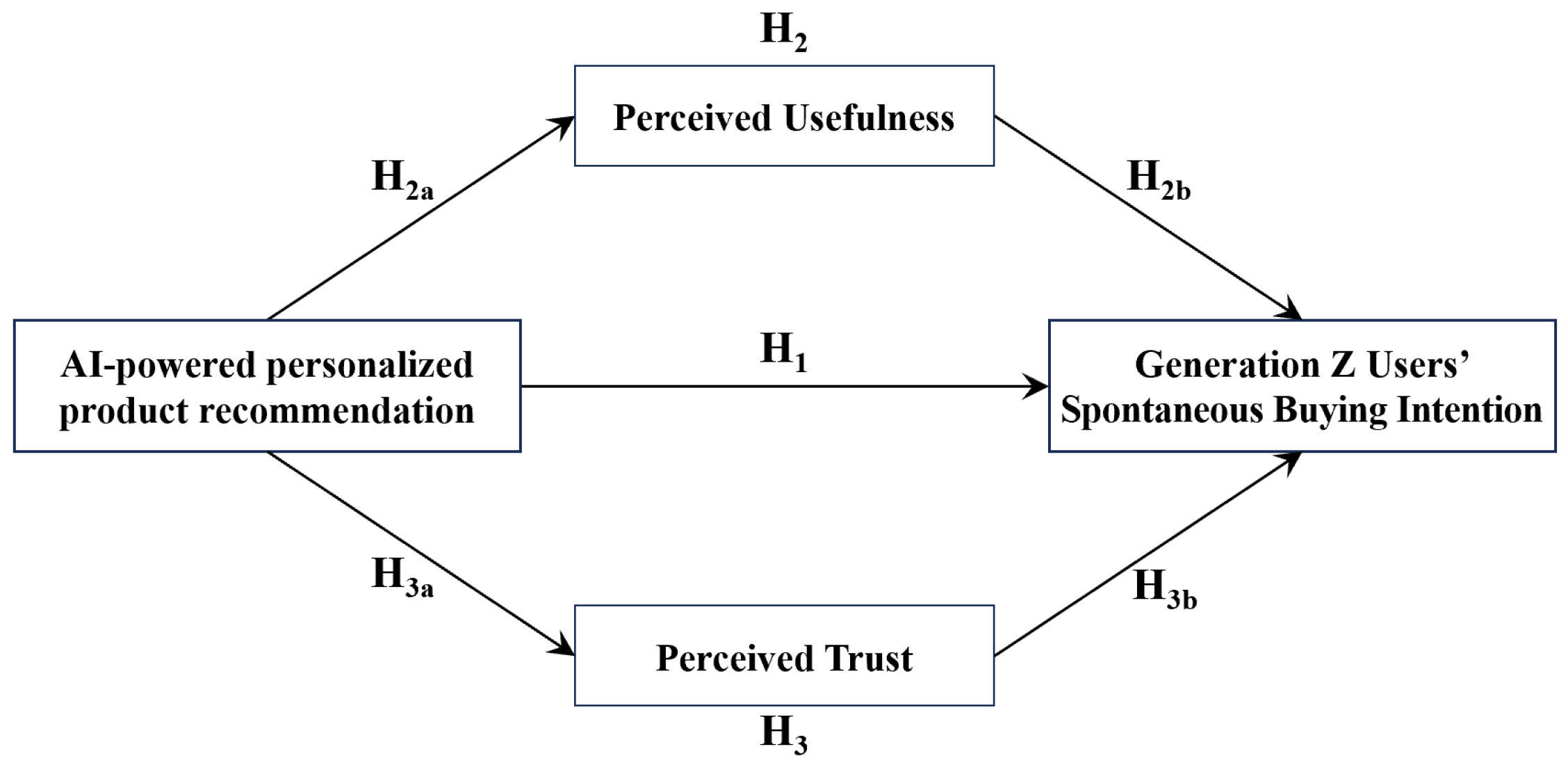
Building on the preceding literature review and the distinctive characteristics of short-form video platforms, this study develops a theoretical research model to systematically examine how AI-PPR influence Generation Z users’ S-BI through the mediating roles of perceived usefulness and perceived trust, as illustrated in Figure 1. The proposed model integrates the rational evaluation logic of the TAM with the contextual stimulus perspective of the S-O-R framework, thereby offering a robust theoretical foundation for exploring the underlying mechanisms linking algorithmic recommendations to consumer decision-making.
Structurally, the remaining sections of this paper are organized around this model. First, the study introduces the overall research design and methodology, including sampling strategies, data collection procedures, and variable measurement, to ensure the validity and reliability of the empirical analysis. Next, statistical analyses and hypothesis testing are conducted on large-scale survey data, encompassing reliability and validity assessments, correlation analysis, regression modeling, and Bootstrap-based mediation analysis, in order to test the theoretical model and evaluate the proposed hypotheses. Finally, drawing on the empirical findings, the paper highlights its theoretical contributions and practical implications—providing insights for both academia and industry stakeholders such as short-form video platforms and brand managers. Additionally, the paper acknowledges its limitations and outlines directions for future research, thereby laying the groundwork for further theoretical development and practical refinement.

3. Research Design

To test the dual-mediation mechanism—“AI-powered personalized product recommendation (AI-PPR) → perceived usefulness/perceived trust → spontaneous buying intention (B-BI)”—this study adopts a cross-sectional, survey-based empirical design. We first develop the conceptual model and hypotheses through theoretical integration and literature review, then build the measurement instrument from validated scales and refine item wording via a small pilot to ensure clarity and structure. After formal data collection, we implement a sequential analysis pipeline: quality controls and methodological checks (reliability and validity assessments), correlation and regression analyses, and Bootstrap-based mediation testing to identify the psychological pathways through which AI-PPR influences Generation Z users’ S-BI via instrumental (perceived usefulness) and relational (perceived trust) evaluations. Necessary control variables are included, and robustness diagnostics (e.g., common method bias and multicollinearity checks) are conducted to enhance internal validity and explanatory power. This design positions ‘perceived evaluation’ as the nexus linking algorithmic features to reasoned spontaneous decisions, while keeping the subsequent sampling and measurement details (see Section 3.1 and Section 3.2) aligned within a consistent methodological framework.

3.1. Sample and Data Collection

This study adopted a questionnaire survey method to collect sample data from Generation Z in mainland China (October 2024 to April 2025). Drawing on prior studies, the original items were appropriately revised to align with the research objectives. To minimize measurement bias during revision, the core item structures and measurement dimensions were retained, with only the key concepts and terminology modified to suit this study, as shown in Table 1. The survey was distributed through multiple mainstream social media platforms (WeChat, Weibo, TikTok, rednote) as well as university campus forums. This study collected multi-source data through several mainstream social media platforms and university campus forums, aiming to enhance sample heterogeneity and cover Generation Z users across different regions of China, thereby improving the robustness and generalizability of the research findings. A total of 1043 questionnaires were collected. To ensure the validity of the data and the consistency of the respondents with the research target, strict screening criteria were applied: (1) excluding respondents not belonging to Generation Z (born between 1997 and 2012) via the first filter question; (2) removing questionnaires with uniform responses across all items, illogical skip answers, or other signs of careless completion; and (3) excluding questionnaires with completion times shorter than 60 s, given that the average completion time was approximately 3–5 min. After rigorous screening, 754 valid questionnaires were obtained, yielding a valid response rate of 72.3%.

3.2. Variable Measurement

All variables were measured using a five-point Likert scale. The control variables include gender, monthly disposable income, years of short-form video platform usage, and platform type. Gender was classified as male or female; monthly disposable income was categorized into four groups: below RMB 1000, RMB 1000–5000, RMB 5001–10,000, and above RMB 10,000; years of usage were divided into four groups: less than 1 year, 1–3 years, 3–5 years, and more than 5 years; and platform type was categorized as TikTok, Bilibili, rednote, and others. The descriptive statistics of the sample are presented in Table 2.

4. Empirical Analysis and Hypothesis Testing

4.1. Reliability and Validity Analysis

4.1.1. Reliability Analysis

Reliability analysis is primarily conducted to examine the stability and consistency of measurement instruments during the research process, serving as a crucial prerequisite to ensure the scientific rigor and credibility of the findings. In this study, Cronbach’s α coefficient was employed to test the internal consistency of the scale, covering 16 items. The results are presented in Table 3.
All corrected item–total correlations exceeded 0.5, indicating strong correlations between the items and their respective constructs. Moreover, even after deleting individual items, the coefficients remained stable, suggesting that the items were appropriately designed. Cronbach’s α values for all dimensions were above the theoretical threshold of 0.7, demonstrating high internal consistency and reliability of the scale. Therefore, the measurement instrument used in this study is statistically reliable and provides a solid data foundation for subsequent empirical analyses.

4.1.2. Validity Analysis

Validity refers to the extent to which a measurement tool or instrument can accurately measure the intended construct. In this study, the Kaiser-Meyer-Olkin (KMO) test, Bartlett’s test of sphericity, exploratory factor analysis (EFA), and confirmatory factor analysis (CFA) were employed to verify whether the scale reliably captured the expected constructs. As shown in Table 4, the KMO value reached 0.939 (greater than the 0.7 threshold), and Bartlett’s test was significant (p < 0.001), indicating strong correlations among variables and the suitability of the data for factor analysis. Using principal component analysis, four common factors with eigenvalues greater than 1 were extracted and rotated via Varimax to ensure structural clarity. The cumulative variance explained reached 68.549%, which aligns with the four theoretical dimensions (AI-powered personalized product recommendation, perceived usefulness, perceived trust, and spontaneous buying intention). Moreover, all item loadings on their corresponding factors exceeded 0.7, with no significant cross-loadings, thereby demonstrating satisfactory structural validity.
As shown in Table 3, the composite reliability (CR) values for all subscales exceeded 0.8, and the average variance extracted (AVE) values were greater than 0.5, confirming convergent validity. Subsequently, CFA was conducted using AMOS 29.0 to further examine discriminant validity. The results, presented in Table 5, indicate that the baseline model demonstrated good fit indices: χ2/df = 1.699, RMR = 0.030, GFI = 0.974, NFI = 0.973, IFI = 0.989, and CFI = 0.989. These values meet the commonly accepted thresholds for model fit, suggesting that the constructs in this study possess strong discriminant validity.

4.2. Correlation Analysis

To further examine the relationships among the core variables, Pearson’s correlation coefficient analysis was conducted. The results, presented in Table 6, indicate that AI-PPR is significantly and positively correlated with perceived usefulness, perceived trust, and S-BI among Generation Z users (r = 0.607, r = 0.554, r = 0.527, all p < 0.01). In addition, perceived usefulness and perceived trust are both significantly and positively correlated with S-BI (r = 0.583, r = 0.577, both p < 0.01). These findings are consistent with the theoretical assumptions of this study, suggesting that AI-PPR can enhance users’ S-BI by increasing their perceived usefulness and perceived trust. The correlation analysis not only lays the groundwork for subsequent regression and mediation effect testing but also provides preliminary validation of the logical relationships embedded in the research model.

4.3. Common Method Bias and Variance Inflation Factor Tests

During the questionnaire design stage, this study implemented procedural remedies such as ensuring respondent anonymity and applying psychological separation of items to mitigate potential common method bias (CMB). Furthermore, as shown in Table 7, Harman’s single-factor test was conducted by including all measurement variables in the factor analysis. The unrotated results revealed four factors with eigenvalues greater than 1, with the largest single factor explaining 46.344% of the total variance—below the 50% threshold—indicating that serious single-factor bias is unlikely to exist.
Additionally, as shown in Table 8, the variance inflation factor (VIF) test was employed to examine multicollinearity. The VIF values for the three explanatory variables were 1.756, 1.829, and 1.666, all well below the empirical threshold of 10, suggesting no severe collinearity issues. Taken together, these results demonstrate that the study does not suffer from significant common method bias or multicollinearity, thereby providing a robust foundation for subsequent regression analyses and mediation effect testing.
Moreover, these diagnostic tests not only ensure the statistical robustness of the results but also enhance the explanatory power and credibility of the model estimates. By combining procedural controls with statistical verification, this study strengthens the methodological safeguards against potential bias, thereby improving the reliability of the model estimation. This approach offers a useful paradigm for future research and enhances the replicability and generalizability of the findings across different platforms and cultural contexts.

4.4. Empirical Testing

4.4.1. Direct Effect of AI-PPR on Generation Z Users’ S-BI

In this study, AI-PPR was treated as the independent variable, while perceived usefulness, perceived trust, and Generation Z users’ S-BI were treated as dependent variables. Perceived usefulness and perceived trust were also treated as independent variables when examining their effects on Generation Z users’ S-BI. Linear regression analyses were conducted to test these relationships.
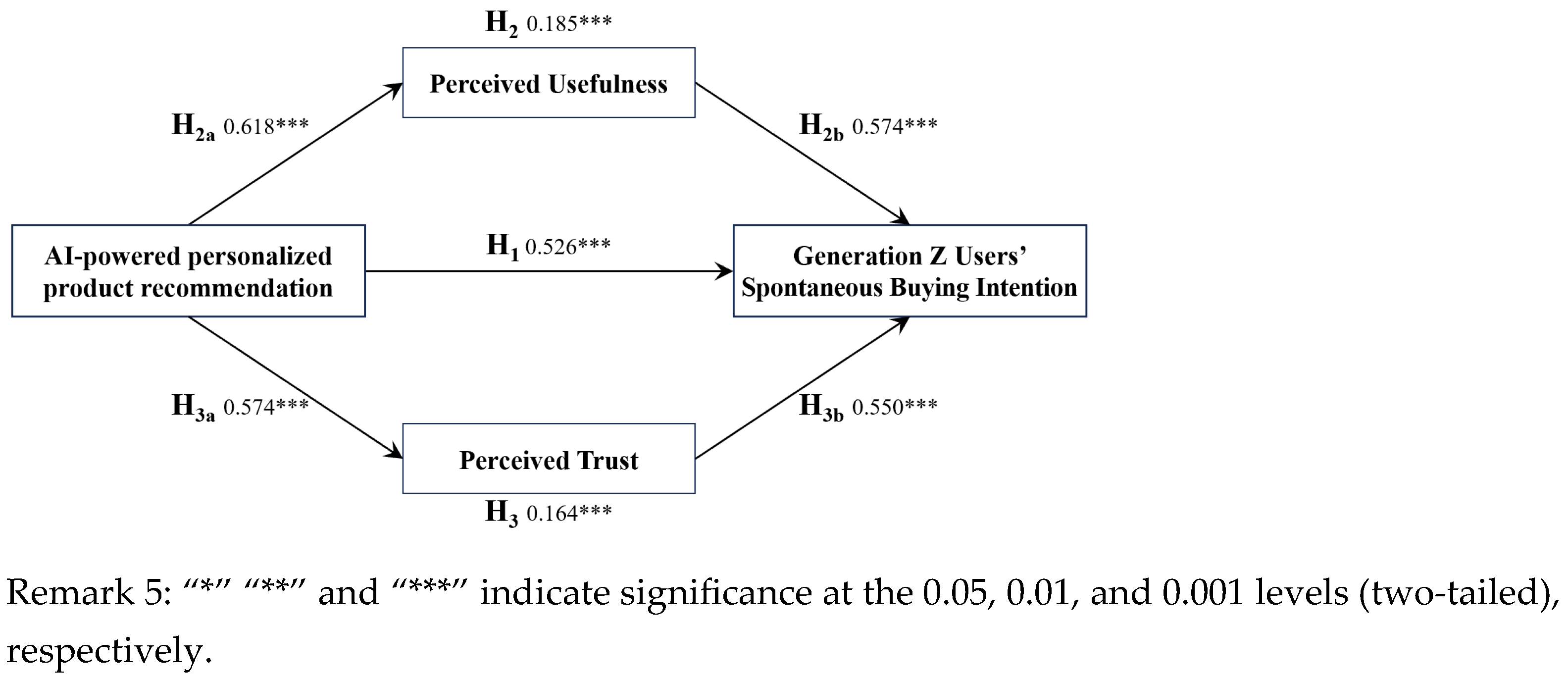
As shown in Table 9, AI-PPR had a positive effect on Generation Z users’ S-BI (M6, β = 0.526, p < 0.01), with an adjusted R2 of 0.289, indicating that AI-PPR explains 28.9% of the variance in Generation Z users’ S-BI, thus supporting H1. AI-PPR also positively influenced perceived usefulness (M2, β = 0.618, p < 0.01) and perceived trust (M4, β = 0.574, p < 0.01), with adjusted R2 values of 0.366 and 0.308, respectively, showing that AI-PPR accounts for 36.6% and 30.8% of the variance in perceived usefulness and perceived trust, supporting H2a and H2b. Additionally, perceived usefulness (M7, β = 0.574, p < 0.01) and perceived trust (M8, β = 0.550, p < 0.01) positively influenced Generation Z users’ S-BI, with adjusted R2 values of 0.353 and 0.338, indicating that perceived usefulness and perceived trust explain 35.3% and 33.8% of the variance in S-BI, respectively, thus supporting H3a and H3b. The coefficients for control variables, including gender, years of short-video platform usage, and disposable income, were not significant, suggesting that Generation Z users’ S-BI is more dependent on the perceived usefulness and perceived trust generated by AI-PPR in the short-video platform context rather than other demographic or behavioral characteristics. Including these control variables helped rule out alternative explanations and enhanced the statistical robustness of the regression results.

4.4.2. The Indirect Effect Test of Perceived Usefulness and Perceived Trust

To test the mediating effects of perceived usefulness and perceived trust between AI-powered personalized product recommendation (AI-PPR) and Generation Z users’ spontaneous buying intention, this study followed the procedure recommended by [61] and conducted stepwise regression analysis. As shown in Table 10, AI-PPR had a significant positive effect on spontaneous buying intention (M10, β = 0.526, p < 0.001). When the mediating variable perceived usefulness was included, both AI-PPR (M11, β = 0.271, p < 0.001) and perceived usefulness (M11, β = 0.412, p < 0.001) remained significant predictors of spontaneous buying intention, though the effect of AI-PPR weakened. This supports Hypothesis H2, indicating that perceived usefulness plays a partial mediating role in the relationship between AI-PPR and spontaneous buying intention.
Similarly, when perceived trust was added as a mediating variable, both AI-PPR (M12, β = 0.302, p < 0.001) and perceived trust (M12, β = 0.389, p < 0.001) continued to exert significant effects on spontaneous buying intention, but the effect of AI-PPR was again reduced. This confirms Hypothesis H3, suggesting that perceived trust also serves as a partial mediator in the relationship between AI-PPR and spontaneous buying intention among Generation Z users.

4.4.3. Testing the Parallel Mediating Effects of Perceived Usefulness and Perceived Trust

Using a Bootstrap-based mediation analysis, this study systematically examined the dual mediating roles of perceived usefulness (PU) and perceived trust (PT) in the relationship between AI-PPR and Generation Z users’ S-BI. Overall, as shown in Table 11, the total indirect effect of AI-PPR on S-BI was 0.349, with a Boot SE of 0.037 and a 95% Bootstrap confidence interval [0.280, 0.424]. Since this interval does not include zero, the dual mediation effect is significant. The total indirect effect accounts for 66.42% of the total effect, indicating that AI-PPR’s impact on S-BI is primarily realized through the psychological mechanisms of perceived usefulness and perceived trust.
Further analysis of the two specific mediation paths shows: the first path, “AI-PPR → Perceived Usefulness → S-BI”, has a mediation effect of 0.185, Boot SE = 0.030, 95% CI [0.128, 0.246], accounting for 35.16% of the total effect. This indicates that AI-PPR significantly enhances users’ perceived usefulness, thereby stimulating Generation Z users’ S-BI. The second path, “AI-PPR → Perceived Trust → S-BI”, has a mediation effect of 0.164, Boot SE = 0.029, 95% CI [0.108, 0.226], accounting for 31.26% of the total effect, showing that AI-PPR can also significantly increase Generation Z users’ S-BI by enhancing their trust in the system.
In summary, the effect sizes of the two mediation paths are relatively close, each contributing approximately one-third of the total indirect effect, further supporting hypotheses H2 and H3. These results not only reveal the underlying psychological mechanisms through which AI-PPR influences Generation Z users’ S-BI but also highlight the importance of enhancing users’ perceived usefulness and perceived trust on short-video platforms or other AI-driven platforms.

4.5. Test Results

As shown in Table 12, AI-PPR exerts both a direct effect and significant indirect effects on Generation Z users’ S-BI through perceived usefulness and perceived trust, with the dual mediation jointly explaining the majority of the total effect. These results indicate that AI-PPR on short-form video platforms not only directly stimulates Generation Z users’ S-BI but also enhances it by improving users’ perceived usefulness and perceived trust. This finding provides empirical evidence for understanding the mechanism through which AI-PPR on short-form video platforms promotes Generation Z users’ S-BI and offers practical insights for platforms to optimize algorithms and for marketers to design effective marketing strategies. The research model and the observed effect sizes after empirical testing are illustrated in Figure 2.

5. Conclusions, Implications, and Future Directions

5.1. Research Conclusions

Based on the empirical analysis, this study finds that AI-PPR on short-form video platforms have a significant positive effect on Generation Z users’ S-BI. This effect is primarily transmitted through users’ perceived evaluations—specifically, perceived usefulness and perceived trust. Perceived usefulness plays a partial mediating role between AI-PPR and S-BI, accounting for 35.17% of the mediation effect. Similarly, perceived trust also plays a partial mediating role between AI-PPR and S-BI, accounting for 31.18% of the mediation effect. Together, these two mediators constitute 66.35% of the total effect, indicating that perceived usefulness and perceived trust jointly form the primary psychological pathway through which AI-PPR influences spontaneous buying, while a significant direct effect remains. Therefore, while short-form video platforms strive to enhance the accuracy and practicality of personalized product recommendations, they must simultaneously strengthen algorithm transparency, recommendation explainability, and privacy protection to foster short-term conversions while consolidating user trust and long-term value.

5.2. Theoretical Contributions

This study makes three important theoretical contributions.
First, it extends the research boundaries and theoretical positioning of S-BI. This study incorporates S-BI, conceptualized as a consumption intention centered on rational evaluation, into the AI-PPR research framework, clearly distinguishing it from the traditionally defined I-BI driven by emotions or strong external stimuli (e.g., Chen et al., 2022; Li et al., 2025) [62,63]. Theoretically, this study argues that in short-form video platform contexts, AI-PPR enhances information relevance and reduces search and comparison costs, enabling consumers to form rationalized purchase intentions in non-planned scenarios. This constitutes a “reasoned immediate decision” rather than a purely emotion-driven or stimulus reflex. Consequently, this study advances consumer behavior research by positioning algorithmic recommendations as contextual cues that facilitate rational spontaneous decision-making, thereby extending the applicability and explanatory power of the S-O-R and Technology Acceptance Model (TAM) frameworks in digital-native consumption contexts.
Second, this study reveals the pivotal mediating role of perceived usefulness as a cognitive intermediary between AI-PPR and S-BI. Prior research has primarily emphasized perceived usefulness in predicting technology adoption [64,65], with limited exploration in the domain of purchase intention. This study constructs and empirically validates perceived usefulness as the core cognitive mediation mechanism through which AI-PPR affects S-BI: when users perceive that recommendations “substantially help them meet their needs faster and more accurately”, they are more likely to rationally evaluate non-planned product information and immediately adopt the recommendations, forming spontaneous buying intentions. Compared with treating perceived usefulness merely as a predictor of technology adoption, this study extends its functional role as a psychological resource that empowers rational purchase judgment in fragmented, real-time decision contexts—by reducing information processing costs and enhancing decision confidence and expected utility evaluation, it directly facilitates the generation of spontaneous buying intentions. This refinement helps theoretically link algorithm characteristics (accuracy, relevance, explainability) to the mediation chain in consumers’ rational decision-making processes.
Finally, this study elucidates perceived trust as a relational mediator in Generation Z users’ decision-making. Existing literature has extensively explored the role of trust in e-commerce and social commerce [36,66], but rarely focuses on the cognitive logic of Generation Z. Although S-BI emphasizes rational evaluation, this study highlights the indispensable role of perceived trust in the algorithm–decision chain. In AI-PPR contexts, perceived trust reduces verification costs and selection risks, facilitating the translation of rational evaluation into immediate adoption. For Generation Z users, their digital literacy and platform dependency make trust influenced not only by algorithm performance (accuracy, stability, explainability) but also by platform governance and social cues (reviews, KOL demonstrations). Based on this, one theoretical contribution of this study is positioning perceived trust as a complementary mediator alongside perceived usefulness. Perceived trust lowers external verification barriers and ensures the feasibility of rational adoption, while perceived usefulness provides instrumental justification for the decision. Integrating these two mediation paths, this study proposes a more complete “AI-Algorithm → Perceived Usefulness/Perceived Trust → S-BI” framework, offering clear theoretical hypotheses and testable pathways for future research on generational differences, platform heterogeneity, and short- versus long-term consumer behavior.

5.3. Managerial Implications

This study provides three practical implications for technology updates on short-form video platforms and marketing practices of brand owners.
First, short-form video platforms should optimize AI-PPR technology to enhance users’ S-BI. The study finds that AI-PPR not only affects users’ perceived usefulness and perceived trust but also promotes S-BI by enhancing the rational information-matching process. Unlike traditional e-commerce platforms that focus on encouraging “impulse consumption”, short-form video platforms should emphasize transparency and accuracy in recommendations, allowing users to perceive a high alignment between recommended products and their actual needs. This implies that platforms need to further improve algorithm explainability, informing users “why this recommendation” is made to reduce doubts and resistance, thereby strengthening trust in the AI system. In practice, platforms could, for instance, provide a visible “why recommended” tag beneath each product, explain which interaction behaviors triggered the recommendation, or allow users to adjust recommendation parameters manually (e.g., prioritizing price, popularity, or novelty). However, platforms must also guard against unintended outcomes such as consumer over-reliance on algorithms, potential privacy risks from excessive data collection, or the formation of filter bubbles that narrow users’ exposure to diverse products. Thus, platform managers should establish transparent data governance policies, adopt opt-in personalization mechanisms, and periodically diversify recommendations to mitigate these risks.
Second, brand owners should balance anthropomorphic presentation and professional content in short-form video marketing to facilitate rational consumer decision-making. The study finds that Generation Z users experience enhanced trust in recommendations when exposed to highly anthropomorphized content; however, overreliance on emotional or entertainment-driven content may lead users to perceive that the platform is merely inducing impulse consumption, reducing long-term trust. Therefore, brand owners should combine interactivity with professionalism in short-form video promotion: using anthropomorphic expressions to shorten psychological distance while delivering rational information (e.g., product efficacy verification, expert endorsements, scenario demonstrations) to reinforce rational judgment. For example, a cosmetics brand could integrate playful influencer content with dermatologists’ scientific explanations to strike a balance between emotional appeal and rational assurance. At the same time, firms should be cautious of unintended consequences such as “over-anthropomorphizing” their content, which might blur the boundary between authenticity and persuasion, potentially triggering consumer skepticism in the long run.
Third, firms should emphasize the integration of S-BI with long-term consumer relationship management. Unlike I-BI, S-BI is grounded in users’ rational cognition, which is more conducive to creating a positive “satisfaction—repurchase” cycle. Managers need to recognize that spontaneous buying is not a one-time random behavior but a rational choice made after users develop trust in the recommendation system, platform mechanisms, and brand image. Therefore, firms should strengthen post-transaction services, user feedback mechanisms, and personalized care to maintain consumer trust and satisfaction. For example, firms could leverage big data to track users’ purchase habits and provide personalized follow-up recommendations, such as suggesting complementary products after a major purchase, or delivering service reminders. Additionally, building transparent after-sales policies (e.g., return guarantees, privacy protection statements) can help sustain consumer confidence. Yet managers should also be alert to possible downsides of overly optimized personalization—such as narrowing users’ purchase diversity or causing “algorithm fatigue”—and thus complement algorithmic strategies with human-centered customer service.

5.4. Research Limitations and Future Research Directions

Although the findings of this study hold significant theoretical value and practical implications, several limitations remain, which open opportunities for future research and expansion.
First, regarding causality, this study employed a cross-sectional survey to conduct empirical tests and applied regression analysis and Bootstrap mediation analysis to ensure robustness. However, challenges remain in establishing the causal direction of the relationships. In digital commerce and algorithm-driven recommendation contexts, user behavior is highly dynamic and context-dependent. Relying solely on cross-sectional data may overlook the evolving processes of user cognition and behavior over time. Therefore, future research should adopt longitudinal panel data, natural experiments, field experiments, or A/B testing to more accurately capture the causal mechanisms and effects of AI-PPR on perceived evaluations and spontaneous buying intention, particularly in dynamic environments where algorithms continuously iterate and user interactions unfold.
Second, in terms of generalizability and external validity, this study focused on Generation Z short-form video users in mainland China. The consumption psychology and platform ecosystems in this context may be unique, which limits the cross-cultural transferability of the conclusions. Future research should extend to different geographic, cultural, and institutional contexts (e.g., Western countries, Japan, or emerging markets) to examine how cultural dimensions—such as collectivism versus individualism and uncertainty avoidance—shape the relationships between AI-PPR, perceived usefulness, perceived trust, and spontaneous buying intention. Additionally, studies could compare different platform types (e.g., traditional e-commerce, live-streaming commerce, online communities, or metaverse platforms) to test the boundary conditions of the proposed framework, thereby enhancing the universality of the findings across diverse digital business models and ecosystems.
Third, the proposed research model primarily focuses on the mediating effects of perceived usefulness and perceived trust. Although these two mechanisms jointly explain 66.35% of the total effect—demonstrating strong explanatory power—they may still overlook other important psychological and social factors that influence spontaneous buying intention (S-BI). For instance, perceived enjoyment, algorithm transparency, social identity, and platform governance mechanisms may all play critical roles in shaping the relationship between AI-PPR and Generation Z’s S-BI. These additional factors not only help capture the complexity of users’ cognitive and behavioral responses but also open new theoretical and empirical avenues for research on AI-driven consumer behavior. Accordingly, future studies could build on the Technology Acceptance Model (TAM) by integrating perspectives from social capital theory and affective computing, while expanding both mediating and moderating pathways. Such integration would enable the development of a more systematic and multi-dimensional explanatory framework, thereby offering a more comprehensive understanding of how AI-PPR enhances users’ spontaneous buying intention and under what contextual conditions [67].
Finally, in terms of methodology and measurement tools, this study relied primarily on users’ subjective self-reported perceptions. While this approach ensured reliability and validity, it lacked integration with objective behavioral data, which limits the explanatory power of the findings. Future research should combine subjective survey data with big data analytics, clickstream behavior, and algorithm performance metrics (e.g., accuracy, interpretability, and transparency) to establish a hybrid paradigm that integrates “subjective perception-objective behavior.” Such an approach would not only enhance the explanatory and generalizability strength of research findings but also provide more actionable and operational insights for the management of e-commerce platforms and digital ecosystems.

Author Contributions

Conceptualization, H.L.; methodology, S.H., H.L. and J.Y.; data curation, S.H., J.L. and X.L.; investigation, J.L.; formal analysis, S.H., J.L. and J.Y.; writing—original draft, S.H., J.L. and J.Y.; writing—review & editing, H.L., S.H. and J.L.; visualization, S.H., J.Y. and X.L.; supervision, H.L.; project administration, H.L.; Resources, H.L.; Software, X.L.; Validation, S.H., J.Y. and X.L.; funding acquisition, H.L. All authors have read and agreed to the published version of the manuscript.

Funding

This study was supported by the “National Social Science Foundation of China (Grant No. 24AGL016)”.

Institutional Review Board Statement

The study was conducted in accordance with the Declaration of Helsinki, and approved by the Ethics Committee of Business School, Beijing Information Science and Technology University (protocol code EA20240915, 15 September 2024).

Informed Consent Statement

Informed consent was obtained from all subjects involved in the study.

Data Availability Statement

The data presented in this study are available on request from the author.

Acknowledgments

The authors would like to thank the anonymous reviewers for their reviews and comments.

Conflicts of Interest

The author declares no conflicts of interest.

References

  1. Chin, T.; Li, Q.; Mirone, F.; Papa, A. Conflicting impacts of shadow AI usage on knowledge leakage in metaverse-based business models: A Yin-Yang paradox framing. Technol. Soc. 2025, 81, 102793. [Google Scholar] [CrossRef]
  2. Li, H.; Yang, Z.; Jin, C.; Wang, J. How an industrial internet platform empowers the digital transformation of SMEs: Theoretical mechanism and business model. J. Knowl. Manag. 2023, 27, 105–120. [Google Scholar] [CrossRef]
  3. Tu, S.H.; Wang, J.; Lin, C.L.; Liao, K.T. Analyzing the Impact of IoT on E-commerce Trends Through Topic Modeling and Co-Citation Techniques. Rev. Socionetw. Strateg. 2025, 1–25. [Google Scholar] [CrossRef]
  4. Li, H.; Wang, H.; Yang, Z.; Guo, C. Cross-level interaction mechanism for high growth among digital start–ups: An fsQCA analysis. Chin. Manag. Stud. 2025. [Google Scholar] [CrossRef]
  5. Amin, A. Artificial intelligence in social media: A catalyst for impulse buying behavior? Young Consum. 2025. [Google Scholar] [CrossRef]
  6. Li, H.; Hu, Q.; Zhao, G.; Li, B. The co-evolution of knowledge management and business model transformation in the post-COVID-19 era: Insights based on Chinese e-commerce companies. J. Knowl. Manag. 2022, 26, 1113–1123. [Google Scholar] [CrossRef]
  7. Hassan, N.; Abdelraouf, M.; El-Shihy, D. The moderating role of personalized recommendations in the trust–satisfaction–loyalty relationship: An empirical study of AI-driven e-commerce. Future Bus. J. 2025, 11, 66. [Google Scholar] [CrossRef]
  8. Nagy, S.; Hajdú, N. Consumer acceptance of the use of artificial intelligence in online shopping: Evidence from Hungary. Amfiteatru Econ. 2021, 23, 155–173. [Google Scholar] [CrossRef]
  9. Rook, D.W. The buying impulse. J. Consum. Res. 1987, 14, 189–199. [Google Scholar] [CrossRef]
  10. Xia, Y.X.; Chae, S.W.; Xiang, Y.C. How social and media cues induce live streaming impulse buying? SOR model perspective. Front. Psychol. 2024, 15, 1379992. [Google Scholar] [CrossRef]
  11. Iyer, G.R.; Blut, M.; Xiao, S.H.; Grewal, D. Impulse buying: A meta-analytic review. J. Acad. Mark. Sci. 2020, 48, 384–404. [Google Scholar] [CrossRef]
  12. Redine, A.; Deshpande, S.; Jebarajakirthy, C.; Jiraporn, S. Impulse buying: A systematic literature review and future research directions. Int. J. Consum. Stud. 2023, 47, 3–41. [Google Scholar] [CrossRef]
  13. Ampadu, S.; Jiang, Y.; Debrah, E.; Antwi, C.O.; Amankwa, E.; Gyamfi, S.A.; Amoako, R. Online personalized recommended product quality and e-impulse buying: A conditional mediation analysis. J. Retail. Consum. Serv. 2022, 64, 102789. [Google Scholar] [CrossRef]
  14. Mican, D.; Sitar-Tăut, D.A.; Moisescu, O.I. Perceived usefulness: A silver bullet to assure user data availability for online recommendation systems. Decis. Support Syst. 2020, 139, 113420. [Google Scholar] [CrossRef]
  15. Wang, Y.D.; Zhu, J.J.; Liu, R.H.; Jiang, Y.S. Enhancing recommendation acceptance: Resolving the personalization–privacy paradox in recommender systems: A privacy calculus perspective. Int. J. Inf. Manag. 2024, 76, 102755. [Google Scholar] [CrossRef]
  16. Mandolfo, M.; Lamberti, L. Past, present, and future of impulse buying research methods: A systematic literature review. Front. Psychol. 2021, 12, 687404. [Google Scholar] [CrossRef]
  17. Morozova, N.; Vlaev, I. The urge to splurge: Differentiating unplanned and impulse purchases. Int. J. Mark. Res. 2024, 66, 519–542. [Google Scholar] [CrossRef]
  18. Li, H.; Yang, Z.; Wang, H.; Li, Y. Digitalization of business models, knowledge management and green technology innovation of Chinese manufacturing enterprises: A mixed analysis based on the Haier COSMOPlat ecosystem. Asia Pac. Bus. Rev. 2023, 1–29. [Google Scholar] [CrossRef]
  19. Adomavicius, G.; Tuzhilin, A. Toward the next generation of recommender systems: A survey of the state-of-the-art and possible extensions. IEEE Trans. Knowl. Data Eng. 2005, 17, 734–749. [Google Scholar] [CrossRef]
  20. Su, Y.S.; Wang, J.Q.; Tu, S.H.; Liao, K.T.; Lin, C.L. Detecting latent topics and trends in IoT and e-commerce using BERTopic modeling. Internet Things 2025, 32, 101604. [Google Scholar] [CrossRef]
  21. Gao, C.; He, X.; Gan, D.; Chen, X.; Feng, F.; Li, Y.; Jin, D. Learning to recommend with multiple cascading behaviors. IEEE Trans. Knowl. Data Eng. 2019, 33, 2588–2601. [Google Scholar] [CrossRef]
  22. Hostler, R.E.; Yoon, V.Y.; Guo, Z.; Guimaraes, T.; Forgionne, G. Assessing the impact of recommender agents on on-line consumer unplanned purchase behavior. Inf. Manag. 2011, 48, 336–343. [Google Scholar] [CrossRef]
  23. Hallikainen, H.; Luongo, M.; Dhir, A.; Laukkanen, T. Consequences of personalized product recommendations and price promotions in online grocery shopping. J. Retail. Consum. Serv. 2022, 69, 103088. [Google Scholar] [CrossRef]
  24. Wu, L.; Chen, K.W.; Chiu, M.L. Defining key drivers of online impulse purchasing: A perspective of both impulse shoppers and system users. Int. J. Inf. Manag. 2016, 36, 284–296. [Google Scholar] [CrossRef]
  25. Priporas, C.V.; Stylos, N.; Fotiadis, A.K. Generation Z consumers’ expectations of interactions in smart retailing: A future agenda. Comput. Hum. Behav. 2017, 77, 374–381. [Google Scholar] [CrossRef]
  26. Chen, Y.; Lu, Y.; Wang, B.; Pan, Z. How do product recommendations affect impulse buying? An empirical study on WeChat social commerce. Inf. Manag. 2019, 56, 236–248. [Google Scholar] [CrossRef]
  27. Jeong, J.; Kim, D.; Li, X.; Li, Q.; Choi, I.; Kim, J. An empirical investigation of personalized recommendation and reward effect on customer behavior: A stimulus–organism–response (SOR) model perspective. Sustainability 2022, 14, 15369. [Google Scholar] [CrossRef]
  28. Cheng, Z.; Shao, B.; Zhang, Y. Effect of product presentation videos on consumers’ purchase intention: The role of perceived diagnosticity, mental imagery, and product rating. Front. Psychol. 2022, 13, 812579. [Google Scholar] [CrossRef]
  29. Yin, J.; Qiu, X.; Wang, Y. The Impact of AI-Personalized Recommendations on Clicking Intentions: Evidence from Chinese E-Commerce. J. Theor. Appl. Electron. Commer. Res. 2025, 20, 21. [Google Scholar] [CrossRef]
  30. Covington, P.; Adams, J.; Sargin, E. Deep neural networks for YouTube recommendations. In Proceedings of the 10th ACM Conference on Recommender Systems, Boston, MA, USA, 15–19 September 2016; pp. 191–198. [Google Scholar] [CrossRef]
  31. Meng, L.M.; Kou, S.; Duan, S.; Bie, Y. The impact of content characteristics of Short-Form video ads on consumer purchase Behavior: Evidence from TikTok. J. Bus. Res. 2024, 183, 114874. [Google Scholar] [CrossRef]
  32. Chin, T.; Li, Z.; Huang, L.; Li, X. How artificial intelligence promotes new quality productive forces of firms: A dynamic capability view. Technol. Forecast. Soc. Change 2025, 216, 124128. [Google Scholar] [CrossRef]
  33. Davis, F.D. Perceived usefulness, perceived ease of use, and user acceptance of information technology. MIS Q. 1989, 13, 319–340. [Google Scholar] [CrossRef]
  34. Jannach, D.; Adomavicius, G. Recommendations with a purpose. In Proceedings of the 10th ACM Conference on Recommender Systems, Boston, MA, USA, 15–19 September 2016; pp. 7–10. [Google Scholar] [CrossRef]
  35. Bunea, O.I.; Corboș, R.A.; Mișu, S.I.; Triculescu, M.; Trifu, A. The next-generation shopper: A study of generation-Z perceptions of AI in online shopping. J. Theor. Appl. Electron. Commer. Res. 2024, 19, 2605–2629. [Google Scholar] [CrossRef]
  36. Gefen, D.; Karahanna, E.; Straub, D.W. Trust and TAM in online shopping: An integrated model. MIS Q. 2003, 27, 51–90. [Google Scholar] [CrossRef]
  37. Gao, Y.; Liang, J. The Impact of AI-Powered Try-On Technology on Online Consumers’ Impulsive Buying Intention: The Moderating Role of Brand Trust. Sustainability 2025, 17, 2789. [Google Scholar] [CrossRef]
  38. Ngo, T.T.A.; Nguyen, H.L.T.; Nguyen, H.P.; Mai, H.T.A.; Main, T.H.T.; Hoang, P.L. A comprehensive study on factors influencing online impulse buying behavior: Evidence from Shopee video platform. Heliyon 2024, 10, e35743. [Google Scholar] [CrossRef]
  39. Wei, Y. The impact of content marketing on consumer purchase intention on TikTok. Asia Pac. J. Mark. Logist. 2025. [Google Scholar] [CrossRef]
  40. Luo, C.; Hasan, N.A.M.; Zamri bin Ahmad, A.M.; Lei, G. Influence of short video content on consumers purchase intentions on social media platforms with trust as a mediator. Sci. Rep. 2025, 15, 16605. [Google Scholar] [CrossRef]
  41. Liang, Q.; Liu, J. Research on the influence of short video AI personalized recommendation on consumers’ impulsive buying behavior—Moderating effects based on algorithmic attitudes. In Proceedings of the 2024 7th International Conference on Information Management and Management Science, Beijing, China, 23–25 August 2024; pp. 45–50. [Google Scholar] [CrossRef]
  42. Xue, Y.; Feng, T.; Wu, C. How technical and situational cues affect impulse buying behavior in social commerce? Evidence from bored consumers. Front. Psychol. 2024, 15, 1405189. [Google Scholar] [CrossRef] [PubMed]
  43. Jiang, W.; Chen, H.L. Can short videos work? The effects of use and gratification and social presence on purchase intention: Examining the mediating role of digital dependency. J. Theor. Appl. Electron. Commer. Res. 2024, 20, 5. [Google Scholar] [CrossRef]
  44. McKnight, D.H.; Choudhury, V.; Kacmar, C. Developing and validating trust measures for e-commerce: An integrative typology. Inf. Syst. Res. 2002, 13, 334–359. [Google Scholar] [CrossRef]
  45. Zhao, X.; You, W.; Zheng, Z.; Shi, S.; Lu, Y.; Sun, L. How do consumers trust and accept AI agents? An extended theoretical framework and empirical evidence. Behav. Sci. 2025, 15, 337. [Google Scholar] [CrossRef]
  46. Vanneste, B.S.; Puranam, P. Artificial intelligence, trust, and perceptions of agency. Acad. Manag. Rev. 2024. [Google Scholar] [CrossRef]
  47. Gallin, S.; Portes, A. Online shopping: How can algorithm performance expectancy enhance impulse buying? J. Retail. Consum. Serv. 2024, 81, 103988. [Google Scholar] [CrossRef]
  48. Wang, W.; Benbasat, I. Trust in and adoption of online recommendation agents. J. Assoc. Inf. Syst. 2005, 6, 3. [Google Scholar] [CrossRef]
  49. Komiak, S.Y.; Benbasat, I. The effects of personalization and familiarity on trust and adoption of recommendation agents. MIS Q. 2006, 30, 941–960. [Google Scholar] [CrossRef]
  50. Wang, J.; Shahzad, F.; Ahmad, Z.; Abdullah, M.; Hassan, N.M. Trust and Consumers’ Purchase Intention in a Social Commerce Platform: A Meta-Analytic Approach. SAGE Open 2022, 12, 21582440221091262. [Google Scholar] [CrossRef]
  51. Moreno, D.; Fabre, E.; Pasco, M. Atmospheric Cues Roles: Customer’s Online Trust, Perceived Enjoyment, and Impulse Buying Behavior. Open J. Bus. Manag. 2022, 10, 223–244. [Google Scholar] [CrossRef]
  52. Wahyudi, M.A.; Rahmadhani, M.V.; Mu’is, A.; Feby, E. The Impact of Short-Form Video Marketing, Influencer Relatability, and Trust Signals on Gen Z’s Purchase Intention. Int. J. Bus. Law Educ. 2025, 6, 855–864. [Google Scholar] [CrossRef]
  53. Jakhodia, Y.; Gupta, T.; Singh, T. Impact of Artificial Intelligence on Consumer Online Purchase Intention. In Multi-Industry Digitalization and Technological Governance in the AI Era; IGI Global: Hershey, PA, USA, 2025; pp. 297–316. [Google Scholar] [CrossRef]
  54. Li, G.; Jiang, Y.; Chang, L. The influence mechanism of interaction quality in live streaming shopping on consumers’ impulsive purchase intention. Front. Psychol. 2022, 13, 918196. [Google Scholar] [CrossRef]
  55. Ye, Y.; Zhou, Z.; Duan, H. Philanthropic sales in live-streaming shopping: The impact of online interaction on consumer impulse buying. Front. Psychol. 2022, 13, 1041476. [Google Scholar] [CrossRef]
  56. Singh, P. What drives or decelerates Generation Z? An empirical study navigating consumer buying intentions in online shopping. SAGE Open 2024, 14, 21582440241263173. [Google Scholar] [CrossRef]
  57. Tam, K.Y.; Ho, S.Y. Web personalization as a persuasion strategy: An elaboration likelihood model perspective. Inf. Syst. Res. 2005, 16, 271–291. [Google Scholar] [CrossRef]
  58. Davis, F.D.; Bagozzi, R.P.; Warshaw, P.R. User acceptance of computer technology: A comparison of two theoretical models. Manag. Sci. 1989, 35, 982–1003. [Google Scholar] [CrossRef]
  59. Morgan, R.M.; Hunt, S.D. The commitment-trust theory of relationship marketing. J. Mark. 1994, 58, 20–38. [Google Scholar] [CrossRef]
  60. Grange, C.; Benbasat, I. Online social shopping: The functions and symbols of design artifacts. In Proceedings of the 2010 43rd Hawaii International Conference on System Sciences, Honolulu, HI, USA, 5–8 January 2010; pp. 1–10. [Google Scholar] [CrossRef]
  61. Baron, R.M.; Kenny, D.A. The moderator–mediator variable distinction in social psychological research: Conceptual, strategic, and statistical considerations. J. Pers. Soc. Psychol. 1986, 51, 1173–1182. [Google Scholar] [CrossRef] [PubMed]
  62. Li, H.; Li, W.; Ma, T. Exploring the Mechanism of AI-Powered Virtual Idols’ Intelligence Level on Digital Natives’ Impulsive Buying Intention in E-Commerce Live Streaming: A Perspective of Psychological Distance. J. Theor. Appl. Electron. Commer. Res. 2025, 20, 173. [Google Scholar] [CrossRef]
  63. Chen, S.; Zhi, K.; Chen, Y. How active and passive social media use affects impulse buying in Chinese college students? The roles of emotional responses, gender, materialism and self-control. Front. Psychol. 2022, 13, 1011337. [Google Scholar] [CrossRef] [PubMed]
  64. Venkatesh, V.; Morris, M.G.; Davis, G.B.; Davis, F.D. User acceptance of information technology: Toward a unified view. MIS Q. 2003, 27, 425–478. [Google Scholar] [CrossRef]
  65. Venkatesh, V.; Davis, F.D. A theoretical extension of the technology acceptance model: Four longitudinal field studies. Manag. Sci. 2000, 46, 186–204. [Google Scholar] [CrossRef]
  66. Kim, J.; Giroux, M.; Lee, J.C. When do you trust AI? The effect of number presentation detail on consumer trust and acceptance of AI recommendations. Psychol. Mark. 2021, 38, 1140–1155. [Google Scholar] [CrossRef]
  67. Xie, Z.; Niu, W.; Lin, C.L.; Fu, S.; Liao, K.T.; Zhang, W. Loss of control: AI-based decision-making induces negative company evaluation. Chin. Manag. Stud. 2025. [Google Scholar] [CrossRef]
Figure 1. Research Model of This Study.
Jtaer 20 00290 g001
Figure 2. Research model and effect sizes after empirical testing.
Jtaer 20 00290 g002
Table 1. Scale items design of the survey questionnaire.
VariablesCodeItemReference
AI-PPRA1During browsing on short-form video platforms, the products automatically recommended by the platform match my actual needs.Tam and To (2005) [57]
A2During browsing on short-form video platforms, the platform can accurately identify my interests and recommend products to me.
A3When recommending personalized products, the short-form video platform emphasizes the product features I care about.
A4As my browsing and liking activity increases, the platform can more accurately identify my interests and needs.
Perceived usefulnessB1The product recommendation function of short-form video platforms helps me quickly find suitable products.Davis et al. (1989) [58]
B2The product recommendation function of short-form video platforms helps me identify the products with the best cost-performance ratio.
B3The product recommendation function of short-form video platforms helps me make more rational purchasing decisions.
B4The product recommendation function of short-form video platforms greatly enhances my purchasing experience.
Perceived trustC1I believe the information of products automatically recommended by the short-form video platform is authentic.Morgan and Hunt (1994), McKnight et al. (2002) [44,59]
C2I believe the quality of products automatically recommended by the short-form video platform is reliable.
C3I recognize that the platform is professional in guiding consumption related to products.
C4I trust that the short-form video platform will recommend products according to my actual needs.
Generation Z users’
S-BI
D1After the platform recommends a product, I find that the product indeed meets my needs.Grange and Benbasat (2010) [60]
D2After the platform presents product information, I understand that the product features match my needs.
D3Without prior plans, after the platform recommends a product, I find that I should purchase it.
D4Without prior plans, after the platform recommends a product, I rationally believe that this product should be “Buy Now”.
Table 2. Descriptive statistics of the sample (N = 754).
VariablesCategoryFrequencyPercentage
GenderFemale37549.73%
Male37950.27%
Monthly disposable consumption amountWithin RMB 100010914.46%
RMB 1000–500029839.52%
RMB 5000–10,00021728.78%
Above RMB 10,00013017.24%
The duration of Generation Z users’ engagement with short-form video platformsLess than 1 year16421.75%
1–3 year14419.10%
3–5 year14218.83%
More than 5 years30440.32%
Short-form video platforms frequently used by usersTIKTOK57175.73%
Bilibili25533.82%
rednote44358.75%
Kwai14018.57%
Others557.29%
Table 3. Reliability test of scale items (N = 754).
VariablesItemCorrected Item-Total Correlation
(CITC)
Factor LoadingsCronbach’s α If Item DeletedCronbach’s αCRAVE
AI-PPRA10.6930.7730.7830.8370.8380.563
A20.6800.7520.789
A30.6440.7260.805
A40.6560.7500.800
Perceived usefulnessB10.6800.7600.8050.8460.8460.579
B20.7090.7840.793
B30.6740.7500.808
B40.6660.7490.811
Perceived trustC10.6840.7640.8190.8540.8540.594
C20.6940.7750.815
C30.7110.7770.807
C40.6920.7660.816
Generation Z users’ S-BID10.6770.7510.8020.8440.8440.575
D20.6720.7620.804
D30.7010.7730.792
D40.6640.7460.808
Table 4. KMO and Bartlett’s test.
MeasureValue
KMO0.939
Bartlett’s test of sphericityapproximate chi-square6051.686
degrees of freedom120
significance0.000
Table 5. Confirmatory factor analysis.
MeasureValueThreshold
χ2/df1.699acceptable if <3
RMR0.030acceptable if <0.08
GFI0.974acceptable if >0.90
NFI0.973acceptable if >0.90
IFI0.989acceptable if >0.90
CFI0.989acceptable if >0.90
Table 6. Correlations among variables (N = 754).
VariablesMeanStd. DevAI-PPRPerceived UsefulnessPerceived TrustGeneration Z Users’ S-BI
AI-PPR3.6440.9551
Perceived usefulness3.6150.9700.607 ***1
Perceived trust3.5980.9940.554 ***0.578 ***1
Generation Z users’ S-BI3.7000.9580.527 ***0.583 ***0.577 ***1
Remark 1: “*” “**” and “***” indicate significance at the 0.05, 0.01, and 0.001 levels (two-tailed), respectively.
Table 7. Variance explained.
Initial EigenvaluesExtraction Sums of Squared LoadingsRotation Sums of Squared Loadings
Total% of VarianceCumulativeTotal% of VarianceCumulativeTotal% of VarianceCumulative
17.41546.34446.3447.41546.34446.3442.76717.29517.295
21.3278.29254.6361.3278.29254.6362.75317.20934.504
31.1777.35661.9921.1777.35661.9922.75217.19751.701
41.0496.55768.5491.0496.55768.5492.69616.84868.549
50.5323.32371.873
60.5193.24175.113
70.4993.12178.235
80.4472.79381.028
90.4462.78683.814
100.4282.67686.49
110.4112.56989.058
120.3912.44791.505
130.3772.35893.863
140.3472.16896.031
150.3262.0498.071
160.3091.929100
Extraction Method: Principal Component Analysis.
Table 8. VIF test result.
MeasureToleranceVIFResult
AI-PPR0.5691.756Multicollinearity diagnostics indicated a low degree of collinearity among the three explanatory variables, confirming no substantial bias in the regression estimates.
Perceived usefulness0.5471.829
Perceived trust0.6001.666
Table 9. The direct effect of AI-PPR on Generation Z users’ S-BI (N = 754).
Explanatory
Variable
Dependent Variable
PUPTGeneration Z Users’ S-BI
M1M2M3M4M5M6M7M8
AI-PPR0.617 ***
(0.029)
0.618 ***
(0.030)
0.577 ***
(0.032)
0.574 ***
(0.032)
0.529 ***
(0.031)
0.526 ***
(0.031)
PU 0.574 ***
(0.029)
PT 0.550 ***
(0.029)
Constant1.368 ***
(0.111)
1.227 ***
(0.182)
1.498 ***
(0.119)
1.584 ***
(0.195)
1.774 ***
(0.117)
1.848 ***
(0.191)
1.794 ***
(0.176)
1.810 ***
(0.179)
Control Variable Control Control ControlControlControl
R-squared0.3690.3690.3070.3120.2780.2930.3560.342
Adjusted R-squared0.3680.3660.3060.3080.2770.2890.3530.338
F439.346 ***109.573 ***333.215 ***84.859 ***289.128 ***77.470 ***103.618 ***97.247 ***
Remark 2: “*” “**” and “***” indicate significance at the 0.05, 0.01, and 0.001 levels (two-tailed), respectively.
Table 10. The indirect effect of AI-PPR on Generation Z users’ S-BI (N = 754).
Explanatory VariableDependent Variable
Generation Z Users’ S-BI
M9M10M11M12
AI-PPR0.529 ***
(0.031)
0.526 ***
(0.031)
0.271 ***
(0.036)
0.302 ***
(0.034)
PU 0.412 ***
(0.035)
PT 0.389 ***
(0.033)
Constant1.774 ***
(0.117)
1.848 ***
(0.191)
1.322 ***
(0.181)
1.232 ***
(0.183)
Control Variable ControlControlControl
R-squared0.2780.2930.4020.405
Adjusted R-squared0.2770.2890.3980.401
F289.128 ***77.470 ***100.625 ***101.640 ***
Remark 3: “*” “**” and “***” indicate significance at the 0.05, 0.01, and 0.001 levels (two-tailed), respectively.
Table 11. Parallel dual mediation (N = 754).
VariablesEffect ValueSELLCIULCIEffect Size
Total effect0.5260.0310.4650.586100%
Direct effect0.1770.0360.1060.24733.65%
Indirect effectPU0.1850.0300.1280.24635.17%
PT0.1640.0290.1080.22631.18%
Table 12. The empirical results of hypothesis testing in this study (N = 754).
HypothesesPathEffect ValueConclusion
H1AI-PPR → Generation Z Users’ S-BI0.526 ***Support
H2aAI-PPR → Perceived usefulness0.618 ***Support
H2bPerceived usefulness → Generation Z users’ S-BI0.574 ***Support
H2AI-PPR → Perceived usefulness → Generation Z users’ S-BI0.185 ***Support
H3aAI-PPR → Perceived trust0.574 ***Support
H3bPerceived trust → Generation Z users’ S-BI0.550 ***Support
H3AI-PPR → Perceived Trust → Generation Z Users’ S-BI0.164 ***Support
Remark 4: “*” “**” and “***” indicate significance at the 0.05, 0.01, and 0.001 levels (two-tailed), respectively.
Disclaimer/Publisher’s Note: The statements, opinions and data contained in all publications are solely those of the individual author(s) and contributor(s) and not of MDPI and/or the editor(s). MDPI and/or the editor(s) disclaim responsibility for any injury to people or property resulting from any ideas, methods, instructions or products referred to in the content.