1. Introduction
The increasing consumer inclination towards store brands has compelled platforms to vigorously expand their product offerings [
1]. Industry titans Amazon and JD illustrate this tendency, having introduced their inaugural store brands in 2005 and 2018, respectively. These projects have developed into strong brand portfolios, including JD’s J. ZAO, as well as Amazon’s Kindle series. Market performance data demonstrates the exceptional commercial success of this strategy; JD’s 2022 financial reports suggest that J. ZAO attained a 60% year-on-year sales increase, with over 100 product categories exceeding an average annual sales growth of 300% (
https://www.nbd.com.cn/articles/2023-03-17/2716262.html (accessed on 20 June 2025)).
The swift growth of the market poses intricate strategic challenges for platforms concerning supply chain configuration. Platforms encounter a critical sourcing dilemma: the decision to acquire store brands from national manufacturers or specialized third-party producers. The previous strategy, illustrated by Guangdong Xinbao Electric Appliances Holdings Co., Ltd. (a manufacturer for high-end brands such as Xiaomi, which also produces JD’s J.ZAO products), utilizes the brand spillover effect [
2,
3]. This is because collaboration with these famous national manufacturers can aid platforms in establishing consumer trust in their store brands. Therefore, consumers are more likely to regard the quality of store brands as like that of national brands, thus drawing a broader array of prospective consumers for the store brands. As a result, consumer perception of quality parity between store brands and national brands significantly broadens the potential consumer base when products originate from the same manufacturing sources. Nevertheless, many of JD’s store brand categories still come from third-party manufacturers [
4]. The underlying motivation for these alternative sourcing strategies is not clear.
At the same time, since consumers cannot directly assess product attributes when shopping online, it becomes difficult for them to ascertain the true value of products, exacerbating uncertainty about product quality [
5,
6]. Moreover, compared to established national brands that have been on the market for some time, consumer uncertainty about the quality of newly introduced store brands is even more pronounced. This uncertainty can deter purchases, negatively impacting businesses. In practice, platforms can disclose product quality information through sales assistance or in-store media. For example, marketing expenses of JD increased by 127.6% to RMB27.0 billion for the second quarter of 2025 from RMB11.9 billion for the second quarter of 2024 (
https://ir.jd.com/news-releases/news-release-details/jdcom-announces-second-quarter-and-interim-2025-results (accessed on 18 September 2025)).
Recent studies have examined the operational and marketing management of store brands, the sourcing of store brands, and quality information disclosure. However, these studies primarily focus on symmetric information settings or neglect the interplay between quality information disclosure and sourcing strategies. Although disclosing high-quality information can build the reputation of store brands and help consumers make informed purchasing decisions based on their preferences and needs, it may also intensify competition between store brands and national brands, adversely affecting the platform’s profitability. Additionally, compared to sourcing store brands from third-party manufacturers, procuring from well-known manufacturers generates a brand spillover effect, which helps consumers form higher quality expectations. Due to these consumer impression differences between sourcing strategies, this study tackles three key research questions: (1) When does the platform have the incentive to disclose quality information of the store brand? (2) Will the platform choose to source the store brand from the national manufacturer or the third-party manufacturer? (3) How do the brand spillover effect and the disclosure cost affect these strategic decisions?
To address these research questions, we develop a three-part supply chain framework in which a platform distributes a national brand, sourced from a national manufacturer, alongside a store brand offering. The platform must make a crucial sourcing decision regarding its store brand: whether to source from the national manufacturer (Strategy ) or a third-party manufacturer (Strategy ). Under Strategy , the store brand gains advantages from the brand spillover effect resulting from common manufacturing origins. The quality of the national brand is modeled as common knowledge among consumers due to its established market presence, while the quality of the store brand is characterized by ex ante uncertainty as a new market entrant. The platform must make a crucial decision about disclosing the store brand quality information to mitigate consumer uncertainty. This study characterizes equilibrium outcomes for all members of the supply chain within the combinatorial framework of sourcing and disclosure strategies. We analyze profit comparisons to identify the platform’s optimal quality disclosure and sourcing strategies across different market conditions.
This research uses game theory to analyze the decision-making behaviors and their interactions among the platform and the two manufacturers. Game theory, which elucidates the impact of interaction decisions among multiple decision-makers, has been extensively applied in the literature on store brand supply chain management to investigate the decision-making behavior of supply chain partners and is also utilized in this research [
1,
2,
3,
4]. Through the examination of the interactive dynamics between the national manufacturer, the third-party manufacturer, and the platform utilizing game theory, we can offer theoretical support and decision-making guidance for the platform in selecting sourcing and quality information disclosure strategies for the store brand.
The analytical results provide three key insights that have important theoretical and managerial implications. The brand spillover effect consistently improves platform profitability in the context of national manufacturer sourcing, yet its impact on quality disclosure is non-monotonic. A stronger brand spillover effect may paradoxically inhibit quality disclosure relative to third-party sourcing. Secondly, the disclosure cost exhibits dual effects: while it generally impedes quality information disclosure across sourcing strategies, it can paradoxically increase the platform’s expected profit under certain market conditions. Finally, the platform’s optimal sourcing strategy systematically depends on critical parameters: a higher disclosure cost combined with a significant brand spillover effect favors sourcing from the national manufacturer, whereas their absence systematically shifts the preference toward third-party sourcing.
The subsequent sections of this work are organized as follows.
Section 2 examines pertinent literature.
Section 3 establishes the analytical framework.
Section 4 subsequently deduces equilibrium results across different sourcing strategies.
Section 5 delineates main findings and managerial insights, while
Section 6 offers concluding observations.
Appendix A contains mathematical proofs.
3. Model Description and Assumptions
We model a tripartite supply chain comprising a national brand manufacturer (
), a third-party manufacturer (
), and an online marketplace platform (
). Following Cao et al. [
16] and Xiao et al. [
11], we suppose that the national brand manufacturer
produces the national brand (
) distributed through the platform. To capture additional market segments, the platform can introduce an alternative store brand (
) that competes with the national brand. The platform faces a critical sourcing decision for the store brand: sourcing either from manufacturer
(Strategy
) or from manufacturer
(Strategy
). For analytical tractability and without loss of generality, we normalize production costs for both brands to zero.
Assume the two brands engage in price competition, with their demand functions as follows:
Let
denote the degree of substitutability between the national brand and the store brand.
and
(
and
) denote the demands (retail prices) for the two brands, respectively.
and
represent their respective quality levels. Without loss of generality, we assume
, and
indicates the quality difference between the two brands. When the platform sources the store brand from the national manufacturer (Strategy
), consumers’ perceived quality exhibits a spillover premium:
, where
quantifies the brand spillover effect [
2,
3,
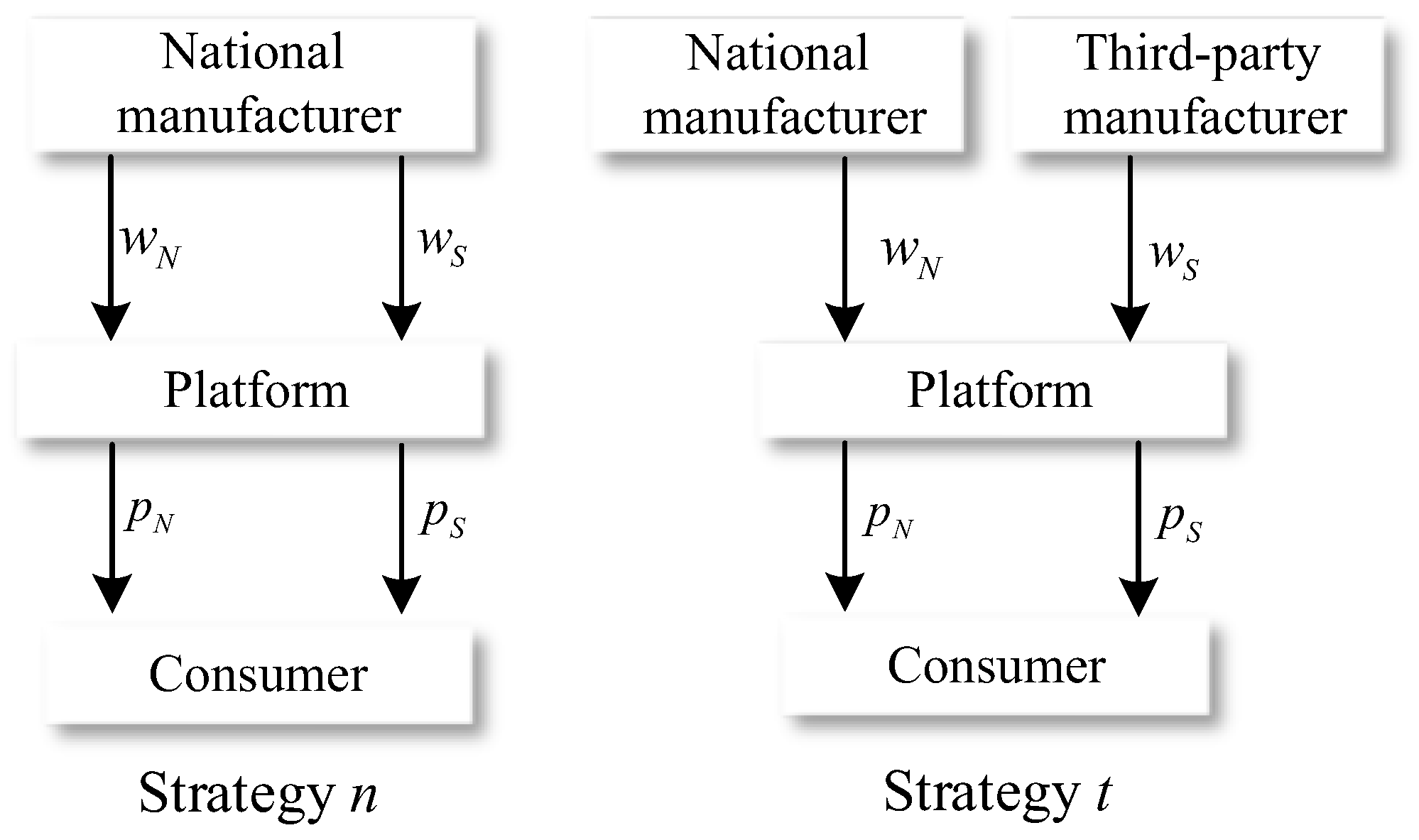
4]. This formulation captures two essential properties: (1) the national brand’s reputation confers a perceived quality enhancement on the store brand; (2) the store brand’s perceived quality remains strictly dominated regardless of the brand spillover effect. The channel structure is shown in
Figure 1.
Given the national brand’s established market presence, its quality level constitutes common knowledge among consumers and is normalized to be 1, i.e.,
. Conversely, the store brand’s quality—modeled as a random variable
—remains unobservable to consumers upon introduction. The platform, possessing private information about
prior to product launch, strategically decides whether to disclose this quality information. Let
denote consumers’ posterior quality perception, where
under disclosure and
under non-disclosure. Consistent with rational expectations literature [
34], the platform will disclose only when quality exceeds an endogenous threshold
where marginal disclosure benefits outweigh costs. Thus, if the platform does not disclose quality information, we have
. Additionally, information disclosure must be truthful—either the true quality is disclosed, or the platform remains silent [
40,
41]. Let
represents the platform’s disclosure strategy, where
denotes disclosure and
denotes non-disclosure. If the platform chooses to disclose, it incurs a fixed disclosure cost
. To ensure the platform has an incentive to disclose in equilibrium, assume
; otherwise, a sufficiently large disclosure cost will always inhibit the platform from disclosing quality information.
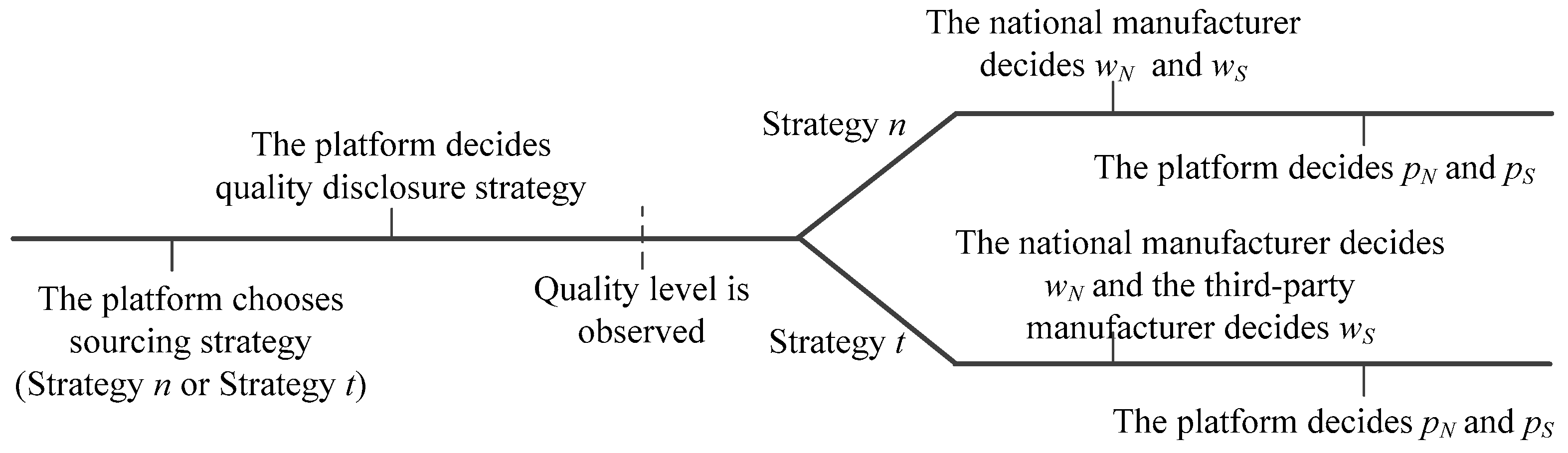
The sequence of the game is illustrated in
Figure 2. In Stage 1, following Li et al. [
20] and Cui et al. [
26], we assume that before observing the store brand’s quality information, the platform decides its sourcing strategy (i.e., Strategy
or Strategy
). In Stage 2, the platform decides whether to disclose the store brand’s quality information. In Stage 3, after observing the quality information, the platform and manufacturers determine optimal prices. Specifically, under Strategy
, the national manufacturer first sets wholesale prices
and
for both brands, followed by the platform sets retail prices
and
. Under Strategy
, the national manufacturer and the third-party manufacturer simultaneously set wholesale prices
and
, respectively, while the platform sets retail prices
and
.
Notably, this model assumes the platform decides its sourcing strategy before observing the quality level for the store brand. This is because sourcing is a relatively long-term decision; it can be changed occasionally, but manufacturers generally like contracts that span a year or longer. This is because they must allocate resources to meet the demands of producing the store brand. This assumption aligns with the literature on store brand sourcing [
4,
16,
19].
Table 2 summarizes the notations employed in this paper.
4. Model Analysis
4.1. Strategy
Under Strategy
, the platform sources the store brand from manufacturer
, and thus,
. Given the quality disclosure strategy, i.e.,
, the profit functions for the manufacturers and the platform are as follows:
By solving the firms’ problems, we derive Lemma 1.
Lemma 1. Under Strategy , given , the optimal wholesale prices are and , and the optimal retail prices are and . The equilibrium sales volumes are
and , respectively.
Lemma 1 establishes that an enhancement in consumers’ perceived quality of the store brand (i.e., a larger ) induces strictly increasing wholesale price responses from both manufacturers. Consequently, the platform optimally adjusts retail prices upward, demonstrating monotonicity in . Crucially, while elevated retail prices exert downward pressure on demand, this effect is dominated by the positive demand elasticity with respect to quality perception. Thus, equilibrium sales volumes for both brands maintain their monotonically increasing relationship with .
Proposition 1. Under Strategy
, there exists
such that:
- (1)
The platform will disclose the store brand’s quality information if and only if .
- (2)
and always hold.
Proposition 1(1) characterizes the platform’s optimal disclosure strategy under Strategy . Building on Lemma 1’s established monotonic relationship between platform profit and perceived quality, the platform adopts a threshold disclosure rule: quality information is revealed if and only if . This equilibrium strategy reflects rational economic calculus-disclosure of subthreshold quality levels would both depress demand and incur unnecessary disclosure costs , while supra-threshold disclosure generates net positive returns.
Proposition 1(2) identifies two critical determinants of the disclosure threshold : the fixed disclosure cost and the product substitutability . The comparative statics reveal: (i) The disclosure threshold increases monotonically with , as a higher cost erodes the net benefit of quality disclosure, consistent with observed corporate non-disclosure practices; (ii) The threshold decreases with , since greater substitutability attenuates inter-brand competition, thereby amplifying the marginal profit from quality disclosure.
4.2. Strategy n
Under Strategy
, the platform sources the store brand from manufacturer
, and thus,
. Again, given the disclosure strategy, i.e.,
, the profit functions are:
By solving the firms’ problems, we derive Lemma 1.
Lemma 2. Under Strategy , given , the optimal wholesale prices are and , and the optimal retail prices are and . The equilibrium sales volumes are
and , respectively.
Lemma 2 shows that under Strategy , the impact of on prices aligns with Strategy , i.e., , , , and are monotonically increasing in . Additionally, as the brand spillover effect strengthens (i.e., a larger ), manufacturer can charge higher wholesale prices, leading the platform to set higher retail prices as well. Again, the joint positive effects of and will dominate the negative effect of the increased retail prices, thus ensuring demand remains non-negatively affected (where is independent of and , while is monotonically increasing in both).
Proposition 2. Under Strategy, there exists
such that:
- (1)
The platform will disclose the store brand’s quality information if and only if .
- (2)
and always hold.
- (3)
if
and
; otherwise, we have
.
Similarly, Proposition 2 shows that under Strategy , the platform will only disclose quality information if the store brand’s quality exceeds a threshold (i.e., ). Otherwise, disclosing low-quality information would harm demand and incur the disclosure cost. Additionally, a higher disclosure cost discourages disclosure, while a greater substitutability encourages it.
Interestingly, Proposition 2(3) reveals that while a stronger spillover effect boosts the platform’s profit, it does not always incentivize disclosure. Specifically, when both the brand spillover effect and the disclosure cost are below certain thresholds (i.e., and ), an increase in encourages disclosure (i.e., ). Conversely, beyond these thresholds, a higher discourages disclosure. This is because while the brand spillover effect elevates the store brand’s perceived quality, it narrows the quality gap between disclosure and non-disclosure scenarios. When approaches 1, the quality levels under both strategies converge, making disclosure less beneficial relative to its cost. Thus, under certain conditions, is monotonically increasing in .
5. Results and Managerial Insights
Based on the pricing and quality disclosure decisions of the platform under the two sourcing strategies,
Section 5.1 firstly analyzes the differences in quality disclosure strategies between the two sourcing strategies.
Section 5.2 then examines the platform’s optimal sourcing strategy and the influence of parameters such as the brand spillover effect and the fixed disclosure cost on this strategy.
5.1. Quality Disclosure Strategies Comparison
By comparing the quality disclosure thresholds as presented in Propositions 1 and 2, we can identify the differences in the platform’s disclosure strategies under the two sourcing strategies, as well as whether parameters like the brand spillover effect and the disclosure cost influence these differences.
Proposition 3. Comparing the disclosure thresholds under Strategy and Strategy , we find that when
,
, and
, we have
; otherwise, we have
.
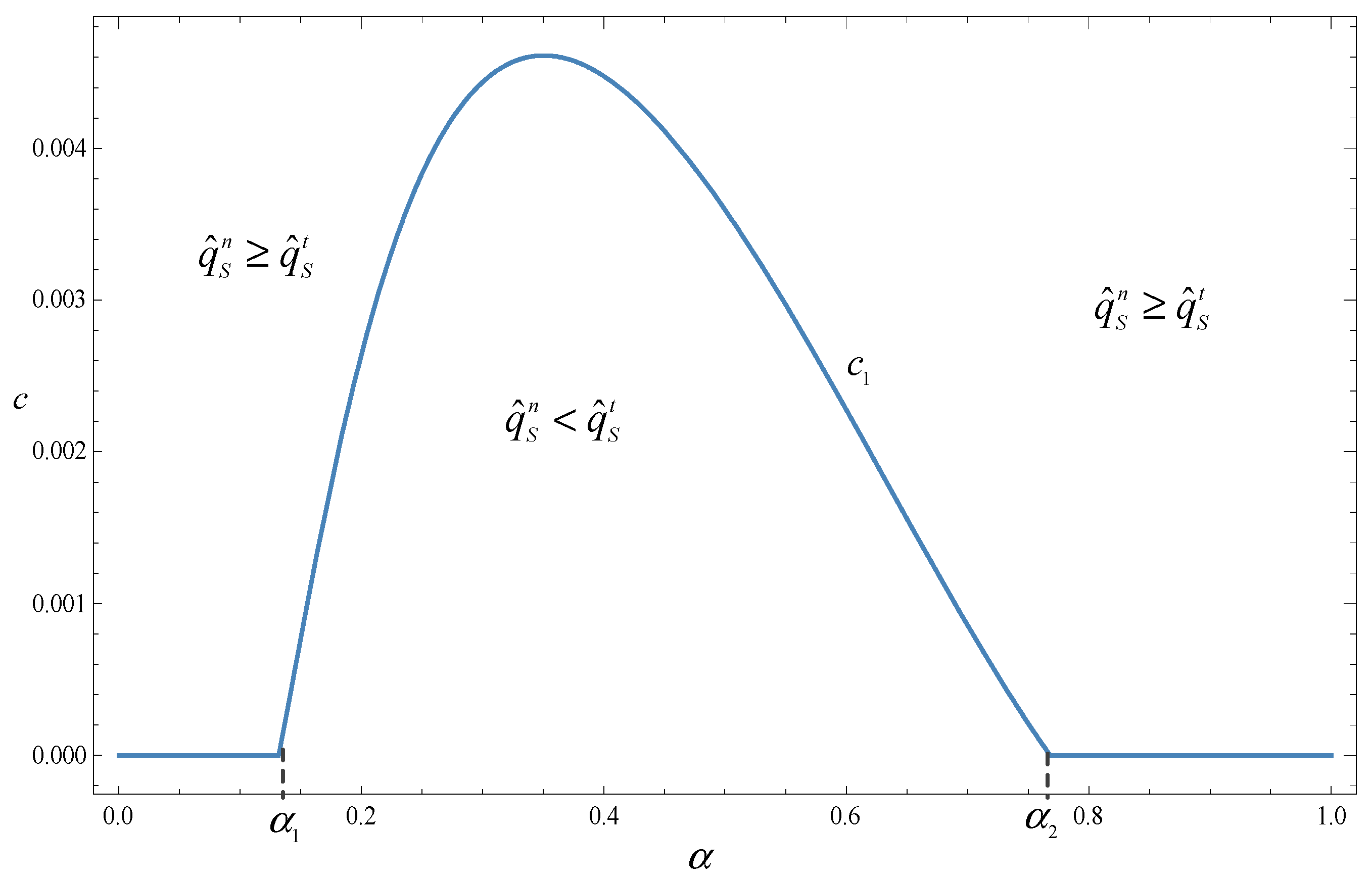
Proposition 3 and
Figure 3 reveal that, compared to Strategy
, an increase Strategy
, in the brand spillover effect does not always incentivize the platform to disclose the store brand’s quality information when sourcing from a national manufacturer. Specifically, when the substitutability between the two brands is low and the disclosure cost is below a certain threshold, either an excessively weak or excessively strong brand spillover effect will discourage quality disclosure under Strategy
, leading to
. Conversely, a moderate brand spillover effect encourages disclosure. Recall from Proposition 2(3), the disclosure threshold under Strategy
first decreases and then increases with
, which explains this result.
The findings of Proposition 3 offer important managerial insights for the platform’s quality disclosure decision. Although sourcing from a national manufacturer enhances profits through the brand spillover effect, it does not always incentivize quality disclosure. Therefore, when deciding whether to disclose quality information, the platform must consider the interplay of product substitutability, the brand spillover effect, and the disclosure cost.
5.2. The Optimal Sourcing Strategy
Based on the above results, the platform’s expected profits under the two sourcing strategies can be calculated as:
Proposition 4. Under Strategy , we have
always hold;
if
and
otherwise. Under Strategy
, we have
if
and
otherwise.
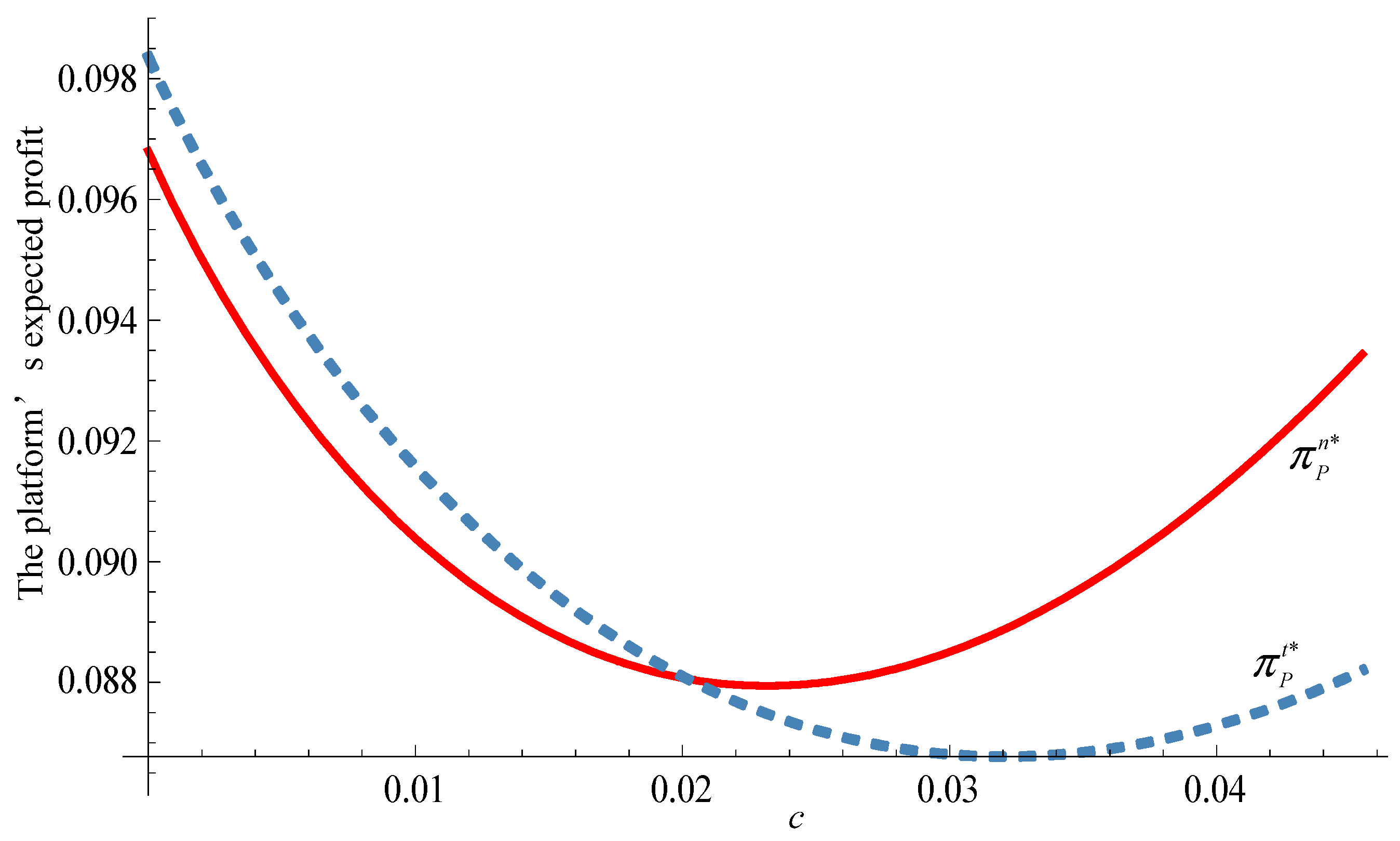
Intuitively, the platform’s expected profit decreases as the disclosure cost rises. However, Proposition 4 shows that once the disclosure cost exceeds a certain threshold, further increases may benefit the platform. This is because a higher disclosure cost reduces the platform’s willingness to disclose (i.e.,
and
hold), which mitigates the negative impact of the disclosure cost on the expected profit. Thus, the platform’s expected profit may increase with
.
Figure 4 illustrates that higher disclosure costs may paradoxically enhance the platform’s profitability.
Proposition 5. Given , always holds.
Proposition 5 indicates that in the absence of brand spillover effects, the platform prefers sourcing from a third-party manufacturer. Without the brand spillover effect, Strategy offers no additional benefits. Moreover, the third-party manufacturer intensifies upstream competition, driving down wholesale prices and benefiting the platform. Thus, when , the platform consistently prefers Strategy .
Proposition 6. When the brand spillover effect exists (i.e., ), the platform is incentivized to source from a national manufacturer.
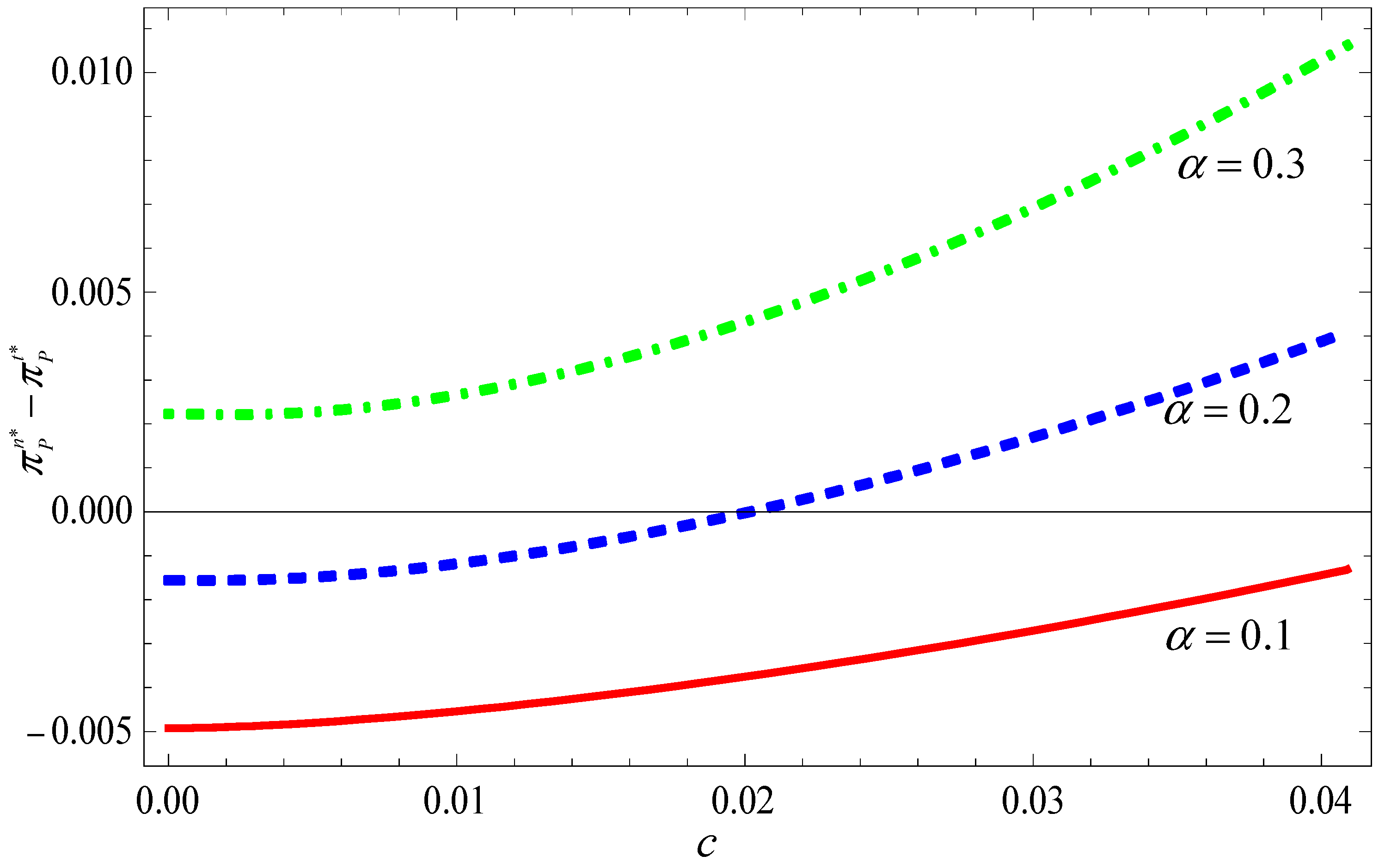
As shown in
Figure 5, the platform’s sourcing strategy depends on the magnitude of the brand spillover effect and the disclosure cost. Specifically, for the weak spillover effect, the platform prefers third-party procurement, as upstream competition suppresses wholesale prices, boosting profits. In contrast, with the strong brand spillover effect, the platform favors sourcing from a national manufacturer, where spillover-driven profit gains dominate the decision. Interestingly, with the moderate brand spillover effect, the high (low) disclosure cost incentivizes sourcing from a national (third-party) manufacturer. Here, the positive brand spillover effect offsets the disclosure cost, but when this cost exceeds a threshold, the brand spillover advantages become decisive.
These findings provide practical guidance for the platform’s procurement strategy. While the brand spillover effect enhances profits, the platform must weigh its value against the disclosure cost when selecting a procurement approach.
6. Conclusions
This study investigates the strategic interplay between quality disclosure and sourcing strategies for the platform, introducing store brands to compete with national brands. The analytical framework examines a dual-sourcing scenario where (1) the national brand is exclusively sourced from the national manufacturer, while (2) the store brand can be sourced either from the national manufacturer (enabling the brand spillover effect) or a specialized third-party manufacturer. Key model assumptions reflect fundamental market asymmetries: the national brand’s quality is common knowledge due to its market maturity, whereas the store brand’s quality remains ex ante unobservable to consumers as a market entrant. The platform strategically determines quality disclosure to resolve this information asymmetry and facilitate consumer decision-making. Through systematic comparison of expected profit functions under alternative strategy combinations, we derive equilibrium solutions for both sourcing and disclosure decisions.
Our analysis highlights several novel findings. First, regarding the strategy of quality information disclosure, our research reveals that the platform has an incentive to disclose this information if the store brand’s quality level exceeds a certain threshold; otherwise, disclosure is not profitable. Second, the platform’s sourcing strategy is heavily influenced by the brand spillover effect and the disclosure cost. Specifically, when the brand spillover effect is relatively large (small), the platform prefers to source the store brand from the national (third-party) manufacturer. Additionally, with a moderate brand spillover effect, a higher (lower) disclosure cost encourages the platform to source from the national (third-party) manufacturer.
6.1. Theoretical Implications
Our study contributes to the existing literature on quality disclosure and store brand sourcing in several important ways. First, this study extends the research on quality information disclosure strategies for store brands. We show that, compared with Strategy t, an increase in the brand spillover effect does not always motivate the platform to disclose quality information when sourcing from a national manufacturer. Specifically, when the substitutability between the two brands is low and the disclosure cost is below a certain threshold, either an excessively weak or an excessively strong brand spillover effect discourages quality disclosure under Strategy n. Conversely, a moderate brand spillover effect encourages disclosure.
Second, this study enriches the literature on store brand sourcing decisions. We find that there is no one-size-fits-all approach to store brand sourcing; instead, this decision depends on several key factors. Specifically, when the brand spillover effect is relatively large (small), the platform prefers to source the store brand from the national (third-party) manufacturer. When the brand spillover effect is moderate, a higher (lower) disclosure cost encourages the platform to source from the national (third-party) manufacturer.
6.2. Managerial Implications
These findings provide important managerial insights for retail practitioners concerning quality disclosure and sourcing strategies of the store brand. First, the platform must carefully balance the benefits and drawbacks of disclosing the store brand’s quality information. While disclosing high-quality information can enhance the reputation of the store brand and help consumers make more informed purchasing decisions, it may also intensify competition between the store brand and the national brand, thereby reducing the platform’s profitability. Moreover, the brand spillover effect resulting from sourcing from the national manufacturer influences consumers’ quality expectations, which in turn affects both the platform’s expected profit and its preference for quality disclosure. Therefore, when determining the quality disclosure strategy, platforms must weigh the trade-offs between the advantages and disadvantages while also considering their sourcing strategies.
Second, our results shed light on the underlying factors driving the variation in sourcing strategies, namely, why some store brands are sourced from national manufacturers while others are sourced from third-party manufacturers. This critical decision is influenced by parameters such as the brand spillover effect and the disclosure cost. Hence, platforms should carefully take these factors into account when formulating their sourcing strategies.
6.3. Limitations and Suggestions for Future Research
Several promising extensions merit future investigation. First, for analytical tractability, we normalize the production costs of both brands to zero. Future research could extend the model by incorporating differentiated production costs for the two brands. Second, while our analysis focuses on quality uncertainty, introducing demand uncertainty would represent another valuable research direction. Exploring how both types of uncertainty interact could further enhance the understanding of supply chain decisions under imperfect information. Finally, considering quality level as an endogenous decision variable can enrich our study. These extensions would further bridge the gap between theoretical modeling and practical implementation.