Eccentricity Fault Diagnosis System in Three-Phase Permanent Magnet Synchronous Motor (PMSM) Based on the Deep Learning Approach

 , , , , and
Abstract
1. Introduction
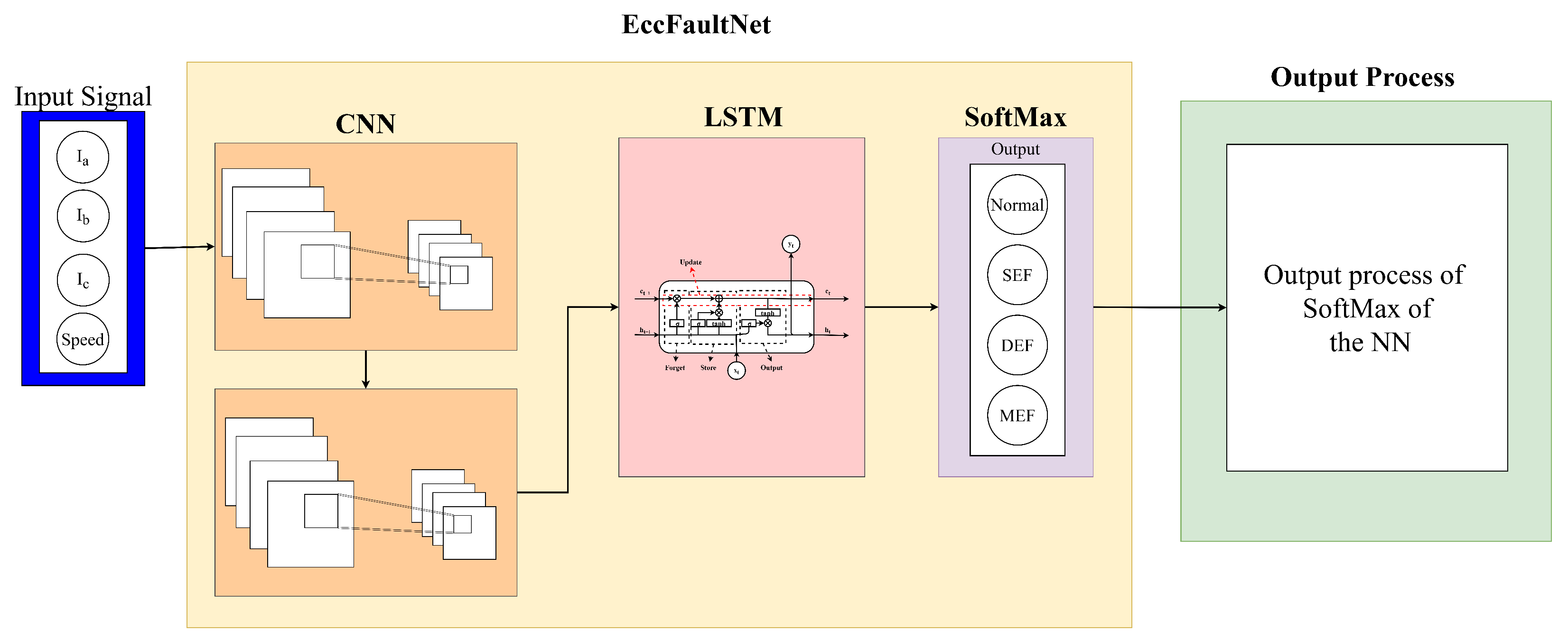
- Eccentricity Fault Diagnosis Network (E-FDNet): A framework (CNN–LSTM Network) that stabilizes transition predictions and resolves class ambiguity among SEF/DEF/MEF.
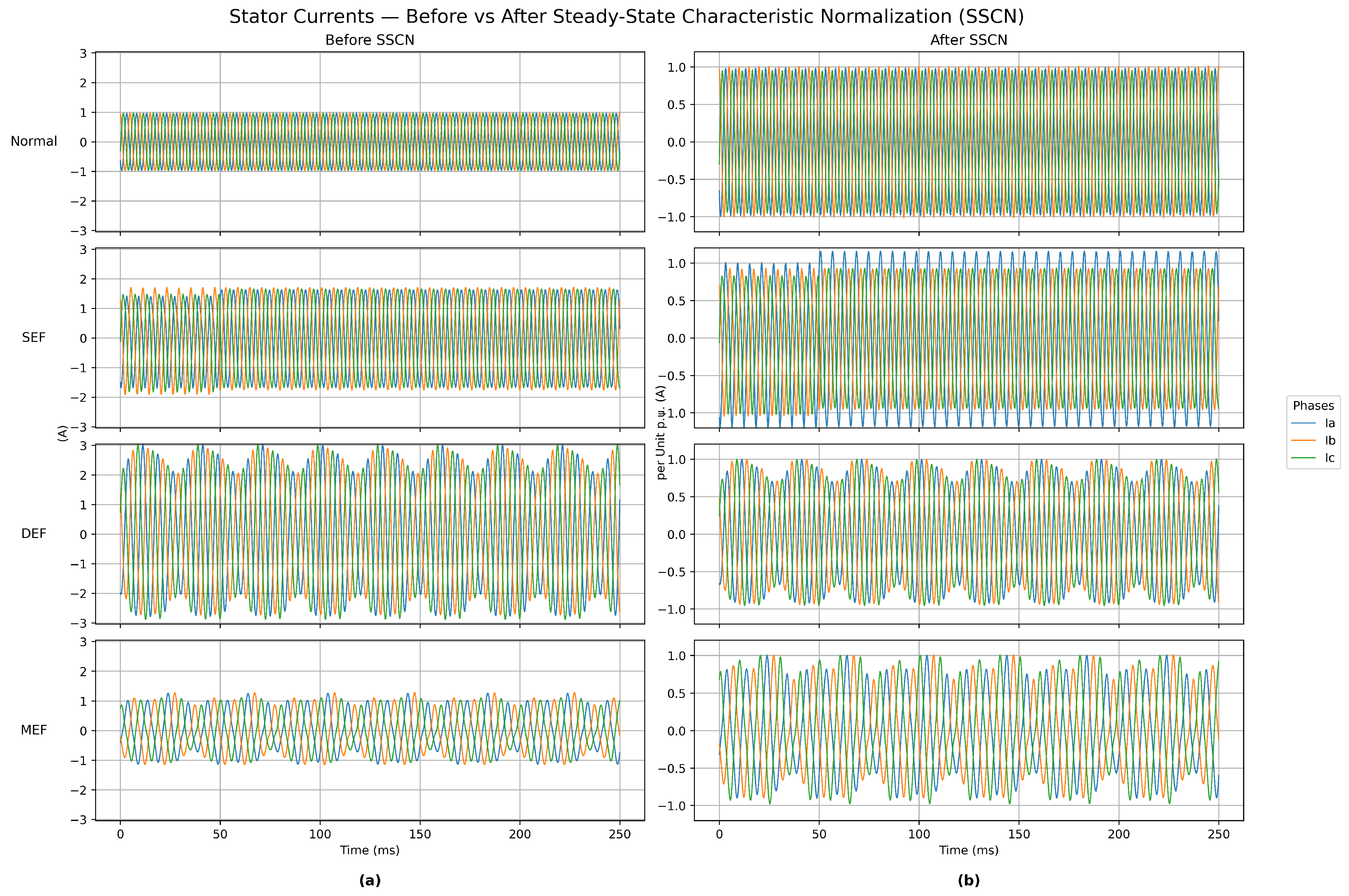
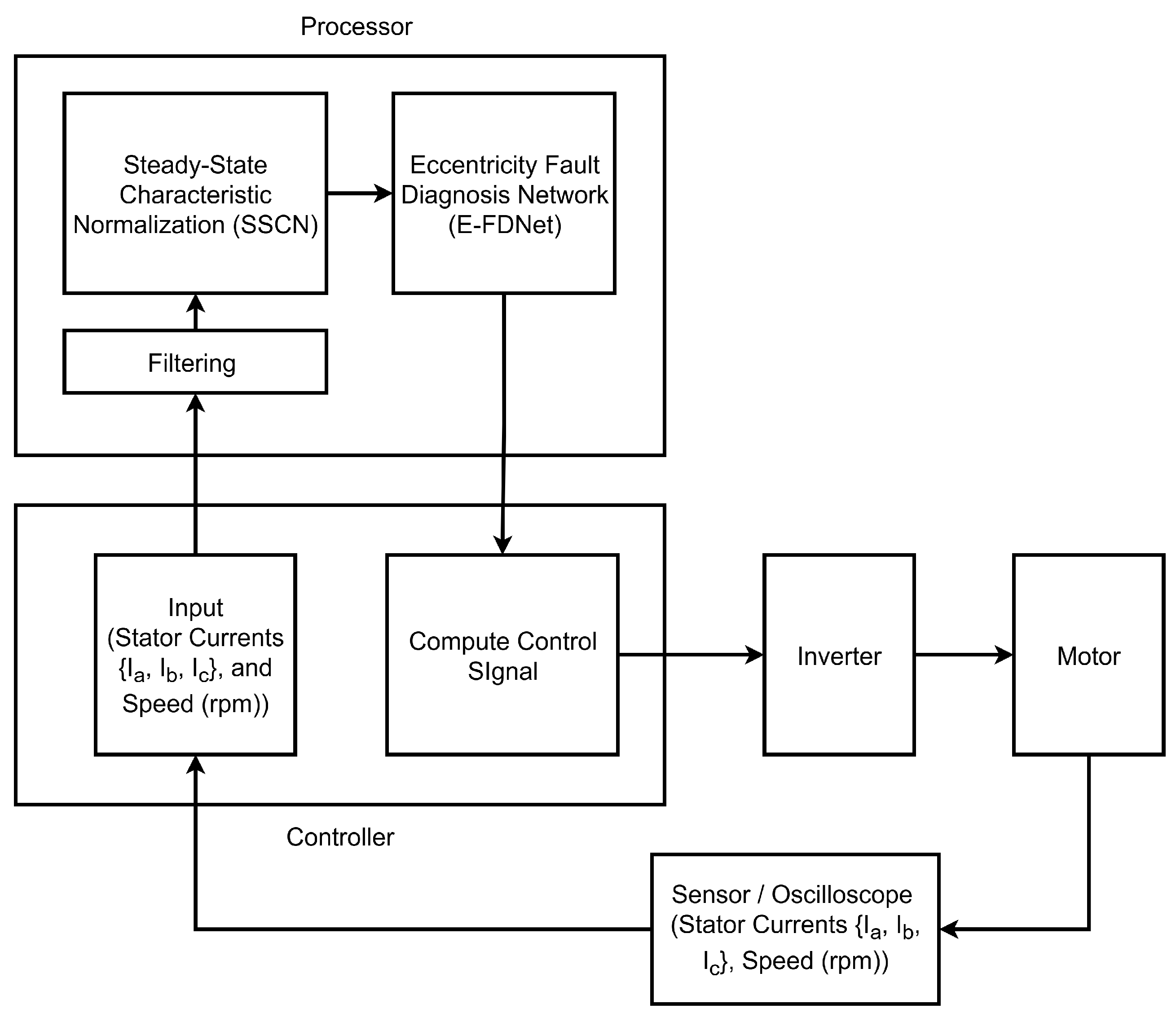
- Steady-State Characteristic Normalization (SSCN): An automatic scheme that finds steady-state segments and scales by a characteristic amplitude, improving feature consistency under dynamic responses and reducing training instability.
- Physics–simulation–experiment pipeline: A physics-based PMSM eccentricity model and FEM setup integrated with hardware-acquired normal data, enabling controlled analysis and validation of SEF, DEF, and MEF.
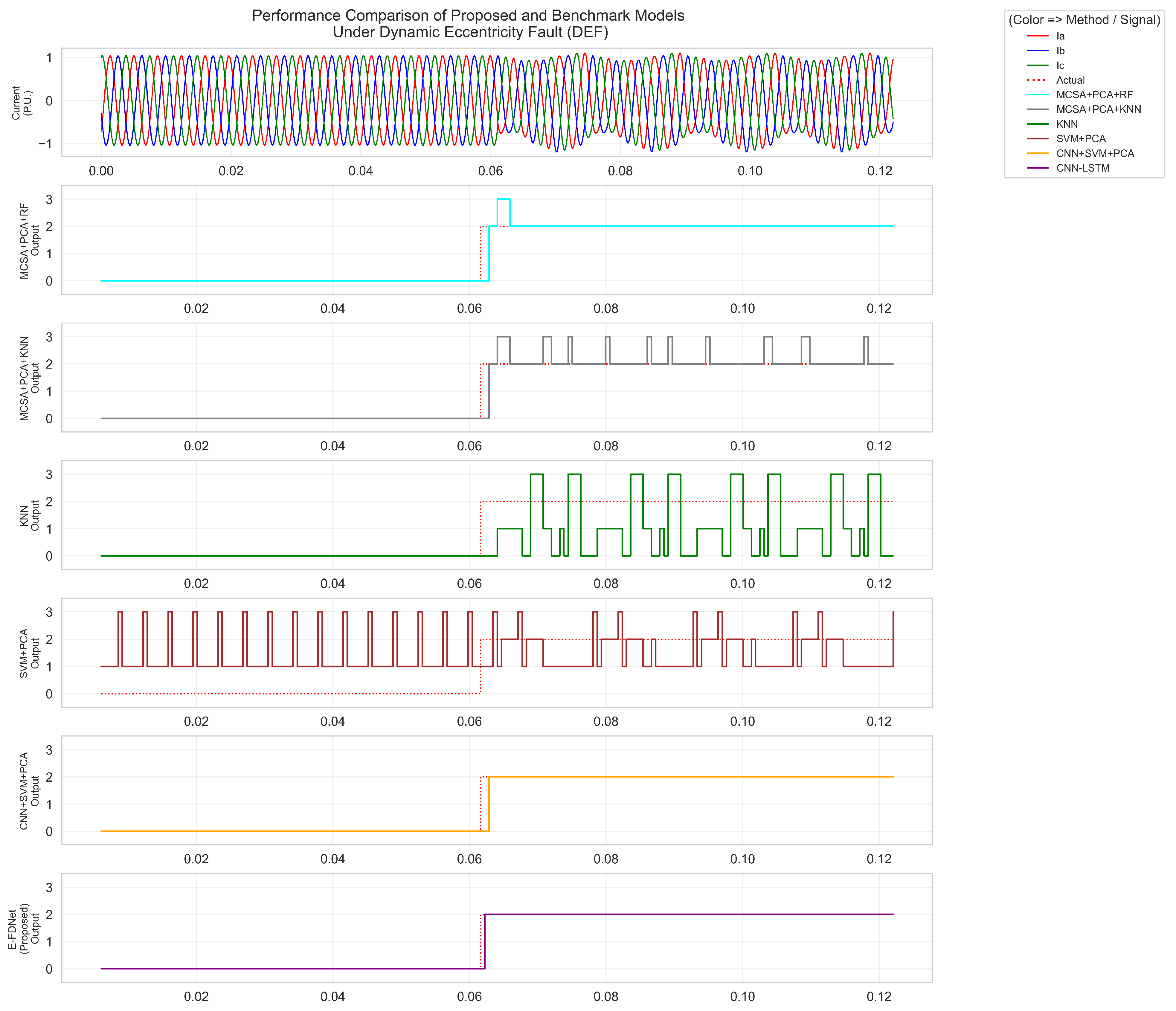
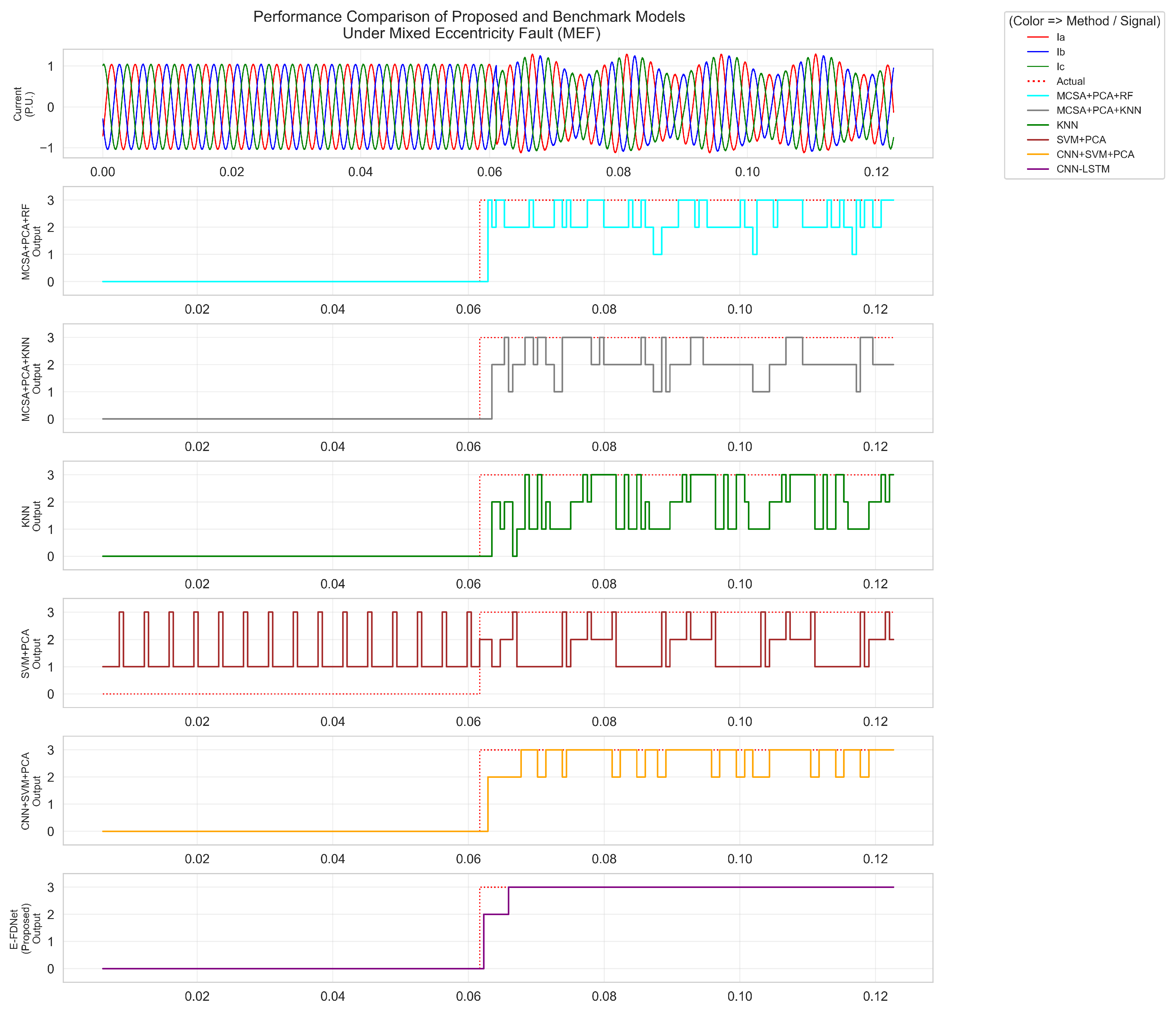
- End-to-end performance gains: Within one E-FDNet pipeline, the CNN–LSTM backbone attains ≈98% accuracy and ≈98% F1 with short detection latency (about 1–3 ms)
- Non-invasive, current-only sensing: Relies solely on stator current, avoiding extra sensors and supporting practical industrial deployment.
2. Mathematical Characteristics of Motor Eccentricity
2.1. Static Eccentricity (SEF)
2.2. Dynamic Eccentricity (DEF)
2.3. Mixed Eccentricity (MEF)
3. Methodology
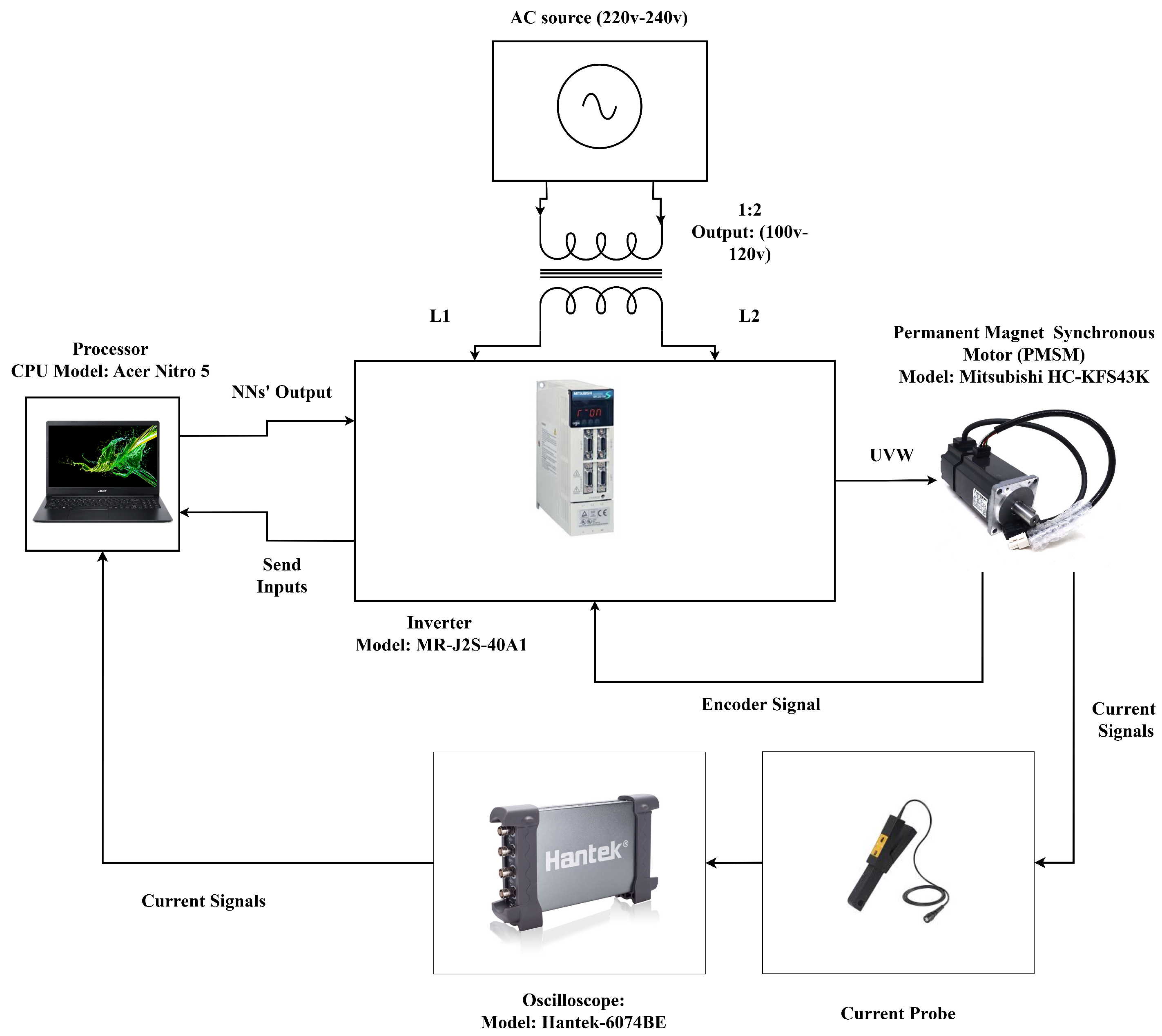
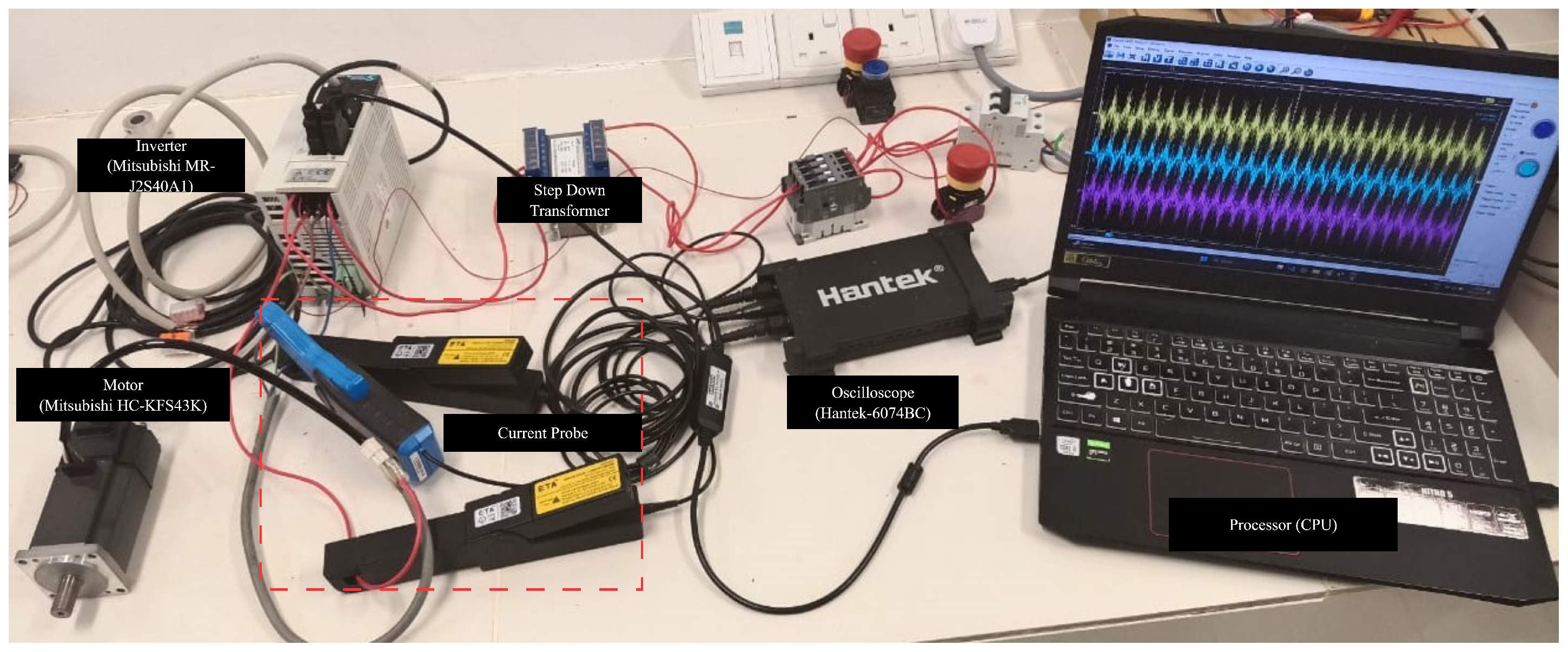
3.1. Experimental Setup
3.2. Data Preprocessing and Labelling
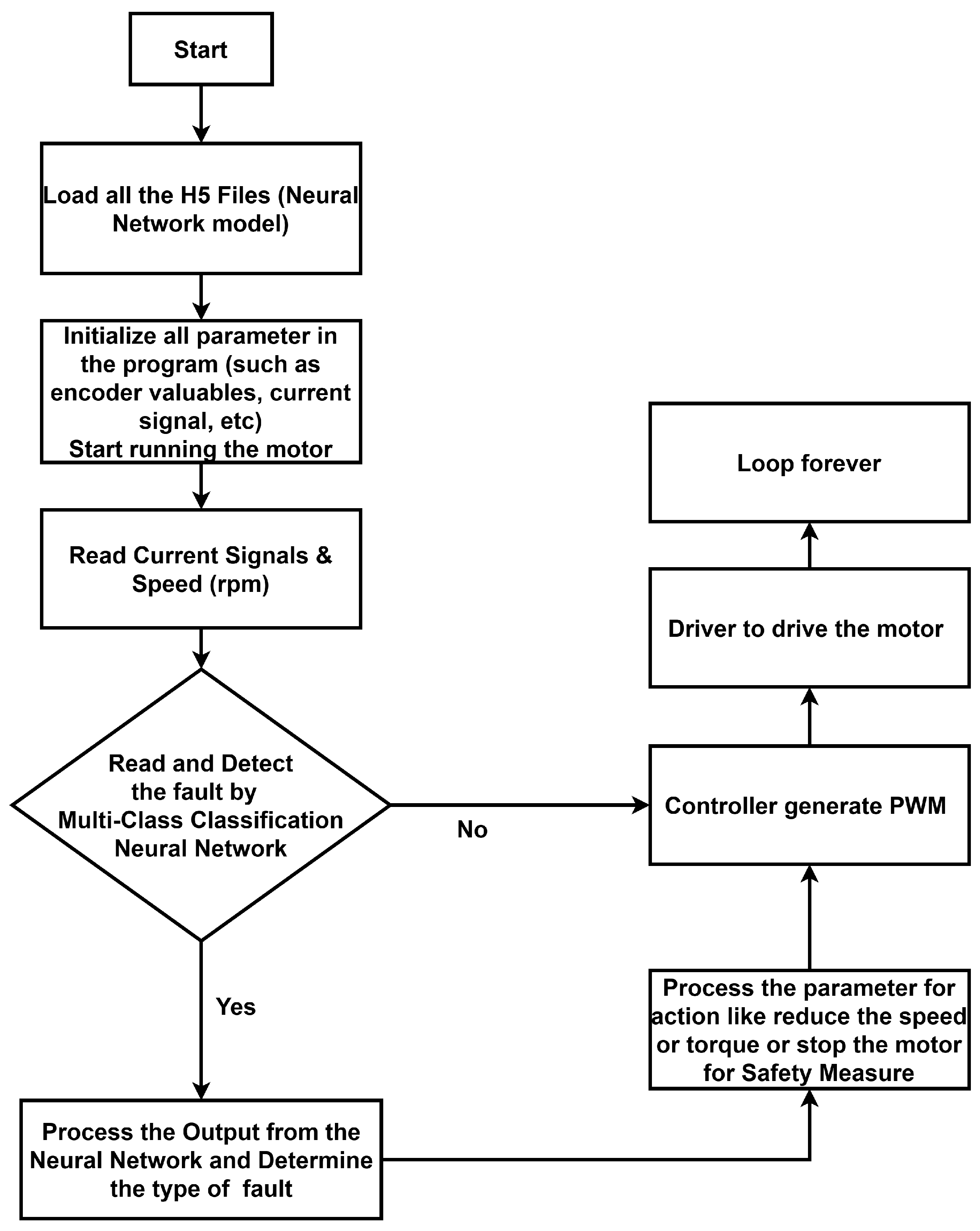
3.3. Structure of the Eccentricity Fault Diagnosis Network (E-FDNet)
4. Result & Discussion
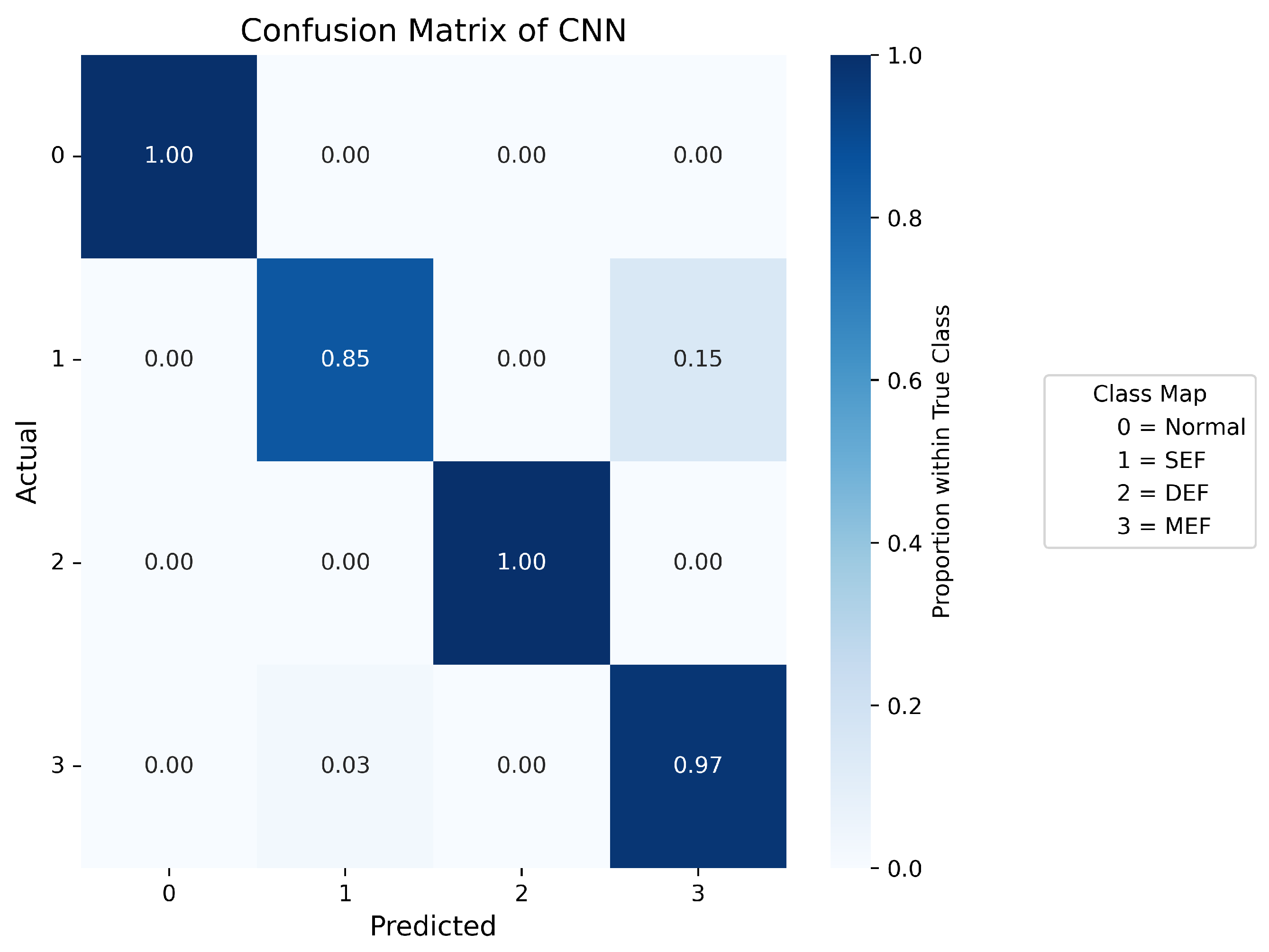
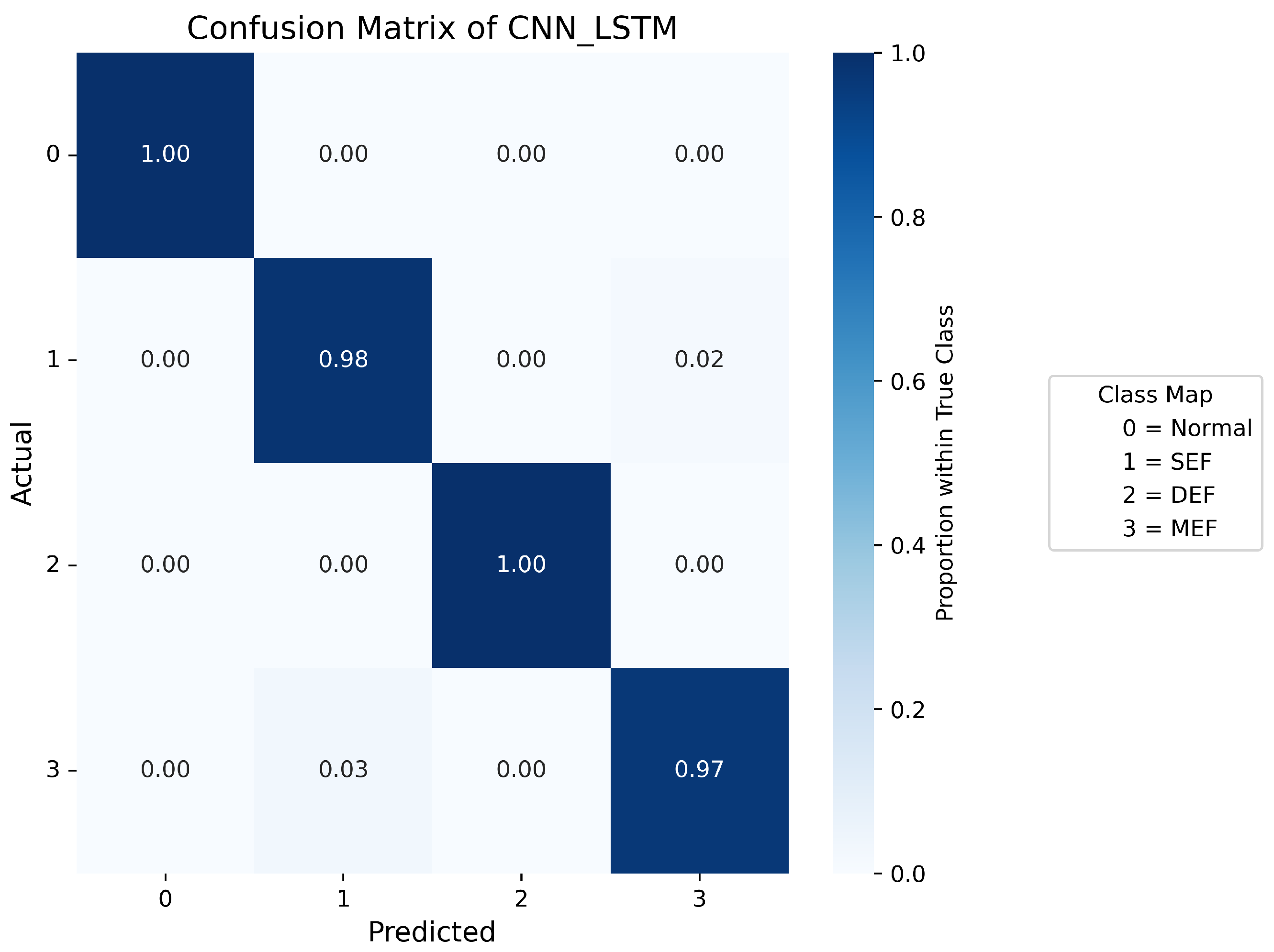
4.1. Evaluation of Performance Under Different Types of Neural Networks
4.2. Performance Evaluation Under Different Hyperparameter Configurations
4.3. Performance Evaluation of the Proposed Motor Eccentricity Fault Diagnosis System Under Various Conditions
4.4. Response of the Proposed Motor Eccentricity Fault Diagnosis System
5. Conclusions
Author Contributions
Funding
Institutional Review Board Statement
Informed Consent Statement
Data Availability Statement
Conflicts of Interest
References
- Aggarwal, A.; Allafi, I.M.; Strangas, E.G.; Agapiou, J.S. Off-Line Detection of Static Eccentricity of PMSM Robust to Machine Operating Temperature and Rotor Position Misalignment Using Incremental Inductance Approach. IEEE Trans. Transp. Electrif. 2021, 7, 161–169. [Google Scholar] [CrossRef]
- Im, J.H.; Kang, J.K.; Hur, J. Static and Dynamic Eccentricity Faults Diagnosis in PM Synchronous Motor Using Planar Search Coil. IEEE Trans. Ind. Electron. 2023, 70, 9291–9300. [Google Scholar] [CrossRef]
- Pal, R.S.C.; Mohanty, A.R. A Simplified Dynamical Model of Mixed Eccentricity Fault in a Three-Phase Induction Motor. IEEE Trans. Ind. Electron. 2021, 68, 4341–4350. [Google Scholar] [CrossRef]
- Niu, G.; Dong, X.; Chen, Y. Motor Fault Diagnostics Based on Current Signatures: A Review. IEEE Trans. Instrum. Meas. 2023, 72, 1–19. [Google Scholar] [CrossRef]
- Ebrahimi, B.M.; Javan Roshtkhari, M.; Faiz, J.; Khatami, S.V. Advanced Eccentricity Fault Recognition in Permanent Magnet Synchronous Motors Using Stator Current Signature Analysis. IEEE Trans. Ind. Electron. 2014, 61, 2041–2052. [Google Scholar] [CrossRef]
- Wang, B.; Lin, C.; Inoue, H.; Kanemaru, M. Induction Motor Eccentricity Fault Detection and Quantification Using Topological Data Analysis. IEEE Access 2024, 12, 37891–37902. [Google Scholar] [CrossRef]
- Kolb, J.; Hameyer, K. Classification of Tolerances in Permanent Magnet Synchronous Machines With Machine Learning. IEEE Trans. Energy Convers. 2024, 39, 831–838. [Google Scholar] [CrossRef]
- Nunes, Y.T.P.; Guedes, L.A. Concept Drift Detection Based on Typicality and Eccentricity. IEEE Access 2024, 12, 13795–13808. [Google Scholar] [CrossRef]
- Zhou, S.; Ma, C.; Wang, Y.; Wang, D.; He, Y.L.; Bu, F.; Wang, M. A New Data-Driven Diagnosis Method for Mixed Eccentricity in External Rotor Permanent Magnet Motors. IEEE Trans. Ind. Electron. 2023, 70, 11659–11669. [Google Scholar] [CrossRef]
- Sun, M.; Wang, H.; Liu, P.; Long, Z.; Yang, J.; Huang, S. A Novel Data-Driven Mechanical Fault Diagnosis Method for Induction Motors Using Stator Current Signals. IEEE Trans. Transp. Electrif. 2023, 9, 347–358. [Google Scholar] [CrossRef]
- Wang, H.; Sun, W.; Jiang, D.; Liu, Z.; Qu, R. Rotor Eccentricity Quantitative Characterization Based on Physics-Informed Adversarial Network and Health Condition Data Only. IEEE Trans. Ind. Electron. 2024, 71, 6738–6752. [Google Scholar] [CrossRef]
- Sun, W.; Wang, H.; Qu, R. A Novel Data Generation and Quantitative Characterization Method of Motor Static Eccentricity with Adversarial Network. IEEE Trans. Power Electron. 2023, 38, 8027–8032. [Google Scholar] [CrossRef]
- Liu, X.; Hong, J.; Zhao, K.; Sun, B.; Zhang, W.; Jiang, J. Vibration Analysis for Fault Diagnosis in Induction Motors Using One-Dimensional Dilated Convolutional Neural Networks. Machines 2023, 11, 1061. [Google Scholar] [CrossRef]
- Mian, T.; Choudhary, A.; Fatima, S. Multi-Sensor Fault Diagnosis for Misalignment and Unbalance Detection Using Machine Learning. IEEE Trans. Ind. Appl. 2023, 59, 5749–5759. [Google Scholar] [CrossRef]
- Song, J.; Wu, X.; Qian, L.; Lv, W.; Wang, X.; Lu, S. PMSLM Eccentricity Fault Diagnosis Based on Deep Feature Fusion of Stray Magnetic Field Signals. IEEE Trans. Instrum. Meas. 2024, 73, 1–12. [Google Scholar] [CrossRef]
- Zafarani, M.; Goktas, T.; Akin, B.; Fedigan, S.E. Modeling and Dynamic Behavior Analysis of Magnet Defect Signatures in Permanent Magnet Synchronous Motors. IEEE Trans. Ind. Appl. 2016, 52, 3753–3762. [Google Scholar] [CrossRef]
- Electric, M. HC-KFS43 AC Servo Motor; Product Page; Mitsubishi Electric US: Cypress, CA, USA, 2005. [Google Scholar]
- Wang, B.; Inoue, H.; Kanemaru, M. Motor Eccentricity Fault Detection: Physics-Based and Data-Driven Approaches. In Proceedings of the 2023 IEEE 14th International Symposium on Diagnostics for Electrical Machines, Power Electronics and Drives (SDEMPED), Chania, Greece, 28–31 August 2023; IEEE: New York, NY, USA, 2023; pp. 42–48. [Google Scholar] [CrossRef]
- Goktas, T.; Zafarani, M.; Akin, B. Discernment of Broken Magnet and Static Eccentricity Faults in Permanent Magnet Synchronous Motors. IEEE Trans. Energy Convers. 2016, 31, 578–587. [Google Scholar] [CrossRef]
- Kang, K.; Song, J.; Kang, C.; Sung, S.; Jang, G. Real-Time Detection of the Dynamic Eccentricity in Permanent-Magnet Synchronous Motors by Monitoring Speed and Back EMF Induced in an Additional Winding. IEEE Trans. Ind. Electron. 2017, 64, 7191–7200. [Google Scholar] [CrossRef]
- Zhu, X.; Cheng, Y.; Wu, J.; Hu, R.; Cui, X. Steady-State Process Fault Detection for Liquid Rocket Engines Based on Convolutional Auto-Encoder and One-Class Support Vector Machine. IEEE Access 2020, 8, 3144–3158. [Google Scholar] [CrossRef]
- Lv, H.; Chen, J.; Wang, J.; Yuan, J.; Liu, Z. A Supervised Framework for Recognition of Liquid Rocket Engine Health State Under Steady-State Process Without Fault Samples. IEEE Trans. Instrum. Meas. 2021, 70, 1–10. [Google Scholar] [CrossRef]
- Sun, X.; Song, C.; Zhang, Y.; Sha, X.; Diao, N. An Open-Circuit Fault Diagnosis Algorithm Based on Signal Normalization Preprocessing for Motor Drive Inverter. IEEE Trans. Instrum. Meas. 2023, 72, 1–12. [Google Scholar] [CrossRef]
- Huang, Y.; Zhu, F.; Jia, G.; Zhang, Y. A Slide Window Variational Adaptive Kalman Filter. IEEE Trans. Circuits Syst. II Express Briefs 2020, 67, 3552–3556. [Google Scholar] [CrossRef]
- Fu, Y.; Zhou, C.; Huang, T.; Han, E.; He, Y.; Jiao, H. SoftAct: A High-Precision Softmax Architecture for Transformers Supporting Nonlinear Functions. IEEE Trans. Circuits Syst. Video Technol. 2024, 34, 8912–8923. [Google Scholar] [CrossRef]
- Aggarwal, C.C. Neural Networks and Deep Learning; Springer International Publishing AG: Cham, Switzerland, 2018. [Google Scholar]
- Chollet, F. Deep Learning with Python, Third Edition, 1st ed.; Manning Publications Co. LLC: New York, NY, USA, 2025. [Google Scholar]
- Zhang, Y.; Zhang, Y.; Peng, L.; Quan, L.; Zheng, S.; Lu, Z.; Chen, H. Base-2 Softmax Function: Suitability for Training and Efficient Hardware Implementation. IEEE Trans. Circuits Syst. I Regul. Pap. 2022, 69, 3605–3618. [Google Scholar] [CrossRef]
- Mei, Z.; Dong, H.; Wang, Y.; Pan, H. TEA-S: A Tiny and Efficient Architecture for PLAC-Based Softmax in Transformers. IEEE Trans. Circuits Syst. II Express Briefs 2023, 70, 3594–3598. [Google Scholar] [CrossRef]
- Trask, A.W. Grokking Deep Learning; Manning Publications Co. LLC: New York, NY, USA, 2019. [Google Scholar]
- Géron, A. Hands-on Machine Learning with Scikit-Learn, Keras, and TensorFlow, 3rd ed.; Data Science/Machine Learning; O’Reilly: Beijing, China, 2023. [Google Scholar]
- Salman, T.; Ghubaish, A.; Unal, D.; Jain, R. Safety Score as an Evaluation Metric for Machine Learning Models of Security Applications. IEEE Netw. Lett. 2020, 2, 207–211. [Google Scholar] [CrossRef]
- Liu, Z.; Zhang, P.; He, S.; Huang, J. A Review of Modeling and Diagnostic Techniques for Eccentricity Fault in Electric Machines. Energies 2021, 14, 4296. [Google Scholar] [CrossRef]



| Variable (Unit) | Value |
|---|---|
| Input AC Voltage (V) | 100–120 |
| Rated Current (A) | 2.3 |
| Maximum Current (A) | 6.9 |
| Rated Power (kW) | 0.4 |
| Rated Speed (rpm) | 3000 |
| Maximum Speed (rpm) | 4500 |
| No. of Poles Pairs | 4 |
| Moment of Inertia (kg.cm2) | 0.46 |
| Rated Torque (Nm) | 1.3 |
| Maximum Torque (Nm) | 3.8 |
| Condition | Type of Data | Labeling | ||
|---|---|---|---|---|
| Experimental Data | Simulation Data (PMM) | Simulation Data (FEM) | State (Class) | |
| Normal | Yes | Yes | Yes | 0 |
| Static Eccentricity Fault (SEF) | No | Yes | Yes | 1 |
| Dynamic Eccentricity Fault (DEF) | No | Yes | Yes | 2 |
| Mixed Eccentricity Fault (MEF) | No | Yes | Yes | 3 |
| Component | Parameter | Value/Type |
|---|---|---|
| General | Motor type | 3-phase PMSM (Servo) |
| Rated power | 0.4 kW | |
| Rated speed | 3000 rpm | |
| Rated torque | 1.3 N·m | |
| Number of poles | 8 (4 pole pairs) | |
| Stator | Outer diameter | 80 mm (approx.) |
| Bore diameter | 40.6 mm | |
| Slots | 12 | |
| Winding type | Copper, 3-phase, star (Y) | |
| Turns per coil | 22–28 | |
| Slot fill factor | 0.40 | |
| Rotor | Topology | IPM–spoke type |
| Magnet type | XG196/96 (NdFeB) | |
| Magnet thickness | 2.5–3.0 mm | |
| Magnet arc coverage | ∼0.8 pole pitch | |
| Rotor outer diameter | 40.0 mm | |
| Rotor back-iron | 4.0 mm | |
| Shaft diameter | 11 mm | |
| Air-gap | Radial length | 0.3 mm |
| Layer | CNN1D | CNN-LSTM (Proposed) | DNN |
| I | Conv1D(64, 7, ReLu) | Conv1D(32, 5, ReLu) | Flatten |
| II | MaxPooling1D(2) | MaxPooling1D(2) | Dense(512, Relu) |
| III | Conv1D(128, 5, ReLu) | Conv1D(64, 5, ReLu) | Dropout(0.3) |
| IV | GlobalAveragePooling1D | MaxPooling1D(2) | Dense(256, Relu) |
| V | Dropout(0.3) | LSTM(64, tanh) | Dropout(0.3) |
| VI | Dense(128, ReLu) | Dropout(0.3) | Dense(128, Relu) |
| VII | Dense(4, SoftMax) | Dense(64, ReLu) | DropOut(0.2) |
| VIII | - | Dense(4, SoftMax) | Dense(4, SoftMax) |
| Layer | TCN | Transformer | |
| I | Conv1D(64, 5, ReLu) | Dense(64) | |
| II | Dropout(0.2) | PositionalEncoding(200, 64) | |
| III | Residual Add() | MultiHeadAttention(200, 64) | |
| IV | Conv1D(64, 5, ReLu) | Residual Add() | |
| V | Dropout(0.2) | LayerNormalization() | |
| VI | Residual Add() | Dense(128, ReLu) | |
| VII | Conv1D(64, 5, ReLu) | Dropout(0.1) | |
| VIII | Dropout(0.2) | Dense(64) | |
| IX | Residual Add() | Residual Add() | |
| X | GlobalAveragePooling1D() | LayerNormalization() | |
| XI | Dense(64, ReLu) | Repeat Layers | |
| III to X | |||
| XII | Dropout(0.3) | GlobalAveragePooling1D() | |
| XIII | Dense(4, SoftMax) | Dropout(0.3) | |
| XIV | - | Dense(128, Relu) | |
| XV | - | Dense(4, SoftMax) |
| Neural Networks’ Types | Accuracy in Each Label (%) | F1 Score (%) | |||
|---|---|---|---|---|---|
| 0 | 1 | 2 | 3 | ||
| CNN | 100 | 89.05 | 100 | 90.45 | 95.31 |
| CNN-LSTM | 100 | 97.54 | 100 | 97.50 | 98.86 |
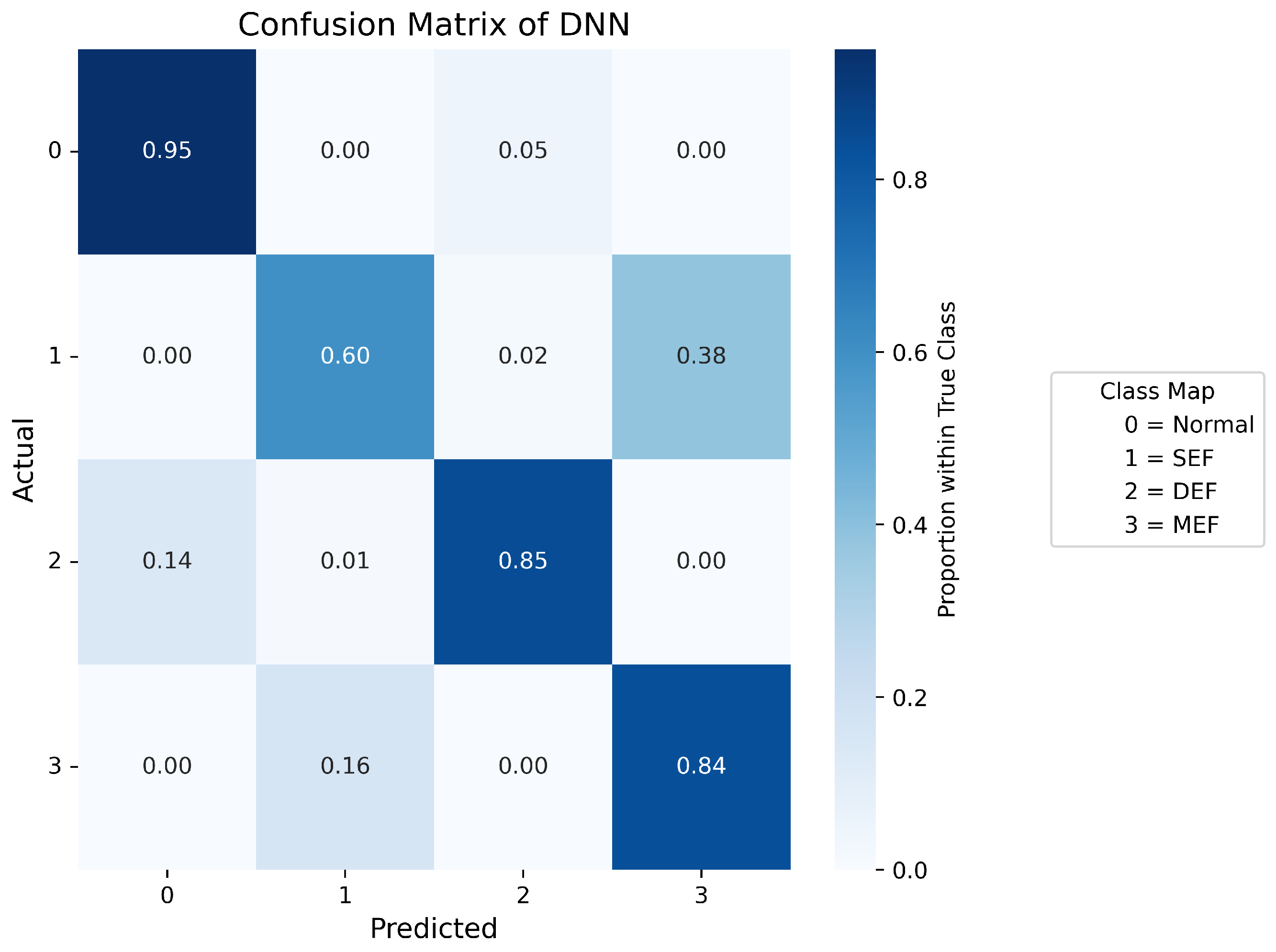
| DNN | 92.54 | 67.56 | 87.75 | 75.38 | 82.00 |
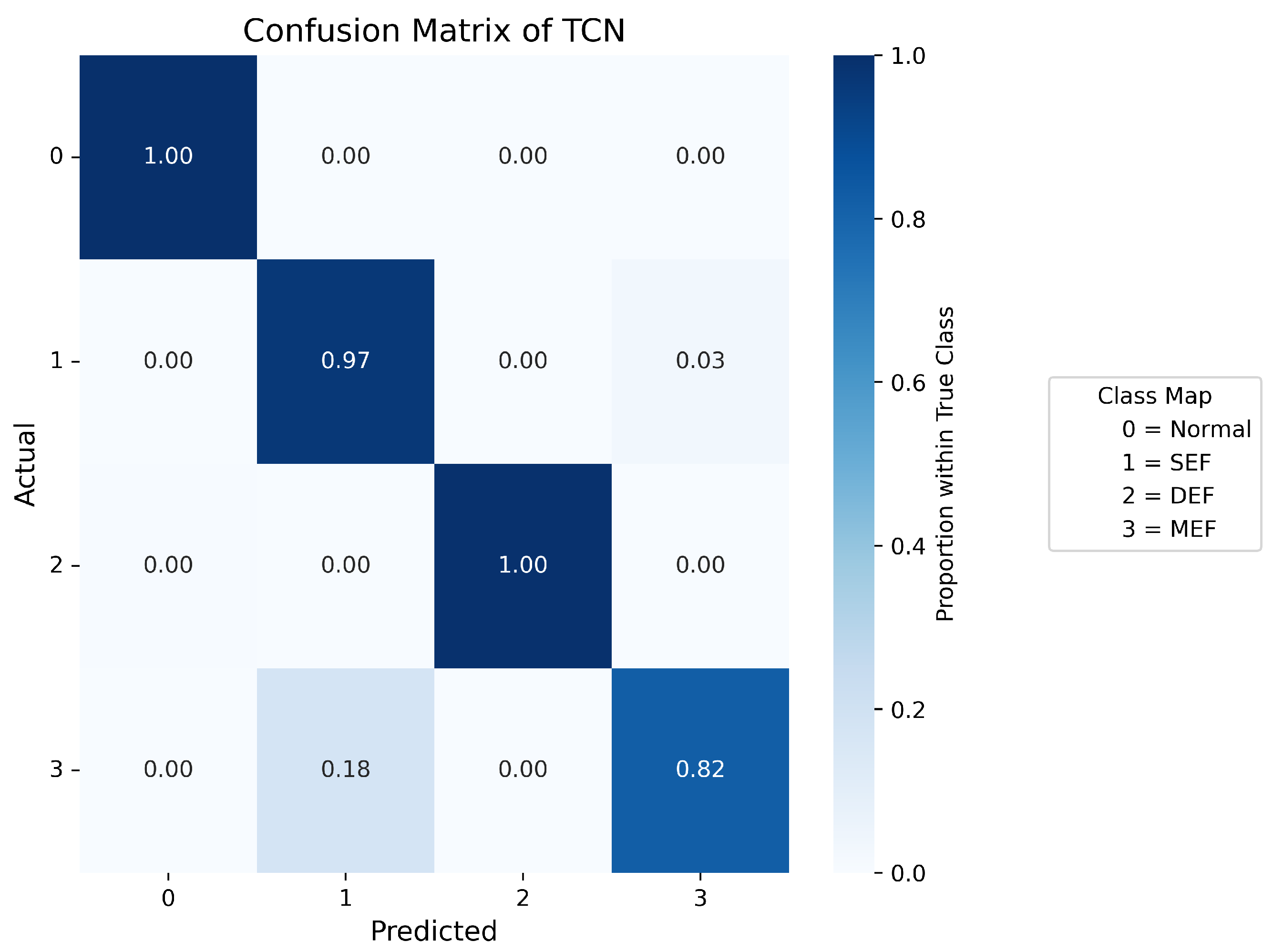
| TCN | 99.83 | 90.23 | 99.77 | 88.73 | 95.08 |
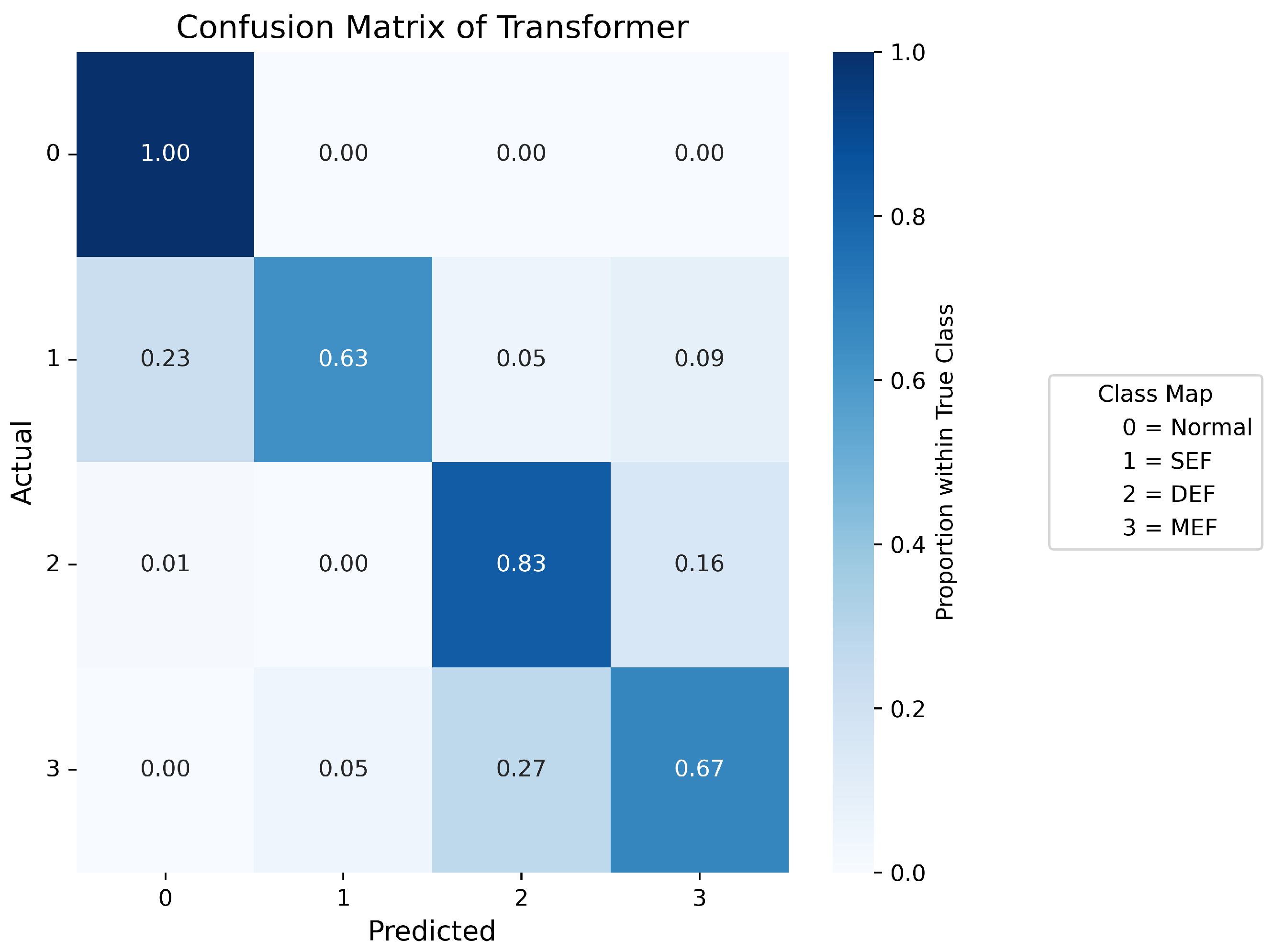
| Transformer | 91.75 | 75.02 | 76.90 | 70.28 | 80.09 |
| Layer | CNN-LSTM Test 1 | CNN-LSTM Test 2 (Proposed) | CNN-LSTM Test 3 |
| I | Conv1D(32, 5, ReLu) | Conv1D(32, 5, ReLu) | Conv1D(32, 5, ReLu) |
| II | MaxPooling1D(2) | MaxPooling1D(2) | MaxPooling1D(2) |
| III | LSTM(64, tanh) | Conv1D(64, 5, ReLu) | Conv1D(64, 5, ReLu) |
| IV | Dropout(0.3) | MaxPooling1D(2) | MaxPooling1D(2) |
| V | Dense(64, ReLu) | LSTM(64, tanh) | Conv1D(128, 5, ReLu) |
| VI | Dense(4, SoftMax) | Dropout(0.3) | MaxPooling1D(2) |
| VII | - | Dense(64, ReLu) | LSTM(64, tanh) |
| VIII | - | Dense(4, SoftMax) | Dropout(0.3) |
| IX | - | - | Dense(64, ReLu) |
| X | - | - | Dense(4, SoftMax) |
| Layer | CNN-LSTM Test 4 | CNN-LSTM Test 5 | |
| I | Conv1D(32, 5, ReLu) | Conv1D(64, 5, ReLu) | |
| II | MaxPooling1D(2) | MaxPooling1D(2) | |
| III | Conv1D(64, 5, ReLu) | Conv1D(128, 5, ReLu) | |
| IV | MaxPooling1D(2) | MaxPooling1D(2) | |
| V | LSTM(64, tanh) | LSTM(128, tanh) | |
| VI | Dropout(0.3) | Dropout(0.3) | |
| VII | Dense(64, ReLu) | Dense(64, ReLu) | |
| VIII | Dense(4, SoftMax) | Dense(4, SoftMax) |
| Neural Networks’ Types | Accuracy in Each Label (%) | F1 Score (%) | |||
|---|---|---|---|---|---|
| 0 | 1 | 2 | 3 | ||
| CNN-LSTM Test 1 | 85.9 | 32.0 | 57.1 | 58.0 | 66.7 |
| CNN-LSTM Test 2 (Proposed) | 97.1 | 95.9 | 95.4 | 94.4 | 96.0 |
| CNN-LSTM Test 3 | 96.5 | 86.7 | 95.8 | 87.4 | 92.6 |
| CNN-LSTM Test 4 | 96.2 | 93.8 | 93.2 | 91.9 | 94.3 |
| CNN-LSTM Test 5 | 96.9 | 92.9 | 95.8 | 91.8 | 94.9 |
| Speed = 500 rpm | ||||||
| Condition | MCSA + PCA + KNN | MCSA + PCA + RF | SVM + PCA | KNN | CNN + SVM + PCA | E-FDNet |
| Normal | 97.3% | 97.2% | 33.6% | 5.6% | 97.9% | 94.1% |
| SEF | 85.7% | 88.1% | 12.0% | 3.6% | 36.2% | 94.0% |
| DEF | 96.4% | 97.3% | 40.8% | 4.5% | 97.1% | 94.2% |
| MEF | 80.0% | 87.3% | 8.8% | 2.5% | 65.6% | 96.6% |
| Total | 91.7% | 93.5% | 22.7% | 3.2% | 81.28% | 94.6% |
| Speed = 1000 rpm | ||||||
| Condition | MCSA + PCA + KNN | MCSA + PCA + RF | SVM + PCA | KNN | CNN + SVM + PCA | E-FDNet |
| Normal | 72.2% | 91.9% | 7.2% | 38.9% | 97.2% | 94.3% |
| SEF | 0.0% | 14.8% | 0.0% | 11.2% | 97.0% | 95.0% |
| DEF | 0.7% | 1.5% | 33.0% | 19.7% | 94.1% | 95.3% |
| MEF | 54.0% | 30.4% | 0.0% | 32.5% | 98.0% | 97.4% |
| Total | 50.5% | 50.0% | 21.0% | 30.07% | 96.7% | 95.3% |
| Speed = 1500 rpm | ||||||
| Condition | MCSA + PCA + KNN | MCSA + PCA + RF | SVM + PCA | KNN | CNN + SVM + PCA | E-FDNet |
| Normal | 97.3% | 97.2% | 7.2% | 93.2% | 98.1% | 98.5% |
| SEF | 91.2% | 92.8% | 42.9% | 90.0% | 98.8% | 99.0% |
| DEF | 90.0% | 92.1% | 31.3% | 79.8% | 97.1% | 97.5% |
| MEF | 89.7% | 91.8% | 13.5% | 80.9% | 98.7% | 99.2% |
| Total | 93.2% | 94.3% | 26.8% | 87.6% | 98.2% | 98.6% |
| Speed = 2000 rpm | ||||||
| Condition | MCSA + PCA + KNN | MCSA + PCA + RF | SVM + PCA | KNN | CNN+SVM + PCA | E-FDNet |
| Normal | 97.3% | 97.3% | 15.4% | 95.1% | 98.1% | 98.5% |
| SEF | 91.4% | 92.5% | 42.9% | 92.7% | 98.8% | 99.0% |
| DEF | 89.8% | 92.1% | 32.3% | 80.0% | 97.1% | 97.5% |
| MEF | 89.7% | 92.3% | 13.6% | 81.2% | 98.7% | 99.2% |
| Total | 93.2% | 94.4% | 28.7% | 89.0% | 98.2% | 98.6% |
| Speed = 2500 rpm | ||||||
| Condition | MCSA + PCA + KNN | MCSA + PCA + RF | SVM + PCA | KNN | CNN + SVM + PCA | E-FDNet |
| Normal | 96.5% | 96.5% | 20.6% | 94.9% | 97.7% | 98.0% |
| SEF | 91.1% | 92.5% | 43.7% | 91.1% | 98.5% | 99.0% |
| DEF | 89.2% | 90.6% | 34.9% | 80.0% | 96.6% | 97.5% |
| MEF | 90.2% | 92.9% | 14.2% | 81.2% | 98.7% | 99.2% |
| Total | 92.4% | 93.6% | 31.3% | 88.0% | 97.9% | 98.4% |
| Speed = 3000 rpm | ||||||
| Condition | MCSA + PCA + KNN | MCSA + PCA + RF | SVM + PCA | KNN | CNN + SVM + PCA | E-FDNet |
| Normal | 96.8% | 96.9% | 21.1% | 95.0% | 97.7% | 98.0% |
| SEF | 91.1% | 92.5% | 43.7% | 91.1% | 98.5% | 99.0% |
| DEF | 89.6% | 91.4% | 34.9% | 80.2% | 96.6% | 97.5% |
| MEF | 90.2% | 92.7% | 14.2% | 81.2% | 98.7% | 99.2% |
| Total | 92.6% | 93.9% | 31.4% | 88.1% | 97.9% | 98.4% |
Disclaimer/Publisher’s Note: The statements, opinions and data contained in all publications are solely those of the individual author(s) and contributor(s) and not of MDPI and/or the editor(s). MDPI and/or the editor(s) disclaim responsibility for any injury to people or property resulting from any ideas, methods, instructions or products referred to in the content. |
© 2025 by the authors. Licensee MDPI, Basel, Switzerland. This article is an open access article distributed under the terms and conditions of the Creative Commons Attribution (CC BY) license (https://creativecommons.org/licenses/by/4.0/).
Share and Cite
Chu, K.S.K.; Chew, K.W.; Chang, Y.C.; Morris, S.; Hoon, Y.; Chen, C. Eccentricity Fault Diagnosis System in Three-Phase Permanent Magnet Synchronous Motor (PMSM) Based on the Deep Learning Approach. Sensors 2025, 25, 7416. https://doi.org/10.3390/s25247416
Chu KSK, Chew KW, Chang YC, Morris S, Hoon Y, Chen C. Eccentricity Fault Diagnosis System in Three-Phase Permanent Magnet Synchronous Motor (PMSM) Based on the Deep Learning Approach. Sensors. 2025; 25(24):7416. https://doi.org/10.3390/s25247416
Chicago/Turabian StyleChu, Kenny Sau Kang, Kuew Wai Chew, Yoong Choon Chang, Stella Morris, Yap Hoon, and Chen Chen. 2025. "Eccentricity Fault Diagnosis System in Three-Phase Permanent Magnet Synchronous Motor (PMSM) Based on the Deep Learning Approach" Sensors 25, no. 24: 7416. https://doi.org/10.3390/s25247416
APA StyleChu, K. S. K., Chew, K. W., Chang, Y. C., Morris, S., Hoon, Y., & Chen, C. (2025). Eccentricity Fault Diagnosis System in Three-Phase Permanent Magnet Synchronous Motor (PMSM) Based on the Deep Learning Approach. Sensors, 25(24), 7416. https://doi.org/10.3390/s25247416