Review

Molecular Mechanisms of Shigella Pathogenesis; Recent Advances

by
Babak Pakbin
1,2,
Wolfram Manuel Brück
2,* and
Thomas B. Brück
1,*
1
Werner Siemens Chair of Synthetic Biotechnology, Department of Chemistry, Technical University of Munich (TUM), Lichtenberg Str. 4, 85748 Garching bei München, Germany
2
Institute for Life Technologies, University of Applied Sciences Western Switzerland Valais-Wallis, 1950 Sion, Switzerland
*
Authors to whom correspondence should be addressed.
Int. J. Mol. Sci. 2023, 24(3), 2448; https://doi.org/10.3390/ijms24032448
Submission received: 30 December 2022 / Revised: 21 January 2023 / Accepted: 23 January 2023 / Published: 26 January 2023
(This article belongs to the Section Molecular Microbiology)

Abstract

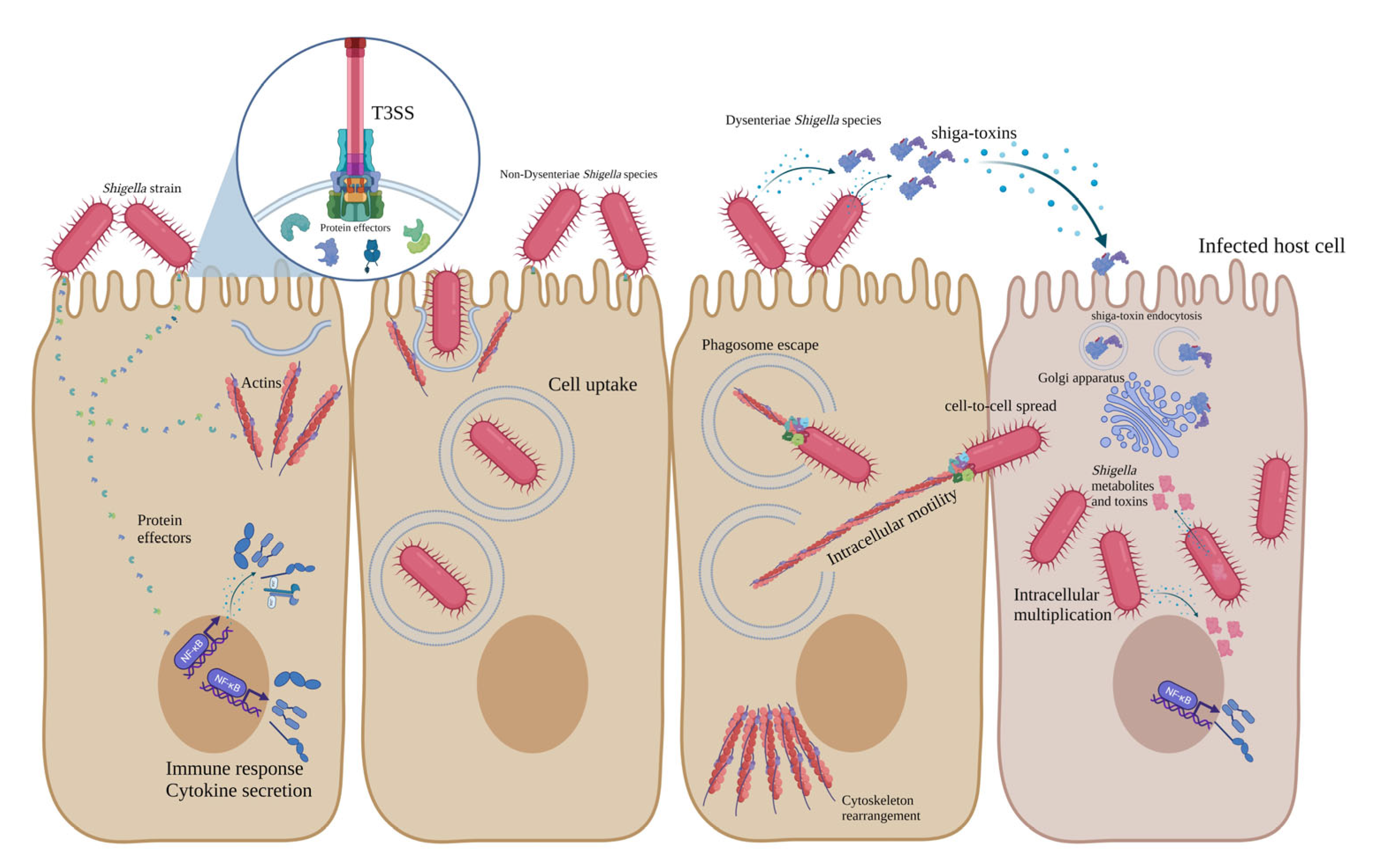
Shigella species are the main cause of bacillary diarrhoea or shigellosis in humans. These organisms are the inhabitants of the human intestinal tract; however, they are one of the main concerns in public health in both developed and developing countries. In this study, we reviewed and summarised the previous studies and recent advances in molecular mechanisms of pathogenesis of Shigella Dysenteriae and non-Dysenteriae species. Regarding the molecular mechanisms of pathogenesis and the presence of virulence factor encoding genes in Shigella strains, species of this bacteria are categorised into Dysenteriae and non-Dysenteriae clinical groups. Shigella species uses attachment, invasion, intracellular motility, toxin secretion and host cell interruption mechanisms, causing mild diarrhoea, haemorrhagic colitis and haemolytic uremic syndrome diseases in humans through the expression of effector delivery systems, protein effectors, toxins, host cell immune system evasion and iron uptake genes. The investigation of these genes and molecular mechanisms can help us to develop and design new methods to detect and differentiate these organisms in food and clinical samples and determine appropriate strategies to prevent and treat the intestinal and extraintestinal infections caused by these enteric pathogens.
Keywords: pathogenesis; virulence factor encoding genes; Shigella dysenteriae type 1; non-Dysenteriae Shigella species pathogenesis; virulence factor encoding genes; Shigella dysenteriae type 1; non-Dysenteriae Shigella species