


Leveraging Strategic Foresight to Advance Worker Safety, Health, and Well-Being



Abstract
:1. Introduction
1.1. A Brief Overview of Strategic Foresight
1.2. Approaches to Strategic Foresight
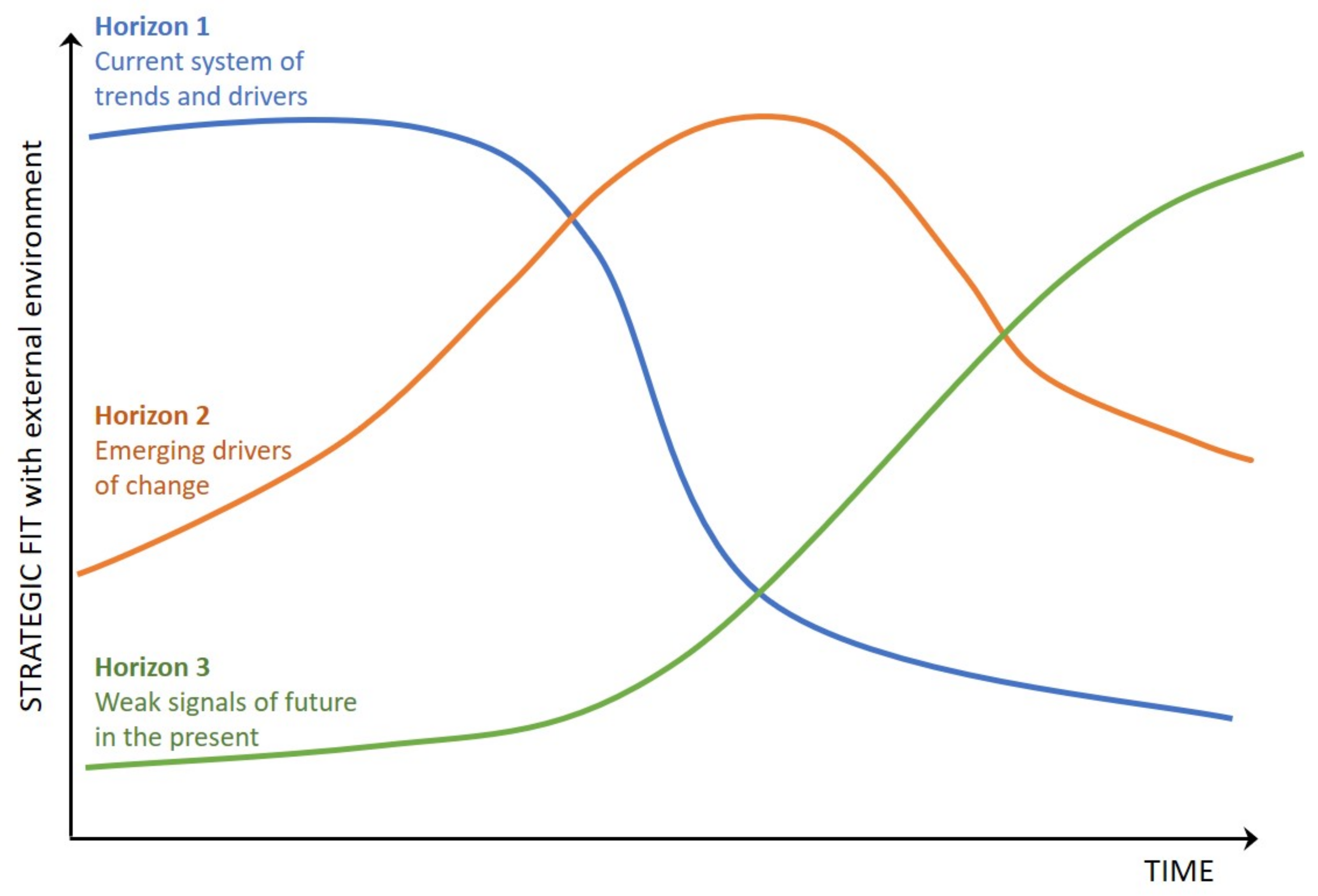
1.2.1. Time Horizons
1.2.2. Scenarios
1.3. Uses of Scenario-Based Strategic Foresight
2. Developing Plausible Future Scenarios for Worker Safety, Health, and Well-Being
2.1. The Matrix Method of Constructing Future Scenarios
2.2. Applying the Matrix Method to Develop Alternative Work Scenarios
2.3. The Archetypes Method of Constructing Future Scenarios
- Continuation (or Continued Growth): A future where the trends of the present accelerate without any major changes or disruptions.
- Collapse: A future where the current system fails due to some negative force(s) or dysfunction.
- New Equilibrium (or Constraint): A future where the current system is challenged in some way and must respond with some type of change to achieve a new sense of balance and stability.
- Transformation: A future where there is a fundamental change and the current system is discarded for an entirely new one.
2.4. Applying the Archetypes Method to Develop Future Work Scenarios
3. Using Scenarios to Protect and Promote Worker Safety, Health, and Well-Being
4. Foresight Framework for Occupational Safety and Health (OSH)
5. Conclusions and Recommendations
Author Contributions
Funding
Institutional Review Board Statement
Informed Consent Statement
Data Availability Statement
Acknowledgments
Conflicts of Interest
References
- Amick, B.; McLeod, C.; Bültmann, U. Labor markets and health: An integrated life course perspective. Scand. J. Work. Environ. Health 2016, 42, 346–353. [Google Scholar] [CrossRef] [PubMed]
- Chia, G.; Lim, S.; Sng, G.; Hwand, Y.-F.J.; Chia, K. Need for a new workplaces safety and health (WSH) strategy for the Fourth Industrial Revolution. Am. J. Ind. Med. 2019, 62, 275–281. [Google Scholar] [CrossRef]
- International Labour Organization International Training Centre. The Future of Work Centenary Initiative. Available online: https://www.ilo.org/wcmsp5/groups/public/---ed_norm/---relconf/documents/meetingdocument/wcms_369026.pdf (accessed on 20 February 2021).
- Peckham, T.; Baker, M.; JE, C.; Kaufman, J.; Seixas, N. Creating a future for occupational health. Ann. Work. Expo. Health 2017, 61, 3–15. [Google Scholar] [CrossRef]
- Schulte, P.; Delclos, G.; Felknor, S.; Chosewood, L. Toward an expanded focus for occupational safety and health: A commentary. Int. J. Environ. Res. Public Health 2019, 16, 4946. [Google Scholar] [CrossRef] [PubMed] [Green Version]
- Tamers, S.; Streit, J.; Pana-Cryan, R.; Ray, T.; Syron, L.; Flynn, M.; Castillo, D.; Roth, G.; Geraci, C.; Guerin, R.; et al. Envisioning the future of work to safeguard the safety, health, and well-being of the workforce: A perspective from the CDC’s National Institute for Occupational Safety and Health. Am. J. Ind. Med. 2020, 63, 1065–1084. [Google Scholar] [CrossRef]
- The World Bank. The World Development Report (WDR) 2019: The Changing Nature of Work. Available online: https://www.worldbank.org/en/publication/wdr2019 (accessed on 12 May 2020).
- Katz, L.; Krueger, A. The rise and nature of alternative work arrangements in the United States, 1995–2015. Int. Labor Rev. 2018, 72, 382–416. [Google Scholar] [CrossRef] [Green Version]
- Cummings, K.; Kreiss, K. Contingent workers and contingent health: Risks of a modern economy. J. Am. Med. Assoc. 2008, 299, 448–450. [Google Scholar] [CrossRef] [PubMed]
- Howard, J. Nonstandard work arrangements and worker health and safety. Am. J. Ind. Med. 2017, 60, 1–10. [Google Scholar] [CrossRef] [Green Version]
- Eurofound & the International Labour Office. Working Anytime, Anywhere: The Effects on the World of Work. Available online: http://eurofound.link/ef1658 (accessed on 4 June 2020).
- Arntz, M.; Gregory, T.; Zierahn, U. The Risk of Automation for Jobs in OECD Countries: A Comparative Analysis. OECD Social, Employment and Migration Working Papers No. 189. Available online: https://www.oecd-ilibrary.org/social-issues-migration-health/the-risk-of-automation-for-jobs-in-oecd-countries_5jlz9h56dvq7-en (accessed on 1 March 2021).
- Eichhorst, W. Labor Market Institutions and the Future of Work: Good jobs for all? IZA Policy Paper, No. 122, Institute of Labor Economics. Available online: https://www.econstor.eu/bitstream/10419/162533/1/87818922X.pdf (accessed on 20 February 2021).
- Bureau of Labor Statistics (BLS). Women in the Workforce. Available online: https://www.bls.gov/opub/reports/womens-databook/2019/home.htm (accessed on 12 May 2020).
- Dodgen, D.; Donato, D.; Kelly, N.; La Greca, A.; Morganstein, J.; Reser, J.; Ruzek, J.; Schweitzer, S.; Shimamoto, M.; Thigpen, K.; et al. Ch. 8: Mental Health and Well-Being. The Impacts of Climate Change on Human Health in the United States: A Scientific Assessment. pp. 217–246. Available online: https://health2016.globalchange.gov/mental-health-and-well-being (accessed on 19 March 2021).
- Hayutin, A.; Beals, M.; Borges, E. The Aging U.S. Workforce: A Chartbook of Demographic Shifts. Available online: http://longevity3.stanford.edu/wp-content/uploads/2014/01/The_Aging_U.S.-Workforce.pdf (accessed on 1 March 2021).
- Toosi, M. Projections of the Labor Force to 2050: A Visual Essay. Available online: https://www.bls.gov/opub/mlr/2012/10/art1full.pdf (accessed on 1 March 2021).
- Budiman, A. Key Findings about U.S. Immigrants. Pew Research Center FactTank. Available online: https://www.pewresearch.org/fact-tank/2020/08/20/key-findings-about-u-s-immigrants/ (accessed on 23 March 2021).
- Blit, J.; Amand, S.; Wajda, J. Automation and the Future of Work: Scenarios and Policy Options. CIGI Paper No. 174. Available online: https://www.cigionline.org/publications/automation-and-future-work-scenarios-and-policy-options?utm_source=twitter&utm_medium=social&utm_campaign=imf-fall-18 (accessed on 23 February 2021).
- Sinclair, R.; Allen, T.; Barber, L.; Bergman, M.; Britt, T.; Butler, A.; Ford, M.; Hammer, L.; Kath, L.; Probst, T.; et al. Occupational health science in the time of COVID-19: Now more than ever. Occup. Health Sci. 2020, 4, 1–22. [Google Scholar] [CrossRef]
- Felknor, S.; Streit, J.; Chosewood, L.; McDaniel, M.; Schulte, P.; Delclos, G. How will the future of work shape the OSH professional of the future? A workshop summary. Int. J. Environ. Res. Public Health 2020, 17, 7154. [Google Scholar] [CrossRef]
- Felknor, S.; Streit, J.; Chosewood, L.; McDaniel, M.; Schulte, P.; Delclos, G. How will the future of work shape OSH research and practice? A workshop summary. Int. J. Environ. Res. Public Health 2021, 18, 5696. [Google Scholar] [CrossRef]
- Tamers, S.; Chosewood, L.; Childress, A.; Hudson, H.; Nigam, J.; Chang, C.-C. Total Worker Health® 2014–2018: The novel approach to worker safety, health, and well-being evolves. Int. J. Environ. Res. Public Health 2019, 16, 321. [Google Scholar] [CrossRef] [PubMed] [Green Version]
- Iden, J.; Methlie, L.; Christensen, G. The nature of strategic foresight research: A systematic literature review. Technol. Forecast. Soc. Chang. 2017, 116, 87–97. [Google Scholar] [CrossRef]
- Voros, J. A Primer on Futures Studies, Foresight, and the Use of Scenarios. Prospect. Foresight Bull. 2001, 6, 1–8. Available online: https://foresightinternational.com.au/wp-content/uploads/2020/03/Voros-Primer-on-FS-2001-Final.pdf (accessed on 15 April 2021).
- Bishop, P.; Hines, A. Teaching about the Future; Palgrave Macmillan: New York, NY, USA, 2012. [Google Scholar]
- Hines, A. Strategic foresight: The state of the art. Futurist 2006, 40, 18–21. [Google Scholar]
- Hines, A.; Bishop, P. Thinking about the Future: Guidelines for Strategic Foresight, 2nd ed.; Hinesight: Houston, TX, USA, 2015. [Google Scholar]
- Institute for the Future (IFTF). Forecasts + Perspectives. Available online: https://www.iftf.org/what-we-do/forecasts/ (accessed on 21 March 2021).
- Association of Governmental Risk Pools (AGRiP). Framing the Future: A Guide to Strategic Foresight. Available online: https://www.agrip.org/intelligence/strategic-foresight (accessed on 15 April 2021).
- Ramirez, R.; Wilkinson, A. Strategic Reframing: The Oxford Scenario Planning Approach; Oxford University Press: Oxford, UK, 2016. [Google Scholar]
- Wilkinson, A. Strategic Foresight Primer. Available online: https://cor.europa.eu/Documents/Migrated/Events/EPSC_strategic_foresight_primer.pdf (accessed on 4 May 2021).
- Institute for the Future (IFTF). IFTF Foresight Essentials. Available online: https://www.iftf.org/foresightessentials/ (accessed on 22 April 2021).
- Platform, F. Collaborative Foresight for Decision-Makers. Available online: https://www.futuresplatform.com/ (accessed on 22 April 2021).
- Keenan, M.; Popper, R. Comparing foresight “style” in six world regions. Foresight 2008, 10, 16–38. [Google Scholar] [CrossRef]
- Dewar, J.; Builder, C.; Hix, W.; Levin, M. Assumption-Based Planning: A Planning Tool for Very Uncertain Times; RAND: Santa Monica, CA, USA, 1993. [Google Scholar]
- Ecola, L.; Popper, S.; Silberglitt, R.; Fraade-Blanar, L. The Road to Zero: A Vision for Achieving Zero Roadway Deaths by 2050; RAND Corporation: Santa Monica, CA, USA, 2018. [Google Scholar]
- Da Costa, O.; Warnke, P.; Cagnin, C.; Scapolo, F. The impact of foresight on policy-making: Insights from the FORLEAN mutual learning process. Technol. Anal. Strateg. Manag. 2008, 20, 369–387. [Google Scholar] [CrossRef] [Green Version]
- Bishop, P.; Hines, A.; Collins, T. The current state of scenario development: An overview of techniques. Foresight 2007, 9, 5–25. [Google Scholar] [CrossRef] [Green Version]
- Voros, J. A generic foresight process framework. Foresight 2003, 5, 10–21. [Google Scholar] [CrossRef]
- Dator, J. Alternative futures at the Manoa School. J. Futures Stud. 2009, 14, 1–18. [Google Scholar]
- Royal Dutch Shell. Scenarios: An Explorer’s Guide. Available online: https://www.shell.com/energy-and-innovation/the-energy-future/scenarios/new-lenses-on-the-future/earlier-scenarios/_jcr_content/par/expandablelist/expandablesection_842430368.stream/1519772592201/f5b043e97972e369db4382a38434d4dc2b1e8bc4/shell-scenarios-explorersguide.pdf (accessed on 21 March 2021).
- Curry, A.; Hodgson, A. Seeing in multiple horizons: Connecting futures to strategy. J. Futures Stud. 2008, 13, 1–20. [Google Scholar]
- International Labour Organization; ITC Limited Foresight Toolkit. Three Horizons Framework. Available online: http://training.itcilo.org/delta/Foresight/3-Horizons.pdf (accessed on 20 October 2020).
- Rhydderch, A. Scenario Building: The 2 × 2 Matrix Technique. Prospective and Strategic Foresight Toolbox. Available online: https://www.futuribles.com/en/group/prospective-and-strategic-foresight-toolbox/document/scenario-building-the-2x2-matrix-technique/ (accessed on 23 March 2021).
- Mietzner, D.; Reger, G. Advantages and disadvantages of scenario approaches for strategic foresight. Int. J. Technol. Intell. Plan. 2005, 1, 220–239. [Google Scholar] [CrossRef] [Green Version]
- Popper, R. Mapping Foresight: Revealing how Europe and Other World Regions Navigate into the Future. European Foresight Monitoring Network Report EUR 24041 EN. Available online: https://rafaelpopper.files.wordpress.com/2010/04/efmn-mapping-foresight_en.pdf (accessed on 20 March 2021).
- Amer, M.; Daim, T.; Jetter, A. A review of scenario planning. Futures 2013, 46, 23–40. [Google Scholar] [CrossRef]
- Van Notten, P.; Rotmans, J.; van Asselt, M.; Rothma, D. An updated scenario typology. Futures 2003, 35, 423–443. [Google Scholar] [CrossRef]
- Schoemaker, P. Scenario planning—A tool for strategic thinking. Sloan Manag. Rev. 1995, 36, 25–40. [Google Scholar]
- Curry, A.; Schultz, W. Roads less travelled: Different methods, different futures. J. Futures Stud. 2009, 13, 35–60. [Google Scholar]
- Sarpong, D.; Maclean, M.; Alexander, E. Organizing strategic foresight: A contextual practice of ‘way finding’. Futures 2013, 53, 33–41. [Google Scholar] [CrossRef]
- Wilkinson, A. Using strategic foresight methods to anticipate and prepare for the jobs-scarce economy. Eur. J. Futures Res. 2016, 4, 12. [Google Scholar] [CrossRef] [Green Version]
- Kaplan, S.; Orlikowski, W. Beyond forecasting: Creating new strategic narratives. MIT Sloan Manag. Rev. 2014, 56, 23–28. [Google Scholar]
- Fergnani, A. The future persona: A futures method to let your scenarios come to life. Foresight 2019, 21, 445–466. [Google Scholar] [CrossRef]
- Bradfield, R.; Wright, G.; Burt, G.; Cairns, G.; Van Der Heijden, K. The origins and evolution of scenario techniques in long range business planning. Futures 2005, 37, 795–812. [Google Scholar] [CrossRef]
- Rhisiart, M.; Miller, R.; Brooks, S. Learning to use the future: Developing foresight capabilities through scenario processes. Technol. Forecast. Soc. Chang. 2015, 101, 124–133. [Google Scholar] [CrossRef]
- Rohrbeck, R.; Battistella, C.; Huizingh, E. Corporate foresight: An emerging field with a rich tradition. Technol. Forecast. Soc. Chang. 2015, 101, 1–9. [Google Scholar] [CrossRef] [Green Version]
- Schoemaker, P. Multiple scenario development: Its conceptual and behavioral foundation. Strateg. Manag. J. 1993, 14, 193–213. [Google Scholar] [CrossRef]
- Roubelat, F. Scenario planning as a networking process. Technol. Forecast. Soc. Chang. 2000, 65, 99–112. [Google Scholar] [CrossRef]
- Wack, P. Scenarios: Unchartered waters ahead. Harv. Bus. Rev. 1985, 63, 72–89. [Google Scholar]
- Schwartz, P. The Art of the Long View: Planning for the Future in an Uncertain World; Currency Doubleday: New York, NY, USA, 1996. [Google Scholar]
- Dreyer, I.; Stang, G. Foresight in Governments—Practices and Trends around the World; European Union Institute for Security Studies: Paris, France, 2013; Available online: https://core.ac.uk/display/30676012?utm_source=pdf&utm_medium=banner&utm_campaign=pdf-decoration-v1 (accessed on 21 March 2021).
- Hammoud, M.; Nash, D. What corporations do with foresight. Eur. J. Futures Res. 2014, 2, 42–62. [Google Scholar] [CrossRef]
- Institute for Futures Research. NEDLAC Futures of Work in South Africa. Available online: http://www.foresightfordevelopment.org/library/54/1466-nedlac-future-of-work-in-south-africa (accessed on 16 April 2021).
- Ajman Department of Economic Development (DED). Ajman DED Launches Future Foresight Initiatives. Available online: https://www.ajmanded.ae/en/30dec2020.aspx (accessed on 5 March 2021).
- Loveridge, D. Foresight: The Art and Science of Anticipating the Future; Routledge: New York, NY, USA, 2009. [Google Scholar]
- Schulte, P.; Streit, J.; Sheriff, F.; Delclos, G.; Felknor, S.; Tamers, S.; Fendinger, S.; Grosch, J.; Sala, R. Potential scenarios and hazards in the work of the future: A systematic review of the peer-reviewed and gray literatures. Ann. Work Expo. Health 2020, 64, 786–816. [Google Scholar] [CrossRef]
- Millett, S. The future of scenarios: Challenges and opportunities. Strategy Leadersh. 2003, 31, 16–24. [Google Scholar] [CrossRef]
- Stacey, N.; Ellwood, P.; Bradbrook, S.; Reynolds, J.; Williams, H.; Lye, D. Foresight on New and Emerging Occupational Safety and Health Risks Associated with Digitalization by 2025. Available online: https://osha.europa.eu/en/publications/foresight-new-and-emerging-occupational-safety-and-health-risks-associated/view (accessed on 6 November 2019).
- Brown, J.; Gosling, T.; Sethi, B.; Sheppard, B.; Stubbings, C.; Sviokla, J.; Williams, J.; Zarubina, D.; Fisher, L. The Workforce of the Future: The Competing Forces Shaping 2030. Available online: https://www.pwc.com/gx/en/services/people-organisation/workforce-of-the-future/workforce-of-the-future-the-competing-forces-shaping-2030-pwc.pdf (accessed on 5 March 2021).
- World Economic Forum (WEF). Eight Futures of Work: Scenarios and Their Implications. Available online: http://www3.weforum.org/docs/WEF_FOW_Eight_Futures.pdf (accessed on 5 March 2021).
- Hines, A. Evolution of framework foresight. Foresight 2020, 22, 643–651. [Google Scholar] [CrossRef]
- Dator, J. The futures of cultures and cultures of the future. In Perspectives on Cross-Cultural Psychology; Marsella, A., Ciborowski, T., Tharp, R., Eds.; Academic Press: New York, NY, USA, 1979. [Google Scholar]
- Hines, A. Fun with scenario archetypes. Hinesight: For Foresight, Use Hinesight. 2014. Available online: https://www.andyhinesight.com/forecasting/fun-with-scenario-archetypes/ (accessed on 4 May 2021).
- Institute for the Future (IFTF). Foresight Essentials: IFTF Scenario Building Training Course; Institute for the Future: Palo Alto, CA, USA, 2021. [Google Scholar]
- Glenn, J. The Milliennium Project Team. Work/Technology 2050: Scenarios and Actions. Available online: http://www.millennium-project.org/projects/workshops-on-future-of-worktechnology-2050-scenarios/ (accessed on 5 March 2021).
- Glenn, J.; Florescu, E. The Millennium Project Team. State of the Future v.19.1. Available online: http://www.millennium-project.org/publications-2-3/#sof2015-16 (accessed on 27 March 2021).
- Tapinos, E. Perceived environmental uncertainty in scenario planning. Futures 2012, 44, 338–345. [Google Scholar] [CrossRef]
- Institute for the Future (IFTF). IFTF Alternative Futures Scenario Toolkit: Tools for Making Choices in Uncertain Times; IFTF: Palo Alto, CA, USA, 2021. [Google Scholar]
- Osoba, O.; Welser, W. The Risks of Artificial Intelligence to Security and the Future of Work. Available online: https://www.rand.org/content/dam/rand/pubs/perspectives/PE200/PE237/RAND_PE237.pdf (accessed on 23 February 2021).
- Rhisiart, M.; Störmer, E.; Daheim, C. From foresight to impact? The 2030 Future of Work scenarios. Technol. Forecast. Soc. Chang. 2017, 124, 203–213. [Google Scholar] [CrossRef]
- Abdychev, A.; Alonso, C.; Alper, E.; Desruelle, D.; Kothari, S.; Liu, Y.; Perinet, M.; Rehman, S.; Schimmelpfennig, A.; Sharma, P. The Future of Work in Sub-Saharan Africa. Available online: https://www.imf.org/en/Publications/Departmental-Papers-Policy-Papers/Issues/2018/12/14/The-Future-of-Work-in-Sub-Saharan-Africa-46333 (accessed on 30 January 2021).
- Münch, C.; von der Gracht, H.A. A bibliometric review of scientific theory in futures and foresight: A commentary on Fergnani and Chermack 2021. Futures Foresight Sci. 2021, 1–9. [Google Scholar] [CrossRef]
- Hines, A.; Bishop, P. Framework foresight: Exploring futures the Houston way. Futures 2013, 51, 31–49. [Google Scholar] [CrossRef]
- Hines, A. Strategic Foresight, Training seminar presented to the National Institute for Occupational Safety and Health. Online presentation, 14–18 September 2020.
- Börjeson, L.; Höjer, M.; Dreborg, K.-H.; Ekvall, T.; Finnveden, G. Scenario types and techniques: Towards a user’s guide. Futures 2006, 38, 723–739. [Google Scholar] [CrossRef]
- Balliester, T.; Elsheikhi, A. The Future of Work: A Literature Review. Working Paper No. 29. Available online: https://www.ilo.org/global/research/publications/working-papers/WCMS_625866/lang--en/index.htm (accessed on 27 August 2019).
- Rohrbeck, R.; Schwarz, J. The value contribution of strategic foresight: Insights from an empirical study of large European companies. Technol. Forecast. Soc. Chang. 2013, 80, 1593–1606. [Google Scholar] [CrossRef]
- National Institute for Occupational Safety and Health (NIOSH). NIOSH Program Portfolio. Available online: https://www.cdc.gov/niosh/programs/default.html (accessed on 22 April 2021).
- Hines, A.; Gary, J.; Daheim, C.; van Der Laan, L. Building foresight capacity: Toward a Foresight Competency Model. World Futures Rev. 2017, 9, 123–141. [Google Scholar] [CrossRef] [Green Version]
- University of Houston. Professional Certificate in Foresight. Available online: https://www.uh.edu/technology/programs/professional/fore/ (accessed on 22 April 2021).
- University of Oxford. Oxford Scenarios Programme. Available online: https://www.sbs.ox.ac.uk/programmes/executive-education/campus-open-programmes/oxford-scenarios-programme (accessed on 22 April 2021).
- Copenhagen Institute for Futures Studies. Applied Strategic Foresight (Live-Online). Available online: https://cifs.dk/calendar/applied-strategic-foresight/ (accessed on 28 April 2021).
- Federal Foresight Community of Interest (FFCOI). Presentations. Available online: https://www.ffcoi.org/presentations/ (accessed on 22 April 2021).
- United Nations Development Programme. Foresight Manual: Empowered Futures for the 2030 Agenda. Available online: https://www.undp.org/content/dam/undp/library/capacity-development/English/Singapore%20Centre/UNDP_ForesightManual_2018.pdf (accessed on 22 April 2021).
- Policy Horizons Canada. Foresight Training Modules. Available online: https://horizons.gc.ca/en/resources/ (accessed on 22 April 2021).
- Federal Foresight Community of Interest (FFCOI). Federal Foresight Community of Interest. Available online: www.ffcoi.org/ (accessed on 31 January 2021).


| Approach | Originating Organization | Overview of Steps (with Step Name Included, Where Applicable) |
|---|---|---|
| Assumption-based planning [36,37] | The RAND Corporation | • Identify assumptions underlying current operations or plans • Identify assumptions that may be vulnerable to or violated by future changes • Define signposts, or events that would indicate an assumption is becoming more or less vulnerable over time • Define shaping actions that will either cause or prevent the failure of a vulnerable assumption • Define hedging actions that can help better prepare for a potential assumption failure in the future |
| FORLEAN [38] | European Commission | • Diagnosis: Reflect on the current system • Exploration: Build scenarios of possible evolutions of the system • Strategic Orientation: Discuss possible strategies • Making Choices: Encourage open debate to reach consensus • Implementation and Coordination: Translate findings into action |
| Framework Foresight [28,39] | University of Houston | • Framing: Identify the domain, or boundaries and key categories of what will be explored • Scanning: Scan the internal and external environments for information and trends related to the domain • Forecasting: Identify drivers and uncertainties, then create alternative futures • Visioning: Identify implications, challenge assumptions, and develop a strategic vision • Planning: Develop strategic options • Acting: Communicate results, create an action plan, and institutionalize strategic thinking |
| Generic Foresight Process [40] | Swinburne University of Technology | • Inputs: Scan the external environment to identify changes that are shaping the future • Analysis: Analyze the scanning results to explore potential shifts needed to identify strategic implications • Interpretation: Identify assumptions and worldviews affecting how the future is interpreted • Prospection: Develop alternative images, or scenarios, for plausible and preferred futures • Outputs: Identify strategic options • Strategy: Agree on action to take today |
| Manoa Futures Visioning Process [41] | University of Hawaii | • Appreciate the Past: Explore the history of the community or group involved • Understand the Present: Discuss the problems and possibilities of the present • Forecast Aspects of the Future: Discuss possible challenges and opportunities from the futures • Experience Alternative Futures: Craft alternative futures trends, emerging issues, challenges, and opportunities from the future • Envision the Futures: Envision a preferred future • Create the Futures: Decide the sequence of what to do now to move toward the preferred future • Institutionalize Futures Research: Set up an ongoing ‘futures’ unit to keep the process going |
| Oxford Scenario Planning Approach [31] | University of Oxford | • Develop an understanding of the problematic situation • Define, develop, verify, and refine a set of strategic frames—the underlying structures of belief, perception, and appreciation used to make sense of the world • Generate alternative scenarios • Engage in iterative learning cycles comprised of: • Reframing: Contrasting alternative scenarios of the future to reveal, test, and redefine the official future, generate alternatives, and generate new knowledge and insights • Reperception: Defining a new course of action |
| Exploring the Future [42] | Royal Dutch Shell | • Preparation: Assembling a clear description of the project, goals, and resources • Pioneering: Challenging assumptions and identifying themes • Map-making: Building and vetting the scenarios • Navigation: Presenting the scenarios to inform plans and actions of key stakeholders, and refining the scenarios based on feedback • Reconnaissance: Examining implications, interpreting signals of change, and further disseminating the scenarios • Preparation: Beginning the process anew to develop fresh scenarios in response to change over time |
| Product Type * | Definition |
|---|---|
| Artifact | Linguistic, conceptual, cultural, and material objects and articles, including physical tools, technical processes or procedures, or symbols and logos [52] |
| Headline or News Story | Brief captions or stories describing events that may happen in the future [53] |
| Narrative | Stories of organizations and the people in them that rethink the past, reconsider present conditions, and reimagine the future [54] |
| Persona | Characters who live in one plausible future and fully embody the human representation in that future [55] |
| Headquarters Location | Organization Name | Organization Type * |
|---|---|---|
| Australia | Institute for Safety, Compensation, and Recovery Research | Research |
| Belgium | European Parliamentary Research Service | Government |
| Canada | Brookfield Institute for Innovation + Entrepreneurship | Research |
| Centre for International Governance Innovation | Think Tank | |
| Institut National de la Recherche Scientifique (INRS) | Academic | |
| Policy Horizons Canada | Government | |
| Finland | Demos Helsinki | Think Tank |
| France | Organisation for Economic Co-Operation and Development | IGO |
| Germany | Federal Ministry of Labour and Social Affairs | Government |
| Fraunhofer-Gesellschaft | Research | |
| Ireland | European Foundation for the Improvement of Living and Working Conditions (Eurofound) | IGO |
| Netherlands | Netherlands Organisation for Applied Scientific Research (TNO) | Research |
| Scotland | Scotland’s Futures Forum | Think Tank |
| Spain | European Agency for Safety and Health at Work (EU-OSHA) | IGO |
| Switzerland | International Labour Organisation (ILO) | IGO |
| World Economic Forum (WEF) | NGO | |
| United Kingdom | Deloitte | Consulting |
| Health and Safety Executive | Government | |
| PricewaterhouseCoopers (PwC) | Consulting | |
| Rethinkery Foresight | Consulting | |
| The Royal Society for Arts, Manufactures and Commerce (RSA) | Research | |
| Schumacher Institute | Think Tank | |
| University of Oxford, Saïd Business School | Academic | |
| United States | Cognizant | Consulting |
| Data & Society Research Institute | Research | |
| Future-IQ | Consulting | |
| The Institute for the Future | Think Tank | |
| International Association of Outsourcing Professionals | Consulting | |
| McKinsey Global Institute | Consulting | |
| Millennium Project | Think Tank | |
| RAND Corporation | Research | |
| Toffler Associates | Consulting |
| Low economic growth and technology application | High economic growth and technology application | |
| Supportive governance and public attitude | Evolution Technology significantly changes half of all jobs. There is continued investment in OSH to address dangerous and unhealthy work. | Transformation Technology significantly impacts most jobs. At the same time, work safety and quality remain a high priority. |
| Resistive governance and public attitude | Fragmentation Technology has had a low impact on jobs overall, though many low-skill repetitive jobs have been fully automated. | Exploitation Technology use varies by industry. Routine, repetitive jobs have been fully automated to save costs. Job competition is high. |
| Individualism | Collectivism | |
| Corporate Integration | Blue World Capitalism rules, widening the wage gap. Performance-enhancing augmentation technologies, medications, and implants are normalized. Privacy is lost to continuous employer surveillance inside and outside the workplace. | Green World Corporate social responsibility rules. Employers offer fair pay, family-friendly policies, and skills development. The increased use of technology for ethical and environmental reasons reduces the number of available jobs. |
| Business Fragmentation | Red World Innovation rules. High rates of technology use decrease job opportunities, inflate market pressures, and increase work pace. Skills, not workers, are valued. | Yellow World Business ethics rules. A collective desire for the fair distribution of wealth and resources drives policy. Autonomous and flexible work provides purpose and fulfillment. |
| Steady Technological Change | Accelerated Technological Change | |||
| Low Talent Mobility | High Talent Mobility | Low Talent Mobility | High Talent Mobility | |
| Slow Learning Evolution | Workforce Autarkies A large number of displaced workers compete for few jobs. Governmental policies restrict international labor mobility. | Mass Movement Worker mobility has resulted in steady incomes, lower living costs, and high levels of competition between workers at all skill levels. | Robot Replacement Widening skills gaps have increased inequalities and polarized views. Borders are tightly controlled in an effort to keep talent local. | Polarized World Due to fast-paced tech and low-paced learning, large portions of the workforce are unemployable. ‘Super economies’ of high-skilled people trade only with one another. |
| Fast Learning Evolution | Empowered Entrepreneurs Lifelong learning is embraced. Workers are able to create their own opportunities in dynamic markets, but migration is restricted in an attempt to retain talent. | Skilled Flows A fast-paced skills evolution enhances creativity and productivity. Abundant opportunities normalize labor mobility. Inequality at the country level increases based on access to tech resources. | Productive Locals There is high demand for workers to complement machines. Borders are tightly controlled in an effort to keep talent local. | Agile Adapters The global workforce is mobile and agile. There is worldwide harmony of social and workforce policies, standards, and credentials. Rapid tech changes, however, have created instability for the economy and society. |
Publisher’s Note: MDPI stays neutral with regard to jurisdictional claims in published maps and institutional affiliations. |
© 2021 by the authors. Licensee MDPI, Basel, Switzerland. This article is an open access article distributed under the terms and conditions of the Creative Commons Attribution (CC BY) license (https://creativecommons.org/licenses/by/4.0/).
Share and Cite
Streit, J.M.K.; Felknor, S.A.; Edwards, N.T.; Howard, J. Leveraging Strategic Foresight to Advance Worker Safety, Health, and Well-Being. Int. J. Environ. Res. Public Health 2021, 18, 8477. https://doi.org/10.3390/ijerph18168477
Streit JMK, Felknor SA, Edwards NT, Howard J. Leveraging Strategic Foresight to Advance Worker Safety, Health, and Well-Being. International Journal of Environmental Research and Public Health. 2021; 18(16):8477. https://doi.org/10.3390/ijerph18168477
Chicago/Turabian StyleStreit, Jessica M. K., Sarah A. Felknor, Nicole T. Edwards, and John Howard. 2021. "Leveraging Strategic Foresight to Advance Worker Safety, Health, and Well-Being" International Journal of Environmental Research and Public Health 18, no. 16: 8477. https://doi.org/10.3390/ijerph18168477
APA StyleStreit, J. M. K., Felknor, S. A., Edwards, N. T., & Howard, J. (2021). Leveraging Strategic Foresight to Advance Worker Safety, Health, and Well-Being. International Journal of Environmental Research and Public Health, 18(16), 8477. https://doi.org/10.3390/ijerph18168477

