Exploring the Association Between Attention-Deficit/Hyperactivity Disorder and Essential Hypertension in a Pediatric Population

 , ,
, ,  , ,
, ,  ,
,  , , ,
, , ,
Highlights
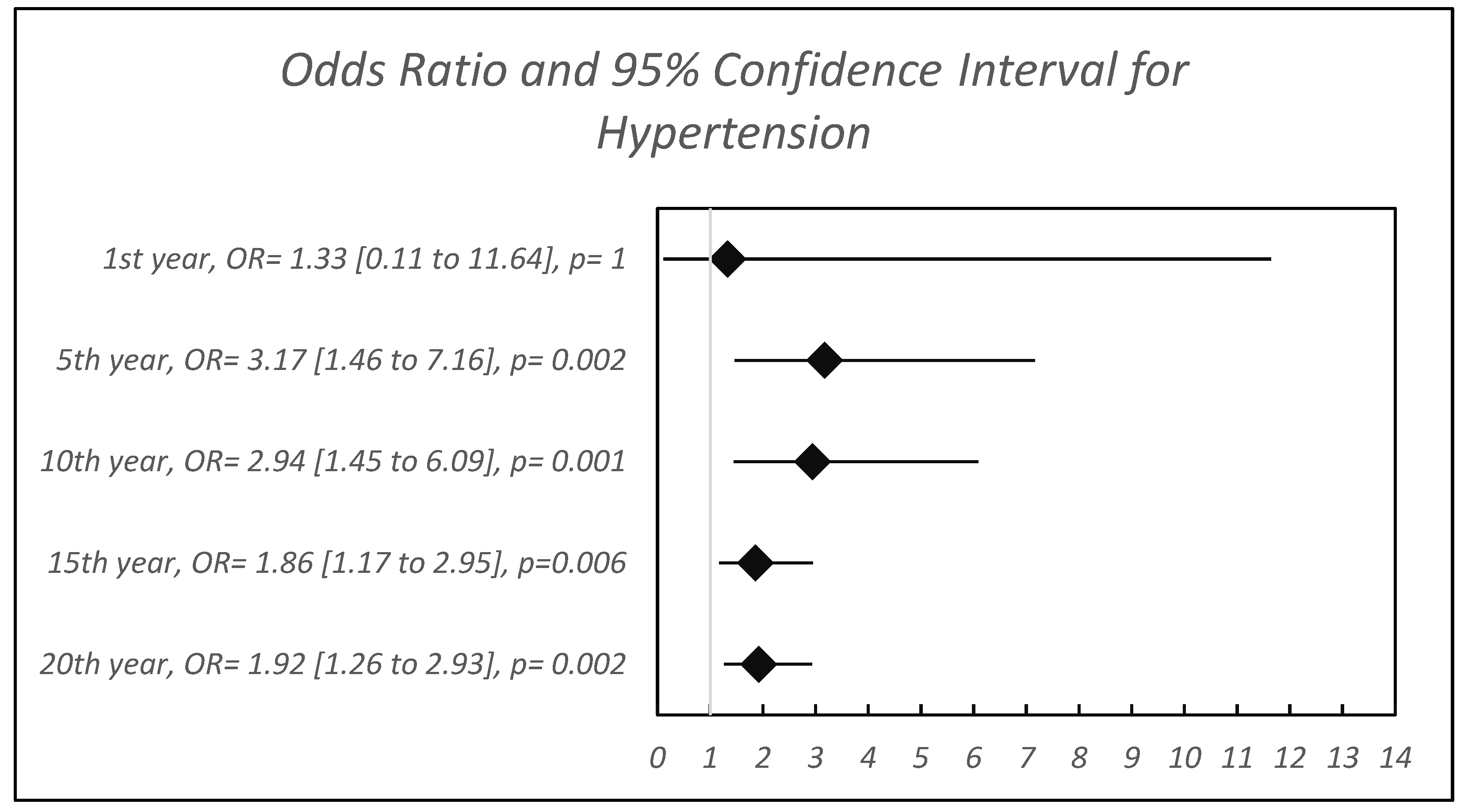
- Children diagnosed with ADHD had a significantly higher long-term prevalence of essential hypertension compared to matched controls, with odds ratios ranging from 3.17 at 5 years to 1.92 at 20 years of follow-up.
- ADHD patients demonstrated greater use of antihypertensive medications, including calcium channel blockers, renin–angiotensin system blockers, and diuretics, indicating clinically meaningful hypertension requiring pharmacological management.
- These results underscore the need for regular cardiovascular monitoring in pediatric patients with ADHD to enable early detection and management of hypertension.
- The findings suggest potential shared biological and behavioral mechanisms between ADHD and hypertension, highlighting the importance of integrated care and further research to guide preventive strategies.
Abstract
1. Introduction
2. Methods
3. Results
3.1. Study Groups and Matching
3.2. Essential Hypertension
3.3. Antihypertensive Medication Use in ADHD and Control Groups over Time
3.3.1. Calcium Channel Blockers (C08)

| C08 Calcium Channel Blockers | Case N = 18,558 | Controls N = 37,116 | OR (95%CI) | p Value | FDR BH |
|---|---|---|---|---|---|
| 1st year after diagnosis | 5 (0.027%) | 4 (0.011%) | 2.50 [0.54 to 12.60] | 0.170 | 0.312 |
| 5th year after diagnosis | 10 (0.054%) | 11 (0.03%) | 1.82 [0.69 to 4.72] | 0.171 | 0.282 |
| 10th year after diagnosis | 14 (0.075%) | 14 (0.038%) | 2.00 [0.88 to 4.53] | 0.071 | 0.139 |
| 15th year after diagnosis | 24 (0.129%) | 26 (0.07%) | 1.85 [1.02 to 3.35] | 0.035 | 0.071 |
| 20th year after diagnosis | 27 (0.145%) | 32 (0.086%) | 1.69 [0.97 to 2.91] | 0.052 | 0.102 |
3.3.2. Agents Acting on the Renin–Angiotensin System (C09)
| C09 Agents Acting on The Renin–Angiotensin System | Case N = 18,558 | Controls N = 37,116 | OR (95%CI) | p Value | FDR BH |
|---|---|---|---|---|---|
| 1st year after diagnosis | 11 (0.059%) | 8 (0.022%) | 2.75 [1.01 to 7.88] | 0.029 | 0.069 |
| 5th year after diagnosis | 22 (0.119%) | 20 (0.054%) | 2.20 [1.15 to 4.25] | 0.013 | 0.029 |
| 10th year after diagnosis | 27 (0.145%) | 40 (0.108%) | 1.35 [0.80 to 2.26] | 0.244 | 0.395 |
| 15th year after diagnosis | 49 (0.264%) | 57 (0.154%) | 1.72 [1.15 to 2.57] | 0.007 | 0.016 |
| 20th year after diagnosis | 57 (0.307%) | 82 (0.221%) | 1.39 [0.97 to 1.98] | 0.059 | 0.113 |
3.3.3. Diuretics (C03)
| C03 Diuretics | Case N = 18,558 | Controls N = 37,116 | OR (95%CI) | p Value | FDR BH |
|---|---|---|---|---|---|
| 1st year after diagnosis | 4 (0.022%) | 5 (0.013%) | 1.60 [0.32 to 7.44] | 0.493 | 0.691 |
| 5th year after diagnosis | 7 (0.038%) | 12 (0.032%) | 1.17 [0.39 to 3.21] | 0.809 | 0.949 |
| 10th year after diagnosis | 11 (0.059%) | 18 (0.048%) | 1.22 [0.52 to 2.73] | 0.694 | 0.816 |
| 15th year after diagnosis | 54 (0.291%) | 61 (0.164%) | 1.77 [1.21 to 2.60] | 0.003 | 0.007 |
| 20th year after diagnosis | 58 (0.313%) | 67 (0.181%) | 1.73 [1.20 to 2.50] | 0.003 | 0.007 |
3.3.4. Stimulants
4. Discussion
- Strengths and limitations
5. Conclusions
Author Contributions
Funding
Institutional Review Board Statement
Informed Consent Statement
Data Availability Statement
Conflicts of Interest
References
- Thomas, R.; Sanders, S.; Doust, J.; Beller, E.; Glasziou, P. Prevalence of attention-deficit/hyperactivity disorder: A systematic review and meta-analysis. Pediatrics 2015, 135, e994–e1001. [Google Scholar] [CrossRef]
- Faraone, S.V.; Banaschewski, T.; Coghill, D.; Zheng, Y.; Biederman, J.; Bellgrove, M.A.; Newcorn, J.H.; Gignac, M.; Al Saud, N.M.; Manor, I.; et al. The World Federation of ADHD International Consensus Statement: 208 Evidence-based Conclusions about the Disorder. Neurosci. Biobehav. Rev. 2021, 128, 789–818. [Google Scholar] [CrossRef]
- Chen, Q.; Hartman, C.A.; Haavik, J.; Harro, J.; Klungsøyr, K.; Hegvik, T.-A.; Wanders, R.; Ottosen, C.; Dalsgaard, S.; Faraone, S.V.; et al. Common psychiatric and metabolic comorbidity of adult attention-deficit/hyperactivity disorder: A population-based cross-sectional study. PLoS ONE 2018, 13, e0204516. [Google Scholar] [CrossRef]
- Kapellen, T.M.; Reimann, R.; Kiess, W.; Kostev, K. Prevalence of medically treated children with ADHD and type 1 diabetes in Germany—Analysis of two representative databases. J. Pediatr. Endocrinol. Metab. 2016, 29, 1293–1297. [Google Scholar] [CrossRef]
- Sedky, K.; Bennett, D.S.; Carvalho, K.S. Attention deficit hyperactivity disorder and sleep disordered breathing in pediatric populations: A meta-analysis. Sleep Med. Rev. 2014, 18, 349–356. [Google Scholar] [CrossRef]
- O’Nions, E.; El Baou, C.; John, A.; Lewer, D.; Mandy, W.; McKechnie, D.G.J.; Petersen, I.; Stott, J. Life expectancy and years of life lost for adults with diagnosed ADHD in the UK: Matched cohort study. Br. J. Psychiatry 2025, 226, 1–8. [Google Scholar] [CrossRef]
- Global Report on Hypertension: The Race Against a Silent Killer. Available online: https://www.who.int/publications-detail-redirect/9789240081062 (accessed on 30 December 2023).
- Song, P.; Zhang, Y.; Yu, J.; Zha, M.; Zhu, Y.; Rahimi, K.; Rudan, I. Global Prevalence of Hypertension in Children. JAMA Pediatr. 2019, 173, 1154–1163. [Google Scholar] [CrossRef]
- Elliott, W.J. Systemic Hypertension. Curr. Probl. Cardiol. 2007, 32, 201–259. [Google Scholar] [CrossRef]
- Bao, W.; Threefoot, S.A.; Srinivasan, S.R.; Berenson, G.S. Essential Hypertension Predicted by Tracking of Elevated Blood Pressure From Childhood to Adulthood: The Bogalusa Heart Study*. Am. J. Hypertens. 1995, 8, 657–665. [Google Scholar] [CrossRef]
- Mick, E.; McManus, D.D.; Goldberg, R.J. Meta-analysis of increased heart rate and blood pressure associated with CNS stimulant treatment of ADHD in adults. Eur. Neuropsychopharmacol. 2013, 23, 534–541. [Google Scholar] [CrossRef]
- Cortese, S.; Fava, C. Long-Term Cardiovascular Effects of Medications for Attention-Deficit/Hyperactivity Disorder—Balancing Benefits and Risks of Treatment. JAMA Psychiatry 2024, 81, 123. [Google Scholar] [CrossRef]
- Dalsgaard, S.; Kvist, A.P.; Leckman, J.F.; Nielsen, H.S.; Simonsen, M. Cardiovascular Safety of Stimulants in Children with Attention-Deficit/Hyperactivity Disorder: A Nationwide Prospective Cohort Study. J. Child Adolesc. Psychopharmacol. 2014, 24, 302–310. [Google Scholar] [CrossRef]
- Fuemmeler, B.F.; Østbye, T.; Yang, C.; McClernon, F.J.; Kollins, S.H. Association between attention-deficit/hyperactivity disorder symptoms and obesity and hypertension in early adulthood: A population-based study. Int. J. Obes. 2011, 35, 852–862. [Google Scholar] [CrossRef]
- Instanes, J.T.; Klungsøyr, K.; Halmøy, A.; Fasmer, O.B.; Haavik, J. Adult ADHD and Comorbid Somatic Disease: A Systematic Literature Review. J. Atten. Disord. 2018, 22, 203–228. [Google Scholar] [CrossRef]
- Merzon, E.; Gutbir, Y.; Vinker, S.; Golan Cohen, A.; Horwitz, D.; Ashkenazi, S.; Sadaka, Y. Early Childhood Shigellosis and Attention Deficit Hyperactivity Disorder: A Population-Based Cohort Study with a Prolonged Follow-up. J. Atten. Disord. 2021, 25, 1791–1800. [Google Scholar] [CrossRef]
- Andersen, M.; Matthiesen, N.B.; Murra, M.; Nielsen, S.Y.; Henriksen, T.B. Early-Onset Neonatal Infection and Attention Deficit Hyperactivity and Autism Spectrum Disorder: A Nationwide Cohort Study. Paediatr. Perinat. Epidemiol. 2025, 39, 588–597. [Google Scholar] [CrossRef]
- Sadaka, Y.; Freedman, J.; Ashkenazi, S.; Vinker, S.; Golan-Cohen, A.; Green, I.; Israel, A.; Eran, A.; Merzon, E. The Effect of Antibiotic Treatment of Early Childhood Shigellosis on Long-Term Prevalence of Attention Deficit/Hyperactivity Disorder. Children 2021, 8, 880. [Google Scholar] [CrossRef]
- Heslin, K.P.; Haruna, A.; George, R.A.; Chen, S.; Nobel, I.; Anderson, K.B.; Faraone, S.V.; Zhang-James, Y. Association Between ADHD and COVID-19 Infection and Clinical Outcomes: A Retrospective Cohort Study From Electronic Medical Records. J. Atten. Disord. 2023, 27, 169–181. [Google Scholar] [CrossRef]
- Merzon, E.; Israel, A.; Ashkenazi, S.; Rotem, A.; Schneider, T.; Faraone, S.V.; Biederman, J.; Green, I.; Golan-Cohen, A.; Vinker, S.; et al. Attention-Deficit/Hyperactivity Disorder Is Associated With Increased Rates of Childhood Infectious Diseases: A Population-Based Case-Control Study. J. Am. Acad. Child. Adolesc. Psychiatry 2023, 62, 253–260.e1. [Google Scholar] [CrossRef]
- Hadzic, E.; Sinanovic, O.; Memisevic, H. Is Bacterial Meningitis a Risk Factor for Developing Attention Deficit Hyperactivity Disorder. Isr. J. Psychiatry. 2017, 54, 54–57. [Google Scholar]
- Misiak, B.; Wójta-Kempa, M.; Samochowiec, J.; Schiweck, C.; Aichholzer, M.; Reif, A.; Samochowiec, A.; Stańczykiewicz, B. Peripheral blood inflammatory markers in patients with attention deficit/hyperactivity disorder (ADHD): A systematic review and meta-analysis. Prog. Neuropsychopharmacol. Biol. Psychiatry 2022, 118, 110581. [Google Scholar] [CrossRef]
- Vázquez-González, D.; Carreón-Trujillo, S.; Alvarez-Arellano, L.; Abarca-Merlin, D.M.; Domínguez-López, P.; Salazar-García, M.; Corona, J.C. A Potential Role for Neuroinflammation in ADHD. Adv. Exp. Med. Biol. 2023, 1411, 327–356. [Google Scholar]
- Kerekes, N.; Sanchéz-Pérez, A.M.; Landry, M. Neuroinflammation as a possible link between attention-deficit/hyperactivity disorder (ADHD) and pain. Med. Hypotheses 2021, 157, 110717. [Google Scholar] [CrossRef]
- Kerekes, N.; Lundqvist, S.; Schubert Hjalmarsson, E.; Torinsson Naluai, Å.; Kantzer, A.K.; Knez, R. The associations between ADHD, pain, inflammation, and quality of life in children and adolescents-a clinical study protocol. PLoS ONE 2022, 17, e0273653. [Google Scholar] [CrossRef]
- Norlander, A.E.; Madhur, M.S.; Harrison, D.G. The immunology of hypertension. J. Exp. Med. 2018, 215, 21–33. [Google Scholar] [CrossRef]
- Richards, E.M.; Li, J.; Stevens, B.R.; Pepine, C.J.; Raizada, M.K. Gut Microbiome and Neuroinflammation in Hypertension. Circ. Res. 2022, 130, 401–417. [Google Scholar] [CrossRef]
- Winklewski, P.J.; Radkowski, M.; Wszedybyl-Winklewska, M.; Demkow, U. Brain inflammation and hypertension: The chicken or the egg? J. Neuroinflammation 2015, 12, 85. [Google Scholar] [CrossRef]

| AHDH Group | Control Group | p Value | OR [95% CI] | ||
|---|---|---|---|---|---|
| Number | 18,558 | 37,116 | |||
| Gender, n (%) | Male | 11,777 (63.5%) | 23,553 (63.5%) | 0.999 | 1.00 [0.96 to 1.04] |
| Female | 6781 (36.5%) | 13,563 (36.5%) | 0.999 | 1.00 [0.96 to 1.04] | |
| Age at diagnosis, year, mean (±SD) | 8.38 (±2.71) | 8.38 (±2.71) | 0.979 | ||
| Age category, years, n (%) | ≤9 | 13,581 (73.2%) | 27,138 (73.1%) | 0.871 | 1.00 [0.96 to 1.04] |
| 10–18 | 4977 (26.8%) | 9978 (26.9%) | 0.879 | 1.00 [0.96 to 1.04] | |
| Sector, n (%) | General | 10,280(55.3%) | 20,488 (55.2%) | 0.999 | 1.01 [0.97 to 1.04] |
| Jewish Ultra-orthodox | 6629(35.7%) | 13,319 (35.9%) | 0.708 | 0.99 [0.96 to 1.03] | |
| Arab | 1649 (8.9%) | 3309 (8.9%) | 0.999 | 1.00 [0.94 to 1.06] | |
| Geographic region, n (%) | Jerusalem | 6891 (37.1%) | 13,799 (37.2%) | 0.919 | 1.00 [0.96 to 1.04] |
| Center | 4722 (25.4%) | 9428 (25.4%) | 0.918 | 1.00 [0.96 to 1.04] | |
| South | 4356 (23.5%) | 8705 (23.5%) | 0.966 | 1.00 [0.96 to 1.04] | |
| North | 2589 (14.0%) | 5184 (14.0%) | 0.969 | 1.00 [0.95 to 1.05] | |
| Socioeconomic status, mean (SD) | 7.92 (±3.94) | 7.92 (±3.98) | 0.928 | 1.00 [0.95 to 1.05] | |
| Socioeconomic Status | Very low (1–3) | 2717 (14.6%) | 5432 (14.6%) | 0.98 | 1.00 [0.96 to 1.05] |
| Category | Low (4–6) | 3988 (21.5%) | 7975 (21.5%) | 0.943 | 1.00 [0.95 to 1.04] |
| Medium (7–9) | 3227 (17.4%) | 6450 (17.4%) | 0.911 | 1.00 [0.96 to 1.04] | |
| Medium-High (10–20) | 6498 (35.0%) | 13,020 (35.1%) | 0.974 | 1.00 [0.95 to 1.06] | |
| Missing Data | 2128 (11.5%) | 4256 (11.5%) | 0.97 | 1.00 [0.95 to 1.05] | |
| BMI, mean (SD) | 17.77 (±3.95) | 17.47 (±3.94) | 0.294 | ||
| Bronchial Asthma, n (%) | 4666 (25.1%) | 8393 (22.6%) | 0.001 | 1.15 [1.10 to 1.20] | |
| Diabetes Mellitus, n (%) | 61 (0.33%) | 130 (0.35%) | 0.701 | 0.94 [0.68 to 1.28] | |
| Epilepsy, n (%) | 306 (1.65%) | 294 (0.79%) | 0.001 | 2.10 [1.78 to 2.48] | |
| Physical activity | Missing | 16,428 (88.52%) | 32,694 (88.09%) | 0.1355 | 1.04 [0.99 to 1.10] |
| Category | None | 217 (1.17%) | 488 (1.31%) | 0.1593 | 0.89 [0.75 to 1.05] |
| Occasionally | 767 (4.13%) | 1597 (4.30%) | 0.3607 | 0.96 [0.88 to 1.05] | |
| 1–3 h weekly | 847 (4.56%) | 1678 (4.52%) | 0.829 | 1.01 [0.93 to 1.10] |
| Diagnosis of— Hypertension, Essential, (ICD-9 Code 401) | Cases N = 18,558 | Controls N = 37,116 | OR (95%CI) | p Value | FDR BH |
|---|---|---|---|---|---|
| 1 year after ADHD diagnosis | 2 (0.011%) | 3 (0.008%) | 1.33 [0.11 to 1.64] | 1 | 1 |
| 5 years after ADHD diagnosis | 19 (0.102%) | 12 (0.032%) | 3.17 [1.46 to 7.16] | 0.002 | 0.035 |
| 10 years after ADHD diagnosis | 22 (0.119%) | 15 (0.04%) | 2.94 [1.45 to 6.09] | 0.001 | 0.025 |
| 15 years after ADHD diagnosis | 39 (0.21%) | 42 (0.113%) | 1.86 [1.17 to 2.95] | 0.006 | 0.097 |
| 20 years after ADHD diagnosis | 47 (0.253%) | 49 (0.132%) | 1.92 [1.26 to 2.93] | 0.002 | 0.028 |
| N06BA04 Methylphenidate | Case N = 18,558 | Controls N = 37,116 | OR (95%CI) | p Value | FDR BH |
|---|---|---|---|---|---|
| 1st year after diagnosis | 12,214 (65.815%) | 190 (0.512%) | 377.08 [318.73 to 434.68] | <0.0001 | <0.0001 |
| 5th year after diagnosis | 14,051 (75.714%) | 721 (1.943%) | 157.72 [144.90 to 171.60] | <0.0001 | <0.0001 |
| 10th year after diagnosis | 14,278 (76.937%) | 1012 (2.727%) | 118.93 [110.62 to 127.74] | <0.0001 | <0.0001 |
| 15th year after diagnosis | 13,894 (74.868%) | 975 (2.627%) | 110.32 [102.50 to 119.13] | <0.0001 | <0.0001 |
| 20th year after diagnosis | 14,542 (78.36%) | 1202 (3.238%) | 108.31 [101.11 to 115.34] | <0.0001 | <0.0001 |
| N06BA01 Amphetamine | Case N = 18,558 | Controls N = 37,116 | OR (95%CI) | p Value | FDR BH |
|---|---|---|---|---|---|
| 1st year after diagnosis | 1598 (8.611%) | 17 (0.046%) | 205.54 [128.34 to 353.29] | <0.0001 | <0.0001 |
| 5th year after diagnosis | 4260 (22.955%) | 106 (0.286%) | 103.69 [85.53 to 127.96] | <0.0001 | <0.0001 |
| 10th year after diagnosis | 5095 (27.454%) | 168 (0.453%) | 83.23 [71.20 to 97.94] | <0.0001 | <0.0001 |
| 15th year after diagnosis | 4515 (24.329%) | 120 (0.323%) | 99.34 [82.28 to 119.59] | <0.0001 | <0.0001 |
| 20th year after diagnosis | 5157 (27.789%) | 178 (0.48%) | 79.85 [68.55 to 93.78] | <0.0001 | <0.0001 |
Disclaimer/Publisher’s Note: The statements, opinions and data contained in all publications are solely those of the individual author(s) and contributor(s) and not of MDPI and/or the editor(s). MDPI and/or the editor(s) disclaim responsibility for any injury to people or property resulting from any ideas, methods, instructions or products referred to in the content. |
© 2026 by the authors. Licensee MDPI, Basel, Switzerland. This article is an open access article distributed under the terms and conditions of the Creative Commons Attribution (CC BY) license.
Share and Cite
Merzon, E.; Poluksht, M.; Ashkenazi, S.; Grossman, E.; Magen, E.; Geishin, A.; Manor, I.; Weizman, A.; Golan-Cohen, A.; Vinker, S.; et al. Exploring the Association Between Attention-Deficit/Hyperactivity Disorder and Essential Hypertension in a Pediatric Population. Children 2026, 13, 107. https://doi.org/10.3390/children13010107
Merzon E, Poluksht M, Ashkenazi S, Grossman E, Magen E, Geishin A, Manor I, Weizman A, Golan-Cohen A, Vinker S, et al. Exploring the Association Between Attention-Deficit/Hyperactivity Disorder and Essential Hypertension in a Pediatric Population. Children. 2026; 13(1):107. https://doi.org/10.3390/children13010107
Chicago/Turabian StyleMerzon, Eugene, May Poluksht, Shai Ashkenazi, Ehud Grossman, Eli Magen, Akim Geishin, Iris Manor, Abraham Weizman, Avivit Golan-Cohen, Shlomo Vinker, and et al. 2026. "Exploring the Association Between Attention-Deficit/Hyperactivity Disorder and Essential Hypertension in a Pediatric Population" Children 13, no. 1: 107. https://doi.org/10.3390/children13010107
APA StyleMerzon, E., Poluksht, M., Ashkenazi, S., Grossman, E., Magen, E., Geishin, A., Manor, I., Weizman, A., Golan-Cohen, A., Vinker, S., Green, I., Bershadsky, A., & Israel, A. (2026). Exploring the Association Between Attention-Deficit/Hyperactivity Disorder and Essential Hypertension in a Pediatric Population. Children, 13(1), 107. https://doi.org/10.3390/children13010107