

Abstract
This study is aimed at evaluating the outcomes of mind-body transformation therapy (MBT-T), previously known as the creative psychosocial genomic healing experience© (CPGHE). The intervention was aimed at reducing the perceived level of stress in two non-clinical groups of students with different educational levels and different expertise in the domain of well-being. Whereas participants from the first group were first-year university students, participants from the second group were students attending a post-graduate program in psychotherapy. All participants (n = 159) were exposed to a single session of MBT-T, each group in a separate session. The results of two paired-samples t-tests, conducted separately on the two samples, showed that there was a statistically significant reduction in the participants’ perceived level of stress between pre- and post-intervention states in both samples (t88 = 5.39, p < 0.001; t53 = 4.56, p < 0.001 respectively). The results, therefore, showed that a single session of MBT-T was beneficial in reducing the perceived level of stress in both first-year university students and students attending a post-graduate program in psychotherapy, regardless of educational level and expertise in the domain of well-being.
1. Introduction
Rates of distress are increasing in schools and universities [1]. Current research [2,3] indicates that the recent COVID-19 pandemic, in particular, has significantly worsened mental health issues in students, and there is growing concern regarding the long-term psychological consequences of this outbreak in higher education settings [3,4]. Under normal conditions, undergraduate students witness several important changes related to personal life and education. University students might feel homesick and overwhelmed by academic demands, which might become a major cause of stress for undergraduate students [5,6]. During this transition, students might also experience minor psychological problems related to sleep, eating habits, and concentration [5]. Likewise, more severe psychological problems, such as mental disorders, also share onset within this age range [4], which might explain the high rates of depression, anxiety, and suicidality [2,3,4]. Though a few years older, graduate students, too, are often exposed to significant stress because of the pressure and the challenges posed by post-graduate programs. Moreover, graduate students are more likely to be married and have children and, thus, they might be more exposed to personal and family problems that cause stress in their everyday life. Greater stress may lead to increased anxiety, depression, and suicidality [1]. Among graduate students, we believe that post-graduate medical students and students attending a post-graduate program in psychotherapy can be regarded as a special class because stress-related issues are particularly relevant to their work. Recent studies on post-graduate medical students [2,3] demonstrate that they are under severe stress and that a high level of stress leads to academic underperformance, absenteeism, and a poor quality of life. Moreover, graduate students attending a post-graduate program in psychotherapy, who generally hold a master’s degree in psychology, are expected to be able to command state-of-the art information and other key skills in their field of study, including stress management and well-being. Yet, further pressures arising from this expectation might lead to increased distress and feelings of failure in these students [7,8]. Despite experiencing significant stress, most students do not reach out for professional help [2]. Research indicates that the most important barriers to seeking mental health therapy among young adults include perceived stigma, self-denial of a mental health problem, negative attitudes about treatment, and practical barriers, such as not knowing where to seek help, cost issues, etc. [4,5]. These findings prompt universities and institutions providing undergraduate and post-graduate education and training to ensure that stress management programs are always available and, importantly, that these services are structured in such a way as to engage young people. Mind-body interventions (MBIs) are generally well suited to this purpose because they are often practiced by non-clinical individuals as well, and are often endorsed by celebrities, which steers clear of the stigma usually attached to mental health treatments. Mind-body interventions are designed to enhance the mind’s positive impact on the body [9,10]. They are based on various practices that range from ancient techniques for self-care and well-being (e.g., meditation, yoga, tai chi, etc.) to more modern Western practices (e.g., mindfulness, hypnotherapy, psychological therapies, etc.) [11]. Several studies support the effectiveness of a number of mind-body interventions in reducing stress in university students [12,13,14,15,16]. Moreover, research indicates that the cause of many disease conditions, including inflammatory and neurodegenerative diseases, is a complex interaction between stressful life experiences, the genome, the mind, and behavioral factors [9,17,18,19]. A recent line of research [10,17,20,21,22,23,24] has provided new insights into the pathophysiology of stress-related disorders and it has identified the gene sets involved in a number of biological pathways, including stress response, inflammation, and physical health. These studies describe the genomic and epigenetic pathways of stress, focusing on gene expression changes brought about by mind-body therapies. Despite a number of studies supporting the effectiveness of these interventions in lowering the level of stress, [13,25,26,27,28], improving well-being [29,30,31,32], and academic attainment in student populations [33], they may also present adverse effects and contraindications [34,35,36,37,38], especially for those individuals who are advised against mild to moderate physical exertion. In addition, mind-body therapies often require training that may be challenging to learn, and they are generally time-consuming to perform. In order to avoid some of the issues posed by these interventions, we carried out a study on stress reduction using a novel mind-body technique known as mind-body transformation therapy (MBT-T).
MBT-T—previously known as the creative psychosocial genomic healing experience© (CPGHE) [39,40,41]—is a therapeutic protocol that has been shown to improve therapeutic results without the need for long traditional therapies. From both a theoretical and an empirical perspective, it is derived from the studies of M. H. Erickson and E. Rossi’s Mind–Body Therapy [10,42,43]. The protocol is based on the so-called four-stage creative process [10], which is a very easy to learn procedure, allowing individuals to obtain stress reduction without the need for traditional, complex, and intricate methods.
Although there is extensive literature evaluating stress reduction among university students [44], relatively few studies have evaluated stress reduction techniques in graduate students [25] and we are not aware of many studies on graduate students attending a post-graduate program in psychotherapy. Because we believe that graduate students likely face the same (if not a greater) amount of stress as undergraduates, even if their expertise in stress management is different, we chose to include both groups in our study. Our goal was to evaluate whether the positive effects of the MBT-T intervention on stress in undergraduates would be noted in graduate students as well. Such findings would suggest that MBT-T is a suitable stress reduction intervention in more than one academic setting, with implications for decision-makers regarding the psychological support programs made available for students in such settings.
2. Materials and Methods
We used an uncontrolled quasi-experimental design to evaluate the effects of a single MBT-T session on two groups of students sampled by cluster. The first group (Group 1) included n = 58 first-year university students, 50% males, mean age = 24.45 (±8.70) years old. The second group (Group 2) consisted of n = 101 graduate students attending a post-graduate program in psychotherapy, 22.8% males; mean age = 35.56 (±10.14) years old. Women were overrepresented and the age range was broad, reflecting the typical demographics of the university and post-graduate courses our participants attended.
Overall, 159 students were selected for the study. Participants were all exposed to a single session of MBT-T, each group in a separate session. Stress was measured using the Distress Thermometer (DT) [45,46,47,48,49,50,51,52,53]. The DT is a single-item screening tool that is well validated to be sensitive and specific to the construct of stress [45]. In order to assess change in self-perceived stress, at the beginning of the session, the researcher asked participants to indicate their perceived “initial stress” on an 11-point scale ranging from 0 (no stress) to 10 (maximum stress) [54]. Once the session was terminated, participants were asked again to indicate their “final stress” on the same scale. Moreover, participants’ feedback about the benefits of CPGHE was also collected. As for the measures, although longer measures for the screening of stress might have been used, we opted for a single-item scale for its brevity and ease of administration. However, we based our choice on studies that validated the DT against other robust measures [45], and confirmed that the single-item DT can be compared with other measures [46]. Besides, a number of validation studies and reviews [45,47,48,49,50] show that the DT has good psychometric properties across countries and cultures. Its sensitivity and specificity, as well as its positive and negative predictive value, are in the range of good overall accuracy (Donovan et al., 2014; Snowden et al., 2014). Moreover, the median scores for these properties are consistent with existing studies written in the English language, whereas different language versions of the DT may have different cut-off scores for clinically significant problems, which is likely due to cultural differences [46,48]. The cut-off score has also been found to change depending on subject characteristics and setting [46,49]. Nonetheless, a cut-off score of four is widely agreed to indicate clinically significant distress [45,46,48]. Thanks to its good psychometric properties, as well as its brevity, the DT was an ideal screening tool to include in a study on stress management with university students.
The stress reduction method we used in this study was MBT-T, previously known as the creative psychosocial genomic healing experience© (CPGHE). The CPGHE is based on the four-stage creative process [10,17], which facilitates positive psychosocial transformations. It presents certain advantages over traditional mind-body methods (i.e., it is very easy to learn, it can be performed in minutes, it can be administered to both single individuals and large groups, it does not require specific premises or tools, and it only demands one researcher). The CPGHE protocol is a four-stage protocol. The first stage is “Focusing Consciousness”, which implies self-awareness of thoughts and feelings. The second stage is “Problem Review”, during which participants assessed the thoughts and feelings from the first stage by focusing on the problem at hand. The third stage is “Problem Solving”, during which participants learned how to cope with the problem arising from the third stage. The final stage is “Self-Care”. Within this stage, participants applied what they had learnt from the third stage to their present situation. Participants were allowed to share their experiences with each other [39]. The CPGHE protocol starts a therapeutic dialogue that may generate new consciousness for a positive exploration of all emotions related to experience, thus reducing acute and/or chronic stress [10] (see Appendix A).
In order to evaluate changes in the level of participants’ stress over time 0 (pre-intervention) and time 1 (post intervention), a paired-samples t-test was conducted separately for each sample (undergraduates and post-graduates). The analyses were conducted with IBM SPSS Statistics for Windows, version 23 (IBM Corp., Armonk, New York, NY, USA).
All participants gave their informed consent for inclusion before they participated in the study. Tests were anonymous to ensure the confidentiality and reliability of the data. All procedures in this study were performed in accordance with the ethical standards of the Italian Association of Psychology (AIP) research committee and with the 1964 Helsinki Declaration and its later amendments. No further approval was required.
3. Results
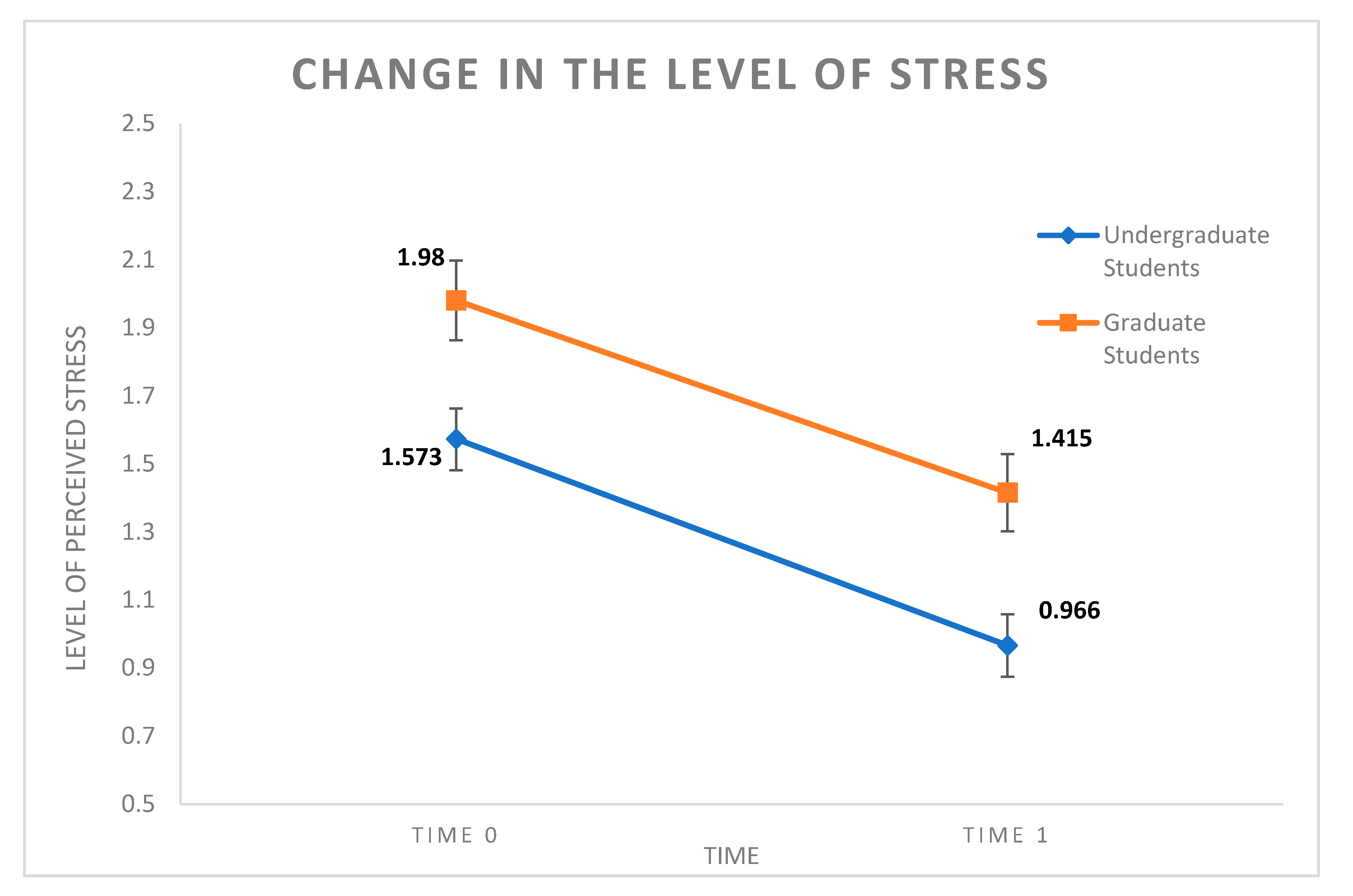
We computed two paired-samples t-tests to make a pre-test–post-test comparison, one for each sample. The results of the paired-samples t-test conducted in undergraduate students showed that the level of post-treatment stress was statistically significantly different and lower than the level of pre-treatment stress (t (53) = 4.56, p < 0.001), as displayed in Figure 1. Furthermore, the results of the paired-samples t-test conducted in graduate students showed that the level of post-treatment stress was statistically significantly different and lower than the level of pre-treatment stress (t (88) = 5.39, p < 0.001), as is also displayed in Figure 1. In order to test for regression toward the mean, we computed a bivariate correlation between stress scores at t0 and the change scores (calculated by subtracting the time 0 stress scores from the time 1 stress scores) separately for each group of participants. The results of these analyses showed that the correlation was statistically significantly different and negative for both groups (r = −0.56, p < 0.001; r = −0.60, p < 0.001 for undergraduate and graduate students, respectively).
Figure 1.
Changes in the level of perceived stress in participants from undergraduate students and graduate students.
4. Discussion
The present study described the implementation of MBT-T on stress management to reduce the perceived level of stress in a non-clinical group of university students. We compared the levels of stress before and after a single intervention of MBT-T in a population of both undergraduate students and graduate students attending a post-graduate program in psychotherapy.
The results suggested that a single session of MBT-T could reduce the perceived level of stress among our participants. In particular, our results indicated that CPGHE/MBT-T showed a significant reduction in final stress as measured at the end of the interventions regardless of educational level and previous expertise in the domain of well-being. Our preliminary investigation seems to confirm that MBT-T might be a suitable stress reduction intervention for university students, as well as graduate students attending a post-graduate program in psychotherapy. In being an easy to implement, sustainable, and reproducible intervention, MBT-T might be a suitable approach that students may be willing to use as compared to other types of intervention. Therefore, we believe that if MBT-T were incorporated into undergraduate and post-graduate stress reduction programs, students would probably benefit from it and improve their well-being. The MBT-T presents certain advantages over traditional mind-body methods (i.e., it is very easy to learn, it can be performed in minutes, it can be administered to both individuals and large groups, it does not require specific premises or tools, and it only demands one researcher).
Despite these encouraging findings, we are aware that the uncontrolled quasi-experimental design was a major limitation to our study. Furthermore, the absence of a control group did not allow us to draw definitive conclusions regarding the effects of the intervention and caution must be made when interpreting the presented results. The results of the correlations between stress scores at t0 and the change scores (calculated by subtracting the time 0 stress scores from the time 1 stress scores), showed no regression to the mean. However, future research should address this potential critical threat to internal validity by using a clinical trial with a pre-test–post-test assessment in at least two conditions: experimental and control. Other limitations to our study could have included circadian rhythms, time effects, history effects, local history effects, and test–retest sensitization. Yet, with regard to time effects, the study included a single intervention, which was carried out within the same time slot (from 10 a.m. to 12 p.m.) in both groups. Therefore, neither circadian rhythm nor ultradian cycle effects were relevant. Furthermore, the intervention was carried out before the COVID-19 pandemic, which made history effects and local history effects relatively non-salient. Moreover, we acknowledge that participants may have become sensitized to the measure. Yet, the mechanism of the so-called pre-test effect or pre-test sensitization is typically not investigated or even known [51], therefore, it was difficult for us to reduce this effect in our uncontrolled quasi-experimental study. Finally, we did not include follow-ups because, at the time of this study, our interest was in investigating the technique’s effect after just a single intervention. We acknowledge that the positive results presented may require discounting due to the absence of a control group. Besides, this was a pilot study for a preliminary investigation, and we are planning to carry out a randomized controlled trial to evaluate the technique with more statistical power.
Despite these issues, the present study has a major strength, which is the replication. Although reproducibility is the foundation of science [54,55], direct replication is seldom pursued [54,56]. Furthermore, as one study shows, replication rates are much higher when the original researchers are involved [57]. Our study included replication because it was conducted with two different groups; importantly, it involved the same researchers, so the methods and procedures were carefully mirrored. The results we achieved held true in both settings and populations. Hence, the replication gave greater validity to our findings. In addition, our study could be a springboard for further studies on the effects of MBT-T/CPGHE. This method could be integrated into more structured programs including more sessions (four to eight) over a longer period of time, which would help us understand how the benefits obtained with a single MBT-T intervention can be maintained and/or enhanced over time.
Because stress among university students is a widespread and growing problem [44,52,53], we believe that universities should develop more effective and sustainable stress management programs for students that are based on mind-body therapies. In particular, future research should examine innovative methods like MBT-T. In our view, future studies should investigate the effects of this type of intervention to identify and examine methods to maintain the benefits of stress reduction interventions, as well as their effects on different individuals. For this reason, we hope that researchers will further investigate this field of study, taking into consideration the possible use of MBT-T.
Author Contributions
Conceptualization, M.C.; writing, M.C. and D.R.V.; review and editing, M.C. and D.R.V.; formal analysis, L.G.; project administration, P.L. and G.C. All authors have read and agreed to the published version of the manuscript.
Funding
This research received no external funding.
Acknowledgments
We would like to thank the University of Foggia, Department of Humanistic Study and the University of Salerno, Department of Humanities, Philosophy and Education (DISUFF), for their support and cooperation.
Conflicts of Interest
The authors declare no conflict of interest.
References
- Joshi, A.R.; Nagpal, M. Assessment of Perceived Stress in Postgraduate Medical Students during Training Programme. J. Clin. Diagnostic Res. 2018, 12, 1–4. [Google Scholar] [CrossRef]
- Grover, S.; Dua, D.; Shouan, A.; Nehra, R.; Avasthi, A. Perceived stress and barriers to seeking help from mental health professionals among trainee doctors at a tertiary care centre in North India. Asian J. Psychiatr. 2019, 39, 143–149. [Google Scholar] [CrossRef]
- Jiang, Y.; Guan, Y.; Dai, D.; Huang, W.; Huang, Z. Prevalence of stress and its determinants among residents enrolled in china standardized training program for resident doctor (C-STRD) program: A cross-sectional study. PLoS ONE 2019, 1. [Google Scholar] [CrossRef]
- Vanheusden, K.; Mulder, C.L.; van der Ende, J.; van Lenthe, F.J.; Mackenbach, J.P.; Verhulst, F.C. Young adults face major barriers to seeking help from mental health services. Patient Educ. Couns. 2008, 73, 97–104. [Google Scholar] [CrossRef]
- Jennings, K.S.; Goguen, K.N.; Britt, T.W.; Jeffirs, S.M.; Wilkes, J.R.; Brady, A.R.; Pittman, R.A.; DiMuzio, D.J. The role of personality traits and barriers to mental health treatment seeking among college students. Psychol. Serv. 2017, 14, 513–523. [Google Scholar] [CrossRef]
- Girelli, L.; Alivernini, F.; Salvatore, S.; Cozzolino, M.; Sibilio, M.; Lucidi, F. Coping with the first exams: Motivation, autonomy support and perceived control predict the performance of first-year university students. J. Educ. Cult. Psychol. Stud. 2018, 2018, 165–185. [Google Scholar] [CrossRef]
- Venuleo, C.; Mangeli, G.; Mossi, P.; Amico, A.F.; Cozzolino, M.; Distante, A.; Ignone, G.; Savarese, G.; Salvatore, S. The Cardiac Rehabilitation Psychodynamic Group intervention (CR-PGI): An explorative study. Front. Psychol. 2018, 9. [Google Scholar] [CrossRef]
- Rocco, D.; Pastore, M.; Gennaro, A.; Salvatore, S.; Cozzolino, M.; Scorza, M. Beyond verbal behavior: An empirical analysis of speech rates in psychotherapy sessions. Front. Psychol. 2018, 9, 978. [Google Scholar] [CrossRef] [PubMed]
- Rossi, E.L.; Rossi, K.L.; Yount, G.; Cozzolino, M.; Iannotti, S. The Bioinformatics of Integrative Medical Insights: Proposals for an International Psycho-Social and Cultural Bioinformatics Project. Integr. Med. Insights 2006, 1, 7–26. [Google Scholar] [CrossRef]
- Rossi, E.L.; Cozzolino, M.; Mortimer, J.; Atkinson, D.; Rossi, K.L. A Brief Protocol for the Creative Psychosocial Genomic Healing Experience: The 4-Stage Creative Process in Therapeutic Hypnosis and Brief Psychotherapy. Am. J. Clin. Hypn. 2011, 54, 133–152. [Google Scholar] [CrossRef] [PubMed]
- Cozzolino, M.; Girelli, L.; Vivo, D.R.; Limone, P.; Celia, G. A mind-body intervention for stress reduction as an adjunct to an information session on stress management in university students. Brain Behav. 2020, 10. [Google Scholar] [CrossRef] [PubMed]
- Finkelstein-Fox, L.; Park, C.L.; Riley, K.E. Mindfulness and emotion regulation: Promoting well-being during the transition to college. Anxiety, Stress Coping 2018, 31, 639–653. [Google Scholar] [CrossRef] [PubMed]
- Gallego, J.; Aguilar-Parra, J.M.; Cangas, A.J.; Rosado, A.; Langer, Á.I. Efecto de intervenciones mente/cuerpo sobre los niveles de ansiedad, estrés y depresión en futuros docentes de edu. Rev. Psicodidact. 2016, 21, 87–101. [Google Scholar] [CrossRef]
- Meier, N.F.; Welch, A.S. Walking versus biofeedback: A comparison of acute interventions for stressed students. Anxiety Stress Coping 2016, 29, 463–478. [Google Scholar] [CrossRef]
- Running, A.; Hildreth, L. A Pilot Study: The Effect of Bio-Energy on Stress for University Faculty, Staff, and Students During Finals Week. J. Holist. Nurs. 2017, 35, 25–32. [Google Scholar] [CrossRef]
- Saoji, A.; Mohanty, S.; Vinchurkar, S.A. Effect of a Single Session of a Yogic Meditation Technique on Cognitive Performance in Medical Students: A Randomized Crossover Trial. J. Relig. Health 2017, 56, 141–148. [Google Scholar] [CrossRef]
- Cozzolino, M.; Cicatelli, A.; Fortino, V.; Guarino, F.; Tagliaferri, R.; Castiglione, S.; De Luca, P.; Napolitano, F.; Celia, G.; Iannotti, S.; et al. The Mind-Body Healing Experience (MHE) Is associated with Gene Expression in Human Leukocytes. Int. J. Phys. Soc. Sci. 2015, 5, 361–374. [Google Scholar]
- Hsieh, J.; Eisch, A.J. Epigenetics, hippocampal neurogenesis, and neuropsychiatric disorders: Unraveling the genome to understand the mind. Neurobiol. Dis. 2010, 39, 73–84. [Google Scholar] [CrossRef]
- Lloyd, D.; Rossi, E.L. Ultradian rhythms from molecules to mind: A new vision of life; Springer: Dordrecht, The Netherlands, 2008; ISBN 9781402083518. [Google Scholar]
- Buric, I.; Farias, M.; Jong, J.; Mee, C.; Brazil, I.A. What is the molecular signature of mind-body interventions? A systematic review of gene expression changes induced by meditation and related practices. Front. Immunol. 2017, 8, 670. [Google Scholar] [CrossRef]
- Kanherkar, R.R.; Stair, S.E.; Bhatia-Dey, N.; Mills, P.J.; Chopra, D.; Csoka, A.B. Epigenetic Mechanisms of Integrative Medicine. Evidence-Based Complement. Altern. Med. 2017, 2017, 1–19. [Google Scholar] [CrossRef]
- Kuan, P.-F.; Waszczuk, M.A.; Kotov, R.; Marsit, C.J.; Guffanti, G.; Gonzalez, A.; Yang, X.; Koenen, K.; Bromet, E.; Luft, B.J. An epigenome-wide DNA methylation study of PTSD and depression in World Trade Center responders. Transl. Psychiatry 2017, 7, e1158. [Google Scholar] [CrossRef]
- Miller, M.W.; Maniates, H.; Wolf, E.J.; Logue, M.W.; Schichman, S.A.; Stone, A.; Milberg, W.; McGlinchey, R. CRP polymorphisms and DNA methylation of the AIM2 gene influence associations between trauma exposure, PTSD, and C-reactive protein. Brain. Behav. Immun. 2018, 67, 194–202. [Google Scholar] [CrossRef] [PubMed]
- Niles, H.; Mehta, D.H.; Corrigan, A.A.; Bhasin, M.K.; Denninger, J.W. Functional genomics in the study of mind-body therapies. Ochsner J. 2014, 14, 681–695. [Google Scholar] [PubMed]
- Stillwell, S.B.; Vermeesch, A.L.; Scott, J.G. Interventions to reduce perceived stress among graduate students: A systematic review. Worldviews Evidence-Based Nurs. 2017, 00, 1–7. [Google Scholar]
- Upchurch, D.M.; Gill, M.; Jiang, L.; Prelip, M.; Slusser, W. Use of Mind–Body Therapies Among Young Adults Aged 18–24 Years: Findings From the 2012 National Health Interview Survey. J. Adolesc. Heal. 2018, 63, 227–232. [Google Scholar] [CrossRef] [PubMed]
- Nanthakumar, C. The benefits of yoga in children. J. Integr. Med. 2018, 16, 14–19. [Google Scholar] [CrossRef]
- Wang, D.; Hagins, M. Perceived benefits of yoga among urban school students: A qualitative analysis. Evidence-Based Complement. Altern. Med. 2016, 2016, 1–7. [Google Scholar] [CrossRef]
- Zhang, J.; Qin, S.; Zhou, Y.; Meng, L.; Su, H.; Zhang, J.; Qin, S.; Zhou, Y.; Meng, L.; Su, H.; et al. A randomized controlled trial of mindfulness-based tai chi chuan for subthreshold depression adolescents. Neuropsychiatr. Dis. Treat. 2018, 14, 2313–2321. [Google Scholar] [CrossRef]
- Sarkissian, M. Building Spiritual Capital: The Effects of Kundalini Yoga on Adolescent Stress, Emotional Affect, and Resilience. Ph.D. Thesis, Loyola Marymount University, Los Angeles, CA, USA, 2012. [Google Scholar]
- Soares, D.S.; Chan, L. Stress and wellbeing of junior doctors in Australia: A comparison with American doctors and population norms. BMC Med. Educ. 2016, 16. [Google Scholar] [CrossRef]
- Birtwell, K.; Williams, K.; van Marwijk, H.; Armitage, C.J.; Sheffield, D. An Exploration of Formal and Informal Mindfulness Practice and Associations with Wellbeing. Mindfulness (N. Y). 2019, 10, 89–99. [Google Scholar] [CrossRef]
- Bennett, K.; Dorjee, D. The Impact of a Mindfulness-Based Stress Reduction Course (MBSR) on Well-Being and Academic Attainment of Sixth-form Students. Mindfulness (N. Y). 2016, 7, 105–114. [Google Scholar] [CrossRef]
- AAP Section on Integrative Medicine. Mind-Body Therapies in Children and Youth. Pediatrics 2016, 138, e20161896. [Google Scholar] [CrossRef]
- Brancaleone, F. TBA: Terapia bionomico-autogena: Fondamenti, principi, tecniche e applicazioni; Franco Angeli: Milan, Italy, 2010; ISBN 8856822237. [Google Scholar]
- Dobkin, P.L.; Irving, J.A.; Amar, S. For whom may participation in a mindfulness-based stress reduction program be contraindicated? Mindfulness (N. Y.) 2012, 3, 44–50. [Google Scholar] [CrossRef]
- Guo, Y.; Xu, M.; Ji, M.; Wei, Z.; Zhang, J.; Hu, Q.; Yan, J.; Chen, Y.; Lyu, J.; Shao, X.; et al. The effect of Imaginary Working Qigong on the psychological well-being of college students. Medicine (Baltimore) 2018, 97, e13043. [Google Scholar] [CrossRef]
- Wielgosz, J.; Goldberg, S.B.; Kral, T.R.A.; Dunne, J.D.; Davidson, R.J. Mindfulness Meditation and Psychopathology. Annu. Rev. Clin. Psychol. 2019, 15, 285–316. [Google Scholar] [CrossRef]
- Cozzolino, M.; Tagliaferri, R.; Castiglione, S.; Fortino, V.; Cicatelli, A.; Guarino, F.; Napolitano, F.; Raiconi, G.; Celia, G.; De Luca, P.; et al. The Creative Psychosocial and Cultural Genomic Healing Experience: A new top-down epigenomic psychotherapeutic protocol. Int. J. Psychosoc. Cult. Genomics, Conscious. Heal. Res. 2014, 1, 18–26. [Google Scholar]
- Cozzolino, M.; Guarino, F.; Castiglione, S.; Cicatelli, A.; Celia, G. Pilot Study on Epigenetic Response to A Mind-Body Treatment. Transl. Med. @ UniSa 2017, 17, 40. [Google Scholar]
- Celia, G. Les styles narratifs du groupe comme indicateurs de changement. Rev. Psychother. Psychanal. Groupe 2020, 74, 157. [Google Scholar]
- Rossi, K.; Mortimer, J.; Rossi, E. Mind-Body Transformations Therapy (MBT-T). A single case study of trauma and rehabilitation. Int. J. Psychosoc. Genomics Conscious. Heal. Res. 2013, 1, 32–40. [Google Scholar]
- Rossi, E.; Rossi, K. The Creative Psychosocial Genomic Healing Experience©: An Open Invitation to Mind-Body Psychotherapy, Clinical & Experimental Research! Available online: Ernest@ernestrossi.com (accessed on 5 May 2020).
- Regehr, C.; Glancy, D.; Pitts, A. Interventions to reduce stress in university students: A review and meta-analysis. J. Affect. Disord. 2013, 148, 1–11. [Google Scholar] [CrossRef]
- Snowden, A.; White, C.A.; Christie, Z.; Murray, E.; McGowan, C.; Scott, R. The clinical utility of the Distress Thermometer: A review. Br. J. Nurs. 2014, 20, 220–227. [Google Scholar] [CrossRef] [PubMed]
- Jacobsen, P.B.; Donovan, K.A.; Trask, P.C.; Fleishman, S.B.; Zabora, J.; Baker, F.; Holland, J.C. Screening for psychologic distress in ambulatory cancer patients: A multicenter evaluation of the distress thermometer. Cancer 2005, 103, 1494–1502. [Google Scholar] [CrossRef] [PubMed]
- Cutillo, A.; O’Hea, E.; Person, S.D.; Lessard, D.; Harralson, T.L.; Boudreaux, E. The distress thermometer: Cutoff points and clinical use. Oncol. Nurs. Forum 2017, 44, 329–336. [Google Scholar] [CrossRef] [PubMed]
- Donovan, K.A.; Grassi, L.; McGinty, H.L.; Jacobsen, P.B. Validation of the Distress Thermometer worldwide: State of the science. Psychooncology. 2014, 23, 241–250. [Google Scholar] [CrossRef]
- Goebel, S.; Mehdorn, H.M. Measurement of psychological distress in patients with intracranial tumours: The NCCN distress thermometer. J. Neurooncol. 2011, 104, 357–364. [Google Scholar] [CrossRef]
- Gunnarsdottir, S.; Thorvaldsdottir, G.H.; Fridriksdottir, N.; Bjarnason, B.; Sigurdsson, F.; Skulason, B.; Smari, J. The psychometric properties of the Icelandic version of the Distress Thermometer and Problem List. Psychooncology. 2012, 21, 730–736. [Google Scholar] [CrossRef]
- Salkind, N.J. Encyclopedia of Research Design: Grounded Theory. Encycl. Res. Des. 2010, 181–186. [Google Scholar] [CrossRef]
- Beiter, R.; Nash, R.; McCrady, M.; Rhoades, D.; Linscomb, M.; Clarahan, M.; Sammut, S. The prevalence and correlates of depression, anxiety, and stress in a sample of college students. J. Affect. Disord. 2015, 173, 90–96. [Google Scholar] [CrossRef]
- Chaló, P.; Pereira, A.; Batista, P.; Sancho, L. Brief Biofeedback Intervention on Anxious Freshman University Students. Appl. Psychophysiol. Biofeedback 2017, 42, 163–168. [Google Scholar] [CrossRef]
- Alexander, A.; Barnett-Cowan, M.; Bartmess, E.; Bosco, F.A.; Brandt, M.; Carp, J.; Chandler, J.J.; Clay, R.; Cleary, H.; Cohn, M.; et al. An open, large-scale, collaborative effort to estimate the reproducibility of psychological science. Perspect. Psychol. Sci. 2012, 7, 657–660. [Google Scholar] [CrossRef]
- Simons, D.J. The Value of Direct Replication. Perspect. Psychol. Sci. 2014, 9, 76–80. [Google Scholar] [CrossRef] [PubMed]
- Kahneman, D. A new etiquette for replication. Soc. Psychol. (Gott) 2014, 45, 310–311. [Google Scholar]
- Makel, M.C.; Plucker, J.A.; Hegarty, B. Replications in Psychology Research: How Often Do They Really Occur? Perspect. Psychol. Sci. 2012, 7, 537–542. [Google Scholar] [CrossRef] [PubMed]
© 2020 by the authors. Licensee MDPI, Basel, Switzerland. This article is an open access article distributed under the terms and conditions of the Creative Commons Attribution (CC BY) license (http://creativecommons.org/licenses/by/4.0/).


