Low Testosterone and Sperm Quality Alterations: A Prospective Study of Sperm DNA Fragmentation and Chromatin Condensation in Infertile Men

 , , ,
, , ,
Simple Summary
Abstract
1. Introduction
2. Materials and Methods
2.1. Study Design and Population
2.2. Semen Analysis
2.3. DNA Fragmentation Index
2.4. Sperm Decondensation Index
2.5. Determinations of Serum Sex Hormones
2.6. Statistical Analysis
3. Results
3.1. Baseline Characteristic of the Study Population
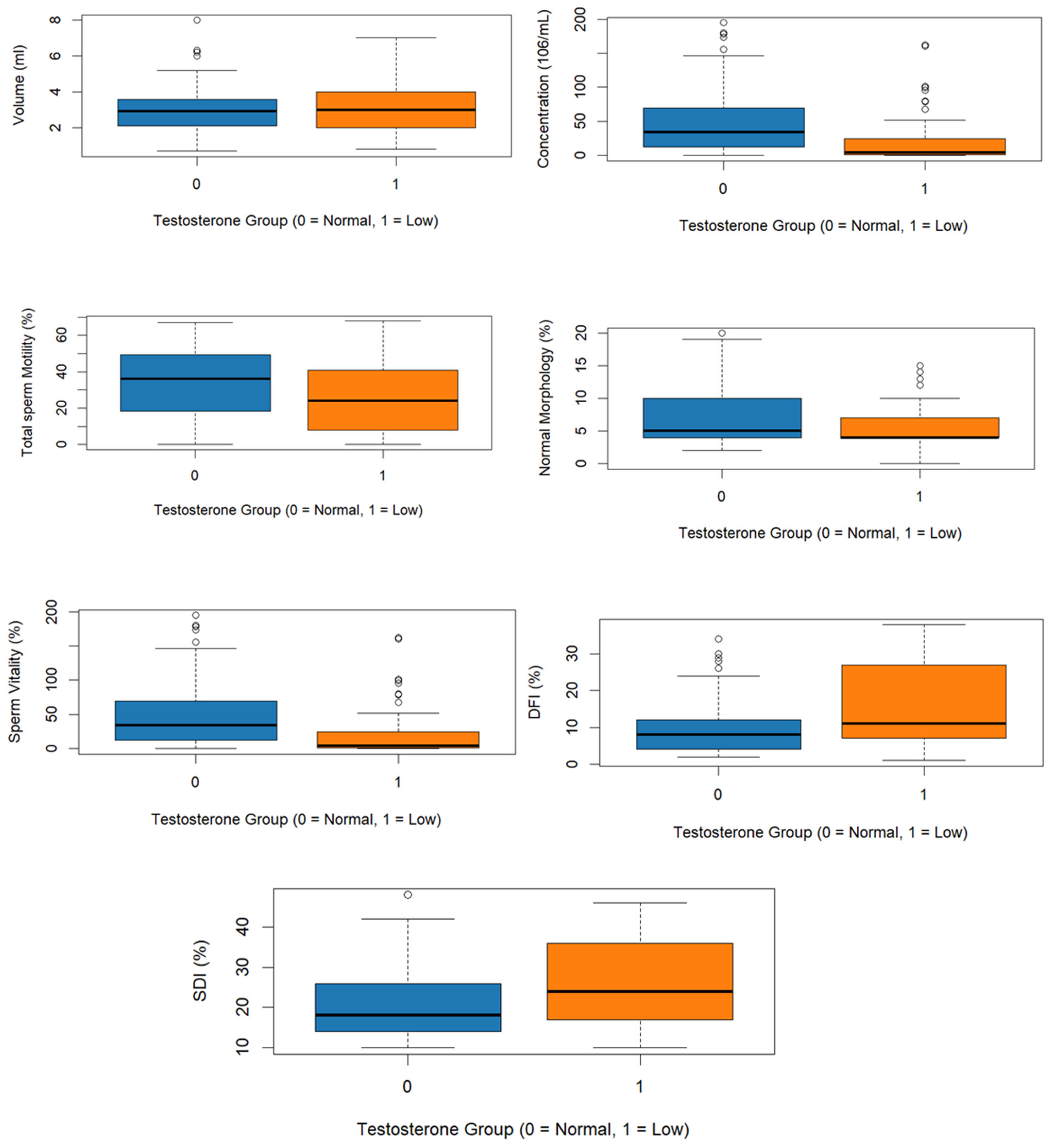
3.2. Semen Parameters According to Testosterone Levels
3.3. DFI and SDI According to Testosterone Levels
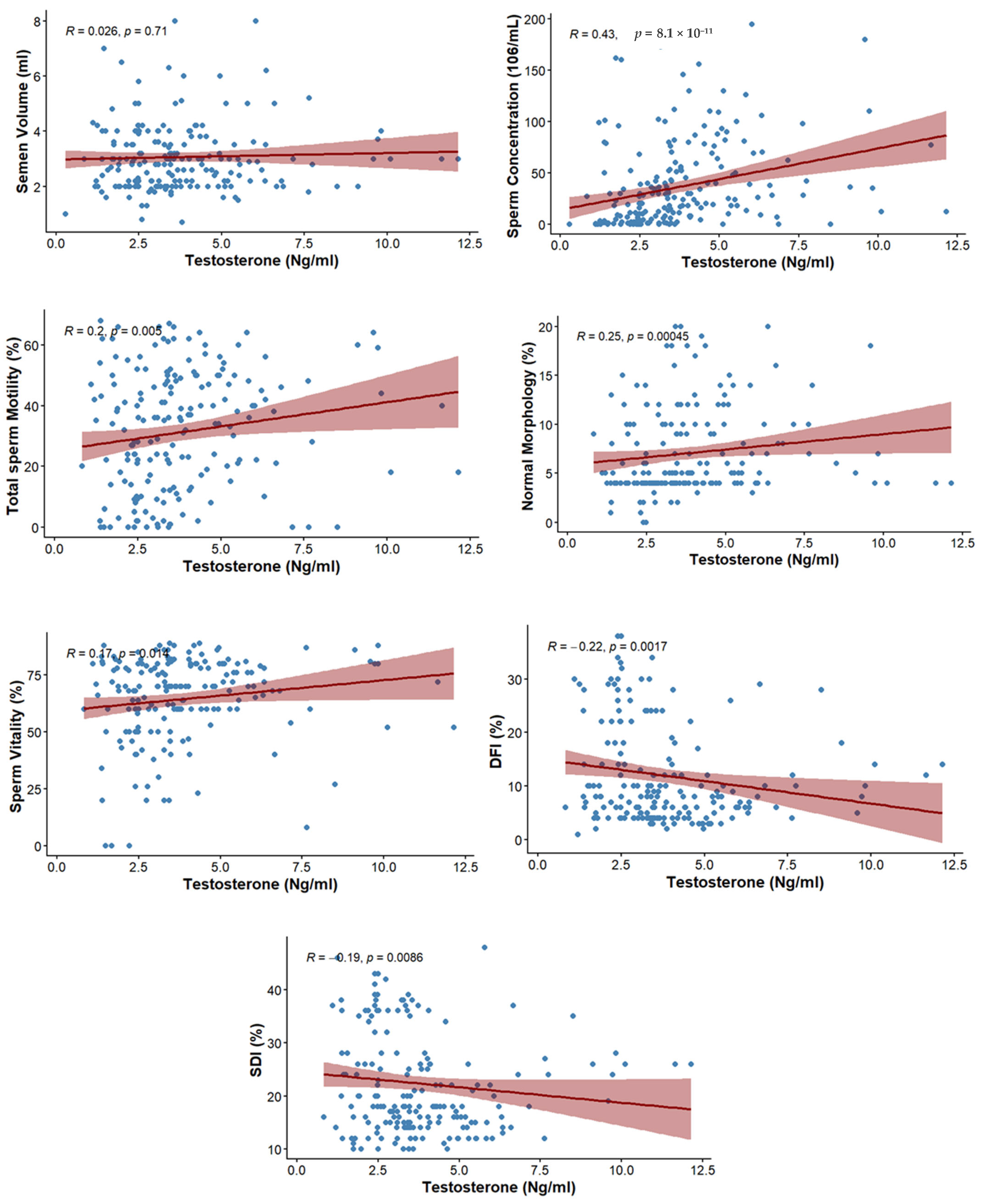
3.4. Correlation Between Testosterone and Semen Parameters
3.5. Correlation Between Testosterone and DFI, SDI
4. Discussion
5. Conclusions
Author Contributions
Funding
Institutional Review Board Statement
Informed Consent Statement
Data Availability Statement
Acknowledgments
Conflicts of Interest
Abbreviations
| WHO | World Health Organization |
| LH | Luteinizing Hormone |
| GnRH | Gonadotropin-Releasing Hormone |
| SDF | Sperm DNA Fragmentation |
| DFI | DNA Fragmentation Index |
| SCC | Sperm Chromatin Condensation |
| TUNEL | Terminal deoxynucleotidyl transferase-mediated deoxyuridine triphosphate-Nick End Labeling. |
| PBS | Phosphate-Buffered Saline |
| SDI | Sperm Decondensation Index |
| FSH | Follicle-stimulating hormone |
| ECLIA | Electrochemiluminescence immunoassay |
| TT | Total Testosterone |
| SD | Standard deviation |
| IQR | Median with interquartile range |
| rs | Spearman’s rank correlation coefficient |
| AR | Androgen receptors |
| EAU | European Association of Urology |
| AUA | American Urological Association |
References
- World Health Organization. Infertility. WHO Fact Sheets. Available online: https://www.who.int/news-room/fact-sheets/detail/infertility (accessed on 2 December 2025).
- Babakhanzadeh, E.; Nazari, M.; Ghasemifar, S.; Khodadadian, A. Some of the Factors Involved in Male Infertility: A Prospective Review. Int. J. Gen. Med. 2020, 13, 29–41. [Google Scholar] [CrossRef]
- Agarwal, A.; Baskaran, S.; Parekh, N.; Cho, C.-L.; Henkel, R.; Vij, S.; Arafa, M.; Selvam, M.K.P.; Shah, R. Male infertility. Lancet 2021, 397, 319–333. [Google Scholar] [CrossRef]
- Elhussein, O.G.; Ahmed, M.A.; Suliman, S.O.; Yahya, L.I.; Adam, I. Epidemiology of infertility and characteristics of infertile couples requesting assisted reproduction in a low-resource setting in Africa, Sudan. Fertil. Res. Pract. 2019, 5, 7. [Google Scholar] [CrossRef] [PubMed]
- Bhattacharya, I.; Sharma, S.S.; Majumdar, S.S. Etiology of Male Infertility: An Update. Reprod. Sci. 2024, 31, 942–965. [Google Scholar] [CrossRef]
- Li, L.; Lin, W.; Wang, Z.; Huang, R.; Xia, H.; Li, Z.; Deng, J.; Ye, T.; Huang, Y.; Yang, Y. Hormone Regulation in Testicular Development and Function. Int. J. Mol. Sci. 2024, 25, 5805. [Google Scholar] [CrossRef] [PubMed]
- Di Guardo, F.; Vloeberghs, V.; Bardhi, E.; Blockeel, C.; Verheyen, G.; Tournaye, H.; Drakopoulos, P. Low Testosterone and Semen Parameters in Male Partners of Infertile Couples Undergoing IVF with a Total Sperm Count Greater than 5 Million. J. Clin. Med. 2020, 9, 3824. [Google Scholar] [CrossRef] [PubMed]
- Adamczewska, D.; Słowikowska-Hilczer, J.; Walczak-Jędrzejowska, R. The Fate of Leydig Cells in Men with Spermatogenic Failure. Life 2022, 12, 570. [Google Scholar] [CrossRef]
- Marinaro, J.A.; Schlegel, P.N. Sperm DNA Damage and Its Relevance in Fertility Treatment: A Review of Recent Literature and Current Practice Guidelines. Int. J. Mol. Sci. 2023, 24, 1446. [Google Scholar] [CrossRef]
- Agarwal, A.; Farkouh, A.; Parekh, N.; Zini, A.; Arafa, M.; Kandil, H.; Tadros, N.; Busetto, G.M.; Ambar, R.; Parekattil, S.; et al. Sperm DNA Fragmentation: A Critical Assessment of Clinical Practice Guidelines. World J. Men’s Health 2022, 40, 30–37. [Google Scholar] [CrossRef]
- Kim, H.-S.; Kang, M.J.; Kim, S.A.; Oh, S.K.; Kim, H.; Ku, S.-Y.; Kim, S.H.; Moon, S.Y.; Choi, Y.M. The utility of sperm DNA damage assay using toluidine blue and aniline blue staining in routine semen analysis. Clin. Exp. Reprod. Med. 2013, 40, 23–28. [Google Scholar] [CrossRef]
- Sellami, A.; Chakroun, N.; Ben Zarrouk, S.; Sellami, H.; Kebaili, S.; Rebai, T.; Keskes, L. Assessment of chromatin maturity in human spermatozoa: Useful aniline blue assay for routine diagnosis of male infertility. Adv. Urol. 2013, 2013, 578631. [Google Scholar] [CrossRef] [PubMed]
- Bhasin, S.; Brito, J.P.; Cunningham, G.R.; Hayes, F.J.; Hodis, H.N.; Matsumoto, A.M.; Snyder, P.J.; Swerdloff, R.S.; Wu, F.C.; Yialamas, M.A. Testosterone Therapy in Men with Hypogonadism: An Endocrine Society Clinical Practice Guideline. J. Clin. Endocrinol. Metab. 2018, 103, 1715–1744. [Google Scholar] [CrossRef]
- World Health Organization. WHO Laboratory Manual for the Examination and Processing of Human Semen, 6th ed.; World Health Organization: Geneva, Switzerland, 2021. [Google Scholar]
- Gavrieli, Y.; Sherman, Y.; Ben-Sasson, S.A. Identification of Programmed Cell Death in Situ via Specific Labeling of Nuclear DNA Fragmentation. J. Cell Biol. 1992, 119, 493–501. [Google Scholar] [CrossRef] [PubMed]
- European Association of Urology (EAU). EAU Guidelines on Sexual and Reproductive Health; EAU: Arnhem, The Netherlands, 2025; Available online: https://uroweb.org/guidelines/sexual-and-reproductive-health (accessed on 27 January 2026).
- Mulhall, J.P.; Trost, L.W.; Brannigan, R.E.; Kurtz, E.G.; Redmon, J.B.; Chiles, K.A.; Lightner, D.J.; Miner, M.M.; Murad, M.H.; Nelson, C.J.; et al. Évaluation et prise en charge du déficit en testostérone: Recommandations de l’AUA. J. Urol. 2018, 200, 423–432. [Google Scholar] [CrossRef]
- Keskin, M.Z.; Budak, S.; Zeyrek, T.; Çelik, O.; Mertoglu, O.; Yoldas, M.; Ilbey, Y.Ö. The relationship between serum hormone levels (follicle-stimulating hormone, luteinizing hormone, total testosterone) and semen parameters. Arch. Ital. Urol. Androl. 2015, 87, 194–197. [Google Scholar] [CrossRef]
- Trussell, J.C.; Coward, R.M.; Santoro, N.; Stetter, C.; Kunselman, A.; Diamond, M.P.; Hansen, K.R.; Krawetz, S.A.; Legro, R.S.; Heisenleder, D.; et al. Association Between Testosterone, Semen Parameters and Live Birth in Men with Unexplained Infertility in an Intrauterine Insemination Population. Fertil. Steril. 2019, 111, 1129–1134. [Google Scholar] [CrossRef] [PubMed]
- Rehman, R.; Lalani, S.; Baig, M.; Nizami, I.; Rana, Z.; Gazzaz, Z.J. Association Between Vitamin D, Reproductive Hormones and Sperm Parameters in Infertile Male Subjects. Front. Endocrinol. 2018, 9, 607. [Google Scholar] [CrossRef]
- Zhao, W.; Jing, J.; Shao, Y.; Zeng, R.; Wang, C.; Yao, B.; Hang, D. Circulating Sex Hormone Levels in Relation to Male Sperm Quality. BMC Urol. 2020, 20, 101. [Google Scholar] [CrossRef]
- Mohammadzadeh, M.; Montazeri, F.; Poodineh, J.; Vatanparast, M.; Koshkaki, E.R.; Esmailabad, S.G.; Mohseni, F.; Talebi, A.R. Therapeutic Potential of Testosterone on Sperm Parameters and Chromatin Status in Fresh and Thawed Normo- and Asthenozoospermic Samples. Rev. Int. Andrología 2023, 21, 100352. [Google Scholar] [CrossRef]
- Lispi, M.; Drakopoulos, P.; Spaggiari, G.; Caprio, F.; Colacurci, N.; Simoni, M.; Santi, D. Testosterone Serum Levels Are Related to Sperm DNA Fragmentation Index Reduction after FSH Administration in Males with Idiopathic Infertility. Biomedicines 2022, 10, 2599. [Google Scholar] [CrossRef]
- Richthoff, J.; Spano, M.; Giwercman, Y.L.; Frohm, B.; Jepson, K.; Malm, J.; Elzanaty, S.; Stridsberg, M.; Giwercman, A. The impact of testicular and accessory sex gland function on sperm chromatin integrity as assessed by the sperm chromatin structure assay (SCSA). Hum. Reprod. 2002, 17, 3162–3169. [Google Scholar] [CrossRef] [PubMed]
- Appasamy, M.; Muttukrishna, S.; Pizzey, A.R.; Ozturk, O.; Groome, N.P.; Serhal, P.; Jauniaux, E. Relationship between male reproductive hormones, sperm DNA damage and markers of oxidative stress in infertility. Reprod. Biomed. Online 2007, 14, 159–165. [Google Scholar] [CrossRef]
- Wang, J.-M.; Li, Z.-F.; Yang, W.-X. What Does Androgen Receptor Signaling Pathway in Sertoli Cells During Normal Spermatogenesis Tell Us? Front. Endocrinol. 2022, 13, 838858. [Google Scholar] [CrossRef]
- Walker, W.H. Androgen Actions in the Testis and the Regulation of Spermatogenesis. Adv. Exp. Med. Biol. 2021, 1288, 175–203. [Google Scholar] [CrossRef] [PubMed]
- Chen, S.-R.; Hao, X.-X.; Zhang, Y.; Deng, S.-L.; Wang, Z.-P.; Wang, Y.-Q.; Wang, X.-X.; Liu, Y.-X. Androgen receptor in Sertoli cells regulates DNA double-strand break repair and chromosomal synapsis of spermatocytes partially through intercellular EGF-EGFR signaling. Oncotarget 2016, 7, 18722–18735. [Google Scholar] [CrossRef]
- Stanton, P.G.; Sluka, P.; Foo, C.F.H.; Stephens, A.N.; Smith, A.I.; McLachlan, R.I.; O’Donnell, L. Proteomic changes in rat spermatogenesis in response to in vivo androgen manipulation; impact on meiotic cells. PLoS ONE 2012, 7, e41718. [Google Scholar] [CrossRef]
- Wang, Y.; Fu, X.; Li, H. Mechanisms of oxidative stress-induced sperm dysfunction. Front. Endocrinol. 2025, 16, 1520835. [Google Scholar] [CrossRef]
- Câmara, M.L.; Almeida, T.B.; de Santi, F.; Rodrigues, B.M.; Cerri, P.S.; Beltrame, F.L.; Sasso-Cerri, E. Fluoxetine-induced androgenic failure impairs the seminiferous tubules integrity and increases ubiquitin carboxyl-terminal hydrolase L1 (UCHL1): Possible androgenic control of UCHL1 in germ cell death? Biomed. Pharmacother. 2019, 109, 1126–1139. [Google Scholar] [CrossRef]
- Holdcraft, R.W.; Braun, R.E. Androgen receptor function is required in Sertoli cells for the terminal differentiation of haploid spermatids. Development 2004, 131, 459–467. [Google Scholar] [CrossRef]
- Beardsley, A.; O’Donnell, L. Characterization of normal spermiation and spermiation failure induced by hormone suppression in adult rats. Biol. Reprod. 2003, 68, 1299–1307. [Google Scholar] [CrossRef] [PubMed]
- Olli, K.E.; Li, K.; Galileo, D.S.; Martin-DeLeon, P.A. Plasma membrane calcium ATPase 4 (PMCA4) co-ordinates calcium and nitric oxide signaling in regulating murine sperm functional activity. J. Cell. Physiol. 2018, 233, 11–22. [Google Scholar] [CrossRef] [PubMed]



| Group 0 (TT ≥ 2.64 ng/mL) | Group 1 (TT < 2.64 ng/mL) | p-Value | |
|---|---|---|---|
| Age (years) | 0.0015 y | ||
| Mean (SD) | 39 ± 4.7 | 41 ± 4 | |
| Median (IQR) | 39 (36–43) | 41 (38–45) | |
| FSH (UI/L) | <0.001 x | ||
| Mean (SD) | 5.75 ± 4.5 | 9.38 ± 7.3 | |
| Median (IQR) | 4.40 (3.14–6.63) | 7.80 (4.05–13.05) | |
| LH (UI/L) | <0.001 x | ||
| Mean (SD) | 4.34 ± 3.69 | 7.18 ± 4.18 | |
| Median (IQR) | 3 (2–5.71) | 7.12 (4.10–10) | |
| TT (ng/mL) | <0.001 x | ||
| Mean (SD) | 4.66 ± 1.8 | 2 ± 0.5 | |
| Median (IQR) | 4.02 (3.42–5.29) | 2.12 (1.67–2.48) |
| Group 0 (TT ≥ 2.64 ng/mL) | Group 1 (TT < 2.64 ng/mL) | p-Value | |
|---|---|---|---|
| Semen Volume (mL) | 0.515 | ||
| Mean (SD) | 3.03 ± 1.22 | 3.10 ± 1.22 | |
| Median (IQR) | 2.90 (2.10–3.60) | 3 (2–3.4) | |
| Sperm Concentration (106/mL) | <0.001 | ||
| Mean (SD) | 45.8 ± 43.2 | 19.6 ± 33.3 | |
| Median (IQR) | 34 (12–69.5) | 4 (0.8–25) | |
| Total sperm Motility (%) | 0.011 | ||
| Mean (SD) | 33.7 ± 19.3 | 26.2 ± 19.9 | |
| Median (IQR) | 36 (18.50–49.5) | 24 (8–41) | |
| Normal Morphology (%) | 0.003 | ||
| Mean (SD) | 7.69 ± 4.63 | 5.78 ± 3.60 | |
| Median (IQR) | 5 (4–10) | 4 (4–7) | |
| Sperm Vitality (%) | 0.024 | ||
| Mean (SD) | 66.4 ± 17.8 | 60.2 ± 21.2 | |
| Median (IQR) | 70 (60–80) | 64 (50–77) |
| Group 0 (TT ≥ 2.64 ng/mL) | Group 1 (TT < 2.64 ng/mL) | p-Value | |
|---|---|---|---|
| DFI (%) | <0.001 | ||
| Mean (SD) | 9.99 ± 7.75 | 15.93 ± 10.82 | |
| Median (IQR) | 8 (4–12) | 11 (7–26.5) | |
| SDI (%) | 0.001 | ||
| Mean (SD) | 20.6 ± 8.52 | 25.8 ± 10.62 | |
| Median (IQR) | 18 (14–26) | 24 (17.5–36) |
| Spearman’s Rank with Testosterone | p-Value | |
|---|---|---|
| Semen Volume (mL) | 0.026 | 0.710 |
| Sperm Concentration (106/mL) | 0.43 | <0.001 |
| Total sperm Motility (%) | 0.2 | 0.005 |
| Normal Morphology (%) | 0.25 | <0.001 |
| Sperm Vitality (%) | 0.173 | 0.014 |
| Spearman’s Rank with Testosterone | p-Value | |
|---|---|---|
| DFI (%) | −0.221 | 0.0017 |
| SDI (%) | −0.19 | 0.0086 |
Disclaimer/Publisher’s Note: The statements, opinions and data contained in all publications are solely those of the individual author(s) and contributor(s) and not of MDPI and/or the editor(s). MDPI and/or the editor(s) disclaim responsibility for any injury to people or property resulting from any ideas, methods, instructions or products referred to in the content. |
© 2026 by the authors. Licensee MDPI, Basel, Switzerland. This article is an open access article distributed under the terms and conditions of the Creative Commons Attribution (CC BY) license.
Share and Cite
Serbouti, A.; Berrada, K.; Housbane, S.; Louanjli, N.; Aboutaieb, R. Low Testosterone and Sperm Quality Alterations: A Prospective Study of Sperm DNA Fragmentation and Chromatin Condensation in Infertile Men. Biology 2026, 15, 287. https://doi.org/10.3390/biology15030287
Serbouti A, Berrada K, Housbane S, Louanjli N, Aboutaieb R. Low Testosterone and Sperm Quality Alterations: A Prospective Study of Sperm DNA Fragmentation and Chromatin Condensation in Infertile Men. Biology. 2026; 15(3):287. https://doi.org/10.3390/biology15030287
Chicago/Turabian StyleSerbouti, Asmaa, Kenza Berrada, Samy Housbane, Noureddine Louanjli, and Rachid Aboutaieb. 2026. "Low Testosterone and Sperm Quality Alterations: A Prospective Study of Sperm DNA Fragmentation and Chromatin Condensation in Infertile Men" Biology 15, no. 3: 287. https://doi.org/10.3390/biology15030287
APA StyleSerbouti, A., Berrada, K., Housbane, S., Louanjli, N., & Aboutaieb, R. (2026). Low Testosterone and Sperm Quality Alterations: A Prospective Study of Sperm DNA Fragmentation and Chromatin Condensation in Infertile Men. Biology, 15(3), 287. https://doi.org/10.3390/biology15030287