1. Introduction
AI has transformed educational practices by enabling adaptive learning, automated assessment, and enhanced data-driven decision-making. In language education, AI demonstrates transformative potential by enabling personalized learning through chatbots and empowering teachers to generate tailored materials (
Kohnke et al., 2023;
Suchánová, 2023;
Tan et al., 2024;
Żammit, 2025).
To harness these opportunities, pre-service teachers (PSTs) should develop multidimensional AI competencies, encompassing technical knowledge, lesson planning skills, and positive mindsets (
Celik, 2023;
Mishra et al., 2023;
Seufert et al., 2021). However, studies indicate that PSTs were generally unprepared for AI-integrated English instruction compared to in-service teachers (
Moorhouse, 2024), and possess an unsatisfactory understanding of AI’s pedagogical applications (
Lauran et al., 2024;
Pokrivcakova, 2023). Consequently, many PSTs lack the specific skills required for AI-integrated lessons (
Harakchiyska & Vassilev, 2024), underscoring a pressing need for targeted training to enhance PSTs’ ability to select and implement AI-driven teaching (
Chan & Tang, 2025;
Hastomo et al., 2024;
Metwally & Bin-Hady, 2025).
Beyond professional knowledge and skills, attitudinal factors are critical determinants of AI adoption. Research consistently shows that PSTs’ behavioral intention to design AI-assisted teaching is significantly predicted by perceived usefulness and AI anxiety (
K. Wang et al., 2024;
Zhang et al., 2023). Despite the general optimism about AI’s potential (
Özer-Altınkaya & Yetkin, 2025;
Pokrivcakova, 2023), PSTs still experience pressure and concerns regarding technical proficiency (
Chung & Jeong, 2024;
Falebita, 2025). This complex interplay suggests that effective teacher training must address competency development and attitudinal barriers concurrently.
Despite the urgent need, structured teacher preparation programs dedicated to cultivating AI competencies remain scarce (
Hsu et al., 2024;
Kim & Kwon, 2023;
Tan et al., 2024;
Żammit, 2025). A recent review reveals that teacher education programs tend to prioritize discrete technological knowledge, with insufficient attention being paid to how these tools can be pedagogically integrated within specific subjects (
Fabian et al., 2024). Qualitative studies reinforce this finding, revealing that PSTs recognize their own “insufficient training” as a significant challenge to developing AI competencies (
Kohnke et al., 2025). This is particularly critical given evidence that English teachers’ technological pedagogical knowledge lags behind their technical proficiency (
Chan & Tang, 2025;
Lauran et al., 2024). Meanwhile, although valuable insights have been gained from PSTs’ self-efficacy (
Meegan & Young, 2025;
Yang et al., 2024), AI literacy (
Younis, 2024), or individual knowledge components (
Kayaalp et al., 2025), there is a paucity of research that holistically examines the interplay of professional knowledge, lesson planning skills, and attitudes. Moreover, while frameworks like Intelligent-TPACK theorize the requisite knowledge, there remains a gap in operationalizing it through established pedagogical training models to move from theoretical awareness to practical pedagogical reasoning. Furthermore, existing studies often rely on small-scale or single-group designs (
Fabian et al., 2024), leaving it unclear whether structured training surpasses self-directed exploration. Addressing these essential components of teaching competency is critical for fostering sustainable AI adoption (
Sun et al., 2023).
To address these gaps, this study developed and evaluated a structured intervention guided by a triadic instructional design. This model combines: (1) the Intelligent-TPACK model (
Celik, 2023), which defines the requisite knowledge domains; (2) the Synthesis of Qualitative Data (SQD) model (
Tondeur et al., 2012), which provides evidence-based strategies for teacher training; and (3) curated AI tools, which serve as the medium for application. This study employs a mixed-method design to investigate the efficacy of this model. Specifically, the following hypotheses were tested to compare the experimental group receiving the triadic intervention with a control group engaged in self-directed AI exploration:
H1. The experimental group would demonstrate significantly greater gains in self-reported Intelligent-TPACK scores.
H2. The experimental group would demonstrate significantly greater improvements in applying Intelligent-TPACK in AI-integrated lesson planning.
H3. The experimental group would report significantly higher perceived usefulness and lower levels of perceived pressure regarding AI integration.
To complement this quantitative comparison and to better understand the mechanisms behind the outcomes, qualitative data from participant reflections were analyzed.
This study contributes to the field by moving beyond conceptual proposals to provide empirical validation for a structured, theory-grounded model of AI teacher preparation. It explicitly operationalized the Intelligent-TPACK framework through the synergistic application of the SQD model, demonstrating that structured training, unlike self-directed AI exploration, can transform PSTs’ AI knowledge, skills, and attitudes. In addition, this study employs a quasi-experimental design and triangulates survey data with lesson plans, offering performance-based evidence that validates the development of PSTs’ pedagogical reasoning.
2. Literature Review
2.1. Conceptual Frameworks for Teachers’ AI Knowledge and Competence
The rapid integration of AI into education necessitates significant changes in teachers’ knowledge. The Digital Competence Framework for Educators defines the competencies required to use digital technologies in the educational context. In 2022, the
European Commission (
2022) described that teachers’ competencies for ethical use of AI include professional engagement, digital resources, teaching and learning, assessment, empowering learners, and facilitating learners’ digital competence. The framework emphasizes that teachers should use AI-driven tools to enhance their professional and pedagogical knowledge as well as learners’ competencies (
Ng et al., 2023). While this framework provides a comprehensive overview of digital competence, it lacks the granular focus on tool-content alignment required for instructional design.
The TPACK model refers to teachers’ professional knowledge required to effectively use technology for instructional purposes (
Mishra & Koehler, 2006). It has long served as a framework for designing and evaluating pre-service teacher training (
Fabian et al., 2024). To understand TPACK in the age of AI,
Celik (
2023) developed an Intelligent-TPACK framework. Specifically, Intelligent-technological knowledge (I-TK) addresses the knowledge required to understand the functionalities and limitations of AI-based tools and how to use these tools. Intelligent-technological pedagogical knowledge (I-TPK) refers to the skills needed to utilize AI-based tools to support pedagogical processes. Intelligent-technological content knowledge (I-TCK) is the knowledge of field-specific AI tools and how they are used to address subject-matter learning in that field. Intelligent-technological pedagogical content knowledge (I-TPACK) is regarded as the core knowledge domain that focuses on how teachers make informed decisions on selecting appropriate AI-based tools for teaching strategies within a particular content domain. While the Intelligent-TPACK framework includes an ethics dimension, it is not the focus of this study.
This study utilizes Intelligent-TPACK as the primary theoretical lens because it extends a validated, generative framework (
Mishra et al., 2023) to the specific affordances of AI, providing a robust foundation for defining the essential knowledge base of an AI-ready teacher.
2.2. Educational Frameworks to Prepare Teachers for Technology Use
Teacher training programs play a critical role in transforming teaching practices, attitudes, and beliefs (
Stavermann, 2025). A representative framework is the SQD model (
Tondeur et al., 2012), which synthesizes key principles for preparing PSTs for technology use, including role modeling, collaborative design, and scaffolding authentic experiences. The effectiveness of these SQD principles is corroborated by empirical and longitudinal studies (
Darling-Hammond et al., 2017;
Meletiou-Mavrotheris & Paparistodemou, 2024). For example,
Lachner et al. (
2021) designed a TPACK module based on these principles, where PSTs collaboratively designed subject-specific lesson plans and conducted micro-teaching, resulting in significant improvements in PSTs’ technology-related self-efficacy and professional knowledge.
Building on the established foundation, recent research has explored various approaches to cultivate AI-specific teaching competencies. For example,
Sun et al. (
2023) leveraged the TPACK framework to structure professional development programs, demonstrating its utility in enhancing teachers’ AI knowledge and teaching skills.
Yang et al. (
2024) explored how a program grounded in social cognitive theory (
Bandura, 1989) could enhance teachers’ self-efficacy and identified the importance of enactive mastery experiences, community support and observational learning. Other researchers have proposed specific instructional approaches for AI integration, such as the 6E learning by design model (
Saimon et al., 2024) and AI-assisted lesson planning and micro-teaching (
Moorhouse et al., 2025;
Park & Son, 2022).
In summary, while the technological focus has evolved from general information and communication technologies to AI, the pedagogical principles synthesized in the SQD model—such as learning by design, collaboration, and authentic practice—continue to underpin effective teacher training. Hence, the present study leverages this enduring potential by explicitly applying the SQD model to structure an AI-focused intervention.
2.3. AI Applications in EFL Teacher Preparation
Given the unique affordances of AI in language learning, recent research has begun to specify approaches and AI tools pertinent to EFL teacher preparation.
Suchánová (
2023) categorized AI applications essential for PSTs into domains including natural language processing (NLP) tools, chatbots, and generative AI. PSTs are required to understand these tools not only for their direct impact on student learning but also for their potential to be leveraged effectively in instructional design and classroom practice. For instance, chatbots and conversational AI have been shown to enhance writing skills by providing iterative feedback (
Boudouaia et al., 2024) and to increase student engagement via personalized, interactive dialogs (
Y. Wang & Xue, 2024). NLP tools for automated writing evaluation require teachers to critically interpret and integrate AI-generated feedback in conjunction with their own assessment (
Lu et al., 2024;
Suchánová, 2023). Furthermore, generative AI supports PSTs in creating differentiated materials aligned with learners’ proficiency levels (
Chan & Tang, 2025), a competency central to adaptive teaching.
Recent studies explicitly highlight how these AI tools facilitate PSTs’ professional development and instructional planning.
Moorhouse et al. (
2024) highlighted the utility of generative AI in streamlining lesson preparation through content creation and feedback generation. Similarly,
Kusuma et al. (
2024) found that PSTs leveraged generative AI for resource generation and for consulting on teaching strategies and assessments. Therefore, to harness these affordances, training programs should prioritize hands-on experience, guiding teachers to critically align AI applications with specific EFL pedagogical goals.
2.4. A Triadic Instructional Design: Synthesizing Intelligent-TPACK, SQD Strategies, and AI Tools
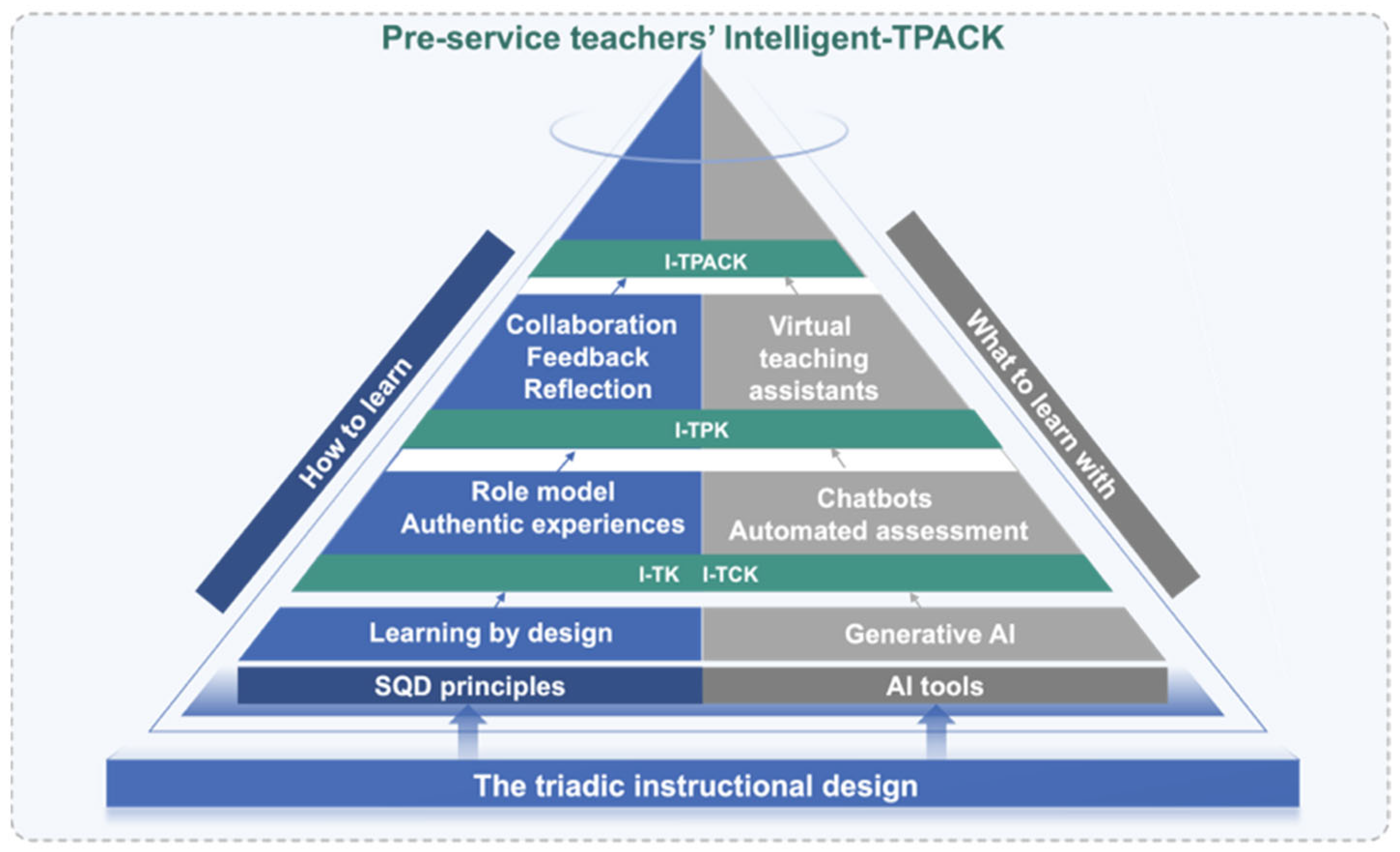
To address the critical gap in preparing PSTs for AI integration—particularly their competencies in pedagogical knowledge (I-TPK) and contextualized integration (I-TPACK)—this study proposes a triadic instructional design (see
Figure 1). In this model, the Intelligent-TPACK model (
Celik, 2023) provides the foundational knowledge structure, defining what PSTs need to know about AI integration. The SQD model (
Tondeur et al., 2012) operationalizes this structure by dictating how knowledge should be developed through authentic, collaborative, and reflective learning experiences. Finally, AI tools serve as the medium with which these experiences are enacted, allowing PSTs to directly interact with and critically evaluate pedagogical affordances.
Contextualized for EFL teaching, the model defines the knowledge domains as follows: I-TK concerns the knowledge of how to interact with AI-based tools, covering the five big ideas of AI, how AI works, and the functionalities of common AI-based tools. I-TCK involves understanding how AI tools transform the demonstration of English learning content and contribute to teachers’ content-specific knowledge, such as creating AI-generated English materials and assessments tailored to different language proficiency levels. I-TPK focuses on the pedagogical affordances of AI tools, including facilitating timely assessment, personalized feedback for teaching and learning, managing differences, and sustaining students’ motivation. I-TPACK represents the highest-order synthesis, emphasizing the alignment of suitable AI tools and pedagogical strategies with English teaching objectives.
The pedagogical approach of this model draws on the SQD model and the strategic use of AI tools, structuring activities to progressively build competencies from foundational knowledge to integrated practice. The selection of specific AI tools for this model was guided by three criteria: (1) alignment with specific Intelligent-TPACK domains; (2) relevance to EFL instruction; and (3) accessibility for PSTs and K-12 classrooms.
Foundational Design (I-TK & I-TCK): Leveraging the learning-by-design principle, PSTs use generative AI to create assessments and learning materials tailored to diverse proficiency levels (
Koraishi, 2023). This task builds technical familiarity while introducing the pedagogical concept of personalization.
Pedagogical Deepening (I-TPK): To deepen their I-TPK, PSTs engage in role modeling by analyzing video demonstrations of AI integration into domain-specific instruction. This is paired with authentic experiences, such as evaluating spoken pronunciation with automated assessment systems (
Y. Wang & Zhao, 2020), designing chatbots for oral practice (
Suchánová, 2023), and modeling questioning strategies (
Lee et al., 2025). These activities provide direct experience with key AI affordances (e.g., providing timely, personalized feedback and scaffolding student learning), thereby solidifying understanding of AI’s pedagogical contributions.
Integrated Synthesis (I-TPACK): To synthesize these competencies, PSTs engage in collaborative design and reflection. They collaboratively design lesson plans and conduct micro-teaching sessions that integrate AI. AI-powered virtual teaching assistants are used to scaffold this process. This includes conversational AI for reviewing lesson plans and automated video analysis tools for evaluating micro-teaching performance. The reflective step compels PSTs to evaluate the alignment of AI tools, pedagogical strategies, and content, which is the core of I-TPACK.
The model posits that engaging in these scaffolded tasks does more than build knowledge; it fosters psychological readiness. By providing enactive mastery experiences (
Bandura, 1989), the model aims to reduce AI-related pressure and cultivate the self-efficacy required for sustainable adoption (
Yang et al., 2024).
3. Methods
3.1. Design
This study employed a pretest-posttest quasi-experimental design to compare the efficacy of a structured, pedagogically grounded intervention against a baseline of unguided, self-directed AI exploration. This study was conducted within an undergraduate educational technology course for English education majors. The course comprised two phases: an initial online phase covering foundational theory and basic lesson planning, followed by the offline, lab-based phase where this study took place. Four intact classes were randomly assigned to either the experimental group or the control group, with two classes in each condition.
To ensure group equivalence, participants’ prior AI learning experiences were collected and compared before the intervention. All participants completed pretests measuring their Intelligent-TPACK knowledge and attitudes toward AI integration. Both groups completed the same number of sessions and engaged in core activities such as lesson planning and micro-teaching. The experimental group received the structured intervention guided by the triadic instructional design, while the control group completed the traditional educational technology course.
To assess learning outcomes, the self-reported Intelligent-TPACK and attitudinal scales were administered as posttests. To evaluate the application of knowledge in instructional design, participants in both groups were required to design two lesson plans: one before the intervention (Lesson Plan #1) and a new one after (Lesson Plan #2).
3.2. Participants
A total of 259 undergraduate students from an English Education program at a university in China participated in this study. As the program prepares students for careers in primary and secondary EFL education, all participants were considered PSTs.
Table 1 presents the demographic information of the participants. The sample comprised 56 males (21.6%) and 203 females (78.4%), with 137 participants in the experimental group and 122 in the control group. Regarding prior AI learning experiences, 97 participants (37.5%) reported some exposure to AI, primarily through personal use of generative AI. This experience was distributed relatively evenly between the experimental group (
n = 52, 38.0% of the experimental group) and the control group (
n = 45, 36.9% of the control group). None had participated in a structured course on AI for teaching. The remaining 162 participants (62.5%) had no prior AI learning experiences. Ethical approval was obtained from the research ethics committee at the university. All participants were informed of the project’s aims and procedures, and informed consent was obtained prior to data collection.
3.3. Intervention
The intervention was a direct application of the triadic instructional design. It consisted of seven 90 min sessions, each addressing a specific dimension of Intelligent-TPACK (see
Table 2). Sessions 1–2 established I-TK and I-TCK through learning by design with generative AI. Sessions 3–4 deepened I-TPK through role modeling (analyzing expert videos) and authentic experiences. Finally, sessions 5–7 cultivated I-TPACK via collaborative design and reflection, where participants co-created, refined, and taught AI-integrated lesson plans, using an AI-based chatbot for analysis and feedback.
In contrast to the experimental group, the control group completed the standard educational technology course focusing on information and communication technologies (ICTs; see
Table 3). This condition was designed to represent a baseline of unguided, self-directed AI exposure within a typical technology course. To operationalize this, the instructor provided a brief overview of AI’s impact on education. During a session on pedagogical affordances (session 3), the instructor contrasted ICTs with the potential of AI tools through a short introduction to motivate self-directed AI exploration. However, the control group received no specific training or scaffolding on how to use AI for teaching. Their AI use was not monitored. Participants were only encouraged to explore AI tools on their own, mirroring the common scenario where technology is available but integrated without structured pedagogical support.
3.4. Data Collection
3.4.1. Intelligent-TPACK Scale
A self-report scale adapted from the validated Intelligent-TPACK scale (
Celik, 2023) was administered to assess pre-service EFL teachers’ required knowledge for AI-integrated English teaching. The adapted scale comprised 16 items across four dimensions (see
Appendix A): 3 items measuring I-TK (e.g., “I know how to interact with AI-based tools in daily life”), 5 items for I-TPK (e.g., “I can understand the pedagogical contribution of AI-based tools to EFL teaching”), 4 items for I-TCK (e.g., “I can use AI-based tools to search for educational material in EFL teaching”), and 4 items for I-TPACK (e.g., “I can teach English lessons that appropriately combine my teaching content, AI-based tools, and teaching strategies”). Items from the original scale deemed irrelevant to the current intervention context were excluded. Items were rated on a 5-point Likert scale (1 = strongly disagree, 5 = strongly agree). To ensure linguistic and conceptual equivalence, the survey was translated into Chinese and underwent a back-translation procedure by a bilingual expert. The adapted scale demonstrated satisfactory to high reliability, with Cronbach’s alpha coefficients ranging from 0.73 to 0.87 across the four dimensions.
3.4.2. Scoring Rubric for Lesson Plans
Lesson plans were evaluated using an AI Integration Assessment Rubric (see
Appendix B), adapted from the validated Technology Integration Assessment Rubric (
Harris et al., 2010). In this rubric, four criteria related to key TPACK dimensions were scored on a 4-point Likert scale (1 = unsatisfactory, 4 = exemplary). Specifically, curriculum goals & AI technologies (I-TCK) measures the alignment between selected AI tools and curricular objectives. Instructional strategies & AI technologies (I-TPK) evaluates the appropriateness of AI use in supporting pedagogical approaches. AI Technology selection (I-TPACK) assesses the suitability of AI tools in relation to both curricular goals and instructional strategies. The last criterion, named “fit” (I-TPACK), examines the holistic coherence among learning content, instructional strategies, and technology usage. The rubric thus specifically focused on evaluating the deliberate selection and pedagogical application of AI technologies.
To establish scoring reliability, two trained raters (the first author and a research assistant) independently scored a pilot set of 10 randomly selected lesson plans using the rubric (each dimension scored on a scale of 1 to 4 per dimension). Raters were blinded to participant identity and group membership (experimental or control) throughout the scoring process. Initial Cohen’s kappa measure was calculated (
J. Cohen, 1968), yielding moderate inter-rater reliability: curriculum goals & AI technologies = 0.58, instructional strategies & AI technologies = 0.46, AI technology selection = 0.71, and fit = 0.56. Discrepancies in scoring between the two raters were resolved through a structured consensus-building process (
Zhou et al., 2025). First, the two raters reviewed the lesson plan together to identify specific evidence of AI integration. Then, the raters mapped the evidence against the descriptions and illustrative examples provided in the rubric and clarified the boundary between levels. A third domain expert was consulted when needed. This process ensured that illustrative examples were interpreted consistently. Following this calibration, a second round of independent scoring on a new set of 10 lesson plans demonstrated substantial agreement (Cohen’s kappa > 0.73). In accordance with established methodological guidelines (
O’Connor & Joffe, 2020), this substantial agreement confirmed the stability of the coding frame. Consequently, the remaining lesson plans were assessed by the raters independently.
3.4.3. Attitudinal Scale
McAuley et al. (
1989) developed the Intrinsic Motivation Inventory to measure subjects’ experience regarding the intervention tasks. It has been revised and utilized in educational settings for various purposes, including understanding teachers’ attitudes toward skill development in professional development programs (
Chiu et al., 2021). Aligning with prior literature identifying perceived usefulness and pressure as critical predictors of AI adoption (
K. Wang et al., 2024;
Zhang et al., 2023), this study employed the usefulness and pressure subscales. Perceived usefulness of AI-integrated instruction was measured through four items from the sub-scale usefulness (Cronbach’s alpha = 0.87). For example, “I believe learning to use AI for EFL teaching could be of some value to me.” Perceived pressure was measured using three items from the pressure sub-scale (Cronbach’s alpha = 0.89). This subscale is explicitly designed to measure the extent to which an individual feels pressured while performing a specific task (
McAuley et al., 1989). An example item is “I felt very tense while learning to use AI for EFL teaching.” The attitudinal scale can be found in
Appendix A.
3.4.4. Reflection Journal
At the end of the intervention, the experimental group submitted a reflective journal alongside their final lesson plans, responding to three open-ended questions: (1) How did the intervention help you improve your professional knowledge and skills? (2) How did you use AI tools in your lesson plans, and why? (3) What difficulties did you encounter during the intervention? These questions were designed to elicit qualitative insights into participants’ experiences and facilitate triangulation with the quantitative data.
3.5. Data Analysis
Quantitative data analysis was conducted using SPSS Statistics (Version 26). As the experimental conditions were assigned at the class level, we applied a linear mixed model to account for the nested data structure (i.e., participants within classes). The experimental condition (group), time (pre- and post-test), and their interaction were included as fixed effects. The interaction effect was the primary term of interest, as a significant interaction indicates that the change in scores over time differed significantly between the two groups. Additionally, class was specified as a random effect to control for class-level clustering. To estimate the magnitude of the difference within groups, Cohen’s d (
J. Cohen, 1988) effect size was calculated.
Qualitative data analysis followed the procedure of
Saldaña (
2015). To ensure a comprehensive understanding of the participants’ experiences, a hybrid coding strategy was employed, integrating both deductive and inductive approaches. In the deductive phase, large text segments were categorized based on the guiding reflection questions, establishing the initial analytical framework. Two researchers (the first author and a research assistant) then read the data multiple times to become familiar with the content. In the inductive phase, the researchers independently identified frequently mentioned phrases and concepts within each segment (e.g., enhanced efficiency, teaching materials creation, prompts), generating initial codes through an open coding process. To ensure the credibility and trustworthiness of the findings, investigator triangulation was utilized (
L. Cohen et al., 2007). The two researchers engaged in iterative discussions to compare their independent codes, clustering related codes to identify emerging patterns. The selection of the main themes was guided by their alignment with the study’s research objectives and their ability to provide an in-depth understanding of participants’ experiences with AI integration (e.g., leveraging AI for instructional activities). Through this process of negotiated consensus, the researchers defined and finalized the definition and naming of the three themes reported in the findings.
4. Results
4.1. Self-Reported Intelligent-TPACK Results
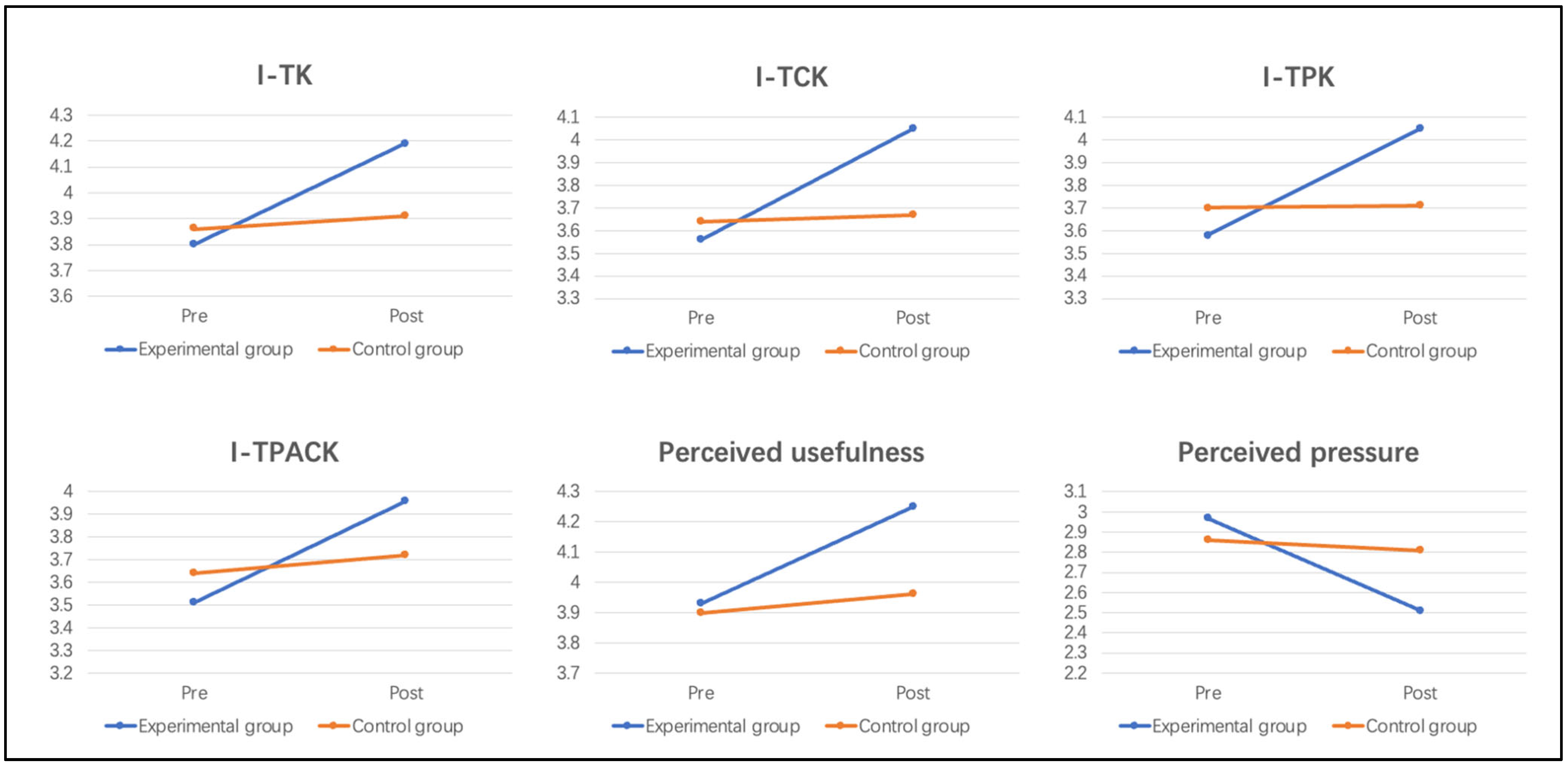
Table 4 presents the descriptive statistics for self-reported Intelligent-TPACK results. In line with H1, linear mixed model analysis revealed significant interaction effects across all four dimensions (see
Figure 2): I-TK, F (1, 512.04) = 9.93,
p = 0.002; I-TPK, F (1, 512.00) = 18.67,
p < 0.001; I-TCK, F (1, 512.00) = 16.72,
p < 0.001; and I-TPACK, F (1, 512.05) = 11.88,
p = 0.001. Pairwise comparisons using Bonferroni adjustment showed no significant differences between the experimental and control groups at pre-test for any dimension (
p > 0.05), confirming that both groups started with comparable levels of knowledge. Compared to the control group, the experimental group showed significant improvement in I-TK (M
difference = 0.39,
p < 0.001) with a moderate effect size (0.63), I-TCK (M
difference = 0.49,
p < 0.001) with a moderate to large effect size (0.77), I-TPK (M
difference = 0.47,
p < 0.001) with a moderate to large effect size (0.78), I-TPACK (M
difference = 0.45,
p < 0.001) with a moderate to large effect size (0.75). In contrast, the control group showed no significant pre-to-post changes (
p > 0.05).
4.2. Lesson Plan Results
Only participants who completed both lesson plans were included in the analysis (N
experimental = 126, N
control = 118). Missing data were primarily attributed to administrative factors, such as personal leave on the day of submission or students changing majors during the study. A Chi-square test confirmed that there was no significant difference in attrition rates between the two groups (
= 2.67,
p > 0.05), indicating that the dropout was not influenced by the experimental conditions.
Table 5 presents the descriptive statistics for lesson plan data.
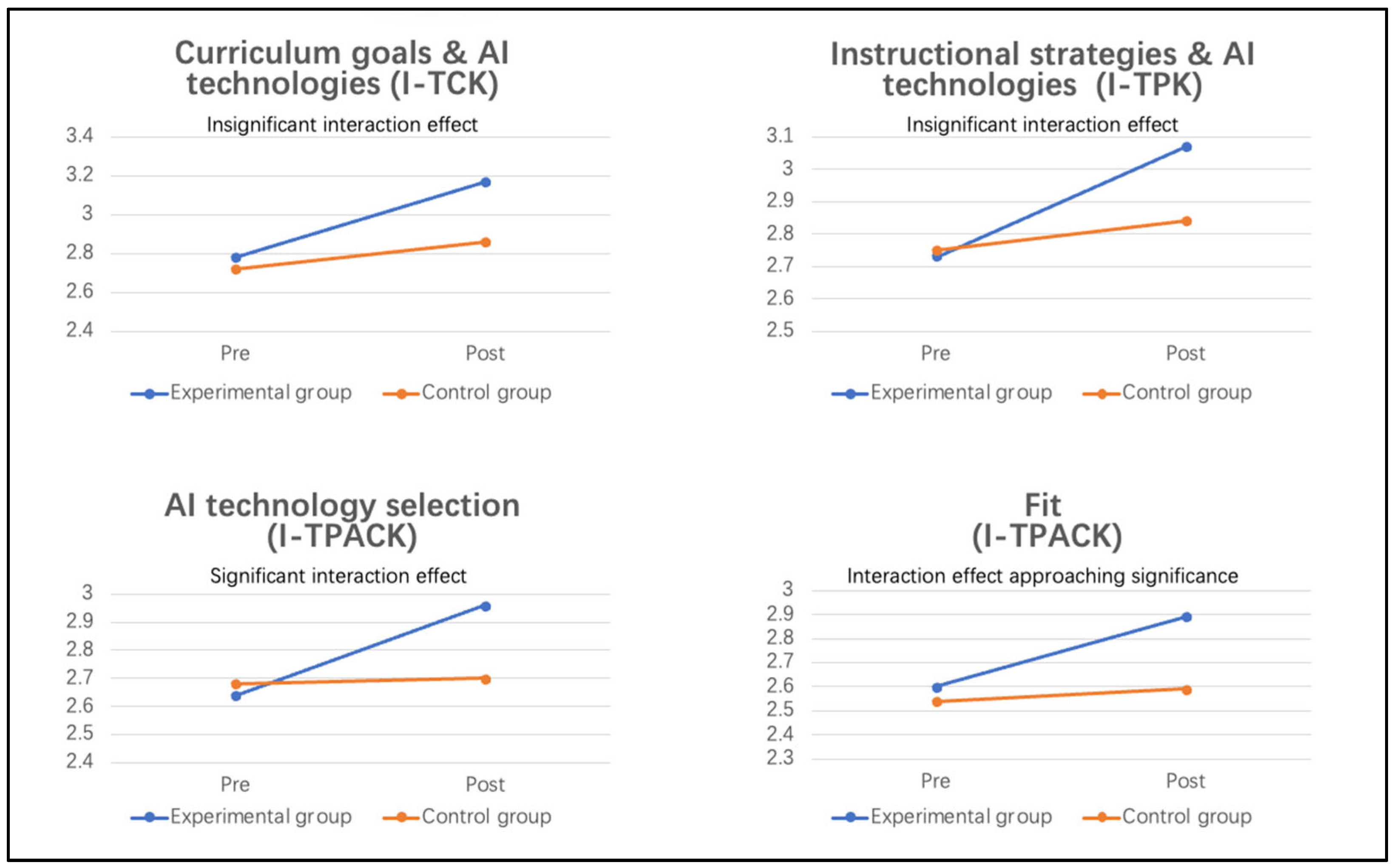
The mixed linear model analysis yielded distinct patterns across the four dimensions of lesson planning (see
Figure 3). A significant interaction effect was found for AI Technology Selection (I-TPACK, F (1, 481.70) = 5.05,
p = 0.025). Pairwise comparisons indicated that while both groups started at similar levels (
p > 0.05), the experimental group demonstrated a significantly steeper growth trajectory than the control group, suggesting the intervention was particularly effective in helping PSTs select appropriate AI tools. For the
Fit dimension (I-TPACK), the interaction effect approached significance (F (1, 484.00) = 3.39,
p = 0.066). This trend suggests that the experimental group showed a tendency toward greater coherence in integrating AI with content and pedagogy. Regarding the Curriculum goals & AI technologies (I-TCK) and Instructional strategies & AI technologies (I-TPK) dimensions, the interaction effects were not statistically significant (
p = 0.060 and
p = 0.076, respectively). However, a significant main effect of time was observed for the two dimensions (F (1, 480.46) = 16.88,
p < 0.001; F (1, 481.55) = 9.71,
p = 0.002), indicating that the experimental and control groups significantly improved their scores from pre-test to post-test, with no statistically significant difference in their rates of growth. As such, H2 was partially confirmed.
4.3. Attitudes Toward AI-Integrated Instruction
As for attitudes toward AI-integrated instruction, significant interaction effects were found for perceived usefulness, F (1, 511.89) = 6.46,
p = 0.011, and perceived pressure, F (1, 514.00) = 6.67,
p = 0.010 (see
Figure 2). This finding confirms H3. Follow-up pairwise comparisons revealed significant differences between the two groups after the intervention across the two dimensions, even though they did not differ significantly at the pre-test (
p > 0.05). Specifically, the experimental group reported higher perceived usefulness of AI integration (M
difference = 0.316,
p < 0.001, Cohen’s
d = 0.56) and reduced perceived pressure (M
difference = −0.455,
p < 0.001, Cohen’s
d = 0.51) compared to the control group. The descriptive statistics of pre-service EFL teachers’ attitudes are shown in
Table 6.
4.4. Qualitative Analysis
4.4.1. Building Confidence Through Practical Application
Participants reported that direct hands-on experiences with AI tools enhanced their technical skills, contributing to a growing sense of confidence. Many highlighted how AI tools directly supported their content knowledge and material development. For example, one participant noted, “I learned to use more AI tools. I now know how to use AI for making instructional videos and have learned the basics of creating micro-lectures, so I feel more fluent in using AI”. Another participant said, “AI provided ideas and frameworks for my instructional design. It provided me with complete reading texts and test items”. Beyond resource creation, participants utilized AI as a teaching assistant to facilitate reflection. One participant described how the technology served as an objective mirror for their micro-teaching, “I uploaded my micro-teaching recordings to Qwen. It highlighted my strength like clear expression while teaching. But also showed that I did not have enough interaction with students. So, I knew I had to improve that.” The AI-generated feedback not only reinforced their existing strengths but also provided actionable insights for professional growth.
The focus on leveraging AI for efficiency gains was also prominent. For example, a participant stated, “AI helps me handle some repetitive, simple tasks, which really improves my work efficiency and saves time, allowing me to focus more on instructional design itself”. Similarly, one participant mentioned, “I could quickly create different versions of the same reading. That’s something I wouldn’t have had time to do manually.” These reflections point to the development of a pragmatic form of self-efficacy, rooted in the mastery of time-saving and content-specific applications.
4.4.2. Leveraging AI for Instructional Activities
Participants demonstrated growing technological pedagogical knowledge by designing activities that strategically embedded AI to achieve specific instructional goals. For example, one participant reported that her perspective evolved from merely knowing how to use AI tools to critically evaluating their instructional purpose. She described, “I have used AI in the past for my assignment in other courses. In this course, I learned how to use AI for teaching. I developed a team competition where an AI-generated word list was used for a quiz, and Seewo (an automated assessment tool) can automatically evaluate answers. This increases engagement and enriches classroom activities”. Another participant focused on supporting the writing process using a poster design task. She said, “At first, I thought of giving feedback on students’ posters by myself. Later I learned to use DeepSeek as a teaching assistant, so I thought I can use it to give real-time feedback on students’ posters”. A participant stated that using AI in lesson planning help her to “design more diverse learning activities and use various instructional strategies.” These responses illustrate the intentional alignment of AI affordances with pedagogical strategies aimed at increasing engagement and scaffolding learning.
4.4.3. Critical Adaptation and the Challenges of Synthesis
While developing foundational skills, participants shared the difficulties they faced, including crafting effective prompts, selecting appropriate AI tools, and evaluating AI-generated content critically. Many described a challenging trial-and-error process, with one participant noting, “The prompts I give might be inaccurate, so the AI doesn’t produce the result I want. It requires changing the prompts repeatedly.” Beyond communication, challenges emerged in making appropriate judgments regarding the integration of different AI tools into instruction. One participant reflected on the gap between accessing tools and using them wisely, “There are so many tools available now. The difficulty lies in not knowing how to fully utilize the strengths of each or how to mix them together effectively for a teaching purpose.” Another pointed to the ongoing critical work required after AI generation, “The content AI provides can be somewhat rigid and formulaic. It always requires me to add my own thinking and make revisions. They can’t be used directly.” Additionally, one participant mentioned that she had to constantly revise her lesson plan because “the activities AI generated were too complex in my opinion”. These reflections highlight that achieving a coherent alignment of technology, pedagogy, and content knowledge is a complex skill that presents significant challenges for pre-service EFL teachers.
5. Discussion
This study validated a triadic instructional design for cultivating AI-ready PSTs. The structured intervention yielded significant quantitative gains in knowledge, lesson planning skills, and attitudes compared to the control group. Qualitative insights corroborated these findings, showing that participants built confidence through practical application and leveraged AI for instruction, while navigating complex integration challenges.
5.1. Effects on Self-Reported Intelligent-TPACK
In line with H1, pre-service EFL teachers in the experimental group showed significant gains in Intelligent-TPACK, with medium to large effect sizes for the I-TK, I-TPK, I-TCK, and I-TPACK dimensions. Notably, I-TPK—the central target of the model—showed the largest effect size (
d = 0.78). This finding is consistent with recent research indicating that professional development systematically incorporating AI into the TPACK framework fosters a more comprehensive understanding of the pedagogical use of AI (
Sun et al., 2023;
Younis, 2024).
These self-reported gains likely reflect a significant enhancement in participants’ self-efficacy. This aligns with
Karina and Kastuhandani (
2024), who demonstrated that pre-service English teachers enhanced their self-efficacy through engaging in AI-integrated lesson preparation. As
Yang et al. (
2024) noted, teachers’ AI self-efficacy is mediated by enactive mastery experiences. The qualitative findings confirm that the intervention explicitly provided these experiences. Participants attributed their growth not only to content creation but also to using AI as a reflective partner. For example, they mentioned using AI for instructional design, assessment development, and analyzing teaching behaviors. These activities served as powerful sources of self-efficacy (
Bandura, 1989). Furthermore, participants strategically used AI for pedagogical purposes. They emphasized the importance of “
how to use AI for teaching” by leveraging various tools to support game-based learning and provide real-time feedback. Therefore, the active and strategic application of AI appears to be the key mechanism driving the reported increase in efficacy.
5.2. Effects on Lesson Planning Skills
While the self-reported data provides valuable insight into participants’ improved confidence, the analysis of lesson plans provided objective evidence of how Intelligent-TPACK is operationalized. A triangulation of these data sources reveals that despite gains in self-reported Intelligent-TPACK, participants’ practical application in lesson design showed a more complex trajectory.
Although the experimental group demonstrated significant improvements, their scores on the lesson plan rubric remained moderate. This is reflected in the mean scores for the AI Technology Selection (M = 2.96/4) and Fit (M = 2.89/4) dimensions. Qualitative data confirmed that synthesizing tools and pedagogy into contextualized judgments remains a higher-order challenge, as participants struggled with “
mixing tools together effectively for a teaching purpose” or critically evaluating and adapting AI outputs. This aligns with findings by
Max et al. (
2022), who found that pre-service teachers overestimated their TPACK when compared to performance-based assessments in maker-space projects. The findings confirm the complex nature of applying Intelligent-TPACK in lesson planning, since making sophisticated judgments about tool-strategy-content alignment requires the ability to synergistically combine these knowledge domains (
Bautista et al., 2024;
Celik, 2023).
However, the comparison between the experimental and control groups confirms that structured intervention is essential for overcoming these challenges. The analysis revealed that both groups demonstrated improvement in the Curriculum goals & AI technologies (I-TCK) and Instructional strategies & AI technologies (I-TPK) dimensions. This supports the argument that the ubiquity and availability of AI tools (
Meegan & Young, 2025) enable PSTs to acquire foundational technological knowledge through self-directed exploration. The control group likely leveraged AI for content generation and brainstorming (
Hsu et al., 2024), leading to observable gains in basic curricular alignment even in the absence of explicit scaffolding. However, they did not achieve the same level of growth as the experimental group in higher-order competencies, as significant and marginally significant interaction effects were found for AI Technology Selection and Fit dimensions, respectively. Consequently, H2 was partially confirmed. These results suggest that while unguided personal use of AI may contribute to a basic understanding of its pedagogical potential, it is insufficient for developing the sophisticated judgment required to select appropriate tools and integrate them coherently into instructional practice (
Hsu et al., 2024). By providing enactive mastery experiences, the triadic instructional design scaffolded the experimental group to move beyond mere tool usage toward strategic pedagogical integration.
5.3. Effects on Attitudes Toward AI Adoption
Regarding attitudes toward AI adoption, the study revealed that the experimental group reported a significant increase in perceived usefulness and a significant reduction in perceived pressure with moderate effect sizes, whereas the control group showed no significant changes in either dimension. The results are in line with H3.
This differential outcome may be attributed to the specific design of the intervention. For the experimental group, the intervention demystified the pedagogical affordances of AI through activities such as critical comparisons of AI versus human performance and the design of AI-enhanced lessons. These experiences provided concrete evidence of AI’s value in creating unique learning experiences, thereby enhancing perceived usefulness (
Salas-Pilco et al., 2022). More importantly, the reduction in pressure is likely linked to the concurrent growth in Intelligent-TPACK. Participants reported that they gained fluency in using AI and recognized its role in improving efficiency in their reflection, which may contribute to a sense of control and alleviate pressure associated with AI use. This aligns with established research indicating that higher technological self-efficacy and TPACK are associated with lower levels of technology-related anxiety (
K. Wang et al., 2024). In contrast, while the control group was aware of AI tools and encouraged to use them, the lack of explicit scaffolding likely prevented them from recognizing its deeper pedagogical potential while alleviating their pressure.
6. Implications
Although the intervention developed in this study aimed at preparing pre-service EFL teachers, we believe that the triadic instructional design offers practical implications for teacher educators in general. The contrasting lesson plan results between experimental and control groups demonstrated that while PSTs may intuitively use AI for lesson planning, developing the higher-order capacity to select the right tool for specific curricular and pedagogical goals requires explicit scaffolding. To address this, educators can explicitly map the progression of Intelligent-TPACK dimensions onto specific SQD-model pillars, using curated AI tools as the mediating technology. Beginning with I-TK, PSTs build foundational AI literacy through hands-on interaction with AI tools on generic tasks. I-TCK can be developed through learning-by-design tasks where PSTs use generative AI to create subject-specific learning materials tailored to diverse learner needs. I-TPK is deepened through role modeling and authentic experiences, such as using automated assessment systems and customized chatbots for timely assessment, personalized feedback, and scaffolding student learning. Finally, I-TPACK integration may be achieved through collaborative lesson design and micro-teaching tasks. This involves leveraging AI not just for content, but as a reflective partner for instructional analysis.
Second, the finding that only the experimental group showed significant improvement in perceived usefulness and reduction in pressure indicates that structured experiences are needed to prepare future teachers psychologically for AI integration. Therefore, training programs should go beyond mere access and intentionally embed sources of self-efficacy, such as enactive mastery experiences (e.g., lesson design with AI), observational learning (e.g., analyzing model teaching videos), and verbal persuasion (e.g., AI-generated feedback).
Finally, participants struggled with selecting, evaluating, and synthesizing AI outputs for instructional purposes in this study. This highlights that developing sophisticated I-TPACK is an iterative process. Future curricula should include the critical auditing of AI outputs and incorporate longitudinal support mechanisms to sustain competency beyond initial training.
7. Conclusions
This study addresses the scarcity of effective AI teacher preparation by validating the triadic instructional design that synthesizes the Intelligent-TPACK, SQD principles, and curated AI tools. The results confirm that while self-directed exploration may contribute to basic familiarity with AI, structured intervention is essential to achieve substantial gains in AI-integrated pedagogical knowledge, develop higher-order skills for selecting and coherently integrating AI tools in lesson plans, and facilitate a reduction in AI-related pressure. These findings provide a holistic model for moving teachers from passive awareness to confident integration.
Methodologically, this study advances beyond the prevalent reliance on self-reports and single-group designs. By employing a quasi-experimental design and triangulating subjective measures with objective lesson plan analysis, it distinguishes the effects of targeted AI training from unguided experiences.
Despite these contributions, several limitations warrant consideration. First, the study relied on the analysis of lesson plans as proxies for instructional competence. While these artifacts demonstrate planning proficiency, they do not capture the actual teaching practices in classroom. Second, the sample was restricted to pre-service EFL teachers at a single university, limiting generalizability to other disciplines or in-service contexts. Third, although the seven-session intervention was effective, short-term training may be insufficient to ensure the long-term retention of complex skills without continued practice. Future research should address these gaps by employing longitudinal designs to track the sustainability of these competencies as pre-service teachers enter the workforce. Furthermore, scholars are encouraged to test the scalability of the triadic instructional design across diverse disciplines to verify its adaptability. As AI technologies continue to evolve, teacher education should foster the adaptive, critical pedagogical reasoning required to navigate an AI-driven educational landscape effectively.
Author Contributions
Conceptualization, S.J. and J.L.; methodology, S.J. and J.L.; software, S.J.; validation, S.J. and J.L.; formal analysis, S.J.; investigation, S.J.; resources, J.L.; data curation, S.J. and J.L.; writing—original draft preparation, S.J.; writing—review and editing, S.J. and J.L.; visualization, S.J.; supervision, J.L.; project administration, S.J.; funding acquisition, S.J. All authors have read and agreed to the published version of the manuscript.
Funding
This research was funded by Chongqing Social Science Planning Project [2024PY63], Chongqing Normal University Higher Education Teaching Reform Research Project [202333], and Chongqing Normal University Funding Project [23XWB028].
Institutional Review Board Statement
The study was conducted in accordance with the Declaration of Helsinki, and approved by the Ethics Committee of School of Educational Sciences at Chongqing Normal University (protocol code CNUEDU20241220 on 20 December 2024).
Informed Consent Statement
Informed consent was obtained from all subjects involved in the study.
Data Availability Statement
Data supporting reported results can be found from the corresponding author.
Conflicts of Interest
The authors declare no conflicts of interest.
Abbreviations
The following abbreviations are used in this manuscript:
| PST | pre-service teachers |
| EFL | English as a foreign language |
| SQD | Synthesis of Qualitative Data |
| TPACK | Technological, pedagogical, and content knowledge |
Appendix A
Table A1.
Intelligent-TPACK scale and attitudinal scale.
Table A1.
Intelligent-TPACK scale and attitudinal scale.
| I-TK | I know how to interact with AI-based tools in daily life.
I know how to execute some tasks with AI-based tools.
I have sufficient knowledge to use AI-based tools. |
| I-TPK | I can understand the pedagogical contribution of AI-based tools to EFL teaching.
I can evaluate the usefulness of feedback from AI-based tools for EFL teaching.
I know how to use AI-based tools to monitor students’ EFL learning.
I can interpret messages from AI-based tools to give real-time feedback.
I have the knowledge to select AI-based tools to sustain students’ motivation. |
| I-TCK | I can use AI-based tools to search for educational material in EFL teaching.
I am aware of various AI-based tools which are used by professionals in EFL teaching.
I can use AI-based tools to better understand the contents in EFL teaching.
I know how to utilize my field-specific AI-based tools. |
| I-TPACK | In EFL teaching, I know how to use different AI-based tools for adaptive feedback.
In EFL teaching, I know how to use different AI-based tools for personalized learning.
I can teach English lessons that appropriately combine my teaching content, AI-based tools, and teaching strategies.
I can teach English using AI-based tools with diverse teaching strategies. |
| Perceived usefulness | I believe learning to use AI for EFL teaching could be of some value to me.
I would be willing to learn AI for EFL teaching again because it has some value to me.
I believe learning to use AI for EFL teaching could be beneficial to me.
I think learning to use AI for EFL teaching is an important activity. |
| Perceived pressure | I felt very tense while learning to use AI for EFL teaching.
I was anxious while working on AI-integrated EFL teaching.
I felt pressured while learning to use AI for EFL teaching. |
Appendix B
Table A2.
AI Integration Assessment Rubric for lesson plans and grading examples.
Table A2.
AI Integration Assessment Rubric for lesson plans and grading examples.
| Criteria | 4 | 3 | 2 | 1 |
|---|
| Curriculum Goals & AI Technologies | AI tools selected for use in the instructional plan are strongly aligned with one or more curriculum goals.
e.g., using an AI chatbot for individualized speaking practice to improve listening and speaking proficiency. | AI tools selected for use in the instructional plan are aligned with one curriculum goal.
e.g., using a grammar check tool to help students improve writing accuracy. | AI tools selected for use in the instructional plan are partially aligned with curriculum goals.
e.g., using GAI to create pictures for a vocabulary list. | AI tools selected for use in the instructional plan are not aligned with any curriculum goals.
e.g., using an AI chatbot with no clear connection to language learning objectives. |
| Instructional Strategies & AI Technologies | AI use transforms instructional strategies, enabling effective forms of teaching and learning that are not possible without it.
e.g., using AI to simulate authentic debate partners. | AI use supports instructional strategies.
e.g., using AI to quickly generate formative assessments. | AI use minimally supports instructional strategies.
e.g., using AI simply to retrieve a definition of a word. | AI use does not support instructional strategies.
e.g., using AI for entertainment. |
| AI Technology Selection | AI use is exemplary and justified. The tool’s affordances and limitations are considered.
e.g., using AI for learning analytics to provide tailored educational resources for students of varying abilities. | AI use is appropriate. A basic rationale for its selection is evident.
e.g., generating worksheets where step-by-step guidance is given for a project. | AI use is marginally appropriate. A more suitable AI or non-AI tool could have been more effective.
e.g., using an AI-integrated tool to draw mind map for lower grade students. | AI use is inappropriate, given curriculum goal(s) and instructional strategies.
e.g., choosing an image recognition AI for a writing lesson. |
| “Fit” | AI, pedagogy, and content are seamlessly integrated.
e.g., using AI tools to enhance real-time online collaboration. | AI, pedagogy, and content fit together within the plan. The plan includes some consideration of responsible AI use.
e.g., using AI to generate model essays and comparing its output with human-written samples. | AI, pedagogy, and content fit together somewhat.
e.g., asking students to search data with AI tools without discussing the possibility of AI hallucinations. | AI, pedagogy, and content do not fit together. The use of AI is forced, irrelevant, or problematic.
e.g., asking students to submit AI-generated essays as their own work without critical evaluation. |
References
- Bandura, A. (1989). Human agency in social cognitive theory. American Psychologist, 44(9), 1175. [Google Scholar] [CrossRef] [PubMed]
- Bautista, A., Estrada, C., Jaravata, A. M., Mangaser, L. M., Narag, F., Soquila, R., & Asuncion, R. J. (2024). Preservice teachers’ readiness towards integrating AI-based tools in education: A TPACK approach. Educational Process: International Journal, 13(3), 40–68. [Google Scholar] [CrossRef]
- Boudouaia, A., Mouas, S., & Kouider, B. (2024). A study on ChatGPT-4 as an innovative approach to enhancing English as a foreign language writing learning. Journal of Educational Computing Research, 62(6), 1289–1317. [Google Scholar] [CrossRef]
- Celik, I. (2023). Towards Intelligent-TPACK: An empirical study on teachers’ professional knowledge to ethically integrate artificial intelligence (AI)-based tools into education. Computers in Human Behavior, 138, 107468. [Google Scholar] [CrossRef]
- Chan, K. K. W., & Tang, W. K. W. (2025). Evaluating English teachers’ artificial intelligence readiness and training needs with a TPACK-based model. World Journal of English Language, 15(1), 129–145. [Google Scholar] [CrossRef]
- Chiu, T. K., Chai, C. S., Williams, P. J., & Lin, T. J. (2021). Teacher professional development on self-determination theory–based design thinking in STEM education. Educational Technology & Society, 24(4), 153–165. [Google Scholar]
- Chung, J. Y., & Jeong, S.-H. (2024). Exploring the perceptions of Chinese pre-service teachers on the integration of generative AI in English language teaching: Benefits, challenges, and educational implications. Online Journal of Communication and Media Technologies, 14(4), e202457. [Google Scholar] [CrossRef]
- Cohen, J. (1968). Weighted kappa: Nominal scale agreement provision for scaled disagreement or partial credit. Psychological Bulletin, 70(4), 213. [Google Scholar] [CrossRef] [PubMed]
- Cohen, J. (1988). Statistical power analysis for the behavioral sciences. Lawrence Erlbaum. [Google Scholar]
- Cohen, L., Manion, L., & Morrison, K. (2007). Research methods in education. Routledge/Taylor & Francis Group. [Google Scholar]
- Darling-Hammond, L., Hyler, M. E., & Gardner, M. (2017). Effective teacher professional development. Learning Policy Institute. [Google Scholar]
- European Commission. (2022). Ethical guidelines on the use of artificial intelligence (AI) and data in teaching and learning for educators. Publications Office of the European Union. [Google Scholar]
- Fabian, A., Backfisch, I., Kirchner, K., & Lachner, A. (2024). A systematic review and meta-analysis on TPACK-based interventions from a perspective of knowledge integration. Computers and Education Open, 7, 100200. [Google Scholar] [CrossRef]
- Falebita, O. S. (2025). Evaluating artificial intelligence anxiety among pre-service teachers in university teacher education programs. Journal of Mathematics Instruction, Social Research and Opinion, 4(1), 1–16. [Google Scholar] [CrossRef]
- Harakchiyska, T., & Vassilev, T. (2024). Pre-service teachers’ perceptions of AI and its implementation in the foreign (English) language classroom. Strategies for Policy in Science & Education, 32, 218. [Google Scholar]
- Harris, J., Grandgenett, N., & Hofer, M. (2010, March 29–April 2). Testing a TPACK-based technology integration assessment rubric. Society for Information Technology & Teacher Education International Conference, San Diego, CA, USA. [Google Scholar]
- Hastomo, T., Mandasari, B., & Widiati, U. (2024). Scrutinizing Indonesian pre-service teachers’ technological knowledge in utilizing AI-powered tools. Journal of Education and Learning, 18(4), 1572–1581. [Google Scholar] [CrossRef]
- Hsu, H. P., Mak, J., Werner, J., White-Taylor, J., Geiselhofer, M., Gorman, A., & Capurro, C. T. (2024). Preliminary study on pre-service teachers’ applications and perceptions of generative artificial intelligence for lesson planning. Journal of Technology and Teacher Education, 32(3), 409–437. [Google Scholar] [CrossRef]
- Karina, B. D., & Kastuhandani, F. C. (2024). Pre-service English teachers’ lived experience in using AI in teaching preparation. Edunesia: Jurnal Ilmiah Pendidikan, 5(1), 550–568. [Google Scholar] [CrossRef]
- Kayaalp, F., Durnali, M., & Gökbulut, B. (2025). Enhancing competence for a sustainable future: Integrating artificial intelligence–supported educational technologies in pre-service teacher training for sustainable development. European Journal of Education, 60(1), e12865. [Google Scholar] [CrossRef]
- Kim, K., & Kwon, K. (2023). Exploring the AI competencies of elementary school teachers in South Korea. Computers and Education: Artificial Intelligence, 4, 100137. [Google Scholar] [CrossRef]
- Kohnke, L., Moorhouse, B. L., & Zou, D. (2023). ChatGPT for language teaching and learning. RELC Journal, 54(2), 537–550. [Google Scholar] [CrossRef]
- Kohnke, L., Zou, D., Ou, A. W., & Gu, M. M. (2025). Preparing future educators for AI-enhanced classrooms: Insights into AI literacy and integration. Computers and Education: Artificial Intelligence, 8, 100398. [Google Scholar] [CrossRef]
- Koraishi, O. (2023). Teaching English in the age of AI: Embracing ChatGPT to optimize EFL materials and assessment. Language Education and Technology, 3(1), 55–72. [Google Scholar]
- Kusuma, I. P. I., Roni, M., Dewi, K. S., & Mahendrayana, G. (2024). Revealing the potential of ChatGPT for English language teaching: EFL preservice teachers’ teaching practicum experience. Studies in English Language and Education, 11(2), 650–670. [Google Scholar] [CrossRef]
- Lachner, A., Fabian, A., Franke, U., Preiß, J., Jacob, L., Führer, C., Küchler, U., Paravicini, W., Randler, C., & Thomas, P. (2021). Fostering pre-service teachers’ technological pedagogical content knowledge (TPACK): A quasi-experimental field study. Computers & Education, 174, 104304. [Google Scholar]
- Lauran, J. E., Abdillah, A. I., Nabila, N., & Jain, J. (2024, August 20–22). Investigating pre-service English teachers I-TPACK and perceptions to incorporate generative AI-based tools in education: A case study in a public university. International Conference on Innovation & Entrepreneurship in Computing, Engineering & Science Education (InvENT 2024) (pp. 544–554), Shah Alam, Malaysia. [Google Scholar]
- Lee, D., Son, T., & Yeo, S. (2025). Impacts of interacting with an AI chatbot on preservice teachers’ responsive teaching skills in math education. Journal of Computer Assisted Learning, 41(1), e13091. [Google Scholar] [CrossRef]
- Lu, Q., Yao, Y., Xiao, L., Yuan, M., Wang, J., & Zhu, X. (2024). Can ChatGPT effectively complement teacher assessment of undergraduate students’ academic writing? Assessment & Evaluation in Higher Education, 49(5), 616–633. [Google Scholar] [CrossRef]
- Max, A. L., Lukas, S., & Weitzel, H. (2022). The relationship between self-assessment and performance in learning TPACK: Are self-assessments a good way to support preservice teachers’ learning? Journal of Computer Assisted Learning, 38(4), 1160–1172. [Google Scholar] [CrossRef]
- McAuley, E., Duncan, T., & Tammen, V. V. (1989). Psychometric properties of the intrinsic motivation inventory in a competitive sport setting: A confirmatory factor analysis. Research Quarterly for Exercise and Sport, 60(1), 48–58. [Google Scholar] [CrossRef]
- Meegan, J., & Young, K. (2025). It’s a tool not a crutch: A pilot generative AI intervention to enhance pre-service teachers’ self-efficacy and AI literacy. Technology, Knowledge and Learning, 30(4), 1895–1916. [Google Scholar] [CrossRef]
- Meletiou-Mavrotheris, M., & Paparistodemou, E. (2024). Sustaining teacher professional learning in STEM: Lessons learned from an 18-year-long journey into TPACK-guided professional development. Education Sciences, 14(4), 402. [Google Scholar] [CrossRef]
- Metwally, A. A., & Bin-Hady, W. R. A. (2025). Probing the necessity and advantages of AI integration training for EFL educators in Saudi Arabia. Cogent Education, 12(1), 2472462. [Google Scholar] [CrossRef]
- Mishra, P., & Koehler, M. J. (2006). Technological pedagogical content knowledge: A framework for teacher knowledge. Teachers College Record, 108(6), 1017–1054. [Google Scholar] [CrossRef]
- Mishra, P., Warr, M., & Islam, R. (2023). TPACK in the age of ChatGPT and Generative AI. Journal of Digital Learning in Teacher Education, 39(4), 235–251. [Google Scholar] [CrossRef]
- Moorhouse, B. L. (2024). Beginning and first-year language teachers’ readiness for the generative AI age. Computers and Education: Artificial Intelligence, 6, 100201. [Google Scholar] [CrossRef]
- Moorhouse, B. L., Ho, T. Y., Wu, C., & Wan, Y. (2025). Pre-service language teachers’ task-specific large language model prompting practices. RELC Journal, 00336882251313701. [Google Scholar] [CrossRef]
- Moorhouse, B. L., Wan, Y., Wu, C., Kohnke, L., Ho, T. Y., & Kwong, T. (2024). Developing language teachers’ professional generative AI competence: An intervention study in an initial language teacher education course. System, 125, 103399. [Google Scholar] [CrossRef]
- Ng, D. T. K., Leung, J. K. L., Su, J., Ng, R. C. W., & Chu, S. K. W. (2023). Teachers’ AI digital competencies and twenty-first century skills in the post-pandemic world. Educational Technology Research and Development, 71(1), 137–161. [Google Scholar] [CrossRef]
- O’Connor, C., & Joffe, H. (2020). Intercoder reliability in qualitative research: Debates and practical guidelines. International Journal of Qualitative Methods, 19, 1609406919899220. [Google Scholar] [CrossRef]
- Özer-Altınkaya, Z., & Yetkin, R. (2025). Exploring pre-service English language teachers’ readiness for AI-integrated language instruction. Pedagogies: An International Journal, 20, 584–600. [Google Scholar] [CrossRef]
- Park, M., & Son, J.-B. (2022). Pre-service EFL teachers’ readiness in computer-assisted language learning and teaching. Asia Pacific Journal of Education, 42(2), 320–334. [Google Scholar] [CrossRef]
- Pokrivcakova, S. (2023). Pre-service teachers’ attitudes towards artificial intelligence and its integration into EFL teaching and learning. Journal of Language and Cultural Education, 11(3), 100–114. [Google Scholar] [CrossRef]
- Saimon, M., Mtenzi, F., Lavicza, Z., Fenyvesi, K., Arnold, M., & Diego-Mantecón, J. M. (2024). Applying the 6E learning by design model to support student teachers to integrate artificial intelligence applications in their classroom. Education and Information Technologies, 29(17), 23937–23954. [Google Scholar] [CrossRef]
- Salas-Pilco, S. Z., Xiao, K., & Hu, X. (2022). Artificial intelligence and learning analytics in teacher education: A systematic review. Education Sciences, 12, 569. [Google Scholar] [CrossRef]
- Saldaña, J. (2015). The coding manual for qualitative researchers. Sage. [Google Scholar]
- Seufert, S., Guggemos, J., & Sailer, M. (2021). Technology-related knowledge, skills, and attitudes of pre-and in-service teachers: The current situation and emerging trends. Computers in Human Behavior, 115, 106552. [Google Scholar] [CrossRef] [PubMed]
- Stavermann, K. (2025). Online teacher professional development: A research synthesis on effectiveness and evaluation. Technology, Knowledge and Learning, 30(1), 203–240. [Google Scholar] [CrossRef]
- Suchánová, Z. (2023, October 20–23). AI tools for pre-service EFL teachers: Exploring applications and implications. International Conference on Studies in Education and Social Studies (ICSES), Antalya, Turkey. [Google Scholar]
- Sun, J., Ma, H., Zeng, Y., Han, D., & Jin, Y. (2023). Promoting the AI teaching competency of K-12 computer science teachers: A TPACK-based professional development approach. Education and Information Technologies, 28(2), 1509–1533. [Google Scholar] [CrossRef]
- Tan, X., Cheng, G., & Ling, M. H. (2024). Artificial intelligence in teaching and teacher professional development: A systematic review. Computers and Education: Artificial Intelligence, 8, 100355. [Google Scholar] [CrossRef]
- Tondeur, J., Van Braak, J., Sang, G., Voogt, J., Fisser, P., & Ottenbreit-Leftwich, A. (2012). Preparing pre-service teachers to integrate technology in education: A synthesis of qualitative evidence. Computers & Education, 59(1), 134–144. [Google Scholar] [CrossRef]
- Wang, K., Ruan, Q., Zhang, X., Fu, C., & Duan, B. (2024). Pre-service teachers’ GenAI anxiety, technology self-efficacy, and TPACK: Their structural relations with behavioral intention to design GenAI-assisted teaching. Behavioral Sciences, 14(5), 373. [Google Scholar] [CrossRef]
- Wang, Y., & Xue, L. (2024). Using AI-driven chatbots to foster Chinese EFL students’ academic engagement: An intervention study. Computers in Human Behavior, 159, 108353. [Google Scholar] [CrossRef]
- Wang, Y., & Zhao, P. (2020). A probe into spoken English recognition in English education based on computer-aided comprehensive analysis. International Journal of Emerging Technologies in Learning (iJET), 15(3), 223–233. [Google Scholar] [CrossRef]
- Yang, Y.-F., Tseng, C. C., & Lai, S.-C. (2024). Enhancing teachers’ self-efficacy beliefs in AI-based technology integration into English speaking teaching through a professional development program. Teaching and Teacher Education, 144, 104582. [Google Scholar] [CrossRef]
- Younis, B. (2024). Effectiveness of a professional development program based on the instructional design framework for AI literacy in developing AI literacy skills among pre-service teachers. Journal of Digital Learning in Teacher Education, 40(3), 142–158. [Google Scholar] [CrossRef]
- Zhang, C., Schießl, J., Plößl, L., Hofmann, F., & Gläser-Zikuda, M. (2023). Acceptance of artificial intelligence among pre-service teachers: A multigroup analysis. International Journal of Educational Technology in Higher Education, 20(1), 49. [Google Scholar] [CrossRef]
- Zhou, K., Deng, H., Chan, H. C., & Lin, C. H. (2025). Integrating generative AI into language teachers’ professional development: A longitudinal study using the synthesis of qualitative data (SQD) model. Professional Development in Education, 1–29. [Google Scholar] [CrossRef]
- Żammit, J. (2025). Secondary school teachers’ experiences with generative AI in Maltese language teaching. Technology, Knowledge and Learning, 30, 2103–2121. [Google Scholar] [CrossRef]
| Disclaimer/Publisher’s Note: The statements, opinions and data contained in all publications are solely those of the individual author(s) and contributor(s) and not of MDPI and/or the editor(s). MDPI and/or the editor(s) disclaim responsibility for any injury to people or property resulting from any ideas, methods, instructions or products referred to in the content. |